Updates (source of funds litigation, options after I-829 denial, election impacts)
November 8, 2024 1 Comment
Path of Funds Litigation
Path of funds has been a major factor in I-526 denials, especially since 2019, and behind many appeals to the AAO. Is USCIS right to demand the tracing of every penny so many steps beyond the EB-5 investor? The AAO generally upholds USCIS decisions, but now a federal judge has weighed in with more nuance, and nice ammunition for future appeals. To quote Battineni v. Mayorkas: “In sum, the Court concludes that while the regulations require a petitioner to ‘show’ that their funds were obtained from a lawful source, they do not require the petitioner to ‘trace every penny’ beyond their initial acquisition.” For more, see: Alert: Another Victory for the Klasko Immigration Litigation Team.
Other Resources (I-829 denial options, RC audits, RC sanctions, I-526E data analysis)
The latest IIUSA Regional Center Business Journal features many good articles. I’d particularly like to highlight “Review of USCIS I-829 Denials in Removal Proceedings” (John P. Pratt, Edward Ramos, Elizabeth Montano, and Daniel B Lundy) which gives valuable information about the process and investor options following I-829 denial. Regional center operators will want to read Laura Kelly’s article “What Happens During a USCIS Regional Center Audit? Now We Know,” and Robert Divine’s article “EB-5 Sanctions: Real Danger with Possible Relief.” Note also that Li Lee’s full I-526/I-526E analysis, previously available just as an excerpt, is published in full here as “Latest Data on I-526E and I-526 Filings, Adjudications, and Withdrawals: Country-Specific Trends in EB-5 Demand, Investment Preferences, Case Processing, and Reserved Visa Waitlists.”
Election Impacts
What will happen to EB-5 under the new presidency and Congress? If you’d like some comfort, I recommend Carolyn Lee’s discussion with Christine Chen in this webinar: “Navigating EB-5 Amid Political Change: How Recent Elections Could Shape the Future of Investment Immigration.” They sympathetically review many of the questions and concerns that EB-5 immigrants may have today, bringing perspective as people who have faced the challenges of EB-5 through multiple administrations. To quote Carolyn: “It’s going to be as difficult as it ever was, and perhaps not more so.” I’m also looking forward to the analysis in IIUSA’s upcoming webinar “Post-Election Outlook & EB-5 Advocacy,” coming up on Wednesday, December 11 at 12 PM ET. In the article “Recapping the 2024 Elections and the EB-5 State of Play” (November 11), IIUSA discusses the Congress-level changes that may be even more consequential to EB-5 than the presidency.
Last time around, in 2016, we were excited/anxious that a President Trump might pay attention to EB-5, being a real estate developer with EB-5 projects in the family. But I couldn’t tell that he ever did. EB-5 was tangentially affected during his previous presidency has part of a general turn toward “extreme vetting” of immigrant petitions and reallocation of USCIS resources toward “other priorities.” But it took a couple years for those trends to translate into reduced processing volumes and increased processing times for EB-5. The really devastating impact to processing and visa issuance in that period did not come from administrative choices, but from COVID-19. Former President Trump reauthorized the regional center program five times, though likely unknowingly as it was just a sentence buried in 1000-page spending bills for his signature. Painful new EB-5 regulations were finalized under his administration, but drafted before he arrived.
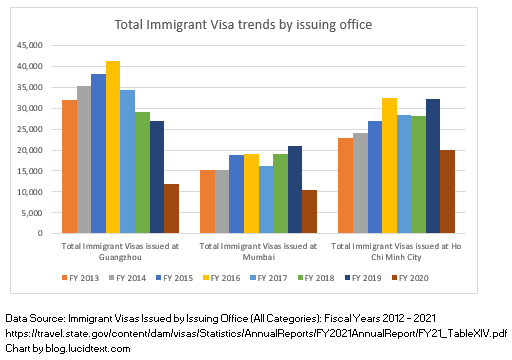
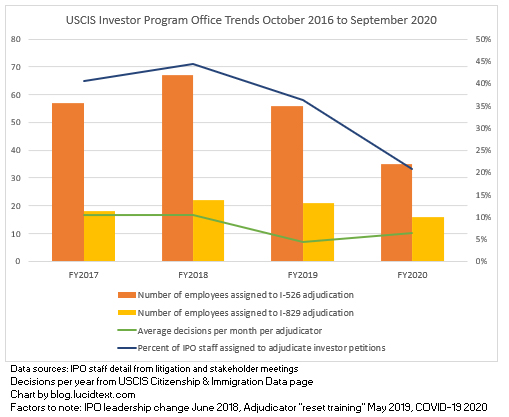
As resident EB-5 chart-maker, I made a few pictures of what happened with EB-5 and immigration generally under the previous Trump administration. The information on IPO staffing comes from stakeholder meetings and litigation, petition processing numbers are from the USCIS data page, and visa issuance numbers from the DOS statistics page. I’ll let you look at the numbers and guess whether correlation means causation. The year 2019 interests me particularly, being the year when policies had had a chance to take effect but the Pandemic hadn’t skewed things yet. If past performance predicts future results, I would expect EB-5 processing to slow within a couple years as fewer staff have to perform more steps, and legal immigration numbers to fall only fractionally (barring the excuse of another pandemic, or unless Steven Miller is able to realize all his evil plans).


Discover more from EB-5 Updates
Subscribe to get the latest posts sent to your email.
 EB-5 Updates
Hello Suzanne , How long it will take to adjudicate all PRE-RIA I 526 petitions especially from back logged countries like China & India?