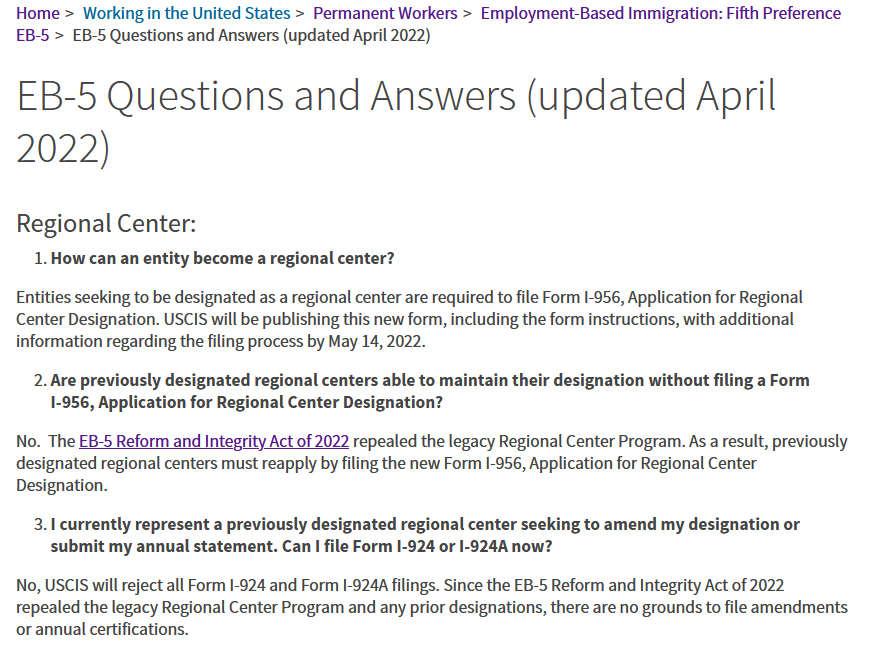
As of this week “EB-5 2.0” has officially launched, with a new regional center program authorized since May 14, 2022. Now that 60 days have passed since enactment, the EB-5 Reform and Integrity Act of 2022 (“RIA”) has taken full effect. New regional center I-526 still cannot be filed, and none of the USCIS EB-5 pages or policies or petitions have yet been updated with the rules now in effect. But one EB-5 2.0 process is moving: entities can begin to apply for new regional center designation.
Form I-956 asks open-ended questions, and provides minimal instructions. I-956 requests less evidence than the previous I-924 Application for Regional Center – whether intentionally or not, it’s hard to tell. I foresee that 100% of Form I-956 submissions will receive a Request for Evidence, given the minimal instructions. Until we start seeing RFEs from USCIS, we need to guess at how USCIS interprets new regional center designation requirements. I wonder if USCIS has drafted the Form I-956 worksheet for adjudicators, and what’s on that worksheet. If only USCIS would tell the public what’s on its adjudication checklists, then we might make submissions correct and complete the first time. The guess-question-clarification process is inefficient, and the regional center program does not have years to waste.
Top Takeaways from Form I-956 Application for Regional Center
What’s New: I-956 and I-956H are almost entirely language copied straight from the RIA text, without interpretation or comment. The I-956 instructions offer one item of additional guidance: “The description [of policies and procedures] may include, but is not limited to, the regional center’s policies and procedures regarding internal controls, risk management and assessment, governance, and fraud detection and/or deterrence. Documentation may include, but is not limited to, Policy Manuals and Standard Operating Procedures.” I-956 offers no comment on what USCIS considers to be the specific “applicable laws” and “program requirements” for which applicants should provide policies and procedures.
Evidence Required: Form I-956 specifies little required evidence. While the old Form I-924 Application for Regional Center had a seven-point list of “evidence you must submit,” Form I-956 has mostly open-ended questions, and says ”may provide” more often than “must submit.” An applicant following the letter of the I-956 instructions (and interpreting “should” as closer to “may” than “must”) could technically submit I-956 with the form blanks completed but no exhibits whatsoever beyond copies of the Form I-956H for persons involved. As an applicant I’d be tempted to go for a minimal initial filing, considering that I can hardly avoid an RFE in any case, given the vague and minimal instructions provided upfront.
RC History: Form I-956 implies that USCIS has no interest in and attaches no relevance to the applicant’s previous history of regional center designation. I-956 asks only forward-looking questions. I-956 gives no space to provide information about any prior regional center designation, good or bad history of promoting economic growth as a previously-designed regional center, previously-approved geographic scope, in-progress EB-5 projects, or EB-5 funds currently under management. There’s no indication in I-956 that USCIS has any plan to link designation and investors under the new law with designation and investors under the old law. The I-924 had required disclosing the applicant’s previous regional center termination and denial history, and prohibited use of names that duplicated pre-existing RC names, but the I-956 lacks even this.
Geographic Area: Form I-956 is less specific than I-924 about regional center geographic area and economic impact. I-956 says generally “You should provide evidence that the regional center’s pooled investment will have a substantive economic impact on the proposed geographic area,” and asks for “reasonable predictions” supported by economic impact analysis. But it does not define “substantive impact” or request project-specific basis for predictions. By contrast, Form I-924 required the applicant to base economic impact analysis on business plan inputs, and to show “that the boundaries of the regional center are reasonable based on evidence that the proposed area is contributing significantly to the supply chain and labor pool of the proposed new commercial enterprises.” Either USCIS was careless in writing I-956, or it now has a looser/more open-ended standard than before for geographic area requests. It may be that by separating regional center designation from NCE/project approvals, USCIS has blocked itself from demanding project-specific grounding for regional center impact claims. If that’s the case, surely all applicants will submit theoretic cases for sprawling multi-state geographies.
Organizational Evidence: The “who are you” questions in Form I-956 are limited to identifying the legal name of the regional center entity and the identities of persons involved with the regional center. Unlike I-924, Form I-956 does not specifically request the regional center’s formation documents, Operating Agreement, or management agreements. I-956H requests personal identity detail needed to check for law/rule violations, but not any of the business experience or professional track record detail that a banker or investor would want to know about persons involved. This may or may not be an oversight.
Business Plans: The “what will you do” questions in Form I-956 are limited to compliance policies and theoretic economic impact predictions. I-956 does not specifically ask the applicant for any kind of business plan, either for regional center operations or to support economic activity projections. (By contrast, I-924 required an Operational Plan and Plan of Promotion to describe how the regional center would operate and support its operations, and project business plans to provide reasonable real-world inputs to support impact analysis. The I-956 silence on business planning may or may not be an oversight. Surely such detail should still be relevant for designation.)
Further Guidance: The I-956 instructions promise that “The approval notice will provide information about the responsibilities and obligations of your USCIS designated regional center. It will also list the evidence to submit in support of regional center-associated individual EB-5 petitions, as well as details on the reporting and oversight requirements for regional centers.” Why not disclose the approval notice template upfront, USCIS, so that applicants can shape their plans around these requirements?
NCE Approval Form: The Form I-956H Instructions reveal that USCIS has chosen a name for the yet-to-be-published project approval form that needs to be filed before regional center investors can start filing I-526. The application for NCE approval will be called Form I-956F. (In the old days, applicants could file for regional center designation and exemplar project approval at the same time using the same I-924, but now the process has two separate and consecutive forms.)
Timing: I foresee significant processing times for Form I-956 (given the back-and-forth that will result from the open-ended questions and minimal instructions), and for I-956H (given the number of agencies that USCIS will need to coordinate with to perform security checks). I will be pleasantly surprised if the first new regional center gets designated before 2023, and astonished if all I-956 filed in the next few weeks get adjudicated before 2025. [Update: The May 18 Declaration of Alissa Emmel in the Behring lawsuit states that: “IPO … as of this date has received approximately 8 applications. …While every application will be reviewed on a case-by-case basis, IPO aims for its processing times on Form I-956 applications to meet or exceed the statutory goal of 180 days.”] I very much hope that the first applicants to receive RFEs will be public-spirited and share the RFEs with the rest of the community. The more guidance we can extract from USCIS, the more we’ll be able to improve application quality and speed up the adjudication process for everyone.
Caution: Historically, an EB-5 document requirement will spark a cottage industry of chancers who smell profit in producing documents with the right title on a nice cover and any old filler shoved under the cover. Thus the proliferation of shoddy economic impact reports, business plans, and offering documents in EB-5. I suggest, look closely at anyone who offers to relieve you of thousands of dollars in exchange for documents with covers that that say “Policy Manuals” and “Standard Operating Procedures.” If there isn’t an EB-5-experienced securities attorney involved in drafting and signing off on the content, consider only paying what the cover is worth. USCIS adjudicators may have little way to judge compliance policies but by the cover, and might possibly just rubber stamp whatever gets submitted. But even better for regional center applicants to invest in solid content, especially in the sensitive area of securities compliance.
I’m copying below an invitation from USCIS to participate in another EB-5 listening session. The invitation asks some excellent questions, but oddly — considering the engagement’s stated purpose — no questions specifically related to implementation of the EB-5 Reform and Integrity Act of 2022, or the rulemaking required by the Act. The invitation also offers no way to answer the questions, except to call in to the engagement. If USCIS is serious about getting solid feedback, it should provide a path for written answers.
From: U.S. Citizenship and Immigration Services <uscis@public.govdelivery.com> Sent: May 17, 2022 8:09 AM Subject: Listening Session: EB-5 Reform and Integrity Act of 2022 Rulemaking
EB-5 Reform and Integrity Act of 2022 Rulemaking Listening Session
Wednesday, May 25 | 2 – 3 p.m. Eastern
U.S. Citizenship and Immigration Services (USCIS) invites you to participate in a listening session on Wednesday, May 25, 2022, from 2 to 3 p.m. Eastern. The listening session is for stakeholders to provide individual input on rulemaking related to the implementation of the EB-5 Reform and Integrity Act of 2022. USCIS is committed to public engagement and sessions such as these provide us with valuable feedback as we work to improve our programs.
Questions for consideration: Although we are interested in overall feedback about the EB-5 program, we would also appreciate your input on the following questions:
1. Evidence a. Are there evidentiary requirements for Form I-526 filings in the existing regulations that should be simplified or modernized? We invite specific estimates of these burdens and potential effects of these simplifications.
2. Definitions a. Are there undefined or other ambiguous terms in the existing regulations or statute that DHS should define or clarify through rulemaking? b. Should we keep the “troubled business” definition in the existing regulations (8 CFR 204.6(e), 204.6(h)(3), and 204.6(j)(4)(ii))? If we keep the definition, should we revise it and, if so, how? c. Should we keep the definition of “new” for a commercial enterprise in the existing regulations? Is there an alternative approach for what should be considered “new” (for example, a more recent cutoff date or a particular period for determining whether a commercial enterprise is “new”)?
3. General a. Are there other processes or requirements in the existing regulations or statute that DHS should clarify or further develop through rulemaking? For example: • The process we will use to designate and communicate high unemployment areas. • Factors we should consider in determining if a regional center’s geographic area is “limited.” • How construction jobs for less than two years will be calculated. • Are the expansion and restructuring requirements in the existing regulations still relevant?
2. You will be asked to sign up for updates or to access your subscriber preferences, please enter your email address and select “Submit”
3. Select “Subscriber Preferences”
4. Select the “Questions” tab
5. Complete the questions and select “Submit.”
Once we process your registration, you will receive a confirmation email with additional details.
If you have any questions, or if you have not received a confirmation email within three business days, please email us at public.engagement@uscis.dhs.gov.
To request a disability accommodation to participate in this engagement, email us at public.engagement@uscis.dhs.gov by 4 p.m. EST on May 20, 2022.
The https://egov.uscis.gov/processing-times/ page now reports a number that is apparently arbitrary. What is relevant about 80%? Why not report the median age of recent completions? (The USCIS historical processing times report gives the median, which is logically more indicative of “normal” and “average” processing.) Why not the first and third quartile? (That would at least be meaningful statistically.) Why not 93%? (Significant if the threshold for case inquiry.) What possible justification/explanation is there for choosing to report 80% on this page? Unless explained, it would appear the USCIS chose 80% to 1) cover up the major deviations from FIFO processing that had been exposed by the previous “estimated time range” method, 2) prevent petitioner inquiries by not reporting median or average processing, and 3) confuse and disguise the derivation of the Case Inquiry Date, which is not calculated from the 80% month. I suggest that this page would be more meaningful if it reported the median (or even better, the median and the average) age of recently-adjudicated cases. The number of months used to calculate the Case Inquiry Date should also be disclosed.
The https://egov.uscis.gov/processing-times/ page is not clear or transparent about the Case Inquiry Date – the single most important piece of information on the page. The “get inquiry date” tool on this page uses a month multiplier that is not disclosed, and is not equal to the 80% month reported on the page. The page vaguely says “we only allow inquiries for cases that are well outside the processing time listed above.” To be transparent, this page needs to state “93% of recent adjudications were completed within ___ months,” and then explain that this number of months is used to calculate the case inquiry date.
The case inquiry date and answer to the question “When can I ask about my case” are both unreasonable. To protect USCIS from Mandamus litigation (which must be much more expensive to the agency than individual inquiries), the processing times report needs to define a reasonable boundary for “normal” processing. Outside the 93rd percentile is too-obviously a boundary for extreme outliers, not a definition of what’s normal – especially given the well-documented spread of processing times. For example, for Form I-829, the historical times page gives a median of 41.5 months in 2022, and the I-829 Case Inquiry Date is calculated at 64.8 months. What judge will believe that a I-829 petitioner should have to wait 15 months longer than the median processing time to even inquire about case status? The 64.8-month case inquiry boundary in the processing times report is too-blatantly unreasonable, and appears to be arbitrarily set to prevent inquires.
Strictly speaking, the processing times report simply and only reports past performance. But the USCIS Report and More Info pages do not speak strictly, but as if the past performance numbers were true for all time and predictive for the future.
“We display case processing times for select forms and locations to let you know how long it generally takes to process benefit requests.” This sentence conflates “how long it has recently taken” with “how long it generally takes.” This conflation is false and misleading, implying a status quo where none exists. USCIS has a history of large processing time fluctuations, and actively plans on processing time changes going forward. The sentence had better be “We display case processing times for select forms and locations to let you know how long it has recently taken to process benefit requests.”
“80% of cases are completed within” This language is misleading, when in fact the number only represents “the amount of time it took us to complete 80% of adjudicated cases over the last six months.” At minimum, the verb “are” should be replaced with “were” or “have been.” Or could replace “80% of cases are completed within” with “80% of recent adjudications completed were within”
“The earliest you can submit questions is _____. Please do not contact us before this date.” This statement has two problems: it directly uses past performance to predict future results, and it implies that the date given in the sentence is a firm barrier not subject to constant change. The sentence copies the time it took to complete 93% of adjudications over the past six months and pastes it into the future, which is only meaningful if USCIS plans for no improvements over past performance. But USCIS does plan improvements, so the prediction is not meaningful. And it is not even a prediction, given that a petitioner consulting the page from month to month will see the “earliest you can submit questions” sentence populated with ever-changing dates that fluctuate forward and backward in time depending on recent adjudications. To make the sentence transparent and meaningful, better to say something like “You may not submit questions until your case has been pending longer than __% of recent adjudications. If your receipt date is before _______, you may submit questions.” It’s meaningless to give a sentence that predicts a future date, if the given date is not actually intended or usable as a prediction.
USCIS announced new cycle time goals on March 29, 2022 for multiple forms. If USCIS is serious about making progress toward these cycle time goals, and willing to be transparent and responsible to the public, USCIS should regularly publish current cycle times for those forms.
During the first five minutes of the listening session, USCIS Director Ur Jaddou provided opening remarks. My recording sadly does not include this intro, thanks to my apparent inability to read call-in instructions. From the portion I heard, it seems that Director Jaddou provided a “big picture” perspective of changes and improvements at USCIS, covering the points about agency-wide performance and goals that she made in her April 6 testimony to the House Committee on Appropriations (which is worth reading). She did not have significant EB-5-specific input (that I heard), but it was nice of her to be on the call. I applaud her goals and accomplishments so far at USCIS, and her seriousness about challenges.
My recording starts with the EB-5-specific portion of the call.
New Investor Program Office Chief Alissa Emmel introduced herself and talked about the new law (minute 0-5), and processing times (5-9).
A Policy Analyst with USCIS Office of Policy and Strategy discussed upcoming policy manual revisions and regulations. (minute 9-11)
An Adjudication Officer with USCIS Service Center Operations confirmed that I-485 processing for regional center petitions has resumed. He incidentally dropped the revelation that “over 4,000” regional center I-485 were already pending before July 1, 2021. (minute 11-13)
A Visa Policy Analyst with State Department Bureau of Consular Affairs Office of Visa Services Field Operations confirmed that RC-associated visa processing has resumed as of April 2022. (minute 13-16)
From minute 16 of my recording, the call consists of stakeholders making comments and asking questions, and USCIS responding with thanks for the input (but not any answers).
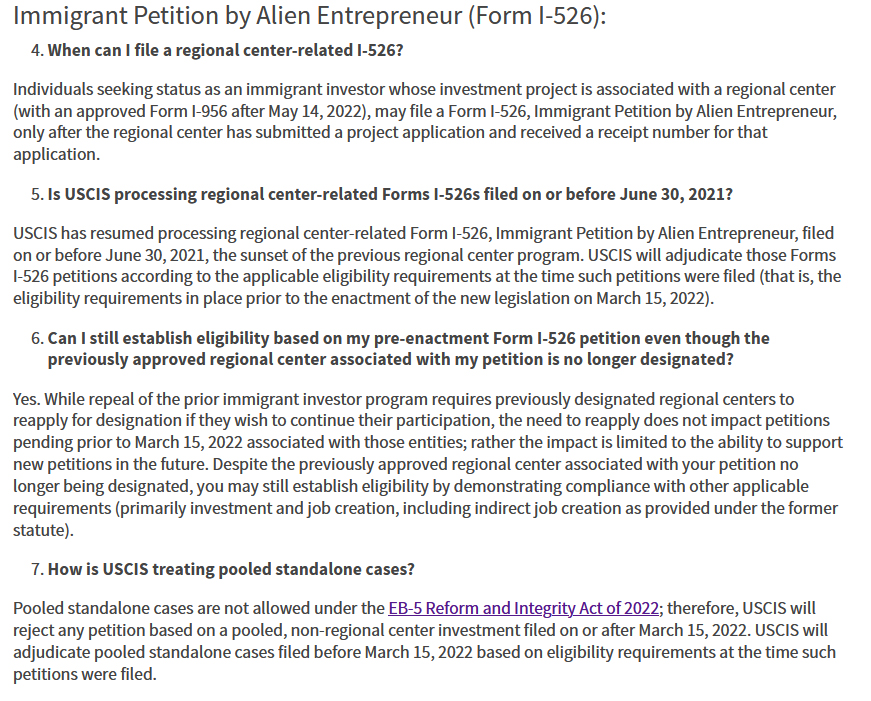
The headline news is that new regional center I-526 cannot be filed starting with the new regional center program authorization on May 14, 2022. Instead, investor filings will need to wait until after USCIS designates individual regional centers under the new program; i.e. wait for new RC application forms to be not only filed but also approved. USCIS did not estimate a time for this process. (For reference, the previous RC application form, I-924, had a median processing time from 19 to 22 months between 2017 and 2021. The most I-924 approvals that USCIS ever managed in one month was about 40, back in 2018. Since 2019, the average was more like 15 per month. Based on new law requirements, the new RC application will have less offering-specific and project-specific content than I-924, but more compliance content and more security checks. The processing workload will depend on how many of the previously-designated 632 regional centers decide to apply for new designation. I guess that at least most of the 344 RC that were committed enough to file I-924A even during the RC program expiration will apply.)
A second headline, which I doubt that USCIS thought through: USCIS now claims no jurisdiction over the entities that were formerly designated as regional centers, and that are still handling billions of dollars of EB-5 investment. The written Q&A states that USCIS will no longer require these entities to file annual reports about what they are doing with those billions of dollars, or to file amendments when they change plans or ownership. Unless and until they choose to apply for new designation, the entities holding pre-enactment EB-5 investment are now apparently exempt from the new EB-5 integrity measures, and also from such oversight as USCIS used to provide for regional centers. This follows from USCIS’s interpretation that “regional centers previously designated under section 610 are no longer authorized,” and thus no longer have any status for USCIS to regulate. But I doubt this was intended. I understand the rationale to make regional centers demonstrate compliance with the new law before raising new investment (and to buy more time for USCIS to figure out how to implement the new law). I doubt USCIS thought about the negative integrity side effects of cancelling the only status that allowed USCIS to monitor or dictate to pre-existing regional centers. “USCIS abrogates oversight of entities currently deploying $27 billion dollars in immigrant investment.” This is a true and shocking headline, unless USCIS scrambles to make some clarifications on the status of formerly-designated regional centers.
The written Q&A and the listening session provide welcome clarity about grandfathering of regional center investor petitions. Regional Center I-526, I-485, and visa applications are already being processed as of April 2022. Pre-enactment I-526 are judged “according to the applicable eligibility requirements at the time such petitions were filed,” and with opportunity to demonstrate eligibility “despite the previously approved regional center associated with your petition no longer being designated.”
In the listening session, we heard for the first time from new IPO Chief Alissa Emmel, a career civil servant who was appointed to her position in September 2021 after having previously worked at IPO as an economist starting in 2013, and managing the IPO Compliance Division since 2017. On the call she sounded upbeat, relaxed, and unworried about the challenges of performance improvement or law implementation. She stated one firm plan for EB-5 law implementation: to publish a form and instructions for a new Form I-956, Application for Regional Center Designation, by May 14, 2022. If she has other implementation plans yet, she did not articulate them. No mention of a timeline for publishing the new project approval form or revising Form I-526 or I-829, no mention of processing time targets for regional center application adjudications, and no mention of plans for training adjudicators in the new law. If IPO has started tackling the major challenge of assessment metrics for new regional center compliance plans – a task that will presumably require coordination with the SEC and other outside experts – Chief Emmel didn’t mention it. I came to the call prepared with sympathy for the enormous burden that law implementation puts on USCIS, and for how harassed and panicky the USCIS staff would sound as they grappled with that burden, and with the intense time pressure. But I did not get a chance to deploy my sympathy. I couldn’t tell that much grappling has yet been undertaken or foreseen, or that much pressure has yet been felt.
The call included a Policy Analyst with USCIS Office of Policy and Strategy, who spoke to the need for new policy and regulations. She divulged one plan: “to hold another engagement in late May to gather individual feedback from impacted stakeholders on those areas or topics from the legislation that require rule-making or other sub-regulatory policy considerations.” And she expressed one specific “hope”: to roll out substantive policy manual revisions “over the next few months.” She also noted that “USCIS fully intends to follow appropriate rule-making procedures for implementing regulatory changes, which is by no means a quick process.” As background, the current EB-5 policy originated with a three-year process (with a policy memo drafted in 2011 and finalized in 2013), redeployment policy took three years (promised in 2014, draft released in 2015, published as policy in 2017), and the EB-5 Modernization regulation emerged over three years (promised in 2016, Notice of Proposed Rulemaking in 2017, Final Rule in 2019). With that background, to rewrite all EB-5 policy based on the RIA in a matter of months will be a herculean task. I would love USCIS to manage this; we badly need speed so that investor I-526 can be filed based on known guidance as soon as possible! But the Policy Analyst on Friday’s call did not sound stressed, as I’d expect she would be if herculean efforts were underway. She announced without audible shame what her office has done in 1.5 months so far: added a one-sentence “alert” to the Policy Manual (without deleting or revising the two other contradictory alerts), and archived one of the five Policy Manual chapters already made obsolete by the new law.
Regarding processing, Chief Emmel stated that “I want you to know that we are taking critical steps to reduce processing times for I-526s and I-829s, knowing that this goal will take some time to achieve for the reasons I’m about to discuss.” The steps cited were to resume regional center I-526 processing (“one of our predominant adjudication goals for our I-526 staff is to work through the large volume of I-526 petitions that were in process pre-sunset”), and to increase staffing levels (Emmel did not offer specifics, but I see that USAJobs.gov has listed two open positions at IPO). Chief Emmel expects that improved processing will take “time to achieve” because “it is important to note that in addition to adjudicating cases, IPO requires the time and subject-matter expertise of our adjudication staff to address other necessary efforts including implementation of the new legislation, litigation responses, FOIA requests, public inquiries, and others.” IPO processed over a 1,000 I-525 per month under Julia Harrison’s leadership, around 300 per month under Sarah Kendall, and 20 per month under Alissa Emmel in her first quarter at the helm. In Chief Emmel’s words on Friday, I heard positive intent to achieve incremental improvement over recent performance. I did not hear a plan for the exponential improvement that would be required to regain past performance levels or achieve new processing time targets in the foreseeable future. I listened closely for a sense of whether Chief Emmel intends to change the culture of IPO, which since 2019 has taken a time-is-no-object extreme-vetting approach to EB-5 adjudications, with gratuitously lengthy and hostile RFEs, high denial rates, and low completion rates. Chief Emmel spoke about the EB-5 program and investors in very positive terms, and she repeated the new service-oriented USCIS mission statement promising “fairness, integrity, and respect for all we serve.” She then went on to say that “for our office, what that means is to accurately and efficiently adjudicate petitions and applications, as well as safeguard the integrity of our nation’s immigration system through our efforts to combat fraud, protect national security and pubic safety, and maximize our law enforcement, intelligence community, and other federal agency partnerships.” Other than the word “efficiently,” those are still Stephen Miller/Sarah Kendall-era enforcement-centric talking points. I am still waiting for a changing tide in EB-5 adjudications, and to see efficiency, fairness, and respect treated as integrity issues by the Investor Program Office.
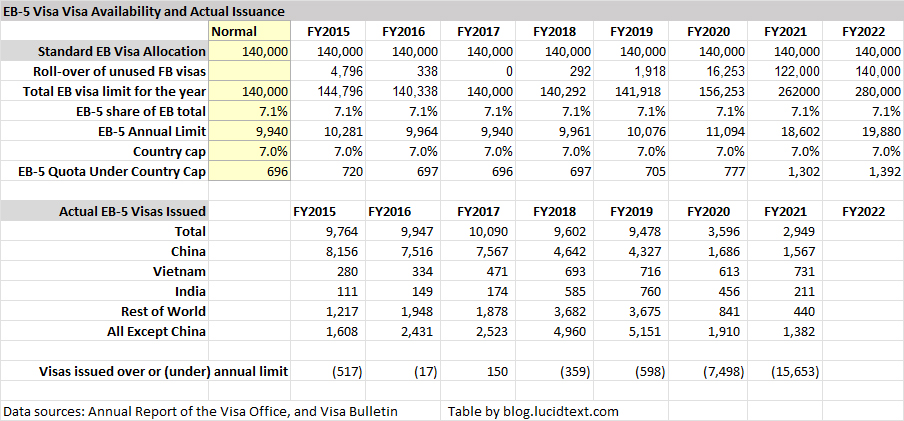
Department of State has published the Report of the Visa Office 2021, including data for the number of EB-5 visas issued by country through consular processing and adjustment of status from October 2020 through September 2021. The following three tables summarize key data points for traditionally high-volume countries.
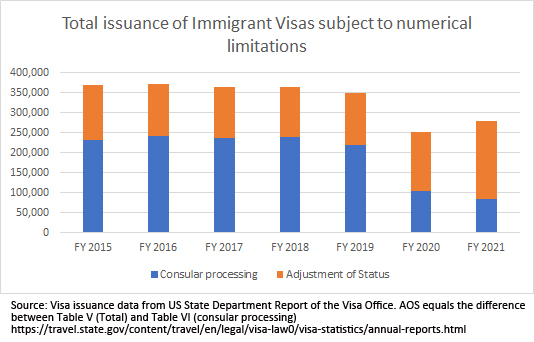
In normal years, visa statistics tell a story about EB-5 visa demand. In 2020 and 2021, they tell a story of processing constraints.
Fewer than 3,000 EB-5 visas were issued in FY2021, limited by neither supply nor demand. FY2021 started with 18,602 EB-5 visas available to be issued and 50,936 EB-5 applicants registered at NVC waiting for visas (including 45,749 from China). Available visas were not issued to available demand due to COVID-19, regional center program expiration, and long-standing processing problems.
Direct EB-5 visas accounted for a relatively high percent of the total visas issued in FY2021 – not due to a spike in direct EB-5 applicants, but because regional center program expiration halted regional center visa issuance for three months of FY2021.
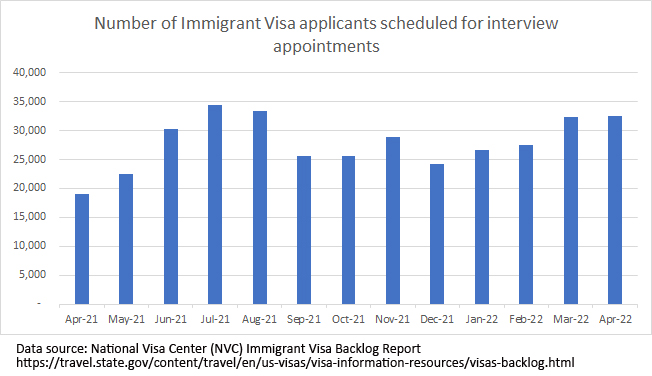
A relatively high percentage of EB-5 visas in FY2021 were issued through Adjustment of Status — not because 31% of EB-5 demand is living in the U.S., but because COVID-19 shut down consular processing abroad more than I-485 processing in the U.S. (For the on-going pandemic impact on consular processing, see the NVC Immigrant Visa Backlog Report page.)
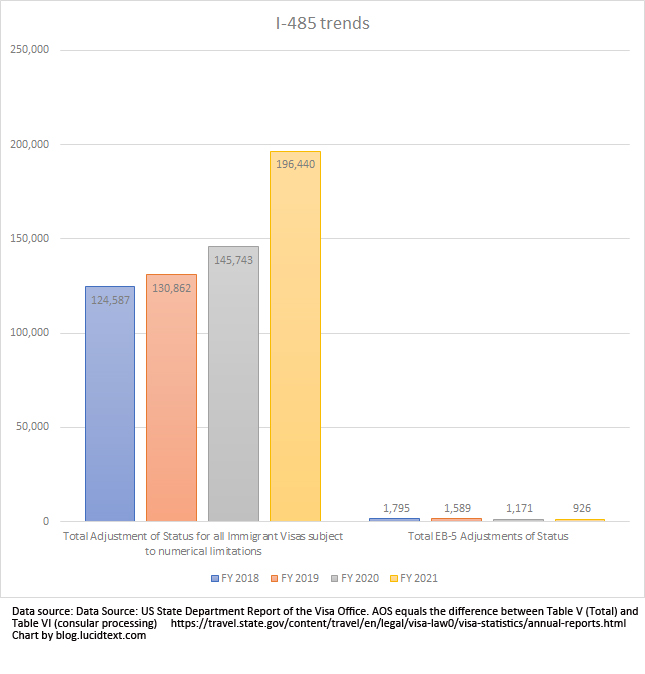
While a relatively high in terms of percentage, Adjustment of Status EB-5 visas were still a very low number in FY2021 – the lowest in five years. Generally, USCIS boasted of its efforts in FY2021 to ramp up I-485 processing volume to help compensate for consular closures and prevent visa loss. Data shows that employment-based I-485 completions increased across the board in FY2021 — except sadly not at the California Service Center, and not for EB-5 status adjustments. AOS visas between FY2020 and FY2021 increased 35% overall, but fell 21% for EB-5. See the base of the post for additional charts illustrating I-485 trends. The regional center program expiration must be partly to blame for abnormally low AOS EB-5 visa numbers last year. Trend charts also show I-485 processing issues that predate the regional center program expiration, and even the pandemic. If you have a pending or future I-485, consider these charts and what has to change.
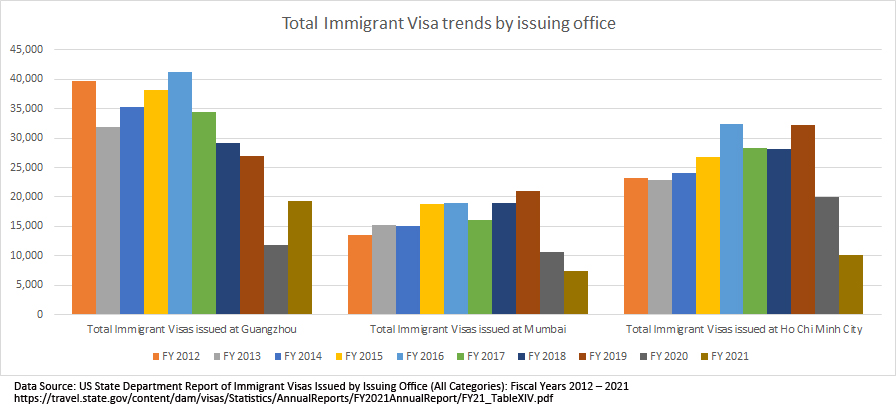
Vietnamese received more than three times as many EB-5 visas as Indians in FY2021 – not because Vietnam had more applicants ready (it had fewer), but because the consulate in Ho Chi Minh City weathered the pandemic better than the consulate in Mumbai or the California Service Center. (See charts below for processing trends by post.)
Chinese received even fewer EB-5 visas in FY2021 than in FY2020. This cannot be blamed on China demand (which was higher than ever in FY2021) or supply (with over 15,000 visas left “unused”), or entirely on COVID-19 (the Guangzhou consulate processed more immigrant visas overall in FY2021 than in FY2020). Chinese applicants particularly suffered from the regional center program expiration putting a stop to regional center visa issuance from July 2021.
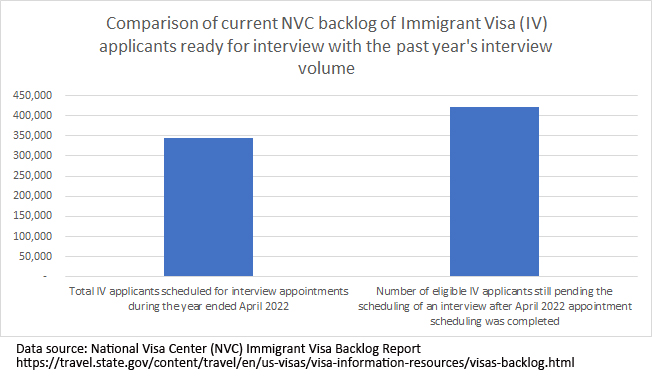
The May 2022 Visa Bulletin indicates that visas now “may” be allocated to regional center EB-5 applicants – thus eliminating one constraint from 2021. The next question is whether and when DOS and USCIS “can” issue visas, considering the many other factors delaying and limiting visa issuance besides RC program status. I made a number of additional charts of data that bear on this question, including I-485 processing trends, I-485 backlogs, consular processing trends, and appointment interview trends. The charts help to put EB-5 delays in a wider context, and highlight problems that need to be addressed.
I’ve thought about reopening my paid EB-5 timing service, to accommodate everyone who’s thinking “don’t make me look at charts, just tell me when I can expect a visa, given my specific situation.” The barrier is that the firm answers that people want aren’t possible. At best, I can offer personalized explanations of and reflections on contributing factors to wait times, such as described in this post. Email me at suzanne@lucidtext.com if you want a personalized (but still unfortunately complicated and qualified) guided tour. Note also my page of EB5 Timing resources.
I haven’t had time to write about this yet (and waiting on the answers to a couple questions), but note also that IIUSA has nicely published the slides from its April 2022 conference presentation with Charles Oppenheim on What the Latest EB-5 Data is Telling Us. See also Lee Li’s article on per-country I-526 data in the latest Regional Center Business Journal.
Welcome to the first EB-5 stakeholder engagement since March 2020! (Only a listening session, but still a good sign!) I look forward to the updates with bated breath.
From: U.S. Citizenship and Immigration Services <uscis@public.govdelivery.com> Sent: April 19, 2022 10:10 AM Subject: USCIS EB5 Reform and Integrity Act of 2022 Listening Session
USCIS EB–5 Reform and Integrity Act of 2022 Listening SessionFriday, April 29, 2022 | 2-3:30 p.m. Eastern
U.S. Citizenship and Immigration Services (USCIS) invites you to participate in an engagement on the EB-5 Program, in line with the EB-5 Reform and Integrity Act of 2022 on Friday, April 29, 2022, from 2-3:30 p.m. Eastern. This will be a virtual meeting.
The EB-5 Reform and Integrity Act of 2022 requires all entities seeking regional center designation to provide a proposal in compliance with the new program requirements, which will take effect on May 14, 2022.
Director Jaddou will provide opening remarks, and USCIS will share updates on the implementation of the EB-5 Reform and Integrity Act of 2022 and guidance about the new designation filing process to entities desiring to be designated as regional centers under the new program. We will then hold a listening session to hear feedback from stakeholders regarding statutory changes made by the EB-5 Reform and Integrity Act of 2022.
USCIS is committed to public engagement, and sessions such as these provide us with valuable feedback as we work to improve our programs. We will not address case-specific questions, questions outside the scope of the engagement, or issues currently or likely to be in litigation.
To Register: 1. Visit our registration page2. You will be asked to sign up for updates or to access your subscriber preferences, please enter your email address and select “Submit”3. Select “Subscriber Preferences”4. Select the “Questions” tab5. Complete the questions and select “Submit.” Once we process your registration, you will receive a confirmation email with additional details. If you have not received a confirmation email within three business days, please email us at public.engagement@uscis.dhs.gov. If you wish to provide written feedback on this topic in advance of this session, please email us at public.engagement@uscis.dhs.gov. To request a disability accommodation to participate in this engagement, email us at public.engagement@uscis.dhs.gov by 4 p.m. Eastern on Friday, April 22, 2022. Note to media: This webinar is not for press purposes. Please contact the USCIS Press Office at media@uscis.dhs.gov for any media inquiries. We look forward to your participation!
On March 15, 2022, President Biden signed a law that made changes to the EB-5 program, authorized a new EB-5 Immigrant Investor Regional Center Program, and directed that certain “grandfathered” immigration benefits be processed. The Department has resumed processing visas associated with the Regional Center Program based on approved USCIS Forms I-526 (Immigrant Petition by Alien Entrepreneur), including those filed on or before the expiration of the previous regional center program on June 30, 2021. Further, pursuant to the new legislation, processing of visas associated with the new Regional Center Program may begin 60 days after enactment of the law.
Thank goodness for the push from well-drafted grandfathering language in the new law. Notice the two policies: one for Regional Center 1.0, and one for Regional Center 2.0. The Department “has resumed” processing visas based on approved I-526 based on previous regional center program authorization. For I-526 based on the “new Regional Center Program,” DOS “may begin” processing after 60 days.
Commenters, let me know if you can access your NVC accounts, or have any other evidence that the Department has actually resumed processing for pending applicants.
We have resumed processing regional center-based Form I-526, Immigrant Petition by Alien Entrepreneur, filed on or before the sunset of the previous regional center program on June 30, 2021. We will adjudicate all Form I-526 petitions filed before March 15, 2022, according to the applicable eligibility requirements at the time such petitions were filed (that is, the eligibility requirements in place before the enactment of the EB-5 Reform and Integrity Act of 2022, Div. BB of the Consolidated Appropriations Act, 2022 (Pub. L. No. 117-103) (Sec. 101 and 102). We will continue to process Form I-526 petitions under the visa availability approach, prioritizing those Form I-526 petitions for investors with an available visa or a visa that will be available soon. We will continue to reject all Form I-526 petition received on or after July 1, 2021, when it indicates that the petitioner’s investment is associated with a regional center.
I’m glad to see that USCIS does not intend to hold pending regional center petitions in abeyance pending regional center recertification. I have noted a recent uptick in I-526 processing, with around 10 actions and at least two or three completions most working days this month. That’s a great improvement over last month (but still far from the volumes needed to process over 13,000 pending I-526 petitions in a timely manner).
The USCIS EB-5 page was updated today April 11 with this message.
Congress repealed Section 610 of the Departments of Commerce, Justice, and State, the Judiciary, and Related Agencies Appropriations Act, 1993, in the EB-5 Reform and Integrity Act of 2022, Div. BB of the Consolidated Appropriations Act, 2022 (Pub. L. No. 117-103) (Sec. 101 and 102). Therefore, regional centers previously designated under section 610 are no longer authorized. The EB-5 Reform and Integrity Act of 2022 requires all entities seeking regional center designation to provide a proposal in compliance with the new program requirements, which will be effective on May 14, 2022. We will provide further guidance to entities desiring to be designated as regional centers under the new program. We are not accepting Form I-924, Application For Regional Center Designation Under the Immigrant Investor Program, for this purpose.
Sigh. The EB-5 Reform and Integrity Act text does not does not, in fact, say that all previously-designated regional centers lose designation and need to reapply. But we’d been wondering about this since Senator Grassley expressed his impression that the law included such a provision. I guess I shouldn’t be surprised that USCIS has chosen the interpretation that will lead to maximum delays for future regional center investment and maximum confusion for in-process EB-5 projects and pending regional center applicants. There were 632 regional centers at last count as of October 25, 2021, and over 100,000 pending EB-5 applicants associated with the previously-designated regional centers. What happens next? Are billions of dollars in regional center investment suddenly stateless, pending the USCIS timeframe to review hundreds of new regional center applications? I would bet that as of today, USCIS intends no retroactive harm but simply hasn’t thought anything through and doesn’t know what further guidance it’s going to provide.
This post tackles a momentous question: what is the impact of the 32% reserved visas provision in the EB-5 Reform and Integrity Act of 2022?
In the zero-sum visa game, newly-reserving visas for some means newly-restricting visa availability for others. That’s self-evident. But who wins and loses, and how much?
I’ll start with my conclusions, then take a deep dive into the detail, calculations, and questions behind the conclusions.
Reserved visas will probably not harm pending EB-5 applicants from countries other than China, Vietnam, and India, because country caps still protect minority-country visa availability, and demand under per-country limits has always been well under 68% of the annual EB-5 quota.
Reserved visas also have no incentive value for incoming EB-5 applicants from low-demand countries, since these applicants already have visa availability protected by country caps, and no visa backlogs to avoid.
Reserved visas can have incentive value for incoming EB-5 applicants from high-demand countries with backlogs (China, Vietnam, India) provided that the reserve visas are exclusive to incoming applicants, and thus offer a way to avoid standing in line behind thousands of pending applicants with earlier priority dates.
Reserved visas have a devastating cost for pending China-born applicants, because reserved visas drain the pool of “otherwise unused” numbers normally generally available at the end of every year to applicants with the oldest priority dates. The magnitude of the negative impact depends on whether or not Department of State interprets and applies the new law as making all reserve visas practically exclusive to post-March 15, 2022 priority dates, and thus inaccessible to the 80,000+ pending EB-5 applicants already queued up for visas. [6/21/2022 Update: DOS has announced that it interprets reserve visas as only available to applicants who file I-526 after March 15, 2022, and unavailable to the backlog.] But even with optimal interpretation, the China backlog is poised to lose access to at least 2,000 visas a year.
This article has five parts:
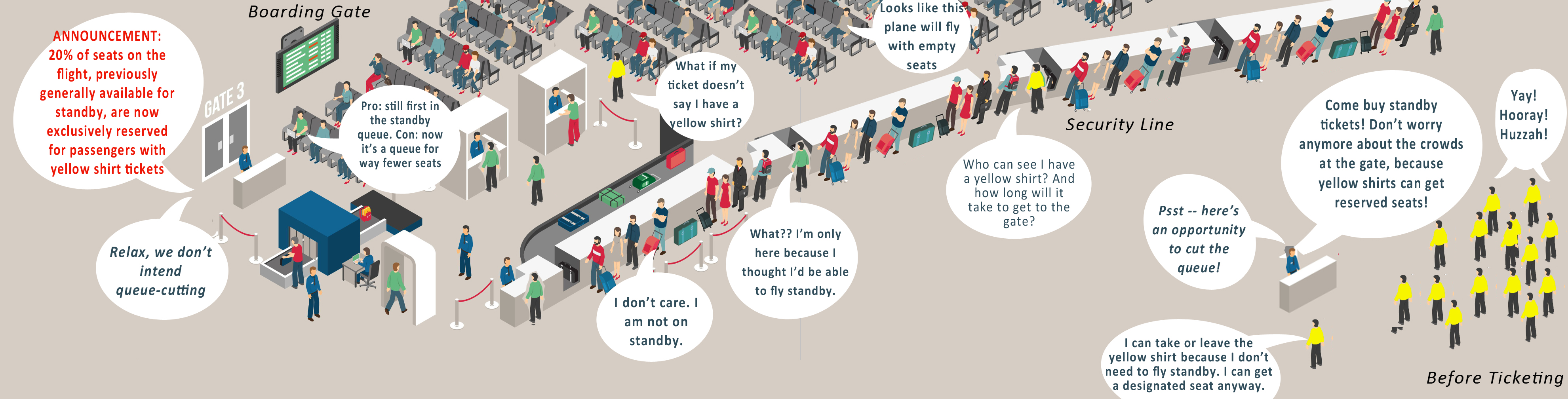
Analogy: To set the stage, I suggest the analogy of an airport (like EB-5, a multi-stage process), and passengers waiting on standby (analogous to oversubscribed EB-5 applicants waiting on unused visas).
Law: I list out all the provisions in existing law that govern EB-5 visa availability, and the specific changes made in the EB-5 Reform and Integrity Act of 2022. This exercise highlights ambiguities and room for interpretation. I transcribe comments on the ambiguities from Charles Oppenheim, recently retired from Department of State, at a March 22 webinar with Wolfsdorf Law.
Data: I lay out data for historical EB-5 visa demand, supply, and allocation.
Application: I review how EB-5 visa wait time estimates worked under the old law, and consider the marginal impact of the new law on visa supply and wait times.
Conclusion: I consider possibilities for making the reserve visas law turn out less bad for our past clients than it could be
Three stages: buy a ticket, wait in the security queue to get to the gate area; wait in the gate area to get on a flight. Only passengers who reach the gate area are practically as well as theoretically eligible to use their tickets to get seats on a flight.
File I-526, wait for I-526 processing, then wait in the consular or adjustment process for a visa. An I-526 priority date is a kind of ticket to maybe claim a visa in the future, but only people who are documentarily qualified at the visa stage can use their priority dates to claim visas.
Standby tickets: Flying standby means that my ticket doesn’t lock in a specific designated seat, but I still have a chance to get a seat — assuming that a flight will have enough undesignated seats leftover for standbys to take.
Most EB-5 applicants from China are waiting on standby status for visas. Most Chinese do not have designated places in the annual EB-5 visa quota thanks to overbooking (under country caps, only 7% of annual visas can go to any one country by right). But having the oldest priority dates, Chinese are at the front of the standby line for any annual visas left unclaimed after by-right per-country allocations. Historically, at least over 40% of annual EB-5 visas have been “otherwise unused” and therefore leftover for the standby queue. Chinese have been able to depend on flying standby, because (1) they’ve been waiting longest and therefore at the head of the standby queue, and (2) a good number of “otherwise unused” visas have been reliably available to standby given the inherently low EB-5 demand from most other countries in the world. (Vietnam and India, while also overbooked, have not been able to expect any visas over the per-country limit, because they’re more recent and thus behind tens of thousands of Chinese in the standby queue.)
I believe that in real life, an airline will try to fill a flight with whoever at the gate can board, with people registered on the standby list getting otherwise unused seats in first come first served order.
Imagine if an agent at a crowded gate suddenly announced that 32% of seats on the flight are now exclusively reserved for passengers with codes that don’t yet exist in the boarding area or current standby list, but can be sold on tickets outside to prospective passengers who had been deterred by the long standby queue already at the gate. That’s the closest analogy I can think of to the 32% reserved visa provision in the new law (and particularly the 20% rural reserve, given very few past rural investments).
In the picture, I tried to illustrate who’s happy (the ticket seller), who’s sad (the displaced standby passengers at the gate), who’s confused (the pending standby passengers who technically match reserve conditions, but not sure yet how/if they can claim new codes only being stamped outside on new tickets), who doesn’t care (the passenger who has a designated seat anyway and not dependent on standby or reserves), who’s frustrated (the guy at the gate who looks around, sees no one positioned yet to use up the reserved seats, and realizes that planes will have to take off partly empty until new reserve-eligible passengers finally make it to the gate, meaning existing standbys get further delayed for nothing), who’s conflicted (the prospective passengers standing in a crowd outside the ticket counter, wondering how to interpret the pitch that they won’t find themselves stuck in a crowd once they get to the boarding gate), and who’s two-faced (the airline, with different messages at the ticket counter and the gate).
Part 2: Law
The EB-5 Reform and Integrity Act of 2022 introduces two changes to the law for EB-5 visa allocation:
it repeals/replaces the two pre-existing categories of EB-5 set-aside visas (3,000 regional center, 3,000 TEA), and adds three newly-defined reserved visa categories (20% rural, 10% high unemployment, 2% infrastructure);
it introduces an instruction to preserve unused reserved visas from year to year within the EB-5 category (without, however, repealing or amending the parts of the existing law that define/cap the annual EB-5 limit and allocate any used EB-5 visas to other visa categories).
Law prior to the EB-5 Reform and Integrity Act of 2022
INA 201(d): The Employment-Based category is allocated a base 140,000 visa annually. The EB limit for a given year is the base 140,000 plus any unused Family-Based visas from the previous year.
RIA specifies no change to INA 201(d)
INA 203(b)(5)(A) Each year, the EB-5 category is allocated a maximum of 7.1% of the EB limit for that year.
RIA specifies no change to INA 203(b)(5)(A)
INA 203(e)(1) Available EB visas are generally issued to eligible immigrants in the order in which the immigrant petition was filed.
RIA specifies no change to INA 203(e)(1)
INA 202(a)(2) states a per-country limit: that no more than 7 percent of visas available within an EB category in a fiscal year can be made available to natives of any one country. INA 202(a)(3) and (5)(A) provide an exception: that EB immigrants are not subject to the per country limit allocation in a period where available visas exceed the number of qualified applicants to take them.
RIA specifies no change INA 202(a)
INA 203(b)(1) If visas still remain unused within the EB-5 category near the end of a fiscal year, such unused visas are made available for use by priority workers (EB-1/EB-2)
RIA specifies no change to INA 203(b)(1)
INA 201(c): If the EB category as a whole does not use all its allocated visas in a fiscal year, such unused visas are made available within the Family-Based category in the next fiscal year.
RIA specifies no change to INA 201(c)
I’m not sure where this is in the INA, but DOS explains in its document on Operation of the Numerical Control Process that DOS allots visa numbers monthly to consular posts and CIS to be given to reported documentarily-qualified applicants within established cut-off dates. Significantly, visa numbers do not get allotted to applicants earlier in the process; including not when petitioners invest or file I-526.
RIA specifies no change to the timing of visa allotment.
Section 610 of the Departments of Commerce, Justice, and State, the Judiciary, and Related Agencies Appropriations Act, 1993 (8 U.S.C. 1153 note) sets aside 3,000 visas annually for regional center applicants.
RIA Section 103(a) repeals Section 610 of the Departments of Commerce, Justice, and State, the Judiciary, and Related Agencies Appropriations Act, 1993 (8 U.S.C. 1153 note), thus doing away with the regional center visa set aside in that section. RIA Section 103(b) says that “visas under this subparagraph shall be made available” to a new program for pooled investment, but does not specify a specific number of visas to be made available specific to regional center applicants.
INA Section 203(b)(5)(B) specifies that “Not less than 3,000 of [EB-5] visas made available in each fiscal year shall be reserved for qualified immigrants who invest in a new commercial enterprise … which will create employment in a targeted employment area.”
RIA Section 102(a) (2) “amends” (i.e. apparently deletes and replaces) the old INA Section 203(b)(5)(B) to read as follows: “(B) DESIGNATIONS AND RESERVED VISAS.— “(i) RESERVED VISAS.— “(I) IN GENERAL. —Of the visas made available under this paragraph in each fiscal year— “(aa) 20 percent shall be reserved for qualified immigrants who invest in a rural area; “(bb) 10 percent shall be reserved for qualified immigrants who invest in an area designated by the Secretary of Homeland Security under clause (ii) as a high unemployment area; and “(cc) 2 percent shall be reserved for qualified immigrants who invest in infrastructure projects. “(II) UNUSED VISAS.— “(aa) CARRYOVER.—At the end of each fiscal year, any unused visas reserved for qualified immigrants investing in each of the categories described in items (aa) through (cc) of subclause (I) shall remain available within the same category for the immediately succeeding fiscal year. “(bb) GENERAL AVAILABILITY.—Visas described in items (aa) through (cc) of subclause (I) that are not issued by the end of the succeeding fiscal year referred to in item (aa) shall be made available to qualified immigrants described under subparagraph (A). ERIA Section 102 has an effective date of March 15, 2022.
Notes on what did and didn’t change in the law, and what’s ambiguous
Minority Country Protection: The new law does not change the rule that protects low-volume countries with an annual 7% per country limit – a cap that high-volume countries may only exceed if and when there’s insufficient demand for available visas. Even if the new law does make 32% of 10,000 annual EB-5 visas practically unavailable to the backlog of pending applicants, that shouldn’t hurt minority countries in theory. An EB-5 applicant from Ireland doesn’t depend on a total 10,000 visas available anyway, but only on one of the 7% of EB-5 visas that must be made available to the few Irish applicants ready to claim them before other countries can start to exceed their 7% caps. Thus far, the highest that EB-5 demand under per-country limits has ever gone is 5,851 total in FY2019 (other visas that year were “otherwise unused” and thus issued to the oldest Chinese applicants). So even reducing generally-available EB-5 visas to about 6,800, if set asides have that effect, may not threaten applicants under per-country limits. At the same time, reserved visas don’t stand to benefit minority countries, since applicants from low-demand countries don’t have visa backlogs/visa wait times to avoid.
Eliminating RC and TEA Visa Set-asides: The new law explicitly repeals or replaces the EB-5 visa set asides in previous law: 3,000 for regional centers and 3,000 for TEA. Those set-asides were popularly forgotten because they hardly mattered in practice. There never were over 7,000 non-regional center or over 7,000 non-TEA investors ready to request visas in a year, and thus no one ever ran up against the old set-aside limits. With the backlog dominated by RC and TEA investors, the previous RC and TEA set-asides gave no short-cut around the backlog. So, who cares about eliminating those insignificant set-asides? At minimum, pending applicants are confused now, since their pending applications and the Visa Bulletin are marked for visa codes (C5, T5, I5, or R5) that correspond to the now-eliminated reserved visa categories. The reserve categories around which they invested have suddenly disappeared. For applicants not dependent on the Visa Bulletin anyway, this records confusion shouldn’t affect their actual visa availability. But it’s a reminder that the grandfathering fight is not done; we need to improve the law so that filing I-526 locks in something for future visa availability, not just regional center status. As it is, the law and situation that exists when you commit to the EB-5 process guarantees nothing for visa availability; people are dependent on the visas that exist and the rules for allocating them once they finally reach the visa stage. If the law changes midstream, too bad.
Creating New Reserved Visa Categories: The new law creates three new EB-5 set-aside categories: 20% rural, 10% DHS-designated high unemployment, and 2% infrastructure. These changes are effective as of the date of enactment — March 15, 2022 – which means that someone filing I-526 today should be assigned a new code that marks him or her as belonging or not to one or more of the three new categories. What’s not clear: are any of those these reserved visas theoretically or practically available to the 80,000+ people in the EB-5 visa backlog, who are coded C5, T5, I5, and R5 under the now-abolished RC and TEA set-aside categories? [6/21/2022 Update: DOS has announced that it interprets reserve visas as only available to applicants who file I-526 after March 15, 2022, and unavailable to the backlog.]
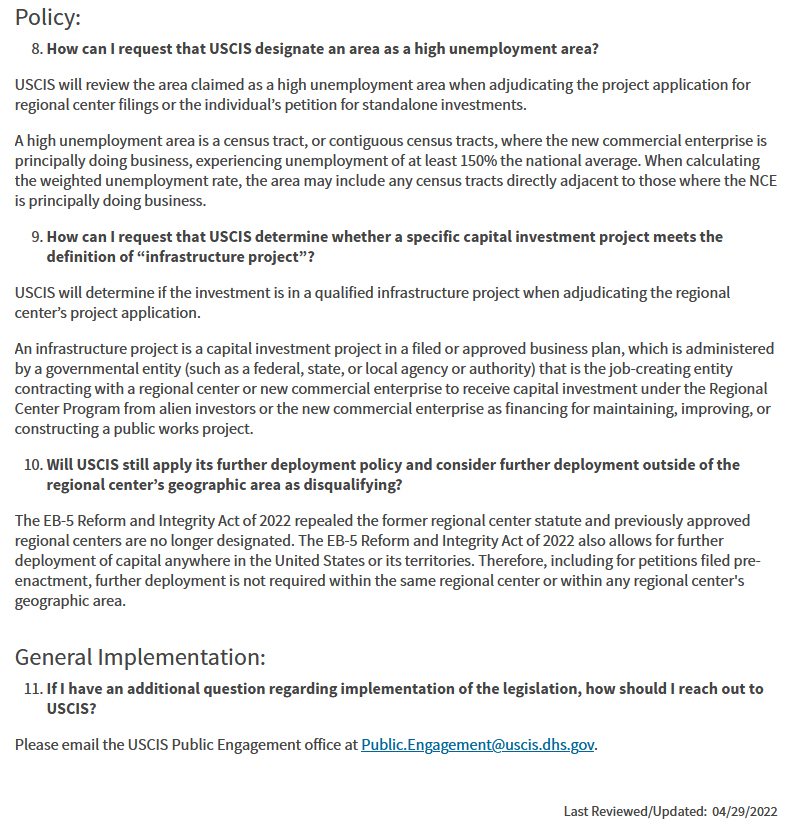
In fact, most of the backlog invested in TEAs based on high unemployment. Whether or not those applicants can touch the new 10% high-unemployment set-aside would depend on (1) whether or not DOS interprets the new set-asides as theoretically available to people who started the process pre-enactment and under slightly different high-unemployment area definitions, and (2) whether or not DOS can get USCIS to go back and re-code all the backlogged TEA applicants as being either high unemployment or rural investors, such that DOS is practically able to offer reserve visas to the backlog as well as to new investors.
Of course, the people who drafted the reserved visa law must have wanted the reserve visas available to incentivize new investment. Reserved visas can only have an incentive function if they can offer a priority/timing advantage to new investors, which is only possible if the visas are not absorbed by the many people already in the backlog waiting for visas. Thus the talking point that reserved visas should only apply “prospectively.” This has long been an industry lobbying focus (e.g. this 2019 industry letter to Congress requesting set-asides that apply only to new I-526 petitions and not pending applicants.)
Of course, pending applicants do not want reserved visas to be prospectively available only to incoming I-526. The China backlog must particularly fight to lose as few visa numbers as possible, which means keeping their access to reserve visas if possible. At least, the backlog has a potential chance to access the 10% of visas newly reserved for high unemployment investment. Many backlogged applicants in fact invested in high-unemployment areas, and just need to be re-coded and recognized as such – something for investor associations to fight for. The 20% rural set-aside is probably largely an inevitable loss to the backlog because, as a practical matter, few past investments were in rural projects. Most rural reserves are therefore effectively off the table for the backlog even if DOS decides that past rural applicants could theoretically qualify for rural reserves.
On March 22, Bernard Wolfsdorf and Joseph Barnett held a wonderful webinar with special guest Charles Oppenheim, recently retired chief of Visa Control at Department of State. A webinar recording is now available on Youtube, and I’ve transcribed below a few of Charlie’s comments on the reserved visas provision in the new law.
[Quoted from minute 32] Oppenheim: I do believe that the State Department will have to have new visa categories, and issuance codes or issuance symbols need to be established to identify the applicants who are going to be eligible for processing under the 10, 20, and 2 percent set aside limits. This may actually eventually result in there being five EB-5 visa listings in the visa bulletin. Right now there are only two for non-regional centers and regional centers. Again, with the establishment of new codes to cover the set-asides, I think that is likely to go to five listings.
[Quoted from minute 40] Oppenheim: It’s important to note that the use of the use of the new codes to distinguish the 20, 10, 2 set-asides is going to be necessary for Department of State to compare the amount of numbers which have already been used in those categories, the amount of documentarily complete demand ready for immediate processing, and to know the potential demand requiring use of a number in the future. That information is used not only for the set-asides, but for the determination of any of the preference category’s final action dates. And it’s necessary to apply that to control number use under the respective limits. Therefore it is going to be very important for the officers to know which of the visa codes to be used for final action on a case so that the number use can be accurately tracked and then reported to the visa office for numerical control purposes. Unfortunately my previous position did not require me to know the detailed information which is included on these petitions, so I can’t really say how easy it’s going to be for them to make that distinction between the rural and high unemployment applicants for these set asides.
[Quoted from 1:01:36] Question: Do the reserved visa categories create even longer delays for Mainland China, with the fact that 3,200 visas are being pulled from the general category? Oppenheim: I think there is the potential for that. Although, it’s unknown how many of the Chinese applicants that are in line may be able to benefit by this new set-aside. I think that is one of the unknowns at this point, and I don’t think it’s worth worrying about too much until we know in terms of the official determination of the implementation of the set-asides. [end Oppenheim quote]
Impact of Reserved Categories: If the reserved visas are genuinely reserved for post-enactment I-526, not available to the pending backlog, who wins? In the near term, reserved visas benefit incoming applicants from oversubscribed countries, who would otherwise be stuck in line behind many thousands of fellow-countrymen for generally available visas.
The new law creates visa reserves that work if they restrict 32% of visas such that those visas can’t be issued to the oldest priority dates, and must be issued to post-2022 priority dates or go unused. For example, in 2023 Department of State will have about 2,000+ visas restricted for rural investment. If Department of State has already issued 700 visas to the oldest applicants from every country in 2023 and sees 1,000 rural set-asides still lying unused on the table, it will have to start waving up whichever remaining rural applicants are eligible for those visas, even if they’re Indians or Vietnamese or Chinese already over the 700 limit and with priority dates far more recent than their backlogged fellow-countrymen. That’s the queue-cutting opportunity. Genuinely reserved visas serve to create a new category of standby that can attract new applicants from China, Vietnam, and India who would’ve otherwise been at the back of the old generally-available standby queue. I emphasize “near-term” advantage for in-coming applicants, though, because a new standby category only benefits the people who start the new queue. 2,000 rural visas per year can sustainably accommodate around 700 investors per year, and will cease to offer a fast track when demand exceeds that level and creates new backlogs.
For the rest of the world, reserved visas should not be significant. Department of State already waves up minority-country EB-5 applicants as soon as they’re ready by virtue of their nationality priority under the per-country limits, with no need for other priority. (I still expect to see quite a few minority-country rural investors, though, because the I-526 processing priority provision for rural in the new law does offer time advantage for everyone.)
Unused Reserved Visas: It’s hard to tell whether the “unused visas” provision in the new law is careless or crafty. Maybe it was written by people who just forgot all those conflicting parts of existing law that prevent EB-5 visas from rolling over to EB-5 from year to year. Maybe it was written by people who ignored the existing law conflicts on purpose, gambling that Department of State might choose to settle the conflict in favor of EB-5, start allowing a limited amount of EB-5 visa recapture for the first time in history, and start letting the EB-5 annual limit exceed its statutory maximum 7.1% of EB allocation for the first time. This could be a back door to recapturing at least FY2022’s large number of unused EB-5 visas, which would be very valuable. The darkest possible interpretation is that the “unused visa” provision was just put in the law to help ensure that no matter how interpreted – whether the unused set-aside visas are retained for new applicants or lost to other preference categories as usual — at least they’ll definitely not be generally available to the China backlog at each year-end, and thus conveniently serve to lengthen wait times for redeployable Chinese investment. I hope no one did think that way, because investors and their projects are not infinitely patient.
In the March 22 webinar, Oppenheim addressed questions about the unused visas provision in light of existing law.
[Quoted starting from minute 42] Oppenheim: In one way of looking at this, the INA guidelines clearly state how unused numbers within a preference category’s annual limit should be made available to other preferences. For example, Section 203(b)(1) indicates already that any unused employment fourth or fifth preference numbers should be added to the EB-1 annual limit. Also Section 201(c) says that any unused numbers from the previous year’s worldwide employment limit fall across and are to be used in the determination of the next year’s family sponsored annual limit. So, despite the fact there are these set aside provisions, I think it could be argued that the current year’s unused set-aside numbers could be made available to other EB-5 applicants, and then if they were still unused numbers under the overall EB-5 limit, such numbers could then fall up for potential use in EB-1 during the current fiscal year. And if you followed that logic, then the only numbers that ultimately remained unused after the fall-up provision would then fall across for the next year’s set-aside limit. That’s confusing, but I think that there’s room for interpretation, and it could be argued either way on this. …I think that there likely will be a need for technical corrections. … I do think that there potentially will be some changes, at least to the language to clearly identify what is meant. Because, for example on this set-aside provision where it’s saying, ok, if there are unused numbers under the 20 percent set-aside, that those numbers should be reserved and added to the next year’s limit. That is fine in regards to the EB-5 applicants, but if you’re an advocate for EB-1 or EB-2 or family fourth or any other preference category, you may be saying, well why can’t we have the same benefit where our unused EB-1 numbers are reserved for the next year, etc. That type of “reserved for the next year” previously has only occurred through legislative action to recapture unused numbers. So this is kind of a whole new world. And again, I think that’s why it’s going to be important to clearly interpret how you distinguish unused numbers.
[Quoted from minute 58] Joseph Barnett: Can I try to paraphrase what you mentioned before, Charlie, and let me know if I’m getting this right here. You think that the Department of State is going to have to create new visa categories to deal with the reserved visa classes. You don’t necessarily know how the existing investors are going to be included into those new visa categories without further action by investors or USCIS or some way to report that demand. And with regards to the unused visas provisions, there’s going to have to be some interpretation and discussion in DOS about how that’s going to play out and how it’s going to fall up or fall across – they’re just kind of unknowns at this point?
Oppenheim: Correct. [end Oppenheim quote]
Part 3: Data
After all this general talk, let’s look at numbers. I’ve copied below tidy tables of figures that represent the individual real people caught up in all this, and the history of how EB-5 visa demand and allocation has played out to date. (To interact with the data and see source citations, access the Excel file of Key Backlog data linked to my EB-5 Timing page.)
Points to note as you look at visa issuance numbers:
The variable number of EB-5 visas issued each year has followed from (1) the number of visas technically available to EB-5 and each country that year as calculated under the INA rules described above, and (2) the number of visas that applicants were practically able/willing to claim (by getting through I-526 processing to the visa stage) and that the government was practically able to issue (considering processing constraints).
Note the number of EB-5 visas actually issued to China-born applicants each year, from over 8,000 in FY2015 to just over 4,000 in FY2018 and FY2019. Those China visa numbers were a function of visa demand from the rest of the world. Each year, the oldest applicants received whatever was leftover of the EB-5 limit after DOS satisfied rest-of-world demand within per-country limits. (Except FY2020, when everyone got constrained by COVID-19.)
On the following I-526 table, note the number and timing of I-526 filings from countries other than China. See that China had its I-526 filing surge early, which is why it now leads the standby queue at the visa stage, while India had a later surge that’s thus further back in queue priority (and largely not at the visa stage yet, thanks to sluggish I-526 processing). Most significant of all, note the relatively flat line of I-526 filings from non-backlogged countries since 2015, even during years of peak EB-5 popularity and the $500,000 threshold. EB-5 just doesn’t have a big market in most of the world. That “all except China, India, Vietnam” column in the I-526 filing trend gave hope to the China backlog and concern to people selling EB-5. Backlogged Chinese applicants could rejoice to see on-going low rest-of-world I-526 filing numbers, which underwrote the hope that “otherwise unused” visas would continue to be leftover from the rest of the world in significant numbers for the oldest Chinese applicants. Marketers would lament the persistently and organically low ROW I-526 numbers, and strategize to get more visas to offer the historically fruitful China/India/Vietnam markets now constrained by backlogs of old priority dates.
Part 4: Application
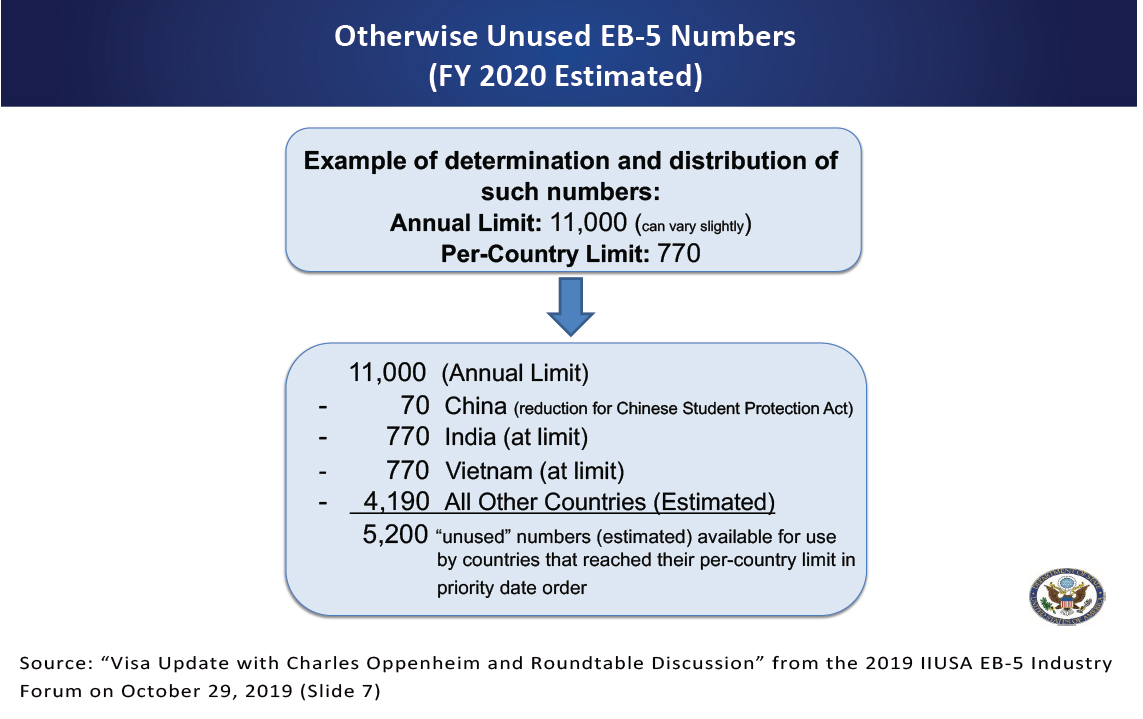
For a reminder of how EB-5 visa distribution used to work, consider this slide from the “Visa Update with Charles Oppenheim and Roundtable Discussion” at the 2019 IIUSA EB-5 Industry Forum (October 29, 2019). The equation starts with the annual visa limit, then deducts all qualified demand from applicants at/under the per-country limit, and ends with a difference of “unused” numbers available for allocation to the oldest applicants regardless of per-country limit.
As it turned out, a global pandemic intervened and prevented Department of State from actually issuing the number of visas anticipated for FY2020. But in theory, the 11,000 visa available for FY2020 should’ve been distributed first to all prepared applicants up to their 7% country limits, with the balance then leftover for the oldest i.e. Chinese applicants. Oppenheim estimated in 2019 that over 5,000 visa could be allocated to Chinese in FY2020, as a function of the expected number of “otherwise unused” numbers.
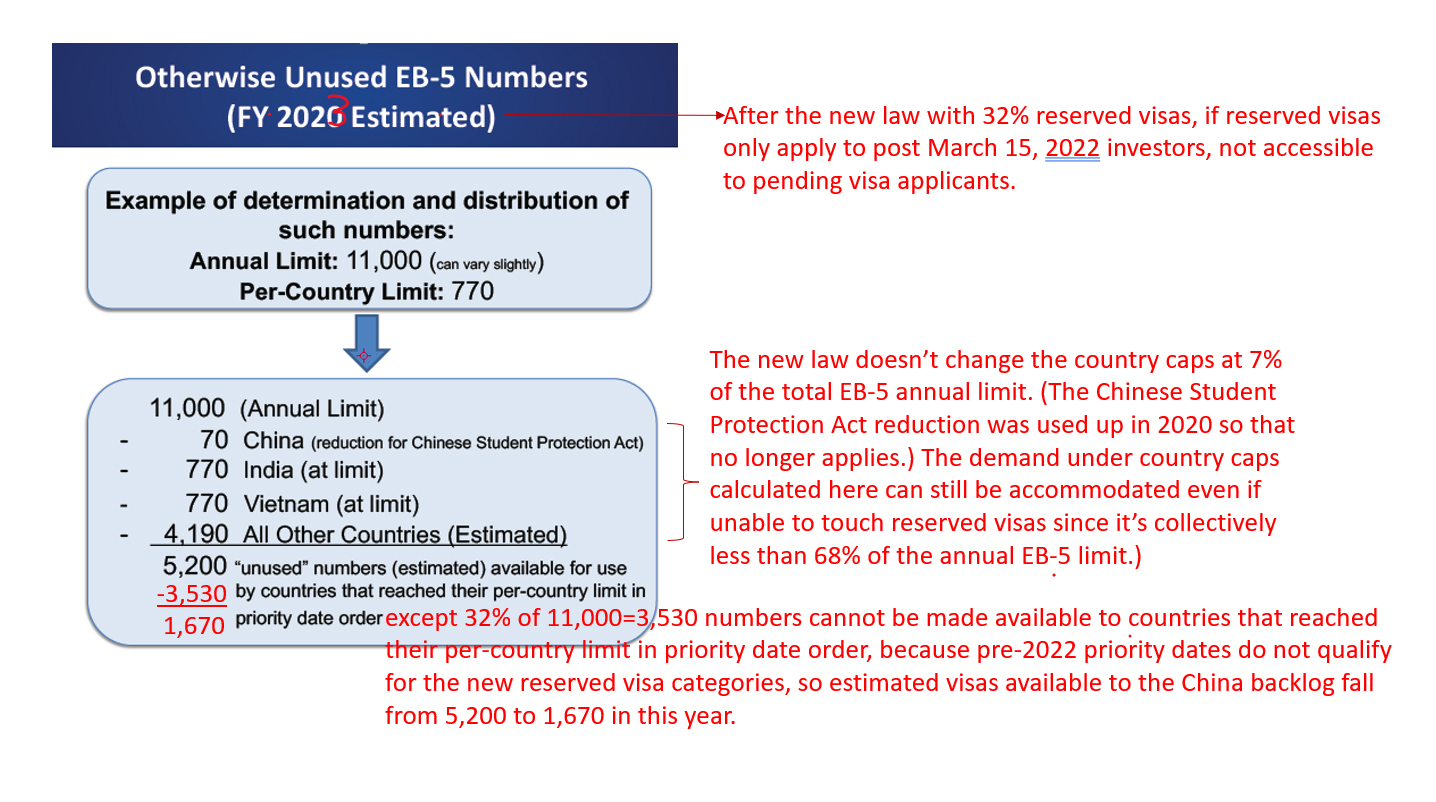
Now here’s a version of the same slide, but marked up to show how the calculation would change with reserved visas — if reserved visas are indeed reserved in new categories and not accessible to pending pre-March 2022 priority dates.
As illustrated, the difference falls on the “unused numbers” calculation. Removing 32% percent of visas from the general pool does not affect visa allocation under per-country limits in this year, because more than 32% of visas were going to be leftover after per-country allocation anyway. The impact is on the number of available leftovers for the oldest applicants, and the applicants depending on leftovers for their visa allocation. In the year shown in the slide example, the number of leftover visas for the oldest (Chinese) priority dates falls from 5,200 to 1,670.
Let’s say I’m a China-born EB-5 applicant who can estimate 40,000 other Chinese applicants in process with earlier priority dates. How does my wait time calculation change depending on whether I can estimate the queue before me proceeding at an average rate of 5,000+ visas per year to China, or 1,700 per year? 40,000/5,000=8 years. 40,000/1,700=24 years. That’s a huge difference. Of course, real life is complicated. For example 40,000 isn’t just a number but represents humans who are liable to giving up and aging out and dying, in increasing numbers as time goes on. So in real life, changing the denominator of a wait time equation – as reserved visas does for China – will change the numerator as well. In practice, if supply relief doesn’t bring down wait times, demand failure inevitably will. Meanwhile, a variety of factors besides reserved visas sway the denominator of the China wait time equation. Probably new minority-country investors who would’ve invested in EB-5 anyway will choose the new TEA categories, thus eventually blunting the marginal-difference impact of set-asides. Probably overall demand at the $800,000+ level will be lower than before, such that lower incoming demand will leave more visas unused and available to the China backlog eventually even above set-aside limits. Maybe the backlog will get some supply relief in three years if DOS actually allows recapturing unused reserve visas. Real life gives many moving parts to account for. But, all other factors being equal, reserved visas in themselves (if genuinely reserved) certainly have a dreadful impact on the wait time equation for backlogged Chinese applicants. (For detailed analysis, see EB5 Sir’s recent posts.)
Part 5: Conclusion
Anyone who made it to the end of this exhausting article obviously cares about the impact of reserved visas. What can we do now? The EB-5 Reform and Integrity Act of 2022 is law since March 15, 2022. Is there any room to stand athwart history yelling Stop?
Here are some theoretical possibilities for making the reserve visas law turn out less bad for our past clients than it could be.
The China backlog will lose at least 1,000 fewer annual visas than it would lose otherwise if (A) Department of State interprets the new reserved visa categories as being available theory to pending applicants who happen to have invested in high unemployment area, rural area, or infrastructure projects, and also (B) DOS and USCIS communicate to mark pending applications that match the new set-aside categories.
The China backlog will lose fewer visas if Department of State interprets the “unused visas” provision in the law to mean that 32% of the visas that will go unused in FY2022 (6,362 numbers) can be added to the EB-5 limit in FY2024, and generally available.
The China backlog will lose fewer visas if Department of State disregards the “unused visas” provision in the new law as contradictory to the INA, and makes any unused EB-5 visas available to the oldest EB-5 priority dates at the end of each year, regardless of reserved status.
The China backlog may lose fewer visas if we decline to promote reserve visas to new Chinese, Indian and Vietnamese clients, realizing that every one EB-5 visa taken to accommodate a new backlog-country client who wouldn’t have invested otherwise is one visa removed from the pool that would have been available to the oldest backlogged priority dates if not for visa reserves. But this grand gesture would only help our past clients if unused reserved visas can indeed eventually be accessed by the backlog – an open question.
Investors and project companies can best manage impacts if they are realistic about what’s happening. Let’s refuse fallacies (“this is queue cutting with no queue cuts”) and cop-outs (“it’s complicated, so don’t bother thinking or worrying about it”)
Most important, we need to pour advocacy dollars and energy into getting any possible backlog relief for the oldest EB-5 applicants, who need it now more desperately than ever. Regional centers who don’t want to deal with a fight for the exits will want to help fight for visa conditions that keep immigration hopes alive. The best way to incentivize new EB-5 demand is to create an environment where past EB-5 users can also be seen to flourish.
H.R.2471 – Consolidated Appropriations Act, 2022 was enacted on March 15, 2022, and contains the EB-5 Reform and Integrity Act of 2022 in Division BB (PDF page 1022 of the enrolled bill). This means that the regional center program will have a new authorization and new requirements as of May 15, 2022, and other EB-5 program changes are effective as of March 15, 2022 as I discussed in my previous post.
Now we wait for USCIS and Department of State to react with their interpretation and applications of the new EB-5 law. So far, the USCIS EB-5 page has still not been updated since December 2021. I hereby predict that the USCIS page will be updated later this week with one sentence saying “We are evaluating the EB-5 Reform and Integrity Act enacted on March 15, 2022 and will provide additional guidance as soon as practical,” followed by silence. But surprise me, USCIS! (3/17 UPDATE: The USCIS page is now updated to say almost exactly what I predicted.) The April 2021 Visa Bulletin published today has RC category Unavailable in Part A and mostly Current in Chart B, makes no changes yet to reserved visa categories, and says “The Consolidated Appropriations Act, 2022, which reauthorizes and reforms the EB-5 Immigrant Investor Regional Center Program, was signed by the President of the United States on March 15, 2022. Certain Regional Center Program aspects of this legislation go into effect 60 days after the date of the enactment of this Act. More information will be published in coming editions of the Visa Bulletin.”
Pending official interpretation, I’m continuing to update the Reauthorization page on this blog with links to a selection of industry articles and upcoming webinars, as they come to my attention.
In case this helps anyone else’s sanity and clarity, I’m sharing a folder of Word documents that I made for myself. The folder includes:
The text of the EB-5 Reform and Integrity Act of 2022 with heading styles applied. The text is copied from the “enrolled bill” version of H.R.2471 at Congress.gov (which has a few minor tweaks from the EB-5 bill text first released on March 6). I formatted to flag six layers of headings so that I can always track where I am using Word’s Navigation Pane.
The text of Immigration and Nationality Act sections referenced in the EB-5 Reform and Integrity Act of 2022, with headings applied. I didn’t redline the new law changes onto the INA (I just copied INA excerpts as-is), but at least this facilitates looking back and forth to see changes in context. We must be able to follow section headings in order to translate innocuous-looking sentences like “An alien seeking to pool his or her investment with 1 or more additional aliens seeking classification under section 203(b)(5) shall file for such classification in accordance with section 203(b)(5)(E)” and realize the explosive meaning: “from now on, an EB-5 investor may only invest with other EB-5 investors through a regional center; pooled direct EB-5 is no longer an option for new I-526.”
A document comparison showing the EB-5 Reform and Integrity Act of 2022 red-lined on the base of S.831 – EB–5 Reform and Integrity Act of 2021. S.831 is the bill that Senators Leahy and Grassley introduced back in March 2021 and tied to pass last June before the RC program expired. No surprise considering Senator Leahy’s negotiating position, document comparison shows that the new EB-5 law largely reproduces S.831. There were no changes to the S.831 integrity measures, and no backlog relief additions. Negotiations just added higher investment amounts, new visa restrictions, new TEA definitions, redeployment policy, and grandfathering protection for the future.
I’m occupied with business plan deadlines at the moment, but will write more as soon as possible about reserved visas, the new EB-5 law change that most concerns me as resident EB-5 data collector and backlog Cassandra.
Here, in one picture, is what’s happened to USCIS performance in adjudicating EB-5 forms.
Official data now confirms what I previously reported based on leaked information: the Investor Program Office reduced I-526 processing volumes to almost nothing at the end of 2021, and also had the lowest I-829 performance numbers in two years.
These charts show performance over the course of IPO’s history.
Comparing FY2022 Q1 volumes with the average for 2017-2018, IPO processed 2 times fewer I-829 and 54 times fewer I-526. And that’s despite having (or at least, paying) more employees in 2022 than in 2017/2018. I-526 productivity for the second half of 2021 was so low as to be almost invisible in the comparison chart, and not for lack of I-526 to process. The report shows quite a few I-526 receipts that must have been direct EB-5 in the second half of 2021, not to mention the hundreds of direct cases in the backlog. I have no idea why I-829, after having shown an improvement trend in 2020, actually got worse again in 2021, even after the regional center program lapse made more resources available to work on I-829.
I previously lamented how productivity tumbled after Sarah Kendall took over as IPO chief at the end of 2018, and celebrated when she moved on at the end of 2020. Now we know that her replacement Alissa Emmel (an internal promotion, unfortunately) is even worse. If you’re a Congressperson or journalist hungry to be the hero who tackles a hot scandal that’s tying up billions of dollars and endangering thousands of job-creating projects and inviting fraud, the USCIS Investor Program Office is red meat ready for you. The numbers alone tell a shocking story, and I could offer further spicy details about what’s been going on specifically with processing, lack of industry engagement, and some evidence of conspiracy. This government department desperately needs attention and accountability.
Petition by Investor to Remove Conditions on Permanent Resident Status
618
299
27
326
11,731
41.2
I-924
Application For Regional Center Designation Under the Immigrant Investor Program
–
–
–
–
138
N/A
I-924A
Annual Certification of Regional Center
344
–
–
–
1,734
N/A
Notes:
The I-526 denial number looks high, but many of these are actually withdrawals (which get coded with denials for summary reports).
I-526 receipt numbers were impressively high in Q1, considering that only direct cases could be filed in October to December 2021.
The 40+ month processing times reported for EB-5 forms reflect the fact that IPO spent the end of 2021 working on a low volume of very old petitions,. “Processing times are defined as the number of months it took for an application, petition, or request to be processed from receipt to completion in a given time period. The number of months presented is the median which is the time it took to complete 50% of all the cases processed in the quarter.” The “All Forms Report” conveniently shows that EB-5 forms have almost the worst processing times in the entire immigration service.
While USCIS does not report data specific to EB-5 I-485, I always check the category-wide I-485 report and look at performance numbers for the California Service Center, where most (all?) EB-5 I-485 get adjudicated. California Service Center productivity unfortunately also does not look good for the inventory of 5,400 Employment-Based forms. (I don’t know what fraction of the EB inventory is EB-5.)
Future processing times can be estimated by dividing inventory by processing volume. Looking at FY2022 Q1 I-526 data for example, I can see 13,132 I-526 pending and 61 I-526 processed in a quarter, and calculate that it would take 13,132/61=215 quarters (i.e. 54 years) to clear the inventory and reach my petition, if I file I-526 today and IPO does not improve on recent processing productivity. On the other hand, if IPO does improve and quickly returns to processing over 4,000 I-526 per quarter (as they did in the recent past and could do again), then the I-526 processing time estimate equation for a new I-526 becomes 13,132/4,000=3 quarters (i.e. less than one year). When prospective investors ask “how long will I-526 take?” they want an answer much closer to one year than 54 years. When Congressional reformers ask “how long will it take the agency to examine investor petitions and find any problems,” they also don’t want to hear about half centuries. IPO needs an intervention, ASAP.
The EB-5 Reform and Integrity Act just passed by Congress mandates USCIS to study the fees necessary to adjudicate I-526 in less than 240 days (or 120 days for a TEA investment) and I-829 in 240 days. IPO would have to process almost 5,000 I-526 per quarter and 4,400 I-829 per quarter to clear the the current inventory in 8 months.
I also have additional leaked data with processing detail for January to March 2022, including specific dates processed and RFE volume, and will report that as time permits. But my first priority is articles on the new law and how reserved visas will affect the China backlog. And I have my business plan writing day job to manage. (I hear the I-485 questions but I don’t know how to answer them. When a lawyer writes about who can use I-485 concurrent filing and when and how, I will link the article here. Or I welcome insights in the comments.)
I appreciate the miracle that an EB-5 bill exists at all, considering the conflicting interests and story behind it. I am bubbling with reactions, but will start with what I love about this bill – that it passed. The bill is not the greatest good for the greatest number, but it’s some good for someone, and better than nothing for everyone. The immigration and economic promises of the regional center program still need a fight, but at least they’re still alive to be fought for.
The EB-5 Reform and Integrity Act of 2022 puts both the direct and regional center programs on a new footing, and makes changes that affect EB-5 investors past and future. USCIS will need to rewrite its policies and training and forms, I get new topics to address while marking my 12 years of past articles as all outdated, regional centers and direct EB-5 project companies will reorganize their processes and rethink their plans, past EB-5 investors will recalculate their wait time expectations and success prospects, and future EB-5 investors will enjoy new protections (including grandfathering protection, thanks to AIIA) and face new feasibility considerations.
While I wait for the Act as finalized with the President’s signature, I’ll start with a few points on timing, based on effective dates written in the text.
Date of enactment: The President has until March 15, 2022 to sign the Consolidated Appropriations Act; the date of enactment should be as soon as that happens (could be as early as today).
Regional Center program authorization timing: In the EB-5 law in Division BB of the Act, the new regional center program authorization is in Sec. 103(b), which has an effective date of “the date that is 60 days after the enactment of this Act.” So we’re looking at RC authorization in May. The regional center integrity requirements also in Sec. 103(b) share the 60-day effective date (giving RCs some time to organize compliance for a host of new rules, and USCIS some time to figure out new forms and procedures).
Investment amounts and TEAs: The new investment amounts ($1,050,000 or $800,000) and TEA definitions are in Sec. 102 of the new law, which has an effective date immediately “on the date of enactment of this Act.” Investment amount and TEA changes apply prospectively. Sec. 105 repeats the principle that “a petitioner shall establish eligibility at the time that he or she files a [I-526]. A petitioner who was eligible for such classification at the time of such filing shall be deemed eligible for such classification at the time such petition is adjudicated.”
New direct I-526 filings: Sec. 105 of the new law provides that immediately from the date of enactment, direct EB-5 I-526 can only be filed for projects with a single EB-5 investor. (If a project has more than one EB-5 investor, new I-526 must be filed through the regional center route).
New regional center I-526 filings: The new law stipulates that regional center I-526 can be filed after the regional center sponsor has filed an “application for approval of investment in a commercial enterprise.” This application will be similar to an I-924 exemplar, but with different content requirements. At minimum, new regional center I-526 filings will wait for 60 days until the program is authorized. The wait could be longer if USCIS claims longer than 60 days to figure out the new process to accommodate the regional center approval filings that must now precede investor I-526. It will also be longer if USCIS interprets the repeal of the old statute to mean that all regional centers authorized under the old statute are voided and must reapply for designation under the new statute. (Considering processing times, I sincerely hope that’s not the interpretation.)
Regional center visa issuance: Department of State must wait to issue regional center visas until the regional center program is authorized. But since authorization in May is now certain, I hope DOS chooses to redeem the time in March and April with advancing paperwork and interviews at least up to the point of visa issuance. (But consular and I-485 processing have been backlogged and inefficient across the board since 2020, so I am not counting on very swift action specially for EB-5 – much as we need it to minimize the impending loss of over 10,000 FY2022 EB-5 visas.)
Visa issuance generally: The reserved visa provision in the new law is in Sec. 102, which is effective immediately on the date of enactment. The provision will not be felt immediately in practice because FY2022 has so many extra visas available in theory and so constrained by consular/USCIS processing capacity in fact that visa loss in FY22 was already overdetermined, regardless of the additional role of set-asides. I’ll write separately on this reserved visa issue, which is complicated in detail (thanks to the backlog and country caps and how EB visas roll over), but an obvious and serious concern on its face given the basics that 100%-32%=68% and that “reserved” means “reserved.”
Concurrent filing of I-526 and I-485: The nice provision that allows I-485 filing any time “if I-526 approval would make a visa immediately available to the beneficiary” is in the Sec. 102 of the Act that’s effective immediately. I’m not sure how the visa availability condition will play out. The Visa Bulletin will show regional center visas generally available starting in May, with likely changes to final action and filing dates. The window of availability for India and Vietnam will depend on how long it takes the thousands of petitions now stuck in I-526 processing to register as backlog for the visa stage. If I were a direct investor with pending I-526, I’d talk to my lawyer about filing I-485 right away before the Visa Bulletin or USCIS have a chance to think about the regional center crowd. It looks to me as if the I-485 language in Sec. 102(d) simply references the EB-5 category, and doesn’t mention qualifications such as when the underlying I-526 was filed, but I defer to the lawyers.
I-526 processing: Section 105(c) says that DHS should continue to process I-526 and I-829 petitions during the implementation of this Act and its amendments. It’s not perfectly clear that this directive includes regional center I-526, and I wouldn’t put it past USCIS to wait 60 days before taking up RC I-526 processing. But at least there’s zero basis for USCIS to start bulk denials of RC I-526 after March 11, since RC petitions now certainly have statutory authorization coming. The major barrier for I-526 processing is that USCIS has just been hardly working at all on EB-5, for months. Here is the recent history of Form I-526 approval volume: three approvals in December, eight in January, and eight in February. Seriously! I hope the staff that hasn’t been working on I-526 adjudication since July 2021 hasn’t been lost permanently. But even if EB-5 can get its adjudicators back very soon, I don’t expect an instant pivot from <10 I-526 approvals per month to the 300+ decisions per month that we had before July 2021 (not to mention the 1,000+ decisions per month we had before Sarah Kendall). The battle to get USCIS to process petitions is only beginning. Thankfully the new law offers new resources for the battle. Sec. 106 of the new law mandates DHS to at least make a plan for “timely processing.”
Law interpretation: Having watched the progress of EB-5 policy and regulations since 2010, and witnessed how much time the agency takes to think or write about anything, I’m feeling faint as I contemplate how they’re going to deal with translating the hefty EB-5 Reform and Integrity Act into policies and procedures. Time to start praying for another miracle: this time, efficiency and sense at DHS. (And at the same time, to move advocacy energies toward assisting that miracle.)
Every so often, I put out the reminder that I welcome reader support for my effort on this labor intensive and otherwise unmonetized blog. I have Paypal and Zelle accounts linked to my email address suzanne@lucidtext.com (and a Paypal button), and appreciate any contributions. Regardless, I will keep writing as time permits to support the community that’s developed here, and my clients who are still bravely trying to make good use of EB-5. I appreciate all of you who have taken time to write comments and share your insights and experience here, especially over the difficult past year.
The drama of regional center program reauthorization is racing toward the zero hour of March 11, 2022: the date when the FY2022 omnibus appropriations bill is now finally, firmly likely to pass with or without EB-5 legislation on board. The omnibus text should be released at the end of next week, and we’ll know then whether the industry has agreed with Senator Leahy on reauthorization (and/or grandfathering language). Advocacy groups have been working hard, taking the deadline seriously, and cautiously optimistic about a favorable outcome (including EB5IC, IIUSA, and AIIA in last week’s donor call). USCIS apparently believes in March 11 as a hard deadline as well. I heard 4th hand from multiple sources that USCIS told the U.S. Chamber of Commerce lobby that the current abeyance policy for regional center petitions will be ended after the omnibus passes. Such a message, assuming true, places scary but helpful pressure on the omnibus to actually carry reauthorization or at least protections for RC petition eligibility. Not that USCIS is likely to act very quickly starting March 12, whether on approvals or NOID (it appears that the Investor Program Office has maybe two employees left working on I-526), but at least there’s a line in the sand for Congress/industry to see. Now is the time for the legislative debate to produce a result.
For timely updates, look to your primary-source advocacy channels. Or look away and focus on your health, remembering that life is precious, whatever happens with EB-5. Comments are open, with the reminder that my blog is not a widely influential platform, and not Twitter.
Personally, I have been busy with business plan work, but also overcome with pity and fear over the EB-5 scene. Some people believe that this is some kind of modern Hollywood story full of sophisticated conspiracy and slick villains, but I don’t think so. The ingredients look to me like plain old-fashioned tragedy, with hubris and hamartia driving the action. As the end unfolds and pressure builds I’m torn between wanting to hide my eyes, just run from the theater, or maybe stand up and wave my arms and try to shout to the players onstage. Not that that works, but here’s what I’d say.
Regional center self-interest calls for action to protect past investment, because the past is also the future. EB-5 visa availability constraints necessarily limit how much more new EB-5 capital can be raised going forward, regardless of other factors. Meanwhile a huge fund of existing EB-5 investment remains to be either deployed into the future or lost. Profit depends on regional center actions today to protect the immigration eligibility that keeps past investors on board.
Please don’t let negotiations die in an investment threshold battle that couldn’t have helped even if won. We must avoid misjudging the role of investment amounts. Demand for regional center investment is based first on a chance to immigrate, and secondarily on the price of that chance. The large crowds who flocked to affordable investment levels in 2012-2018 did so because they believed in the promise of a visa, and weren’t apprised of overall or per-country visa limits. Those unsustainable crowds can’t return again, even with a good win on investment/TEA terms, because the ignorance that underwrote that excess demand has dissipated, and backlogs are in view for all major markets. With 80,000+ people queued up for visas only available at 10,000 per year, and backlogs concentrated by country caps on the few large EB-5 markets, the future has already been sold.
The visa availability/awareness damper on future demand precludes the possibility of any RCs with large past EB-5 raises depending on a Ponzi principle for their future. “But I need to replicate the past EB-5 investor stream or I can’t keep operating or repay past investors” (besides being a statement that the SEC might like to investigate) is not a reason to hijack legislation over investment amounts, since affordability alone couldn’t restore past demand anyway. Appetite for what’s possible has a point, but grasping for the impossible is not the vice of greed so much as of stupidity.
There are strong public policy arguments for accessible EB-5 investment thresholds, especially for small direct EB-5 projects, but it’s not a rational dealbreaker issue for the big regional centers.
Please don’t let negotiations die over a visa relief battle that couldn’t have been won. Getting actual extra visas for EB-5 would be a wonderful win, and essential to holistic reform, but it’s not on the table for March 11 — or anywhere outside multi-category immigration reform, considering that Republicans don’t want to increase overall immigration at all, Democrats have suggested relief for almost every visa category except EB-5, and no one would let EB-5 get first and only what more powerful interests want just as badly. This is all unfortunate, but understood. But there’s lingering thought in some corners: what’s the closest we could get to the unobtainable good? In absence of visa relief, what if we could at least manage half-measures? Something is better than nothing, and we might restore the historically-effective illusion of an immigration opportunity, if nothing else. Thus the ideas of set-asides and advance parole. Visa set-aside categories could only support a few hundred new annual Chinese investments before creating their own backlogs, but could still be effective marketing tools if the limits went unnoticed upfront. Regional centers with previous success in raising four Chinese investments for every one visa actually available to China might believe that a new set-aside category would significantly beguile/reopen the China market, despite not numerically supporting the desired demand. Advance Parole also sounds very promising, so long as one doesn’t look up what Advance Parole is and how it’s implemented. However, the China market is on the alert now, and equipped to calculate visa incentives and avoid illusion. Unexaggerated, how much could the small set-aside allocation or a limited advance parole program possibly help the market? On the other hand, how much could insisting on such half-measures in face of opposition still hurt the chance to pass any legislation at all? Advance Parole in particular, while not controversial for industry, is very controversial in Congress because it involves allocating immigration benefit, looks like expansion, and triggers the interests of other factions. The limited actual good of advance parole is worth at least trying for, but not worth forcing negotiation death in the attempt to get, if (and assuming) it’s too controversial for assent from the Congressional leaders who need to sign off on EB-5 legislation. Meanwhile, the extended legislation fight is losing already-available extra visas by the day: the nearly 20,000 EB-5 visas technically available in FY2022 will be lost without immediate action to restore RC investor eligibility.
Do not reckon without the gods. In calculating what’s possible in March 2021, remember Senator Leahy’s power over the omnibus, and his long-standing and passionately expressed personal motivations and public commitments with respect to his legacy in EB-5. Note that Senator Grassley sounds as unbending as ever, telling Roll Call last week: “The program is now dead, and it’ll remain that way until all corners of the industry wake up to the reality that Congress is not going to allow these abuses to continue.” Observe that Senator Schumer is powerful and there for his constituents, but can be counted on to do what’s expedient (which includes negotiating with but not railroading idealist and noisy Leahy and Grassley in an election year). Though motivated by his campaign contributors, Senator Graham is not placed to unilaterally include favorable legislation on the omnibus, Considering this configuration of the gods over the March 11 opportunity, industry compromise looks like the only possible path to March 11 success, painful as that will be. Our boldest industry ambitions will have to be modified or else fall from the sky with melted wings. See recent articles by Carolyn Lee and Ishaan Khanna for further discussion and insights and the lobby state of play and need for compromise.
Go ahead and try the Hail Mary pass, but do not rely on it. How about if we escape the regional center lapse tragedy by denying its existence? The regional center program itself is not temporary, but was established without time limit in 1992: so goes the case recently brought forward by multiple lawyers (e.g. Michael Chen last year, in a case that has a decision, and now with modifications by Wasden Banias/Orbit Law, GreenbergTraurig/Behring/EB5IC, Joseph and Hall/Galati/IMMPACT, and counting.) The basic case turns on a program authorization/visas authorization distinction that seems like it ought to exist, although grammar doesn’t put it in the regional center statute. The case stares down 30 years of recorded history, including Senator Leahy’s many published comments on his understanding of the program he has shepherded over the years (e.g. from 2008 and 2012), records from multiple Congressional hearings on the RC program, 12 reauthorizations (not counting CRs), and decades of agency and EB-5 industry communications. It seems we were all mistaken about RC program status all that time — even those Senators who are somehow still on the scene now 30 years after attending the birth of the regional center program. The litigation has attractions because it implies that we don’t actually need reauthorizing legislation, with its excruciating process and delays and unpalatable reforms. Even better for some purposes, it places full blame and responsibility for the current dreadful limbo of visa-less regional center investors on USCIS and DOS, exculpating the industry and Congress and getting them off the hook for further effort. How expedient if USCIS and DOS just made an administratively-fixable error of interpretation in December 2019 (repeating previously-published errors going back to at least 2009). I understand that this Surrealist litigation has sophisticated legal nuances and represents the best that smart and well-regarded lawyers can offer us, under the circumstances, accommodating our demand for some kind of litigation alternative, and also having ancillary strategic functions. But if I could shout more advice to the actors on the RC lobby stage, I’d say: do not count on this litigation to function as a plausible alibi for letting the legislative effort fail. You, we, and the Internet know too much for this line to fly: “But we genuinely believed that this litigation would protect regional center investors as a fallback, allowing us to give up a hard compromise for reauthorization or grandfathering legislation.” (For further comment on litigation, see attorney Robert Divine’s article EB-5 Reaches Crescendo of Confusion for Past and New Investors.)
My hope for our EB-5 industry future and face depends on some kind of EB-5 legislation passing with the March 11, 2022 omnibus. No matter how much painful sacrifice that will take, to avoid wider tragedy to come. Let’s get this done.
I will start 2022 by attempting a comment on where we are with regional center and direct EB-5, and what should be done
Regional Center Situation
Regional Center Legislation
In 2021, Congressional reformers and the industry lobbies delivered their best offers on EB-5 legislation, worked harder and more successfully than ever before to establish industry consensus around their respective proposals, and still ended up on the horns of their differences, demonstrating power to block each other and inability to overcome each other’s blocks.
Where can we look for resolution to an industry/Congress impasse that’s been ongoing since at least 2015? I’d say it’s theoretically impossible that personally-motivated reformers Senator Leahy and Senator Grassley will change their EB-5 priorities this year, or exercise less power in 2022 than in 2021. Industry theoretically has more motivation to compromise our priorities, because we have more to lose from continued delay and growing investor frustration. Industry priorities are also more open to self-reflection. For example, simple calculation shows that 1,000 or even 3,000 set-aside visas would not accommodate enough investors to significantly re-open a now quota-aware China market, and would not significantly incentivize rural investment. The very limited practical benefit would not justify a bloody battle. Side-by-side comparison of the largely similar industry consensus vs Grassley/Leahy integrity measures begs a blushing question “and this is what we’re still fighting about?”. Narrowing the TEA investment differential to insignificance would be too-obviously bad politics and bad press today, and would be a worthless win in the future if an investor explosion in 2022 gets a chance to permanently stain the reputation of EB-5 at any price. I believe everyone now understands the near-term political impossibility of genuine EB-5-specific visa relief while larger immigration priorities remain unresolved. So maybe there’s realistically not much left to fight about this year. We shall see how realistic advocates will be in assessing costs, benefits and political possibilities in 2022. I hope that the sunk cost fallacy will be recognized and avoided.
At this point, my personal best hope for 2022 legislation is that everyone will unite around a few-sentence grandfathering provision to resume the immigration process for past investors. This would be an interim expedient to protect time for negotiations around substantial reauthorization legislation, otherwise threatened by the imminent mass bloodbath of past investor frustration. My slim hope would depend on all regional centers with lobbyists correctly realizing that near-term grandfathering is in their best interest to buy time, given the political realities delaying holistic reform and the increasing pressure from desperate investors who cannot tolerate further delay. It also depends on Senator Leahy not suspecting the regional center self-interest motive and time-buying tactic in grandfathering, but rather recognizing the unquestionable case of fairness and responsibility to people who invested in the authorized RC program, and/or the real need to protect existing EB-5-funded U.S. jobs and economic activity from being derailed by investor frustration. There’s a long road to making these cases, to regional centers especially, but I see a theoretical possibility at least.
I expect and hope that education will be a major difference between 2022 and 2021. Last year, a large part of the EB-5 ecosystem did not know what was going on. Industry associations tended to provide messaging rather than information. Most of us had no access to intel from lobbyists and Congressional staffers. The typical first-line advisors for EB-5 investors – immigration attorneys, regional centers, and agents – were often honestly unable or sometimes strategically unwilling to inform investors. We witnessed a few concerted efforts to spread misinformation, and some genuine (if still culpable) simple ignorance from advocates about their own proposals and the legislative process. All this ignorance had a function in 2021, deferring delay repercussions and avoiding dissension. But it came with a fearful cost for business and personal decision-making.
In 2022 and going forward, I see the EB-5 ecosystem demanding and getting better information and accountability. The fact and consequences of RC program expiration have had time to sink in. Messaging has had time to stand the test of history. Recent comments on this blog show how sentiment has developed, and the growing investment in education and action far beyond this occasional little blog. Personally, I donate to the EB-5 association AIIA because AIIA is motivated to communicate what their lobbyist finds out and what they hear in meetings with Congressional staffers. I would love every EB-5 investor, service provider, and regional center to take advantage of donor access to the AIIA Microsoft Teams group and Telegram chat for the sake of the intel and collaboration offered, if nothing else. I do not know how much AIIA can accomplish in terms of advocacy in a few months, but even their emerging role in obtaining and sharing info about who’s doing and saying what in Washington DC is gold for accountability and educated action. No wonder my blog comments are filling with advertising “Donate to AIIA! Learn from AIIA!” and also “Do not donate to AIIA! Nothing happening there! Don’t look!”
Hopefully everyone on the front lines of regional center advocacy will step up their game this year, realizing that they are being watched. “Speak and act as those who will be judged” could be a good mantra for all of us in 2022. Along with the reminder “We’re all in this together.”
AIIA is holding a town hall webinar on Saturday January 15th at 6pm PT to discuss reauthorizationand provide updates. Free to the public: register here. [UPDATE: A partial recording now available on the AIIA Youtube channel.] AIIA’s informative December newsletter is also still available, in case you missed it.
If anyone else is holding RC-related events to share information plus host discussion, please let me know so that I can promote them. Let the year of information and accountability begin.
Regional Center Petition Processing
The USCIS website continues to have one alert saying that USCIS will hold regional center I-526, I-485, and I-924 and “at the end of calendar year 2021, unless there is new legislation for regional centers, we will reevaluate whether to keep this hold in place.” Now a second alert as of 12/30/2021 adds “USCIS is reevaluating the decision [and] will provide additional guidance as soon as practical.” I am not holding my breath for guidance or action from USCIS.
So far this month, IIUSA has filed a brief arguing that USCIS should process regional center petitions during a regional center program lapse, and sent a letter arguing that USCIS should not process regional center petitions during the regional center program lapse. Each document makes the argument for the sake of investor protection. I can’t tell whether a contradiction has been noticed.
In the case of Yuhua Zhu et al v. Antony John Blinken et al, 111 EB-5 investors with pending I-485 sued USCIS “to either adjudicate their applications, or issue them visas, under the EB-5 Immigrant Investor Regional Center Program.” On January 3, 2022, a judge assessed and dismissed the claim: “The court is persuaded that because the lapse in congressional authorization for the Regional Center Program prevents the court from granting effective relief, the claim is moot and must be dismissed.” (Thanks to Jason and Bunuel Yang who brought the litigation to our attention in their comments on my previous post.)
Unfortunately, we do depend on Congress to act to provide regional center petitions with a basis for approval and visas.
Direct EB-5 situation
Investment Amount
The stability of direct EB-5 investment improved since January 5, 2022 when DHS dismissed its appeal of the Behring Regional Center lawsuit. With the appeal pending, we had operated under the risk that DHS might eventually win the appeal, and that a future win could make today’s direct I-526 retroactively ineligible. With the appeal dismissed, that risk has disappeared, thankfully. I feel more comfortable now that each I-526 may be judged by the rules under which it was filed. (My confidence would be boosted if Congress passes the proposed grandfathering language to that effect.) The EB-5 investment amount is still subject to change, but at least not retroactive change for filed I-526. I’d also worried that the recent lack of I-526 processing might reflect an appeal-related abeyance policy. With the appeal dismissed, that possible explanation for processing delay disappears. All good news for direct EB-5 at least, though the Behring suit and the dismissed appeal complicate regional center legislation negotiations.
I-526 Processing
I-526 processing times for direct EB-5 investors remain in question, as USCIS continues to have apparently almost no one working on I-526 adjudications. Here’s the total I-526 processing activity since January 5, 2022:
Thursday January 6: One RFE sent to an I-526 filed in 2016
Friday January 7: One I-526 filed in 2018 approved
Monday January 10: One notice sent to an I-526 filed in 2016
Tuesday January 11: No action
Wednesday January 12: Denied one I-526 filed in 2015 and one I-526 filed in April 2019
In the entire month of December 2021, USCIS approved three I-526 and denied four I-526 and that’s all. (I updated my previous processing post with the full month log.) The estimated I-526 processing time will be very long if we have to assume that the many hundreds of pending direct I-526 will continue to be processed at a rate of less than 10 completions per month. We should not have to assume an indefinite meltdown, since USCIS has over 200 EB-5-fee-funded employees who could be and ought to be working on EB-5 forms. For direct EB-5 to remain an attractive option for project companies and investors, pressure must mount on USCIS to use its EB-5 resources to adjudicate EB-5 forms. And for regional center investment to have a future, we must also press USCIS to retain and use its EB-5 processing resources today.
Direct EB-5 visa timing and availability
Today’s Visa Bulletin is wide open for EB-5, because RC program expiration combined with processing barriers means that the visa stage currently lacks excess demand to control. The future visa availability outlook and timing calculation are complicated. Incoming direct EB-5 investors from China, Vietnam, and India have a slender chance to avoid future delay at the visa stage. This chance is unrelated to visa bulletin conditions today, which only apply to people later in the process. The chance for incoming investors exists if rapid USCIS processing plus delayed Congressional action combine to allow incoming direct investors to eventually reach the visa final action stage while regional center investors are still prevented from claiming visas. If that window closes, and older regional center investors are able (and willing) to rejoin the queue while newer direct investors are still waiting for I-526 processing, then the Visa Bulletin will jump and recent investors from China, Vietnam, and India will find themselves at the back of large regional center crowds (a 7-10+-year queue) at the visa stage. I prefer to avoid bets on USCIS promptness and regional center program failure.
Direct EB-5 project availability and due diligence
I plan to write more about finding and assessing direct EB-5 projects, and I am considering a directory of direct EB-5 contacts. If you have a current or future direct EB-5 project available and might be interested in such a directory, please email me at suzanne@lucidtext.com.
As a business plan writer, I’ve been working with a number of direct EB-5 ventures that could be wonderful for the economy. I hope that EB-5 policy and administration will improve to better reward good projects and their investors.
Thank you to Carolyn Lee for noticing that the USCIS EB-5 page was quietly updated yesterday 12/20 to include this paragraph in the alert on regional center program expiration:
We will still accept and review Form I-924A, Annual Certification of Regional Center, including those filed on or after July 1, 2021. Regional centers should continue to submit Form I-924A, for fiscal year 2021.
Regional centers have been asking about I-924 since September, and USCIS waited until Christmas week, just a few days before the deadline to file I-924A, to say yes, we do want you to file this form and especially to send us the fees, even though the program is expired and we’ve said we’re not reviewing I-924A. Happy Holidays.
The only nice thing I can think of to say is that the request for I-924A filings can only be based on USCIS assumption that the program will be revived. And if USCIS is making that assumption for I-924A purposes, they could hardly justify making the contrary assumption in context of deciding whether to keep holding regional center investor petitions.
While the USCIS report simply uses the word “denied” in the column heading, the 4-point font notes at the base of the report clarifies that “Denied are the number of applications or petitions that were denied, terminated, withdrawn, or revoked during the reporting period.” This is particularly significant for I-526, as the majority of I-526 cases in the “denied” column for July to September 2021 were actually withdrawals. (i.e. not reflecting any adjudication work or petition problems, but USCIS simply acknowledging investor decisions to withdraw their petitions). An inside source tells me that from July to September 2021, there were 254 I-526 withdrawn and 48 I-526 denied. Not sure how USCIS gets to the number 266 – possibly again due to the confusion exhibited in the I-526 report about when months begin and end.
I started 2021 with hope for EB-5 processing. I foresaw improvement from the confirmation of Alejandro Mayorkas as the new DHS Secretary, since as USCIS Director under Obama he was attentive to EB-5 and personally responsible for getting resources to establish the Investor Program Office and fill it with high-grade staff. I had hopes for Ur Jaddou, who promised this year that “As USCIS director, I will work each and every day to ensure our nation’s legal immigration system is managed in a way that honors our heritage as a nation of welcome,” and who rightly opined that “USCIS must process applications fairly, efficiently, and in a humane manner.” I was excited to hear about the departure last year of IPO Chief Sarah Kendall, who was responsible for decimating IPO productivity in 2019/2020, and I looked forward to better new leadership at IPO. When the regional center program lapsed, thus temporarily reducing the I-526 processing workload by at least 90% and eliminating the I-924 and RC compliance workloads, I expected a silver lining in the form of more resources for direct EB-5 and I-829.
Data on EB-5 form processing has disappointed my hopes so far. (Oh how I miss reporting good news. I do truly search for it.) I-526 and I-829 processing productivity fell in FY2021, even below previous low levels. I-829 only got a little worse over the course of the year. I-526 got much worse, with post-RC-shutdown processing volume reduced by an even greater percentage than post-shutdown inventory.
EB-5 forms won first, second, and third prize for the worst processing times of all USCIS forms in FY2021. Form I-526 and Form I-829 continue to dominate in FY2022 so far, with median processing times so lengthy (48.8 and 41.8 months) that they’re almost double the third place finisher for worst processing in all of USCIS forms (Form I-730, at 25.4 months). (As an aside, note that the historical PT page that I linked is now more timely and worth checking now than the regular processing times page, which has changed to a 6-month average method to help hide fluctuations.)
It’s important to remember that the median processing times reported by USCIS reflect the median PT time experienced by people at the end of the process, and not predictive for people starting the process under entirely different conditions. But I’m also alarmed by results from the equation for predicting future processing times: inventory divided by throughput. That equation looks disheartening when throughput falls (as has been happening for I-829, though I keep expecting the tide to turn), and impossible when both inventory and throughput are not in a trend but liable to go up or down by over 90% (the case with I-526). At the moment, the I-526 processing time prediction equation is flirting with what happens when a denominator reaches zero. In the entire month of November, only 14 I-526 were approved or denied. Many days in December have passed with no I-526 work completed at all, not even RFEs.
What’s going on? The numbers suggest that EB-5 is not a priority yet for the administration/USCIS. (I also note the absence of any EB-5 benefit in USCIS’s celebration of FY2021 accomplishments.) On-going lack of leadership at the Investor Program Office must be partly to blame. (IPO hasn’t had a chief since December 2020). The regional center program expiration has had an impact, with completion rates suggesting that IPO has, at least temporarily, lost most of its I-526 adjudicators. Instead of re-allocating resources to direct EB-5 and I-829, IPO appears to have merely let resources go.
The EB-5 program clearly needs to be stabilized, so that it can work again, and stop the bleeding at IPO. Clients are coming to me with wonderful job-creating business ideas, but we depend on USCIS processing to support that economic development potential, and to provide any chance of an immigration incentive for investment in good business. The current dire EB-5 processing situation provides yet more incentive and pressure for industry and Congress to get EB-5 legislation as soon as possible. The status quo at the Investor Program Office is not good for anyone, not even direct EB-5.
I considered a possible innocent explanation for falling I-526 completion rates: USCIS has been working since July on direct EB-5 cases, which they usually RFE before approving or denying, and the direct EB-5 inventory is relatively small. However, even RFE issuance has been falling in recent months, even as direct I-526 receipts keep coming in. IPO has been assigning a miscellaneous but decreasing assortment of I-526 up to but so far (since July) never passing November 2019 priority dates, despite available direct EB-5 inventory that was filed more recently. Why is IPO not processing new I-526 receipts, as an alternative to doing almost nothing with I-526? I copy below a table of unofficial data from my leaker at IPO. I have reached out to number of lawyers to ask for help to interpret what’s happening here, and what might be done to hold IPO to account.
Data from an unofficial source for I-526 RFE and NOID issued since July 1, 2021
Number of I-526 RFE+NOID sent from 7/21 to 11/21, by calendar year of I-526 priority date
Month that RFE or NOID was sent
2016
2017
2018
2019
2020
2021
TOTAL
Jul-21
4
4
33
36
0
0
77
Aug-21
1
0
9
89
0
0
99
Sep-21
2
3
9
104
0
0
118
Oct-21
1
4
3
59
0
0
67
Nov-21
2
9
0
26
0
0
37
And finally, in case publicity helps to shame IPO into action, here is a day-by-day accounting of actions completed by I-526 adjudicators in December 2021 so far, according to my fly-on-the-wall source. Attention IPO, YOU ARE BEING WATCHED! Wake up and look busier! I want to take a Christmas vacation too, but this doesn’t look good for an office with over 200 EB-5-fee-funded employees.
Working Day
Final I-526 Actions Completed
Intermediate I-526 Actions Completed
1-DecWednesday
Denied an I-526 filed in 2016 (after receiving an RFE response 13 months ago)
RFE sent to an I-526 filed in October 2019
2-DecThursday
None
RFE sent to an I-526 filed November 20, 2019
3-DecFriday
None
RFE sent to an I-526 filed September 2017 (after receiving response to a previous RFE 31 months ago) RFE sent to an I-526 filed September 2019
6-DecMonday
None
Notice sent to an I-526 filed in February 2017
7-DecTuesday
Denied an I-526 filed in September 2018
RFE sent to an I-526 filed March 2018 RFE sent to an I-526 filed November 20, 2019
8-DecWednesday
None
None
9-DecThursday
None
Notice sent to an I-526 filed in April 2019
10-DecFriday
None
None
13-DecMonday
None
None
14-DecTuesday
None
None
15-DecWednesday
None (re-issued an approval notice sent to the wrong address)
None
16-DecThursday
Approved an I-526 filed in 2017 Approved an I-526 filed in May 2021
RFE sent to an I-526 filed November 20, 2019 RFE sent to an I-526 filed November 20, 2019 Notice sent to an I-526 filed November 20, 2019
17-DecFriday
None
None
20-DecMonday
Denied an I-526 filed in 2017
RFE sent to an I-526 filed November 20, 2019
21-DecTuesday
Notice sent to an I-526 filed November 20, 2019
22-DecWednesday
None
None
23-DecThursday
None
None
24-DecFriday
Holiday
27-DecMonday
None
None
28-DecTuesday
None
None
29-DecWednesday
None
None
30-DecThursday
RFE sent to an I-526 filed July 2019
31-DecFriday
None
None
Looking forward to new legislation and new leadership at IPO to turn this situation around.
I observe confusion about how and why regional center program expiration affects various stages of the EB-5 process.
What specifically is the “lapsed statutory authority” that USCIS cites as the reason for not accepting regional center I-526 and not acting on pending regional center I-526 or I-485, but continuing to act on I-829 for everyone (in theory)?
What specifically is the “legislative action extending this category” that the Visa Bulletin states as necessary before I5 and R5 visas may be issued overseas, or final action taken on adjustment of status cases?
What all is to blame for the fact that regional center I-526 petitions are currently not being processed and visas not issued, and – therefore – what are the possible options to change the situation?
To help think about these questions, let’s back up and look at the law and the process.
The Law
Statutory authority for the regional center program came from Section 610(b) of Departments of Commerce, Justice, and State, the Judiciary, and Related Agencies Appropriations Act, 1993 (Public Law 102-395). You can review the 1993 law (see PDF p 47), or even better this section from USCIS EB-5 training materials that presents the text together with amendments up to 2012. I’ve copied the 1993 language below, with underlines added at key points. This is it: three short paragraphs upon which stand billions of dollars. After the quote, I comment on significant points in the regional center statute.
Quoted from Departments of Commerce, Justice, and State, the Judiciary, and Related Agencies Appropriations Act, 1993 SEC. 610. PILOT IMMIGRATION PROGRAM- (a) Of the visas otherwise available under section 203(b)(5) of the Immigration and Nationality Act (8 U.S.C. 1153(b)(5)), the Secretary of State, together with the Attorney General, shall set aside visas for a pilot program to implement the provisions of such section. Such pilot program shall involve a regional center in the United States for the promotion of economic growth, including increased export sales, improved regional productivity, job creation, and increased domestic capital investment. (b) For purposes of the pilot program established in subsection (a), beginning on October 1, 1992, but no later than October 1, 1993, the Secretary of State, together with the Attorney General, shall set aside 300 visas annually for five years to include such aliens as are eligible for admission under section 203(b)(5) of the Immigration and Nationality Act and this section, as well as spouses or children which are eligible, under the terms of the Immigration and Nationality Act, to accompany or follow to join such aliens. (c) In determining compliance with section 203(b)(5)(A)(iii) of the Immigration and Nationality Act, and notwithstanding the requirements of 8 CFR 204.6, the Attorney General shall permit aliens admitted under the pilot program described in this section to establish reasonable methodologies for determining the number of jobs created by the pilot program, including such jobs which are estimated to have been created indirectly through revenues generated from increased exports resulting from the pilot program
Discussion of the law
The 1993 law said “shall set aside visas” for a program that “shall involve a regional center.” Details here and there in the law have been amended over time, but note the key point that the regional center program difference is baked into visas. The Visa Bulletin therefore sets specific categories for regional center applicants — I5 and R5 – and stops issuing visas in the I5 and R5 categories whenever the regional center program authorization expires.
The 1993 law specified a time limit on setting aside visas for the regional center program: “five years.” It’s those two little words “five years” that have been replaced over and over again since 1993, in successive laws reauthorizing the regional center program. Reauthorizing legislation started by substituting the original “five years” with new time durations, and eventually moved to providing calendar date deadlines. The most recent reauthorization in 2020 simply said: “Section 610(b) of the Departments of Commerce, Justice, and State, the Judiciary, and Related Agencies Appropriations Act, 1993 (8 U.S.C. 1153 note) shall be applied by substituting ‘June 30, 2021’ for ‘September 30, 2015.’” When no new law appeared to substitute the June 30, 2021 date, then regional center visas became unavailable as of July 1, 2021, and all the processing stages leading up to visa issuance therefore screeched to a halt. At its most basic, regional center program authorization has just meant giving a new expiration date in place of the five-year time limit in the 1993 law. (Here’s my log of reauthorizations to date.)
The 1993 law specified that regional center category visas are for “such aliens as are eligible for admission under section 203(b)(5) of the Immigration and Nationality Act and this section.” The law further specified that the government “shall permit aliens admitted under the pilot program described in this section to establish reasonable methodologies for determining the number of jobs created by the pilot program, including such jobs which are estimated to have been created indirectly.” These words help explain why regional center program authorization is an issue leading up to and at the visa stage, but not a problem for people who have already been admitted to the U.S. on a regional center visa, and now in the Conditional Permanent Resident or I-829 stages.
The key word is “admission” i.e. starting U.S. residence on an EB-5 visa. The 1993 law puts pre-visa regional center investors in a vulnerable position, because it specifies that they must be “eligible for admission” under the core EB-5 program at INA 203(b)(5) AND “this section” i.e. the temporary regional center program authorization. Lawmakers in 1993 surely did not foresee that inefficient USCIS processing and backlogs would insert many many years between (A) investing in the regional center program and (B) becoming eligible for admission to the U.S. Proposed “grandfathering” language now seeks to rectify that vulnerable long gap between A and B by specifying that the investor eligibility can rely throughout the process on the statutory authority that existed at Point A: the time of filing I-526. By simply focusing on eligibility at the time of admission — the visa stage that can be delayed for years into the EB-5 process — the 1993 law provided no such protection.
Meanwhile, the 1993 law does at least effectively lock in/grandfather regional center eligibility from the time of admission on a visa. The government “shall permit aliens admitted under the pilot program described in this section to establish reasonable methodologies for determining the number of jobs created by the pilot program, including such jobs which are estimated to have been created indirectly.” If you were admitted under an I5 or R5 visa, you may then go on to remove conditions on that visa under the regional center rules that apply to that visa, including using economic methodologies to count indirect jobs. The 1993 law permits you to do so because you were admitted to residence under the RC program. Based on the statute, EB-5 policy confirms that even following loss of regional center sponsorship, “The conditional permanent resident investor will continue to have the opportunity to demonstrate compliance with EB-5 program requirements, including through reliance on indirect job creation.”
The Process
The following figure summarizes stages and actions in the EB-5 process. Under the law as described above, the regional center applicant needs the regional center program to stay authorized throughout the grey-shaded stages, such that the applicant stays eligible until the point of being able to cash in on regional center eligibility by getting an I5 or R5 visa at Step 4.
Suggested “grandfathering” language for EB-5 legislation would change this risky scenario by clarifying the law to lock in regional center eligibility based on regional center program authorization status at Step 1. Then future investors could start the process with confidence, knowing that their future eligibility at Step 4 — whenever that time comes — will still follow the rules and authorities that existed at Step 1. The proposed grandfathering language does not merely protect existing applicants (indeed, it’s irrelevant for many past investors if there’s a significant near-term reauthorization), but essential to protect all incoming demand from the future threat of expiring legislation. AIIA’s suggested grandfathering language proposes to amend the INA as follows: “(E) In the case of statutory provisions that establish temporary authority for visas to be made available under paragraph (A) to beneficiaries of such authority, the suspension or termination of such temporary authority shall not suspend or terminate the allocation of visas to such beneficiaries, provided that the petition seeking such allocation was filed when the authority was in effect.”
Note that all regional centers have a self-interest in ensuring that such protective language gets included in any new reauthorization legislation. Future investors will want to avoid the vulnerability to change that’s been on display during the current lapse. Who will commit to a program that’s liable to disappear before it’s needed? Eligibility should be securable at the time an investor commits to the regional center program, and such assurance requires an addition to the law.
Implications
I hope that looking at the regional center statute and contemplating the EB-5 process chart helps to clarify thinking about where we are now, and possible paths forward.
The key lesson that I take: the core problem in regional center program expiration is loss of authority to issue regional center visas and loss of eligibility to receive regional center visas. The current stop to all RC processing leading up to visa issuance is a side effect of that core problem, not the problem itself. Further, the authority to issue RC visas and eligibility for RC visas is based in statute, and thus the solution must be statutory: to get a law passed that renews authority and eligibility for regional center visas. It would not be a solution to simply force USCIS to receive and process regional center I-526 and I-485, and Department of State to process visa applications. If we did that, we could force USCIS and DOS to start denying applications. Because how could agencies possibly approve applications for benefits that don’t currently exist? To quote EB-5 immigration attorney Ron Klasko, from an email kindly sent to me on this topic: “I can advise you of the general legal principle that prevents a government agency from approving a petition or a visa unless there is statutory or regulatory authorization to do so.”
USCIS and Department of State do not make laws or create benefits, they just administer them. By choosing to pause regional center application processing, USCIS and DOS chose to put the regional center patient in a coma, pending a RC program revival by Congress. The regional center processing coma is not the problem in itself – in fact it’s a kindness, to defer the final action of death. In that case, begging or suing USCIS to resume processing RC petitions during an RC program expiration would not be a solution, and indeed would harm any RC applicants who do not want denials.
Congress must pass a law that enables EB-5 visas to be issued in the regional center categories. A law that reauthorizes the regional center program would accomplish that purpose. A reauthorization law will inevitably include many provisions in order to pass, but the minimum necessary content to protect existing investors is an RC program expiration date that’s in the future. Reauthorization legislation is the top priority, and Plan A. If Congress does not act to reauthorize the RC program for the future, Congress should at least pass a law that keeps faith with past investment by allowing applicants who filed I-526 while the regional center program was authorized to remain eligible for regional center visas. The one-sentence grandfathering proposal quoted above could be enough, if a minimal Plan B becomes necessary. So far, I have heard no Plan C path to regional center visa issuance that sounds promising to me. I do not know what litigation argument could work for visas in light of what’s in the law and EB-5 process as reviewed above. The top EB-5 lawyers will try their creative best if necessary, but do not speak optimistically about litigation prospects in lieu of legislative solution. The one RC visa lawsuit attempt I’ve read so far did not make sense to me (except for the couple pages of it that were copied from my blog). But if you can see a solid Plan C option, or note any problems with my analysis, please comment, and make your case in detail. Or email me at suzanne@lucidtext.com.
Updates: I’ll continue to update this final section with other ideas as they occur to me, or suggested in the comments. Lawyers, please weigh in on whether there’s any traction here.
Regional Center Investor A has a clear and well-documented case that “I would have had a regional center visa by now were it not for egregious government agency processing delay.” Is that an argument that can be taken anywhere or accomplish anything? If so, with whom to pursue it?
Is the USCIS “material change” policy the primary reason that people who filed I-526 as regional center investors cannot possibly get direct EB-5 visas? If so, is there any hope of or path to a policy-level remedy of changing the material change policy?
I do not have definitive news about regional center program reauthorization, but will pass on action items suggested by EB-5 advocates. (Personally, I have decided to celebrate EB-5 legislation as a miracle once it happens, and to avoid predictions before it happens. When a miracle is a necessity, it’s risky to comment in advance on its probability and timing.)
The first condition for EB-5 legislation is a vehicle to which it can attach, and that condition has not been available yet in our crazy Congress. The date for one hoped-for vehicle — the FY2022 omnibus appropriations — remains unknown. It was due by December 3, but political news shows that Congress is still heading to miss that deadline (due to issues much larger than EB-5). (12/3 UPDATE: We now know that a new CR has extended the deadline to February 18, 2022, and per usual is a brief bill with no special interest content, including no RC program authorization.) But knowing the new CR deadline will still not support predictions about EB-5 legislation, since I won’t know whether the new CR is the last CR, or whether appropriations remains the best/nearest available vehicle for EB-5 legislation. Everyone in the EB-5 industry feels the urgency, and will at least try for nearer opportunities as the appropriations act opportunity gets deferred by Congress. (FYI, here again is my Excel file logging the recent history of appropriations bills.)
“Congress’s goal in December: Avoid shutdown and default,” reported The Hill yesterday. If only the headline referred to avoiding shutdown of the job-creating regional center program, and avoiding U.S. government default on the EB-5 visa promise to over 80,000 past foreign investors whose over $40+ billion investment is now at work in the U.S. economy! Those are major concerns, yet overshadowed. The shutdown and default threats occupying Congress involve funding for the entire federal government and the $20+ trillion national debt. Not to mention dealing with President Biden’s social spending and climate bill priorities. No wonder EB-5 struggles for attention.
With the nation’s solvency and Biden’s legacy teetering on the brink, what room is there for any other concerns? And yet I notice the disproportionate power of catchy individual stories. Even reading The Hill, I have had to scroll far down the page to get to major news about the national debt and Build Back Better, down below headlines about the wheelchair shoplifter and Lindsey Lohan’s engagement. People respond to stories about individual experience, especially when featured in print and in a position to get shared.
EB-5 advocates have been thinking about the power of stories. The regional center lobby just conducted a PR blitz with a message to EB-5 investors: please call Senator Leahy and Senator Schumer and tell your story, to urge action on reauthorization. The word used to be: stand back and relax because we have this under control, the key Congressional representatives are on board, and we possess the political capital to get this done. The new messaging acknowledges that reauthorization is not in the bag, that Congressional support is not a given, and that we need all the political capital we can get, including from EB-5 investors who can talk about their important contributing work and/or investment projects in the U.S.. While the case for reauthorization has many planks, the case for urgent reauthorization comes specifically from the plight of past investors, whose pending immigration petitions may be reevaluated after December. The plight of past investors also provides the moral motive for reauthorization. Regional centers and investors equally need that plight to be highlighted, to help motivate urgent action on reauthorization legislation.
EB5IC representatives have particularly encouraged EB-5 investors to call or email Senator Leahy’s office, and tell a personal story about the impact of regional center program lapse. While Senator Leahy practically founded the regional center program and does not need to be educated about EB-5 or the need for reform legislation (as discussed in my previous post), investor stories may help stoke his sense of urgency about the current EB-5 situation, in midst of many competing priorities.
Meanwhile, AIIA is working to gather and disseminate EB-5 investor stories for maximum impact in the media and in personal meetings with Congressional representatives. The media drive is supported by IIUSA and its PR firm FischTank, which can help to get stories placed. Additionally, AIIA is planning a trip to Washington DC next week, and has an urgent call for investors to join in meetings with Congressional reps. If you can assist either or both of these efforts, please reach out to them ASAP. I cannot promise the success of these campaigns, but the effort can only help. And the more participation, the more potential impact.
FischTank would like to develop a media campaign that focuses on the investors’ personal stories, highlighting what you and your families have sacrificed, where you are in your immigration process, current obstacles you are facing, and what you have contributed to your local community. Once FischTank has had a chance to connect with those of you who are willing to share your story, it would then like to package it together to focus on the importance of the program, the impact of the lapse on investors and the communities that have benefited from the program and pitch it to relevant local and national media. If you are interested, consent to your identity and story being made public, and are prepared to speak with members of the press about your story and how this program lapse has affected you, please reach out to us right away at info@goaiia.org
Quoted from an email sent by info@goaiia.org on November 28, 2021
Dear EB-5 Stakeholder,
You may remember we had previously sent an email asking for personal stories of how the EB-5 lapse has affected you. We received a few responses, although honestly, we would have liked to receive more.
As a result of that request, we received a response from Dr. Chandra Ojha, an interventional cardiologist, who lives in El Paso, Texas. Despite being a highly trained doctor, he was not able to extend his full service to the society during the raging pandemic last year as a result of the delay in processing his EB-5 visa. His story was published in a local newspaper. You can read it here: Opinion: I’m an El Paso doctor. The immigration system has put my future in jeopardy – El Paso Matters
Within hours of the publication of his story, the office of a sitting Senator reached out and asked to speak with him.
This is how grassroots campaigning works! It moves things one little step at a time. If this is the power of just one genuine story, published by a constituent living in America, imagine hundreds of such voices being heard all across America and the power they would have to move things in our favor.
We need more people to speak up and advocate for themselves. We need more voices to be heard. We need you to step forward to help our community that is hurting because of the Regional Center program lapse.
There is something we urgently need your help with now. We are looking for EB-5 investors (or their dependents) to visit lawmakers with us in Washington, D.C. on December 9 and 10.
We hope that issuers and immigration attorneys alike can also help us with this effort. We are lining up a series of meetings with members of Congress and are seeking investors that have invested in a project in these following areas:
– Texas (especially Houston) – Iowa – South Dakota – South Carolina – Illinois – Vermont – California (specifically Silicon Valley) – Arizona (Phoenix) – Upstate NY (Syracuse) – Ohio (North of Cleveland) – Georgia (South of Atlanta)
As a reminder, locations of investment is more important than residence and we are seeking investors whose projects are located in the areas mentioned above. Attorneys, we request you to forward this email to your clients and we appreciate getting your support in working together to achieve our common goal of helping EB-5 Regional Center investors continue their immigration process.