Gold Card Executive Order

“For He said and it came about; He commanded and it endured.” This verse is quoted from the Psalms, not from the U.S. Constitution. The “he” in this verse refers to God, not the U.S. President. “By the word of the Lord the heavens were made” — but it happens that by the word of the President is not how U.S. immigration law gets made.

I don’t know how much more than that to say about the executive orders that were dropped on Friday regarding H-1B fees and Gold Card.  The release made for effective theater with dramatic audience response, but new immigration requirements and legal options do not instantly come about and endure by word of the President.  The reality is more complicated.

The legal immigration system, which does after all exist and control borders, is now trying to sort the confusion around H-1B. (USCIS FAQ here.) The courts will soon be hearing about conflicts between the executive order and established processes and authority for setting immigrant fees. And then there’s the Gold Card. I’m bemused by everyone solemnly reporting on this meme as a live immigration option. The President spoke, and it was so? The President speaking starts a process, and where could the process end up, realistically? How can people be opening https://trumpcard.gov/ and reading it straight, not bursting into a hearty collective guffaw and giving Trump credit for a brilliantly funny troll of immigration?

Can the executive branch executively redefine who qualifies for U.S. visas defined in the law? If the answer is “no,” then the Gold Card executive order has the weight of the paper it’s written on. If the answer is “yes,” then the order can be effective on the President’s word until the next president comes along with his or her different word. If the 47th president can stipulate that giving a money gift qualifies as an extraordinary ability and thus a path to an EB-1 visa, then the 48th president has as much basis to decide, for example, that being a still-living Haitian today clearly reflects extraordinary ability and thus qualifies for an EB-1 visa.

Could President Trump possibly be serious about making the Gold Card a reality, enough to get Congress involved? On the off chance that he truly wants to back up the pitch to “receive U.S. residency in record time with the Trump Gold Card,” then he’ll have to push Congress for more visa numbers. (Otherwise as a practical matter, EB categories are already oversubscribed nearly across the board, with long visa number wait times to offer to incoming new priority dates for EB-1/EB-2 visas, even if new ways to qualify could be created and even if the pre-visa processing steps can be expedited.)  What a funny and welcome plot twist if current leadership become the ones who finally raise the employment-based visa limit and increase the overall level of legal immigration, for the sake of making the Gold Card project work. And then future leadership might redefine more dignified bases than unrestricted cash gifts to qualify for the expanded visa limit. For example, what about supporting job creation? So I can sympathize with the lobbying flutter around the proposal. But … it all seems so improbable. But if anyone feels inclined to make an unrestricted cash gift in exchange for a Trump-branded immigration promise, what can I say? Department of Commerce could use the money.

For more discussion of the Gold Card idea, I refer for once to Center for Immigration Studies, and to Carolyn Lee and Joey Barnett. (I also note that immigration lawyers, who would know, are more optimistic than I am that Trump’s word on the Gold Card is effective.)

Second Joint Status Report in Sustainment Litigation

George Orwell defined an important political skill called doublethink: “To know and not to know, to be conscious of complete truthfulness while telling carefully constructed lies, to hold simultaneously two opinions which cancelled out, knowing them to be contradictory and believing in both of them…” This skill is adaptive in many situations these days, including for the EB-5 sustainment litigation IIUSA vs. DHS et al. (previously discussed here).

The second Joint Status Report in the sustainment litigation has now been released. In JSR2, IIUSA asks the Court for a ruling that would apparently revert to the legacy sustainment period tied to an investor’s conditional residency. IIUSA has shared JSR2 in a blog post that states: “Once again, IIUSA reaffirmed that we do not support reverting to a sustainment period tied to an investor’s conditional residency.”

Let’s take a look at JSR2, starting with the first paragraph:

The parties continued to discuss a potential resolution of this matter but have been unable to reach agreement. Plaintiff respectfully requests that the Court resolve the pending motions before it; Defendants respectfully request that the Court hold the case in abeyance while Defendants engage in rulemaking that will resolve this litigation within the estimated timeframe as described below.

Here USCIS (Defendant) is requesting what IIUSA (Plaintiff) had offered in the first JSR – to hold the lawsuit in abeyance pending rulemaking. Abeyance could be an effective strategy to avoid falling back on legacy CPR sustainment period, because abeyance would close the gap between ruling (which could simply void the post-RIA change, if the Court rules as IIUSA had suggested) and rulemaking (which could define a modified new sustainment rule). When IIUSA first offered abeyance in JSR1, I had thought that that IIUSA truly wanted to avoid near-term reversion to the legacy sustainment policy.

But in JSR2, IIUSA declines to accept litigation abeyance because rulemaking can take a long time. USCIS was able to offer a start date for the rulemaking process (November 2025), but not a completion date. IIUSA explains that they do not want the lawsuit to be held in abeyance until rulemaking because that would mean “no change in the status quo between now and then” and thus “no relief in connection with bringing this lawsuit.” Apparently, Plaintiff is primarily fighting for a profitable change to the status quo EB-5 sustainment requirement. Plaintiff does not want to have to wait for a change for as long as it could take to make via the proper notice-and-comment rulemaking process that it had claimed to be fighting for.

IIUSA rests its case by asking the Court to “resolve the pending motions before it.” I assume that means asking the Court to sign off on IIUSA’s [Proposed] Order on Summary Judgment, whose content is simply to order “that USCIS’s action changing the investment sustainment period for EB-5 immigrant investors is vacated, held unlawful, and set aside.” I further reason that the single action of vacating a change puts us back to the sustainment period that existed before the change.

On the other hand, the USCIS side of JSR2 does argue against reverting to legacy sustainment period. First, because stakeholders would predictably react to the unfairness. As USCIS contends:

Applying regulatory requirements based on the pre-amendment version of the INA to investors who filed petitions for classification after the enactment of RIA and amendment of the INA would result in such investors also having investment sustainment periods with unknown future end dates based on uncontrollable variability in visa availability despite the plain language of the post-amendment version of the INA, and would expose Defendants to significant risk of litigation from such investors with potentially contrary judicial rulings.

Secondly, there is some “fact of the matter” here. RIA did make statutory changes, however one interprets the language. The USCIS portion of the JSR concludes:

4. In the event the Court does not hold this case in abeyance, Defendants are amenable to revising the existing website guidance to restate the statutory changes and amendments to the INA made by the RIA. This would also resolve Plaintiff’s claims to the extent that anything in the existing guidance goes beyond a mere restatement of applicable statutory provisions.

How can regional centers and investors deal with the uncertainty created by litigation challenges to USCIS guidance? I wish I knew. It’s so material for deal-planning, structuring, marketing, management, and investing to have a ballpark idea of how long EB-5 funds need to stay invested. I don’t know when and how this open question will be resolved. I sincerely regret the reputational damage that this lawsuit has caused for IIUSA, which occupies such an important place in the industry and needs a strong, respected, and unifying voice. And I’m ashamed of the regional centers who chose not to sue in their own names or own their support for this shameful and compromising if very profitable effort, but using IIUSA as a mask to push it forward.

Joint Status Report in sustainment lawsuit

7/30 UPDATE: See Good news (CIS Ombudsman, Sustainment litigation, good faith investor litigation, FOIA on Security Checks)

— ORIGINAL POST —

I am happy to see that the February 27 Joint Status Report in the IIUSA sustainment lawsuit addresses the issues that I raised last month. The JSR did not conclude with agreement — IIUSA and USCIS now have a March 21 deadline to try again. But IIUSA took care in its side of the February 27 JSR to speak to industry concerns.

To address concerns about rulemaking delay and negative effects on the market, IIUSA proposes holding the sustainment lawsuit in abeyance pending USCIS rulemaking. If it were practically possible, this could allow jumping straight from the current USCIS interpretation to a new sustainment rule – leaving no gap to be stuck with the legacy sustainment regulation. IIUSA suggests that post-RIA investors prior to the settlement could “receive the benefit” of USCIS policy at the time, while investors after the settlement would be subject to the concurrently-finalized new regulation. “While IIUSA does not believe that this [the current USCIS] policy is lawful because of the way in which it was adopted, IIUSA has no interest in disrupting the interests of investors who relied in good faith on the USCIS policy.”

In its side of the JSR, USCIS did not comment on its ability to give investors benefit from pre-existing policy if the court ultimately chooses, as IIUSA had requested, to vacate and hold that policy unlawful. USCIS did respond to concerns about rulemaking timing, stating that “USCIS considers this matter to be a regulatory priority at this time and does not anticipate rule promulgation to take several years.” New regulations to fully implement RIA are in progress, but USCIS was unable to promise IIUSA a specific “limited timeframe” for completion. “In light of the recent change in administration, USCIS requires additional time for its new leadership to review the proposed regulations, familiarize themselves with this litigation, and assess the appropriate next steps for the regulatory process.” To put it mildly.

What are we trying to accomplish? IIUSA states in the JSR that “IIUSA ultimately wishes for a sustainment rule that would mirror the intent of Congress, as clearly articulated expressed by the co-sponsors of the RIA in their letter to USCIS Chief Emmel dated February 2, 2024.” The IIUSA statement refers to a letter by Representatives Greg Stanton and Brian Fitzpatrick – who claim in their letter to be “lead authors” of RIA. As it happened, Senators Grassley and Leahy were RIA’s lead authors while Stanton and Fitzpatrick co-sponsored a companion bill mirroring the Grassley/Leahy bill in the House. But in any case, IIUSA filed the 2024 Stanton/Fitzpatrick letter with the Court, and this letter calls for “a fair and reasonable investment holding period, a minimum of at least five years, for all EB-5 investments made at any time after March 15, 2022, when RIA became law.”

How likely is new USCIS rulemaking to land on the five-year minimum sustainment rule that is IIUSA’s “ultimate wish”? Such a rule could be nice for good projects, but could USCIS make it? How could USCIS require a fixed minimum investment period greater than USCIS’s minimum period of oversight over the EB-5 process? As designed by Congress, the minimum EB-5 process is less than three years from inception to filing of the last petition. RIA defined processing time goals of less than a year for I-526E, I-526E approval is followed by a visa with two-year conditions, and I-829 is filed in the final three months of conditional residence. How could USCIS require or enforce five-year minimum holding periods if USCIS may get its last review of an EB-5 case in as little as three years from the time of investment? As EB-5 users, we have to count on the realistic likelihood of processing delay and visa delay extending the immigration process far beyond that base three years for many investors. But how could USCIS formulate a policy predicated on the assumption that USCIS will never reach processing time goals, and that Department of State will not have or be able to issue timely visas.

The goal of sustainment litigation is worth rethinking. I concluded my last post on the lawsuit by fearing that the only possible win could be for anyone “looking forward to cashing in on visa backlogs and slow USCIS rulemaking to help keep that money beyond expected timelines.” But IIUSA protests in the February 27 JSR that it seeks no such win. In case of slow USCIS rulemaking: “IIUSA would receive no relief—nothing at all—in connection with bringing this lawsuit.” On that basis, if USCIS proves unable to offer a limited rulemaking timeline, then IIUSA should naturally want drop the lawsuit. IIUSA could still celebrate a win in having brought USCIS to public commitment in the February 27 JSR to — at least — prioritize new EB-5 regulations, subject to administration approval.

Trump Gold Card transcripts

The Trump administration has put immigrant investment in the spotlight and crosshairs, with discussions in the Oval Office yesterday and at a cabinet meeting today that talked up a potential new “Gold Card” immigration path, and mentioned EB-5. You can go to social media and your favorite advisors to get “what does this mean for EB-5 investors” analysis and reassurance, and all the alarming new developments. (A few good articles so far: “Will the Gold Card be a Wrecking Ball for the EB-5 Industry” (March 2, 2025) by Matthew Galati and Halston Chavez in IMI Daily, and “Trump’s Gold Card Plan Has Benefits But Legal and Practical Obstacles” (February 26, 2025) by David Bier for Cato Institute.)

What I have done is to transcribe exactly what President Trump and Commerce Secretary Howard Lutnick have said in two events so far, for everyone’s reference. [With on-going updates as the topic continues to be discussed.]  

In the worst case that Congress believes in “Gold Cards” as a spending offset tool and hastily makes them law (reportedly possible as part of the budget reconciliation process) [UPDATE: but not in the draft released on March 8], then at least we’ll have a record of what was said, to hold our representatives to account. And in the best case that the preliminary ideas just introduced get more time to bake, the transcript sets an agenda of misconceptions to address, facts to correct, and objectives to support. The President’s remarks highlight immigration goals that are great points of departure for explaining what’s good about existing EB visa categories.

Reading the transcript, I note that the President and Secretary Lutnick are currently expressing different visions for immigrant investment. The President is focused on a Gold Card “green card for sale” idea, with a range of objectives from deficit reduction to helping companies employ talented young graduates. The President did not name or allude to EB-5 (at least in the meetings I transcribed so far). In fact the President spoke warmly about advantageous types of immigration that could be supported by his Gold Card, without seeming to realize that such good immigration is already happening under EB-1, EB-2, EB-3, and EB-5, only constrained by not enough visas to support it. Meanwhile the Commerce Secretary was negatively focused on EB-5, suggesting yesterday that EB-5 would be eliminated and replaced by the Gold Card, and today suggesting that EB-5 would be moved to his department, with contradictory statements on whether it would then be a project investment or a buy-a-green-card program. It wasn’t clear from either that the Gold Card and EB-5 are necessarily interrelated or mutually exclusive.

I could spend infinite time fact checking the following transcript – pointing out actual worldwide wealth and migration data, the Law of Demand, what’s in current immigration law, what EB-5 does and how tightly it’s regulated, the political and economic differences between EB-5 investment and buying a green card, the negative impact of other high-ticket gold card programs… But would it matter? Does the President need to put forward a Gold Card possibility and repeatedly say that there could be 1 to 10 million wealthy people eager to buy it, thus raising at least $5 trillion for the government, because his tax priorities are estimated to reduce revenue by at least $5 trillion? Does it matter that realizing the deficit elimination objective would require the participation of real aliens, since our planet only has about 600,000 ultra high net worth individuals ($30M+ net worth) and about 2.3 million people with $5M+ net worth, of whom over a third are already in the US? Perhaps the President has the number $5 million in mind because it’s reportedly what people are eager to pay for access to eat dinner with him. I note that top global migration expert Christian Nesheim is optimistic that a $5M Gold Card to the U.S. might get 100+ takers a year if accompanied by quick processing times — which would be $500 million in revenue as compared with the $3.9 billion in revenue generated by EB-5 last year by 4,848 investments at $800,000 each. (Also noting by the way that the real-life EB-5 wait line has five times fewer visa applicants — i.e. 10+ times fewer investors — than the 250,000 number that Secretary Lutnick made up on the fly.)

Before moving on to the transcript, I’d like to remind everyone of my PayPal link. If you benefit from articles like this and would like me to keep reporting and keep the work public, please consider a voluntary donation to support the blog.

Quoted from February 25, 2025 President Trump signs executive orders in the Oval Office

[Minute 24:38-30]

Media: Mr. President, there are approximately 2 million federal employees right now. At the end of your term, what do you expect that number to be? What would you like that number to be?

President Trump: It will be lower, but I can’t tell you. Everybody knows that I ran on downsizing government, but making government better. I ran on tariffs and making our country rich, and that’s what I’m going to do.

We’re going to be doing something else that’s going to be very very good. We’re going to be selling a gold card. If you have a green card, this is a gold card. We’re going to be putting a price on that card of about $5 million dollars, and that’s going to give you green card privileges plus it’s going to be route to citizenship. And wealthy people will be coming into our country by buying this card. They’ll be wealthy. And they’ll be successful. And they’ll be spending a lot of money and paying a lot of taxes and employing a lot of people.  We think it’s going to be extremely successful. Never been done before anything like this. But it’s something that we’re going to be putting out over the next, would you say, two weeks, Howard? Would you like to say something about it?

Media: Do you have to invest a certain amount of money in the country in order to qualify for that gold card?

President Trump: Yes, exactly.

Commerce Secretary Howard Lutnick: So the EB-5 program, was really, you lend some money, but it was all, it was full of nonsense, make believe, and fraud. And it was a way to get a green card that was low priced. So the President said rather than having this sort of ridiculous EB-5 program we’re going to end the EB-5 program. We’re going to replace it with the Trump Gold Card which is really a Green Card Gold so they’ll be able to pay $5 million dollars to the U.S. government. They’ll have to go through vetting of course, we’re going to make sure they’re wonderful world class global citizens. They can come to America. The President can give them a green card. And they can invest in America. And we can use that money to reduce our deficit. Why do we give out lotteries of green cards. Why do we give out EB-5 for green cards. The President of the United States understands that the right answer is “why don’t we eliminate the deficit of the United States of America instead.”

President Trump: The Gold Card will bring in with it people that create jobs, very high level people. I think companies will pay to get people in. Since you today graduate from the Wharton School of Finance or Harvard or Stanford or any college and nobody knows if you can even go to work for a company. So Apple and all these companies that want to get people to be working for them will be able to buy a card. And for the people that are number one in their class at top schools, I see that as one of things.

But generally speaking it will be people with money and people that create jobs. And they won’t have to pay any tax on income outside of the United States. Which they’re not paying right now, they’re not citizens. But they’ll have to pay if they create jobs in the United States – they’ll pay full taxes like everybody else. So you’re getting big taxpayers, big job producers. And we’ll be able to sell maybe a million of these cards, maybe more than that. And if you add up the numbers, they’re pretty good. As an example, a million cards would be worth $5 trillion dollars. $5 trillion.

Secretary Lutnick: Wow!!

President Trump: And if you sell 10 million of the cards, that’s a total of $50 trillion dollars. Well we have $35 trillion in debt – that would be nice. So we’ll see. But it could be great. Maybe it will be fantastic. We have it all worked out from the legal standpoint. It’s totally legal to do. It hasn’t been done before. It’s been done in many different forms. We give them away. Why should we give them away. We shouldn’t give them away. And I think it’s something very exciting. I think it’s potentially something that we’re all very excited about.

So it is a gold card. It is somewhat like a green card but a higher level of sophistication. It’s a road to citizenship for people, and essentially people of wealth or people of great talent, people of wealth pay for people of talent to get in. Meaning companies will pay for people to get in and to have long-term status in the country. I think that is something we are very, very happy about. You have anything to say about that?

Secretary Lutnick: Many other countries do this, by the way, including, of course your 51st state does that.

Media: The money is earmarked for deficit reduction?

President Trump: It may be earmarked for deficit but it actually could be more money than that. I mean if you did $10 million, you’d have $15 trillion left over. But generally it’s going to be paid down debt, yes.

Media: Do you need Congress for this?

President Trump: No, we don’t need Congress. Because we’re not doing citizenship, we’re doing the card. It’s a path to citizenship, a very strong path to citizenship. But we’re not doing citizenship – for that I would have to get Congress.

Media: And would all countries be eligible for this gold card?

President Trump: It depends. Countries largely. The people will be vetted very carefully.

… [Minute 34:17 – 36]

Media: Have you lifted any sanctions on Russia?

President Trump: No, we haven’t lifted any sanctions on anyone.

Media: Is that part of the negotiations?

President Trump: I guess it will be at some point, but right now we haven’t agreed to lift sanctions on anybody.

Media: That gold card, getting back to that. I’m fascinated by that.

President Trump: You should be fascinated. Your taxes will go down to nothing.

Media: Would a Russian oligarch be eligible for a gold card?

President Trump: Yeah, possibly! Hey, I know some Russian oligarchs that are very nice people. It’s possible.

Secretary Lutnick: Heh heh heh.

President Trump: They’re not quite as wealthy as they used to be.

Secretary Lutnick: Heh heh heh heh heh.

President Trump: I think they can afford 5 million dollars. A lot of people are going to want to be in this country. And they’ll be able to work and provide jobs and build companies and pay taxes. All of those things. It’s an incredible thing. This is the group who is the first to hear it. Nobody’s heard about it. Nobody’s ever thought about it. But we’ve been thinking about it very strongly over the last week. And I was going to announce it sometime next week, and I figured why not, we have a lot of cameras blazing right now, might as well do it now. We’ll have Caroline announce it the next time. No, it’s a great thing, the gold card. Remember the words, the gold card. Somebody said, can we call it the “Trump Gold Card”? I said “If it helps, use the name Trump, I’ll give it to you for free.”

Media: You probably just launched 10,000 stories. Do you want to elaborate a little more on what Russian oligarchs you know?

President Trump: I know. Isn’t it interesting how many stories we do tell? And they all turn out to be true.

Secretary Lutnick: Heh heh heh heh

President Trump: And they all turn out to be ultimately correct. Trump was right about everything. Do you have one of the “Trump was right about everything” hats? I’m going to give it to this gentleman. Get me one of those.

Secretary Lutnick: But they’re all going to be vetted. Everybody who comes in gets vetted, ok, they get vetted. So you gotta, you know…

Media: When does this begin?

Secretary Lutnick: We’re going to begin in two weeks.

President Trump: About two weeks. The sale will start in about two weeks.

Secretary Lutnick: Heh heh heh heh

Quoted from President Trump Holds First Cabinet Meeting of Second Administration (February 26, 2025)

[starting at about minute 20] [2/27 UPDATE: text now replaced from the transcript published by the White House in Remarks by President Trump before Cabinet Meeting]

Q    Mr. President.

Q    About the — the Trump gold card idea —

     THE PRESIDENT:  Yeah.

     Q    — that you unveiled yesterday.

     THE PRESIDENT:  I hope you liked it.  (Laughter.)

     Q    I await more information.  But the question is: Does this reflect a view, on your part, that the American immigration system has never been properly monetized as you feel it should be?
    

     THE PRESIDENT:  Well, not so much monetized.  It hasn’t been properly run.  I get calls from, as an example, companies where they want to hire the number one student at a school.  A person comes from India, China, Japan, lots of different places, and they go to Harvard, the Wharton School of Finance.  They go to Yale.  They go to all great schools.  And they graduate number one in their class, and they are made job offers, but the offer is immediately rescinded because you have no idea whether or not that person can stay in the country.  I want to be able to have that person stay in the country. 

     These companies can go and buy a gold card, and they can use it as a matter of recruitment. 

     At the same time, the company is using that money to pay down debt.  We’re going to — we’re going to pay down a lot of debt with that.

     Q    Are they going to have to —

     THE PRESIDENT:  And I think the gold card is going to be used by — not only for that.  I mean, they’ll be used by companies.  I mean, I could see Apple — I’ve spoken with Tim Cook — and, by the way, he’s going to make a $500 billion investment in the country only because of the results of the election and, I think, because of tariffs.  He’s going to want to be in the country because of tariffs.  Because if you’re in the country, there is no tariff.  If you’re out of the country, you got to pay tariffs.  And that’s going to be a great investment, I think, that he’s making.  I know it’s going to be a great investment. 

     But we have to be able to get people in the country, and we want people that are productive people.  And I will tell you, the people that can pay $5 million, they’re going to create jobs.  They’re going to spend a lot of money on jobs.  They’re going to have to pay taxes on that too.  So, they’re going to be hiring people, they’re going to be bringing people in and companies in.  And, I don’t know, maybe it will sell like crazy.  I happen to think it’s going to sell like crazy.  It’s a bargain.

     But we’ll —

     Q    Will they have to commit to a certain number?

     THE PRESIDENT:  — know fairly soon.  I think Howard and — and Scott — a few of you, really, are responsible for it.  But, Howard, if you want to discuss that for a couple of minutes, I think I’d like to have you.  I think it’s going to be a very successful program.

     SECRETARY LUTNICK:  Sure.

     THE PRESIDENT:  This is Commerce.

     SECRETARY LUTNICK:  So, the EB-5 program, which has been around for many years, had investment of a million dollars into projects in America.  And those projects were often suspect, they didn’t really work out, there wasn’t any oversight of it.  And so, for a million-dollar investment, you got a visa, and then you came into the country and ended up with a green card. 

     So, it was poorly overseen, poorly executed.  Then you had our border open, where millions of people came through. 

     So, the idea is we will have a proper business.  We will modify the EB-5 agreement.  Kristi and I are working on it together.  For $5 million, they’ll get a license from the Department of Commerce.  Then they’ll make a proper investment on the EB-5, right?  And we think Scott and I will design the EB-5 investment model, because Scott and I are the best people together to do that.  So, this is joint. 

     This is exactly the Trump administration.  We all work together.  We work it out to be the best.  And if we sell — just remember — 200,000 — there’s a line for EB-5 of 250,000 right now — 200,000 of these gold green cards is $1 trillion

to pay down our debt, and that’s why the president is doing it, because we are going to balance this budget, and we are going to pay off the debt under President Trump. 

     Q    Mr. —

Q    And to qualify, do you have to promise and make commitments to create a certain number of jobs here in the U.S.?

     THE PRESIDENT:  No.  No.  Because not all these people are going to be job builders.  They’ll be successful people, or they’ll be people that were hired from colleges, like — sort of like paying an athlete a bonus.  I mean, Apple or one of the companies will go out and they’ll spend five mil- — they’ll buy five of them, and they’re going to get five people. 

     Look, I’ve had the complaint where — I’ve had the complaint from a lot of companies where they go out to hire people, and they can’t hire them b- — out of colleges.  And you know what they do?  They go back to India, or they go back to the country where they came, and they open up a company, and they become billionaires.  They become — and they’re employing thousands and there are a lot of examples. 

There are some really big examples where they were forced out of the country.  They graduated top in their class at a great school, and they weren’t able to stay.  This is all the time you hear it. 

And the biggest complaint I get from companies, other than overregulation, which we took care of, but we’re going to have to take care of it here, because a lot of that was put back on by Biden.  But the biggest complaint is the fact that they can’t have any longevity with people.  This way, they have pretty much unlimited longevity. 

Also, with the $5 million, you know, that’s a path to citizenship.  So, that’s going to be — it’s sort of a green card-plus, and it’s a path to citizenship.  We’re going to call it the gold card.  And I think it’s going to be very treasured.  I think it’s going to do very well.  And we’re going to start selling, hopefully, in about two weeks.

Now, just so you understand, if we sell a million — right? — a million, that’s $5 trillion.  Five trillion.  Howard was using a different number, but that’s $5 trillion.  If we sell 10 million, which is possible — 10 million highly productive people coming in or people that we’re going to make productive — they’ll be young, but they’re talented, like a talented athlete — that’s $50 trillion. 

That means our debt is totally paid off, and we have $15 trillion above that.  And — now, I don’t know that we’re going to sell that many.  Maybe we won’t so many at all.  But I think we’re going to sell a lot, because I think there’s — there really is a thirst. 

No other country can do this, because people don’t want to go to other countries.  They want to come here.  Everybody wants to come here, especially since November 5th.  (Laughter.)

(Cross-talk.)

SECRETARY LUTNICK:  They’ll all be vetted, by the way.  All these people will be vetted. 

Q    How?

SECRETARY LUTNICK:  Okay?  They’ll be vetted.

Q    On the gold cards, sir.  Can you talk a little bit more about the vetting process, you know —

THE PRESIDENT:  They’ll go through a process.  The process is being worked out right now, and we’re going to be — we’re going to be very careful. 

Q    And will there be restrictions on, for instance, can Chinese nationals get one? 

THE PRESIDENT:  No, we’re not going to restrict. 

Q    Can Iranian nationals get —

THE PRESIDENT:  We’re probably not going to be restricting too much in — in terms of countries, but maybe in terms of individuals.  We want to make sure we have people that love our country and are capable of loving the country.

Q    Is there a process, sir —

Q    Mr. President, there is a measles outbreak in Texas at the moment in which a child is reported to have died.  Do you have concerns about that?  And have you asked Secretary Kennedy to look into that outbreak? 

THE PRESIDENT:  Well, why don’t we — Bobby, do you want to speak on that, please?

Interview of Commerce Secretary, Howard Lutnick by Fox News chief political anchor Bret Baier on February 26, 2025

Baier: Commerce Secretary, Howard Lutnick, thanks for having us here at the Commerce Department.

Lutnick: Great to be with you.

Baier: How’d that cabinet meeting go today? First one!

Lutnick: It was so fun. We have such a great cabinet. There’s great camaraderie. The feeling is just fire. And this administration is winning. Every day it’s winning.

Baier: Let me talk about what you were talking about there the EB-5 program, which is gold, green cards, $5 million that essentially gets you a pathway to citizenship. Explain, first of all, how that came to be.

Lutnick: So there’s an EB-5 program that always had, if you invest in real estate or make a loan in America, you get a path to citizenship with a green card. And so the President had conversations over the weekend with his friend John Paulson, who came up and said, “Hey, why aren’t we doing better with that?” He called me. We talked about it, and I did work over the weekend, on Monday and on Tuesday, at a press conference, the President comes out and gives the path, which says, imagine if we sell a million of them, that’s $5 trillion and that pays off our debt, drives down interest rates and makes America amazing.

Baier: So the coverage of it, you know, Trump gold card to offer rich foreigners route to US citizenship for 5 million; Trump says us can pay off $36 trillion debt by selling wealthy immigrants $5 million gold card visas. And then Politico took another take: “Trump: I know some Russian oligarchs that are very nice people.” What do you say to people who say…

Lutnick: Come on….

Baier: Yeah, no, not about that. Are they going to be vetted?

Lutnick: First of all, of course, deeply vetted. And we said that from the first minute go. These are vetted people. These are going to be great global citizens who are going to bring entrepreneurial spirit, capacity and growth to America. If one of them comes in, think of the jobs they’re going to bring with them, the businesses they’re going to bring with them, and they’re going to pay American taxes as well. So this is huge money for America.

Baier: And how many people are waiting in this line currently?

Lutnick: So there are 250,000 people waiting in line. Now, if they’re willing to pay the 5 million, that’s over a trillion dollars. That comes directly to $1,250,000,000,000 just for that line. And I think these people are going to come enormous ways, because they know they can come into America, and they can be in the greatest country on Earth.

Baier: You’re kind of bullish when you talk about paying down the debt, and you said it again today in the Cabinet meeting, you truly believe that with this program, with DOGE, you can make this money all materialize and counteract a really skyrocketing deficit.

Lutnick: So if you go back to my Twitter feed, which I’m sure no one does, but October 14, when I recruited Elon and came up with the name DOGE, October 14, we agreed to balance the budget that he would take a trillion of expense out. Remember, we have just under $4 trillion of entitlements, but no one’s ever gone through it. No one’s ever looked at it. If I told you, no one’s ever, ever, ever, ever looked at it, you’ve got to assume 20, 25% is just mistakes, errors, and it’s wrong. That’s a trillion dollars a year. We do tariffs, we do the gold card, we drill, baby drill, and we get rid of these tax scams that are all over the United States of America, and that will produce a trillion in revenue, trillion in cuts, and a trillion in revenue and it balances this budget, and we’re going to do it.

From February 28, 2025 interview of President Trump by Ben Domenich of The Spectator

BD: Was it more important for you to use that to balance the budget than to do other things?

DJT: Well. I think a big sleeper is going to be this gold card. It’s an idea I had. I think this could be a very big bridge. If you sell, let’s say, a million at 5 million, that’s $5 trillion. The budget’s almost going to be balanced. It’s not going to be that far short. It’s going to make $5 trillion. That’s part of you know, that’s part of the—

BD: How do you ensure that that’s something that doesn’t get exploited by the wrong people?

DJT: It’s so simple. You know, the other stuff, the different programs you put money in and you can build a building and you get a mortgage, and this and that. Oh, yeah-yeah. You can imagine what’s going on. “I think we’re going to terminate the program,” they say, “it’s just so terrible.” This is very simple. Five million and you have a path to citizenship. You essentially get a green card plus. It’s a green card plus. It’s a gold card. And you have a plan. If we did a million, it’s a lot. Now, if we did 10 million, that’s $50 trillion. Ten million. You know, if that thing exploded, you had people that would pay that. Yeah, I have people all the time begging me to help them get into the country. Some of them are very wealthy people. They’d pay that in two minutes.

Transcribed from President Trump Addresses Joint Session of Congress (March 5, 2025)

Starting at about 1:10:00

THE PRESIDENT: More than 100 years older than our country. 

But we’re going to find out where that money is going, and it’s not going to be pretty. 

By slashing all of the fraud, waste, and theft we can find, we will defeat inflation, bring down mortgage rates, lower car payments and grocery prices, protect our seniors, and put more money in the pockets of American families.  (Applause.) 

And today, interest rates took a beautiful drop — big, beautiful drop.  It’s about time.

And in the near future, I want to do what has not been done in 24 years: balance the federal budget.  We’re going to balance it.  (Applause.) 

With that goal in mind, we have developed in great detail what we are calling the gold card, which goes on sale very, very soon.  

     For $5 million, we will allow the most successful, job-creating people from all over the world to buy a path to U.S. citizenship.  It’s like the green card but better and more sophisticated.  (Laughter.)  And these people will have to pay tax in our country.  They won’t have to pay tax from where they came.  The money that they’ve made, you wouldn’t want to do that, but they have to pay tax, create jobs.

They’ll also be taking people out of colleges and paying for them so that we can keep them in our country, instead of having them being forced out.  Number one at the top school, as an example, being forced out and not being allowed to stay and create tremendous numbers of jobs and great success for a company out there.

So, while we take out the criminals, killers, traffickers, and child predators who were allowed to enter our country under the open border policy of these people — the Democrats, the Biden administration — the open border, insane policies that you’ve allowed to destroy our country — we will now bring in brilliant, hardworking, job-creating people.  They’re going to pay a lot of money, and we’re going to reduce our debt with that money.  (Applause.)

Quoted from President Trump interview with Maria Bartiromo on Fox Sunday Morning Futures on March 9, 2025 (starting at about Minute 2:12)

Bartiromo: So we’re coming up — Congress is doing this reconciliation package. When you look at where the spending is, 76% of the spending is going to the mandatory programs. Don’t you have to really cut into those mandatory programs in order to really make a dent? You say you’re going to balance the budget. You can’t balance the budget just by DOGE cuts, right?

Trump: We’re going to have growth like you’ve never seen before.

Bartiromo: That’s true, you said that.

Trump: We’re going to have growth. I’m not going to touch Social Security, Medicare, Medicaid. Now we’re going to get fraud out of there. … And I’m doing something else that I think is very exciting. Maybe I’m wrong. A Gold Card. For $5 million you buy a path to citizenship in this country. We’ll see. I believe that Apple and all these companies that can’t get people to come out of college and come cause they get thrown out – think of it, you graduate number one at the Wharton School of Finance or Harvard or Stanford and you get thrown out of the country, you can’t stay more than one day. And they want to hire these people, but they can’t. They’ve complained to me about it. Now they can buy a Gold Card. And they can take that Gold Card and make it a part of their deal to get these top students. No different than an athlete. It’s like a bonus, a signing bonus. And you’re going to have a lot of people buy that. You’re going to have a lot of companies buying Gold Cards. So for $5 million – now, it’s a lot of money if you add it up, if you sell a lot of them. If we don’t, it’s nothing ventured nothing lost. But I think it’s very successful. You can’t get a green card. This would be a green card on steroids. This would be much better than a green card.

Bartiromo: How do you know the Chinese are not going to take advantage of it and exploit it? They do that with student visas.

Trump: They may. They may. But they don’t have to do that. They can do it in other ways.

Bartiromo: Look, the Democrats say that Elon Musk and DOGE are overstepping their bounds. …

Transcript from a portion of an interview by Laura Ingraham of President Trump on The Ingraham Angle March 19, 2025

Trump: Now they’ve got a new one. We’re going to back murderers, killers and people that hate our country. We’re going to back people that hate Israel. Want to destroy it, people that are murderers, people that are horrible. We’re going to back them. I think that might be a 100% issue for us. They don’t ever find an issue that’s like a politically, very politically– I mean, backing Khalil is not a great issue, but backing Khalil is better than backing these other you know, hundreds of people that are really serious criminals. It’s probably a step better than that.  

Ingraham: The EB-5 visas, you’ve spoken about them and the fraud and abuse of that process over years. They’re basically immigrant investment visas. $800,000 you can get a fast track to a green card. You don’t have to speak English, you don’t have to have a special skill. But it’s very popular. It’s a big, long line of people waiting to get these.

Trump: We’re going to have one that’s much more popular.

Ingraham: But the golden visa, which you also you’re obviously backing, probably is going to have to go through Congress. We’ll see if they actually do that. But $5 million investment from a foreigner coming into the United States. Why should our citizenship be purchased for any amount of money, especially given the fact that you’re America First, given the types of people who have $5 million to throw down for a visa or for a permanent residency?

Trump: That’s why, because I’m America First, because at $5 million you’re getting a lot of things, but you’re getting $5 million. Let’s say we sell a million of them. That’s $5 trillion. We are now an unbelievably successful country paying down tremendous amounts of debt. It’s all going to pay down debt. We’re going to have very little debt. But if you did think of it, if you did $5 million– Now, generally, people that can pay $5 million are going to be job producers. Okay, they’re going to be successful. They’re going to produce jobs. But here’s another thing, Apple comes to me. A lot of companies come to me, they say, Sir, we just made a deal to hire the number one student at the Wharton School of Finance or at Harvard Business School, or anything else, or MIT, or Stanford, or any– But they’re going to throw them out of the country the day after graduation. They’ll buy these.

Ingraham: Why should any American–?

Trump: By the way, they’re going to call it either the gold card– The problem is, there are many gold cards. I will tell you what my people want to call it. It’ll drive you crazy. It’ll drive the Left crazy. They want to call it the Trump Card, because the Trump Card sells much better than the gold card. Everybody has–

Ingraham: You’re not worried about any unsavory people coming in and taking–

Trump: Yeah, I’m worried about unsavory. In which case we’re going to–

Ingraham: They’re going to be vetted.

Trump: Give them the money back, and they get out.

Ingraham: They’ll be properly vetted.

Trump: They’re going to be properly vetted. But, you know, here we are talking about a lot of people. I think it’s going to be very successful. If somebody’s wrong, we get– we are actually very, very nice, because it makes it a lot easier legally. We give them that money back and we send them out.

Quoted from All-In In DC! Podcast interview with Howard Lutnick on March 20, 2025 (starting at 1:10:37)

Q: Speaking of potentially great ideas, can you tell us about the Trump card.

Lutnick: Sure

Q: So whose idea was that? And how did that come about?

Lutnick: John Paulson had a call with Donald Trump and was talking to Donald Trump and was kicking around the idea of — we should sell. Right. Why do we give away visas? We should sell them. And they’re talking about it. And Donald Trump calls me, gets me on the phone. Right? We all talk about it. Right? And then we go from there. And then my job is to figure out, like I always figure out, how to do it. What’s the path? Let’s go figure it out. Of course, about two weeks from today it goes out. Okay Elon’s building me the software right now. Right. And then out it goes. And by the way, uh, yesterday I sold a thousand.

Q: Oh you did? I got a poly market I created on how many are you guys going to sell this year, So yeah Curious to see how many.

Q: Cool. That’s fantastic. Do you want to tell people just the rough terms?

Lutnick: Okay. So if you’re a US citizen you pay global tax. So you’re not going to bring in outsiders, going to come in to pay global tax. So if you have a green card — which used to be a green card now gold card — you’re a permanent resident of America. You can be a citizen but you don’t have to be. And none of them are going to choose to be. What they’re going to do is they’re going to have the right to be in America. They’d be $5 million and they have the right to be an American. They have the right to be an American as long as they’re good. As long as they’re good people

Q: And they’re vetted

Lutnick: And they’re vetted. And they can’t break the law. We could always take it away if they’re like evil or mean or bad or something. Not mean. But you know if they do something horrible, you could take it away, right? But the idea is if I was not American and I lived in any other country, I would buy six. One for me one for my wife and my four kids because God forbid something happens, I want to be able to go to America and I want to have the right to go to the airport to go to America and them to say “hello Mr Lutnik, Hello Mr Lutlnick and the Lutnick family, Welcome home.” Right? That’s what I want to hear. I don’t want to hear I can’t come here when there’s a you know a a horrible war a horrible whatever? I want to be able to go home, right. And once I’m home – ehhhh, I might as well build a business. So you have the most productive people in the world going to start spending time here. They’re going to have a family office. They’re going to hire some people.

Q: And you’re not going to tax their external worldwide income.

Lutnick: I only tax the money they make in America. Which is what we do now. But their global income stays out.

Q. And they pay 5 million.

Q: And how many people do you think there are that could qualify in the world? How many—

Lutnick: There are 37 million people in the world who are capable of buying the card. In case you were wondering.

Q: 37 million. That’s a lot more than Chat GPT told me.

Lutnick: Who are capable of buying.

Q: Who are capable of buying it.

Lutnick: Now I’m not saying they will but they’re capable of buying.

Q: How many do you think he’ll sell?

Lutnick: Uh the president thinks we can sell a million So five trillion dollars.

Q: I think a million is reasonable.

Q: I mean look as an outsider who came in and got his green card and then got his citizenship and now pays global tax every which way known to man. If this were available 15 years ago after the Facebook IPO that’s what I would have done. It would have been much better for me theoretically. Now I’m happy I’m happy to pay the tax.

Lutnick: So the idea, So the idea is um– and it’s going to go fast. Meaning you apply, right? We take your money. And you know the way computers work now. They have these cool things, like these computer things. They’re amazing. You like you know you put stuff in and they actually check everything. It’s– It’s fantastic. I don’t–You don’t even have to plug them in anymore. It’s amazing. Like they get them– they get the information through the air. I mean you could do a better vet than anybody in government has ever done it before in one second, right? Better than they’ve ever done it before.

Quoted from April 3, 2025 remarks by President Trump aboard Air Force One

President Trump: Five million. For five million dollars this could be yours. Notice the person on the card. You know what that card is? It’s the Gold Card. The Trump Card Gold Card.

Media: Who’s the first buyer?

President Trump: Me. I’m the first.

Media: Who’s the second?

President Trump: I don’t know. But I’m the first buyer. It’ll be out in about– less than two weeks. Pretty exciting, right?

Quoted from Cabinet Meeting at The White House – April 10, 2025

00:06:12-00:06:17 (6 sec)

Howard Lutnick

We’re getting the respect we deserve now and I think you’re going to see historic deals one after the other.

And then I’m very excited that with a week and a half we’re going to start with the Gold Card and the Trump Card. It’s coming out. And we’re very excited about that, and that’s coming soon. So very excited.

Donald Trump

Thank you very much. Good job. Linda?

00:32:16-00:32:34 (18 sec)

Elon Musk

So um, so I think we’re doing a lot of good uh, an excellent collaboration with cabinet to achieve these savings. And it will actually result in better services for the American people. Um, and that we’re going to be spending their tax dollars in a way that is sensible and fair and good.

Donald Trump

And your people are fantastic. In fact, hopefully they’ll stay around for the long haul. We’d like to keep as many as we can. They’re great. Smart, sharp, right?

Unidentified

Yes.

Donald Trump

Finding things that nobody would have thought of. Very computer savvy.

Unidentified

Yes. 100 percent.

Elon Musk

And we’re working hard to get that the Trump gold card operational hopefully in the next week or so.

Donald Trump

That’ll be good.

Unidentified

Incredible.

Donald Trump

That’ll be very exciting.

Unidentified

It’s really exciting.

Donald Trump

That’s a pathway to citizenship into the United States. It’s —

Unidentified

Yeah.

Elon Musk

It’s a big deal.

Donald Trump

Yeah, it’s a big deal. Thank you very much. Great job you’re doing.

From a conversation between Mike Allen and Secretary Howard Lutnick at Axios’ streamed event, Building the Future on May 21, 2025

Mike Allen: Secretary, you promoted the Trump Gold Card, which makes it possible for you to get a visa for $5 million. I think you said, when you’re out to dinner, someone asked you for 10, keep the change. When is this Trump Gold Card coming?

Howard Lutnick: So they’ll I expect there’ll be a website up called trumpcard.gov in about a week.

Allen: So this is news.

Lutnick: Oh yeah. And then, and then the details of that will come soon after. But people can start to register. And all that will come over a matter of the next weeks — not months, weeks.

Allen: How many have you informally sold or pre cleared, or however you think–

Lutnick: So I’m in the Middle East. I’m at one of these giant dinners. There’s 400 people at this giant dinner, and everyone’s really respectful. And I have my phone out, you know? And so someone says, so one of the senior leaders walks by, and they go why do you have your phone out? I go, I’m selling cards. So Okay, so basically, everyone I meet who’s not an American is going to want to buy the card if they have the fiscal capacity. Because why wouldn’t you want to be able if something bad happens?

Allen: Haha.

Lutnick: Well, I’m not saying – Right, for those who can afford to help America pay off its debt, right? This is for people who can help America pay off its debt. Why wouldn’t you want a Plan B that says, God forbid something bad happens, you come to the airport in America and the person in immigration says, Welcome home, right? As opposed to, where the heck am I going? Something bad’s happening in my country– So we’re going to vet everybody. Everybody’s going to be vetted, right? But these are going to be great people who are going to come and bring businesses and opportunity to America, and they’re gonna pay $5 million. So 200,000 people — remember, we give 280,000 visas a year now for free, not counting the 20 million people who broke into this country for nothing under Biden. But 200,000 people who pay. That’s a trillion dollars that pays for everything, everything. And so I want you to think about that. We give it away for free, and said Donald Trump’s gonna bring in a trillion dollars. For what purpose? To make America better. And it makes perfect sense to me. Thank you.

June 11, 2025 announcement by President Trump on Truth Social

THE UNITED STATES OF AMERICA

FOR FIVE MILLION $DOLLARS, THE TRUMP CARD IS COMING! Thousands have been calling and asking how they can sign up to ride a beautiful road in gaining access to the Greatest Country and Market anywhere in the World. It’s called THE UNITED STATES OF AMERICA! THE WAITING LIST IS NOW OPEN. To sign up, go to — TRUMPCARD.GOV.

IPO employee terminations, and why people are important

[3/4 UPDATE: I am happy to see the report that OPM walks back memo on firing probationary employees, leaving decision to agencies. 3/17 UPDATE: USCIS announced Probationary Reinstatements. I’m thankful that IPO can keep as many as possible of its valuable employees.]

Last week the media reported mass firings at DHS, and I can confirm that the USCIS Investor Program Office is affected. Since 2022 IPO has been striving to get staffed up again, hiring for 60 vacancies to reach its previously-authorized level of 237 staff, plus additional positions to support new workloads created as a result of the EB-5 Reform and Integrity Act. The hiring surge I reported in 2023 was ultimately successful. But the recent staff up unfortunately means that a number of IPO employees are newly hired, thus still in probationary periods, thus now on the chopping block. I can’t report total termination numbers yet for IPO, just going from anecdotal evidence, but I see that OPM directs agencies to fire government workers still on probation.

Terminating staff at the USCIS Investor Program Office is wrong as a budgetary measure, wrong for enforcement, and wrong for the economy.

USCIS employee payroll is not funded by taxpayers/the government but by filing fees collected from immigrants, so firing USCIS employees has no impact on the federal budget and saves taxpayers no money. (Indeed terminating IPO employees specifically could have a negative budgetary effect, because EB-5 filing fees are set intentionally very high to not only fully cover EB-5 adjudication costs but also help support non-fee-funded agency costs. Creating EB-5 processing problems could discourage those high-fee forms — not to mention the job-creating investments that occasion such forms to be filed.)

IPO employees represent “The Wall” between EB-5 investors and a chance to immigrate, and are also responsible for realizing nearly every integrity provision in the EB-5 Reform and Integrity Act of 2022. Without IPO employees there are no EB-5 audits, no security checks, no review of disclosures, no review of registrations, no review of job creation claims, no sanctions, and fraud gets to hide indefinitely in dark warehouses for lack of staff to pull out and review files. It’s not as if the EB-5 train can be stopped by terminating USCIS employees: regional centers are still free to raise money and EB-5 investors can still get work authorization and parole just based on filing petitions, even if no one at IPO reviews and approves or denies the EB-5 petitions. What’s reduced, by terminating employees, is oversight for immigrant investment.

IPO employees help make the difference between function and dysfunction for EB-5 as a job-creating investment program. When Alissa Emmel held her first stakeholder meeting as IPO Chief in April 2022, IPO was at rock bottom with 177 employees who had adjudicated fewer than 600 forms in the most recent quarter (and received barely over 800 forms). After two years under Ms. Emmel’s leadership, and since hiring scores of employees, IPO has been completing nearly 4,000 forms per quarter (and receiving over 2,000 forms). Immense improvement, thanks to new people! I apologize for doubting you at the time, Chief Emmel. You accomplished what you promised, though even more work is needed to maximize EB-5 program potential. Who wins, if progress to date is lost by terminating the people who created it? As Chief Emmel explained in October 2022, “Combined with filling vacant positions, proper staffing will allow us to decrease the backlog of pending EB-5 petitions, work toward meeting new statutory processing time goals and implement other provisions under the new EB-5 law, and perform other necessary administrative functions such as data entry for new applications and petitions.” And new hires at IPO represent a major investment of resources – according to the CIS Ombudsman, it takes an average 241 days to move a new USCIS adjudicator from hiring decision to completion of basic training. What a waste, to lose that investment.

I have encouraged terminated IPO employees to contact IIUSA with their stories. Just in case advocacy can help to stem the termination tide, and prevent the Administration from unintentionally reducing oversight and enforcement for immigration and from gutting a job-creating investment program.

IIUSA sustainment lawsuit and EB-5 integrity

7/30 UPDATE: See Good news (CIS Ombudsman, Sustainment litigation, good faith investor litigation, FOIA on Security Checks)

— ORIGINAL POST —

I had hoped to be spared writing more about the IIUSA sustainment lawsuit, IIUSA vs. DHS et al.  I protested when it came out last year, but expected it to die a natural death once a judge had a look at the arguments. Or ideally even earlier, when IIUSA would wisely decide to retract the effort before it brought any more harm to EB-5 program integrity and future viability.

But the litigation has rolled on, and we learned this week that the DC District Court is probably not going to save us from ourselves. Judge Ana Reyes heard oral arguments in the case on Tuesday, and indicated after listening to an ill-prepared DOJ attorney that she did “not understand” the government’s case and was inclined to rule in favor of IIUSA. The judge ordered the parties to discuss and submit a Joint Status Report by February 27. I take time to write now, just in case anything can be done in 30 days, before the litigation comes to a decision that would be disastrous for the industry as well as investors.

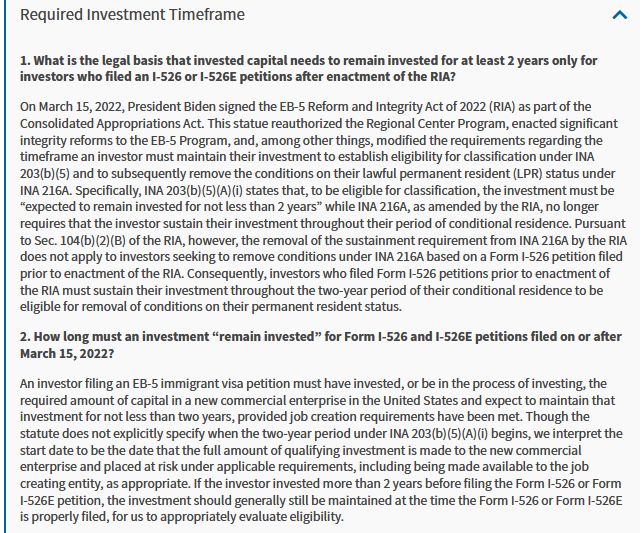
To briefly review the issues and history… the IIUSA sustainment lawsuit questions the required period to sustain an EB-5 investment. Does EB-5 require investment to remain deployed at risk throughout the investor’s two-year conditional permanent residency period (CPR), or is the minimum two years from the time of investment and until jobs are created? CPR-linked sustainment was the rule prior to the EB-5 Reform and Integrity Act of 2022 (RIA), and IIUSA disputes that RIA changed the rule. When RIA came out in 2022, industry read the law and noticed that RIA edited the sustainment requirement. USCIS responded to the apparent RIA change in 2023 when it posted a website Q&A to explain how USCIS would apply the RIA-revised rule that the minimum investment period starts from the time of investment. The market was excited about the RIA change and USCIS interpretation, which promised to protect investors from investment periods that can become unpredictably long when linked to immigration milestones. Over $6.1 billion in EB-5 investment was raised from 2022 to 2024 (judging by data showing 6,160 post-RIA I-526 and I-526E filed) from investors relying on the RIA change. But IIUSA sued in 2024, arguing that the RIA never changed the sustainment period, that CPR-linked sustainment has always been and remains the controlling regulation until properly modified, and USCIS can’t just make new rules on its website but needs to do notice-and-comment rulemaking if we’re going to get a different sustainment rule.

IIUSA’s statements explain why IIUSA filed the sustainment lawsuit. The goal is to get a new rule from USCIS through proper procedure – a good new sustainment rule that will be fair to everyone, and more manageable than the two-year minimum apparently defined by RIA. The IIUSA plaintiffs most definitely aren’t suing for the sake of keeping the already-pocketed $6.1+ billion for years longer than anticipated.

AIIA’s statements explain why investors are so outraged at the sustainment lawsuit. If the lawsuit succeeds in overturning the USCIS interpretation of the RIA change, the immediate result could be to restore the bad old days of having to stay invested throughout conditional permanent residence, however long CPR may be delayed by slow processing and visa backlogs. IIUSA’s stated goal to eventually arrive at a new and better sustainment policy via notice-and-comment rulemaking is not soothing for investors, considering that the USCIS rulemaking process historically takes years, with neither timing nor outcome being predictable.

As an IIUSA member, I’d like to point out that “IIUSA lawsuit” means “a lawsuit promoted by some members under IIUSA’s name, and opposed by some other members.” I also understand that some members have been carried along by the expressed good goals of the litigation, not realizing the practical circumstances that undermine those goals. In case it’s not too late to change a few key minds, let’s remind ourselves of those circumstances.  

  • The apparent Day 1 result of IIUSA litigation success is not a new and fair sustainment rule, but a chance for rulemaking. In other words, the Day 1 result is falling back on the pre-existing sustainment regulation unless and until USCIS promulgates a new sustainment rule.
  • USCIS rulemaking can be expected to take many years, and even then does not reliably produce results that benefit the industry or investors. The most recent EB-5 regulation (EB-5 Modernization) was first promised by USCIS in 2014, published for notice and comment in 2017, finalized in 2019, and vacated in 2021 following industry litigation. As of January 2025, three years after RIA, USCIS has not even proposed any of the three EB-5 regulations that RIA required DHS to prescribe – not even the one for which RIA stipulated a 270-day deadline. If USCIS can’t even make a timely EB-5 regulation when so ordered by Congress, what can we expect now from rulemaking on sustainment? Is the market likely believe in a good new rule coming soon?
  • Backlogs and visa wait times are already a threat to post-RIA investors, and promise immigration wait times far longer, for many new investors, than the sustainment periods IIUSA considers fair. For example, 3,995 high unemployment investors (i.e. about 8,000+ future visa applicants) were already in process as of July 2024, while high unemployment visa supply is only 2,200 visas this year and 1,000 in future years. Until now, we’ve been able to reassure prospective investors that at least visa delay is just visa delay, but not impacting the investment timeline. The sustainment lawsuit could cancel that anodyne, and double the pain of looming visa waits by linking repayment waits.
  • Over $6.1 billion was invested from 2022 to 2024, under the now-challenged USCIS sustainment policy.

Who wants to try to recruit or advise prospective EB-5 investors with this unattractive message: “Sorry but we can’t tell when you may be able to get your money back – it doesn’t depend on when your project creates jobs or repays the issuer. The required sustainment period as of today depends on your immigration process timing. If you fear that your visa could be delayed seven years, that means also having to fear repayment in a minimum of nine years, because existing rules require sustainment through conditional residence. Your funds may need to be redeployed in future projects that you don’t choose. We’re trying to advocate for a reasonable minimum five-year sustainment period insulated from immigration delay, but that’s a goal and not the existing rule that applies now.”

And who wants to manage revolt among existing post-RIA investors who perceive their exit strategies sued out from under them by IIUSA? Who wants to have to explain: sorry, I know you agreed to invest in a four-year project, but I’ll have to hold your money for longer than that if your immigration process takes longer. Who wants IIUSA’s reputation to drip with the appearance of having facilitated a bait-and-switch implicating $6.1+ billion dollars already raised since RIA?

For everyone who wants to avoid such disastrous outcomes, is there any way to influence the Joint Status Report due by February 27? The goal: don’t let the litigation outcome be to apply the legacy conditional-permanent residence sustainment rule to all post-RIA investors pending new rulemaking. Because otherwise, IIUSA and investors will find themselves in the same kind of disaster: having to wait for what they want (a livable new regulation, or chance for investment exit) for as long as it can take for the government to act (whether on new sustainment rulemaking, or to get and allocate enough visas). Otherwise, no one will win except for those few who don’t care about EB-5 program integrity or future, but just laughing all the way to the bank over extending control over billions of banked post-RIA funds, looking forward to cashing in on visa backlogs and slow USCIS rulemaking to help keep that money beyond expected timelines.

What happens to investors after regional center termination (interpreting subsection (M) investor protections)

USCIS is in process of terminating many regional center designations for “purely administrative non-compliance” – meaning that the regional center didn’t do anything actively wrong, but left administrative steps undone. The most common scenario is a regional center that has not and does not intend to raise new EB-5 investment under the new law, and therefore has not paid the annual Integrity Fee required under the new law. (Also possible: a piece of paperwork was missed accidentally either by the regional center or USCIS in the confusion of a new RIA procedures. At this point USCIS is just sending Notices of Intent to Terminate, not final terminations yet, giving opportunity for clarification.)

USCIS understands that regional centers may not want or need to stay in business forever, and has attempted to set up a system that allows good faith investors to stay eligible for EB-5 benefits even if their regional center sponsor exits the program.

The options, process, and conditions for protecting EB-5 investors following regional center termination are described in the law at INA 203(b)(5)(M), elaborated in the USCIS Policy Manual Volume 6 Part G Chapter 3(E) and Chapter 8, and further discussed in multiple sections of the EB-5 Questions and Answers (updated July 2024) on the USCIS website and in “Questions and Answers Updated March 19 2024” posted by the CIS Ombudsman. I painstakingly parsed and sorted this volume of content, and organized it into tidy table format. For others who’d like to be spared this trouble, and have a handy summary for reference and analysis, here is my table “Interpreting Subsection (M) Investor Protections.” The table format helps me to process this complicated and critically important topic, and is designed to facilitate considering: what has been said, and what still needs to be clarified?

Investors face several possible scenarios following regional center termination:

  1. No Action Required: The investor remains eligible for EB-5 benefits, and neither the investor nor the NCE need take any action or make any amendment in response to the regional center termination
  2. Action Required and Allowed: The investor can stay eligible for EB-5 benefits, but only if an amendment is filed and approved
    • Amendment Option A: the investor’s NCE associates with another approved regional center, OR
    • Amendment Option B: the investor makes a qualifying investment in another commercial enterprise
  3. No Action Allowed: The investor has no option to stay eligible for EB-5 benefits (this applies if the investor is considered a knowing participant in the conduct leading to regional center termination)

See my table for detail on each scenario. Generally the first no-action scenario is the ideal – if the investor can simply continue his or her immigration process with no effect from the regional center termination, and no need for any amendments by the investor or the NCE. I’m copying below what USCIS has said so far about the specific conditions under which that no-action path is open to the investor. Note that the conditions are different for pre-RIA and post-RIA investors, and depending on the progress of the project/investment. (Pre-RIA investors rightly get extra protection from terminations resulting from noncompliance with post-RIA requirements. All investors have more protection once having satisfied applicable job creation and sustainment requirements. Investors with project trouble on top of the regional center termination may not only need but welcome amendment options that are not normally allowed under the material change policy.)

Excerpts from USCIS guidance on conditions for maintaining investor eligibility following regional center termination (When are the amendment options under INA 203(b)(5)(M) (“subsection (M)”) required, and when can EB-5 investors stay eligible after regional center termination even without an amendment to the regional center affiliation or investment?)

  • Conditions under which the investor WILL need to make an amendment under subsection (M) following regional center termination — either a new regional center affiliation or new NCE investment:
    • “for both pre- and post-RIA investors, if their regional center is terminated or their new commercial enterprise or job-creating entity is debarred and their capital investment project has failed or will only create less than the requisite number of jobs, they generally will not remain eligible and may use the protections under INA 203(b)(5)(M) to amend their petition to retain eligibility.” (Q#4 in “Retaining Eligibility” at USCIS Q&A)
  • Conditions under which pre-RIA investors in a terminated regional center may remain eligible as-is and NOT need to take action under subsection (M) in order to stay eligible:
    • “where an investor’s capital remains invested and at-risk with their new commercial enterprise and the requisite jobs have been or will be created in accordance with their existing business plan, termination of their associated regional center for failure to pay the EB-5 Integrity Fund fee or for reasons related to a different new commercial enterprise would generally not, by itself, negatively impact the investor’s eligibility.” Policy Manual 3E
    • “In general, pre-RIA investors may remain eligible if their project is complete or will be completed in accordance with the comprehensive business plan, with sufficient job creation for all investors, and the investor’s capital has been and will be sustained through the requisite 2-year sustainment period of their conditional residency.” (Q#4 in “Retaining Eligibility” at USCIS Q&A)
    • “where regional center termination is based on purely administrative noncompliance that does not otherwise directly affect or implicate the underlying investment or job creation, officers may generally determine, in their discretion and on a case-by-case basis, that a pre-RIA investor associated with the terminated regional center continues to be eligible for classification as an immigrant investor, notwithstanding the regional center termination.” (Q#7 in “Regional Centers” at USCIS Q&A) For example “Regional center termination for failure to pay the required EB-5 Integrity Fund fee may generally not have an effect on pre-RIA investor eligibility in many, or even most, circumstances” (Q#3 in “General Implementation” at USCIS Q&A) “The phrase “purely administrative noncompliance” is not intended to be a new termination category, or a term defined by USCIS, but rather a plain language description of the potential circumstances of noncompliance on the part of regional centers that are not typically related to petitioner eligibility (illustrated in the context of failure to pay the EB-5 Integrity Fund fee required by the RIA). USCIS will evaluate the potential impact of noncompliance by regional centers on associated investors on a case-by-case basis.” (Q1 at “Ombuds Q&A”)
  • Conditions under which post-RIA investors in a terminated regional center may remain eligible as-is and NOT need to take action under (M) in order to stay eligible:
    • “In general, post-RIA investors may continue to be eligible if their capital remained invested for at least 2 years after being placed at risk under applicable requirements and satisfied the job creation requirement before termination or debarment.” (Q#4 in “Retaining Eligibility” at USCIS Q&A)
    • “You may continue to be eligible notwithstanding the termination of your regional center where sufficient jobs were already created and your capital was invested for at least 2 years under applicable requirements before the termination of your regional center and subsequent denial or revocation of the associated Form I-956F.” (Q#5 in “Retaining Eligibility” at USCIS Q&A)
  • Conditions under which amendments are NOT allowed, even if desired:
    • “The amendment options in (M) are only available to investors following RC termination or NCE or JCE debarment. Project failure, on its own, is not a basis to retain eligibility under (M). … If you wish to have your NCE reassociate with another regional center or make a qualifying investment in NCE because of a project failure separate from termination or debarment, you must file a new petition for classification based on post-RIA eligibility requirements.”(Q#16 in “Retaining Eligibility at USCIS Q&A)
    • An investor cannot request their regional center to be terminated in order to gain access to the amendment options under (M). However, a regional center may withdraw and request USCIS to terminate its designation.  (Q#14 in “Retaining Eligibility at USCIS Q&A)
    • “Once you have responded within 180 days to the notice and identified that you either remain eligible notwithstanding the termination or debarment or that you are amending your petition based on the reassociation of your new commercial enterprise (NCE) with an approved regional center or you having made a qualifying investment in another NCE, you generally may not further amend your petition in order to retain eligibility on another basis.” (Q#12 in “Retaining Eligibility at USCIS Q&A)
    • “any investor who was a knowing participant in the conduct that led to the termination or debarment may not benefit from section 203(b)(5)(M) of the INA (for example, such would be the case if the petitioner knew of fraud and failed to terminate or report an agent that is engaging in fraud for the EB-5 entity).” (Q#1 in “Retaining Eligibility” at USCIS Q&A)

See my table “Interpreting Subsection (M) Investor Protections” for additional detail on amendment options following regional center termination. I will continue to update the linked document as USCIS releases additional guidance.

Policy Manual Updates (Regional Center Penalties, Good Faith Investor Protections)

USCIS updated the EB-5 section of the USCIS Policy Manual today with substantive new content related to regional center penalties and investor protections. A Policy Alert on EB-5 Regional Center Noncompliance and Sanctions summarizes the update. (UPDATE: USCIS has also added a new section on “Retaining Eligibility” to EB-5 Questions and Answers (updated July 2024) on the EB-5 Resources page.)

Today’s policy update to the USCIS Policy Manual Volume 6 Part G adds a minor resource link to Chapter 2(C), edits terminology in Chapter 4(H)(2) and Chapter 5(E), and inserts major sections of new policy:

  • Special Considerations for Investors Who Filed Their Form I-526 Petitions Before March 15, 2022” in Chapter 3(E) Good Faith Investors Following Program Noncompliance by a Regional Center, New Commercial Enterprise, or Job-Creating Entity
  • Chapter 8 – Sanctions and Discretionary Determinations

I sense the good work of the CIS Ombudsman behind the scenes of this policy update, which is relevant and responsive to live stakeholder questions — not simply regurgitating statue without interpretation or practical application. Regional centers may not be entirely happy with the sanctions policy, but it does go into admirable detail about how USCIS interprets the specific conditions and process for sanctioning Regional Centers, NCEs, and JCEs.  IIUSA has invited members to a webinar on July 18 at 12 ET to discuss the new policy guidance and how to deal with a recent spate of Notices of Intent to Terminate. Thankfully for investors, the pre-RIA investor protection policy newly-added to Chapter 3(E) is even more specific and generous than the interpretations described in the 2023 USCIS website Q&A, rewarding effort by AIIA as well as IIUSA and industry groups to convey investor questions and concerns through the Ombudsman. I will write in more detail about both policies. In the meantime, I am sharing my folder of all EB-5 Policy Manual iterations, and a redline version that I made using Word document comparison to show changes between today’s July 16, 2024 EB-5 policy and the previous version published October 26, 2023.

EB-5 Investment Flow Chart and Comparison of Timeframes (investor, project, and USCIS timeframes), with questions for post-RIA investors

How long do EB-5 funds stay invested? I’ve approached this hot question from several angles, including a previous blog post on the intersection between immigration timing and investment timing, and a webinar with CanAm and Robert Divine about the sustainment period (CanAm’s write-up available here). Now I will try to clarify a factor behind some confusion in sustainment discussions: the fact that an EB-5 investment involves multiple layers and multiple timeframes, each subject to different terms and different USCIS requirements. This post defines the investment timeframes and applicable requirements for post-RIA EB-5 investors (people starting the EB-5 process after March 2022), and suggests questions for potential investors to ask about investment exit timing.

EB-5 Investment Flow Chart

A regional center investment involves at least two deals: one between the EB-5 investor and the new commercial enterprise (NCE) and one between the NCE and a job-creating entity (JCE) that deploys EB-5 capital in a project.

Typical EB-5 process steps (illustrated in the EB-5 Investment Flow Chart below)

  1. EB-5 investor capital deposited in the NCE account
  2. NCE uses EB-5 capital to fund a loan or make an equity investment in the JCE
  3. The JCE spends capital in a project to cover project costs
  4. The JCE repays loan or equity to the NCE (Optional: 4.1-4.2 The NCE reinvests EB-5 capital, if necessary for sustainment, and gets repaid)
  5. EB-5 investor exit from the NCE

When discussing the EB-5 investment timeframe, often the investor assumes that we’re talking about the time from step 1 to step 5 – from the date he invests his money to the date he realizes a return. But when a regional center says “it’s a five-year deal,” this usually refers to the time from step 2 to step 4 – from the date the regional center issuer invests EB-5 capital to the date the issuer expects to be repaid. Meanwhile, when USCIS speaks of the 2+ year minimum “required investment timeframe” for sustainment, it is focused on the interval between step 3 and step 4 – starting from the date that an investor’s EB-5 capital is actually deployed in a project through the period that the capital remains deployed at risk.

Note: the “start date” for a USCIS-defined at-risk investment is later than the date of an investor’s deposit in the NCE account, while the investor’s repayment by the NCE is later than the NCE’s exit from a project. It might be only very little later, as when the NCE immediately transfers investor capital to the JCE, which immediately spends the money in a project, and the NCE goes on to repay the investor immediately after the JCE repays the NCE. However, Timeframe 1-to-5 could also end up years longer than Timeframe 2-to-4 or 3-to-4. If the project development process is lengthy or delayed, an individual investor’s funds might not be used until months or years after the date of the investment deposit. The deal between the EB-5 investor and NCE might have an exit significantly later than the NCE’s exit from its investment in the JCE, particularly in the past when immigration delay forced redeployment. With the large potential differences between investor, project, and USCIS timeframes for investment, it’s important to be clear about the different timeframes and to know which requirements and considerations apply to each.

Timeframe 1-to-5: Timeframe of the EB-5 investor’s investment in the NCE

The timeframe of the EB-5 investor’s investment in the NCE starts when an EB-5 investor deposits $800,000 or $1.05 million in the NCE and ends when the NCE repays/provides an exit the EB-5 investor according to the terms of the NCE offering.

The timeframe of the EB-5 investor-NCE deal CANNOT be guaranteed, per EB-5 rules. To quote precedent decision Matter of Izummi: “For the alien’s money truly to be at risk, the alien cannot enter into a partnership knowing that he already has a willing buyer in a certain number of years.”  The USCIS Policy Manual at USCIS PM 6(G)2 explains that post-RIA capital does NOT count as invested capital if it is “subject to any agreement between the investor and the new commercial enterprise that provides the investor with a contractual right to repayment, such as a mandatory redemption at a certain time or upon the occurrence of a certain event, or a put or sell-back option held by the investor, even if such contractual right is contingent on the success of the new commercial enterprise, such as having sufficient available cash flow.” (See the Policy Manual for discussion of the limited redemption language allowable in the EB-5 investor-NCE agreement.)

USCIS rules give no ceiling to how long the NCE can hold EB-5 money, but they do define some minimums. USCIS rules for post-RIA investors specify that the EB-5 investor’s exit from the NCE can only be after job creation, after I-526 filing, and after the investment has been sustained “at risk” (i.e. deployed, not just in a bank account) for at least two years. For pre-RIA investors, the EB-5 investor exit must be at least after the investor has completed the two-year conditional permanent residence period.

One regional center offering has multiple investors, each with his or her own investment deposit date (which could be months or years apart). Therefore, a variety of individual investor timeframes will overlap the project timeframe and NCE-JCE deal timeframe in different ways. The NCE offering may or may not anticipate treating EB-5 investors as a group when deploying or repaying capital, despite the investors’ different start dates.

Timeframe 2-to-4: Timeframe of the NCE’s investment in the JCE

The timeframe of the NCE’s investment in the JCE starts when the NCE uses EB-5 capital to fund a loan or equity investment in the JCE and ends when the JCE repays/provides an exit to the NCE.

The duration of the NCE-JCE deal timeframe CAN be specified. USCIS rules allow the NCE-JCE deal to be a debt arrangement with a set term. Unlike the EB-5 investor-NCE agreement, the NCE-JCE agreement can have relatively firm redemption language.  The EB-5 investor must look to the NCE’s investment horizon as reference for her own potential timeframe for exit.

The NCE’s investment in the JCE may be funded over time and can have a start date that pre-dates or post-dates the subscription of Investor X in the NCE. The prospective EB-5 investor should keep in mind that sales statements like “it’s a five-year deal” do not refer to directly to her prospective timeframe, but to the in-progress or future term of the deal between the NCE and JCE.

It can happen that a JCE repays the NCE early, before all EB-5 investors have finished their immigration-required minimum investment periods. In case of such timeframe mismatch, the solution is redeployment. EB-5 investors can still meet requirements so long as the NCE reinvests their funds in another project until the immigration-required sustainment period has been fulfilled (see USCIS PM 6(G)2).

It can happen that EB-5 investment reaches the JCE late, after the JCE has already finished spending money and creating jobs. Bridge financing provides a limited solution for project-investor timeframe mismatch. An EB-5 investor can potentially claim credit for contributing to a completed project and job creation, provided her investment is replacing qualifying bridge financing (see USCIS PM 6(G)2), and USCIS training materials on bridge financing). However, the most straightforward case for EB-5 credit is based on sequential timeline:  EB-5 capital enters the JCE followed by job-creating activity.

Timeframe 3-to-4: USCIS-required Sustainment Timeframe

For post-RIA investors, the USCIS-required sustainment timeframe starts when the investor’s full $800,000 or $1.05 million is “placed at risk” and ends a minimum of two years later.

To quote the USCIS Q&A on “Required Investment Timeframe” for post-RIA investors: “INA 203(b)(5)(A)(i) states that, to be eligible for classification, the investment must be ‘expected to remain invested for not less than 2 years’” and “For purposes of determining the date when the two-year period required by INA 203(b)(5)(A)(i) begins, we will generally use the date that the requisite amount of qualifying investment is made to the new commercial enterprise and placed at risk under applicable requirements, including being made available to the job creating entity, as appropriate.”

“Placed at risk” is a defined term in EB-5. An investment counts as “at risk” once these conditions have been satisfied: the full amount of investment is made available to the job-creating entity (not just sitting in a bank account, but in use), the JCE has business activity, and the investor has a risk of loss and chance for gain with no guaranteed return (see USCIS PM 6(G)2). For examples of cases where EB-5 investor funds were deposited in the NCE, but did not count as “at risk” because not fully deployed to the JCE, see the precedent decisions Matter of Izummi and Matter of Ho and non-precedent decisions such as APR052018_05B7203, APR022018_01K1610, JAN222021_04B7203, MAR032021_01B7203, and FEB242022_01B7203.

The start date for “at risk investment” could be interpreted as the date that the investor’s full $800,000 or $1.05 million is transferred from the NCE account to the JCE account. More conservatively, it could be interpreted as the date on which the JCE finishes spending EB-5 investor money, since that’s the date by which the investment has unambiguously been fully “made available to the job creating entity.”

As discussed above, the USCIS-required sustainment timeframe has a start date equal to or later than the date of the NCE’s investment in the JCE, which in turn is more or less later than the date of the EB-5 investor’s investment in the NCE. The investor ideally wants to seek an offering with an NCE-JCE deal slated to end comfortably more than two years later than the latest date the her invested capital could be deployed in the JCE. If the JCE repays the NCE earlier, then the investor will have to see her funds redeployed by the NCE in order to meet the 2+ year requirement. If the JCE repays later than the USCIS-required minimum investment period, there are no immigration consequences for the investor.   

Conclusion: Questions for Prospective EB-5 Investors to Ask

  1. When will the job-creating project start and finish spending EB-5 money?
    1. Why to ask: The USCIS-required investment timeframe is indexed to when EB-5 money is deployed at risk, not just when it’s sitting in a bank account. The start date for the minimum two-year sustainment period is not the date of EB-5 investment, but the date that EB-5 money is made fully available to the job-creating entity.
    1. Where to look for the answer: business plan schedule and budget.
  2. When will my investment be released from the NCE to the JCE? What triggers the release?
    1. Why to ask: The start date for the minimum two-year sustainment period is not the date of EB-5 investment, but the date that EB-5 money is made fully available to the job-creating entity.
    1. Where to look for the answer: PPM and any fund administration documents.
  3. Will the NCE release my funds to the JCE before the JCE finishes project expenditures and before the JCE creates jobs?  If not, is there a good story for why my investment should get credit for funding job-creating activity?
    1. Why to ask: To qualify, EB-5 investment must form a nexus with job creation. If investor money comes in after a project is already complete, then the investor faces additional hurdles to argue that the funds are still “at risk” and made available for job creation.
    1. Where to look for the answer: Consult the business plan schedule and PPM to determine if your investment can come in before the project is completed and jobs are created. If not, have your lawyer scrutinize bridge financing documentation to ensure that the investment can still comply with EB-5 rules.
  4. When will the project be economically able to support a capital event (e.g. loan refinance or profitable sale).
    1. Why to ask: EB-5 investment is a real investment, and the planned exit strategy is only as good as the economics behind it. A three-year loan term between NCE and JCE is plausible only if the project is likely to be positioned in three years to allow refinancing or paying off the loan. If investor repayment depends on selling the project, then timing practically depends on when project value could plausibly support a profitable sale. Different types of projects require different holding periods; for example the average years-to-exit for a large-scale real estate development is naturally longer than for the average energy project. Industry averages and common sense can help apply a reality check to issuer promises, and help investors to consider the investment horizon that’s reasonable and to-be-expected for the type of project they want to invest in. If a deal promises an exit at a certain date regardless of project economics, be suspicious of whether this is a real investment or a reliable promise.
    1. Where to look for the answer: business plan schedule, financial projections, market analysis, appraisal report, and Google.
  5. What position does EB-5 have in the project capital stack?
    1. Why to ask: EB-5 is generally just one of several sources in a project capital stack. Each source has a different position and priority when it comes to repayment. The likelihood of exit sooner rather than later for the NCE’s investment depends in part on the NCE’s level of seniority in the JCE capital stack.    
    1. Where to look for the answer: business plan and PPM.
  6. Is my exit from the NCE contingent on any milestones in my immigration process (e.g. only after receiving a visa, only after I-829 filing, etc.)?
    1. Why to ask: In the past, EB-5 offerings conditioned investor exit on completing the conditional permanent residence period, based on sustainment rules for pre-RIA investors. But USCIS does NOT require sustainment through the CPR period for post-RIA investors. Investors today need not accept an offering that still explicitly links investment exit timing to the risk of immigration process delay. According to USCIS, the sustainment requirement for post-RIA investors is linked to project milestones (using the capital, creating jobs), not to immigration milestones.
    1. Where to look for the answer: PPM or other document describing the terms of the deal between investor and NCE.
  7. Is my exit from the NCE contingent on the exit timing of other NCE investors?
    1. Why to ask: You are looking for assurance that your exit timing won’t be delayed by another EB-5 investor with a much later timeframe than yours. That assurance could come if the offering allows for individual exits and/or if the span of individual investor timeframes is not large.
    1. Where to look for the answer: PPM or other document describing the terms of the deal between investor and NCE.
  8. Is the timing of my exit from the NCE guaranteed?
    1. Why to ask: If the timing of EB-5 investor exit from the NCE is guaranteed in advance, then the investment likely does not qualify as “at risk” according to USCIS requirements, and USCIS will deny the case. 
    1. Where to look for the answer: If there is an I-956F approval, then USCIS should already have judged the offering redemption language to be acceptable. Otherwise, ask your EB-5-experienced immigration lawyer to review the documents to ensure that the terms of the deal between investor and NCE comply with requirements.

2+ years from when? EB-5 sustainment period in context

This week I’m excited to participate in a webinar designed to shine light from multiple directions on the hot button issue of the required EB-5 investment timeframe. The webinar features top EB-5 lawyer Robert Divine, who first noticed and wrote about how the EB-5 Reform and Integrity Act changed the EB-5 sustainment period (interpretations reinforced by the USCIS Q&A but then challenged by the IIUSA lawsuit). The webinar is hosted by venerable regional center operator CanAm, which has a long-standing leadership role in the industry and IIUSA, and has shepherded thousands of investors through the EB-5 process. I’ll be there, as someone who gets heated-up about sustainment as a business plan writer, advocate for EB-5 timing issues, and member of both IIUSA and the investor organization AIIA. Will we have a big fight? Tune in on Thursday May 2 at 1 E.T. to find out! [Update: webinar recording here.]

I think the audience will benefit from a panel coming together with different perspectives, but on the common ground of mutual respect, long experience navigating industry complications, and a common objective of clarity (not an advertising agenda disguised as analysis). The webinar is titled “Putting the 2 Year Sustainment Requirement into Context: What questions should investors be asking?” The idea isn’t to get theoretical about the IIUSA lawsuit or to argue about what policy should be, but to look closely and practically at the policy in place today. We’ll discuss the USCIS Q&A on required investment timeframe, what it says, and how to understand it in context of immigration requirements and investment/project practice. “For how long can/must/will the issuer hold EB-5 money?” What a basic and critical question, and yet with so much confusion, controversy, and self-interested messaging around it. We hope that Thursday’s webinar can help add some clarity and nuance, and empower investors to ask good questions about EB-5 offerings. 

I hear people talking about “two years” or “five years” or “seven years” in isolation, as if EB-5 were a direct payment program where immigrants get a green card in exchange for letting someone hold money for a fixed period of time.  But EB-5 is not that kind of program; instead, it awards green cards based on at-risk investment that creates jobs. The EB-5 investment holding period requirement exists in context of those defining features of at-risk investment and job creation, not in isolation. This insight has major practical results. For example, working within the ”at risk” requirement means that “Day 1” of the required 2-year minimum investment period is not the date of EB-5 investment in the NCE, and the EB-5 investor’s exit date cannot be guaranteed upfront at given number of years. We’ll talk about the factors that do define the sustainment start and end dates, according to current USCIS policy and practical reality, and how to assess those dates in a particular offering.

The trouble with the EB-5 sustainment timeline (comment on IIUSA lawsuit and proposed rule, EB-5 process table)

Last week IIUSA sued USCIS over Q&A that interpret the two-year minimum investment sustainment period, disputing that the EB5 Reform and Integrity Act of 2022 (“RIA”) actually changed the EB-5 sustainment requirement. Concurrently, IIUSA petitioned USCIS for rulemaking to write a minimum five-year investment holding period into the EB-5 regulations.  This move is potentially extremely consequential for the program and for investors, and also problematic. My comment brings a perspective from EB-5 process timing.

The IIUSA litigation complaint explains why regional centers would seek government support for holding on to EB-5 funds for a minimum of five years:

97. As explained above, USCIS has long required investors to sustain their investment “over the two years of conditional residence.” 8 C.F.R. § 216.6(c)(1)(iii). This longstanding rule has incentivized regional centers to invest in high-quality projects that are more likely to generate return for investors, create the necessary number of jobs, and deliver benefits to the community at large. The practical reality is that these large-scale projects require longer investment periods, and as such the industry standard investment term for regional center-backed projects has typically been at least five years, and often longer.

The court might ask in response to this allegation: Why has the industry standard investment term “typically been at least five years, and often longer,” considering that the law and regulations have only ever name-checked “two years” when discussing the EB-5 sustainment period?

In practice, long holding periods have depended on USCIS capacity problems and visa oversubscription to insert delays in the EB-5 process around conditional permanent residence.  The CPR period is the only EB-5 immigration process stage with a firm time attached (two years); all other stages in the process can be very short or extremely long depending on agency processing capacity and workflow and visa availability. The expected EB-5 investment period can vary wildly depending on processing delay plus whether/how the investment period is contingent on immigration milestones.

EB-5 Process Stage1. Time from I-526 or I-526E petition filing to petition approval2. Wait time for visa number3. Time from I-526 or I-526E approval  or visa availability  to visa issuance4. Conditional Permanent Residence5. Time from I-829 filing to removal of conditions for permanent green card
How long is it supposed to take?<120 days for TEA or <240 days for non-TEA (target I-526 processing time set by RIA)No visa wait time so long as EB-5 usage keeps within visa supply limitsVaries depending on USCIS and DOS workload and staffingExactly 2 years by definition from admission under the EB-5 visa, with I-829 filed in the last 90 days of the period.<90 days (target I-829 processing time set by 8 U.S.C. 1186b (c)(3)(A)(ii))
How long can it take?USCIS reports median I-526 process times since 2019 of 19 to 52 months (Total time is determined by USCIS workload and staffing. Adjudication touch time per I-526 is 20.69 hours per USCIS completion rates)Visa wait time can be extremely long (10+ years), in the proportion that EB-5 applicants exceed annual visa supply.Historically around 6 months if no delay; can extend to  years in case of processing constraints.Exactly 2 years by definition from admission under the EB-5 visa, with I-829 filed in the last 90 days of the period.USCIS reports median I-829 process times since 2019 of 26 to 49 months (Total time is determined by USCIS workload staffing. Adjudication touch time per I-829 is 15.86 hours per USCIS completion rates)

If the EB-5 process functioned as Congress intended, then the EB-5 investor could complete the immigration process within three years of the time of investment. People are so used to delay that they forget to do the math. Congress set a goal of 120-240 days for the I-526E processing (per the RIA Timely Processing targets, now in 8 U.S.C. 1153 note). After I-526E approval, the investor applies for the visa that initiates a two-year conditional residence period. (This period was set at two years by the Immigration Act of 1990 “to deter immigration-related entrepreneurship fraud”). The visa application is delayed by nothing but USCIS/DOS capacity to move paperwork, schedule interviews, and approve adjustments, unless excess visa number demand forces visa number waits. After 21 months of conditional permanent residence, the investor can file I-829 to remove conditions. I-829 processing is supposed to take about 90 days (2020 Final Fee Rule: “DHS acknowledges its obligation to adjudicate Form I-829 filings within 90 days of the filing date or interview, whichever is later. See INA section 216(c)(3)(A)(ii), 8 U.S.C. 1186b (c)(3)(A)(ii).”) or at any rate <240 days according to the RIA Timely Processing target. So much for government intent.

Investors take longer than three years to complete the EB-5 immigration process if and when (1) processing delays occur and/or (2) EB-5 gets oversold resulting in lengthy wait times for visa numbers. Both problems have been endemic for years, such that actual immigration times have predictably exceeded five or even ten years for many EB-5 investors as noted above. That doesn’t make the immigration delay situation normal or a right, however.

Part of the outrage over the IIUSA lawsuit comes from tacit admission that the plaintiff regional centers rely on the lengthy investment holding periods underwritten by immigration delays, and fighting to keep immigration support for such economically-advantageous holding periods. If established business models rely on an immigration process lasting much longer than two years, then they depend on USCIS processing problems and visa EB-5 oversubscription. That’s the sad fact, given process facts as outlined above. What gives?  Will IIUSA sue USCIS for the progress it’s recently made toward realizing the RIA timely processing goals, because accomplishing timely processing could undermine projects that need to hold EB-5 money for much longer than the 3-year delay-free immigration process? Will IIUSA sue USCIS to conceal I-526E filing data, because such data helps avoid the visa oversubscription that can profitably inflate wait times? Will IIUSA advocate against visa relief, because lack of visa wait times would undercut profitably-long holding periods? Of course IIUSA would not consider such steps. But then why try to force lengthy holding periods specifically as an immigration necessity through litigation and rulemaking?

Immigration necessity has never been the only reason for an EB-5 investment decision. The holding period for an EB-5 investment is not simply the minimum period required by USCIS for immigration purposes – however that period may be calculated and defined — but also the time it takes a project to successfully create jobs and support an exit strategy. The promise of a five-year exit strategy is realistically more reliable than the promise of a two-year exit strategy for many types of projects, regardless of the EB-5 context. EB-5 investors have historically been willing to accept the prospect of a five year holding period as reasonable for the types of high-quality projects they want to invest in. Considering what’s practical on the investment side, projects with a two-year duration were likely not common even in the years before EB-5 processing delay. Of the 3,000+ EB-5 investments made since the EB-5 Reform and Integrity Act of 2022, I doubt many were in projects offering a two-year exit strategy, even though such projects have been technically allowable immigration-wise under USCIS interpretation of RIA. Investment holding periods around five years have indeed long been offered by regional centers and accepted by investors as reasonable to the type of investment, regardless of immigration policy.

But the general acceptability of a five-year metric does not make the IIUSA lawsuit right, or the rulemaking likely to succeed. If only a five-year holding period requirement had ever existed in law/policy, then IIUSA might sue USCIS to get it back. But it didn’t; “five years” was only ever an industry tradition. (Seeking an origin for the tradition, all I can find is Canadian government intent for the previously-popular five-year Canadian investor visa program that helped influence early industry expectations for EB-5. I blame Canada.) The only time reference for EB-5 in U.S. law or policy since 1990 was a conditional period defined as two years, though vulnerable to being deferred by processing delays and visa waits. All that IIUSA can sue to get back is a connection between that vulnerability and investor holding periods.

If the IIUSA lawsuit can convince a judge that USCIS invented its Q&A guidance, and that RIA didn’t actually decouple the required two-year EB-5 investment period from the two years of conditional permanent residence, the immediate result would be a return to holding periods indexed to however long it takes to get a visa number and start conditional permanent residence. Such a position could kill the future EB-5 market by reviving the nightmare prospect of redeployment. It could also betray the 3,000+ EB-5 investors who committed to the EB-5 program since the EB-5 Reform and Integrity Act of 2022, investing in reliance both on (1) the holding period specified in the offering, and (2) on the RIA law change, and USCIS confirmation of a minimum holding period not conditioned on immigration delay to conditional permanent residence. Why does industry wait to bring in nearly $3 billion dollars from post-RIA investors (incidentally creating the conditions for visa wait delay), then ask a court to pull the rug out from under the law/guidance that helped attract that investment, and that would protect from immigration delay?

In its statement for the public, IIUSA emphasizes that “Importantly, the purpose of this lawsuit is not to return to the previous sustainment policy that required many EB-5 investors to redeploy their capital for extended periods.” That’s good.  However, the IIUSA lawsuit does argue for the previous policy of sustainment through CPR (see for example points 20, 100, 102, and 105 in the complaint). The IIUSA strategy depends on a two-step play to (1) convince a judge that RIA did not actually change the sustainment rules, but also separately (2) convince USCIS to itself change the sustainment rules via formal notice and comment rulemaking. IIUSA suggests to USCIS a fair-looking rule that would delete the CPR link (restoring the generally likeable change that RIA arguably made) while also introducing a 5-year minimum time (thus finally aligning USCIS policy with long-standing industry tradition).

Unfortunately the IIUSA strategy could only deliver on IIUSA intent to avoid previous sustainment policy if the lawsuit fails, or if the USCIS rulemaking process is short and reliable. If the lawsuit wins and rulemaking is slow and unreliable as usual, we’ll be stuck with the old policy IIUSA doesn’t want. For historical context, here’s the timeline of the last EB-5 regulation (EB-5 Modernization): USCIS announced that it was working on an EB-5 rule in 2014 and informally invited stakeholder comments, published the draft rule in the Federal Register as a Notice of Proposed Rulemaking in 2017, accepted public comments in 2017, published a Final Rule in 2019, and vacated the rule in 2021 following industry success in suing USCIS over the rule’s unfavorable content. The USCIS rulemaking process can be shorter than this, but I wonder if anyone can point to an example that took months not years. I also note that the public already provided extensive feedback to USCIS on the sustainment period following invitations to submit comments and questions for USCIS stakeholder meetings and the Ombudsman EB-5 meetings in 2023.

I suggest that plaintiff regional centers should have adopted a less perilous and tenuous strategy: education. If your projects practically need a five-year or longer holding period, then explain that to prospective EB-5 investors in economic terms, just as you’d explain to any investor. Show prospects how your offering is a better/more reliable/more profitable investment opportunity than the other guy who’s offering a shorter term, even if a shorter term is technically allowable under immigration rules. Remind investors that existing and long-standing USCIS guidance puts only a floor but no ceiling to EB-5 investment terms. The USCIS Q&A clearly says: “The INA establishes only minimum required investment timeframes for purposes of applicable eligibility requirements and does not place any upward limit on how long an investor’s capital may be retained before being returned. Regional centers or their associated new commercial enterprises can negotiate longer periods of investment directly with their investors independently of EB-5 eligibility requirements.” Point out that for investment and immigration purposes, the investment term naturally can be and must be as long as it needs to be to economically support required job creation and an exit. The economically-necessary term can plausibly be 5+ years for some if not most excellent projects, even as any promises of near-term exit strategies naturally merit extra scrutiny from investors.

What’s wrong is the attempt to claim or create an immigration necessity for lengthy investment holding periods, and try to force investor decisions in favor of long-term projects by saying that this isn’t just the economic case but what Congress and USCIS actually require for your visa. Such claims flounder for basis, reflect a shameful reliance on processing/visa delay, provoke investor outrage, and hurt the market. Program integrity will particularly suffer if the lawsuit is seen to betray the 3,000+ post-RIA investors who already committed to EB-5 before the lawsuit was filed to challenge USCIS interpretation of RIA, and now thrown into uncertainty and unforeseen exposure to visa-delay-induced redeployment risks beyond their initial agreed investment term. I am willing to believe that IIUSA leadership intended no such outcome, but what can be done to avoid it now that the lawsuit has been filed?  

Analysis of USCIS Fee Schedule Final Rule and EB-5 fee increases

Today the Federal Register published a Final Rule for USCIS filing fee changes scheduled to take effect on April 1, 2024.

The Final Rule includes major increases to EB-5 form filing fees, which is a near-term gift for EB-5 marketing (“Hurry! File now before the fees go up!”), a challenge for service providers (as we try to accommodate the feast of applicants rushing to beat the fee increase and to plan for the subsequent famine), and a long-term benefit to USCIS coffers and burden on EB-5 users (to the extent that EB-5 forms still get filed under the disincentive of increased fees on top of insufficient EB-5 visa availability).

The new EB-5 fees will take effect from April 1 unless or until blocked by litigation or superseded by another EB-5 fee rule. Litigation successfully cancelled the last USCIS fee increase attempt in 2019/2020; I don’t know about litigation prospects this time. DHS is separately working on a different fee study for EB-5 that was mandated by the EB-5 Reform and Integrity Act and due by March 2023. The RIA-mandated study will eventually result in different EB-5 fees designed to support timely processing, but “that effort is still in its early stages” according to the Final Rule. DHS explains that “the provisions of the law are not effective until DHS takes the steps it requires to be implemented.” We fans of Yes Minister know how to interpret the Final Rule statement that DHS has so far “initiated a working group to begin drafting the rule” required to support timely EB-5 processing.

The EB-5 fee increases in the Final Rule are identical to those proposed last year in the Notice of Proposed Rulemaking (NPRM). Good old DHS listened to the chorus of public criticism on the NPRM and accepted some of our corrections – including on the key variable of EB-5 filing volume – but did not recalculate the EB-5 fees in the Final Rule. Multiplying projected annual receipts by filing fee, we can see that the NPRM anticipated generating $80.7 million in EB-5 fee revenue, while the Final Rule projects $139.7 million in EB-5 fee revenue. DHS initially calculated high EB-5 fees based on the need to spread costs across projected low fee-paying receipt volume, then realized receipt volume could actually be much greater, but still decided to keep the high fees.

Summary of EB-5 filing fee changes

FormFiling fee since 2016Proposed filing fee in NPRMProjected annual receipts in NPRMProjected annual receipts in final Fee RuleNew filing fee effective 4/1/2024, per Final Rule
I-526/I-526E$3,675$11,1603,9004,050$11,160
I-829$3,750$9,5253,2504,500$9,525
I-956$17,795$47,69562400$47,695
I-956F$17,795$47,695 600$47,695
I-956G$3,035$4,470728875$4,470
I-956H00 2,0000
I-956K00 5000
Total or Weighted Avg. $10,1637,94012,925$10,806

Here is the formula that DHS uses to calculate filing fees according to its “full cost recovery model,” and how the inputs changed for EB-5 between the NPRM and Final Rule.  (For detail, see my exhaustive article for IIUSA on the NPRM fee-setting methodology.)

 Fee Setting FormulaDifference in inputs and results between NPRM and Final Rule for EB-5 forms
ACost Baseline: “the resources necessary for individual USCIS offices to sustain operations and deliver services.”No change indicated (NPRM reported this amount as $59.4M)
B“Average Annual Projected Workload Receipts”Increased in Final Rule
C=A/BFee per receipt required for cost recoveryDecreased in Final Rule
D“Cost Reallocation”: Additional fee “to provide services for which USCIS does not receive revenue”Increased, apparently
E=C+DFiling fee per receiptNo change

In the Final Rule, DHS increased its estimate of EB-5 fee-paying receipts while deciding to keep EB-5 filing fees the same. In other words, DHS apparently decided to increase cost reallocation to itself instead of passing along anticipated economies of scale to the customer. As the Final Rule notes with satisfaction: “Increasing the fee-paying receipt forecasts for these workloads conversely increased the estimated revenue generated by EB-5 fees. DHS also revised the USCIS budget to reflect these changes.” The EB-5 program not only has no cost to the US taxpayer, it actually helps to fund the government with form filing fees calculated to generate millions of dollars to USCIS above the anticipated cost to process EB-5 forms. Table 11 in the Final Rule quantifies cost/benefit impacts, and notes that “Annual transfer payments from EB-5 investors and regional centers to USCIS will be approximately $44,746,040.”

As the Final Rule explains: “Full cost recovery means not only that fee-paying applicants and petitioners must pay their proportionate share of costs, but also that at least some fee-paying applicants and petitioners must pay a share of the immigration adjudication and naturalization services that DHS provides on a fee-exempt, fee-reduced, or fee-waived basis. …Under the ability-to-pay principle, those who are more capable of bearing the burden of fees should pay more for a service than those with less ability to pay. The requirements of immigrant investor program indicate that immigrant investors and regional centers have the ability-to-pay more than most USCIS customers.”

(To be fair the net windfall to USCIS is only theoretical, since actual receipt volume will likely fall far below USCIS estimates. It’s not wise for the government to plan on ongoing fee revenue from 600 new EB-5 projects and more than 4,000 new EB-5 investors per year when it only offers enough visas to accommodate fewer than 2,000 new EB-5 investors per year on average, considering set-aside visa numbers and spouses/children.)

Here is an index with links to content in the Final Rule relevant to EB-5 stakeholders.

EB-5 Questions and Answers (updated by USCIS December 2023)

I just happened to notice that on December 21, USCIS made unannounced additions to the EB-5 Resources page. The section formerly titled EB-5 Questions and Answers (updated Oct. 2023) has been replaced by a different EB-5 Questions and Answers (updated Dec. 2023). A document comparison between the October and December versions shows that USCIS did not edit the previously-published content, but added four new questions and answers related to regional center withdrawals, I-956G and Integrity Fee requirements, investor eligibility following regional center termination, and how the sustainment period change affects the conditional permanent residence requirement.

New Q&A quoted from EB-5 Questions and Answers (updated Dec. 2023)

13. How can an approved regional center that does not wish to continue participation in the Regional Center Program withdraw from the Regional Center Program?  

The EB-5 Reform and Integrity Act of 2022 (RIA) did not change the process for withdrawing from the Regional Center Program and requesting a termination of a regional center designation. When an approved regional center does not want to continue participating in the Regional Center Program for any reason, a regional center may withdraw from the program and request a termination of its regional center designation pursuant to 8 CFR 204.6(m)(6)(vi). The regional center must notify USCIS of its withdrawal in the form of a letter or as otherwise requested by USCIS. Once USCIS receives a termination request is received, we will evaluate the request and notify the regional center of our decision on the termination request in writing.

Regional centers can mail the letter to:

U.S. Citizenship and Immigration Services 
Immigrant Investor Program Office, 
131 M Street, NE, 3rd Floor, Mailstop 2235, 
Washington, DC 20529

Or the regional center can email the letter to: uscis.immigrantinvestorprogram@uscis.dhs.gov

14.  Where can I find information about approved or terminated regional centers and the reasons for termination?

USCIS publishes a list of approved and terminated regional centers on our website. In addition, USCIS publishes termination notices that are final agency actions in the electronic reading room.

USCIS approved regional centers

USCIS terminated regional centers

USCIS regional center termination notices

15. Do all designated Regional Centers, including those approved prior to March 15, 2022, need to file an I-956G by December 29?

Yes, INA 203(b)(5)(G) requires that each designated regional center shall submit an annual statement, in a manner prescribed by the Secretary of Homeland Security. The Secretary has designated the Form I-956G, Regional Center Annual Statement, as the manner to collect this information. The instructions for the Form I-956G implement the statutory requirement and provide that each approved regional center must file Form I-956G for each federal fiscal year (Oct. 1 through Sept. 30) on or before Dec. 29 of the calendar year in which the federal fiscal year ended. It’s important to note that these dates relate to regional center designation. If a regional center is designated but has a pending amendment, they still need to file the Form I-956G. Form I-956G and its filing requirements were published in the Federal Register on Sept. 2, 2022, 87 FR 54233.  Following public notice and comment, Form I-956G was approved by OMB on July 24, 2023, and subsequently published for use by USCIS. USCIS has also mentioned the filing requirements previously at stakeholder engagements as well as via alerts on our website, including most recently at the Oct. 30, 2023, joint engagement with the CIS Ombudsman and the Nov. 6, 2023, alert on the USCIS website.

For regional centers that fail to file Form I-956G by the required filing date, INA 203(b)(5)(G)(iii) states that USCIS shall sanction designated regional centers that do not file the required annual statement (which DHS designated as Form I-956G). In accordance with this statutory directive, USCIS will sanction regional centers who fail to comply with the requirement to file their Form I-956G, up to and including termination from the Regional Center Program.  

3.    Can EB-5 investors continue to pursue their immigrant visa petitions and receive benefits if their regional center is terminated for failure to pay the EB-5 Integrity Fund Fee, provided all other eligibility requirements are met?

Yes, EB-5 investors associated with a terminated regional center may retain eligibility and receive benefits under certain circumstances as provided by INA 203(b)(5)(M).  However, pre-RIA investors and post-RIA investors may need to take different actions to retain their eligibility because of the different requirements and legal provisions that apply to them.

Pre-RIA investors may, in certain situations, remain eligible based on indirect jobs, as applicable to their petition before the RIA was enacted notwithstanding termination of their associated regional center. Accordingly, where regional center termination is based on failure to pay the EB-5 Integrity Fund fee, which would generally not otherwise directly affect or implicate the underlying investment or job creation, officers may generally determine, in their discretion and on a case-by-case basis, that a pre-RIA investor associated with a terminated regional center continues to be eligible for classification as an immigrant investor, despite the regional center termination and without the need to reassociate with another approved regional center or make an investment in another new commercial enterprise. Such determinations will be made in accordance with applicable USCIS policy regarding deference to prior determinations to ensure consistent adjudication. Also, USCIS will generally not consider such termination a material change that impacts continued eligibility. While regional center termination for failure to pay the required EB-5 Integrity Fund fee may generally not have an effect on pre-RIA investor eligibility in many, or even most, circumstances, it is certainly possible that an investor may invest with a regional center that both fails to pay the required EB-5 Integrity Fund fee and also have project-related eligibility concerns, such that petitioner eligibility is affected separate from the regional center’s termination for failure to pay the required EB-5 Integrity Fund fee. If the pre-RIA investor’s eligibility is affected, they may need to reassociate with another approved regional center or make an investment in another new commercial enterprise to retain eligibility under INA 203(b)(5)(M) since they may not continue to be eligible.

Post-RIA investors, however, are not subject to the same grandfathering provisions of the RIA as pre-RIA investors but are subject to the new requirements added by the RIA, such as the requirement under INA 204(a)(1)(H)(ii) to remain associated with an approved project application under INA 203(b)(5)(F) (Form I-956F). Consequently, post-RIA investors associated with a terminated regional center may retain their eligibility under INA 203(b)(5)(M) if:

Their new commercial enterprise reassociates with another approved regional center (regardless of the regional center’s designated geographic area); or

They make a qualifying investment in another new commercial enterprise. In either case, post-RIA investors should generally continue to be associated with an approved Form I-956F (filed by their new regional center for their existing new commercial enterprise or otherwise associated with the different new commercial enterprise into which they have invested) for purposes of remaining eligible under all applicable requirements.

USCIS will notify investors of the termination of their associated regional center, and impacted investors generally have 180 days after USCIS has provided them such notice to amend their petition to meet applicable eligibility requirements.

4.    Is it possible for an immigrant investor who has invested their capital for the requisite time period and created the requisite number of jobs prior to obtaining lawful permanent resident status to become a lawful permanent resident without conditions under INA 216A, effectively skipping the conditional residence period?

No. The RIA did not change the requirement under INA 216A that all EB-5 investors obtain lawful permanent resident status on a conditional basis subject to having those conditions removed by satisfying applicable requirements under INA 216A. All EB-5 investors who obtain conditional permanent resident status subject to INA 216A must file a Form I-829 within the 90-day period immediately before the second anniversary of their adjustment of status or their admission to the United States as a conditional permanent resident to remove their conditions.

CIS Ombudsman EB-5 Engagement (Oct. 30)

In more good news for future EB-5 process improvements, the CIS Ombudsman has focused attention on the EB-5 program. The CIS Ombudsman’s mission is to “assist individuals and employers in resolving problems experienced when seeking immigration benefits from USCIS; identify trends and areas in which individuals and employers have problems dealing with USCIS; and recommend changes in USCIS’ administrative practices to mitigate problems and enhance processes.” Having recently met with IIUSA, AILA, and AIIA about EB-5, the CIS Ombudsman now invites all EB-5 stakeholders to The CIS Ombudsman’s Webinar Series: Engagement with USCIS on the EB-5 Immigrant Investor Program on Monday, October 30, 2023, from 2 to 3 p.m. Eastern Time.

UPDATE: Here is my recording of the CIS Ombusdman webinar, featuring Ombudsman Chief of Staff Gary Merson asking questions of IPO Chief Alissa Emmel. The discussion covered treatment of pre-RIA investors following regional center termination, policy for the investment sustainment period, and a variety of questions and filing tips. The discussion seemed to show that Mr. Merson had listened intelligently to stakeholder concerns, and that Ms. Emmel was making good faith attempt to engage with and not just deflect the questions. The Ombudsman will be publishing remarks and Q&A from the call, and I’ll link those documents here as soon as I see them.

Complete USCIS Policy Manual EB-5 Update

On October 26, 2023, the USCIS Policy Manual EB-5 section (Volume 6 Part G) received its first complete update since the EB-5 Reform and Integrity Act of 2022 (RIA) was enacted 18 months ago. I have been waiting eagerly for RIA changes to be translated into policy, or at least discussed in one place for ease of reference, and welcome the policy manual update.

Until yesterday, the Policy Manual featured a mix of current content (Chapters 1-2, updated in October 2022), and outdated content (Chapters 3-6, not revised since July 2021, before the law change). As of today, the entire USCIS Policy Manual EB-5 section has been brought up to date, with three chapters significantly revised, two all-new chapters added, and one chapter deleted.

Here’s my summary of the changes, together with links to document comparisons that redline differences between the October 26, 2023 version and the previous October 2022/July 2021 versions. (I typically do a document comparison of the whole volume, but compared individual sections in this case because USCIS reorganized the chapters. For reference, here is the folder I keep of all Policy Manual iterations.)

Summary of the October 26, 2023 update to the USCIS Policy Manual Vol. 6 Part G

Chapter 1 Purpose and Background and Chapter 2 Eligibility Requirements

  • These chapters were previously updated on October 7, 2022 in response to RIA, and the October 26, 2023 version is nearly unchanged. (Here for reference is my Chapter 1-2 redline, showing the minor tweaks between the 10/2022 and 10/2023 versions.)

Chapter 3: Immigrant Petition Adjudication

Chapter 4: Regional Center Applications

  • This new chapter has extensive revisions to the previous Chapter 3 on Regional Center Designation. See my redline of changes.

Chapter 5: Project Applications

  • The Project Applications chapter is all-new to the Policy Manual, and covers eligibility, documents and evidence, adjudication, and amendments to I-956F Applications for Approval of an Investment in a Commercial Enterprise. The content has some overlap with Chapter 2 on Eligibility Requirements.

Chapter 6: Direct and Third Party Promoters

  • The Promoters chapter is all-new to the Policy Manual, and rehearses I-956K requirements. (The previous Chapter 6, on the topic of deference, has been deleted from the Policy Manual, but much of its content folded into the I-526 chapter.)

Chapter 7: Removal of Conditions

  • This new chapter has minor revisions to the previous Chapter 5 on I-829 adjudication. See my redline of changes.

I haven’t had time yet to read everything in detail, but I expect to be surprised less by what is there (more quoting the law and forms than interpreting the law, at first glance) than by what isn’t there (which will take some time and thought to identify).

Top things I learned from the October 11, 2023 EB-5 Questions and Answers from USCIS

Since the EB-5 Reform and Integrity Act of 2022 (RIA) was enacted, stakeholders have had urgent open questions about the status and treatment of pre-RIA investors and regional centers, and about how to interpret RIA provisions related to the investment period and redeployment.

In the April 25, 2023 EB-5 stakeholder engagement, IPO Chief Alyssa Emmel said: “While we’re unable to discuss the regional center operations and investment period topics today, please rest assured that USCIS is engaged in ongoing efforts at the immigrant investor program office and across the agency to ensure that when we do have updates, we’re equipped to provide the EB-5 stakeholder community with clear guidance.Now we have a substantial first installment of that promised guidance, with the EB-5 Questions and Answers (updated Oct. 2023), published on the USCIS website on October 11, 2023.

I appreciate that this Q&A engages with stakeholder questions, and dares to provide some interpretation. I can tell that whoever wrote the Q&A read the feedback on regional center operations and investment period sent to USCIS in advance of that April meeting, including from IIUSA and AIIA. And the Q&A sticks its head out to provide specific some guidance, not only giving safe cop-out responses that rephrase what we already know – a brave move, considering that any new interpretation is going to displease someone and probably inspire litigation.

I also appreciate the spirit of the Q&A, which expresses an intent to protect both regional centers and investors from adverse retroactive impacts from the new law. To my welcome surprise, the Q&A seems to be trying to say “we care, and here’s our best effort to be clear, generous, and fair and to avoid harming anyone.” Or to give an actual quote from the Q&A: “After a consideration of reliance interests and potential retroactive impacts, we believe the interpretations and guidance explained above provide flexibility and lessen the burdens on EB-5 entities.” It’s important to account for that spirit and expressed intent as we respond to any interpretations that we find to be unclear, ungenerous, unfair, retroactive, or burdensome in fact.

Here are my top takeaways the Q&A.

  1. Grandfathering: The Q&A suggests that USCIS broadly interprets the investor grandfathering provision in RIA Section 105(c), such that it not only protects future investors from expiring legislation (the literal language of the law), but also protects pre-RIA investors from retroactive impacts of RIA. (The Q&A interprets this to be the spirit of the law with reference to Senator Grassley’s quote: “the bill allows petitions filed by immigrant investors under the old pilot program to continue to be adjudicated under the law as it existed when they were filed.”) I am not sure how far this will apply in practice, but delighted to see the intent by USCIS to be generous and fair with grandfathering for pre-RIA investors.
  2. Good faith investors: USCIS interprets the RIA provision for “treatment of good faith investors following program noncompliance” (INA 203(b)(5)(M)) to apply to pre-RIA investors. This surprises me, and I’m trying to think whether it’s good news.  For investors with regional center or project problems, pre-RIA policy had the disadvantage of no change options for pre-green card investors, but the advantage of protections and flexibility during Conditional Permanent Residence. Subsection M offers change options, but they’re fraught, and subsection M presupposes no protection from CPR status. More analysis to come once I’ve had more chance to consider and discuss this. (See also Robert Divine’s analysis.) One major concession that USCIS already makes in the Q&A, in attempt to make the subsection M recourse more usable, is to change the deadline for investor action following a regional center termination or NCE debarment.
  3. Regional Center Termination Impact: The Q&A expresses USCIS intent to mark out a path to eligibility for pre-RIA investors in terminated regional centers, which is good news for regional centers. In my previous post on the Integrity Fee and I-956G, I concluded that regional centers would be forced into expensive compliance just for the sake of protecting past investors, regardless of their own EB-5 activity or plans. If USCIS does offer investors a viable option to support eligibility apart from regional center sponsorship, then otherwise inactive regional centers face much less pressure. (I say “if,” because so far I’m more sure of the USCIS intent than the practical outcome. But I’m cautiously optimistic.)
  4. Regional Center Termination Likelihood: USCIS expects that “there is a large volume of investors that could be affected by terminations of previously designated regional centers based solely on noncompliance with certain new administrative requirements added by the RIA” considering that “Before March 15, 2022, there were 632 regional centers and as of June 30, 2023, we have received only 357 Form I-956, Application for Regional Center Designation, applications or amendments for previously designated regional centers, and only 250 of previously designated regional centers have paid the Integrity Fund Fee.” So, again, it’s good to hear that “We interpret the RIA in a manner we hope permits good faith investors of terminated regional centers to retain their eligibility.” (Also, I note that USCIS has yet to officially say whether filing I-956 is an administrative requirement for a regional center that wishes to avoid termination.)
  5. Status of Previously-Approved Regional Centers: USCIS states a position that the new RIA provisions and requirements apply equally to all regional centers, regardless of whether the regional center was designated before or after RIA, and regardless of whether the regional center intends to promote new projects for new investors under RIA. This has been the subject much litigation over the past year.
  6. Investment Period: USCIS confirms its interpretation that RIA does change the minimum investment period for post-RIA investors. Instead of being required to sustain their investment throughout the period of conditional permanent residence (the pre-RIA law), investors who filed I-526 or I-526E post-RIA are expected to maintain investment at least two years from the time that investment was made available to the job-creating entity (plus at least until I-526 filing, and at least until the job creation requirement is satisfied). I would’ve expected USCIS to also say that the investment at least needs to be sustained until the I-526 is adjudicated, but no – USCIS agrees that post-RIA investors could theoretically have return of capital even before I-526 approval so long as they met the two-year investment and job creation requirements. As before, the USCIS-required investment period is only a minimum – the Q&A reminds us that USCIS does not control the maximum time that EB-5 investment can be held. Post-RIA investors are also still subject to the redeployment requirement — but decoupling the investment period from unpredictably-long immigration times almost eliminates redeployment risk. The investment period change will have a seismic effect on the industry, and will no doubt be targeted by litigation. (Again, see Robert Divine’s analysis.)
  7. Redeployment: The Q&A focuses on RIA interpretation and does not address other longstanding questions around redeployment for pre-RIA investors, such as whether the “at risk” requirement actually justifies/forces serial investments decoupled from any job creation requirement. The Q&A does convey some sympathy when it recognizes “the burden on the investor to keep their investment in place for an extended period, due to circumstances beyond the investor’s or the NCE’s control, such as visa backlogs or other such circumstances.” The redeployment conversation will continue, drawn by the established reliance by regional centers on redeployment policy and the rebellion by investors against that policy.
  8. Practical questions: The Q&A answers some technical questions and provides filing tips for a number of EB-5 forms. (Robert Divine’s analysis also covers this nicely.)

USCIS posts Q&A addressing many EB-5 questions

Today USCIS published a page of EB-5 Questions and Answers (updated Oct. 2023), with the most extensive guidance to date on USCIS interpretation of the EB-5 Reform and Integrity Act. For historical reference, here are images as the Q&A posted on October 11, 2023, in case the content is subsequently challenged and revised.

USCIS Provides Additional Guidance (sustainment, termination)

UPDATE: This post now copies the version of the USCIS email sent out at 11:30, which seems to be a correction to the email sent at 10:45. This content is also now posted in the USCIS Newsroom.

From: U.S. Citizenship and Immigration Services <uscis@public.govdelivery.com>
Sent: Wednesday, October 11, 2023 11:39 AM
Subject: USCIS Guidance: EB-5 Reform and Integrity Act of 2022

USCIS Guidance: EB-5 Reform and Integrity Act of 2022

On Oct. 11, we issued additional guidance on our interpretation of changes to the EB-5 Immigrant Investor Program in the Immigration and Nationality Act (INA) made by the EB-5 Reform and Integrity Act of 2022 (RIA).

This guidance clarifies the required investment timeframe for EB-5 investors who file Form I-526, Immigrant Petition by Standalone Investor, or Form I-526E, Immigrant Petition by Regional Center Investor, on or after enactment of the RIA (March 15, 2022), as outlined in the RIA. This guidance also clarifies our interpretation of INA 203(b)(5)(M), regarding investors who are associated with a terminated regional center.

Background
On March 15, 2022, President Biden signed the RIA as part of the Consolidated Appropriations Act. Among other things, the RIA modified the required investment timeframes for investors who file petitions for classification Form I-526, Immigrant Petition by Standalone Investor, or Form I-526E, Immigrant Petition by Regional Center Investor, after enactment and to subsequently remove the conditions on their lawful permanent resident status. The RIA also added other provisions to the INA permitting good faith investors to maintain eligibility in the event their regional center is terminated.

For investors seeking to remove conditions on their permanent resident status under INA 216A based on an EB-5 immigrant visa petition filed on or after enactment of the RIA (post-RIA investors), the RIA removed the requirement that the investor must sustain their investment throughout their conditional residence.

The RIA also modified INA 203(b)(5)(A)(i) (the general requirement for classification to invest or be actively in the process of investing the requisite amount of capital in a new commercial enterprise) by adding new language that the investment required by INA 203(b)(5)(A)(i) must be expected to remain invested for at least two years.

Key Points
Because these changes made by the RIA, investors filing petitions for classification after enactment of the RIA no longer need to sustain their investment throughout their conditional residence, which may be many years in the future and dependent on factors outside the investor’s control, such as visa availability.

Instead, the INA now requires only that the investment must be expected to remain invested for at least two years, provided job creation requirements have been met. Although the statute does not explicitly specify when the two-year period under INA 203(b)(5)(A)(i) begins, we interpret the start date as the date the requisite amount of qualifying investment is made and believe this interpretation is consistent with the statutory language. In other words, we will use the date the investment was contributed to the new commercial enterprise and placed at risk in accordance with applicable requirements, including being made available to the job-creating entity. If invested more than two years before filing the I-526 or I-526E petition, the investment should still remain at the time the I-526 or I-526E is properly filed so we can appropriately evaluate eligibility.

Before enactment of the RIA, the termination of a regional center would have been considered a material change to eligibility for investors who had not yet obtained conditional permanent resident status and, consequently, would likely have resulted in denial or revocation of associated investor petitions. The RIA added a new provision at INA 203(b)(5)(M) that permits good faith investors associated with terminated regional centers to retain eligibility in certain circumstances. Because the statute does not explicitly specify whether it applies only to post-RIA investors or also to pre-RIA investors, we are providing guidance on how we interpret this new provision for pre-RIA investors upon regional center termination:

  • We interpret INA 203(b)(5)(M) to apply to pre-RIA investors associated with a terminated regional center (or debarred new commercial enterprise or job-creating entity). However, rather than strictly applying the notification timeframes at INA 203(b)(5)(M)(ii) and (iii)(I), we will extend the deadline for pre-RIA investors to respond to a regional center termination notification until the agency adjudicates their Form I-526 petition. If needed, we may issue a Request for Evidence or Notice of Intent to Deny for the investor to establish continued eligibility.
  • We may use the procedural flexibilities provided under INA 203(b)(5)(M) to extend the response deadline of 180 days for notices of continued eligibility. The extension will decrease the likelihood of operational burdens and expand the intent of the statute to permit good faith investors of terminated regional centers to retain their eligibility.
  • When a regional center is terminated for purely administrative noncompliance, we may determine that the termination would generally not adversely affect a pre-RIA investor’s basic eligibility under INA 203(b)(5) (including the ability to continue to claim indirect jobs), because their investment and resulting job creation would likely remain undisturbed.
  • We may choose not to extend applicable response deadlines when a regional center is terminated for substantive reasons that may affect continued eligibility of their associated investors.

More Information
For more information on the EB-5 Immigrant Investor Program or USCIS, please visit uscis.gov or follow us on Twitter, Instagram, YouTube, Facebook, and LinkedIn.

Integrity Fees and I-956G Annual Report in 2023 (Who really has to file, and why)

10/11/2023 UPDATE: USCIS has now published a Q&A that discusses the impact on investors of regional center termination, beginning with the statement that “Given the large volume of investors that could be affected by terminations of previously designated regional centers based solely on noncompliance with certain new administrative requirements added by the RIA, such as paying the annual Integrity Fund fee, we interpret the RIA in a manner we hope permits good faith investors of terminated regional centers to retain their eligibility.” Please refer to the USCIS Q&A before reading my post, which I will need to revise as time permits.

[ORIGINAL POST]

Since the EB-5 Reform and Integrity Act (RIA) passed in March 2022, there’s been some confusion and dispute about how RIA applies to regional centers and EB-5 investments that pre-date RIA. After all, RIA creates new rules and procedures primarily for capital raising activities. How do these reasonably apply to regional centers with no post-RIA capital raising activities? Do regional centers that were designated and investments made pre-RIA get any different treatment post-RIA?

After a year and half of conflicting notices on the USCIS website, industry comments, litigation, and other bits and pieces of guidance (more on that below), one point has become clear: USCIS expects every regional center without distinction to pay the annual Integrity Fee of $10,000 or $20,000 and to file the I-956G Annual Report. In 2023, every regional center must pay two years of Integrity Fees (for both FY2023 and FY2024) and also file I-956G, or else be terminated in 2024.

If a regional center has no post-RIA project plans anyway, why jump these expensive hoops and why care about termination? But the regional center’s past investors must care. An EB-5 investor’s continued eligibility depends on having a regional center sponsor in good standing throughout the investor’s EB-5 process, however long that process may take. According to INA 203(b)(5)(M), a regional center termination will be followed by denials, revocations, and conditional permanent residence status terminations for all of the regional center’s past investors, unless the investors can manage to affiliate with another regional center. (Separate article coming shortly on this topic.) [UPDATE: the 10/11 USCIS Q&A contradicts this point.]

Here are the instructions, followed by the background of ambiguities and arguments around these requirements.

  • Regional Center Integrity Fee: The latest USCIS “Alert” on Integrity Fee payments, published on September 29, 2023, can be found here: https://www.uscis.gov/IntegrityFund. The Alert acknowledges that “information about the due dates and penalties might not have been clear” but gives another chance for payment with the bold-face warning that “we will take steps to terminate any regional center that, on or before Dec. 30, 2023, has not paid the required EB-5 Integrity Fund fees for FY 2023 and FY 2024. NOTE: We will reject Integrity Fund fee payments for FY 2023 and FY 2024 we receive after Dec. 30, 2023, including those made in response to a Notice of Intent to Terminate.” (To avoid the FY2024 late fee, pay before October 31, 2023.) 
  • Regional Center Annual Report: The latest I-956G annual report form, dated as of July 2023, can be found here https://www.uscis.gov/i-956g. Unlike the initial I-956G edition of July 2022, which asked for reporting specific to post-RIA NCEs (I-956F), the current form explicitly covers pre-RIA activity and NCEs. It asks the regional center to report on “each capital investment project undertaken by such NCE with active EB-5 investors (i.e. those who are seeking classification under INA 203(b)(5) or who have obtained conditional permanent resident status and not yet filed for removal of conditions),” and to provide data not only for recent activity but “over the lifespan of the project.”

In theory, RIA’s new rules should apply prospectively, not retroactively, but it’s complicated. Regional centers with only pre-RIA capital raises are still asked to grapple with Form I-956G and its questions about compliance with new rules for post-RIA capital raises. Regional centers with no new capital raises are still asked to pay $10,000 or $20,000 every year to fund oversight for new capital raises. EB-5 investors who started the process pre-RIA are still dependent on their sponsor’s ongoing eligibility post-RIA.

How did we get here, and what arguments have been made along the way?

Initially, USCIS interpreted RIA as creating a new regional center program and terminating the previous program — meaning a clear break between past and future. Under that interpretation, pre-RIA regional centers were no longer designated and had no grounds to file annual certifications or amendments (according to the April 2022 Q&A on the USCIS website), while pre-RIA investors were protected as a function of the protections around expiring legislation. But Behring Regional Center filed suit to challenge that interpretation, instead fighting for continuity between pre-RIA and post-RIA regional center designation. The litigation ended in August 2022 with a Settlement Agreement in Behring’s favor. The Settlement specified that “previously approved regional centers sponsoring new projects or new investors under the Integrity Act will comply with all the requirements of the Integrity Act” and “if a previously approved regional center fails to file a Form I-956 application or amendment by December 29, 2022, it may no longer engage in any activities under the Integrity Act, including sponsoring I-526E visa petitions or the development of new projects.” Sadly, the Settlement Agreement was silent on the question of what happened to previously approved regional centers NOT sponsoring new projects or new investors under the Integrity Act, but merely needing to stay designated for the sake of past investor eligibility.

USCIS told Behring plaintiffs on October 14, 2022 that “USCIS has not determined what will happen to regional centers that choose not to file Form I-956. Specifically, it has not decided whether such regional centers will be terminated, whether they will have to file I-956H, whether they will have to file annual statements, or whether any of the RIA requirements apply to them.”

On December 23, 2022, USCIS published an “Alert” on the website (which remains on the site to this day), that “Dec. 29, 2022, is no longer the deadline to file Form I-956, Application for Regional Center Designation, amendments, as required by the Behring Settlement, and Form I-956G, Regional Center Annual Statement. USCIS is extending this deadline until we publish guidance that clarifies the requirements of these forms.”

Also in December 2022, USCIS slipped a file called I-956-001 NEW 60-Day Public Comment Response Matrix 20221207 among the Federal Register supplementary documents for Form I-956. This deeply buried file is the most extensive available Q&A on the various I-956 forms, with 126 responses by USCIS to public comments. For example, Q&A #90 addresses a comment by Ron Klasko who suggested “that a regional center that wishes to continue to exist solely to meet its contractual and fiduciary obligations relating to pre-RIA projects, but does not intend to file form I-956 to sponsor new post-RIA projects, should not be required to file Form I-956G, which requests information and references forms that do not apply to these regional centers.” USCIS did not take this fine point, but simply responded to Klasko that “Each approved regional center must file Form I-526G.” Q&A #51 addresses a I-956G comment from AILA arguing that “regional centers designated prior to the RIA that still choose to operate under the RIA are not required to provide data for fiscal years prior to the RIA passage.” USCIS disagreed in its response: “The statute does not distinguish between capital invested before or enactment of the RIA (EB-5 Reform and Integrity Act of 2022) for purposes of reporting under INA 203(b)(5)(G).” (AILA then shot back with a follow-up letter arguing in detail that some I-956G questions retroactively apply RIA requirements, and why that’s wrong, but AILA’s suggested changes to I-956G still did not make it into the revised form.)

In January 2023, USCIS announced a stakeholder meeting where “We will discuss issues related to regional center operations,” including “those who do not wish to solicit investments for new projects under the RIA.” USCIS received so much written feedback that they first delayed the meeting, to give more time to review all the feedback, and then cut the meeting agenda.  As IPO Chief Alyssa Emmel said in the April 25th meeting: “While we’re unable to discuss the regional center operations and investment period topics today, please rest assured that USCIS is engaged in ongoing efforts at the immigrant investor program office and across the agency to ensure that when we do have updates, we’re equipped to provide the EB-5 stakeholder community with clear guidance.

In meeting with the Behring plaintiffs on May 1, 2023, USCIS reiterated that “Form I-956 and I-956G filing date deadlines still not set. These deadlines continue to be pushed back until the agency publishes guidance clarifying the requirements of these forms.”

The promised “guidance that clarifies the requirements of these forms” has not yet been published, so far as I know.  But I believe that I-956G, at least, nevertheless has a real deadline for all regional centers in December 2023, and that the Integrity Fee requirement is being applied to all regional centers this year without exception. I believe this from the latest fee and form instructions, and because USCIS has yet to grant the rationales for making any exceptions. [10/11 UPDATE: the new USCIS Q&A is part of the promised guidance.]

Everyone agrees that regional centers designated and active under the new law must tick all the compliance boxes under the new law, including filing I-956G annual reports and paying the Integrity Fee. The open question has been over which compliance boxes reasonably apply to regional centers that were designated under the old law and not taking any more investors under the new law. But so far, USCIS has not entertained that question because it has not granted any distinction between types of regional centers. This comes out in USCIS response to litigation. In Sunshine State Reg’l Ctr., Inc. v. Jaddou (23-cv-60795), “Plaintiff alleges that the Act distinguished between those Regional Centers created before the Act was passed, ‘Legacy-Regional Centers,’ and those after the Act was passed, ‘RIA-Regional Centers.’” But both USCIS and ultimately the judge disagreed. To quote the Opinion of May 30, 2023, “Plaintiff has not shown that it is likely to succeed on the argument that the statute unambiguously distinguishes between Regional Centers created before and after the Act for purposes of the Integrity Fund Fee.” In Gulf States Regional Center, LLC v. USCIS (2:2023cv01354), “Gulf States attempts to distinguish between the phrases ‘each regional center designated under subparagraph (E)’ and ‘any regional center’ used throughout the RIA,” (the logic that I also used in my February 2023 suggestion to USCIS about fairly applying RIA requirements).  But USCIS disagreed (as of Doc 49-1 filed 9/13/2023) that “subparagraph (E) is not limited to regional centers approved after the RIA’s enactment, but governs all regional centers in existence, regardless of their time of designation.” At least in litigation, USCIS has not entertained any ground of distinction that would allow treating regional centers differently depending on the time of designation and whether or not they choose to raise new EB-5 investment under RIA. Did the Behring Settlement force this position? Anyway, it seems to be the reality.

Back in October 2022, USCIS said it had then “not determined what will happen to regional centers that choose not to file Form I-956” to sponsor new projects and investors under RIA, including “whether such regional centers will be terminated, whether they will have to file I-956H, whether they will have to file annual statements, or whether any of the RIA requirements apply to them.” USCIS has not yet published a revision to this statement as of October 6, 2023. But based on the above sources, I gather that USCIS has, at least, firmly decided that the requirement to file I-956G and pay the Integrity Fee apply universally this year — and prepared to terminate regional centers that do not comply. Regional centers should prepare accordingly for Integrity Fee(s) due by the end of this month and annual reports due by the end of December. (And let me know if there are other court cases or buried sources of USCIS guidance that I should cite in this post.) [UPDATE: See EB-5 Questions and Answers as of October 11, 2023.]

RIA Implementation Status, one year later

On March 15, 2022, the EB-5 Reform and Integrity Act of 2022 (RIA) became law as part of the Consolidated Appropriations Act, 2022 (Public Law No: 117-103).  One year later, how far have we come? How much of the law has been implemented?

The following bullet points give status as of March 31, 2023 for steps that need to be taken to implement RIA.

Updating policy, forms and guidance based on the new law

  • USCIS Policy Manual: Incomplete. On October 7, 2022, USCIS updated only the introductory Chapters 1-2 of the Policy Manual EB-5 section 6G, while EB-5 Chapters 3-6 remain untouched. The chapters still still not updated with RIA-compliant policy cover I-526 adjudication, I-829 adjudication, and regional center designation and reporting requirements.
  • USCIS website: Incomplete.  Some new EB-5 content has been added to the USCIS website over the course of the year, and some outdated content remains in the mix. It’s still impossible to go to the USCIS website to find out which regional centers are approved or active under the new law.
  • EB-5 forms: In Process. All EB-5 forms required by the new law have been published or revised but remain subject to change. (Indeed, new versions of all I-526 and I-956 were just published today.) USCIS has yet to respond to (and for I-956, even to post) the second round of public comments to the Federal Register on I-526E and I-956.

Prescribing regulations required by the new law

  • Regulation for parameters on capital redeployment: Not done. (RIA does not state a deadline for this regulation.)
  • Regulations prohibiting foreign involvement in a regional center: Not done. (The RIA deadline, 270 days after the date of enactment, has passed.)
  • Regulation to ensure that EB-5 capital is not used on publicly available bonds: Not done. (RIA does not state a deadline.)

Monitoring and enforcing regional center compliance with new requirements

  • Clarify how RIA requirements apply to previously-approved RCs not active under RIA: Not done.  The EB-5 stakeholder meeting previously scheduled for March 20, then delayed to April 25 is slated to address this question. (UPDATE: The April 25 meeting did not after all address expectations for regional centers with pre-RIA but not post-RIA investors.)
  • Review and approve regional center compliance procedures: Status Unknown. USCIS has not reported any decisions on I-956 Regional Center Applications. (We hear anecdotally about approvals received, but USCIS does not report I-956 approvals or denials on the USCIS Regional Center page or the USCIS Immigration and Citizenship data page.)
  • Vetting and background checks of persons involved with regional centers: Status Unknown. USCIS has not reported any decisions on I-956H forms.
  • Review Regional Center Annual Statements and Certifications: Not done.  Form I-956G were not filed for 2022 because “USCIS is extending this deadline until we publish guidance that clarifies the requirements of these forms.”  Such guidance has yet to be published.
  • Review regional center projects: Status Unknown. USCIS has not reported any decisions on I-956F Applications for NCE approval.
  • Review registrations by direct and third party promoters: Status Unknown. USCIS has not reported any decisions on I-956K registrations, and has not made any lists publicly available.

Implementing visa availability changes

  • Reshuffle visa availability to reserve visas for new TEA investment: In process. The Visa Bulletin and Annual Report of the Visa Office show new visa categories as required by RIA. Zero reserved visas were issued in FY2022, due to slow USCIS processing.
  • Carryover of unused reserved visas: In process. The FY2023 Annual Limit report says cryptically “The employment chart (above) does not include numbers carried over from the previous fiscal year in the EB-5 category.” (UPDATE: the April 26, 2023 DOS/AILA Liaison meeting (question 22) confirms intent to carry over visas.)

Other requirements

  • Timely Processing Fee Study: Not done. (RIA gave a deadline of 1 year from the date of enactment to complete a study of fees levels required to achieve timely processing goals, and this study has yet to be published. The USCIS Fee Study does not address timely processing for EB-5.)
  • Announce appropriate channels of communication: Done.  The bottom of the EB-5 Support page has been updated with Channels of Communication.
  • Publish Log of communications: Not done. The FOIA page for USCIS does not show a log of communications with Congress regarding EB-5.
  • Transparency regarding Publication of Information: Mixed. (For example, we know that USCIS is having court-ordered quarterly meetings with litigation plaintiffs. So far one set of meeting minutes has been published, and publication happened more than 30 days after the meeting.)

Other questions

  • Other Rule-Making: Not done. In response to I-956 comments in the Federal Register, USCIS indicated in December 2022 that it could not yet answer questions about but “may consider rule-making to address” each of the following issues:
    • Evidence to establish regional center geography;
    • Whether regional center policies and procedures need to be provided or only described;
    • What circumstances require an I-956F amendment;
    • Whether stand-alone investors need to use fund administration;
    • The definition of an infrastructure project;
    • Whether regional center annual reports need to cover funds raised prior to RIA.
  • Implementing the RIA change to the sustainment requirement and investment period: Not done, but the USCIS April 25 stakeholder meeting is slated to discuss the topic. (UPDATE: USCIS stated at the 4/25 meeting that they were after all “unable to discuss” the topic yet, while “USCIS is engaged in ongoing efforts at the immigrant investor program office and across the agency to ensure that when we do have updates, we’re equipped to provide the EB-5 stakeholder community with clear guidance.”)