What happened?
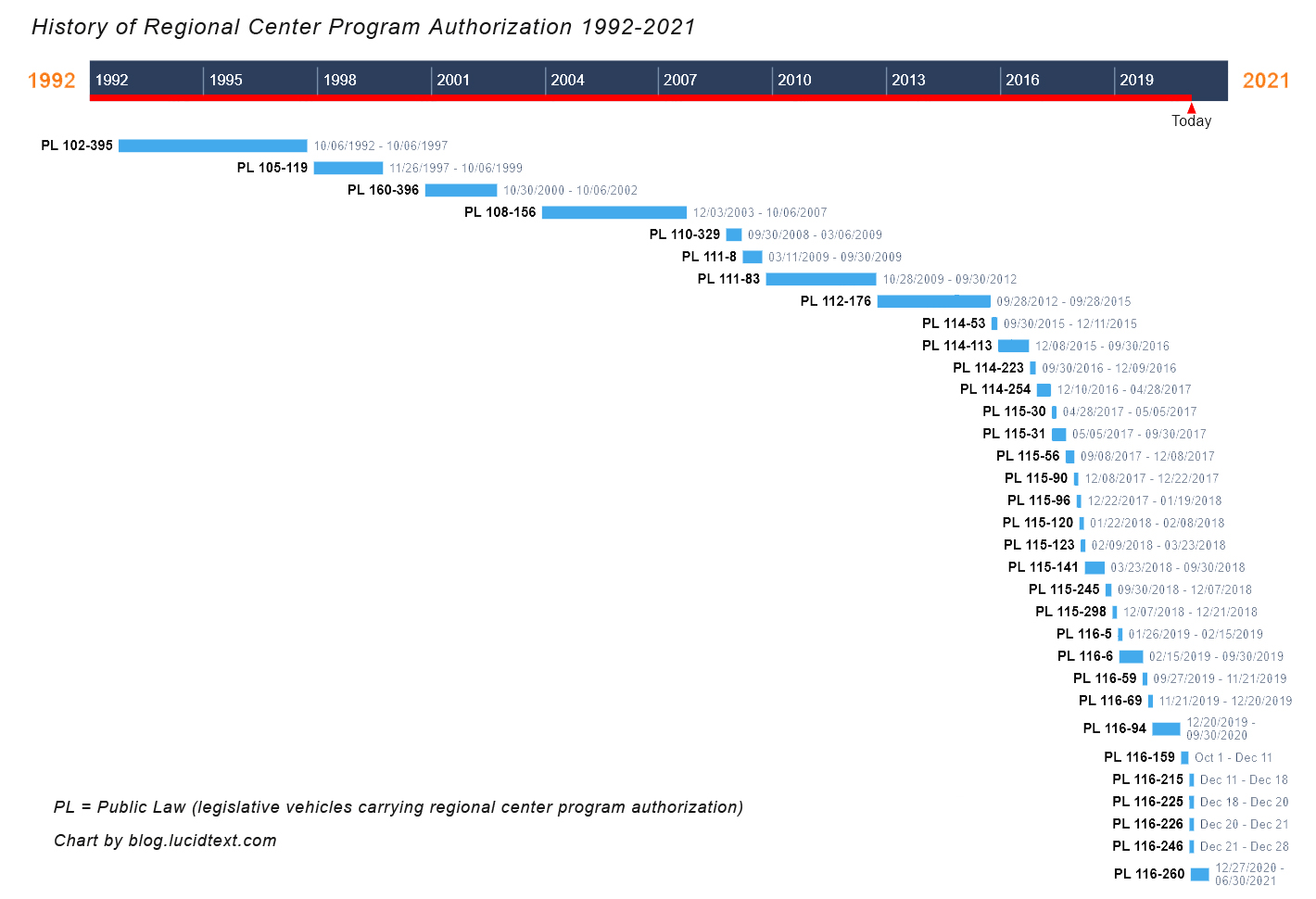
Today June 24, the Senate’s last working day before the regional center program sunset on June 30, Senators Grassley, Leahy, and Cornyn stood together on the Senate floor to request unanimous consent to pass S.831 to reauthorize the regional center program. (The EB-5 portion of the Senate floor proceedings on 6/24 can be reviewed here starting at time 2:54:52.) All three Senators spoke warmly about the regional center program and their efforts to reform and preserve it. Senator Cornyn’s decision to join Grassley and Leahy was significant, since he had been associated with the “holistic” faction alternative to Grassley’s reform efforts, and was an original co-sponsor of the S.2778 bill that the opposition hopes to revive. I was happy to see at least this level of compromise and unity in the cause of reauthorization. However, South Carolina Senator Lindsey Graham, another Senator in the “holistic reform” corner, registered an objection to the unanimous consent. And so S.831 did not pass the Senate today. A short-term extension was not brought forward by Senator Schumer or his proxy, as some had hoped. The Senate is now on recess until after July 4, so the window for legislation in advance of June 30 has closed. (The House version of the Grassley bill has been making progress, with 23 cosponsors so far, but the House can’t pass laws by itself.) The regional center program will sunset starting July 1, 2021. The battle for reauthorization legislation will continue once Congress gets back to work after July 4. The timeline and outlook for final resolution remains unknown.
What does it mean?
Regional center program lapse/expiration does not directly affect direct EB-5, or regional center investors who have already been admitted for conditional permanent residence. The lapse will put a freeze on pre-green card regional center petitioners and applicants, until the RC program is reauthorized.
USCIS has yet to publish guidance for how exactly they will handle regional center petitions during this program lapse/expiration. There’s informed speculation that the policy will initially be similar to what was published in December 2018 during the last lapse. I will report when the USCIS website gets updated. (In the meantime, attorney Robert Divine has a helpful article on practical implications of a lapse.)
The July 2021 visa bulletin gives the Department of State policy on visa issuance during the lapse/expiration for regional center (i.e. I5 and R5) visas. “The I5 and R5 visas may be issued until close of business on June 30, 2021 and may be issued for the full validity period. No I5 or R5 visas may be issued overseas, or final action taken on adjustment of status cases, after June 30, 2021. Since there has been no legislative action at this time, the final action dates for the I5 and R5 categories have been listed as “Unavailable” for July. If there is legislative action extending this category for July, the final action dates would immediately become “Current” for July for all countries except China-mainland born I5 and R5, which would be subject to a November 8, 2015 final action date and Vietnam I5 and R5, which would be subject to an April 1, 2020 final action date.” Any questions regarding what’s in the visa bulletin can be directed to the blessed Charles Oppenheim, who will be hosting another “Chat with Charlie” live on Youtube on Monday, June 28, 2021 at 1:00 PM Eastern Time. (Per the visa bulletin, one can email questions to VisaBulletin@state.gov ahead of the event with “Chat with Charlie Question” in the email subject line.)
Why did it happen?
Maybe there was practically no chance to get RC reauthorization passed before the tight June 30 deadline regardless, given the lack of legislative vehicles to which it could have been attached. Maybe compromise could and should have advanced legislation, if only negotiators had been more flexible.
Instead of speculating about causes and blame, I will start by simply repeating what key players in the reauthorization drama have to say for themselves. As background, key industry players have been IIUSA and its allies, who have chosen to support the current Grassley bill as the best/only way to avoid RC program death; and EB5 Investment Coalition (EB5IC), which considers that the Grassley bill is death and should be opposed to make an eventual path to something better. IIUSA has associated with Senators Grassley and Leahy, while EB5IC has implied association with Senator Schumer, and also Rounds, Graham, and (previously) Cornyn. Grassley v. Schumer represents a long-standing division around EB-5 legislation that has been in place since the last multi-year RC program extension ended in 2015 – a division roughly caricatured as Middle America vs. the Big City. Schumer, Rounds, and Graham did not make any EB-5 statements today that I can find (beyond Graham’s one-word objection on the Senate floor). I’m copying below statements made today by Grassley, Leahy, and Cornyn, and excerpts from the most recent statements from IIUSA and EB5IC. I’ll let you think about where grains of salt need to be applied, where the rights and wrongs lie, and where the path forward could be. (One question I keep thinking about: what does each of these players think the BATNA is? Could compromise be encouraged by pointing out issues with some of those envisioned BATNA?)
IIUSA’s perspective was recently represented in an article by IIUSA Executive Director Aaron Grau published on June 21 in the Times Union. I copy excerpts here:
Recently, Senators Chuck Grassley, R-Iowa, and Patrick Leahy, D-Vt., introduced S.831, the EB-5 Reform and Integrity Act of 2021, a bipartisan bill that protects investors, assures the program’s integrity and secures its longevity. Shortly after, Rep. Greg Stanton, D-Ariz., and Rep. Brian Fitzpatrick, R-Penn., introduced an identical companion bill in the House of Representatives, HR 2901. The House bill has 20 cosponsors and counting, Republicans and Democrats.
However, opposition continues to mysteriously fester, unfairly keeping key policy makers, like Senate Majority Leader Charles Schumer and House Judiciary Committee Chairman Jerry Nadler, away from embracing the bipartisan, bicameral solution at hand.
The EB-5 Regional Program needs change, including increased integrity measures to help protect against the fraud and abuse brought on by one too many bad apples. It needs provisions to protect good-faith investors who, through no fault of their own, may find themselves in a terminated project. And the program needs stability — the kind of stability that only comes from a long-term, five-year reauthorization.
With just days until the program expires, time is of the essence and, without Schumer’s support, this powerful development tool goes away and future EB-5 investments and vital jobs for New Yorkers will be eliminated.
[Update: See also IIUSA’s 6/25 Advocacy Alert on program sunset. I also recommend the 6/23 Investment Migration Report webinar with Aaron Grau, an extremely substantive 1.5-hour discussion that addresses most questions about the legislative process, and also touches on the Behring litigation on regulations.]
EB5 Investment Coalition does not typically make statements, but kindly held a webinar for the public at 9 am EST on June 24, ahead of activity in the Senate. Below, I transcribed an excerpt of legislation-related remarks from that webinar, quoting EB5IC co-founders Laura Foote Reiff of Greenberg Traurig and Jeff Campion, CEO of Pathways EB-5.
Jeff Campion: So I know that we’re working on extension. Obviously you said it expires June 30, we all know that. So let’s talk about where the extension is. Grassley and Leahy, they’ve hot-lined the bill. It’s on UC I guess today. What does that all mean? I know that we’re trying to get the program extended for a period of time. But what’s the lay of the land from your side?
Laura Foote Reiff: So we’ve always had for the last six-plus years some key players who have been interested in the program. We saw last Congress Senators Cornyn, Rounds, Schumer, and Graham introduce a more holistic bill, S.2778. It was a bill that would change the programmatic rules and deal with integrity measures. Senators Leahy and Grassley have introduced an integrity-measure only bill. They reintroduced that bill this Congress. And we’ve been trying to talk to them about adding in some programmatic measures to deal with backlog issues and investment levels and the TEA definitions, to no avail. There were some serious conversations for the last couple weeks with, I think, Senator Schumer’s office. We’re trying to work with them on some edits that would be acceptable. Senators Grassley and Leahy have now done what they called “run a hotline” on the legislation, and I understand they’re going to take the bill to floor of the Senate for unanimous consent without any edits except for the fact that instead of the five-year extension, they’ve amended it to a two and a half year extension of integrity measures only. So it’s unfortunate.
Jeff Campion: So there’s a few options here, right? I guess one option is they make it where its not 27 months, it’s 15 months or 3 months, or someone puts a hold on it and it doesn’t go through. I mean those are kind of the different options, right?
Laura Foote Reiff: Yeah, I mean, it’s unfortunate in Congress these days that you can’t go through regular order to get legislation through. We’ve been trying to get more comprehensive legislation on EB-5 through for many years. So this is one tool that Senators will use, the unanimous consent effort. If there is any objection to the unanimous consent motion, then the thing fails. And we think that there are enough holds on it that it probably won’t pass. But there’s going to be some negotiation. We’re hoping in the end they come up with something, some kind of compromise so that there’s a shorter-term extension of the regional center program with an opportunity to negotiate out that more holistic reform to deal with some of the programmatic issues that exist.
…What could happen with the reauthorization, when Congress comes back from their recess, they could take this up at any time. They could have unanimous consent in July, they could have unanimous consent on something, whether it’s a short-term extension, whether it’s integrity measures, whether it’s a holistic thing. They could also work together, like Senators Cornyn, Graham, Schumer and Rounds did, on a more holistic bill, and have that attached to another vehicle. As we just said at the beginning of this program, it’s very difficult to pass a stand-alone piece of legislation. So the vehicle could be an infrastructure bill, it could be some other immigration bill going through. And/or we could see ourselves being reattached, maybe recoupled back in September. Nothing is guaranteed. It’s all kind of making sausage up on the Hill. I know a lot of people are afraid about the program expiring. It’s never fun to have a program expire, but it happens. I know, as you said Jeff, there’s going to be a lot of pressure to do something to try to resuscitate the program between now and September 30.
(As background on what’s involved in a more holistic bill, see my post EB-5 legislation and the question of options. See also IIUSA’s article on why the industry trade association did not to demand programmatic fixes as a condition of passing integrity reforms. As background for what Senator Grassley thinks about short-term extensions coupled with appropriations bills, see his posts from 2015 and from 2018.)
Senator Grassley published an article on his website today with a typically pugnacious comment about what happened. To quote some excerpts:
Sen. Chuck Grassley, Ranking Member of the Senate Judiciary Committee, and Sen. Patrick Leahy, Chairman of the Senate Appropriations Committee, today condemned a blockade of their bipartisan bill to reform and extend the EB-5 investor visa program, which expires on June 30. The blockade was led by a small group of wealthy and unscrupulous real estate developers who blindly oppose any efforts to improve accountability and transparency in the EB-5 visa program.
“A narrow subset of big moneyed and corrupt interests has now shown that they would rather kill the program altogether than have to accept integrity reforms designed to clamp down on their bad behavior,” Grassley said on the Senate floor.
“It’s really unfortunate that a bipartisan bill supported by the overwhelming majority of EB-5 stakeholders was blocked at the behest of a small minority that blindly opposes much-needed accountability and transparency in the program. Senator Grassley and I have worked together for years to develop a thoughtful, careful compromise that would both keep the program alive and curtail the worst abuses of it. Now that our bill has been blocked, the EB-5 visa program is unfortunately going to lapse in the days ahead and have untold economic consequences throughout the communities that rely on the program for development projects. I remain committed to reforming the EB-5 program should there be another opportunity to do so,” Leahy said.
Senator Cornyn’s website published this message.
Today on the floor, U.S. Senator John Cornyn (R-TX) discussed the importance of the EB-5 Immigrant Investor Program and his legislation that would make commonsense reforms, which was blocked from passage this afternoon. The current authorization runs out on June 30th. Excerpts of Sen. Cornyn’s remarks are below, and video can be found here.
“EB-5 investments are a major economic driver in Texas. EB-5 projects use merit-based immigration to create thousands of American jobs and bring billions of dollars in investment to major urban areas like Dallas and Houston, as well as our rural communities across the state. These projects include investments in infrastructure for a wide variety of sectors, including energy, hospitality, residential and commercial.”
“I’m a supporter of the EB-5 program and its resources it delivers to the community, but there is no question, as Senator Grassley has said, that it could stand some reforms.”
“I’m glad to join Senator Grassley today in offering this legislation to improve the integrity and security of the EB-5 program while ensuring law-abiding Texas job creators aren’t negatively impacted. This bill would have reauthorized the EB-5 program until 2023 with significant oversight and integrity measures.”
Senator Cornyn went on to say (quoting from the end of his statement on the Senate floor starting at time 2:57:11):
This happens to be very similar to legislation that I introduced in 2015 with Senator Schumer and Senator Flake, which included recommendations from both the Department of Homeland Security and the Government Accountability Office. I appreciate Chairman Grassley’s leadership on this legislation, and I hope at some point we can reauthorize the EB-5 program and safeguard critical investments in communities across the country.
Senator Leahy of Vermont had this to say (starting at time 2:59:26 in the recording of Senate floor proceedings for June 24):
I was happy to join both Senators Grassley and Cornyn on the EB-5 reform bill. Senator Cornyn has worked very hard on this, Senator Grassley has, and I have. And it was a truly bipartisan bill that has widespread support among EB-5 stakeholders – those who responsibly welcome changes in the program that would improve oversight and accountability.
Senator Grassley and I have been working for years to reform the EB-5 visa program. We want to reduce the fraud that’s current in several EB-5 projects, including one that occurred in my own state of Vermont. And this legislation – again, bringing Republicans and Democrats across the political spectrum together – reflects a careful, thoughtful compromise that will keep the EB-5 program alive and curtail the worst abuses.
There’s actually only a small minority that wants to keep the program operating without these improved these standards and oversight, and I wish they would be willing to bring it out, vote it up or down. Be on the record, saying how they’re going to vote. Because opposing our effort on this is a vote that allows the EB-5 program to lapse. That’s going to have untold economic consequences throughout the communities that rely on the program for development projects, like those that the Senator from Texas just mentioned.
I wish that the senators supported Senator Grassley’s consent request, but I will take a moment to thank Senator Grassley for working with me over the years to find a bipartisan compromise reform list. Hours have gone into that. He and Senator Cornyn and I and others have worked hard to have a compromise. I’m sorry that the unanimous consent was objected to, especially since it means this will expire, and we won’t have votes on improvements that could take part. I think it’s a wasted opportunity.
And finally, a note for people inspired to share their touching personal-impact stories in response to this post. Advocacy organizations might love to hear your experience, so they can bring it forward in conversations with members of Congress and the media to directly influence legislative outcomes. Consider contacting an advocacy organization to tell your story. AIIA has a form up to collect contact info for a database of EB-5 investors willing to speak with or be quoted to Congresspeople in various constituencies, and journalists. And IIUSA says “Share your EB-5 success stories with us via e-mail so we can share them with members of Congress.”


 EB-5 Updates