How long does I-526 take? (Part II)
February 14, 2018 39 Comments
Update: I have deleted this now-outdated post and replaced it with How long does I-526 take? (Part III)
immigrant investor program news
February 14, 2018 39 Comments
Update: I have deleted this now-outdated post and replaced it with How long does I-526 take? (Part III)
December 28, 2017 51 Comments
Update: I have deleted this now-outdated post and replaced it with How long does I-526 take? (Part III)
October 13, 2017 13 Comments
[2019 Update: My post Forecasting Visa Availability: 5/6 Oppenheim projections and big picture (5/6/2019) provides perhaps a clearer big picture explanation of how the wait line works. 2018 Updates: see also my 4/8/2018 post EB-5 Visa Waiting Line and Visa Allocation and my 4/23/2018 post Visa Numbers (China, Vietnam, India, Brazil, S. Korea, Taiwan)]
How long does it take to get an EB-5 visa? Before we look at numbers, consider this picture illustrating variables in the EB-5 process from initial application to conditional permanent residence.

The investor files an I-526 and receives a priority date, goes through I-526 adjudication, and proceeds along with family members to I-485 status adjustment (if already in the US) or consular processing (if outside the US) in order to get EB-5 visas. The system has two major constraints: USCIS capacity to process petitions, and the annual quota on EB-5 visa numbers. These constraints have produced pile-ups of pending petitions and applications, illustrated by the green bins in the picture.
We have data for many parts of this picture, such as how many people are in each of the pending bins, the historical rate of receipts and approvals and denials, and the annual visa quota. The simplest way to estimate the visa wait line (the time from priority date to green card) is to add up the pending bins and divide that number by the annual quota. As there are currently 90,000+ people associated with the pending bins, and the annual EB-5 visa quota is about 10,000, the current total waiting line is 9+ years long. (Maybe longer, depending on assumptions about the other variables). As recently as mid-2014, the line was only about three years long (as we know from the Visa Bulletin, which indicates that China-born investors with June 2014 priority dates started getting visas in May 2017).
Calculating the actual visa wait time for any given person is complicated. Where is that person in line, relative to other pending petitioners and applicants? Is that person from China (which is oversubscribed and subject to a per-country limit) or from an undersubscribed country that’s free to take the first available visas? How have/will other process variables such as per-country receipts and approval rates change over time and affect calculations?
If I were someone born outside China considering EB-5 now, I’d feel good about the per-country limit that allows me to skip ahead of most China-born applicants in line (i.e. about 87% of the line). For me, the time IPO takes to process I-526 is the major factor in my total wait time.
If I were a China-born prospective investor, I’d look at everyone in line ahead of me, and also try to estimate how many queue-jumping non-Chinese may enter from behind in the time I have to wait. That calculation could add years to the potential wait time, well exceeding 10 years, if the number of non-Chinese investors increases dramatically in the future and IPO processing speeds up. Or future circumstances could quell new EB-5 demand, encourage existing applicants to drop out, or apply the per-country limit to other countries, improving the wait time for China-born investors who stay in the system.
All past investors should consider the significance of the visa quota constraint and the possibility that it will change. Indeed, it could change for the better. For example, if the State Department recognizes that Congress intended the 10,000 visa quota to apply to 10,000 investors, not investors plus family members, this would loosen the constraint and cut about six years from the current visa wait time. Unfortunately, quota reduction is also a live possibility. Industry lobbyists are reportedly considering legislation with visa set-asides that would reduce the generally-available annual EB-5 quota from 10,000 to 7,000. This could be disastrous for past EB-5 applicants, adding about four years to the wait time. Visa set-asides have emerged as a compromise between the Senator Grassley camp, which wants to incentivize rural/urban-distressed investment somehow, and certain regional centers, who resist an incentive based on a significant investment differential that would make their future prosperous urban projects uncompetitive. Tying the TEA incentive to visa set-asides rather than reduced investment would allow regional centers to keep attractive terms and options for future investors. Their past investors would suffer, but that cost seems not much counted. (My impression of the current legislation discussion comes from this webinar and this article.) Of course, maybe protections for past investors will be added to the legislation, or maybe there won’t be any deal and we’ll get new regulations instead. The regulations could significantly reduce new EB-5 demand, which would hurt the industry but benefit people who stay in the current visa queue.
And now, let’s get to the numbers. I’ve expanded and improved my backlog calculation spreadsheet, which now has multiple tabs that compile all the data I can find on each variable influencing the visa wait time for an EB-5 conditional green card. Keep the spreadsheet link, as I will update it whenever new inputs become available. (For those who don’t face backlog issues, see my posts on I-526 processing times Part I and Part II to help estimate the time between you and conditional permanent residence.)
Summary of EB-5 Visa Wait Time Variables
Additional Reading
Benefit from this blog? Please consider supporting the effort behind it. As the EB-5 industry changes, your contribution can help preserve this space for conscientious and freely-available EB-5 reporting. Donations go to Lucid Professional Writing (a for-profit business) to fund work on this blog. Thank you!
October 9, 2017 1 Comment
Direct EB-5 FAQ
The regional center program dominates EB-5, but the alternate direct EB-5 track remains significant. 846 EB-5 visas went to direct EB-5 investors plus family in FY2016, and this number will likely climb as petitions from the past couple years finally reach the visa stage. Direct EB-5 can be an attractive option for foreign investors and U.S. business owners who wish to avoid the uncertainty surrounding the regional center program. About half the business plans I write these days are for direct EB-5.There remain, however, lingering misunderstandings about how EB-5 works outside the regional center program. I’ve prepared a new page, Direct EB-5 FAQ, that addresses questions about the nature and practical uses of direct EB-5.
Test your direct EB-5 knowledge.
- True or False? The direct EB-5 program will sunset unless re-authorized by Congress.
- True or False? A direct EB-5 investor must invest at the $1 million level.
- True or False? Real estate developments are the most common direct EB-5 project type.
- True or False? A majority of direct EB-5 investors have come from China.
- True or False? The direct EB-5 investor must majority-own the enterprise receiving investment.
- True or False? The direct EB-5 investor must have day-to-day managerial responsibilities in the enterprise receiving investment.
- True or False? If a direct EB-5 investor buys a business, that business and its employees will qualify as new for EB-5 by virtue of the new ownership.
- True or False? A new commercial enterprise can use direct EB-5 capital to invest in a separate job-creating enterprise.
- True or False? A direct EB-5 investor can count full-time equivalent jobs created by the enterprise.
Each of these statements is false. If you were surprised, then check out the Direct EB-5 FAQ page for direct EB-5 information, policy references, and case citations.
White House Immigration Principles & Policies
Just in time for Columbus Day, President Trump has sent Congress a list of Immigration Principles & Policies that 15th-century Americans could wish they’d had. The White House principles focus on border security and interior enforcement, and repeat the idea that legal immigration should feature a skills-based points system while reducing admissions for relatives, asylum seekers, and refugees. We shall see how Congress reacts to this guidance from the White House. The White House principles look positive for immigrant investment, but the points system would be fatal (at least in the scenario proposed by Tom Cotton, which would eliminate EB-5 and would not allow immigrant investment to support US entrepreneurs, but only immigrant-controlled business).
In the meantime, in honor of voyagers who continue to build our great nation as they bridge continents and pursue their dreams in face of doubt and adversity, I will quote the first paragraph of President Trump’s Columbus Day proclamation.
Five hundred and twenty-five years ago, Christopher Columbus completed an ambitious and daring voyage across the Atlantic Ocean to the Americas. The voyage was a remarkable and then-unparalleled feat that helped launch the age of exploration and discovery. The permanent arrival of Europeans to the Americas was a transformative event that undeniably and fundamentally changed the course of human history and set the stage for the development of our great Nation. Therefore, on Columbus Day, we honor the skilled navigator and man of faith, whose courageous feat brought together continents and has inspired countless others to pursue their dreams and convictions — even in the face of extreme doubt and tremendous adversity.
October 2, 2017 Leave a comment
Washington Updates
We’re entering FY2018 with another RC program sunset date coming up on December 8, 2017, and new EB-5 regulations waiting for final clearance by the Office of Management and Budget. In a September 28 podcast with Mona Shah, Peter Joseph of IIUSA reports that “Congressional leadership including Senator Cornyn, Majority Leader McConnell, and Speaker Ryan has spent time working with judiciary committee leadership in coming to an agreement. The fact that these parties continue to dedicate time to a legislative solution is a very good sign.” However, “We don’t know the details of what might come out of a Congressional agreement. Investment amounts and other key issues are part of a fluid conversation, and negotiation will continue until there is enough agreement to move to the next stage.” I’m glad to hear that conversations are on-going, with IIUSA taking an active part. I’m also inclined to agree with Mintz Levin’s conclusions in the thoughtful article Lawmakers May Not Spend Political Capital on Standalone EB-5 Bill (September 28, 2017). It’s hard to imagine that Congress will prioritize EB-5 legislation when issues like health care and tax reform are pending, and easy to imagine them deferring responsibility with another content-free short-term RC program extension, or waiting for regulations. If DHS finalizes new EB-5 regulations before Congress gets around to legislation, then Congress doesn’t have to touch donation-losing issues like investment amount increases and TEA reform. Congress must act eventually, because only Congress can authorize the RC program and deal with visa numbers, but we’ll see. Prior to the last couple sunsets I heard whispers that certain lobbyists had secured a gentleman’s agreement with staffers for new legislation that would protect the status quo. (Senator Grassley heard the whispers too, and was not pleased). I’m hearing similar reports this time around, together with protests from other people in communication with the same offices who say no, Congressional leadership is not on board with the status quo proposals (to minimize the investment differential, protect the natural advantage of big-city projects, and generally avoid painful disruption). I’m not sure what to expect. I look forward to listening in to EB-5 Legislation: Where Are We? a free webinar to be hosted on October 4 by Kurt Reuss of EB5 Diligence, with an all-star cast including Stephen Yale-Loehr, Robert Divine, Robert Cornish, Laura Reiff, H. Ronald Klasko, Carolyn Lee, and Douglas Hauer. (10/12 Update: Mona Shah reports on a possible new legislative compromise.)
Interesting Articles
- NES Financial has published another white paper with EB-5 Trends & Insights based on data from the many regional center transactions they facilitate. NES comments on 2017 trends in EB-5 capital structure, investor markets, escrow terms, and size and location of EB-5 projects.
- Bloomberg Businessweek recently featured EB-5 in How Rich Chinese Use Visa Fixers to Move to the U.S. (September 14, 2017). I appreciate the article for its clever graphic, and for its old-fashioned vision of Chinese flocking to the smooth path of EB-5, not sweating at home over backlog calculations and the question of whether an EB-5 green card is worth a decade wait on top of investment risk and political uncertainty and capital control complications. CNN Money seems closer to the current situation with its article America’s ‘golden visa’ is losing its luster in China (September 29, 2017). The changing role of Chinese investors in EB-5 will likely define our experience in 2018. Unless, of course, we get good news on legislation and visa numbers.
- Those involved with EB-5 investors from Iran, and people of conscience generally, will want to keep an eye on the emerging situation with President Trump’s new Presidential Proclamation on Visas. The State Department summarizes the revised travel ban, and how it affects nationals of Chad (?), Iran, Libya, North Korea, Syria, Venezuela, Yemen, and Somalia. (10/24 update: the Supreme Court has dismissed a final attempt to block the ban.)
SEC Actions
The Securities and Exchange Commission continues to highlight the need for investor vigilance. This month brought two new complaints, against Ronald Van Den Heuvel and Green Box NA Detroit (filed September 19, 2017) and Edward and Jean Chen and Home Paradise Investment Center LLC (filed September 20, 2017). I’ve added select details to my log of all SEC actions in EB-5. If we believe the SEC’s version of events, these cases did not involve complex or sophisticated schemes, just daylight theft and open lies enabled by related-party transactions and weak diligence. USCIS wasn’t necessarily taken in (the briefly-posted list of I-526 and I-829 adjudications by RC showed 0 petition approvals for Home Paradise), but quite a few investors were. The market needs to be more careful. The good actors who account for a majority of EB-5 players need to go the extra mile with transparency and account controls to demonstrate their good faith. Meanwhile, we appreciate the SEC putting bad actors on notice that EB-5 is not a free lunch.
Regional Center List Changes
Additions to the USCIS Regional Center List, 8/28/2017 to 10/02/2017
- American Real Estate Regional Center, LLC (Connecticut, New Jersey, New York)
- American Stone Energy EB5, LLC (Texas)
- Broadway Regional Center, LLC (California)
(Additionally Live in America – Carolinas Regional Center LLC, previously removed in error, has been restored to the list of approved regional centers)
- California Blue Sky Regional Center, LLC (California) Terminated August 29, 2017
- Arundel Capital Partners (Massachusetts) Terminated August 29, 2017
- California Economic Development Fund, LLC (California) Terminated September 25, 2017
- Global Medical Center of Southern California (California) Terminated September 25, 2017
September 13, 2017 Leave a comment
EB-5 Immigrant Investor Program: Stakeholder Engagement from New York City
U.S. Citizenship and Immigration Services (USCIS) invites you to participate in a stakeholder engagement on Tuesday, November 7, from 1 to 2:30 p.m. Eastern to discuss the Immigrant Investor Program, also known as the EB-5 program.
September 9, 2017 4 Comments
Regional Center Program Reauthorization
The EB-5 Regional Center Program authorization is now extended to December 8, 2017 thanks to H.R.601, which the President signed into law yesterday. Washington worked with admirable dispatch this time, cutting and finalizing the deal all within one week and nearly a month ahead of the September 30th deadline.
The law is hard to read, but for those who like to confirm things personally here’s the relevant language for regional center program extension. H.R. 601 “Continuing Appropriations Act, 2018 and Supplemental Appropriations for Disaster Relief Requirements Act, 2017” Division D Section 101 (PDF page 11) provides appropriations for “continuing projects or activities…for which appropriations, funds, or other authority were made available in the following appropriations Acts: … (6) The Department of Homeland Security Appropriations Act, 2017 (division F of Public Law 115–31), except section 310.” The previous regional center program authorization is in Public Law 115-31 Division F Section 542 (PDF page 298), so it’s one of the continuing activities that’s extended by H.R. 601 Division D Section 101. (And to go back another step, the language in PL 115-31(F)542 refers back to Section 610(b) of the Departments of Commerce, Justice, and State, the Judiciary, and Related Agencies Appropriations Act, 1993 (Public Law 102-395) page 47, which established the regional center program.) H.R. 601 Division D Section 106 (PDF page 13) further specifies that:
Unless otherwise provided for in this Act or in the applicable appropriations Act for fiscal year 2018, appropriations and funds made available and authority granted pursuant to this Act shall be available until whichever of the following first occurs:
(1) the enactment into law of an appropriation for any project or activity provided for in this Act;
(2) the enactment into law of the applicable appropriations Act for fiscal year 2018 without any provision for such project or activity; or
(3) December 8, 2017.The language in Section 106 is a good reminder that “extended to December 8” doesn’t mean “guaranteed to remain unchanged until December 8.” Congress will reportedly turn its attention to immigration issues in the next couple months, and they could come up with legislation before December that affects multiple visa categories including EB-5.
I-924A Filing Tips
I’m not sure what changed, since I don’t work directly with I-924A, but yesterday USCIS published a new version of the Form I-924A Filing Tips page.
SEC Request Denied (Kameli)
When the SEC files a complaint, it’s easy for the public to just assume that the defendant is guilty as charged and there won’t be any more to the story but determining punishment. Even worse, USCIS tends to assume this and has been known to deny and revoke investor petitions and terminate regional centers before the SEC cases are concluded. We all need to remember that sometimes the defendant might have a compelling other side of the story, and might not be found guilty. The district court judge overseeing a recent EB-5 case filed by the SEC just found that the SEC “in numerous instances has not presented fully developed arguments to show why defendants’ actions violated securities laws.” The judge’s memorandum opinion, which considers the defendants’ side of the story, is linked at the end of the article Senior living developer avoids EB-5 ban, receivership (September 7, 2017). For the SEC’s version of events see SEC v. Seyed Taher Kameli, et al., Civil Action No. 17-cv-04686 (June 22, 2017). The article SEC Suffers One of its First Major Losses in EB-5 Realm (September 12, 2017) summarizes the issues.2018 Update: The SEC v. Kameli case continues, however. The SEC came back with an amended complaint filed on January 29, 2018.
August 24, 2017 Leave a comment
I-924A Webinar
Today USCIS held a webinar to discuss the latest version of Form I-924A, Annual Certification of Regional Center. USCIS has linked an official recording to the webinar page. (I previously posted a folder with my recording.)
The webinar was technical and specifically focused on Form I-924A — what’s new in the December 23, 2016 version of the form, and how to complete it. A couple points of general interest came out in the presentation.
- The presenter highlighted the expanded definition of regional center “principal” in the new I-924A and additional information requested about principals. The presenter confirmed that the IPO Compliance Division plans to use this information to conduct background checks of everyone in a position to control, influence, or direct the management or policies of the regional center, and that the results of such background checks are material to the regional center’s ongoing designation.
- USCIS instructed that petitions that were withdrawn should be reported as “denied” on I-924A. This categorization could explain the petition approval and denial statistics published last month by USCIS, which reported a surprisingly high number of denied petitions. A caller encouraged USCIS to consider recording withdrawn and denied petitions as separate categories, and the call presenters said they’d consider the suggestion. The presenters also indicated that regional centers can add a note to I-924A explaining how many of the “denied” petitions were in fact denied, and how many withdrawn.
EB-5 Regulations
The Semiannual Regulatory Agenda published today by DHS lists regulation 1615-AC07 (the EB-5 regulation concerning TEAs and investment amount increases) as being in the “Final Rule” stage. The timetable on the rule’s summary page gives an estimated date of 04/00/2018 for Final Action. I’m not sure how seriously to take the agenda or the date estimate.
Articles
Developer FAQ: Jim Butler of JMBM Global Hospitality Group has put together a booklet titled The Developer’s EB-5 Handbook for EB-5 Construction Financing. Although targeted to hotel developers, this free booklet provides experienced answers to a range of practical questions common to businesses as they first consider EB-5 financing.
Large-Scale EB-5 Real Etate Projects: Gary Friedland and Jeanne Calderon of the NYU Stern Center for Real Estate Finance Research have released a new paper featuring a database of large-scale real estate projects that incorporate EB-5 into the capital stack. See EB-5 Projects Database: 2017 Supplement with Trends and Observations (August 16, 2017 Draft). This 2017 database collects publicly-available information on 26 projects in major metro areas with current/recent EB-5 raises. The authors previously published a 2016 database with 27 projects and a 2015 database with 25 projects. These large-scale projects are significant for the industry because they target such a large number of investors. The 26 projects in Friedland & Calderon’s 2017 database aim to attract 6,736 EB-5 investors, which means that they alone could use up over two years of available EB-5 visas. Megaprojects take a large piece of a small pie, are too big to fail, can offer attractive and well-managed investment opportunities, and present a public relations challenge. A high-profile luxury development in a Tier 1 city is not typical of the EB-5 program overall, but it is typical of the few projects that seek and find hundreds of EB-5 investors.
Vermont: Speaking of too-big-to-fail, I continue to follow the efforts of Vermont Regional Center to clean up from fraud charges against a couple of its project managers. The regional center has worked hard to recover from the disaster and (at least recently) to protect and compensate investors, but now faces having to respond to a NOIT from USCIS. A Notice of Intent to Terminate is not the same as a termination notice (the RC has a chance to respond to a NOIT, and not all NOITs are followed by termination), but it is a significant development. This news story discusses the whole situation, and this story gives detail of NOIT content. “What level of oversight are regional centers responsible to provide?” is a grey area question in EB-5, and a question that USCIS addresses in its assessment of Vermont Regional Center.
Regional Center List Updates
Additions to the USCIS Regional Center List, 08/01/2017 to 8/23/2017
- Liberty Regional Investment Center (Georgia)
- Nevada First National Regional Center, LLC (Arizona, Nevada)
- Pass2NY Regional Center, LLC (New York)
- USA New York Liberty EB-5 Regional Center, LLC (Connecticut, New Jersey, New York, Pennsylvania)
New Terminations
- IZON, LLC (South Carolina) Terminated 8/17/2017
- America’s Regional Center, LLC (Florida) Terminated 8/15/2017
- First American Regional Center, LLC (California) Terminated 8/14/2017
- Civitas Rio Grande Regional Center (Texas) Terminated 8/10/2017
- Illinois Valley Regional Center (Illinois) Terminated 8/10/2017
- Southern California Investment Center, LLC (California) Terminated 8/10/2017
- Powerdyne Regional Center, LLC (California) Terminated 8/2/2017
August 1, 2017 Leave a comment
Helpful Articles and Resources
- USCIS Ombudsman’s 2017 Annual Report to Congress (June 29, 2017). The EB-5 section of the report (page 30-33) reviews facts we already knew, but is interesting in the way it highlights the EB-5 visa backog as a significant concern. I particularly appreciate the section on the USCIS Administrative Review Process in Employment-Based Decisions (page 23-26), which describes the three alternative administrative options for petitioners who think USCIS has made an erroneous decision: Motion to Reopen, Motion to Reconsider, and appeal to the Administrative Appeals Office (AAO). See especially the very helpful Figure 3.2 on page 25, which lays out the steps and process and considerations in each alternative.
- People who worried about the appointment of Julie Kirchner to Ombudsman (after she previously served as executive director of an anti-immigration group) and other recent appointments will be interested in Angelo Paparelli’s article The Known and Unknown Future of the EB-5 Immigrant Investment Program at USCIS and the Office of the USCIS Ombudsman (2017 Q2 Regional Center Business Journal)
- Bernard Wolfsdorf and Joseph Barnett give a nice summary of possible legislative and administrative solutions to EB-5 visa backlog problems in their post Solutions to the Chinese EB-5 Visa Backlog (July 27, 2017)
- Catherine Holmes and Daniel Lundy tackle another important concern for EB-5 investors in their article The Anatomy of an EB-5 Work Out: What Happens After the SEC Files Complaint and How Can the EB-5 Investors Protect their Interests (July 26, 2017)
- A group of lawyers have updated their white paper interpreting redeployment options in light of the June 14, 2017 update to the EB-5 Policy Manual. Standards and Guidelines for Redeployment of EB-5 Investment Funds (originally published February 21, 2017, updated July 24, 2017) by Klasko Immigration Law Partners, LLP, Arnstein & Lehr LLP, Jeffer Mangels Butler & Mitchell LLP
- Regional Centers will appreciate this practical article USCIS Compliance Audits – Preparing Regional Centers for the First Wave (2017 Q2 Regional Center Business Journal) by Mariza McKee, Kimberly Hare, and Clete Samson
Washington Updates
What is happening with EB-5 in Washington? I wish I knew. Immigration policy generally looks like an orphan child. The top three leadership posts at USCIS are all still filled by “acting” people (Lee Cissna was nominated but still not confirmed as Director), and now we’re missing a DHS Secretary as well, until Congress can find time to confirm a replacement for John Kelly. That can’t facilitate significant USCIS action like finalizing regulations or hiring. The White House website listed immigration as a top issue a few months ago, and gave an immigration policy statement, but not anymore. (8/2 Update: The White House is now talking about immigration with the RAISE Act.) I hear rumors that lobbyists are still actively talking to Congressional staffers about EB-5 legislation and regional center program reauthorization, but don’t know where that will lead. Congress has so many fish to fry. We wonder whether Congress can even figure out funding the government past September 30, and there’s talk of another short-term Continuing Resolution, which could mean another series of hop-and-skip extensions of the RC program, whose current authorization is tied to the 2017 funding bill. But it’s hard to predict. Insights or insider information, anyone? (8/3 Updates: Senator Cornyn, author of the draft EB-5 legislation released most recently, has announced Building America’s Trust Act, a new immigration bill that doesn’t appear to address EB-5. Representative Brian Fitzpatrick has introduced H.R.3471 with the promising title “To amend section 203(b)(5) of the Immigration and Nationality Act to implement new reforms, and to reauthorize the EB-5 Regional Center Program, in order to promote and reform foreign capital investment and job creation in communities in the United States, and for other purposes.” I’ll report more fully when the bill text becomes available.)
Regional Center List Changes
Additions to the USCIS Regional Center List, 07/17/2017 to 8/1/2017
- Cascadia Regional Center (Oregon, Washington): pathwayseb5.com
- Education Fund SW Regional Center (Arizona, California, Nevada, Utah): edufundamerica.com
New Terminations:
- Anacostia Regional Center (District of Columbia) Terminated 7/18/2017
- AAA Florida Senior Living Regional Center, LLC (Florida) Terminated 7/12/2017
- Allied Artist High Desert EB5 Regional Center (New Mexico) Terminated 7/12/2017
- Rosti Capital Regional Center (California) Terminated 7/17/2017
July 19, 2017 1 Comment
IPO has added a very valuable resource to the EB-5 Resources page on the USCIS website:
Suggested Order of Documentation
The links direct to pages that provide a suggested list and order of contents for each EB-5 form. The regulations and Form Instructions already describe the evidentiary requirements for EB-5 petitions and applications, and these new pages don’t add new requirements. Rather, they provide the content in handy checklist form and suggest a way to standardize submissions by arranging required documents in a predictable order. We keep asking IPO what we can do to help improve the adjudication process and processing times, and this is a very helpful response. Immigration lawyers take note! If we can widely adopt the suggested order of documentation for each form, and most petitions take on a standard shape, with the same tabs in the same order, this will certainly support operational efficiencies at IPO and should help reduce processing times. Julia Harrison flagged this resource at today’s Employment Visa engagement in San Jose. I’ll write another post with more complete report of helpful input from the IPO representatives Julia Harrison and Jan Lyons, Kurt Vicha of FDNS, and Charlie Oppenheim from Department of State.
July 17, 2017 Leave a comment
EB-5 Immigrant Investor Program Engagement July 13
At the EB-5 listening session on July 13, the USCIS participants stuck to their resolve to listen only, and did not provide input or feedback. The call solicited stakeholder comments on the questions raised by the Advance Notice of Proposed Rule-Making, which addressed regional center designation and participation and exemplar project approval. The ANPRM inspired few written comments to its preliminary questions, and this call also got tepid response. What did USCIS want to know from us, beyond what those of us who care said already in our written comments? USCIS would not specify, and we weren’t sure what to say. The Wolfsdorf Rosenthal blog has diligently summarized stakeholder comments, and my recording is available for anyone who’s really interested. I hope USCIS learned something from the call, but I did not. People with more to say on the designated topics of RC life-cycle (designation, participation, termination), RC exemplar process, RC compliance audits, or indirect job creation methodologies may email ipostakaeholderengagement@uscis.dhs.gov.
USCIS let slip one bit of info. Lori MacKenzie said that “the agency is working to finalize that rule” — referring to the regulation that people care about, the NPRM dealing with investment amounts and TEAs. No indication of timeline, however, or whether the listening session call reflects intention to combine NPRM and ANPRM topics in one new rule. (On July 3, Senators Dean Heller, John Cornyn, Rand Paul, and Thom Tillis had sent DHS a letter asking that the agency not move forward with the proposed EB-5 regulations. The listening session indicates that DHS is indeed moving forward, however slowly.)
Here is my favorite listening session caller comment, from a Mr. Fuentes in minute 45: “We have a bottleneck of processing in an environment where resources are not the limit.” Yes – that’s exactly what’s wrong and fixable in EB-5. So many problems for EB-5 projects and investors result from the fact of long processing times, and long processing times are traceable to constraints that need not exist in a program of multi-million-dollar projects and high-net-worth immigrants. I’ll write more on this soon.
The call also reminded me that we need to talk more about direct EB-5, and the kinds of business and investment that are and are not workable in that environment. Purchasing an operational existing business rarely works for direct EB-5. The history of AAO denial decisions is thick with business acquisition cases that foundered on the “new commercial enterprise” requirement and/or the requirement to create new jobs. EB-5 rules specify that mere ownership change does not make an enterprise or jobs in that enterprise new. I have a couple related posts (one on the difference between direct and regional center EB-5, and one on options for investing in an existing business), but see the need for a simpler article addressed to entrepreneurs contemplating direct EB-5.
EB-5 and Securities Law
Immigration lawyers happen to be well-placed to match EB-5 investors to EB-5 projects, and are pressured by the market and tempted with commissions to play a match-making role. This role is perilous, however, considering securities laws. In 2015 and 2016, the SEC made examples of several immigration lawyers who had received transaction-based compensation for facilitating investments, and of one of the regional centers that paid such compensation. The message: it’s illegal to be on the giving or receiving end of payments to someone acting as a broker without appropriate license.
One of the law firms targeted by the SEC fought back. Hui Feng (subject of a complaint published in December 2015 by the SEC against himself and his firm Law Offices of Feng & Associates, P.C.) argued that the SEC’s claims fail because EB-5 investments are not securities and the immigration lawyer does not act as a “broker” when receiving finder fees. He pointed out that EB-5 investments are primarily motivated by the visa, without expectation of profit, that his commissions were contingent on visa approval rather than in connection with securities sale, and that the attorney role has its own fiduciary duties and that broker requirements are inapplicable – i.e. the EB-5 process and investment and lawyer’s role are fundamentally immigration matters, not securities matters and not the SEC’s business. (My layman’s paraphrase; see the court filings for the actual legal arguments.) The US District Court, Central District of California, however, has come down on the SEC’s side in its Motions for Summary Judgment (June 29, 2017). The decision has the longest discussion I’ve seen yet in support of the point that yes, EB-5 investments are securities. It also enumerates the activities supporting the conclusion that yes, this immigration lawyer acted as a broker, and explains why the fee arrangement details were material and should have been disclosed to investors and regional centers. If you pay or receive EB-5 finders fees, pay attention to this decision. You may also want to review IIUSA’s Best Practices for Engaging with Sales Intermediaries.
Regional Center Compliance Audits
The Regional Center Business Journal has a helpful article by Mariza McKee, Kimberly Hare, and Clete Samson “USCIS Compliance Audits – Preparing Regional Centers for the First Wave”
RC List Changes
USCIS continues to cull the list of approved regional centers, with 50 terminations so far this year. 2017 termination letters haven’t been published yet, but I’ll guess that most of these terminations are for lack of recent activity.Additions to the USCIS Regional Center List, 6/26/2017 to 7/17/2017:
- No new regional centers.
New Terminations:
- North Country EB-5 Regional Center, LLC (New York) Terminated 7/7/2017
- Guam Strategic Development LLC RC (Guam) Terminated 7/7/2017
- Good Life EB5 Georgia Regional Center, LLC (Georgia) Terminated 6/30/2017
- Tri-Cities Investment District, LLC (California) Terminated 6/30/2017
- Prosperity Regional Center (former name U.S. Prosperity Regional Center) (Florida) Terminated 6/23/2017
June 27, 2017 Leave a comment
New Policy (comments due)
Recall that Wednesday June 28 is the last day to submit comments responding to USCIS’s new policy language on redeployment I appreciate the AILA Comments on the Policy Manual, which explain where the policy goes wrong in imposing an “at risk” requirement after jobs have been created.
Analysis of Draft Legislation (IIUSA, NYU)
IIUSA issued a legislative update on June 22 that comments on draft bills from Senator Grassley/Leahy and Senator Cornyn. I appreciate IIUSA’s thoughtful analysis, and its difficult position when it comes to commenting on contentious issues. The Cornyn bill would make everyone in EB-5 happy by clarifying that investors only (not investors plus family members) should be counted toward the annual EB-5 visa quota. Its TEA proposals would create winners and confirm losers – the winners being projects in rural areas and on closed military bases (which would be incentivized with new visa set-asides) and the losers being projects in distressed high-unemployment urban areas (which would only get 13.5% discount from the standard investment amount). To be fair, the Cornyn proposal would make projects in distressed high-unemployment TEAs slightly more viable than they are currently, since 13.5% is better than 0% — the effective investment threshold differential if projects not in distressed areas can also get TEA designation. But overall the TEA proposal looks designed to support the status quo, with a large percentage of EB-5 investors going to projects in prosperous urban areas and closed military bases.
NYU Scholar-in-Residence Gary Friedland, Esq. and Professor Jeanne Calderon, Esq. have expanded their analysis of paths to TEA reform and other questions in the paper EB-5 Prescription for Reform: Legislation or Regulation? (Draft 6/19/17). The authors review perceived problems in the structure of TEA incentives, summarize proposed changes, and suggest that USCIS expedite reform by finalizing regulations, which could prompt the industry to unite in supporting comparatively moderate EB-5 legislation. The authors throw down a gauntlet by arguing that allocating 100% of job creation by an EB-5-funded project to EB-5 investors overstates the economic impact of EB-5 capital. They clarify that they do not challenge USCIS’s job credit methodology, but only question citing USCIS job credit methodology as evidence of EB-5’s economic impact. This is a helpful distinction, but I don’t see reformers in Congress accepting it, or liking the idea that EB-5 investors might get credit in practice for job impacts not supported in theory. The industry needs to take up the gauntlet, and explain (preferably with reference to economic theory, practicality, and other programs that require job creation) why and how EB-5 job counts and allocations make sense.
NYC RC Investor Lawsuit
After receiving many error reports, USCIS pulled down their logs of EB-5 petition approvals and denials by regional center. I hope that the logs will be reposted soon with corrections, and in the meantime we can prepare to interpret the data. A natural conclusion could be: if X Regional Center has had many investor petitions approved, then it must be a reliable regional center with happy investors. Coincidentally, I heard in the same week that New York City Regional Center ranks #1 among regional centers for number of I-829 approvals and #5 for volume of I-526 approvals, and also that it is facing a lawsuit by over a hundred unhappy investors in the Battery Maritime Building project. Chen Dongwu et al. v. New York City Regional Center et al. claims that the investors’ “dream turned into a financial nightmare,” with fraudulent misrepresentations and subsequent coverups and fiduciary failures leading up to investors facing the loss of their entire investment. Presumably the investors in this suit received I-526 approval, but USCIS adjudication is only part of EB-5 investment success. I’ll look forward to seeing how New York City Regional Center responds to the allegations, which are a big story since this RC is such a big player in EB-5. At-risk investments inherently risk loss, and some will lose, and loss does not equal fraud. Risk does not equal license to shirk responsibility or deceive investors, however, and the defendants need to explain their side of the story. Future filings for the case can be accessed at the New York State Unified Court System website with Index Number 6520242017.
RC Termination Decision
The AAO decision Matter of P-A-K, LLC JUN092017_01K2610 denies motions to reconsider and reopen filed by Path America KingCo regional center. This decision reiterates that termination decisions “take into account a variety of factors, both positive and negative, that encompass past, present, and likely future actions.” But having reviewed new evidence of the RC’s on-going projects, AAO apparently concludes — almost in so many words — that SEC action against a former principal for fraud and mismanagement is the kind of negative that cannot be outweighed by any number of positives in terms of current management and project progress and prospects. I trust that USCIS/AAO thinking will be challenged and will develop more nuance over time.
New SEC Action
Securities and Exchange Commission v. Seyed Taher Kameli, et al. is a new civil action involving a regional center. The Complaint filed June 22, 2017 alleges that Seyed Taher Kameli and his companies, Chicagoland Foreign Investment Group, LLC and American Enterprise Pioneers, Inc., falsely claimed to foreign investors that their investments would be used to fund an EB-5 qualifying project, but instead diverted millions of dollars to fund other projects, make unrelated payments, and for personal enrichment. As with other SEC actions on EB-5, conflicts of interest are the dominant red flag. The defendant Mr. Kameli controlled the regional center, investment funds, and job-creating enterprises, and also represented many investors as their immigration attorney. This kind of scenario should not be hard for future investors (or even legislators) to avoid.
RC List Changes
Additions to the USCIS Regional Center List, 6/6/2017 to 6/26/2017
- Art District Los Angeles Regional Center, LLC (California) Note: This is not a new RC, but recently added back to the approved list after having been briefly listed as a termination
New Terminations
- JI Northern Nevada Regional Center, LLC (Idaho, Nevada, Utah) Terminated 6/5/2017
- Dream Harbor Regional Center (Washington) Terminated 6/1/2017
- ON Regional Center, LLC (California) Terminated 6/16/2017
- Northeast Monument Regional Center LLC (Massachusetts, New Hampshire, Rhode Island) Terminated 6/20/2017
- Rock Hill Regional Center LLC (New York) Terminated 6/1/2017
- Texas Mining & Resource Center, LLC (Texas) Terminated 6/20/2017
- Adirondack Regional Center of New York, LLC (New York) Terminated 5/24/2017
- Las Vegas EB-5 Inmigration, LLC (Nevada) Terminated 6/14/2017
- CIG Regional Center, LLC (California) Terminated 6/5/2017
I continue to update my Terminations Log, though USCIS has not yet posted any new letters for terminations since 2016.
May 30, 2017 5 Comments
Regional Center Termination Reasons
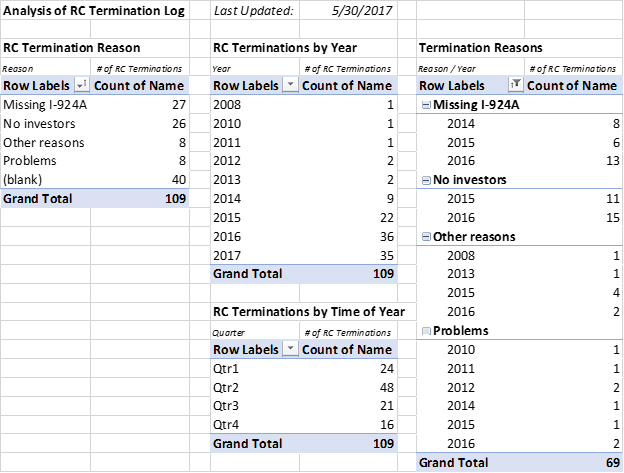
USCIS has terminated 109 regional centers over the past decade, and 23 regional centers in May 2017 alone. This month USCIS also initiated a page for Regional Center Termination Notices, with most notices up to November 2016 posted so far. The page explains that “USCIS will remain consistent and committed to transparency in the EB-5 program by proactively publishing Regional Center termination notices as they become available. This is an important step in assisting investors, the EB-5 industry, and the public to understand the reasons why a regional center has been terminated and what types of regional center activities may trigger the end of a regional center’s designation.”
I’ve started a Termination Log spreadsheet (also linked to my RC List page for ongoing reference) to correlate USCIS’s terminations list with its notices list, and facilitate analysis. Pivot table analysis of this log provides a quick overview of termination reasons (from the 69 termination notices posted so far) and timing.
In fact the termination notices are not very informative (most reference Notices of Intent to Terminate, which are not attached, for specific reasons), but we can generally learn that about 77% of RC terminations from 2008 through November 2016 occurred for one of two reasons: failure to file an I-924A annual report, or the fact that the I-924A report reflected inactivity (i.e. no investor petitions in three or more years). Just 12% (notices for eight regional centers) referenced problematic behavior by the regional center as a basis for termination. Other reasons include the regional center’s voluntary request to withdraw from the program. One letter dated July 13, 2016 explains “USCIS notes counsel’s request to withdraw from the program. The mechanism to end a regional center’s designation, whether initiated by the regional center or USCIS, is termination of the designation.” (This particular letter could’ve raised on-going FBI investigation as a termination issue, but that’s another story.) The Final Fee Rule published 10/24/2016 confirms that a regional center may elect to withdraw from the program, but does not offer an exit more dignified than termination. “A regional center may elect to withdraw from the program and request a termination of the regional center designation. The regional center must notify USCIS of such election in the form of a letter or as otherwise requested by USCIS. USCIS will notify the regional center of its decision regarding the withdrawal request in writing.” This is a pity, as the terminated regional center list looks like a walk of shame, and I think voluntarily withdrawal should be treated differently from termination initiated by USCIS.
Legal Win for EB-5 Investors
Investors who think they’ve fallen victim to errors by USCIS will be interested in this long but ultimately successful battle by a group of EB-5 investors.
- 2013: Twelve EB-5 investors file I-526 petitions based on investment in a regional center hospital project that sought to qualify as a troubled business
- 2013-2015: USCIS denies the I-526 petitions, and then denies Motions to Reopen filed by the petitioners. The petitioners appeal the denials to the Administrative Appeals Office.
- March to May 2016: AAO posts decisions dismissing appeal of I-526 denials (for example, MAR252016_02B7203)
- April 2016: Four petitioners file civil action against USCIS in district court: Wei Gan v. USCIS
- May 2017: USCIS and the plaintiffs resolve the case
- May 2017: AAO posts decisions sustaining appeal of the previously-denied I-526s (For example, MAY182017_01B7203. Other May 18 2017 decisions sustain appeals for other investors in the same project)
Trends, Pitfalls, and Ethics in Working with Overseas Agents
China Market Demand Trends
Ronald Fieldstone reflects on a recent China trip in his post EB-5 Marketplace Measurement – China and Beyond (May 25, 2017). We’re reminded of the extent to which demand shapes supply in EB-5 investment.Agent Marketing Claims
The Kushner Companies EB-5 roadshow in China continues to reverberate, with Senator Grassley mining it for yet another press release, this one calling for investigation of the Chinese agent involved, and its sales claims. (Grassley Seeks Investigation of Companies’ Promises of Green Cards 5/25/2017.) The regional center has protested to journalists that the senator’s allegations are baseless in this case, but all regional centers can take the reminder to double-check what their agents overseas are saying and posting online. Also keep in mind IIUSA’s best practices for engaging with sales intermediaries.Ethics for US Lawyers Retained by Migration Agents
Lawyers who deal with overseas agents in EB-5 may be interested in a March 2017 Ethics Opinion by the New York State Bar Association. The opinion discusses conditions under which a lawyer may enter into an arrangement whereby a nonlawyer “foreign migration agent” hires the lawyer on behalf of the client and assists the lawyer in communicating with the client. Cyrus Mehta explores the matter further in his post EB-5 Green Card, Ethics and Trump (May 22, 2017).
DHS Director and EB-5
Lee Francis Cissna, President Trump’s nominee for Director of USCIS, committed to finalizing EB-5 reforms in his Senate Judiciary Committee hearing last week. In other words, new EB-5 regulations are still on the table. Mr. Cissna spent much of the past two years working for Senator Grassley on immigration issues, and reportedly wrote dozens of the letters sent under the senator’s name to Homeland Security officials. This does not bode well for his attitude to immigration generally or EB-5, though he made a nice statement at the hearing.
Regional Center List Changes
Additions to the USCIS Regional Center List, 05/08/2017 to 05/30/2017
- Atlantic Casino & Entertainment Group Regional Center (Delaware, Maryland, New Jersey, Pennsylvania)
- New York Immigration Regional Center (Connecticut, New Jersey, New York, Pennsylvania): www.goeb5nyc.com/
- American Family Regional Center (Washington)
New Terminations
- Dallas Regional Center (Texas) Terminated 5/22/2017
- East Plumas County Regional Center, LLC (California) Terminated 5/22/2017
- Immigration Funds LLC (former name United States Investors Regional Center) (Maine, Massachusetts, New Hampshire) Terminated 5/22/2017
- Ohio Regional Center, LLC (Ohio) Terminated 5/21/2017
- EB5 Express Regional Center (California) Terminated 5/18/2017
- Arkansas Regional Economic Development Center, LLC (Arkansas, Oklahoma) Terminated 5/16/2017
Art District Los Angeles Regional Center, LLC (California) Terminated 5/16/2017(this RC was removed from the terminated list and added back to the approved list on 6/19/2017)
- The Z Global Corporation Regional Center (California) Terminated 5/16/2017
- Mariana Stones Corporation Ltd. (Guam) Terminated 5/15/2017
- NatureAll Co., Inc. EB-5 Regional Center Terminated 5/15/2017 (New Jersey)
- USA Regional Center, LLC (California) Terminated 5/15/2017
- Eight Islands Regional Center, LLC (Hawaii) Terminated 5/3/2017
- Diamond City Montana EB-5 Regional Center, LLC (Montana) Terminated 5/10/2017
- New York Pioneer Regional Center (New York) Terminated 5/3/2017
- Optima Arizona Regional Center, LLC (Arizona) Terminated 5/3/2017
- Puget Sound RC, LLC (Washington) Terminated 5/3/2017
May 11, 2017 Leave a comment
The media is still full of EB-5 stories, but many reports struggle to explain EB-5. Are we selling citizenship? Is this a cash-for-visas program? Why would a luxury project by celebrity New York developers get to benefit from immigrant investment?
Strictly speaking, EB-5 is not a visa-for-cash program but a visa-for-employment program. The “EB” in EB-5 stands for Employment Based. While some countries do sell citizenship, Congress took care to set up the US program differently. An EB-5 investor can get conditional permanent residence for making a qualifying investment that will result in creation of at least 10 jobs, and may eventually get a permanent green card if the investor sustains the investment and can go on to demonstrate that jobs were in fact created. Cash alone does not win EB-5 status.
Another distinctive feature of the US investor visa program is that it involves private sector investment, not government-sponsored or government-controlled investment opportunities. The prospective immigrant is free to choose to invest in anything from an Iowa farm to a New Jersey skyscraper, and may apply for a visa if job creation and other requirements can be met. Senator Grassley would like the EB-5 investor to chose the Iowa farm, and the investor might prefer it as well if the government bore the risk and responsibility for the choice and replaced market forces in underwriting the investment’s success. The government makes no such offer, however, and the investor is left to decide which private investment opportunity is most suitable. The government influences application of immigrant investor capital in two ways: by defining requirements for EB-5 eligibility, and by offering incentives. An eligible EB-5 investment must be at-risk investment of a certain amount in a for-profit enterprise that creates a certain number and kind of jobs, among other requirements, and the “Targeted Employment Area” incentive with reduced investment was designed to reward investment in high-unemployment and rural areas.
Some observers are concerned that the TEA incentive hasn’t functioned as intended, and that EB-5 investor capital is benefiting the wrong places and the wrong people. Others worry that the investment and job creation requirements need to be more robust to realize Congressional intent. EB-5 reform legislation targets these issues, as do proposed regulations from DHS. And to quote a White House spokesman, the administration “is evaluating wholesale reform of the EB-5 program to ensure that the program is used as intended and that investment is being spread to all areas of the country.”
For additional reading, see my post with comparison of investor immigration programs worldwide based on a Migration Policy Institute report, and my summary of TEA incentive proposals in proposed regulations and legislation (now significantly revised and expanded, and I welcome additional corrections).
May 7, 2017 2 Comments
Now that we’ve celebrated the good news of regional center program extension to September 30, 2017, here’s some concerning news to keep in focus as well.
Regional Center List Changes
Additions to the USCIS Regional Center List, 04/17/2017 to 05/08/2017.
- First American Redevelopment Regional Center (California)
New Terminations:
- North American Center for Foreign Investments, LLC (California) Terminated May 1, 2017
- Westgate Orlando Regional Center, LLC (Florida) Terminated May 1, 2017
- New York Green Hotel Regional Center LLC (Connecticut, New Jersey, New York) Terminated May 1, 2017
- DRC Capital Partners, LLC (Arizona) Terminated May 1, 2017
- E&W Lake Tahoe Regional Center LLC (California) Terminated May 1, 2017
- ACIC Management, Inc. Regional Center (Washington) Terminated May 1, 2017
- PetroSam, LLC (Texas) Terminated May 1, 2017
- Alaska Gold & Mining Regional Center, LLC (Alaska) Terminated April 21, 2017 Liberty West Regional Center (Arizona, California) Terminated April 19, 2017
April 26, 2017 1 Comment
In case anyone would like to review it, here is a link to my audio recording and copies of the slides from today’s webinar on the revised Form I-924 Application for Regional Center Designation. (6/2017 UPDATE:You can now get the sound and slides together, as USCIS has posted a recording of the webinar.) The big news was a comment that the page for the March 3, 2017 EB-5 stakeholder meeting now contains remarks from Lori MacKenzie modifying what she had said at the meeting about geographic area amendments. My original blog post complained about this buried new policy posting, but shortly thereafter USCIS sent out a stakeholder email and posted a statement prominently on the EB-5 section of the USCIS website.
Update to EB-5 National Stakeholder Engagement Remarks: Regional Center Geographic Area Amendments and Form I- 526 Petition Eligibility
On March 3, 2017, USCIS held an EB-5 national stakeholder engagement. This national engagement was part of our ongoing effort to enhance dialogue with our stakeholders in the EB-5 program. Remarks from the EB-5 national stakeholder engagement are available here.At the engagement, USCIS noted that a May 2013 policy memo had previously provided guidance that a formal amendment was not required to expand a regional center’s geographic area, and permitted concurrent filing Form I-526, Immigrant Petition by Alien Entrepreneur prior to approval of the geographic scope amendment. The May 2013 guidance was superseded by the recent publication of the final Form I-924 ,the Application for Regional Center Designation Under the Immigrant Investor Program and instructions. The I-924 revisions included changes to the Form I-924 instructions and require that regional centers file a Form I-924 when seeking an expansion of their geographic area. The revised Form I-924 became effective on December 23, 2016, following publication of the revisions in draft form in the Federal Register in May of 2016, and a period during which the public had the opportunity to comment.
During the engagement, USCIS addressed questions regarding how requests to change a regional center’s geographic area should be filed and the timing of such a filing. Specifically, where a regional center has a filed and pending Form I-924 amendment requesting an expansion in geographic area, stakeholders asked whether or not Form I-526 petitions may be filed prior to approval of the I-924 amendment, relying on such proposed expanded geography. USCIS has reviewed stakeholder concerns raised during the engagement and has updated the engagement remarks to clarify how the agency is implementing the above policy. Specifically:
- Where the regional center’s geographic area expansion request was submitted either through a Form I-924 amendment or Form I-526 petition filed prior to February 22, 2017 (the date on which use of the new Form I-924 became mandatory), and the request is ultimately approved, USCIS will continue to adjudicate additional Form I-526 petitions associated with investments in that area under the guidance reflected in the May 30, 2013 policy memo.
- Any requests for geographic area expansion made on or after February 22, 2017 will be adjudicated under the current guidance; namely, a Form I-924 amendment must be filed, and approved, to expand the regional center’s geographic area.
- For geographic area expansion requests made on or after February 22, 2017, the Form I-924 amendment must be approved before an I-526 petitioner may demonstrate eligibility at the time of filing his or her petition based on an investment in the expanded area. Form I-526 petitioners who believe they may be unable to demonstrate eligibility at the time of filing on this basis may wish to contact USCIS at ipostakeholderengagement@uscis.dhs.gov.
Sincerely,
USCIS Public Engagement
And here, since the I-924 Form and Instructions are apparently our new venue for policy guidance, is the official word on amendment requirements.
Quoted from the I-924 Instructions (version expiring 12/31/2018), page 1
Request an amendment to a previously approved regional center.
A. You must file an amendment to:
(1) Seek approval for any changes to the regional center’s name, ownership, or organizational structure, or any changes to the regional center’s administration that affect its oversight and reporting responsibilities, or to add or remove any of the regional center’s principals, immediately following the changed circumstances; or
(2) Change the geographic area of a regional center.
B. You may also file an amendment to:
(1) Change the industries of focus of the regional center;
(2) Add a new commercial enterprise associated with the regional center and/or seek a preliminary determination of EB-5 compliance for an exemplar Form I-526, Immigrant Petition by Entrepreneur, for that new commercial enterprise, before individual entrepreneurs file their petitions; or
(3) Notify USCIS of changes in the name, organizational structure or administration, capital investment instruments, or offering memoranda (including changes in the economic analysis and underlying business plan used to estimate job creation) for a previously added new commercial enterprise associated with the regional center.
NOTE: An I-924 amendment is not required to report changes of address, contact information, a change of duties among the regional center principals, changes to non-principal managing companies, contracting agents or similar changes, or information described in Item 2.B. above. The regional center must notify USCIS within 30 days of such changes. Notification of these changes can be made by sending an email to the EB-5 Program mailbox at: USCIS.ImmigrantInvestorProgram@dhs.gov. USCIS will review any changes submitted by email and may require or recommend, as appropriate, the regional center to file an I-924 Amendment.
“You must file an amendment to seek approval for….” sounds like it could be discretionary (i.e. you needn’t file an amendment if you’re not seeking approval for…), but apparently it isn’t. (Previously, IPO said that I-924 amendment was recommended to seek approval for management changes, with an option to just notify the IPO email box. No longer.) Today’s webinar slides restated the I-924 instructions as “You must file an amendment in case of…,” and the presenter said that the required amendment must not only be filed but also approved. (But approved “before what”? This point doesn’t go without saying. Before I-526s are filed? Before I-526s can be approved? Before the regional center can take any action at all? IPO needs to clarify the “before what” for each required type of amendment, and whether the requirement is to file or file plus wait for approval.)
Otherwise, today’s webinar mainly just read through the new Form I-924 content, pointing out changes for the benefit of people who hadn’t previously noted just how much the form changed, or implications of those changes. The audience asked few questions. USCIS emphasized two concerns behind Form I-924 revisions: vetting regional center principals and managers, and limiting geographic area. The revisions take effective steps toward the first objective, but make little difference to the second. Geographic area requests are limited only by imagination and chutzpah so long as USCIS continues to allow and even encourage applicants to base their requests on hypothetical/fictitious projects.
April 20, 2017 5 Comments
Two important new press releases:
Meanwhile, a 4/19 post by Miller Mayer reports on a version of EB-5 reform legislation that I haven’t even seen, though Miller Mayer says “all major EB-5 industry representatives have agreed to this tentative compromise.”
April 6, 2017 Leave a comment
In his testimony before the House Judiciary Committee in February 2016, Investor Program Office Chief Nicholas Colucci discussed how much USCIS has done to improve its administration of the EB-5 program, with particular focus on adding resources to prevent the kind of fraud and abuse that can come with investment and immigration.
Over the past few years, USCIS has taken a number of steps to improve the administration of the EB-5 program. In 2013, USCIS realigned the EB-5 program into the Immigrant Investor Program Office, and relocated it from USCIS’ California Service Center, which adjudicates various immigration benefits, to Washington, D.C., with a Chief dedicated exclusively to EB-5 adjudications. As the United States Government Accountability Office (GAO) noted in its August 2015 report to Congressional requesters on the EB-5 program, this move was part of a restructuring to help USCIS better detect fraud. USCIS also created a Fraud Detection and National Security EB-5 Division (FDNS EB-5) and embedded its personnel within IPO to work alongside adjudications officers. Additionally, a dedicated team of attorneys from the USCIS Office of Chief Counsel advise on program-related legal matters. In staffing the IPO, USCIS has, and continues to invest in the specialties needed to manage the complex EB-5 caseload by hiring staff with expertise in economics, law, business, finance, securities and banking to review cases and to enhance consistency, timeliness, and integrity within the program….
USCIS has taken its responsibility to administer the EB-5 program very earnestly, through its specialized staffing devoted solely to this program and its extensive efforts to regulate the quickly growing regional center program. However, no agency can do this alone. The EB-5 program necessitates collaboration with several other agencies, and the establishment of IPO in Washington, D.C. allows USCIS to work closely with partners such as the U.S. Securities and Exchange Commission (SEC), with whom IPO shares a robust collaborative relationship. USCIS also works closely with its sister agency, U.S. Immigration and Customs Enforcement (ICE), as well as with the Federal Bureau of Investigation (FBI) and the U.S. Department of State, in support of our oversight of the EB-5 program.
Improvements have covered staffing, inter-agency collaborations, and improved processes for important functions such as vetting lawful source of investor funds (as further explained in follow-up testimony — see especially Question 15 in response to Senator Grassley and Question 5 in response to Dianne Feinstein.)
This week’s breaking news story Feds raid San Gabriel, Arcadia locations over visa-fraud scheme involving criminals on China’s most-wanted list reminds us why those improvements were so important. The case, as described in an Application for Search Warrant filed by an FBI investigator, indicates that USCIS approved I-526 petitions from 2009 to 2012 that (if FBI evidence is correct) should never have been approved — including cases that involved people who did not invest their own funds, people who were promptly refunded their investments, and three individuals listed on China’s most wanted list for financial crimes. The good news is that the net since 2013 seems to be holding. The warrant does not indicate that any investors named in the investigation have been able to to get permanent green cards (though several have had I-829 petitions on file since 2012, possibly pending this FBI investigation which seems to have started in 2013), and the post-2013 I-526 petitions discussed in the warrant are likewise pending. The investigation stands as evidence that people may try to get away with fraud and abuse — but not that they get away with it. Investors who may have been complicit have not successfully completed the immigration process, and the regional center principals have had the FBI at their heels (sometimes literally: “at approximately 11:13 a.m., observed TAT exit SUBJECT PREMISES #2’s front door and walk across the street, after which he talked to a gardener, and then returned and entered SP#2. At 11:45 a.m. observed TAT exit SP#2 and go to the mailbox in front of the residence and retrieve mail. At 12:13 p.m. observed TAT walking from SP#2 carrying a black-colored briefcase-sized soft bag in his hands. TAT then walked across the street.”) and are now facing formal fraud investigation. Dozens of good faith investors in CIIF offerings and anyone with CIIF who’s innocent of fraud are unfortunate collateral damage, and I wish for their sake that the FBI had worked more quickly. (Updates: Some investors have filed suit in civil court to try to get their money back, and Federal Prosecutors have filed civil complaints seeking asset forfeiture. Victoria Chan has pled guilty to fraud and money-laundering charges.)
April 5, 2017 Leave a comment
Note: The subtext to this webinar may be the storm over IPO’s claim that the revised Form I-924 justifies the new policy to require amendment approval for expanded geographic area prior to I-526 filing. However, the invite doesn’t solicit any advance comments or indicate whether the event will allow questions.
From: U.S. Citizenship and Immigration Services [mailto:uscis@public.govdelivery.com]
Sent: Wednesday, April 05, 2017 10:34 AM
Subject: USCIS Invitation: Form I-924, Application for Regional Center Designation Under the Immigrant Investor Program, 04/26/2017
Dear Stakeholder, U.S. Citizenship and Immigration Services (USCIS) invites you to participate in a webinar on Wednesday, April 26, from 1 to 2 p.m. to discuss the Form I-924, Application for Regional Center Designation Under the Immigrant Investor Program. This webinar will discuss certain changes to the Dec. 23, 2016 edition of Form I-924.
Form I-924 is used by any economic unit, public or private, in the United States that is involved with promoting economic growth (including increased export sales, improved regional productivity, job creation, or increased domestic capital investment) to:
- Ask USCIS to be designated as a regional center under the Immigrant Investor Program; or
- Request an amendment to a previously approved regional center.
Form I-924 and its instructions are available at https://www.uscis.gov/i-924.
To Register:
Please email ipostakeholderengagement@uscis.dhs.gov with your full name and the name of your organization. Also, please place “I-924 Webinar” in the subject line. Once we process your registration, you will receive a confirmation email with additional details.
If you have any questions regarding the registration process, or if you have not received a confirmation email within two business days, please email us at the same address.
Note to Media: This engagement is not for press purposes. Please contact the USCIS Press Office at (202) 272-1200 for any media inquiries.
We look forward to engaging with you!
April 4, 2017 6 Comments
Washington Updates
- Legislation: Another piece of EB-5 legislation has been thrown into the ring – this one from Rand Paul: S.727 Invest in Our Communities Act. Dianne Feinstein made an extreme bargaining statement with S.232, which threatens to eliminate the EB-5 program entirely, and Rand Paul’s bill takes the opposite pole – offering to make the regional center program permanent with more visas for everyone, better processing times, more investor protections, reasonably limited integrity measures, and no changes to the investment amount or Targeted Employment Area incentive. I’ve entered S.727 in my bill comparison chart, but I guess it lacks sufficient compromise to gain traction (and the similar S.2122 from Mr. Paul in 2015 didn’t go anywhere) . I can’t guess what will happen between now and April 28, but am following what The Hill has to say about prospects for a continuing resolution or omnibus spending bill. UPDATE: An April 6, 2017 letter from Senators/Representatives Grassley, Leahy, Conyers, Goodlatte, and Feinstein encourages Congressional leadership not to extend the RC program on April 28 unless accompanied by reforms. (Then why don’t any of these people introduce reform legislation??)
- Regulations: Recall the April 11 deadline if you want to comment on USCIS proposed EB-5 regulations USCIS 2016-0006 and USCIS-2016-0008. So far, 0006 (with proposed TEA and investment amount changes) has 54 comments and 0008 (the advance notice requesting feedback on regional center designation issues) just 11 comments.
Other Resources
- Wolfsdorf Rosenthal and EB-5 Insights have posts about a new kind of source of funds RFE that requests SOF evidence for people transfering funds on behalf of an EB-5 investor.
- Carolyn Lee discusses the newly-unveiled regional center compliance audit program.
- A journalist called to ask me for the story behind the surge of regional center terminations in 2015 and 2016. In case anyone else is interested in this topic, here are the sources I sent him.
RC List
Additions to the USCIS Regional Center List, 03/01/2017 to 04/03/2017:
- Coastline Regional Center (Washington)
- Extell Utah Regional Center (Utah): eb5extell.com
- Mainsail Florida Regional Center (Florida)
Removed from the list of terminated RCs, and restored to the list of approved RCs:
- South Dakota International Business Institute (SDIBI) (South Dakota)
New Terminations:
- San Gabriel Valley Regional Center (California) Terminated 3/15/2017
- Washington Center for Foreign Investment, LLC (Maryland) Terminated 3/28/2017
By the way I work hard to keep my blog Regional Center List complete and consistent with information from USCIS, but the task is not easy and I welcome regional centers to correct my information.

 EB-5 Updates