This post checks in with the backlog of EB-5 applicants with priority dates before March 15, 2022 who are still waiting for Unreserved visas.
The pre-RIA EB-5 backlog is spread across several locations. The following list notes the places where applicants may be waiting, and available information on inventory and progress for each location.
I-526 still pending
1,105 pre-RIA I-526 remained pending as of September 2025. These people mostly have old priority dates (the FY26 Q1 median processing time was 78.5 months) and many will likely be denied in the end. (The FY26 Q1 legacy I-526 denial rate was 49%, with just under 200 petitions processed.) This pool likely represents few future visa applicants.
I-526 approved but no I-485 or visa application filed yet
This number is unreported, but should be small and mainly limited to China-born applicants waiting for Chart B. (One might guess the number by comparing I-485 and NVC applicants with expected numbers given I-526 receipts and approvals and visas issued, but I haven’t tried.)
I-526 approved and I-485 pending for adjustment of status
For pre-RIA, this pool should be just a bit smaller than the total pending I-485 inventory, for which we now have data through January 2026. See below for detailed inventory charts. As of January 2026, the pending pre-RIA Unreserved I-485 inventory was roughly 4,000, including around 3,000 from China, 500 from India, and 600 from Rest of Word. The inventory grows as the Visa Bulletin moves China Chart B and more I-485 get filed, and shrinks as visas get issued. It appears that in FY2026 Q1, AOS Unreserved visa issuance may have been around 100 to China, 220 or so to India, and 75-150 to Rest World.
I-526 approved and registered with the National Visa Center, waiting for consular processing
Department of State used to regularly report on the NVC inventory, but has not updated the official NVC waitlist report since 2023. The last available data is thanks to an IIUSA conference presentation in May 2024. As of May 2024, the NVC waitlist recorded 31,255 pending EB-5 applicants from China, 2,541 from India, and 5,774 from Rest of World. We can guess how many remain today by looking at I-526 approvals and consular visa issuance since May 2024, and guessing how the NVC inventory has been increased since 2024 by petition approvals and decreased by visa issuance, denials, giving up, etc. I guess that the NVC waitlist now has more than 20,000 but fewer than 25,000 pre-RIA applicants still waiting. See below for available detail on EB-5 Unreserved visa issuance in FY2025.
The data file linked to my EB-5 Timing page collects pre-RIA data on the Pre-RIA Data tab, and sets up a current backlog estimate by country on the Unreserved tab. Feel free to work with the data and add your own assumptions.
EB-5 Unreserved I-485 Inventory Detail
The following tables summarize the latest information about the pre-RIA Unreserved I-485 inventory in the reports “Pending Applications for Employment-Based Preference Categories” just published by USCIS for October 2025 to January 2026. One can get a rough sense of I-485 processing activity by looking at inventory differences month-to-month.
FY2025 Consular Visa Issuance
Official and exact FY2025 visa issuance numbers will not be available until Department of State publishes the next annual report. But I made a preliminary rough estimate by summing monthly reports for EB-5 Unreserved visa issuance from October 2024 to September 2025. I used yellow shading to highlight countries who are now blocked/limited by January 2026 executive orders from visas and entry. Sorry $800,000 investor in our economy — you can’t come into our country because you’re congenitally likely to use welfare [face palm]. But congrats to everyone who managed to get EB-5 visas before the 2026 orders, including 10 from Chad, my happy childhood home.
This report looks as if it gives useful information about the EB-5 visa backlog, but it does not. It gives a very specific data point: the number of I-526 petitions that USCIS has approved, as of the report date, that have priority dates later than the Final Action Date in the concurrent Visa Bulletin.
This data point would be meaningful if the Visa Bulletin never retrogressed, and one could assume that everyone with an I-526 approval later than today’s Visa Bulletin’s Final Action Date has no visa yet. But that assumption does not hold in EB-5, given the final action date swings for China and India in recent years. So the USCIS report does not show the backlog of people still waiting for EB-5 visas, or reflect progress in issuing visas. The table below puts the most recent September 2025 USCIS report in context of the referenced Visa Bulletins and past USCIS reports.
For example, the number of “approved I-526 awaiting visa availability” for China plummeted from over 30,000 in the June 2025 USCIS report to under 15,000 in the September 2025 report. That difference tells us nothing about visa issuance or processing activity between June and September 2025. The different Visa Bulletin dates in June and September caused USCIS to be counting a different segment of I-526 approvals for each report. We can conclude from the report comparison that about 15,000 approved China I-526 have priority dates between January 2014 and December 2015. That’s about all we can conclude. The USCIS report cannot mean that these principals mostly don’t have visas yet, since Department of State has been issuing visas past January 2014 for years already per past Visa Bulletins. The report also cannot mean that these principals just received visas, since 15,000 visas cannot have been issued to China between June and September 2025.
Looking at the India column, I compare the USCIS reports from December 2022 and September 2025 — a relatively apples to apples comparison because the Visa Bulletin had a Final Action Date in November 2019 for India in each of these months. The comparison tells me that USCIS had processed more of its post-2019 I-526 inventory by 2025 than it had as of 2022. I cannot conclude that most or all of the 470 Indian investors who had gotten I-526 approval by September 2025, according to the USCIS report, did not also have a visa already by September 2025.
Note
Is this analysis helpful for you? Please consider making a contribution to support all the work that goes into it. I have set up Paypal and Stripe links, and can also offer individual consulting.
I take each month’s inventory report and compare it against the previous month, to get a sense of visa activity. For example, the inventory of China Rural I-485 with December 2022 priority dates shows 61 pending forms as of October 2, 2025, down to 53 on November 3rd, 51 on December 3rd, and 50 on January 2nd. I look at those numbers and guess that 11 Rural visas may have been issued in FY2026 Q1 to China-born Rural applicants with December 2022 priority dates.
If net deductions from the I-485 inventory roughly represent visas issued, then over 800 set-aside EB-5 visas were issued through status adjustment in the first three months of FY2026. That’s twice the average quarterly AOS volume for set-asides in FY2025 — a good sign so far as it goes. If FY2026 set-aside visa issuance overall can double last year’s volume, then all available set-aside visas can be used this year. I note, however, that I-485 movement started strong in October and then tapered off in November and December. We shall see what happens next.
As usual, I-485 inventory deductions were spread over a wide range of priority dates — a reminder that the process is not exactly FIFO by priority date. Activity continued to be particularly concentrated in the Rural category, and on India-born applicants. I note that the I-485 inventory does capture some pending Infrastructure applicants, but with numbers small enough to be redacted with the letter “D”. The following table highlights interesting stories in the I-485 data.
Consular Processing Update
Department of State has posted the Monthly Immigrant Visa Issuance report for September 2025, completing FY2025. I am disappointed to see no year-end surge in consular Unreserved visa issuance (which I’d thought might happen considering the year-end Visa Bulletin notes and date movement for China), but excited to see Infrastructure visas finally making the scoreboard.
Note
Is this analysis helpful for you? Please consider making a contribution to support all the work that goes into it. I have set up Paypal and Stripe links, and can also offer individual consulting.
Thank you again to USCIS for publishing a dedicated EB-5 report with country-specific and category-specific I-526/I-526E data. This detail is so important for backlog and wait time analysis, and now we don’t have to sue to get it.
The major news: EB-5 demand dropped overall in Q4 (particularly from China and India), and processing volume remained low overall. That means that the set-aside backlog growth rate slowed in Q4, and the near-term risk of Visa Bulletin retrogression did not increase very much. Meanwhile, approval rates remained generally high.
As usual, I copied the quarterly data into my spreadsheets and made a variety of charts that put the data update in context of wider trends.
All Forms Report Summary
For convenience, I made image excerpts of EB-5 data in the “All Form Types” report. Note that the Q4 table includes a column for median processing time in months for each form. The Fiscal Year table provides a nice summary of all EB-5 activity in FY2025.
IPO Productivity Trend
Overall, IPO processed about the same number of forms in Q4 as in Q3. A drop in the number of legacy I-526 processed was counterbalanced by a few hundred more I-526E and I-829 completions. But in context of past performance, IPO productivity still looks quite low.
Receipt and Processing Volume Trend
FY2025 ended with more investor petitions filed but fewer investor petitions processed than in the previous year. The following chart compares annual receipt numbers against (1) annual processing volume, and (2) the average number investors who can be accommodated in a year of visas. In years when receipts exceed processing volume, then pending petition backlogs grow. In years when receipts exceed annual investor visa numbers, then visa backlogs grow. FY2025 slightly shrank the pending petition backlog at USCIS, but grew the pipeline backlog of applicants seeking future visas.
I-829 Processing Trend
USCIS processed a few more I-829 in Q4 than in the previous quarter. The approval rate was 90% — a bit lower than previous quarters – and the median processing time inched up to 12.8 months.
Pre-RIA I-526 Processing Trend
A few legacy I-526 remain pending, but USCIS dramatically cut legacy I-526 processing activity in Q4. These unfortunate old petitions, previously held up by the Visa Availability Approach to China I-526 processing, are getting a lot of denials now (49% denial rate in Q4).
Post-RIA I-526, I-526E, and I-956F Processing Trend
I-526E processing picked up a bit in FY2025, but not nearly enough to close the distance with receipts. Denial rates remained low for regional center I-526E and high for direct EB-5.
USCIS has been processing a good volume of I-956F – more than enough to keep up with receipts and prevent a pending backlog. I note that I-956F project denials have increased slightly, which will eventually result in denials for I-526E associated with those projects.
Post-RIA Demand Trend
The report of I-526/I-526E receipts by country and TEA category shows some shifts in Q4 as compared with Q1-Q3. I-526/I-526E receipts dropped for both Rural and High Unemployment in Q4, and from both China and India. “Rest of World” demand picked up in Q4. I don’t know if this will prove a trend, but it would make sense as a self-regulating response to education about backlogs. I have wondered about a potential demand surge as the grandfathering deadline approaches, but no such surge had started as of July to September 2025, at least. The Q4 report continues to report “0” for Infrastructure I-526E filings in every month, though we know that Infrastructure I-526E were filed before September 2025. (For example…)
Note
Is this analysis helpful for you? Please consider making a contribution to support all the work that goes into it. I have set up Paypal and Stripe links, and can also offer individual consulting.
April starts the third quarter of the fiscal year – a prime time for Department of State to reassess progress with annual visa issuance and cut-off dates. I anxiously awaited the April 2026 Visa Bulletin, wondering whether we’d finally see a warning note for EB-5 along the lines of “It may become necessary to establish Dates for Filing and Final Action Dates to ensure that issuances in set aside categories do not exceed annual limits.” But, the April bulletin has no such note.
Looking back, the first-time EB-5 final action dates for China and Vietnam both came in a May Visa Bulletin, and were preceded by several months of warning notes. India got its first-ever EB-5 cut-off date in a July Visa Bulletin, with one warning in the previous month. (India EB-5’s second change from “Current” to a final action date came in the first Visa Bulletin of fiscal year 2023, with no prior warning.)
Considering the history, the continuing Visa Bulletin silence on set-asides — even to April 2026 — makes me guess that Department of State is not making good progress in issuing the 6,400 or so set-aside visas available in FY2026. (I look forward to hearing Charlie’s take on this next week, and appreciate WR Immigration continuing to post cautions about how to interpret/misinterpret the Visa Bulletin and AOS window.)
The April 2026 Visa Bulletin does repeat the general note that “Immigrant visa issuance rates for aliens from certain countries have decreased in light of various actions the administration has taken” and therefore “dates for filing and final action dates have been advanced across various immigrant visa categories” [allowing more visa issuance to those select aliens and countries not blocked by many administrative actions]. China Unreserved advanced from August 15, 2016 to September 1, 2016. The movement is small but could result in visas for quite a few applicants, considering that 5,334 Chinese investors filed I-526 between July 2016 and September 2016 (per IIUSA FOIA Request COW2017000616).
Just a note that I made a significant revision to the 2026 Backlog post published yesterday. (And to the corresponding Summary2 and Infra tabs in the Excel linked to my EB5 Timing page.) The calculation now reflects the monthly visa issuance data just published and — more significantly — more Infrastructure demand. A kind reader brought to my attention a couple large Infrastructure projects not previously on my list. Adding hundreds more Infrastructure investor slots to the log, plus a recent flurry of approvals, required striking most of my backlog analysis for Infrastructure. If only we had timely data from the government for reference, instead of having to piece together anecdotes! And once again, I’m impressed with the thought of how desperately EB-5 needs and deserves more visa numbers to support its demonstrated economic potential. The supply we’re working with is just too small, when one good project can overflow years worth of visas.
I shall claim credit! Hours after I finally gave up on government updates and published my important 2026 backlog post without new data, Department of State updated the Monthly Visa Issuance Statistics page for the first time in nine months. Now we know for sure how many EB-5 visas were issued through consulates in June, July, and August 2025. The numbers are about what I’d guessed — a bit higher for Rural and lower for High Unemployment, and higher for India and lower for China than I’d expected. But it’s really great to see solid numbers again, thank you DOS! Now we just need the NVC waitlist and FY2026 visa limit. The following pivot tables summarize FY2025 monthly consular visa issuance, now including June to August.
[3/6 UPDATE: I have updated the tables and Infrastructure discussion in this post after Department of State published some additional visa issuance data, and I became aware of two additional Infrastructure projects.]
Where are we with EB-5 visa backlogs and wait times as of early 2026?
I have been holding off on this article, thinking that USCIS and/or Department of State would publish more data any day. But the government has maintained its silence since May 2025 as to visa issuance, and silence since June 2025 about the progress of petition receipts and adjudications. But still, we can’t afford to just keep looking at old numbers and thinking as if it were still 2025. The ground has shifted.
This article reviews developments that appear particularly significant to me:
Set-aside backlog growth since last I-526E report
Significance of Unreserved visa availability and access
Infrastructure category activity and outlook
Processing sequence factors and changes
Visa bulletin outlook compared to backlog outlook
Set-Aside Backlog Growth
EB-5 backlog numbers, whatever they may be exactly, are certainly not the same as they were as of mid 2025. Industry chatter suggests undiminished incoming set-aside investor demand, even as the silent Visa Bulletin suggests on-going low set-aside visa issuance.
For a tangible reference in absence of recent EB-5 data, I made a napkin calculation. I took the FOIA numbers we have for I-526/I-526E receipts and approvals through July 2025, and advanced them to the present day with a simple assumption: what if the past seven unreported months mirrored the previous seven reported months. (This calculation is spelled out in the “Summary2” tab now added to my EB5 Backlog Analysis file linked on the EB5 Timing page, and also represented in image thumbnails below. With thanks again to AIIA and Alexandra George of Galati Law for getting data through FOIA as of January 2025 and July 2025, to Google and industry colleagues for Infrastructure intel, and to the government for publishing at least some data in 2025.)
The take-away: if the EB-5 train kept going at its previous reported rate, then by now over 30,000 people are in process heading toward set-aside visas, including over 15,000 each in Rural and High Unemployment, and potentially around 1,000 in Infrastructure. (I call these people “pipeline applicants,” meaning I-526/I-526E filed and investors plus family in the pipeline to claim visas eventually — though most don’t qualify for a visa yet since they are still waiting for the investor petition approval. For the sake of estimate, I make my typical assumption of average two future visa applicants per I-526/I-526E filed, after denials and with family, though the reality could turn out higher or lower than that.) Think about the wait times, if 30,000+ people are in queues headed for windows with just over 3,000 visas to give in a typical year.
Drilling down by country emphasizes set-aside retrogression risk for new investors as of March 2026. If every applicant in the high unemployment area pipeline had to take a high unemployment area visa, then even the new “rest of world” investor (not from China or India) would face a 6+ year HUA visa wait time and Visa Bulletin retrogression, while China-born and India-born investors would theoretically face multi-decade HUA visa wait times. That’s based on looking at the bottom line of the backlog table above — at the difference between pipeline applicants as compared with annual category visas: 6.9x excess for “rest of the world” in high unemployment (even if ROW gets all HUA visas above country caps) and a shocking 49x excess for India and 102x for China. Those massive HUA pileup estimates reflect what would happen if every high unemployment investor and family had to take a high unemployment visa, and if Rest of World demand continued as it has been. The calculation within Rural is less dire than for HUA, considering the double set-aside portion plus less excess demand from Rest of World. But the Rural inventory numbers are still high enough (and the supply numbers low enough) to add up to multi-decade wait times for China and India — if every Rural investor has to take a Rural visa. (But that shouldn’t be so, as further discussed below…)
Meanwhile, the Unreserved backlog has been shrinking. Pre-2022 investors from China and India have apparently been getting a good volume of visas, the Visa Bulletin is advancing dates, and few new investors are heading exclusively for Unreserved by making $1.05M investments.
The upshot: the backlog picture has flipped. When RIA passed in 2022, Chinese and Indian investors faced prohibitive legacy backlogs in Unreserved but clear lanes ahead toward Rural, High Unemployment and Infrastructure visas. For new investors in 2026, the greatest imbalance appears to be on the set-aside side.
Unreserved Visa Availability and Outlook
Once set-aside lanes are unquestionably overcrowded, the hope for a visa number has to depend on Unreserved visas being also on the table for today’s set-aside investors. We are to the point where, effectively, many new set-aside investors are not investing for set-aside visas. Incoming investors from China and India, in particular, are not counting on multi-decade waits for the corresponding set-aside visa. They are relying on the chance to also access Unreserved visas in priority date order, regardless of which type of investment they choose.
Concluding that today’s EB-5 visa wait times depend so heavily Unreserved visas, I have been sweating over the question of Unreserved visa access for set-aside investors.
On the positive side, the theory looks solid. I-526E approval notices for set-aside investors continue to list “Unreserved” as well as “Reserved” as “approved visa classifications.” Department of State published a process for consular applicants to request a visa category from among the options on the approval notice. Immigration lawyers mostly seem optimistic. (For example, listen to 11:30-22:11 in this February 2026 webinar for Carolyn Lee’s thoughtful response to my grilling on Unreserved visa access.)
On the positive side, the Unreserved category made a huge leap forward for India in the January 2026 Visa Bulletin, and may be about to advance quickly for China as well. (The March 2026 Visa Bulletin notes a windfall of extra visas headed for the countries not blocked by President Trump’s various visa orders). Until recently, I had been looking at 2024 data and typical allocations, and thinking that the pre-2022 Unreserved backlogs wouldn’t be out of the way until 2030 for India and the mid/late 2030s for China. Now it looks as if pre-2022 EB-5 priority dates might all be cleared from waiting lines by 2027 for India, and maybe even before 2030 for China. And then there would be opportunity for backlogged post-RIA set-aside investors from China and India to overflow into the larger Unreserved pool.
On the worrisome side, there isn’t friction-free access to Unreserved visas for set-aside investors. USCIS has not yet followed Department of State in establishing a process whereby an I-485 applicant can pro-actively request an Unreserved visa. It naturally hasn’t been a priority for USCIS in this period when set-aside visa supply has gone under-used anyway, but I’ll feel better when I see a process. I also worry about whether the new I-526E inventory management approach just announced by USCIS could limit I-526E adjudication according to set-aside visa availability, erecting another speedbump to Unreserved visa usage.
On the worrisome side, I watched and raged at what happened leading up to 2022, when a new law took 3,200 previously unreserved EB-5 visas and set them aside in new categories untouchable by the legacy backlogged applicants who had been counting on access to those numbers. (Reminded now of what I got right and wrong in old posts on this.) As TEA backlogs have now grown anew, could lobbyists today be dreaming of another carve-out to circumvent backlogs and reduce future unreserved visa availability to today’s investors? They had better not be, but I wish I knew for sure that this couldn’t happen. Prospective investors today must be able to rely on priority date/country-specific access to the full pool of Unreserved visas, or else they will stop considering Rural, High Unemployment, or Infrastructure investments in light of backlogs.
Potential Unreserved Visa Impact
What’s the best possible outcome, assuming no limits or friction to future Unreserved visa access for today’s set-aside investors? How good can visa wait times look, if we can assume that everyone already in process gets efficiently matched with the first qualifying category visa available, including Unreserved, according to priority date and country-specific priority?
As discussed above, the existing EB-5 pipeline to be accommodated by now appears to include about 20,000 old applicants who can only take Unreserved visas, plus 30,000+ applicants with more recent priority dates who could take their set-aside or an Unreserved visa. (The tables above show the numbers by country, and my linked spreadsheet shows the data, assumptions, and calculations behind the rough estimate.)
It would take five full normal EB-5 visa years to issue visas to 50,000 pipeline applicants if country and category limits didn’t apply, or if incoming EB-5 demand shortly stopped for good. When one tries grappling with country-specific and category-specific factors, and assuming on-going demand from Rest of World countries, the calculation can only get worse than the baseline for China and India, while looking better for Rest of World.
I made myself some big spreadsheets to work with the sorting question, experimenting with how the pipelines of Pre-RIA, Rural, High Unemployment and Infrastructure investors from China, India, and Rest of World might get optimally matched into available EB-5 visa pools (and react to a variety of scenarios on factors like family sizes and denial rates and ongoing demand). I can make my spreadsheet conclude that Chinese and Indian investors with priority dates through 2026 could all have been matched with visas by 2033 or so, regardless of the TEA category in which they invested. I’m not putting the spreadsheet on the Internet because it’s a low-confidence conclusion, with many assumptions and elaborate setup that take a lot of explanation and qualification. The reality could be shorter or much longer, particularly for individual cases.
Working with the models did impress a few overall conclusions on me. One: the estimated visa wait time differential between Rural and High Unemployment for India and China increasingly flattens as backlogs increasing depend on accessing Unreserved visas. Two: The market-favored “3-5 year” EB-5 visa wait time estimate looks vanishingly probable, at least in Rural and High Unemployment for China and India, even assuming optimized access to Unreserved visas. Given the sheer number of people who appear to be currently in process, not to mention ongoing demand, I can’t get my calculators to conclude moderate wait times for China and India in HUA or Rural — unless I start entering (what I consider) quite extraordinary assumptions about extra visa supply and/or applicant attrition. (Though not to say that the extraordinary is impossible, in these strange days.) The balance of probability looks to be on the side of greater-than-five-year visa wait times.
Infrastructure Outlook
[3/6 UPDATE: Thank you to the reader who emailed to notify me of two large Infrastructure projects not on my list. It now appears that over 400 Infrastructure investors may have been recruited by the end of 2025, meaning a multi-year backlog already in place in the Infrastructure category. See the Infra tab in my EB5 Backlog Analysis file for such detail as I’ve been able to find on infra projects, and email me if you can contribute any corrections or additional detail.]
What about the infrastructure category? In the last data release through July 2025, USCIS reported zero Infrastructure I-526E filed ever, not to mention zero petition approvals or denials. That must be a database glitch, as I’ve since confirmed reports of a few infrastructure I-526E filed before July 2025. But still, anecdotal evidence suggests that Infrastructure activity is recent and low-volume to date.
Based on the infrastructure project information that I can find from the Internet and by talking to people, I gather that 100 to 200 infrastructure investors may have been recruited by the end of 2025, and that over 1,000 infrastructure project slots are contemplated by the end of 2026. (See the Infra tab in my EB5 Backlog Analysis file for such detail as I’ve been able to find on infra projects, and email me if you can contribute any corrections or additional detail.)
For the investor from China or India, the recent activity means a tantalizing chance to be among the first <400 infrastructure visa applicants (in which case, clear path to a green card before the initial Infrastructure visa limit is reached and triggers the Visa Bulletin). On the other hand, the investor with an early 2026 priority date has no guarantee of ending up among the first wave of visa applicants. Even the earliest investors have no guarantee of snagging the first visas because I-526E processing and visa processing are not quite FIFO. And once Infrastructure demand collects and advances sufficiently to trigger country caps, Infrastructure supply suddenly becomes potentially tiny to China and India.
With supply so small – about 400 visas in the first year and 200 visas in subsequent years – the demand/supply imbalance can potentially go from 0x to 10+x very quickly. If every Infrastructure investor has to take an Infrastructure visa, then the China-born or India-born investor in 2026 faces a realistic chance of anywhere from zero visa wait time to a multi-decade wait time, depending on where he or she happens to sort out in the flurry of petitions coming in around the same time, and ongoing demand from Rest of World investors. On the other hand, assuming access to Unreserved visas, I assume that Infrastructure investors today are — at worst — no worse off than Rural and High Unemployment investors with the same priority date. Since country and priority date theoretically determine access an Unreserved visa, no matter if the investment was in a Rural, HUA, or Infrastructure project. Also, many Infrastructure projects also qualify in High Unemployment or Rural, further diversifying visa options.
Process Factors
My big picture analysis looks at applicants in the aggregate, assuming that groups proceed in order according to the distinguishing features of priority date, TEA category, and country of origin. The reality is not so tidy, and individual experience can vary widely.
Looking around in 2026, I note developments related to the confusing issue of who gets advanced when and why in the EB-5 process.
As of today, there appear to be more processing barriers in consular processing than status adjustment. There appears to be better opportunity for litigation to affect timing in the U.S. Applicants who happen to be currently based in the U.S. may, at least for awhile, enjoy a timing advantage over fellow-countrymen abroad with the same priority date.
The new I-526E inventory management approach now explicitly considers set-aside visa usage, which can result in changes going forward to processing order. I-526E processing in 2024/2025 varied over a wide range of dates, with a few people getting very quick processing times (and thus early chance at a visa) while others waited. I guess that those variations may be about to decrease.
I’ll guess that Mandamus actions, which may explain a lot of individual processing time difference in 2024/2025, have decreasing opportunity/effectiveness going forward for I-526E and visa issuance. Considering the new inventory management guidance, the sheer numbers now awaiting I-526E processing and visa issuance, and impending Visa Bulletin dates. I-956F timing should also have a decreasing effect on investor petition timing, as a greater proportion of the I-956F inventory has now been processed. But I-526E processing order, for good or ill, retains potential to help determine who gets a visa and and when independent of the priority factors that are supposed to control visa allocation.
Visa Bulletin Outlook vs Backlog Outlook
The long-term risk of visa wait times and retrogression follows the difference between total applicants in the pipeline as compared with visa availability in coming years. (When I say “pipeline visa applicants,” I mean everyone who’s started the process by filing I-526/I-526E and who doesn’t have a green card yet, regardless of where they are in processing.)
By contrast, the near-term risk of Visa Bulletin cut-off dates follows from the difference between currently-qualified visa applicants and visa availability/usage this year. (When I say “qualified visa applicants,” I refer to the subset of the pipeline who currently have I-526/I-526E approval and visa applications complete, ready and waiting for the visa interview/adjustment and visa number assignment.)
As of early 2026, we appear to remain in the situation where set-aside categories have many pipeline applicants but few qualified applicants. (Refer again to the tables copied above for detailed estimates from approval data vs receipt data.)
If trends as of early 2025 continued, then there just haven’t been enough I-526E approvals in HUA or Infrastructure yet to create sufficient applicants yet for FY2026 visas. (This may be about to change, as the I-526 inventory management change may spur more HUA and Infra processing.) If lacking qualified applicants for available visas, no wonder the Visa Bulletin keeps showing “current.” This is a total guess on my part (in absence of any 2026 data yet), but (betting on government dysfunction) I would be surprised if High Unemployment gets Visa Bulletin dates this year, and (considering recent demand) astonished if Infrastructure gets Visa Bulletin movement this year. [3/6 UPDATE: I have now been notified of a flurry of Infrastructure approvals in recent months, making Visa Bulletin movement for Infrastructure at least not impossible this year.]
Rural is more dicey for the Visa Bulletin, because a continuation of 2025 USCIS processing trends would’ve resulted in more than enough Rural approvals and qualified visa applicants by now to use FY2026 visas. No dates or warnings yet in the Visa Bulletin for Rural makes me infer that despite having applicants ready and waiting, Department of State is not yet on track – for its own processing reasons — to issue all the 4,000+ Rural visas available in FY2026. If consulates are continuing to move as slowly as last year on set-aside applicants, then there’s no need for the Visa Bulletin to step in and control visas that aren’t being issued anyway. I hope – for the sake of wait times long term – that visa issuance volumes will increase enough to justify Visa Bulletin dates for Rural shortly. But I won’t be very surprised if that doesn’t happen.
If FY2026 ultimately passes without any Visa Bulletin cut-off dates in EB-5 set-aside categories, that’s good for the concurrent filing window, good for anyone who wants to lie that backlogs don’t exist until announced in the Visa Bulletin, and bad for wait times in the long term because it reflects deferred backlog advancement and lost visas.
More Information
If you’d like to discuss specific visa and timing questions one-to-one, my paid timing consultation service remains available. You can book a Zoom meeting through my scheduler. (And if the payment or time zone options don’t work for you, email suzanne@lucidtext.com and I can set you up with an alternative.)
If you benefit from everything I share with the writing and spreadsheets, please consider making a contribution to support the research, thinking, and time behind them. I have Paypal and Stripe links available. This is really a lot of work, on the side of my regular business plan writing service, and the blog is uncompensated except when a few readers step in with support. I appreciate it!
I’m happy to report new USCIS data obtained via Freedom of Information Act by the investor association AIIA (with litigation by Galati Law). See AIIA’s new post AIIA FOIA Series: Updated I-526E Inventory Statistics for July 2025 for the data plus detailed analysis. The FOIA covers I-526/I-526E receipts, approvals, and denials by TEA category, petitioner country, and filing date from April 1, 2022 to July 31, 2025.
The TEA-specific I-526/I-526E approval and denial data through July 2025 is new and particularly interesting to me. I approach the data with two questions at top of mind. Have there been enough total approvals to create qualified applicants for available set-aside visas? (The timing of Visa Bulletin retrogression depends on this.) What does the distribution of approvals by TEA, country, and priority date tell us about how USCIS is choosing to process I-526 and I-526E petitions? (I-526/I-526E processing times depend on this.)
I’ve made three tables below that highlight lessons I take from the AIIA July 2025 data. The first table puts investor petition data in context of visa availability. It highlights the irony of Rural and High Unemployment: that HUA has the greater long-term backlog risk due to high number of investor filings, but lower near-term retrogression risk due to low number of petition approvals.The second and third tables highlight apparent differences in I-526/I-526E processing by TEA and country, and the extent to which the process isn’t FIFO.
I can’t make conclusions for all time based on data through July 2025. (I hope that processing volumes have increased and processing order has become more equitable since then!) But the FOIA data gives a very interesting look at what happened with set-aside investor demand and petition processing through the middle of last year. Once again, Infrastructure was a data blank in the USCIS report as of July 2025. (I guess this reflects a coding problem in the USCIS database, since I’ve heard of a few Infrastructure projects recruiting investors before July 2025. But Infrastructure numbers may indeed have been at least very low last year.) Meanwhile I continue to hit “refresh” daily on the USCIS data page, hoping for another quarterly report, and will support AIIA to pursue another FOIA request/litigation for the next six months of TEA-specific data.
USCIS has published another pending I-485 inventory report as of October 2, 2025. The December 2025 Visa Bulletin is out, with forward movement for EB-5 Unreserved and no notes about forthcoming Reserved dates. Department of State continues to not publish monthly visa issuance reports, not publish the FY2026 visa limit, and not publish the NVC waitlist. What can we learn? I look for insights into what happened with EB-5 visa issuance in FY2025, and hints for Rural, High Unemployment, and Unreserved outlook this fiscal year.
Rural and HUA Visa Issuance in FY2025
Rural and High Unemployment visa issuance through adjustment of status in FY2025 looks higher than I expected. Drilling down to month-by-month changes in I-485 inventory reports throughout the year, it appears that over 600 HUA and over 1,200 Rural AOS visas could have been issued between October 3, 2024 and October 2, 2025. With these numbers in AOS alone, it’s possible that DOS ultimately managed to issue at least the 1,150 HUA and 2,300 Rural carryover visas available in FY2025. If so, that would mean no transfer of unused FY25 carryovers to Unreserved in FY26 (and no net loss to Reserved, since FY25’s new-issue Reserved visas stay with Reserved in FY26).
Comparing monthly I-485 inventory reports merely shows changes, which aren’t all caused by approvals/issued visas. But the pattern continues to suggest that AOS visa issuance is far from orderly by priority date, and that Indian applicants have enjoyed an outsize percentage of I-485 processing activity. (Thank you to the reader who sent me his spreadsheet with data from each monthly I-485 report entered in tandem, facilitating a more granular analysis than my previous bookend-month comparison approach.)
Rural and HUA Visa Issuance in FY2026
It appears that the pace of Rural and High Unemployment visa issuance through consular processing must remain low in FY2026 to date. Considering the pace of I-526E approvals, there are probably 4,000+ Rural applicants and quite possibly 2,000+ High Unemployment applicants currently qualified and waiting for visas. But three months into FY2026, the Visa Bulletin is not yet warning about forthcoming Rural or HUA cut-off dates. I conclude that slow consulates have been organically controlling the crowd with low-volume interview scheduling, such that DOS currently still doubts the operational feasibility of issuing 2,000 HUA or 4,000 Rural visas this year. Slow-walking the Reserved visa backlogs is good for new U.S.-based investors who can keep using the concurrent filing window. It’s good for any salesmen who rely on lying that backlogs don’t exist until flagged in the Visa Bulletin. The consulate slow walk is bad for EB-5 investors abroad who fall behind U.S.-based applicants, and bad for wait times overall as the backlog can’t advance and dissipate on schedule.
Rural and HUA Demand Trends
Since I-485 are concurrently filed with I-526E, we can get a sense of recent I-526E trends by looking at priority dates in the I-485 inventory. No surprise, the numbers for July to September 2025 priority dates suggest that India-born Rural investors continue to drive U.S.-based EB-5 demand.
India Unreserved Backlog and Outlook
When will pre-2022 India Unreserved applicants finish getting visas? People keep thinking “in about a year” because the Visa Bulletin has been a tease. The India Unreserved Final Action Date moved to 2020 two years ago, and to 2022 last year, only to retrogress back and forth. The history shows that one can’t look at any given final action date and conclude “everyone with priority dates within this final action date can expect to get visas shortly.”
The December 2025 Visa Bulletin moved the Indian Unreserved FAD to July 1, 2021. Does this now mean that all Indians with priority dates before July 2021 could get visas shortly? Consider that FY2026 has a minimum of 470 and possibly up to 600 visas for India Unreserved (with the upside depending on as-yet unknown rollover/carryover visas) — and this allocation has to cover consular processing as well as status adjustment. The October 2025 I-485 pending report shows 475 pending I-485 for Indians with pre-July 2021 priority dates. DOS hasn’t published a recent NVC wait list, but it’s likely not empty. (For the record, 2,019 India Unreserved applicants were reported registered at NVC as of May 2024, and likely <1,200 India Unreserved visas have been issued through consulates since May 2024.)
With over 700 Indians still waiting in the U.S. for Unreserved visas, the pre-RIA India backlog could hardly clear this year even if India Unreserved applicants abroad had disappeared. Considering backlog numbers I think it’s safe to expect that the India FAD will retrogress again to 2019 shortly (November 2019 is the major hurdle to pass), and not permanently progress past 2022 for another couple years. This is a controversial question — if you have a different take, please explain it!
China Unreserved
When will pre-RIA China Unreserved applicants finish getting visas? The December 2025 Visa Bulletin moved the China Unreserved Final Action Date to July 14, 2016 – a leap forward from last month, but only returning to where the Visa Bulletin was a year ago for China. The pending I-485 report does not add much insight for China, since most China-born applicants get visas through consular processing. I will copy in for reference the last available breakdown of NVC applicants awaiting consular processing (as of May 2024).
As illustrated, 2016 priority date are a crowd to work through. (And the table captured only the subset of applicants at NVC, not including applicants on I-485 or I-526 pending at USCIS.) I look forward to the publication of an updated NVC waitlist (which should be significantly reduced following FY25 visa issuance and DOS efforts to cull inactive applicants) and recent numbers for visa issuance in Guangzhou (which might be higher than expected, given Visa Bulletin movement). And I copy for reference my comparison of USCIS I-485 inventory reports for China Unreserved from the beginning and end of FY2025 (though I’m not sure what to conclude from it).
Rest of World Unreserved
For countries other than China and India, when will pre-2022 applicants finish getting Unreserved visas? And are new investors choosing to request Unreserved visas? The I-485 inventory reports reflect what happened with status adjustment in FY2025. As usual, I puzzle over the question of order, and why some recent priority dates leave the inventory while older applicants remain pending. I also notice a small but increasing trend of post-RIA priority dates in the Unreserved I-485 inventory. I assume that the trend reflects Rural and HUA investors who decide to bet that an Unreserved visa might get issued first, considering the Rural and HUA crowds and the low rate of Reserved visa issuance to date. (Or some ROW applicants may be kindly requesting Unreserved to leave space for more Chinese and Indian investors to share the small Rural and HUA allocation). I expect the trend of ROW applicants requesting Unreserved visas to continue to increase, especially once enough HUA I-526E get approved to trigger Visa Bulletin cut-off dates for all countries in HUA.
Is this analysis helpful to you? Consider supporting my work with a contribution through PayPal or Stripe.
The EB-5 Backlog Analysis Excel file linked to my EB-5 Timing Page has received another significant update. I incorporated data now available through June 2025, and adjusted the analysis. As demand grows, so does the need to think creatively about timing. Is there a way to look at the EB-5 inventory numbers and conclude “relax, this is not a backlog problem?” Is it possible to calculate an attractive EB-5 visa path for investors from China and India? This is what I’m thinking as I sweat over Excel, trying to model in complications and nuances and imagine best-case scenarios for visa availability.
The Big Picture
We now know that up to June 2025, over 6,000 Rural investors and over 6,000 High Unemployment investors had started the EB-5 process. How long could it take those investors to finish getting visas, considering about 2,000 Rural and 1,000 HU visas to be shared annually by investors, spouses, and children? If 12,000+ investors become 24,000+ visa applicants going for about 3,000 annual visas, what could happen? What happens if we continue to attract 5,000 investors per year, even if all 10,000 annual EB-5 visas were available to give to new investors plus family? Can the situation be saved by one year of carryover visa issuance, by denial/attrition rates, by government reporting error, by category switching, and/or by extra visas?
The big picture problem is clear, but the details are complicated. I bother copying data into Excel and attempting models because there are a lot of moving parts and possible assumptions between what’s known about the waiting line and what we want to assess: prospective visa wait times. Below, a few comments on my recent revisions to the Excel file linked to my EB-5 Timing Page.
What Changed in the Model – Input Data
EB-5 waiting lines are changing in real time, as more people start the process daily while others move on with visas. The previous version of my Excel model was set up with projections assuming that then-unknown incoming EB-5 demand in 2025 was mirroring demand in 2024. Now with actual I-526/I-526E receipt data published through June 2025, we can start to correct that assumption. As it turns out, demand has been trending upward, with the first 9 months of 2025 already exceeding total I-526/I-526E filings in 2024. Two types of demand have particularly steep spikes this year: demand for Rural investments, and demand from India-born investors. More people getting in a line naturally lengthens expected wait times for that line over previous estimates.
And then there’s the question of queue movement: adjudication rates and visa issuance volume. When I originally set up the Excel model for backlog analysis, I didn’t account for past visa issuance because it had been so low at that point, and I optimistically assumed that Rural and High Unemployment petition approvals and visa issuance would finally reach volume in 2025. With that assumption, I assumed that 2025 carryover reserved visas would not be lost, and that country caps could shortly apply in response to high Rural and HU applicant volume. Those assumptions facilitated some simplified scenarios that I’ve now deleted from the model. Now we know that the Visa Bulletin never moved in FY2025, and that cap limits on China and India could be deferred for an extended time due to low visa issuance volume. Revising predictions in light of low backlog movement means assuming fewer total Rural and High Unemployment visas issued (worse for wait times overall), but more visas issued to China-born and India-born applicants (better for China/India wait time predictions).
What Changed in the Model – Alternate Approach
I’ve noted alternate approaches to backlog analysis: a basic approach that I’ve typically used, and the industry standard approach. The formula is the same, but the approaches solve for different variables.
In the industry standard approach, the result – that EB-5 wait times must be tolerable (i.e. “about 5 years or less”) — is entered as a given, and then one solves for the levels of failure, attrition, double-counting, reporting error, category-switching, and/or extra visas needed to achieve that result. I tried to set up the revised model to facilitate this approach, setting up scenarios where one can assign values to a variety of assumptions to make a quantitative bridge between A (available data on people in line) and D (the conclusion of a tolerable wait time).
The industry standard approach has validity, considering that the variables don’t represent inert data points but people with limited lives and patience who are only going to hold out for a green card for as long as is tolerable/possible/feasible. When my basic approach divides 6,000+ China Rural applicants by the minimum 140 annual Rural visas certainly available to China, the result “43+” can’t mean that anyone in real life will wait 43+ years for a visa. Factors like category-switching and attrition can result in actual visa issuance above the theoretical minimum, and in actual visa applicants below baseline expectation. But let’s not wave hands vaguely in the air over the factors, asserting that variables of unspecified value will add up to a preconceived wait time conclusion. One can start with available data, assign specific values to assumptions so that they’re open to consideration/critique, and show the work that leads to the desirable visa wait time conclusion. I’ve tried to set up my Excel file to facilitate that exercise, and invite others to improve on the attempt. I will highlight two tabs in the revised Excel model: the Unreserved tab, and the 5YR Scenarios tab.
What Changed in the Model – Unreserved Tab
The Unreserved tab is set up to assess when Unreserved visas could become available to post-RIA post-2022 priority dates. This is important, because Unreserved visas are technically available to Rural and High Unemployment investors (according to the codes on I-526E approval letters), but only practically available to applicants in order by priority date. Set-aside investors from China and India, who now face long lines in Rural and High Unemployment, need to know when they could start accessing Unreserved visas as well – i.e., when the Visa Bulletin will finally finish dispensing Unreserved visas to Chinese and Indians with pre-2022 priority dates, and able start moving on to later priority dates in 2022, 2023, 2024, 2025, etc. who haven’t managed to get Rural or HU visas yet.
I expanded the Unreserved tab by copying in the very most granular reported data available for the Unreserved backlog. Then I highlighted cells for adding assumptions about denials/attrition at multiple stages, double-counting, and future visa issuance, and set up formulas to calculate the impact of the entered assumptions. Try adjusting the assumption cells, and see what assumption values are required to reach your conclusion about the remaining size of the legacy Unreserved backlog, and remaining time to clear that backlog. Then consider the plausibility of the assumption values. (To assist the plausibility test, the tab includes data on number of I-526 filed 2014-2022, and the number of EB-5/Unreserved visas issued 2015 to 2024.)
What Changed in the Model – 5YR Scenarios Tab
The 5YR Scenarios tab is another attempt to tackle a top question from Rural and High Unemployment investors from China and India: What will happen with visa issuance in the next five years, and could my turn at a set-aside visa number come in that time? On this tab I first highlighted available data related to Rural and HU supply and demand (I-526/I-526E receipt numbers and visa issuance through mid 2025), set up a section for inputting key assumptions about the future, and built a results section to automatically recalculate conclusions from the assumptions entered.
For the 5YR Scenarios tab assumptions section, I set up cells highlighting the two most significant demand factors factors that I see moving the needle on visa wait times for Rural and HU investors from China and India.
For every one who starts the EB-5 process by filing I-526/I-526E, how many visas will actually get used? Smaller family sizes and higher failure rates mean lower visa demand and shorter queues/wait times, and vice versa. (My default assumption of average 2.0 visas per I-526/I-526E filed is based on combining the historical average 2.63 EB-5 visas issued per investor with my guess at 25% future denial/attrition rate overall. But the future reality could plausibly turn out higher or lower. The model lets you adjust these cells to match your best guess.)
How much will investors from China and India have to compete with Rest of World demand for Rural and High Unemployment visas? Could ROW squeeze China and India down to the 7% country caps, or leave some visas unused on the table to allocate above 7%? The Rest of World prediction in the model has two parts: 1) how many ROW investors will continue to file Rural and HU I-526/I-526E on an on-going basis, and 2) how many of those investors will go on to ultimately request a Rural or HU visa rather than the Unreserved visa for which they also qualify? Less ROW visa usage would mean more visas left for cap-limited China and India applicants, and thus less-bad China/India backlogs. And vice versa. (The problem with being a cap-limited applicant is that I not only wait behind applicants with earlier priority dates, but also behind applicants who will invest later but can still have priority over me for visa issuance thanks to the country limit.) For the ROW demand/usage assumptions I entered a limited set of scenarios in the model — mainly to illustrate how much these assumptions move the needle on future backlogs/timing for China and India. For example, prospective visa availability for current China and India Rural investors increases dramatically due to decreased competition if regional center EB-5 becomes unpopular after the 2026 grandfathering deadline, and/or permanently expires after 2027. Likewise, if many existing Rest of World investors volunteer to take Unreserved visas, that means more Rural and HU visas left for post-RIA Chinese and Indian investors who face wait times in all categories. I hope that laying out some of these “what ifs” in scenarios in Excel helps to clarify these considerations. I don’t know what will happen with future EB-5 demand, but I know that whatever happens will significantly effect wait times for Chinese and Indian investors starting the process today.
There’s quite a large range of possibility for what could happen with visa demand. Less so, I think, for supply side predictions. I entered a best guess at to-date and year-by-year Rural and HU visa issuance in the 5YR Scenarios tab, and highlighted these cells as assumptions that you can change. But I can’t think of dramatically different scenarios for estimating total visa issuance by 2030. We can assume one extra helping of visas thanks to carryover, whether Department of State manages to serve that extra helping in 2026 or 2027. We might get a few visas over average one year thanks to extras from family-based, or a few visas under average one year due to consular constraints. Actual to-date visa issuance might turn out a bit higher or lower than my guess based on data through May 2025. But overall, probably not enough variation over the period to make a great difference — unless DOS continued indefinitely to issue <2000 Rural and <1000 HU visas, thus losing many visas, or unless the law changes visa availability/allocation.
The calculations on the 5YR Scenarios tab are set up to reach a conclusion for this question: how many China-born and India-born applicants with priority dates before June 2025 may not have Rural or High Unemployment visas yet by 2030? The calculation totals up demand that may be competing with these applicants (based on given data and the assumptions that you enter for attrition and ROW demand behavior), then subtracts the estimated total visas issued through 2029. The result is an estimate of the existing Rural and HU visa demand that might not be accommodated this decade by Rural and HU visas.
If you need to conclude that a five-year visa wait is still possible for recent China-born or India-born investors, then you can try adjusting assumptions on the 5YR Scenarios tab until it’s calculating 0 set-aside demand unaccommodated by set-aside visas by 2030. And/or changing assumptions on the Unreserved tab until it’s calculating 0 pre-RIA Unreserved demand well before 2030, which would mean an early date for set-aside investors from China and India to start moving over and requesting Unreserved visas. (When I enter my default assumptions, I am seeing thousands of China-born and India-born Rural and High Unemployment investors who may not be able to get Rural or HU visas this decade, or before Unreserved visas start to become available to Chinese and Indian set-aside investors. But play with the numbers and see what you think.)
Personal Note
The EB5 Backlog Analysis Excel linked to the EB-5 Timing Page is my live internal working tool for thinking about backlog questions – not a complete or comprehensive product. I share the link out of generosity and because EB-5 is full of smart people who can take the work further. Download the file, look at the data, critique the formulas, and add your improvements. Or check back in a few weeks to see what changes have occurred to me. I make frequent edits as I get new info or new ideas or notice errors. If you’d like to discuss visa availability/timing questions one-on-one, my consultation service remains available. If you find the Excel data collection and/or models useful for your own analysis, consider my Stripe or Paypal links as a way to support the effort.
Conclusion
Backing up again to the big picture: Unreserved, Rural, and High Unemployment visa applicants in the pipeline exceed forthcoming visa availability. That’s a fact under any calculation – the questions are how much excess, who’s affected, and when the excess will be felt in the Visa Bulletin. Considering the documented and growing EB-5 demand in excess of forthcoming visa supply, do we face:
(1) discouragingly-long visa wait times, particularly for China and India, or
(2) discouragingly-high failure/denial rates, or
(3) rescue from Washington, D.C. in the form of visa relief?
Those are the three options. Where A*B/C=D, and A is a given number of investors/applicants queued up for visas, the wait time D isn’t coming down except by discounting demand with low success rate B or increasing C visas available. I hope that the industry is ready and able to bet on visa relief rather than applicant failure to underwrite the future. I am happy to see visa advocacy discussions in progress. CanAm highlights the issue in a new whitepaper EB-5 After the RIA (with sections by experts around the industry), and is hosting a webinar with IIUSA’s Aron Grau and Lee Li on November 18 that will address visa advocacy among other topics. And the final article in Fall 2025 IIUSA Regional Center Business Journal is “Wasted Set-Aside Visas and A Call for Urgent Action to USCIS” by Lee Li and Joey Barnett.
Quarterly reports at the USCIS Citizenship and Immigration Data page include a confusing report titled “Form I-140, I-360, I-526 Approved EB Petitions Awaiting Visa Final Priority Dates.” I’ll explain how I interpret this report.
I added yellow underlining to the screenshot to highlight key interpretive clues. The data refers to “approved” I-526/E petitions only (not to all filed or pending petitions). It does not cover all approved petitions, but only the subset of approved petitions that are defined as “awaiting visa availability.” And “awaiting visa availability” is defined with reference to a given monthly visa bulletin Final Action Dates chart.
Therefore, to interpret the USCIS report, I turn first to the referenced Visa Bulletin (June 2025, according to Note 6 in the report) and I check the EB-5 Unreserved Chart A dates that month: January 22, 2014 for China, and May 1, 2019 for India. I then interpret the USCIS report to say: “We have approved 30,313 I-526 for 5th Unreserved China investors who have priority dates later than January 22, 2014. We have approved 755 I-526 for 5th Unreserved India investors who have priority dates later than May 1, 2019. Since these priority dates are later than the final action date in the visa bulletin, the cut-off for visa availability, the assumption is that these approved investors don’t have LPR status yet and are still awaiting visa availability. (We’re overlooking the complication that the June 2025 Visa Bulletin retrogressed, so it happens that some approved investors with these priority dates used to be current and thus could’ve already received visas. We are also, by definition, not counting investors who are waiting for visas but whose I-526 we have not approved yet.)”
Compare to the March 2025 USCIS report, which referenced the March 2025 Visa Bulletin to define the cutoff for visa availability.
EB-5 Unreserved Chart A dates in the March 2025 Visa Bulletin were July 15, 2016 for China, and January 1, 2022 for India. I then interpret the March 2025 USCIS report to say: “We have approved 12,117 I-526 for 5th Unreserved China-born investors who have priority dates later than July 15, 2016. We have approved 116 I-526 for 5th Unreserved India investors who have priority dates later than January 1, 2022. We’re not the agency that issues visas but we’re offering the data that we do have – for I-526 approvals — as a hint at the number of petitioners who may still be awaiting visa availability. We are overlooking the complication that in practice approved investors with priority dates BEFORE the visa bulletin final action date may also not have visas yet for for one reason or another. And by definition we’re not counting still-pending I-526, and not counting spouses or children.”
USCIS report numbers between March 2025 and June 2025 are so very different primarily because the two reports are counting a different subset of petition approvals, as defined by different visa bulletin dates. “I-526 approvals for priority dates since June 2016” is a smaller segment than “I-526 approvals for priority dates since January 2014.” A bit of adjudication activity between measurements adds to the difference, but basically the two reports are measuring different things. It’s not that the China backlog abruptly increased in three months from 12,117 to 30,313. The USCIS report numbers are not referring to a total backlog at all, but very specifically to different date-defined segments of approved I-526.
The USCIS report is confusing partly due to the disconnect with what the public wants. The public wants to know how many EB-5 applicants are still waiting for visas. It’s impossible to derive that information from this USCIS report, despite its enticing title. The report simply gives limited information for a segment of the backlog – principals not dependents, approved petitions not pending petitions, and only those approved petitions after a specified Visa Bulletin cut-off date. Furthermore, I judge it impossible that this report actually excludes petitions on behalf of individuals that have obtained LPR status, as Note 8 claims. USCIS isn’t the visa-issuing agency, and how would USCIS know who all of their approved I-526 petitioners went on to LPR? I guess that USCIS has no ready way to judge who exactly is “awaiting visa availability,” except to simply look at a current visa bulletin and take that as a definition of which priority dates might not have visas yet. Finally, the USCIS report numbers make sense when interpreted as a number of I-526 approvals within certain dates (compared against other data for I-526 filings for the same dates and approval volumes), and don’t match up if one expects them to represent still-pending applicants (compared against data for actual pending visa applicants and visa issuance). 30,000 is a plausible number for total I-526 approvals for China Unreserved with priority dates after January 2014, considering about 43,000 China I-526 filed from January 2014 to March 2022. It is not plausible as a number of China-born principal Unreserved applicants still waiting for visas as of 2025, considering that Chinese investors with PD later than January 2014 have in fact been getting visas since 2016, per previous visa bulletins, and data reports showed just over 33,000 total Chinese applicants (principals plus spouses and children) registered at NVC and on pending I-485 as of mid 2024.
Comparing the I-485 pending inventory as of September 2025 with the inventory as of October 2024 gives a hint at the volume and distribution of status adjustment visas issued in FY2025. Only a rough hint, since new receipts and denials also contribute to inventory change, the comparison misses change in intermediate months, and numbers <11 are redacted. But inventory report comparisons at least give some window into visa processing.
Looking at the I-485 inventory report comparisons for High Unemployment and Rural, I’m struck by the low volumes overall, exceptions to FIFO order, and timing differences by country. A wide range of priority date months show a handful of applicants disappear while dozens of others with the same PD remain pending. The lack of visa FIFO presumably originates in non-FIFO I-526/I-526E processing, since I-485 can’t be decided until the I-526/I-526E is approved or denied. I see that India-born applicants have lead the way both in terms of volume and dates for I-485 inventory changes. I assume this is because Indians have been most aggressive with I-526 mandamus actions. But volumes have been so low overall. I assume that the distribution of I-485 decisions will tighten as I-526/I-526E adjudication volumes increase.
For Unreserved, I’m particularly interested to notice a significant number of post-RIA Unreserved applicants. I doubt that many people have invested at the $1.05 million level, so assume that many/most of these post-2022 Unreserved applicants represent Rural or High Unemployment investors who chose to request Unreserved visas. I also note the number of India Unreserved I-485 pending as of September 2025. One would think, looking at the Visa Bulletin alone, that the India Unreserved backlog is on track to clear out this year. That seems less likely when one considers over 600 India Unreserved I-485 still pending as of September 2025, not to mention however many India-born applicants are still registered with NVC for consular processing.
This is the first of a series of posts about USCIS receipt and processing data for FY2025 Q3 (April to June 2025), now published on the Immigration and Citizenship Data page. I’ll start with charts highlighting significant points from the All Forms report.
Overall Processing Productivity
I had been alarmed by the downward trend in EB-5 processing volumes, and happy to see a significant upswing in Q3 — primarily driven by increase to the number of post-RIA I-526 and I-526E processed. It’s good to see the Investor Program Office using the processing resources it evidently has, considering past volumes.
Post-RIA Processing Volume Trend (I-526 and I-526E)
The spike in post-RIA I-526/I-526E processing could well have generated more than enough qualified applicants by now for all 4,000 Rural and 2,000 High Unemployment visas available in FY2026. This is particularly true if high adjudication volume continued into Q4 — and I expect it did, considering that the “net backlog” report indicates over 3,000 I-526E actively in process of adjudication as of Q3. But I’m not certain, because the breakdown of approvals by TEA category is unreported. And we don’t have data yet for the other factor needed to predict retrogression: Has Department of State also increased its processing volume, thus allowing qualified applicants to get matched with visas? So there is not currently a data-based answer to the question of when the Visa Bulletin will have cut-off dates for Rural and High Unemployment.
Post-RIA denial trend
The FY2025 year-to-date section of the USCIS report shows 114 I-526E denials (just 6% of total processed) and 35 post-RIA direct I-526 denials (75% of total processed). Apparently, USCIS is currently mostly processing regional center cases they can approve and direct cases they can deny. Direct EB-5 has always required very careful preparation, and I’m happy to report that two of my business plan clients were among the handful of direct I-526 that got approved in 2025. Regional center adjudications are now divided into two forms, with projects first assessed in I-956F and then investors in I-526E. When projects get denied, I-526E denials will follow for investors in those projects. USCIS reported denying 50 I-956F in FY2024, and 45 I-956F in FY2025 YTD (20% of total projects adjudicated in 24/25). Maybe USCIS is waiting for project denial appeals before pulling and denying the I-526E for investors in those 95 projects.
Post-RIA Processing Trend (I-956 and I-956F)
I-956 regional center application volumes remain low. I-956F project application processing has dipped below receipt numbers as of 2025, causing the backlog to inch up again.
Pre-RIA Processing Trend (Legacy I-526 and I-829) and Processing Times
USCIS has nearly finished clearing the legacy I-526 inventory (with the “net backlog” now down to just 100 forms). The reported legacy I-526 processing time is extremely high only because recent decisions have been on old China I-526 held back by visa availability. For I-829, quarterly processing volumes continue to nearly keep pace with receipts. So the I-829 backlog has been holding steady, neither growing nor shrinking overall. With 7,000+ I-829 pending, how can the median I-829 processing time be only 10.8 months, as reported? Evidently, USCIS has not been processing I-829 in FIFO order. I assume this reflects the impact of Mandamus actions. Reported processing times (which reflect timing for the subset of cases that DID get happen to get adjudicated during the period) should always be looked at in context of the volume and age of pending petitions not getting adjudicated.
Post-RIA Demand Trend
I’ll write a separate post on the TEA-specific new Q3 data and backlog analysis, but I will start with a couple charts to contemplate. Demand from Rural and High Unemployment investors has grown extremely far above the level possible support with timely visas (with 2025 levels proving even higher than 2024). Especially considering that only 38% of EB-5 visas have historically gone to investors, on average, while the remaining get absorbed by spouses and children. Country caps, Unreserved visas, and non-FIFO processing give space for complicated mixing and matching such that some investors won’t have to wait as long as others for visas. But the overall picture shows EB-5 demand so high by June 2025 that visa wait times would exist even if post-RIA investors had access to the full 10,000 or so annual EB-5 visas, not to mention competing for the 32% of visas set-aside. 2026/2027 will have to see either visa relief or a demand crash.
Wonderful news to report: USCIS finally published more quarterly data (for April to June 2025) and preemptively included two new reports with I-526/I-526E receipt detail by country and TEA category! Maybe someone at USCIS wisely thought: we don’t want to see Galati Law’s name one more time — let’s just give the people what they want instead of getting sued. Thanks to AIIA and IIUSA for all the hard work on FOIA requests that helped push this good result of improved data transparency, and to USCIS for listening. You can visit the USCIS Immigration and Citizenship Data page to access the new reports (and appreciate how much work goes into processing the raw data into the kind of analysis you find here). I’m in process of updating my spreadsheets. I will note a couple headlines: over 1,000 I-526E were approved in Q3 (4x more than the previous quarter), meaning that the pool of qualified Rural and High Unemployment visa applicants is very likely large enough by now to trigger Visa Bulletin cut-off dates, if only Department of State can catch up with interview scheduling and visa issuance. And Q3 had another bumper crop of I-526/I-526E receipts, with over 1,700 more investors added to EB-5’s economic benefit and ballooning backlogs. Important knowledge to have!
Today, Department of State announced Annual Limit Reached in the EB-5 Unreserved Category. This is good news overall — meaning that all Unreserved EB-5 visas available for FY2025 (at least 11,229 visas by my count) have been issued and won’t be lost to EB-5. The announcement clarifies that DOS did remember to include carryover of unused FY2023 Reserved visa numbers in FY2025’s Unreserved limit. I’ll be interested to see which countries ultimately benefited from the last-minute flurry of Unreserved visa issuance.
Consular interviews interview scheduling and I-485 adjustments Visa issuance for Unreserved EB-5 will now stop until FY2026 visas become available in October. (“Since all available EB-5 unreserved visas for FY 2025 have been used, embassies and consulates may not issue visas in these categories for the remainder of the fiscal year.”)
Apparently, FY2025 annual limits have sadly not been reached for EB-5 reserved categories, which means harm to the Rural and High Unemployment backlogs but future benefit to Unreserved from unused visas and carryover. For background, see my previous post on the October 2025 Visa Bulletin.
The October 2025 visa bulletin has been published, giving the first indicator for EB-5 visa issuance in FY2026. Spoiler: the October 2025 visa bulletin imposes no filing or final action dates for EB-5 set-aside visa categories, and it has no note warning when such dates may appear in coming months. The bulletin gives Unreserved dates for China and India that are optimistic according to my backlog calculations, but less optimistic than the dates in the October 2024 visa bulletin. This post looks behind the surface of visa bulletin silence on EB-5 set-aside visas, and the retrogression for EB-5 Unreserved.
Rural and High Unemployment Visa Bulletin Silence
Why does the October 2025 visa bulletin still show “C” for all EB-5 set-aside categories? Why isn’t there any note at the base of the visa bulletin warning about cut-off dates coming soon? Because, the visa bulletin only imposes dates when there’s near-term risk of issuing more than the number of visas available in a category. That risk has not yet been triggered for Rural and High Unemployment due to (1) relatively few visa applicants and (2) even fewer visa interviews and adjustments. Reserved visa activity is apparently still low, despite thousands upon thousands of Rural and High Unemployment investors, because USCIS is not creating enough visa applicants by approving enough I-526(E) petitions, and Department of State is not issuing enough visas even to the qualified applicants it does have waiting.
Here’s an attempt to tell the story with a picture. The image shows the EB-5 process – I-526(E) processing followed by visa processing – and the issue: lots of pending and incoming I-526(E) (which aren’t considered in the visa bulletin) but relatively few petition approvals, few qualified visa applicants, and few visas issued (factors that do affect the visa bulletin). The image is more-or-less to scale, with each little ball intended to represent 100 investors, or about 200 current/future visa applicants. (Though it turns out, AI can’t really count.)
The data cited in the image is old now, since USCIS hasn’t published a data report since March 2025 and DOS hasn’t published a report since May 2025. But unless processing volumes magically improved in the unreported last six months, we may still be stuck with little set-aside visa issuance activity — and thus no visa bulletin activity yet — despite the high number of Rural and High Unemployment investors. (By the way, you can find my data collection saved together with source links on the EB5 Timing Page.)
If you’re only wondering when the visa bulletin will announce set-aside retrogression, then you can just look at the base of the image and be comforted by relative lack of activity at the visa processing stage. If you’re wondering how long the green card process will take for a new investor, then you need to consider the entire image. A new EB-5 investor can’t skip straight to visa processing, but first waits in the I-526(E) processing funnel – which, as illustrated in the image, is already very crowded plus continually growing at a high rate and emptying at a low rate. That picture is not good for overall set-aside visa wait times.
The comparison helps flag one wrong way to read the visa bulletin. Don’t look at the dates in one visa bulletin and assume “everyone within these dates is going to get visas soon, and many/most people up to these dates already have visas.”
Any Chinese and Indian EB-5 applicants who got excited back in October 2024 about 2016 and 2022 dates now realize – with Department of State – that those dates were aggressive and needed to be walked back. I am not surprised by the October 2025 visa bulletin dates, because I look at the number of people reportedly queued up within those dates as compared with visas issued and available. As I discussed last year, FY2025 did not have enough visas available to satisfy all pending Chinese EB-5 applicants with pre-2016 dates, or all Indian EB-5 applicants with pre-2022 dates. No wonder that those dates from the October 2024 visa bulletin retrogressed, even after unexpectedly-high Unreserved visa issuance to China and India in FY2025.
I guess that the China Unreserved final action date could advance again to July 2016 shortly, but will not pass September 2016 for another few years — considering that 5,334 Chinese filed I-526 in July to September 2016, and may still be waiting to claim visas with spouses and children. I expect that the India Unreserved final action date will return shortly to November 15, 2019 and stay there, considering that the November 2019 filing surge could take years to work through the system – if most of the 745 Indians who filed I-526 in November 2019 ultimately claim visas with their spouses and children. (For the detail and data behind this analysis, see the Pre-RIA China and Pre-RIA India tabs in the EB5 Backlog Analysis Excel file linked to my EB5 Timing page. I had previously hidden those Pre-RIA tabs because they use old National Visa Center waitlist data – as of May 2024 – and I kept expecting the NVC waitlist numbers to be updated and maybe significantly reduced. I hear that Department of State has been actively culling the NVC waitlist, booting out applicants who registered but then didn’t pursue a visa within a year. If this process eliminates many potential applicants from the backlog reported as of 2024, then my model can be recalculated and wait time estimates will fall accordingly. But, for now I’m working with the data that has been published.)
A benefit (for some) of aggressive visa bulletin dates is opportunity for out-of-order visa issuance. If an Indian EB-5 applicant with a January 2021 priority date had to wait for every Indian with an earlier EB-5 priority date to get visas before his turn came, then he could expect to wait years for a visa. But when the visa bulletin makes final action technically available already to January 2021, maybe that recent investor can skip over the remaining crowd of November 2019 India priority dates and snag a lucky non-FIFO visa shortly. With the disorder in USCIS and consular processing, there’s opportunity to benefit or suffer from queue-jumping. And meanwhile, the visa bulletin is generously letting all Indians benefit from an April 2022 Date for Filing, even though the India EB-5 backlog through April 2022 doesn’t appear on track to clear for several more years.
And finally, here’s an attempt at illustrating the Unreserved EB-5 visa backlog situation in a picture. By contrast with Reserved EB-5, Unreserved has a small and shrinking backlog awaiting I-526 processing but a large crowd of qualified applicants at the visa stage, where they trigger visa bulletin traffic control.
The August 2025 Visa Bulletin has been published with a nice surprise: advanced final action dates for China Unreserved and India Unreserved. These countries had retrogressed back in April 2025, effectively shutting down the flow of Unreserved EB-5 visas for the year to China and India. Now the Visa Bulletin is moving dates forward to allow more visa issuance to these countries in August and September — the last months of this fiscal year. Chart A moved to December 8, 2015 for China and to November 15, 2019 for India.
I’m quoting below the notes at the base of the Visa Bulletin that explain the changes. Basically, when one country/category gets more visas, it means that another is having problems. China EB-5 will get more 2025 visas after all because Department of State has not managed to allocate visas to Rest of World EB-5 applicants. (The Visa Bulletin delicately says: “[rest of world] EB-5 number use has not materialized to the degree that was expected.” This might mean that the thousands of ROW EB-5 applicants registered at NVC have disappeared. But I’m readier to blame consulates for failing to schedule interviews and request numbers for ROW applicants who are ready to go.) Meanwhile, DOS credits low family-based visa issuance for extra visas now being made available at year-end to India EB-5.
The following chart shows how monthly EB-5 visa issuance to China and India dropped after April retrogression, but without any increase to ROW visa issuance. Now we can expect China and India numbers to spike up again for August and September 2025, while Rest of World applicants can look forward to their backlog being punted to 2026. (My previous post discussed how the ROW waitlist as of 2023 mostly did not get 2024 visas but instead pushed into 2025.)
Quoting from the August 2025 Visa Bulletin:
F. VISA AVAILABILITY IN THE EMPLOYMENT-BASED FIFTH PREFERENCE (EB-5) UNRESERVED CATEGORY FOR CHINA
In the April 2025 Visa Bulletin, the EB-5 Unreserved final action date for China was retrogressed due to high Rest of World demand. In the months that followed, EB-5 number use has not materialized to the degree that was expected. Consequently, and in accordance with INA 202(a)(5), the EB-5 Unreserved final action dates for China has advanced to allow continued EB-5 Unreserved number use. Note that if at any time the EB-5 Unreserved annual limit were reached, it would be necessary to immediately make the preference category “unavailable”, and no further requests for numbers would be honored.
G. VISA AVAILABILITY IN THE EMPLOYMENT-BASED FIFTH PREFERENCE (EB-5) UNRESERVED CATEGORY FOR INDIA
In the April 2025 Visa Bulletin, the EB-5 Unreserved final action date for India was retrogressed due to high demand. It is expected that India will have unused family sponsored preference numbers that, under INA 202(a)(2), can fall down for use in the employment-based categories, including EB-5 Unreserved. As a result, the final action date for EB-5 Unreserved has been advanced to use these available numbers. Note that if at any time the EB-5 Unreserved annual limit were reached, it would be necessary to immediately make the preference category “unavailable”, and no further requests for numbers would be honored.
I look forward to hearing what Joey Barnett and Charlie Oppenheim have to say about the August Visa Bulletin in the next episode of WR Immigration’s Chatting with Charlie.
Department of State issued a record 14,501 Unreserved EB-5 visas in FY2024 — even more than technically available under the quota. China, India, and Vietnam did especially well. Vietnam cleared its legacy NVC waitlist with 1,522 Unreserved visas issued, India got 1,323 Unreserved visas (within 7% of the total EB-5 visas theoretically available to India, considering set-asides, but 9% of Unreserved), and China cleaned up with 9,312 Unreserved visas — 64% of visas issued in FY2024. (A few Unreserved visas even got allocated to post-RIA Chinese and Indian applicants — can anyone explain?) Other countries fell behind. Of “other” country EB-5 applicants who were registered at the National Visa Center in November 2023, only 38% got visas in FY2024. The other 62% were not constrained by any cap or quota limit, but by DOS capacity to schedule interviews and USCIS ability to complete I-485.
The answer to the question “who gets a visa” doesn’t only depend on priority date and country limits, but also depends on country-specific processing capacity. I’d like to highlight a helpful new page on the DOS website: IV Scheduling Status Tool. The page explains the visa interview process and factors, and gives timing by post. Post-specific timing differences for immigrant visas generally help explain the differences we see in EB-5 visa issuance. For example, the tool shows that NVC is currently scheduling documentarily complete IV cases with visas available from February 2025 in Ho Chi Minh City, but from March 2023 in Lagos. The page itemizes factors that can affect visa interview times by post, including interview capacity of the embassy or consulate, local conditions that affect operations, staffing levels, volume of cases, and vetting timelines.
Meanwhile at USCIS, the legacy I-526 backlog continues to shrink — but slowly. Fewer than 2,000 I-526 remain pending (and only 300 unassigned), but processing volume dropped from nearly 2,000 in Q2 2024 to only 656 in Q2 2025. Denial rates for old I-526 remain relatively high – 30% in Q2.
I-829 processing volumes in FY2025 Q2 were half what they were this time last year, and not FIFO. The FY2025 Q2 report shows about 1,000 I-829 processed, nearly 7,000 left pending, and a median processing time for completed I-829 of only 8.2 months. This tells me that Mandamus actions are having an impact, causing USCIS to pick out and adjudicate many recently-filed I-829 even as many older cases remain pending.
FY2025 remains on track to issue all available Unreserved visas. ROW should have a good chance at more visas since the Visa Bulletin retrogressed for China in April and India in May. (However, as of May 2025 the effect was to lower visa issuance for China and India without increasing ROW visa issuance.)
Data Insights for Post-RIA EB-5 Investors
The data is not good news from a post-RIA investor perspective. Already-too-large backlogs are getting larger, and an already-too-slow process has been slowing down. Set-aside visa issuance proved low in FY2024 (just 332 Rural and 91 High Unemployment visas issued), and has stalled since March 2025. I-526/I-526E adjudication volume was already low in 2024 and has fallen since then (with just 219 processed in FY2025 Q2). Meanwhile, FY2025 Q2 yielded another bumper crop of new investors with 1,918 I-526/I-526E filings, bringing the post-RIA total to over 10,000 investors. As those 10K investors become 20-30K visa applicants, they’ll overwhelm the 3K annual limit for set-aside visas. Approval rates remain high, which is good for individuals but bad for the backlog. The Visa Bulletin remains current, which is good for people filing I-485 but bad for the backlog. The median processing time for completed I-526E is low (just 11.7 months in Q2) — which is nice for the 3% of I-526E completed in Q2, but no indicator for the 97% of cases not completed. I am interested to note the 31 post-RIA Unreserved visas issued in FY2024 — contradictions/exceptions to what I’d assumed to be the rule: that Unreserved visas get issued in priority date order with the pre-RIA backlog going first.
Data Insights for Regional Centers
Regional centers have facilitated an influx of over 10,000*$800,000=$8 billion dollars from EB-5 investment since 2022. This is great for the U.S. economy and job creation — and also 8x more investment than underwritten by the visa incentive (considering about 3,000 annual set-aside visas able to accommodate about 1,200 annual investors, or about $960M investment).
Slow processing times and low visa issuance are a win for capital raises, because they delay the day of public reckoning with backlogs. The Visa Bulletin can continue to show its encouraging “C” for Rural, High, Unemployment and Infrastructure so long as only a trickle of investors are getting I-526E approvals and becoming visa applicants, while the majority of the backlog stays hidden in I-526E processing. (If I-526E filed through 2024 had all been approved by now, and if DOS were issuing visas, then today’s Visa Bulletin would have final action dates for every country in High Unemployment, and for China and India in Rural.)
Who has to care about the hidden backlog? Or about continuing to accept in three months more investors than could possibly get visas in a year (as happened in FY2025 Q2)? Is it right to offer “immigrant investment” while saying “I honestly have no idea when you’ll be able to immigrate based on this investment”? And even for people who care, what can be done? Could any data milestone make the market/industry collectively decide “this is has gone too far, let’s choose to pause?” Some of us have made this call individually, but there’s no mechanism for the market to regulate itself.
If only EB-5 could get more visas! The program has an outsize economic impact, contributing $184 billion to U.S. GDP from investment in 2016-2019 alone, according to the recent Fourth Economy Economic Impact Analysis. Fourth Economy calculated that EB-5 created an average of 45 American jobs from each EB-5 investor, and has potential to generate 3.1 million American jobs annually if only supported by sufficient visas.
Multiple readers asked me this question about the updated EB-5 backlog analysis I published last week. Why use 2025 as “Year 0” for Rural and High Unemployment visa issuance? Haven’t Rural and High Unemployment EB-5 visas been set aside every year since 2022? Why assume that almost no investors with priority dates since 2022 have visas yet? Is it right to estimate the pipeline visa backlog as of January 2025 as equal to nearly everyone who’s ever filed I-526E, plus their family members?
Unfortunately, TEA visa issuance is indeed only starting to pick up steam as of FY2025. The thousands of Rural and High Unemployment visas available in FY2022, FY2023, and FY2024 are now irrelevant to backlog calculations, because they were mostly not issued. (Indeed most TEA visas theoretically available in FY2025 are also on track to not be issued, but the carryover rule means that FY26 may provide another chance to issue FY25 TEA visas.) The following table summarizes my view of Rural and High Unemployment Visa issuance to date.
Actual FY22-FY23 Visas Issued
Estimated FY2024 Visas Issued via Consulates
Estimated FY2024 Visas Issued via AOS
Estimated FY2025 Visas Issued to date via Consulates (Oct 24-Mar 25)
Estimated FY2025 Visas Issued to date via AOS (Oct-Dec 2024)
Estimated Total TEA Visas Issued 2022 to early 2025
China Rural
0
6
91
31
80
208
India Rural
0
0
32
12
26
70
ROW Rural
0
3
2
244
18
267
Total Rural (RR, NR)
0
9
125
287
124
545
China HU
0
0
14
31
8
53
India HU
0
0
21
12
14
47
ROW HU
0
4
16
84
41
145
Total High Unemployment (RH, NH)
0
4
51
127
63
245
The numbers for FY2022 and FY2023 are actual, according to Annual Reports of the Visa Office. Figures for FY2024 and FY2025 to date are still estimates, since litigation has (reportedly) delayed publication of the 2024 Annual Report. We can estimate consular visa issuance since 2023 by summing up monthly data in the Monthly Immigrant Visa Issuance Statistics reports (currently available through March 2025). And it’s possible to roughly estimate adjustment of status visa issuance by comparing monthly reports for “Pending Applications for Employment-Based Preference Categories” (currently available to January 2025 on the USCIS Immigration and Citizenship Data page.) When the final numbers are published, I expect them to be higher than my estimates from the partial/preliminary reports, particularly for AOS. But the bottom line is clear: we are looking at 100s and not 1000s of Rural and High Unemployment visas issued to date. Which means that we do have to assume most Rural and High Unemployment investors since 2022 are still queued up waiting for visas.
Reserved visa issuance to date has been so low due to processing delay at USCIS and Department of State. People can’t get reserved visas until they can get visa interviews or I-485 processing, which in turn can’t happen until investor I-526/I-526E are approved, which in turn can’t happen until I-956F project applications are approved. With I-956Fs finally getting processed in volume in 2024, we’re starting to see more I-526E approvals and more visa issuance as of 2025. I’m including charts for USCIS processing and consular processing to date, and a table illustrating how monthly I-485 inventory reports can support a rough estimate of AOS visa issuance. For the most comprehensive available view of approval status of Rural and High Unemployment petitions, see the I-526E adjudication data by I-526E filing date and TEA category just published by AIIA “AIIA FOIA Series: Post RIA Petition Approval Statistics for January 2025” (May 16, 2025). As time permits I’ll publish an in-depth post on the USCIS and DOS operational factors that affect EB-5 timing, and prospects for forthcoming processing times. (I regret having more bad news to share about USCIS staffing and resource cuts at the Investor Program Office. And I wish I knew what was preventing consulates from scheduling post-RIA visa interviews for all qualified applicants.)
I’ve updated the Excel files linked to my EB-5 Timing Page. I fixed the first link (which for one day last week linked to an old analysis file instead of to the correct data collection file). And I added Progress and Visa Supply tabs to the EB-5 Backlog Analysis file to help clarify visa supply questions.
My previous analysis foresaw 2025 Rural and High Unemployment investors from China and India potentially getting visas from 2029 to the early 2030s — considering the backlog visibility in mid 2024, and hopes for high visa issuance in 2025.
What has changed? We now know that the pipeline backlog for Reserved visas has been rapidly expanded by new investors, while advancing more slowly than expected through USCIS processing. This adds up to more severe wait time outlook for China and India, which now have more people queued up for fewer visas available. My updated analysis highlights backlogs within each popular EB-5 lane (Unreserved, Rural, High Unemployment), and considers how switching between lanes could optimize visa availability. I also updated the model with a tool to model potential visa number wait times for a variety of priority dates.
The big picture of EB-5 demand shows approximately 60,000 people in the pipeline for visas available at a base rate of 10,000 per year. (“In the pipeline” means people associated with investors who started the EB-5 process by filing I-526/I-526E, and now somewhere in the process between petition filing and receiving a conditional green card.) The EB-5 demand picture is further complicated by multiple TEA and country categories, which affect which applicant could qualify for which visa.
Table 1 summarizes the estimated EB-5 backlog as of January 2025. This includes legacy EB-5 applicants who started the process before RIA passed in March 15, 2022, and now still waiting for Unreserved visas. And the backlog includes nearly all EB-5 applicants with priority dates since March 2022, because Rural and High Unemployment visa issuance is just now finally getting started as of FY2025.
Let’s start with a few incorrect ways to interpret Table 1 above. It’s easy to get confused by these factors: how country caps do and do not limit visa allocation, options for TEA investors to change lanes and choose Unreserved visas, how wait time estimates apply to a variety of priority dates, and whether or not investors born outside China or India need to worry about visa availability.
Incorrect Interpretation of Table 1
Correction
X — The Rural visa wait time is 4 years for a January 2025 investor, because by January there were 4x more pipeline Rural applicants than base annual Rural visas.
Correction — Consider country-specific visa allocation, not only total category supply and demand. The country cap limits affecting China and India EB-5 mean that the expected Rural visa wait would be much longer than 4 years for China and India, and less for applicants from ROW countries.
X — The visa wait time for the last China Unreserved investor is 64 years, because China Unreserved demand exceeds annual Unreserved visa supply under the 7% country cap by 64x.
Correction — The 7% country cap is a base, not a necessarily a ceiling, for high-demand countries. China has been able to count on getting many more than 7% of EB-5 visas because rest-of-world demand is normally never sufficient to use the maximum Unreserved visas available on a priority basis to ROW.
X — The visa wait time for a China Rural investor is 38 years, because China Rural demand exceeds annual Rural visa supply under the 7% country cap by 38x.
Correction — 38-year visa wait times would only be possible if demand continued to grow and all Rural investors ultimately claimed Rural visas. But this is unlikely — given that Rural investors also have access to Unreserved visas that will be available to China in much less than 38 years.
X — If I wasn’t born in China or India, there are no limits on the EB-5 visas available to me. I don’t need to worry about backlogs or retrogression.
Correction — Only China, India, Mexico, and the Philippines are subject to country-specific visa limits — but anyone can still run up against category limits. If 3,000+ High Unemployment Rest of World applicants request HU visas in a year with <1,000 HU visas available, then 2,000+ of those ROW applicants will be stopped by the Visa Bulletin and need to wait for a visa number. This scenario is on track to happen, given pipeline ROW demand for HU.
X — If I’m a Canada-born High Unemployment investor with January 2025 priority date, my visa wait time is 4 years, because ROW demand for High Unemployment visas exceeds maximum annual HU visa supply to ROW by 4x.
Correction — 4-year visa wait times for Rest of World High Unemployment investors would only be the reality if all HU investors ultimately claimed HU visas. But this is unlikely — given that HU investors also have the option to request Unreserved visas, and Unreserved will be available to ROW in less than 4 years.
X — If I’m a Canada-born Rural investor with January 2025 priority date, my visa wait time is 1 year, because all ROW Rural applicants could fit in one year of ROW Rural visa availability.
Correction — Regardless of visa supply, the Canada-born Rural investor will likely wait far longer than a year for a visa due to the separate issue of USCIS and consular processing delay. The real-life wait for a visa is the wait for a visa number (as a function of quota limits) or wait for USCIS/DOS processing (as a function of operational constraints), whichever proves longer.
X — If I’m an investor from China or India since January 2025, I have a chance to get an EB-5 visa in less than four years.
Correction — Considering every option to optimize visa availability across TEA categories and around country limits, I still see no clear path for a 2025 investor from China or India to get an EB-5 visa in less than four years. Except by lucky non-FIFO processing, or unless the as-yet undocumented Infrastructure category proves to have had low demand.
X — If I’m an investor from China or India in 2025, I’ll definitely qualify for an EB-5 visa sooner as a Rural investor than as a High Unemployment investor.
Correction — At some point, the expected wait for an Unreserved visa will be less than the wait for either a Rural or HU visa. When that point is reached, the initial choice between Rural or HU investment becomes less important because the investor may count on ultimately requesting an Unreserved visa regardless of where he invested. This point may already have been reached. (For China and India-born investors in 2025, Unreserved will almost certainly be available earlier than HU visas. Unreserved may or may not be available earlier than Rural visas depending on future Rural demand from ROW.)
X — There’s no demand or backlog yet for Infrastructure visas.
Correction — Infrastructure investors exist, according to anecdotal evidence. Table 1 is only blank for the Infrastructure category because USCIS hasn’t reported data for it yet.
X — Table 1 describes backlogs and wait times that apply to me, regardless of when I started the EB-5 process.
Correction — Table 1 gives a picture of the backlog as of one date – January 31, 2025 – and thus applies specifically to people whose priority date is 1/31/2025. Someone with an earlier priority date faces a shorter backlog/wait time, and someone with a later priority date faces a longer backlog/wait time.
X — Table 1 is not valid, because the Base Annual Visas line does not include extra carryover visas.
Rural and High Unemployment visa availability in 2022-2024 is not counted in the current backlog reduction calculation because — although technically available — those visas were not issued. Reserved visa issuance is getting started as of 2025, though still at a low volume despite high limit. I decided that simply counting base annual visas from 2025 can make sense, because the future above-base visas thanks to carryover may ultimately (approximately) counterbalance initial below-base visa issuance from this year due to processing delays.
(If you’d like a refresher on country caps and options for TEA investors to request Unreserved visas following I-526E approval, see Q5-Q14 from my Q&A published by CanAm last year.)
In revising my backlog analysis model, I tried to account for country caps, consider scope for visa allocation above country caps, account for the possibility of changing lanes between Reserved and Unreserved categories, model scenarios depending on whether applicants elect to change lanes, and then replicate all that for a variety of priority dates. Whew. Here’s a screenshot of summary projections for a January 31, 2025 priority date, showing the very different estimates that result depending on what assumptions one makes about future applicant behavior in choosing between Reserved and Unreserved visas.
Notes on the Scenarios:
“Scenario 1” shows the maximum potential impact of country cap limits. The estimated wait time is the number that results from simply dividing pipeline demand by base annual visa availability in each category. Scenario 1 shows the wait time if all applicants stayed in their TEA lanes, and if China and India were actually limited to 7% of visas in each lane. This scenario could theoretically come true for High Unemployment unless and until many HU investors start selecting Unreserved visas, because HU has enough ROW applicants to limit China and India to 7% long-term. It could come true for Rural if future ROW Rural demand increases, plus all Rural investors ultimately request Rural visas. But this scenario won’t come true in real life, because HU and Rural applicants are free to make the Unreserved switch if desired. And obviously no one’s really waiting 68 years for a visa.
“Scenario 2” models an unlikely but best-case scenario for China and India. What if 100% of Rest of World TEA investors switch to request Unreserved visas, leaving the entire Rural and High Unemployment visa allocations to be shared by China and India? In that case, China and India could get Rural and HU visas in FIFO order, without cap limits. Even in this best case, there could be a 4-year Rural visa wait and 7-year High Unemployment visa wait for January 2025 investors, based on the number of China and India-born applicants in the pipeline at that point compared with annual supply. And this case is unlikely to be fully realized, because ROW investors will (at least initially, before HU retrogression starts) lack personal motivation to request Unreserved visa allocation.
“Scenario 3” models the outlook for China and India Rural if ROW Rural investors do take Rural visas, but the number of ROW Rural investors never grows enough to take all of the Rural visas technically available to ROW. For Scenario 3, I noted that ROW Rural I-526E filings in CY2024 were only high enough to absorb about 70% of the annual base allocation available to ROW on a priority basis. So Scenario 3 shows the “what if” Rural applicants from China and India can count on their own 7% each of annual Rural visas plus 30% of the Rural visas available first to ROW. I consider Scenario 3 relatively realistic, especially for Chinese and Indian investors with early Rural priority dates – but not dependable, given that ROW demand has been trending up. There’s no Scenario 3 for High Unemployment, because ROW demand for High Unemployment already well exceeds maximum visas available to ROW.
“Scenario 4” gives the estimated visa number wait for a January 2025 Rural or High Unemployment investor who takes the first available Unreserved visa. The Scenario 4 estimate starts from quite pessimistic assumptions (about the longest I think the pre-RIA backlog could take to clear, the fewest Reserved visas issued in the meantime, and the most people jumping at an Unreserved switch.) But even with this pessimism, Scenario 4 might be the best visa timing hope for China and India-born investors with 2025 and later priority dates. At least, it’s a potential ceiling to keep in mind. For example as a January 2025 India-born investor looking at the above table, I’d be thinking “So my wait time for a visa number could theoretically be as long as 12 years or as short as 3.5 years in the Rural category, depending on behavior of other Rural investors – but in the worst case I should be able to fall back on the chance for an Unreserved visa in about 7 years.” (We may significantly revise Scenario 4 when the Department of State finally publishes the 2024 NVC Wait List and 2024 Annual Report. I’m told that these reports, which should’ve been published last month, are still pending due to litigation.)
Go ahead and download the EB-5 Backlog Analysis Excel file from the Timing Page to follow the data and formulas behind all these estimates, and to recalculate for different priority dates. You can also experiment with different family size assumptions. (Estimates for priority dates before January 2025 use a xlookup function with the table of historical monthly I-526E filing data. Estimates for dates since January incorporate a guess that future demand will replicate the CY2024 average — but you can change this assumption too if you like.) The model will have to be revised in the future when we get actual numbers after January. The model assumes steady monthly demand for prediction, but real-life demand fluctuation can end up making a huge difference in wait time for applicants with priority dates just weeks apart. If you notice any errors in my Excel, please email suzanne@lucidtext.com. I regularly edit the file as I find mistakes, get new data, or think of additional considerations.
I realize that the conclusions alone don’t look very helpful/actionable. (“My wait time could theoretically be between 4 and 38 years– what?”) And with so many moving parts and future assumptions involved, no one wait time estimate is firmly reliable. For example, the major question for all new China-born and India-born investors is how long it will take the legacy pre-RIA Unreserved backlog to clear. That time could prove years earlier than the pessimistic estimate in this model if on-going ROW Unreserved visa usage proves lower than I currently estimate based on recent trends, or if many legacy applicants recorded in old data reports have actually dropped out by now (or will). But even with the questionable conclusions, I hope that the step-by-step process and calculations that I laid out help to illuminate how wait-time-shaping factors work. And I hope that the bottom line is clear: EB-5 needs more visas.
Please join and donate to AIIA so that we can keep getting data to support ongoing analysis.
You’re invited to join me at a webinar that Carolyn Lee is hosting on May 30 at 2 ET: Latest EB-5 Numbers: What Do They Say About EB-5 Visa Backlog? This topic is so complicated that it’s easy to get lost in the weeds and lose a sense of urgency. I appreciate Carolyn’s efforts to keep EB-5 backlogs in focus as an urgent issue.
And a final caveat: my analysis has to assume FIFO order and average results. In my analysis, “wait for a January 31, 2025 priority date to get a visa” equals “time required for everyone pending in the same queue with PD before 1/31/2025 to get visas.” But real life is not quite FIFO, as illustrated in AIIA’s important new data release: AIIA FOIA Series: Post RIA Petition Approval Statistics for January 2025. The distribution of approvals in AIIA data shows that a few petitions are getting luckily picked out and processed earlier than others. The lucky few who reach the visa stage early/out of order have a chance to snag a visa before others with earlier priority dates, and before the date that would be calculated in my model.
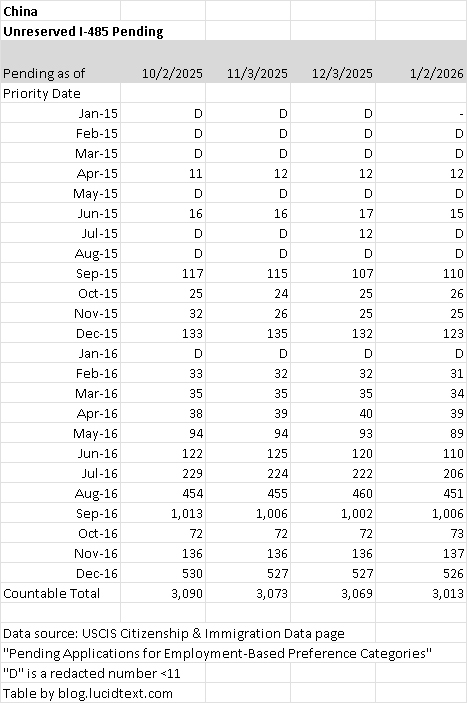
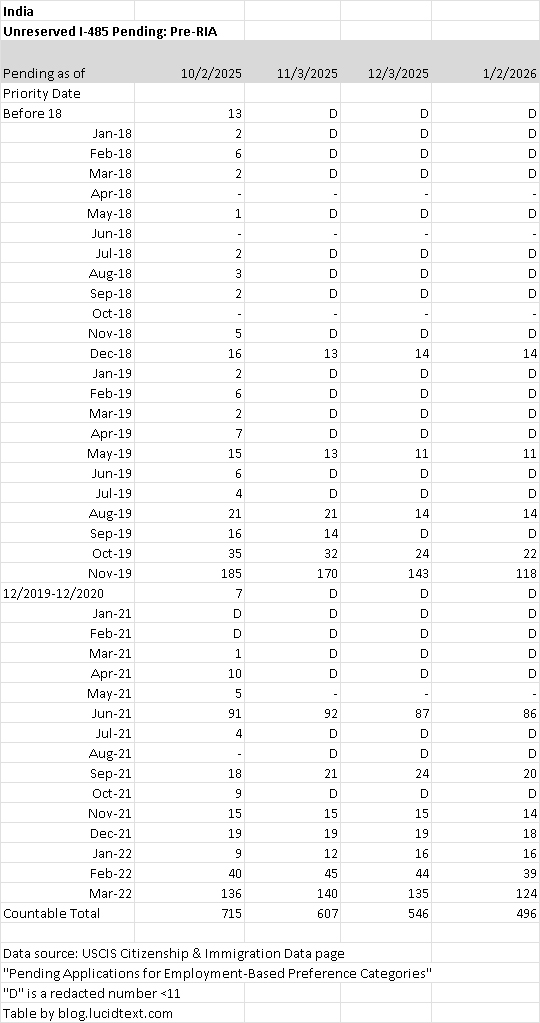
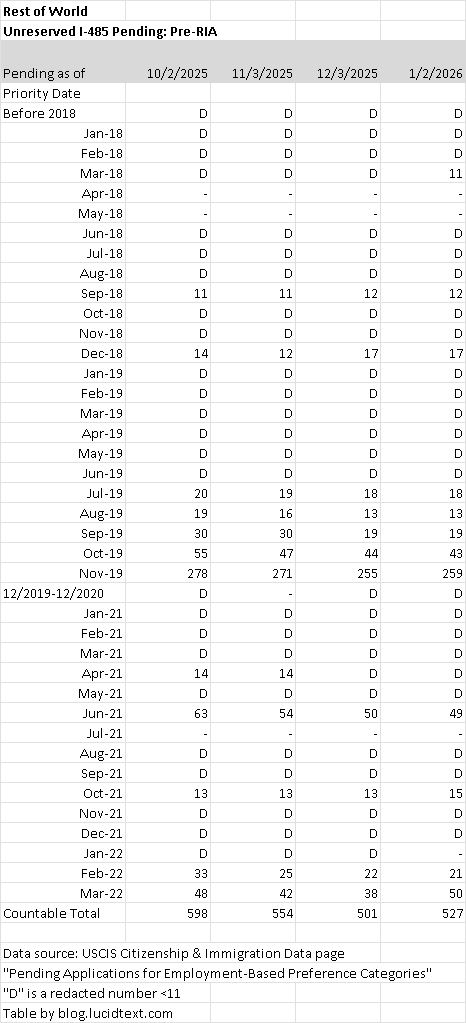
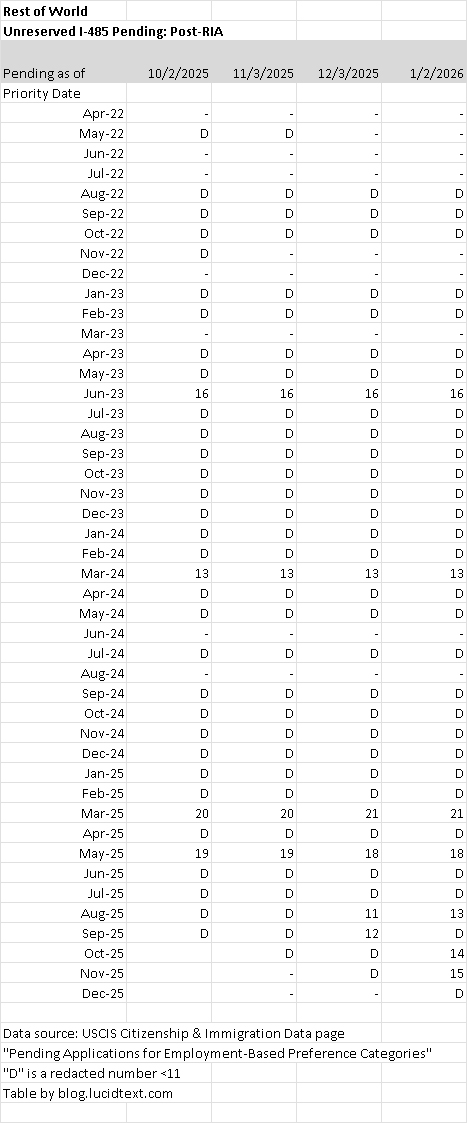
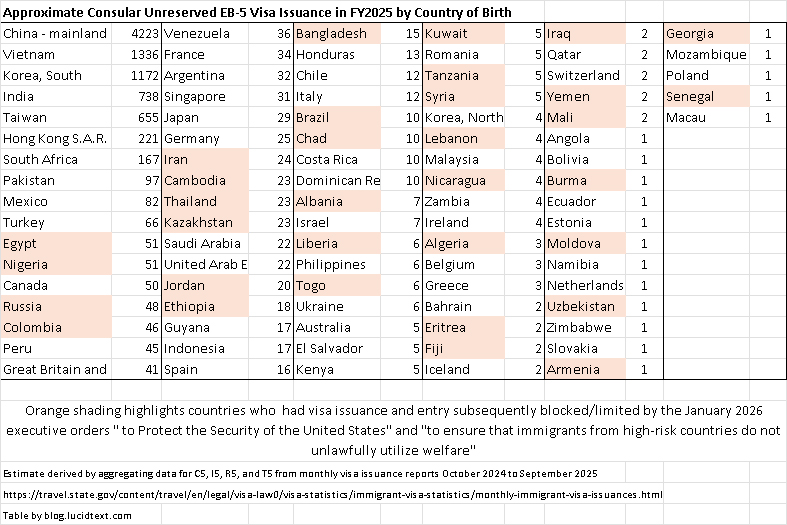
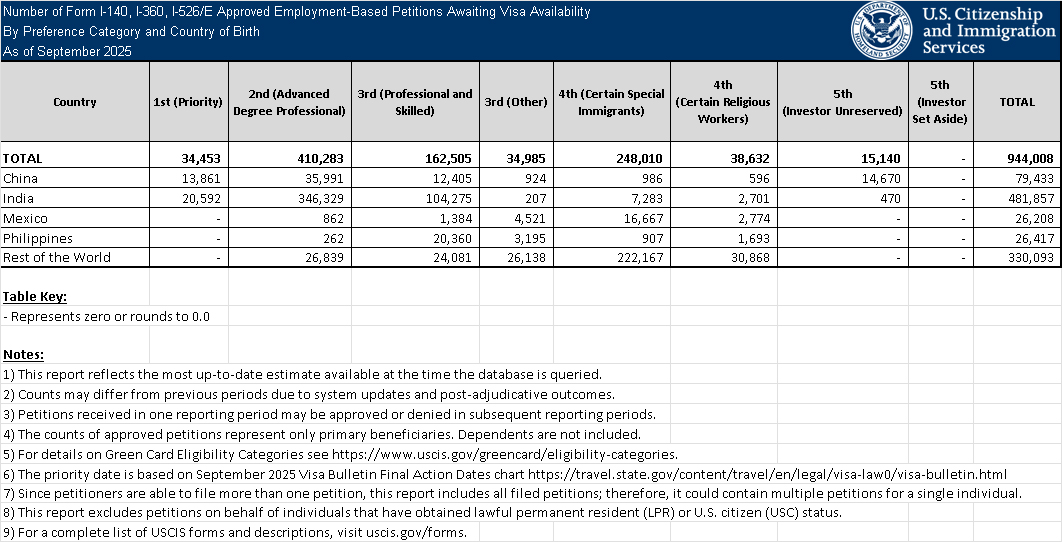
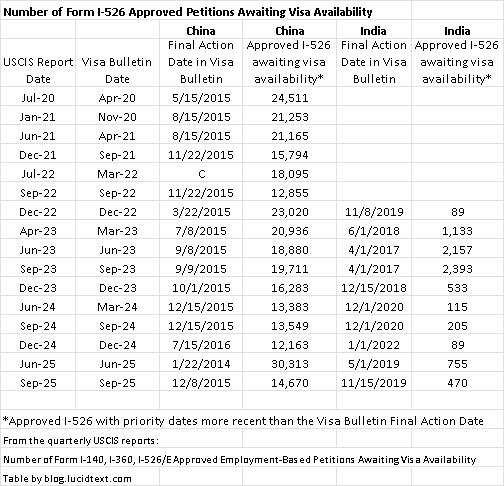
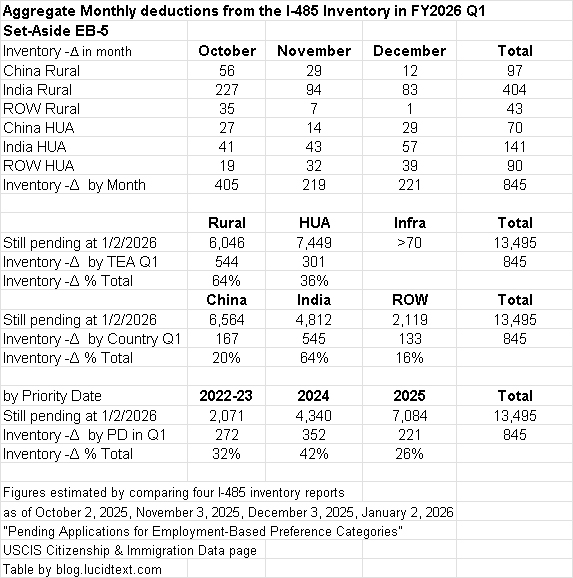
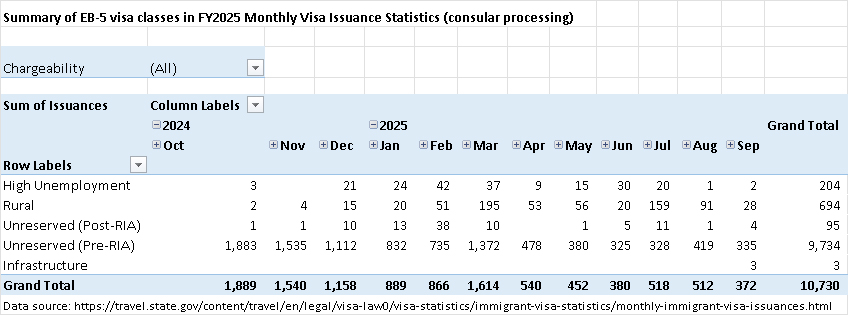
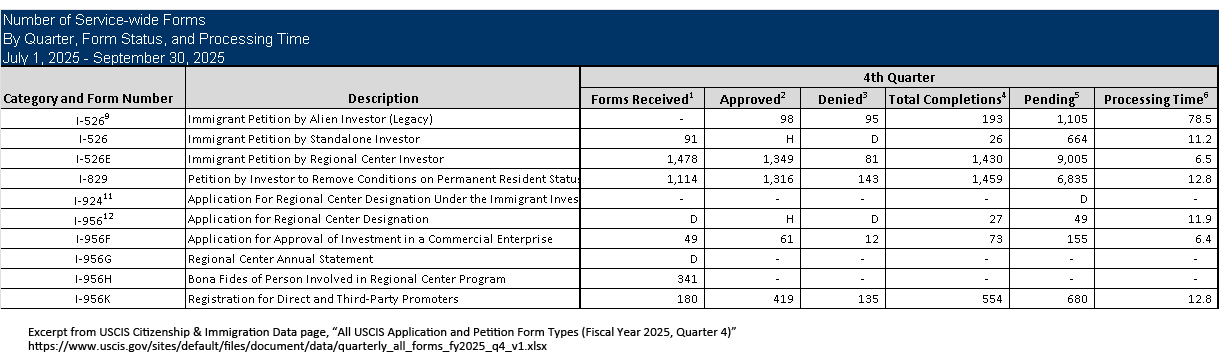
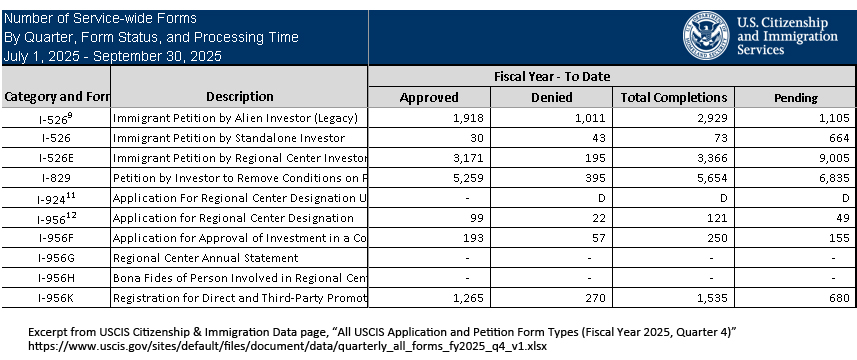
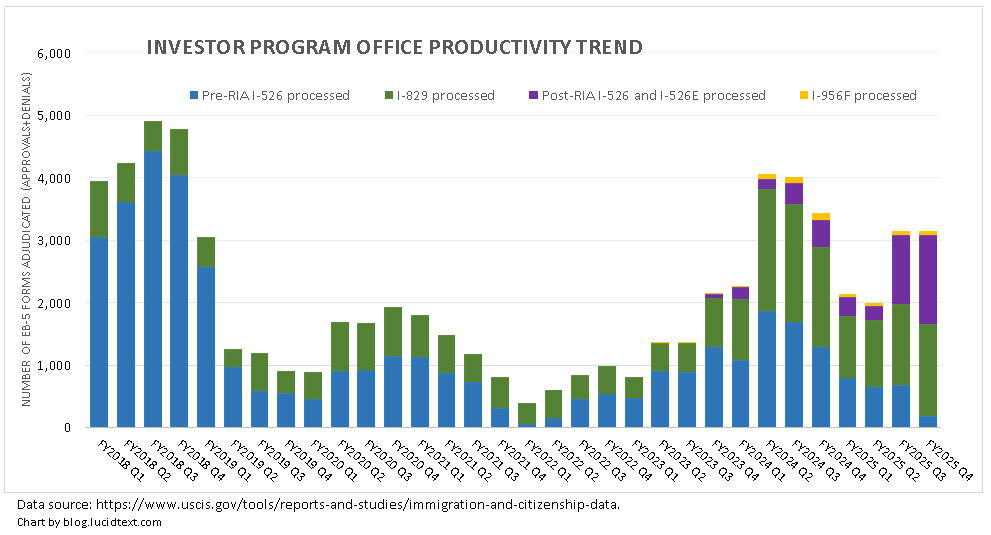
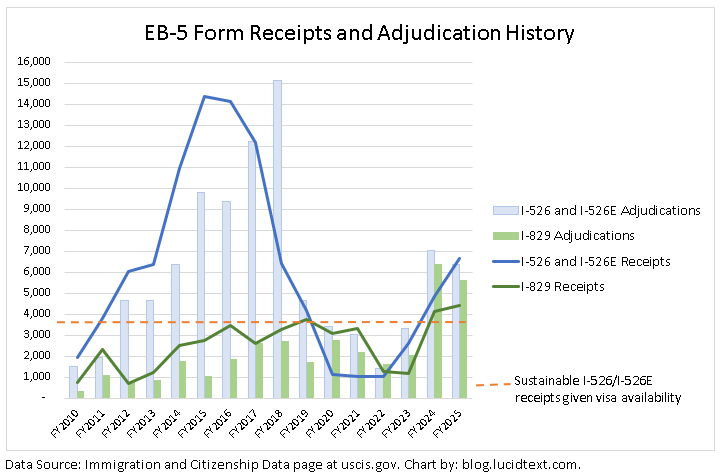
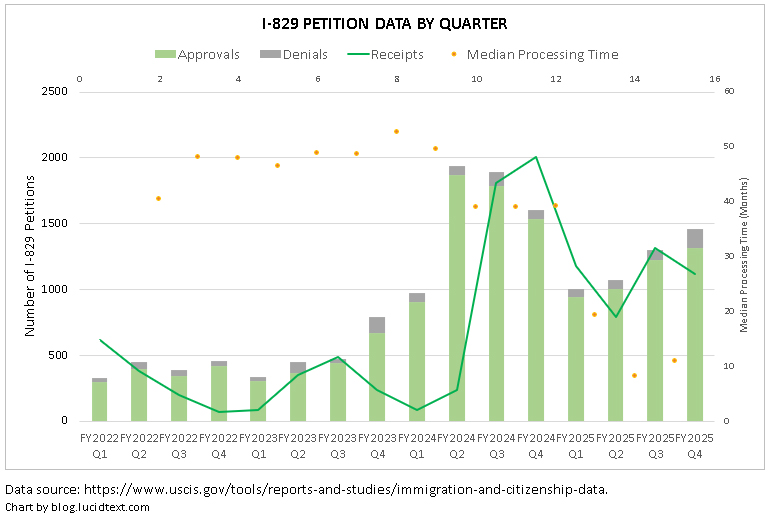
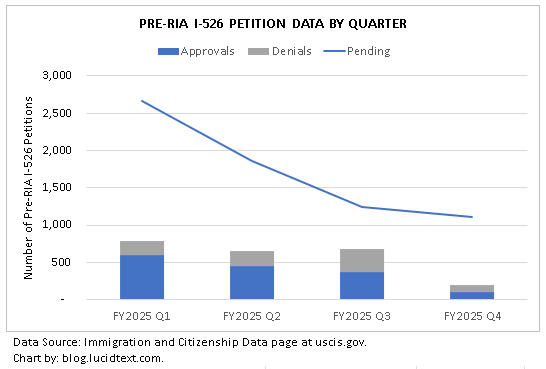
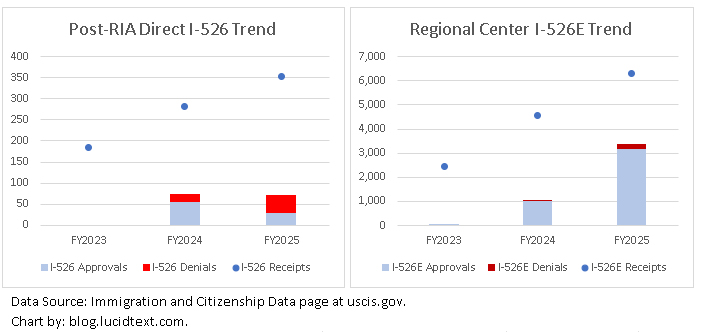
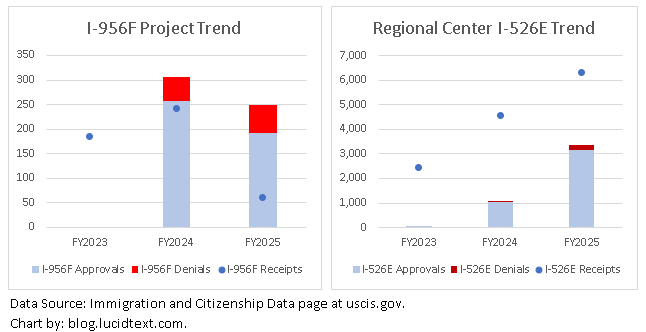
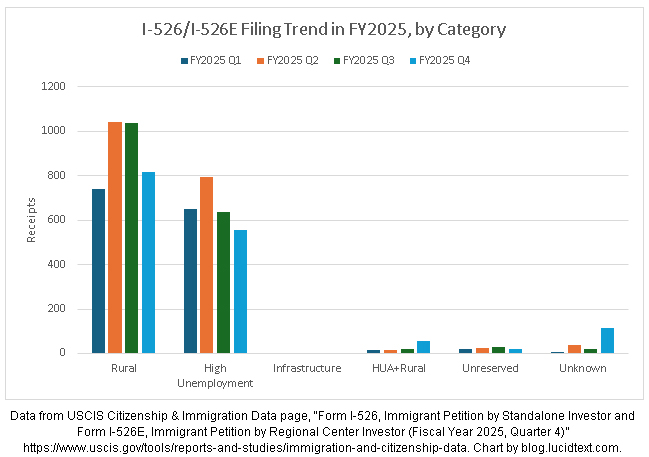
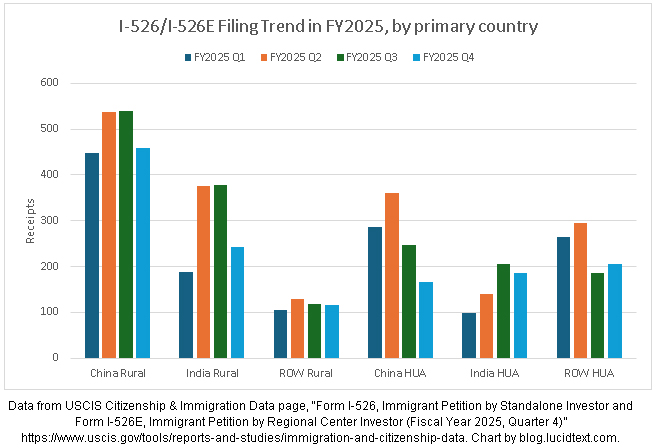
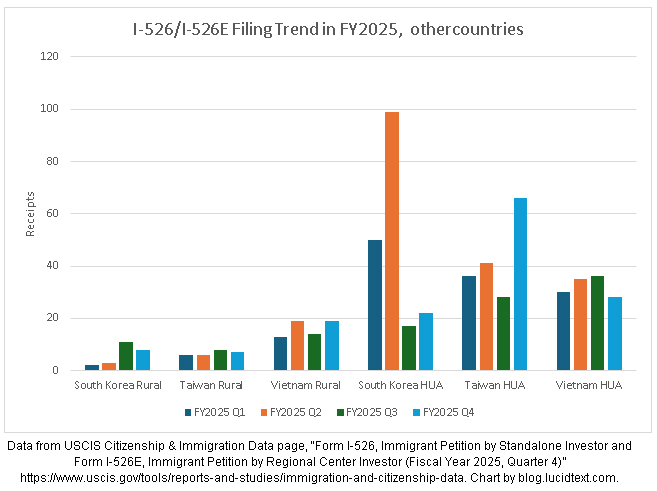
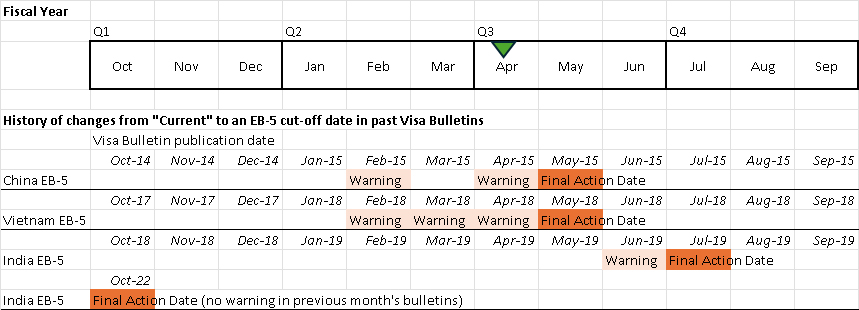
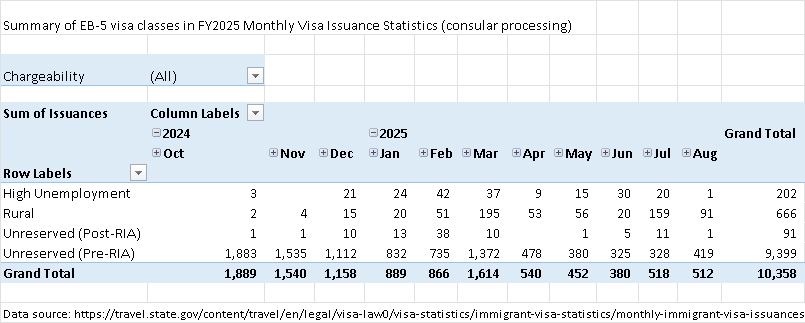
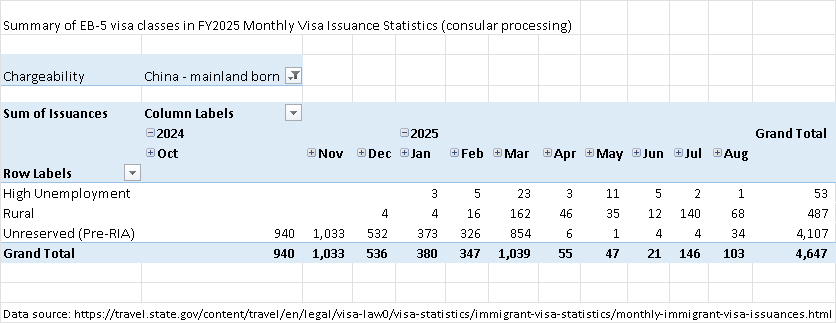
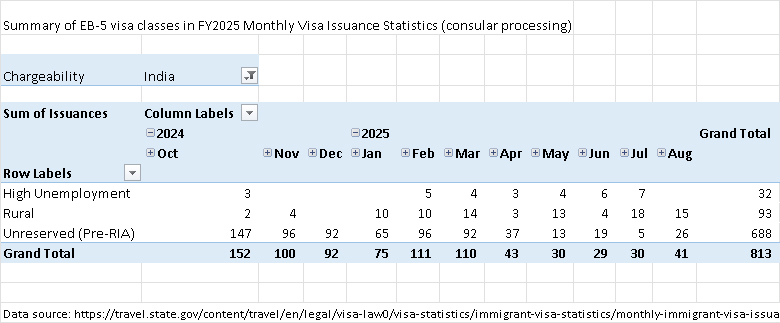
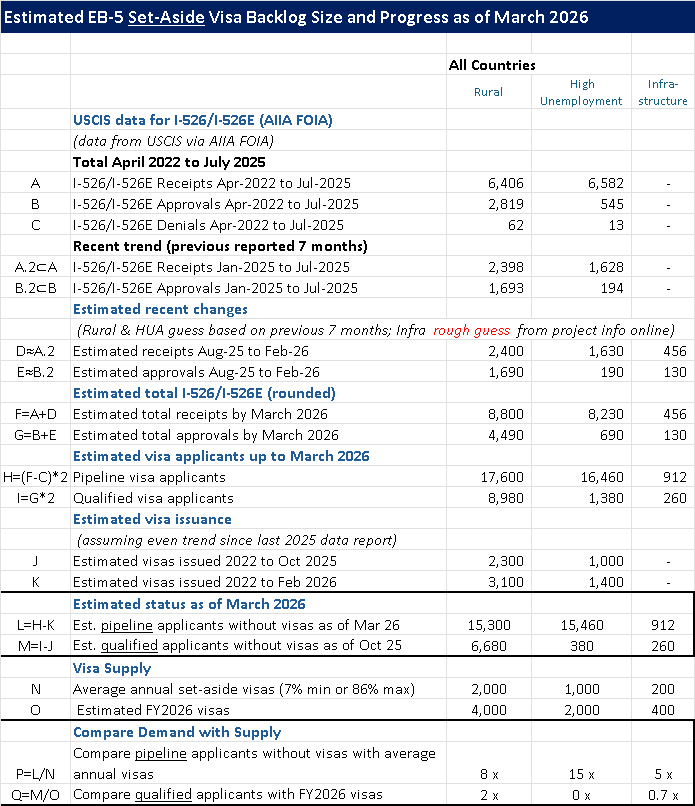
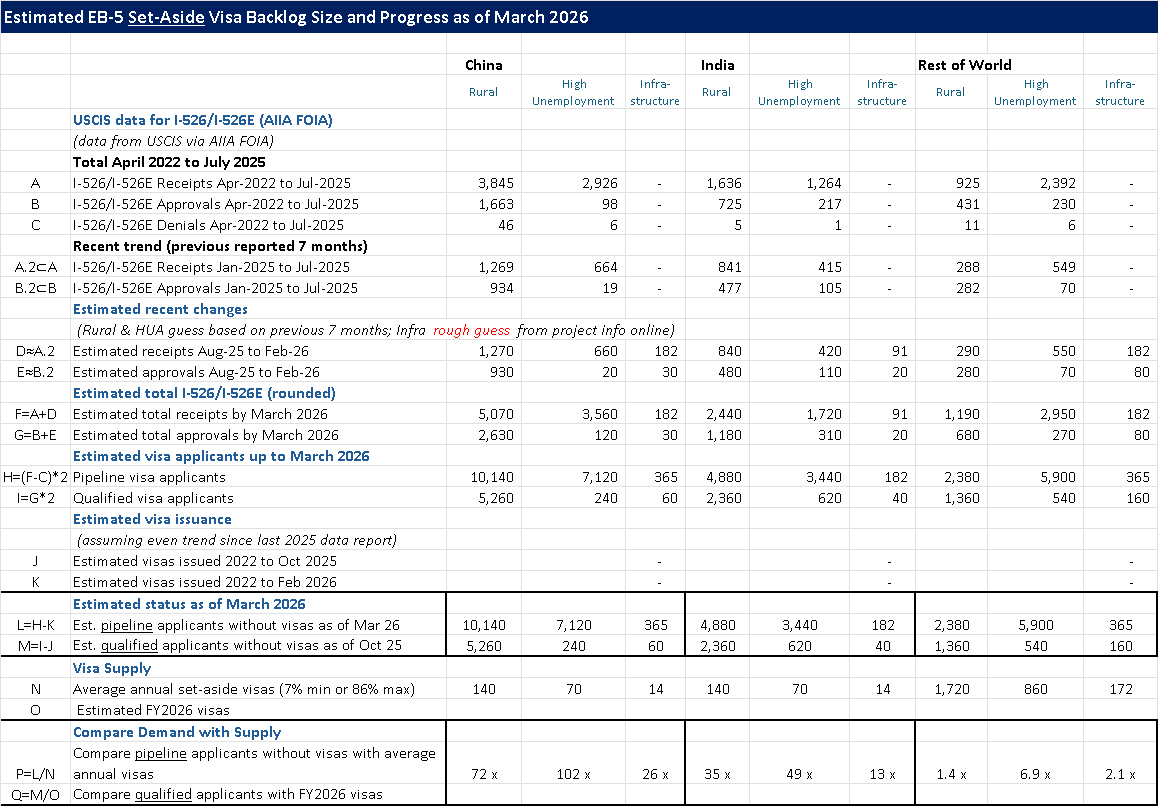
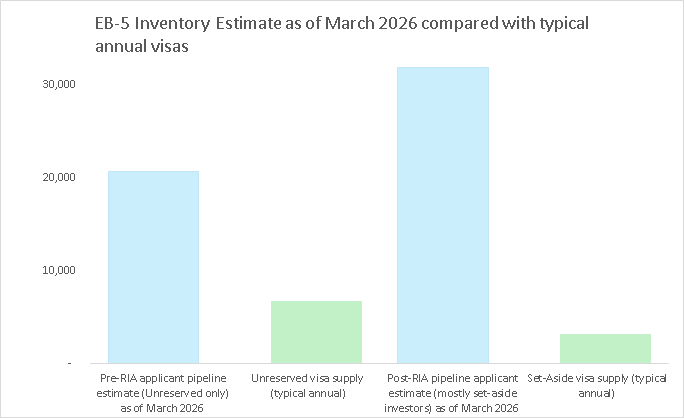
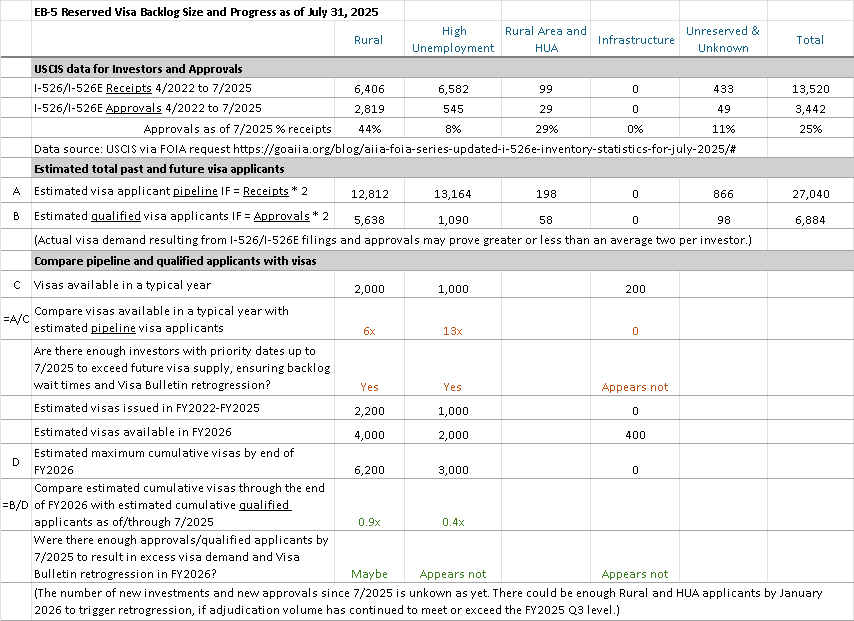
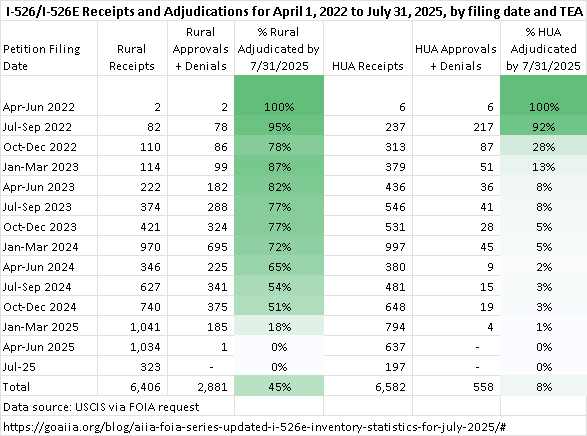
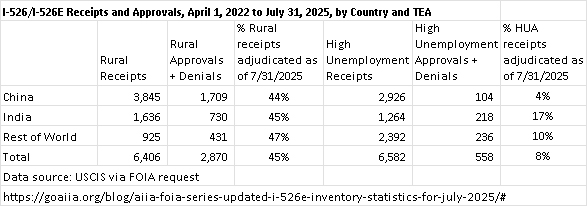
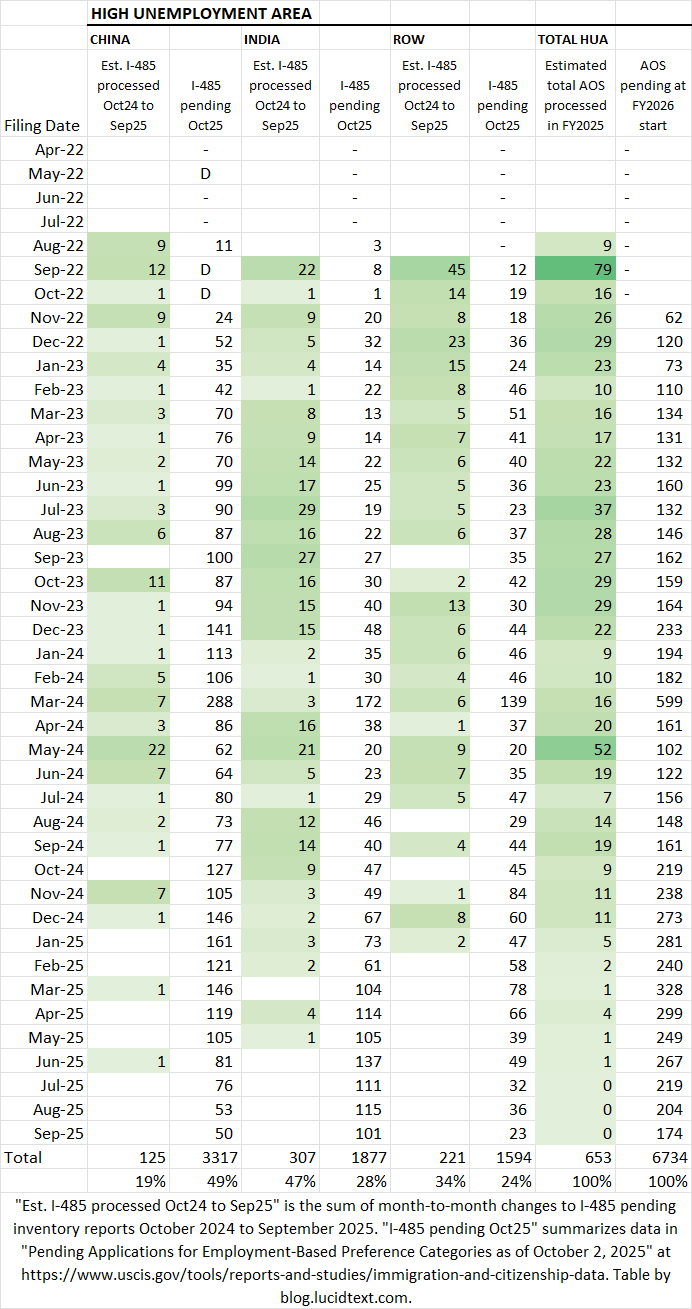

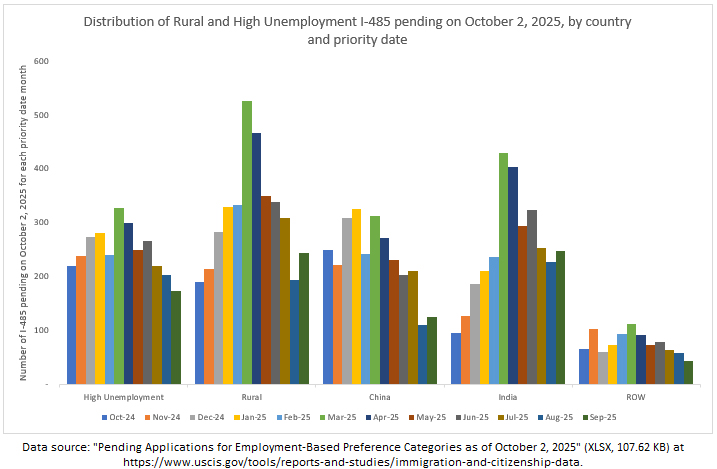
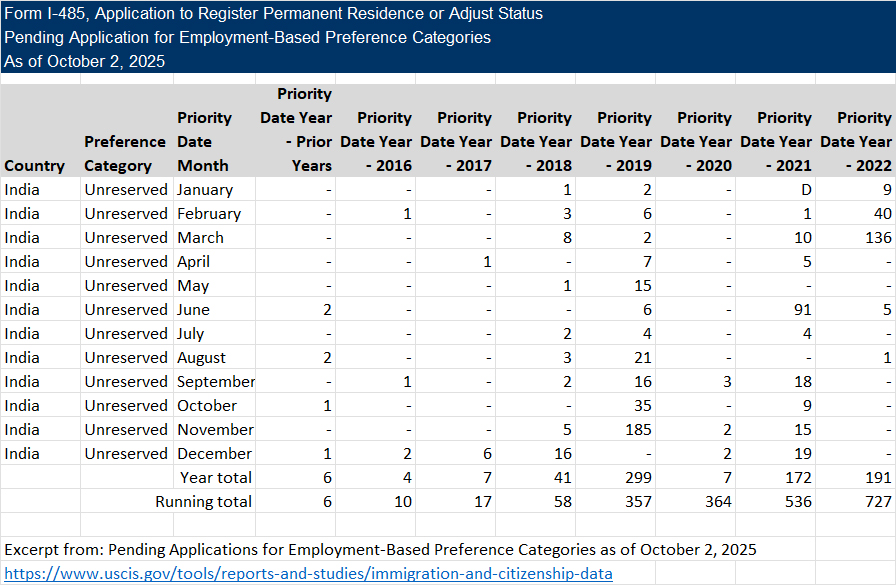
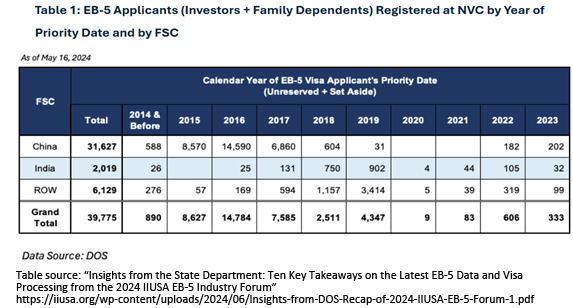

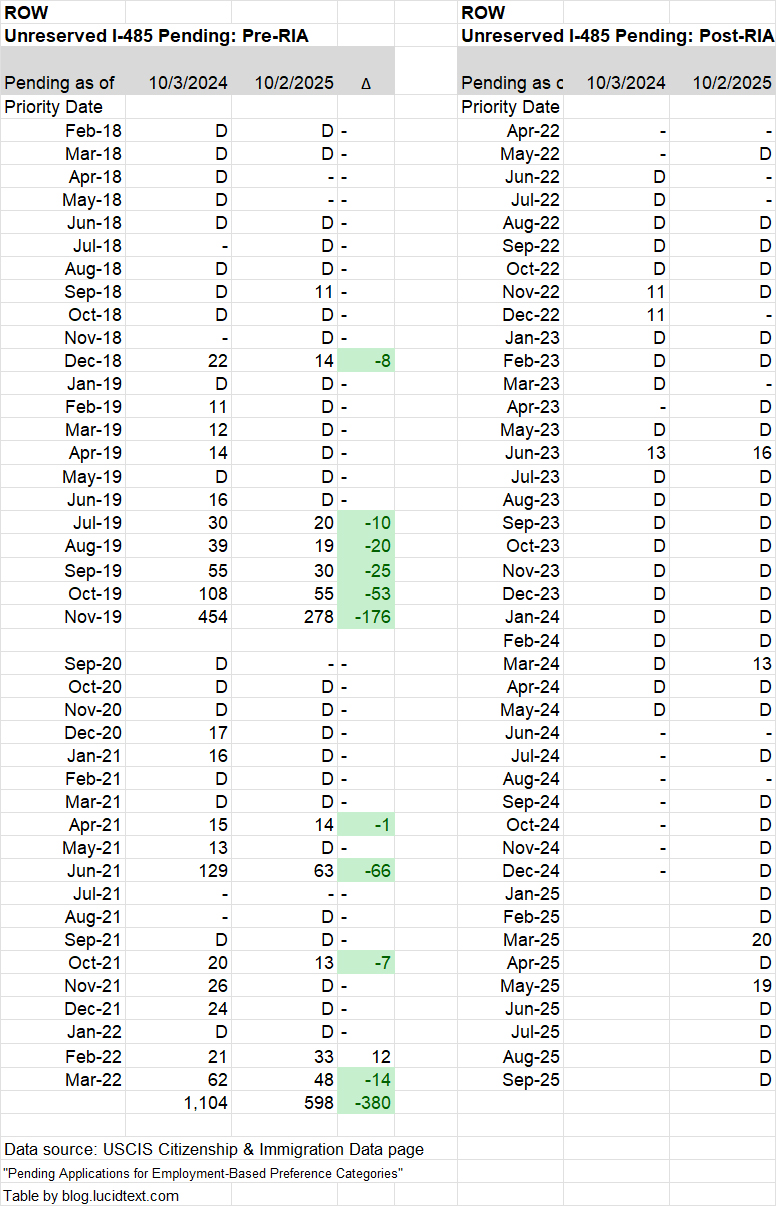


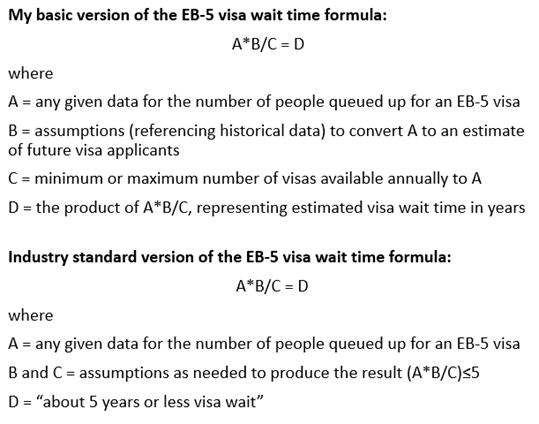


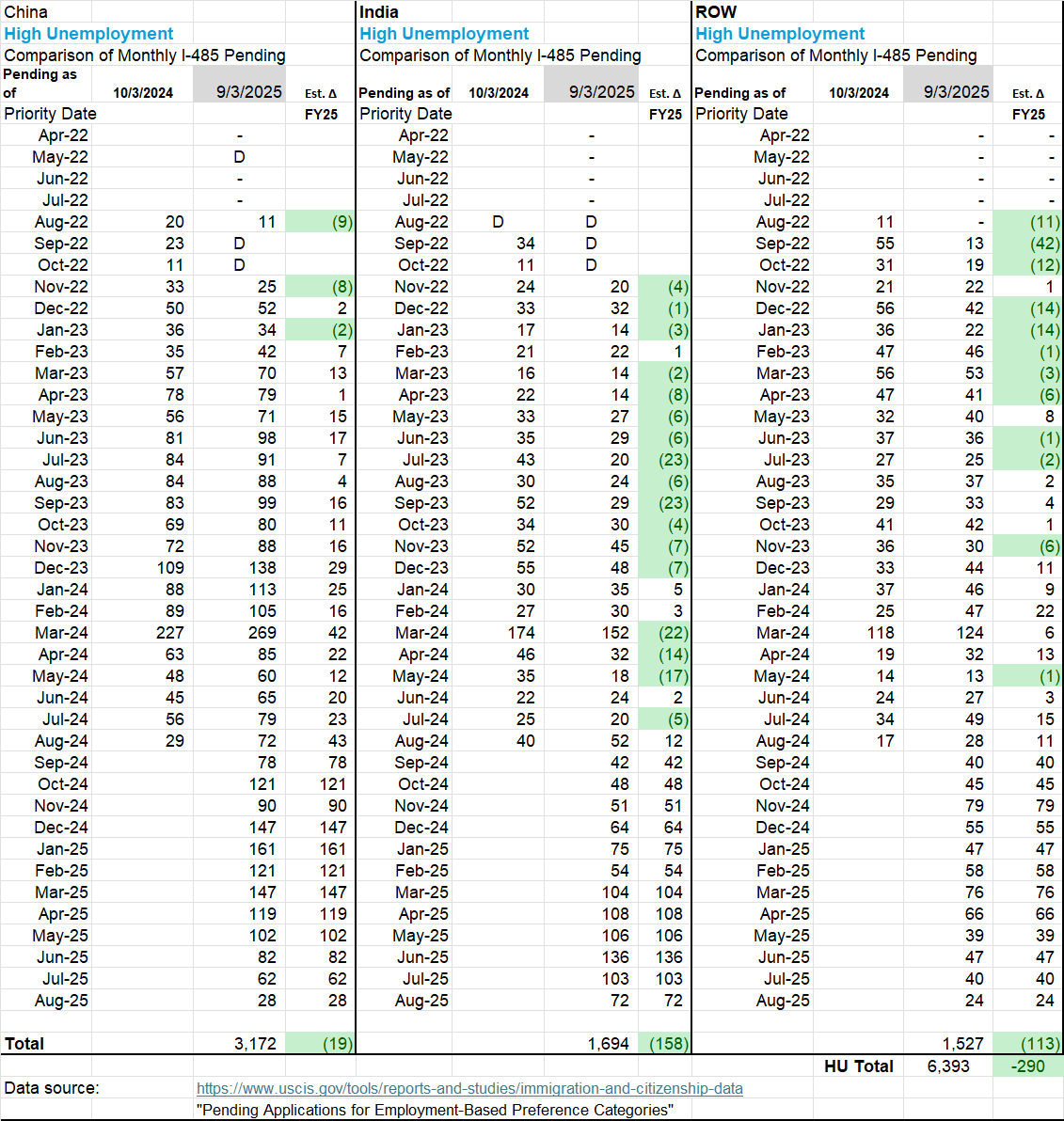


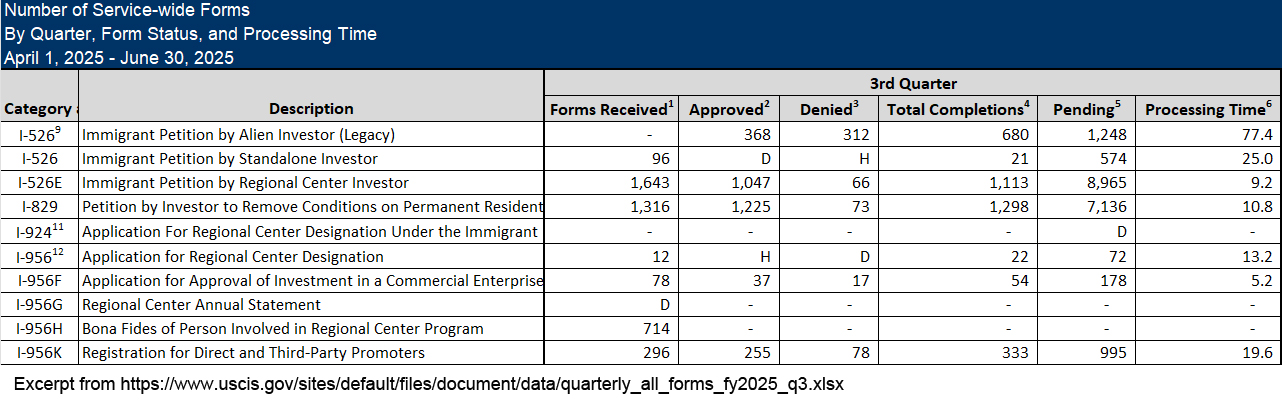
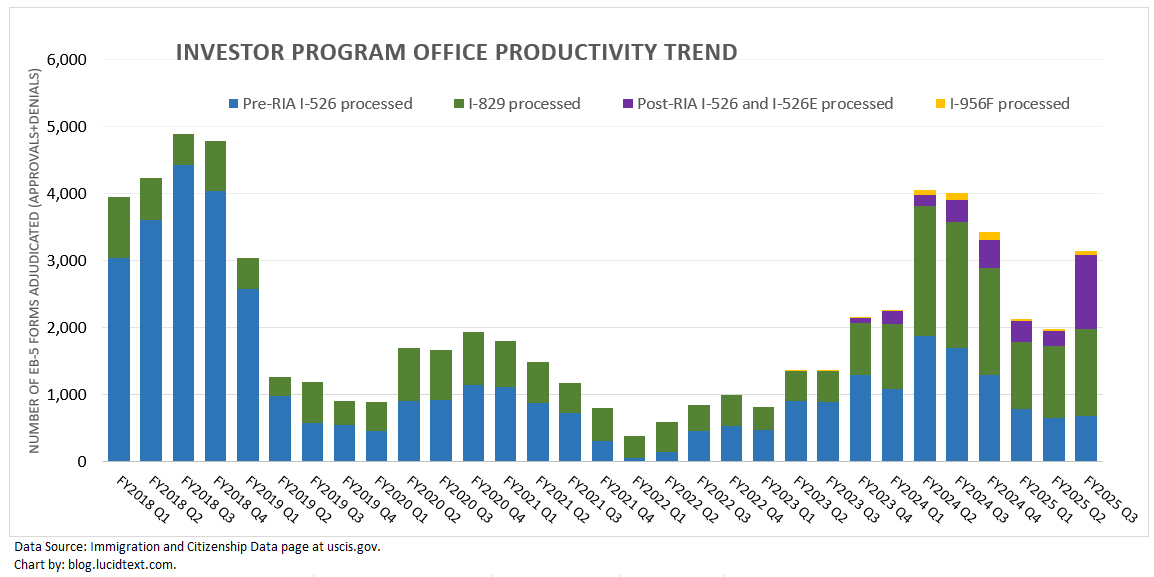

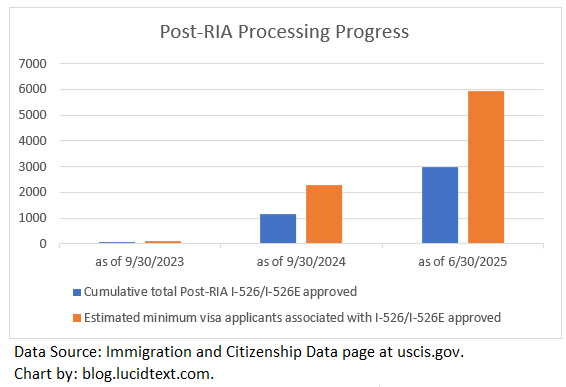

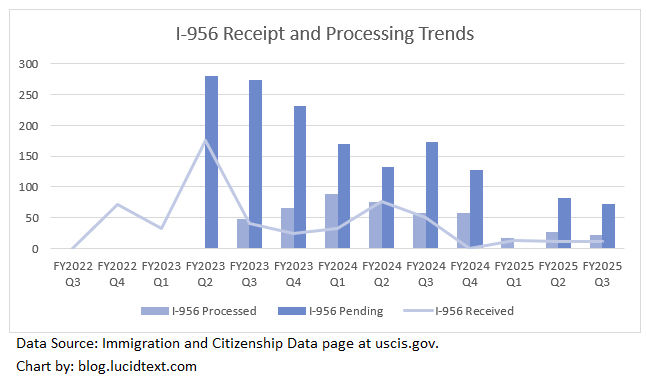
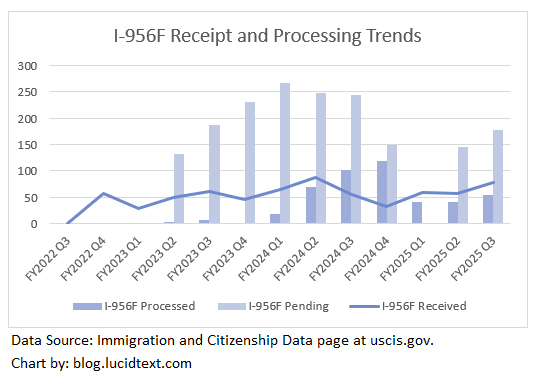
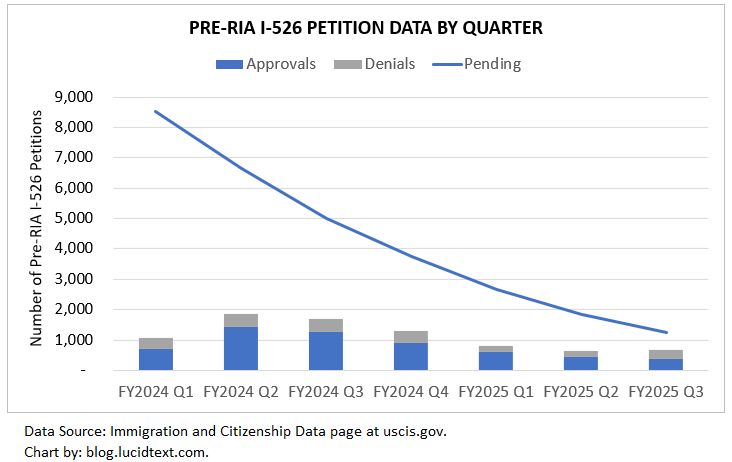
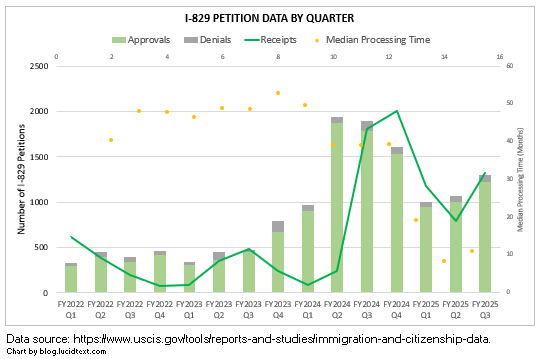
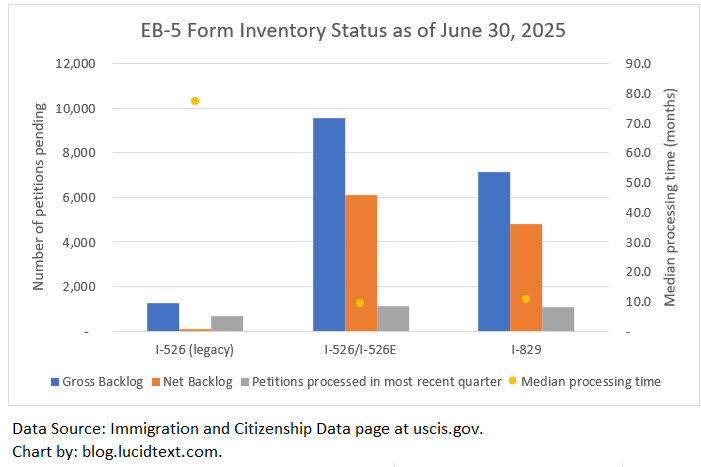
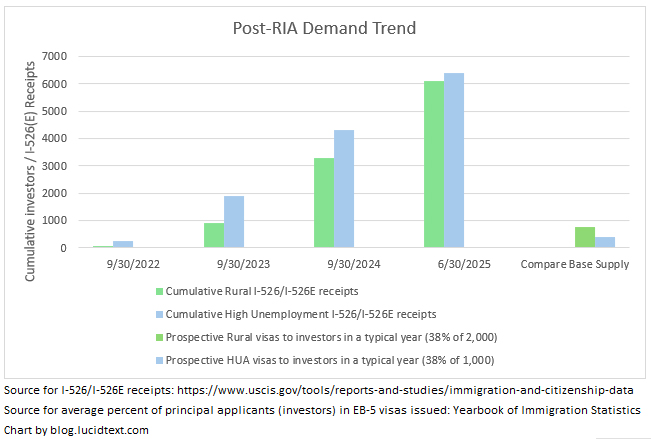
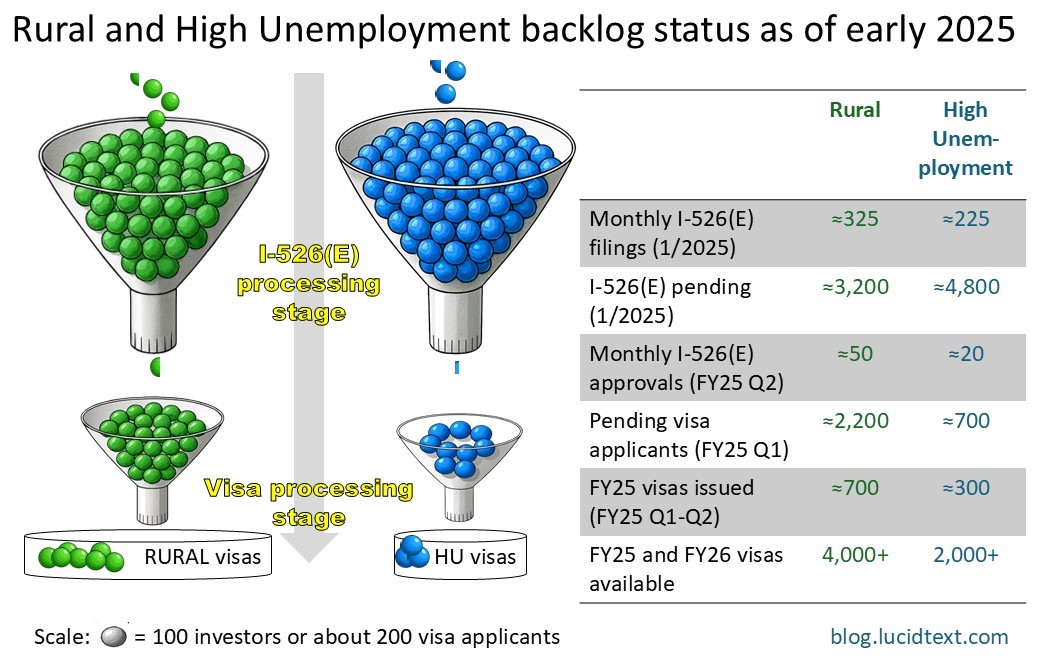


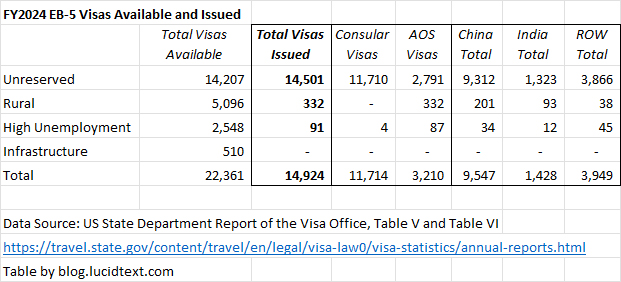

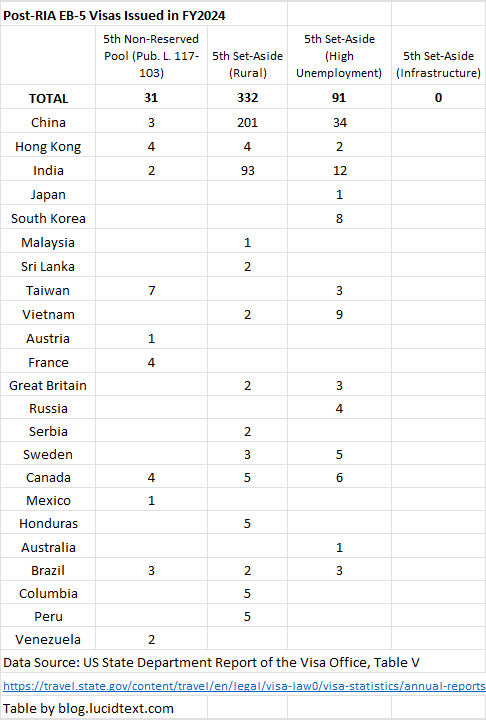


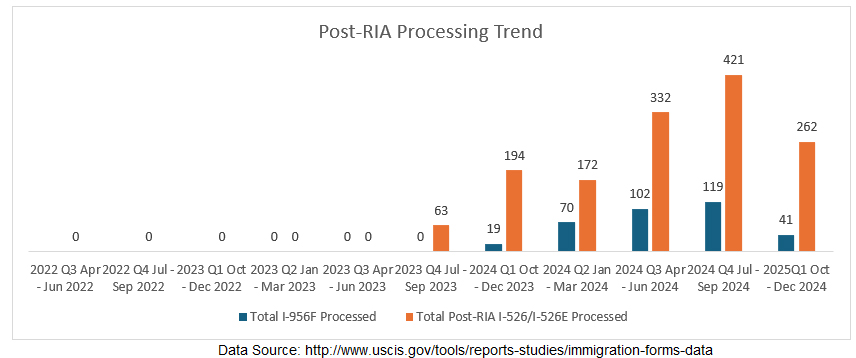


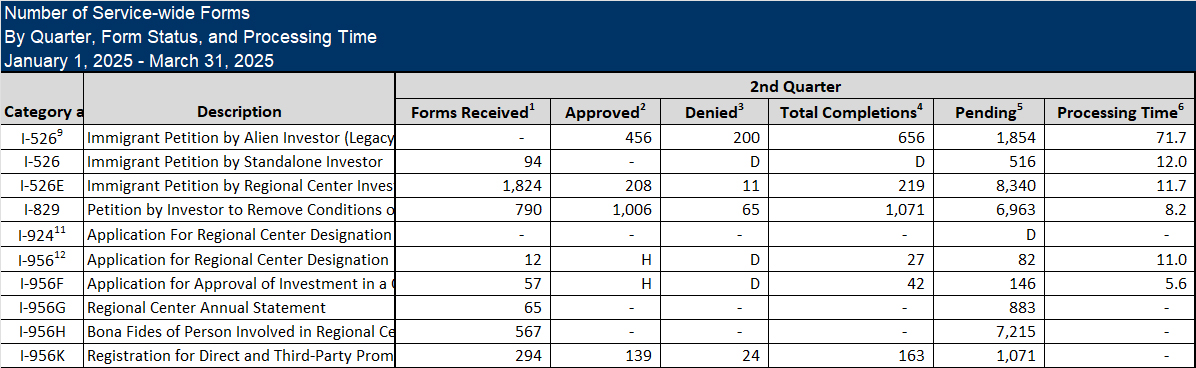

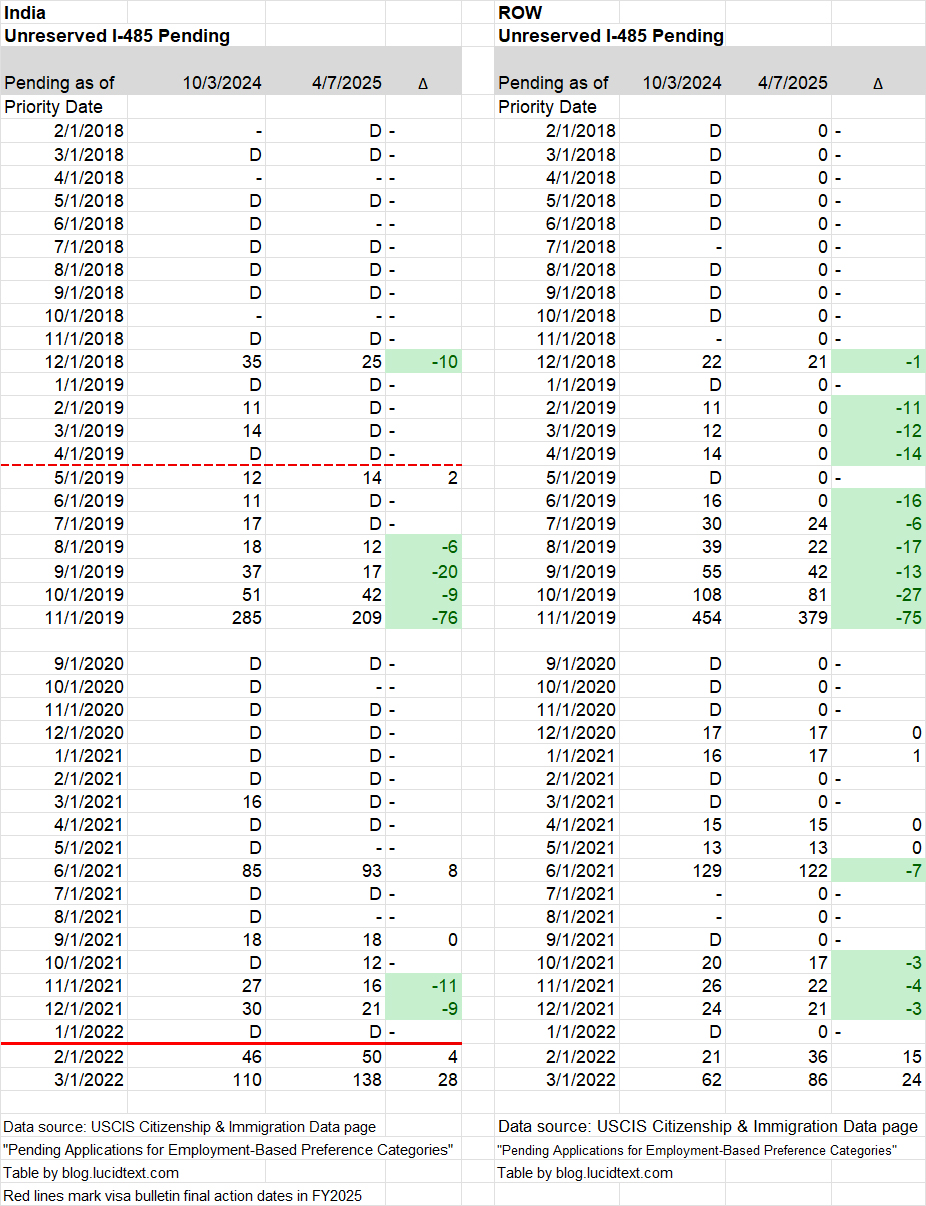

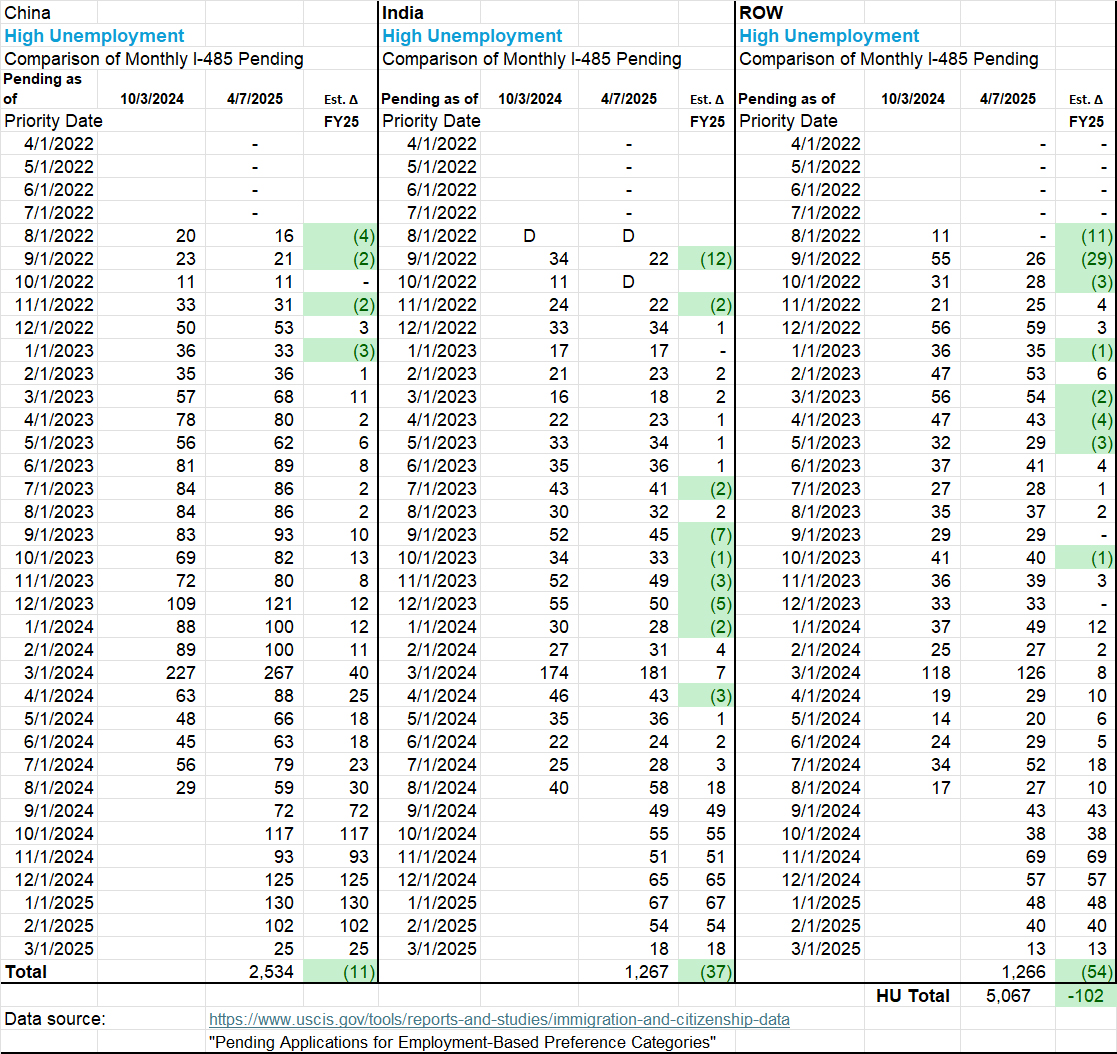


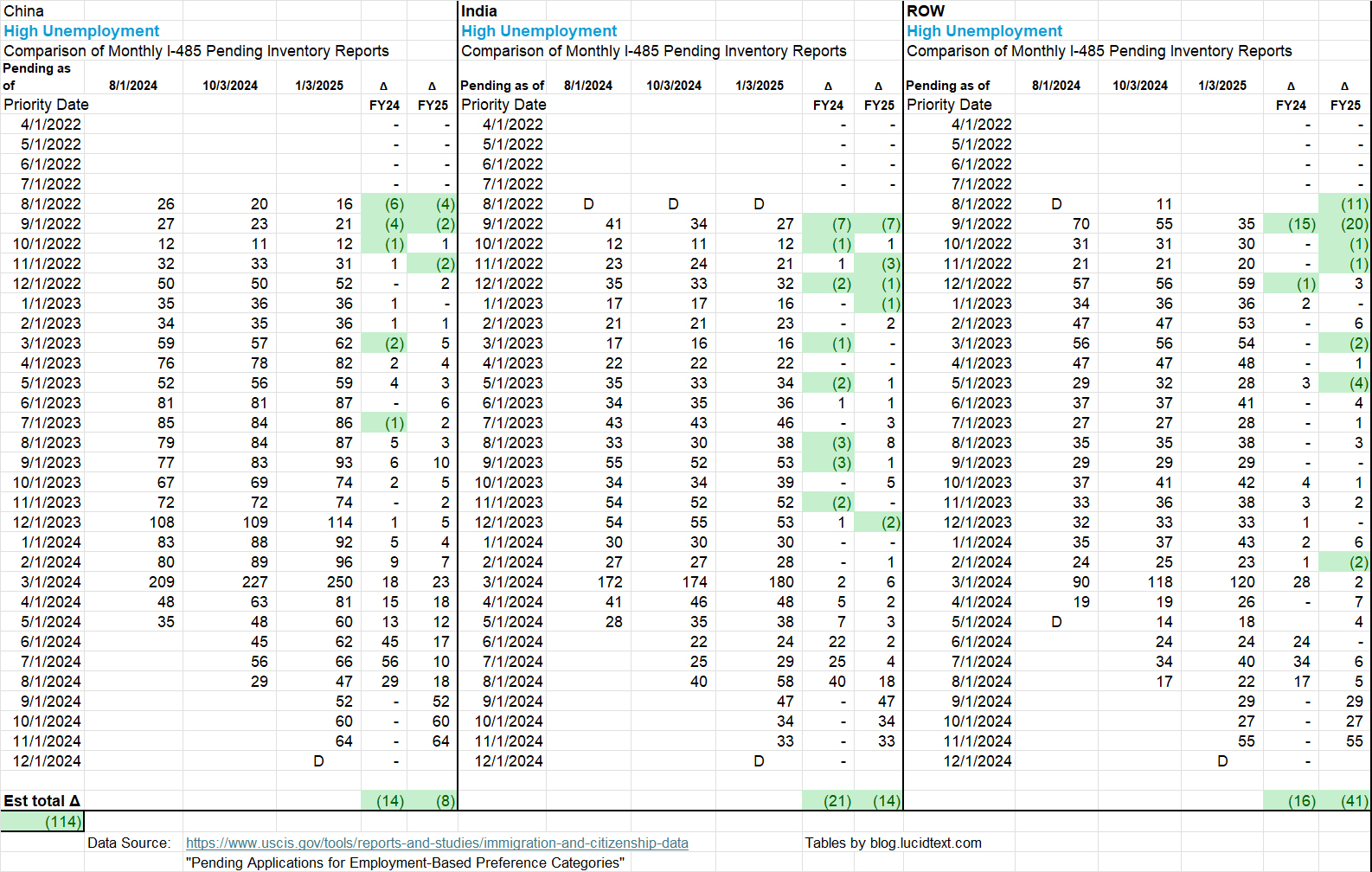

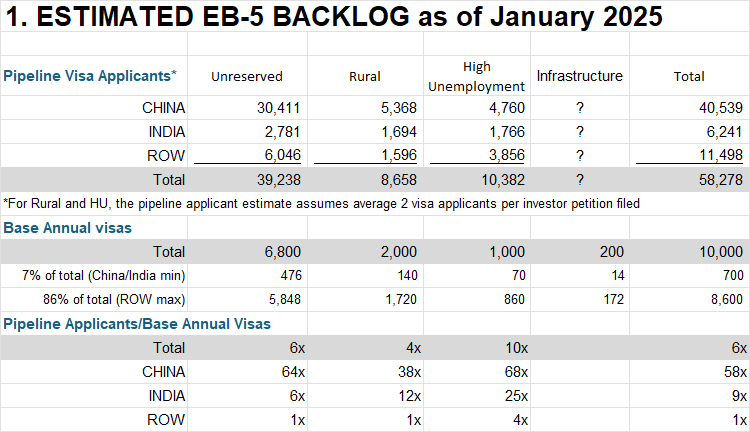

 EB-5 Updates