USCIS has published the All Forms report for FY2020 Q2 (January to March 2020), including entries for EB-5 forms I-526, I-829, and I-924. I look forward to these quarterly reports on the USCIS Immigration and Citizenship Data page because they provide information about EB-5 demand trends (receipts), processing trends (number of approvals and denials), and backlog trends (number of pending petitions).
FY2020 Q2 Data
Form
Receipts
Approvals
Denials
Pending
I-526
21
714
190
16,633
I-829
604
730
57
10,309
I-924
48
10
50
137
IPO Chief Sarah Kendall had indicated at the March 2020 EB-5 stakeholder engagement that “With a lot of the infrastructure development now behind us, IPO is better situated to improve productivity. In fact, preliminary data for February shows a step in the right direction.” Now we can see that indeed, completion rates improved significantly. IPO processed almost twice as many I-526 and I-829 in FY2020 Q2 as in FY2020 Q1. That’s a most welcome update. The productivity in FY2020 Q2 is still three times lower than it was in 2018 with the same staff, so still not a recovery. But “a step in the right direction,” certainly. If IPO can manage more such steps in Q3 and Q4, I will start praising IPO Chief Sarah Kendall instead of pointing out inexcusable mismanagement of resources.
There were just over a handful of I-526 and I-924 receipts in January to March 2020 (21 I-526, and about 48 I-924). That’s no surprise. I would not expect many I-526 filings immediately after a deadline that nearly doubled the minimum investment amount. And I would not expect many I-924 filings considering that USCIS has essentially stopped processing I-924, as indicated by both the volume report (only 10 approvals in three months) and the processing times report (which gives an “estimated time range” for I-924 processing of 53 to 99 months).
Low receipt numbers are part of a trend throughout USCIS, and help explain why the agency is now complaining to Congress about budget trouble. It turns out, measures to discourage immigration can result in falling revenue from immigrant fees. USCIS faces a reckoning from having operated on the Ponzi principle: depending on incoming fee revenue from new petitioners to pay for adjudicating a large backlog of forms whose fees were already spent without performance. I am heartened to see that at least in 2020, IPO did not use plummeting fees as an excuse to reduce productivity. In 2019, the coincidence of EB-5 receipt and adjudication numbers had me wondering whether IPO had decided to process only as many forms as justified by incoming fee revenue. I’m happy to see FY2020 Q2 firmly contradict that suspicion.
Denial rates remain comparatively high for Form I-526, but lower than in 2019. And it’s unclear whether IPO is actually denying more I-526 than usual, or just approving fewer than usual. Form I-924 denial rates remain astronomical – but no surprise, considering that most Form I-924 just request pre-approval for proposed investment projects. When I-924 processing times extend to four to eight years, the typical proposed project will no longer even exist by the time USCIS gets around to reviewing the application. Significant room for improvement in this area.
The charts below put FY2020 Q2 data in context of previous reports. I also included charts of recent processing times reports for reference and comparison. My timing consultation service remains available to people who want the numbers explained and interpreted as applied to their specific circumstances. So far I can only offer this service for I-526, because I have quite a bit of I-526 data available. I hope that I-829 processing will become more transparent in the future.
I appreciated IIUSA’s June 16 webinar A Discussion With Charlie Oppenheim: Chief, Visa Control and Reporting Division, U.S. Department of State. IIUSA has a recording available for purchase, and it’s worth the price. Mr. Oppenheim spoke for 45 minutes and answered many questions in detail. Well-informed IIUSA panelists followed up with another 45 minutes of interesting and helpful discussion about how they are adjusting to current conditions.
Department of State has been discussing when and how consulates can get back to full operations, but there are no decisions or forecasts at this point. It remains a “wait and see game.” Mr. Oppenheim expects that there will not be a “one size fits all” approach, but that different overseas posts will be coming back online at different times and with different capacities. The DOS website remains the best source for updates going forward (https://travel.state.gov/content/travel/en/News/visas-news.html and https://www.usembassy.gov/). Meanwhile, however, the National Visa Center remains operational. Applicants are encouraged to proceed as far as they can at NVC, so that they’ll be ready to go as soon as consulates can give interviews.
FY2020 Visa Usage
Mr. Oppenheim did not have exact numbers available, but estimated that over 4,500 EB-5 visas have been issued in FY2020 to date. (With 11,111 EB-5 visas authorized for this year, that could mean over 6,000 EB-5 visas would have to be issued in the next four months to maximize the FY2020 visa limit.) Mr. Oppenheim said that there is still potential for FY2020 numbers to be utilized if oversees posts open soon. USCIS does not allow Mr. Oppenheim to say how many I-485 are pending for EB-5, but he disclosed that they “don’t have a lot,” and that he’s “not sure there are enough I-485 out there to maximize visa usage this year.”
Based on the information Mr. Oppenheim provided, it appears likely that China will lose EB-5 visa numbers this year. China was expected to have over 5,000 EB-5 visas in FY2020, but in fact just over 1,000 visas were issued in Guangzhou before interviews stopped in February. Mr. Oppenheim said in the webinar that the July 2020 visa bulletin makes about 400 Chinese eligible for final action through adjustment of status, and about 3,000 Chinese eligible through consular processing. But he does not think Guangzhou could handle that many visa interviews this year even if it reopened tomorrow. (For reference, in the three years that I’ve logged monthly EB-5 visas from Guangzhou, the high was 781 visas issued in December 2017.)
Meanwhile, India has already used “well over 500 numbers, possibly 550 or more” for FY2020 (out of 778 visas expected under the quota), partly thanks to rapid movement of the visa bulletin. Mr. Oppenheim made India current for final action in the July 2020 visa bulletin, and expects India to remain current through the end of the fiscal year. (That must mean that he does not see many India I-485 pending or forthcoming, and/or is not optimistic about the number of visa interviews that can be scheduled in India this year. If Mr. Oppenheim did foresee well over 250 Indians ready to claim a visa by September, then India would not be current for final action in the visa bulletin.)
Mr. Oppenheim did not mention how many visas have been issued to Vietnam so far in FY2020. He said that the visa bulletin dates for Vietnam would likely move “consistent with those moves through the end of the fiscal year” (referencing recent visa bulletin movement for Vietnam) but did not further explain that statement.
Mr. Oppenheim encouraged people to become documentarily qualified as soon as they can, so that they’ll be ready to go immediately when consulates can resume interviews. That means responding promptly when notified by NVC to assemble and submit documents. He said that overall, over half of people eligible to become documentarily qualified and pay fees have not done so. The more people are ready to claim a visa, the better chance of maximizing visa number usage this year.
FY2021 Visa Availability
On the bright side, EB-5 visa number loss in FY2020 is likely to be at least offset and possibly far exceeded by gain in numbers in FY2021. Mr. Oppenheim estimates that the EB visa limit, normally around 140,000, will be “at bare minimum” over 200,000 in in FY2021, and probably “well in excess” of 200,000. EB-5 gets 7.1% of total EB visas, so that means the EB-5 visa limit in FY2021 will at least be over 14,200 – and probably significantly over. This will happen because unused family-based visas from one year roll over into employment-based categories the next year. And consulate closures mean that many family-based visa numbers are going unused this year. I have a separate post coming on this topic, to explain the minimum and maximum benefit to EB-5 from unused FB visas in FY2020, and the potential impact on EB-5 wait times.
Mr. Oppenheim confirmed that the offset from the Chinese Student Protection Act will be completely satisfied in FY2020. So in FY2021, China will have the same EB-5 visa rights as other countries – i.e. 7% of the total limit, plus access to leftover visas according to priority date order. Since the number of leftover visas in FY2021 is likely to be very large, and Chinese have the oldest priority dates, FY2021 should be a good year for China EB-5.
Visa Bulletin Movement and Retrogression
Mr. Oppenheim spoke extensively about the thinking behind visa bulletin movement, and surprised me by indicating that he does not expect EB-5 retrogression. I haven’t figured out how this is possible for India in particular, considering the backlog and how visa bulletin dates have jumped in 2020, but Mr. Oppenheim made the statements strongly and repeatedly. He described the visa bulletin date movements this year as “measured,” “not just moved for the sake of movement,” and “trying to avoid retrogression.” He aims to avoid a situation where people get qualified only to see time-sensitive documents expire. When specifically pressed on India, he said that “I don’t think that India is facing a retrogression in the foreseeable future” and “I think the previous wait time [estimate from October 2019] has dropped significantly for somebody that would be filing today.” This considers the possibility that a number of Indian applicants on file at NVC might be able to receive visas this year, and the increased visa quota next year.
I’m still trying to think this through, considering what we’ve been previously told about backlogs. But I credit Mr. Oppenheim’s predictions, because he has much more data than we do. He clarified that USCIS and IPO report to him monthly on processing status, including how many petitions they have at various stages of processing, and how many they are working on. (Why, IPO, do you persistently refuse to provide such reports to the public, even as you claim to stand for integrity?) Meanwhile, the National Visa Center gives monthly updates on the number of applicants who have become qualified and could potentially be scheduled for interviews.
Mr. Oppenheim acknowledged the remote possibility that all countries could become current for EB-5 final action in the visa bulletin in FY2021, for a period of time. This could happen in the first half of FY2021, if consulates remain closed into the new fiscal year, if there were a sufficient number of status adjustment cases to justify the movement, and if the system had the capacity to accommodate the resulting demand.
Other
Mr. Oppenheim clarified that absent change to U.S. immigration law, Hong Kong will continue to be treated as a separate country for the purpose of U.S. visa issuance.
Mr. Oppenheim conveyed mixed messages about IPO productivity. IPO itself has not yet published any processing data for 2020, so we’re left to guess whether their current I-526 completion rates are more like 2019 (horrible) or 2018 (great). Mr. Oppenheim, who does have recent information on volume of I-526 approvals, said that IPO has been “deciding petitions at a rapid pace” and “forwarding petitions at high volume.” He particularly noted a large number of I-526 approvals for Chinese – which must mean that many China I-526 were assigned for adjudication before the new visa availability approach took effect as of April 1, 2020. That all sounds promising. On the other hand, Mr. Oppenheim provided updated information about the NVC backlog that does not clearly reflect many people advancing from I-526 to the visa stage. The following chart compares the number of cases at the National Visa Center between October 1, 2019 and June 1, 2020.
The numbers show that only China has seen a significant net increase this fiscal year in EB-5 visa applicants at NVC. Mr. Oppenheim credited this increase to IPO productivity. However, the increase could also be explained by the fact that the visa bulletin has moved to allow many more Chinese to file documents, even as the consulate has not been issuing visas. For the rest of the world, incoming visa applicants have not been sufficient even to counterbalance the few EB-5 visas issued this year. If IPO were doing its job to adjudicate petitions, we should see more visa applicants. There is a lag between I-526 approval and becoming qualified at NVC, and some approved I-526 go on to status adjustment rather than to NVC. So there’s room for hope that IPO has indeed performed well recently, and I-526 approval numbers just aren’t reflected yet in visa applicant numbers. But Mr. Oppenheim hedged about the amount of visa demand he expected to make it out of USCIS. “I’ve had to temper my expectations with the immigration service because they are under certain processing constraints.”
I’ve written a guest article for LCR Capital on Interpreting the USCIS processing times report. The article examines the disconnect between the content and application of the report, and goes in-depth on the following questions:
Does the USCIS Check Case Processing Times Page reflect the way that USCIS currently processes petitions?
Does the “estimated time range” on the Check Case Processing Times Page refer to the age of petitions that USCIS is processing now?
Does the “receipt date for case inquiry” define the limit between normal processing and unreasonable delay?
Why does the “receipt date for case inquiry” move so erratically, and sometimes retrogress?
Why are the “historical average” processing times reported by USCIS so different from the reported “estimated time range” for processing?
How can I estimate the processing time for my petition?
I wrote the article to give clarity and well-researched ammunition to people who may be discouraged and blocked by the USCIS processing times report, but should not be. My article addresses this core conflict:
USCIS uses the processing times report to create expectations about “normal processing,” and to shut down inquiries.
If you look at what the reported times represent, they in fact define abnormal and delayed processing.
For example, 29.5 months for I-526 indicates, specifically, that 50% of I-526 recently processed had been pending less than 29.5 months. So if my I-526 has been pending for 30 months, the report tells me that I’m being left behind – that over half of recent decisions were on cases younger than mine. And yet some people – including IPO, if I inquire – will blindly treat 29.5 months as the starting point for normal processing, not as the marker it is for delayed processing. Meanwhile, 44.5 months reportedly represents the 93rd percentile of delay in recently-adjudicated cases – by definition, an extreme outlier. Why should we accept the USCIS position that a petitioner doesn’t have a right to inquire unless and until he or she is an extreme outlier?
Or take the appalling 58.5-119 month “estimated time range” reported for Form I-924. How many regional centers have been discouraged by that report from even trying to file Form I-924, despite the importance of that form for project review and program integrity? And yet the report does not actually indicate that I-924 filed now will wait a long time. The processing times report does not claim to report future wait times, average recent wait times, or the age of the inventory. The report merely reflects the fact that half of petitions recently processed happen to have been waiting a long time. At last report, there were only 149 Form I-924 still pending at USCIS. In 2018, USCIS processed that many I-924 every quarter. Who then accepts the current estimated time range of 5-10 years as any reflection on normal processing?
Comparing Report and Reality: The following chart illustrates the processing reality for one quarter for which we have happen to have comprehensive data: October to December 2018. The USCIS processing times report during that quarter gave an estimated time range of 20.6 to 26.5 months for I-526 processing. Meanwhile, we now know that most I-526 processed in that period had been pending 10 to 15 months. And the chart shows the reality behind the USCIS claim: “We generally process cases in the order we receive them.”
Country-Specific Processing: When USCIS implemented the new visa availability approach to I-526 processing, they promised that the processing times report would be updated to reflect the new reality. The new approach took effect April 1, 2020, and the report has still not been revised as of June 2020. It still states “We generally process cases in the order we receive them,” and the time estimates have not been updated appreciably since March. While the report has never been a guide to future processing times, it’s particularly unhelpful now that it’s unmoored from the new reality of country-specific I-526 processing times. My I-526 processing time consultation service attempts to provide the service that USCIS should give, but does not. I approach the visa availability impact by piecing together data from different sources to estimate the current composition of the I-526 backlog by country and priority date. Having this picture in view, I then pick out the portions of the inventory that may be sidelined or fast-tracked by the visa availability approach, considering visa availability predictions, and consider the timing outlook in terms of light of volume trends.
The monthly visa bulletin guides who can apply for and receive visas. The visa bulletin can be confusing, because it gives information about sequence for a process that is not strictly sequential. It’s easy to misinterpret the swift movement of EB-5 final action dates, for example. This post discusses the June 2020 visa bulletin and then, as an alternate/additional approach to the question, discusses how priority does and does not work in context of a couple simplified analogies.
EB-5 is the 5th Employment-based preference. There are separate rows for non-regional center (direct) and regional center EB-5, because these categories get treated differently in case the regional center program authorization lapses. Otherwise, these two rows will be identical to each other each month.
The letter “C” means that visa numbers are currently authorized for issuance to all qualified applicants, regardless of when they filed petitions. For EB-5, all countries except China, Vietnam, and India are current for now.
The 15Jul15 final action date for China EB-5 means that qualified China-born visa applicants who filed I-526 BEFORE (but not on or after) July 15, 2015 may now proceed to finish the process to get conditional green cards. The 10Jan20 final action date for India EB-5 means that qualified India-born visa applicants who filed I-526 before January 10, 2020 may now move forward to receive visas. The final action dates mark the cut-off for visa availability.
The final action date indicates the qualified applicants who MAY move forward – not necessarily those who CAN move forward. As it happens, all applicants outside the U.S., regardless of priority date and qualification, are currently prevented from getting visas by the fact that consulates are sheltering in place and not giving visa interviews. At the moment, the population of people who CAN move forward is practically limited to qualified applicants able to finish the visa process through adjustment of status in the U.S. Department of State would take this practical limitation into account, when defining the final action date-barrier for visa availability. The dates in the June 2020 visa bulletin presumably do not account for the inventory of visa applicants pending at the National Visa Center, since those applicants aren’t practically able to demand visas in June. When it’s possible to temporarily discount many pending applicants, it’s possible to move the final action date quickly to accommodate the few applicants who are practically able to claim visas.
Even without a pandemic, the final action date does not mean that everyone who filed I-526 before that date can proceed to get visas now. The key word is “qualified” applicants – meaning people who already have I-526 approval and have active and complete visa applications on file. If someone from India filed I-526 in 2019, that person can only proceed to final action in June 2020 if qualified at the visa stage. If still waiting for I-526 approval or visa document review, that person is not eligible yet to claim a visa regardless of the visa bulletin.
The final action date in the visa bulletin does not mean that most people who filed petitions before that date already have visas. Department of State issues visas in order by priority date, but processing at USCIS may not be sequential. We know that hundreds of Indians with 2018 and 2017 priority dates (and even some 2016 PD) are still waiting at USCIS for I-526 approval. So when the Visa Bulletin has a January 1, 2020 final action date for India, that can’t mean that most India priority dates from 2019 and earlier are already through the system. It just means that earlier priority dates aren’t yet able to claim visas (thanks, USCIS processing delays and COVID-19), and thus had to be temporarily skipped over for visa issuance. When those earlier PD do reach the point of being able to claim visas, the visa bulletin final action date will need to retrogress (move back in time) to accommodate them. By contrast, the numbers suggest that few I-526 filed before July 2015 should still be pending at USCIS. So the July 2015 final action date for China could indeed reflect the actual progress of China visa issuance, not just the accident of who’s currently positioned to claim a visa. Knowing who’s in line at different stages, I’m certain that the India final action date will retrogress significantly in future visa bulletins. It’s possible that the China and Vietnam date movement might just slow down rather than moving back in time.
Hypothetical Examples
Basically, the key to understanding the visa bulletin is understanding the extent to which the EB-5 process is and is not sequential by priority date. To that end, I’ve made a couple simplified hypothetical scenarios, with pictures. The first scenario reflects how some people assume the EB-5 process works. The second scenario is more analogous to how it really works.
In hypothetical Scenario A:
Each person receives a priority number when entering the “File Petition” door.
People wait in line in order of priority number, and proceed in this order to and through the “Get visa” door.
Three people per month are allowed go through the Get Visa door.
The bulletin over the Get Visa door is updated monthly to post the priority number of the first person who can’t fit through the door that month.
When the bulletin posts #4, that means number 1, 2, and 3 may go through the Get Visa door.
Considering the queue and how it moves sequentially at a rate of three/month, we can confidently predict the following future bulletin updates: Month 2: #7, Month 3: #10, Month 4: #13.
The person with #9 can confidently predict that his turn to get a visa will come no earlier and no later than 9/3=3 months.
Scenario A shows a process that’s predictable because strictly sequential from beginning to end. In that sense, it differs from the EB-5 process.
In hypothetical Scenario B:
The same rules apply as in Scenario A, except that the process includes multiple stages, and only strictly organized by priority number in the last stage.
The queue is mixed in Scenario B due to the first stage, which does not necessarily respect priority numbers. Some petitions are unreasonably delayed here, while others were apparently advanced out-of-order from stage one to the later stage.
In Scenario B, the bulletin over the Get Visa door only considers people in the final stage – in a position to claim visas — when posting who gets through that month.
The bulletin in Scenario B currently posts “10,” because 10 happens to be the first eligible number not possible to accommodate under the three/month limit. Posting #10 allows eligible 1, 3, and 6 through the green door. It does not allow 2, 4, 5, 7, 8, or 9 through the door, because those numbers happen to be still stuck at ineligible stages. (If those numbers had all been in the eligible stage, then the bulletin would’ve posted #4.). If it happens that 2, 4, 5, 7, and 8 reach the final stage by next month, then the next month’s bulletin will “retrogress” to #7, the earliest number not possible to accommodate under the three/month limit.
The person holding #9 has a complex visa wait time calculation. His future turn at the Get Visa door isn’t simply a function of being #9 in queue that moves at a rate of three per month, since the first stage mixed the queue. His turn isn’t now, despite the #10 posted in the current bulletin, because he’s not yet at the stage of being able to claim a visa. It may or may not be his turn once he does reach the eligible visa stage: it depends on who’s at various stages, and when they are able to reach the final stage. We can see that six other people with lower numbers are still in the queue as well. They’re not yet recognized by the bulletin since they’re also not eligible yet, but will be eventually.
The priority numbers create order within the visa stage, but not necessarily before that. The more people are concentrated in the final stage, the more order and predictability in the process. The more people are stuck in the first stage, the more potential for disorder and unpredictability.
Scenario B is relatively comparable to how priority dates function in the EB-5 process.
Bonus Features
For those about to make a comment asking about visa timing for a specific situation, please see my timing consultation page. Timing estimates are tough, as evident in this post. My consultations are rooted in my attempt to quantify (by piecing together sporadic reports from USCIS and Department of State) the current breakdown of the EB-5 backlog by country, priority date, and process stage. Having this picture in view, we can think about the timing outlook for someone at a given place in that backlog.
USCIS has continued to process Form I-526, I-485, and I-829 during the pandemic, since this processing generally does not involve public contact. Domestic USCIS offices that were closed to the public are now slated to re-open on or after June 4, and USCIS continues to offer deadline extensions for RFE and NOID notices issued between March 1 and July 1 (per the latest update to the USCIS Response to COVID-19 page). No EB-5 form processing data has been published yet for 2020, but individual reports suggest a steady flow of EB-5 decisions throughout 2020.
Possibly the most important COVID-19 impact for EB-5 processing involves lawyers. In 2019, the Investor Program Office at USCIS simply dropped the ball on adjudications, becoming FOUR TIMES less productive than previous years, and they got away with it. But in 2020, EB-5 lawyers have little to do and few ways to make money except to convince EB-5 investors to file Mandamus and APA actions to sue USCIS to do its job. With unreasonable delay being so blatant in EB-5, especially in the wake of the 2019 processing meltdown, USCIS does not have a good defense against these suits except to finally adjudicate petitions. The logical defensive strategy for IPO now would be to buckle down and work as hard as they can to clear the delayed backlog that’s inviting and justifying the blizzard of lawsuits. And that may indeed be what’s happening. In the meantime, I have an article forthcoming on the USCIS processing times reports, and my Timing Estimates service is up.
COVID-19 and EB-5 Eligibility
A pandemic presents obvious challenges for immigration that depends on sustained investment and job creation. I’ll write more about this as time permits, but a few timely articles:
The pandemic has effectively stopped EB-5 visas from being issued through consular processing. Department of State cancelled “all routine immigrant and nonimmigrant visa appointments as of March 20, 2020,” and the DOS News page has yet to announce any timeline to resume routine visa services worldwide. Individual consulates also make no promises. The consulate in Guangzhou is silent regarding services. The consulate in Ho Chi Minh City announced May 26 that it will resume some regular services but for American citizens only starting June 1, with no promise for when visa appointments will resume. As of May 25, the embassy and consulates in India are still indefinitely closed to the public for routine consular services. There’s no executive order blocking EB-5 visas, but the lack of visa appointments has created a barrier in practice.
In October 2019, Department of State announced that it had 11,112 EB-5 visas available for FY2020, of which India and Vietnam could expect 778 visas each, and an estimated 5,270 could be leftover for China. DOS normally issues available visas gradually over the course of the year, about a quarter per quarter. But the actual pace of visa issuance has been slow with consulate closures, according to monthly reports of visas issued abroad.
What will happen to the EB-5 visa numbers currently not being issued at consulates? A few possibilities:
Visa numbers can go to applicants who are already in the U.S. and able to complete the process through I-485 adjustment of status. We don’t know how many applicants are currently in this category, because USCIS stopped publishing data on number of pending I-485. However, historically few EB-5 visas have been claimed through status adjustment. In FY2019, the figures for EB-5 adjustment of status were: China, 433 visas; India, 257 visas; Vietnam, 52 visas. (And in FY2018: China, 481; India, 191; Vietnam, 35.) The Visa Bulletin provides one clue to visa demand. If Department of State can see many people ready to claim a visa, then the Visa Bulletin Final Action Date advances slowly to regulate that demand. If few people are in a position to claim visas, then the FAD must advance rapidly to maximize visa issuance. In 2020, the FAD has advanced extremely rapidly for India, and somewhat rapidly for Vietnam and China. This suggests that the I-485 backlog is small and/or mainly composed of recent priority dates.
Consulates might resume routine visa services soon enough, and work hard enough scheduling appointments, that they can catch up with visa issuance before FY2020 ends on September 30, 2020.
If consulates aren’t able to resume visa services soon and there aren’t enough EB-5 applicants in the U.S., then DOS might not manage to issue 11,112 EB-5 visas in FY2020. Any unused visas would then roll over to EB-1 next year. (That loss might be counterbalanced by the roll-over to EB categories of family-based visas that couldn’t be issued in FY2020.)
IIUSA Webinar with Charles Oppenheim on 6/16
In recent years, IIUSA Conferences in the Spring and Fall have featured presentations from Charlie Oppenheim, Chief of the Visa Control and Reporting Division at the U.S. Department of State. I look forward to these presentations for valuable updates on number of EB-5 visas issued, the current size of the backlog, and updated estimates for EB-5 visa wait times and visa bulletin movement.
This pandemic Spring, IIUSA can’t hold a conference, consulates have paused visa services, the Visa Bulletin is jumping wildly to accommodate the few EB-5 applicants lucky to be in a position to claim visas, and visa availability has become a wide-open question. In the midst of all this, Mr. Oppenheim has still kindly consented to join a live webinar with IIUSA to address industry questions about EB-5 visa availability. Register here for the webinar on June 16 at 1 PM EST. Mr. Oppenheim will only be able to discuss visa availability in general terms, rather then providing data and predictions, because even Department of State can’t say at this point what is happening and will happen with EB-5 visa numbers and visa processing. But I appreciate the willingness to engage with the public, and share as much as possible.
The main questions in my mind before I saw the data:
Was there really a massive I-526 surge ahead of the November 2019 deadline to increase the investment amount?
Did IPO show any trend toward improved productivity?
I made my data summary charts go back to 2015 this time, to put recent trends in context. As the charts illustrate, there was a large but not historically large surge in I-526 receipts last quarter. So far from clocking any productivity improvement, IPO once again broke its record for fewest adjudications of all time. Clearly, adjudication was not among IPO’s priorities in 2019. IPO did not even accomplish the minimum of adjudicating sufficient I-526 over the past four quarters to claim a full annual visa quota. I-924 adjudications remain near 0, while I-829 adjudications continue at a steady low level. Now we’re left to hope for FY2020 Q2 data, which IPO Chief Sarah Kendall promised us last month would show some improvement — improvement we’ve been seeing anecdotally. To quote again from Kendall’s remarks about new processing procedures:
USCIS leadership views these initiatives as absolutely vital to the success of the EB-5 program. We acknowledge that case completion rates have decreased partly because of these activities, and we understand the concerns that raises for our stakeholders. With a lot of the infrastructure development now behind us, IPO is better situated to improve productivity. In fact, preliminary data for February shows a step in the right direction. The USCIS Office of Performance and Quality anticipates publishing new data in the coming month.
This quarter’s data release included a new table that I’ll analyze separately in another post.
Buried deep in the Electronic Reading Room, where USCIS probably hoped no one would ever find them, are two Freedom of Information Act files that individually record every I-526 and I-829 receipt and adjudication from October to December 2018 (FY2019 Q1).
Being diligent, I discovered the files, and immediately converted them to Excel and got to work with pivot tables. This data allows fact-based answers, at least for one quarter, to questions generally subject to rumor and speculation.
How do USCIS processing times reports relate to actual processing times?
Have petition processing times differed by country?
Do approval rates differ by country?
From which countries are I-526 receipts coming?
Before considering answers to these questions from FY2019 Q1 data, consider FY2019 Q1 in context.
IPO apparently made dramatic processing changes between 2018 and 2019, and FY2019 Q1 has one foot on either side of that change. So what happened in FY2019 Q1 isn’t necessarily representative of what came before or after. But for what it’s worth, here’s analysis of exactly what happened in that one quarter.
Processing Times Questions
Back in December 2018, the USCIS processing times report gave an “Estimated Time Range” of 20.5-26 months for I-526, and 30-39 months for I-829. USCIS claims that in this range, “The first number is the time it takes to complete 50% of cases (the median). The second number is the time it takes to complete 93% of cases.” Presumably, these percentages get calculated from data for the previous month or two.
In reality, according to FY2019 Q1 data reports, 64% of I-526 adjudicated in October-November 2018 had been pending less than 20.5 months. 79% of I-829 adjudicated in October-November 2018 had been pending less than 27.5 months. Meanwhile, 16% of I-526 and 14% of I-829 adjudicated had been pending longer than the outer limit of the reported estimated time range.
In FY2019 Q1, the actual processing times for adjudicated I-526 and I-829 were quite a bit lower on average than the processing times report would suggest, and also had more deviation from average. The link between the contemporary processing times report and actual performance is not clear. Generally, the reality was somewhat better than the report.
The average I-526 approved in FY2019 Q1 had been pending 17.5 months, while the average approved I-829 had been pending 26 months.
Country Questions
Data on I-526 adjudications for FY2019 Q1 shows differences by country, but not enough to suggest that USCIS was already using a visa availability approach last year.
The average processing time for Chinese I-526 approved in FY2019 Q1 was just two months longer than the average for other countries.
The average processing time for India I-526 approved in FY2019 Q1 was almost five months shorter than the worldwide average, likely due the influence of expedite requests. Indians accounted for 30 of the 36 I-526 processed in FY2019 Q1 within six months of filing.
Indians accounted for a majority (31%) of the I-526 filed in FY2019 Q1, followed by China (15%), Vietnam (11%), and South Korea (6%). Indians filed enough I-526 just in Q1 to use up over a year and half of the EB-5 visa quota for India.
Chinese, as might be expected considering past demand trends, accounted for the majority of I-829 filed (81%) and adjudicated (81%) in FY2019 Q1.
The I-526 approval rate in FY2019 Q1 was over 90% for most countries, but just 81% for China. I suspect this is due to USCIS’s surreptitious policy change regarding currency swaps, which particularly affects China.
Other Notes:
The records show that USCIS codes at least two kinds of I-526 denial: Denied Fraud, and Denied Others. In FY2019 Q1, only one petition was denied due to fraud.
USCIS may not have its best and brightest on data entry and record-keeping. The “country” column for I-526 receipts, for example, includes 20 petitions coded as coming from Falkland Islands (presumably standing for Great Britain, where DOS categorizes Falkland Islands), 13 from “Unknown,” 8 from USSR, and 1 from United States. Also the totals for the quarter do not exactly match the official report of I-526 and I-829 data for FY2019 Q1. (For example, 1,808 I-526 receipts in the official quarterly report; 1,743 I-526 receipts recorded in this detailed report.) However, please do not be shy USCIS: publishing slightly inaccurate records is a thousand times better than hiding data, leaving the industry to rumor and speculation.
It’s always been clear that EB-5 processing is not simply First-In-First-Out. The USCIS Estimated Time Range for processing would obviously not be so broad under a FIFO system, and the range in actual processing times is even broader. But what explains why some petitions have been processed years earlier or later than others? One factor that’s obvious in the data — denial decisions go “out” much later than approvals.
To repeat: petition processing has not been strictly FIFO. This is clear, looking at the dates of petitions that received decisions in this one quarter. The PDF files linked above record individual decisions. If the FY2019 Q1 record shows that one I-526 with X filing date got approved or denied, does that mean that every I-526 with X filing date has been adjudicated? No.
And now some charts based on the FY2019 Q1 data.
I’m compiling materials for a new data room, and hope to launch a new processing time estimate service later this month following the EB-5 stakeholder meeting with USCIS.
And a few legislative notes. Senator Mike Lee continues to work on the S.386 Fairness for Highskilled Immigrants Act to eliminate country caps and reorganize the order of EB visas. Could the bill that’s been on the table since 2011 actually move in 2020? I doubt, but Lee is pushing hard. The competitor RELIEF Act has just a few sponsors so far.
Meanwhile, bright-eyed representatives Cardenas (D-CA) and Stivers (R-OH) have introduced H.R. 5971 Case Backlog and Transparency Act of 2020. This bill refers back to P.L. 106-313, which was passed in the year 2000 with this beautiful sentence in section 202: “It is the sense of Congress that the processing of an immigration benefit application should be completed not later than 180 days after the initial filing of the application.” (p. 12) H.R. 5971 proposes to revive that deadline, and require DHS to report in detail on backlog reduction efforts. Lovely! If only the current Congress could agree that immigration benefit applications should be processed efficiently.
And as always, my PayPal link is open. If my work to find and analyze data is helpful and time-saving for you, consider making a contribution to support the work. And thanks to my past contributors!
The Report of the Visa Office 2019 has been published, with EB-5 visa statistics in Table VI Part IV (visas issued through consular processing) and Table V Part 3 (consular processing plus I-485 status adjustment). The statistics reflect number of green cards issued for conditional permanent residence by country of origin.
In a sense this is old news – not only because Charles Oppenheim summarized this data at the IIUSA conference last October, but also because EB-5 visas issued in FY2019 reflect EB-5 investment decisions made at least two years ago (for most countries, considering I-526 processing times) or five years ago (for China, considering the visa bulletin). To understand current EB-5 demand, we need per-country I-526 data from the beginning of the process. But USCIS resists disclosing such I-526 data, so we make do with visa statistics that reflect usage midway through the EB-5 process.
A few questions that occur to me, as I look at visa statistics:
How close did Department of State get to its goal of issuing the total visas available for the year under numerical limits?
How are EB-5 applicants divided between people living abroad and people already in the US? What populations in the United States are using EB-5 to adjust status?
Beyond the few top countries, how is the EB-5 market diversifying or concentrating?
How many EB-5 visas are actually going to investors, and how many to spouses and children?
Which data points deserve a film contract?
The EB-5 numerical limit is not a fixed number, but 7.1% of a total number of EB visas that varies each year, further divided by the 7% per-country cap. The EB numerical limit for FY19 was 141,918 visas, which put the EB-5 share for FY19 at 10,076 visas, and the individual country share at 705 visas. In practice, it’s not possible to hit the targets exactly. In FY2019, DOS unluckily undershot the worldwide target (issuing only 9,478 total EB-5 visas) but slightly overshot the per-country target for India and Vietnam (which each ended up with more than 705 visas). The worldwide visa numbers don’t reflect lack of demand (there were plenty of visa applications left pending at the end of the year), but complications in the process (p. 2-3 of this article explains some reasons).
US entrepreneurs promoting EB-5 investments may wonder: should I buy plane tickets, or can I find potential EB-5 investors in my own back yard? Visa statistics for consular processing vs adjustment of status can help answer this question. The data shows, for example, that nearly half of South Americans who received EB-5 visas in FY19 were not living in the South America, but already residing in the US on different visas. Likewise 31% of the EB-5 visas to Europeans, and 34% of those to Indians, went through status adjustment in the U.S. By contrast, 90% of EB-5 visas issued to China-born people in FY19 went through consular processing. (But China being China, even the 10% from status adjustment in the U.S. is still a large number: 433 people). Africans got a record (for Africa) 334 visas in FY2019, most of them issued abroad.
The Report of the Visa Office does not itemize visas by principals and derivatives, but the DHS Yearbook of Immigration Statistics does. I’ve added a pie chart below with the most recent data (2018) as a reminder that the 10,000 or so annual EB-5 visas do not – as Congress intended – support 10,000 investments in the US economy, or 100,000 jobs. Because Department of State believes that it needs to fit whole families into the numerical limit, the EB-5 quota is only able to incentivize around 3,300 investments annually. In FY2018, just 3,363 EB-5 visas went to principals i.e. EB-5 investors. The majority of EB-5 visas (42%) went to children. (Interestingly, nearly a third of EB-5 applicants in FY18 apparently immigrated without spouses.)
Back to the Report of the Visa Office, FY2019 was similar to FY2018 in terms of country diversification, with similar regional distribution and number of countries contributing to the visa total. Growing diversification was more evident between FY17 and FY18. The number of visas leftover for Chinese dropped significantly between FY17 (about 7,500) and FY18 (about 4,500), but remained about the same in FY19 (about 4,300). (That could change in FY21, if the visa availability approach succeeds in pushing a larger volume of rest-of-world applicants out of I-526 to the visa stage.)
I would like to see the film about the high-net-worth Chadians and North Koreans who managed to connect with EB-5 projects, document source of funds, and secure EB-5 visas in FY2019. And all those ones promise poignant stories – I’m curious about that one Croat, the one Kazahk, the one Surinamese, and the lone Kiwi who immigrated through EB-5 in FY19.
A few charts to highlight features of interest to me.
And finally, a reminder that visas can only be issued to people with active visa applications. The March 2020 visa bulletin ends with a reminder to Chinese with I-526 approval to get documentarily qualified at NVC, or risk losing place in line. The China Final Action date just jumped five months — not due to lack of Chinese with approved I-526, but due to lack of Chinese eligible to be called for a visa interview.
E. EMPLOYMENT-BASED FIFTH PREFERENCE VISA AVAILABILTY (note from March 2020 visa bulletin)
There has been a very rapid advancement of the China-mainland born fifth preference final action date for the month of March. This action has been taken in an effort to generate an increased level of demand. Despite the large amount of registered China fifth preference demand, currently there are not enough applicants who are actively pursuing final action on their case to fully utilize the amount of numbers which are expected to be available under the annual limit.
Once large numbers of applicants do begin to have their cases brought to final action, some type of corrective action may be required to control number use within the annual limit. It is important to remember that applicants who are entitled to immigrant status become documentarily qualified, and potentially eligible for interview, at their own initiative and convenience. By no means has every applicant with a priority date earlier than a prevailing final action date been processed for final visa action.
This brochure from DOS gives an overview of the NVC process and what it means to be documentarily qualified.
Last week USCIS announced a process change for I-526 adjudications, replacing the (nominal) first-in-first-out approach with a “visa availability approach” that gives priority to petitioners from countries who have visas immediately available, or soon available. This replaces a system that depends on I-526 priority dates with a system that depends on priority date plus country of origin.
To interpret the change, we need to know the composition of the I-526 backlog, by priority date and country of origin. IPO can, at any time, print out and publish a report of this data. IPO did this once, in October 2018, then deleted the report. IPO now refuses to disclose current data for the currently-pending I-526 itemized by petitioner country and priority date month/year. Why? There are obvious wicked reasons – intent to obscure processing, or gratuitous naysaying – and no good reason that I can think of. Please, reconsider, IPO.
In absence of answers direct from USCIS, here’s my estimate of the I-526 inventory as of October 1, 2019. (I can’t guess for a more recent date, not knowing anything about I-526 receipt or adjudication numbers since October.)
The total inventory estimate (Column A) should be nearly accurate, because it’s based on a Department of State applicant estimate that we can deconstruct into a pending petition estimate, with a few given clues. (Calculation and sources at the base of this post.)
Columns B, C, and D would be nearly accurate, if processing since October 2018 had been FIFO as USCIS claims. (According to the October 2018 pending petition inventory report, 4,630 petitions had priority dates earlier than March 2017, and 9,583 petitions had priority dates from March 2017 to September 2018. USCIS processed 4,673 I-526 from October 2018 to September 2019. So if USCIS processed the oldest petitions first, the remaining inventory as of October 1, 2019 should have no pending I-526 left from before March 2017, while all priority dates since March 2017 would still be pending. Reality contradicts the FIFO theory, judging by the I-526 processing times report and individual experience. But I leave the theoretical calculation in Table II as a reference, until USCIS finally consents to give us the real numbers.)
Look at my estimated I-526 inventory above, and imagine the difference a “visa availability approach” will make once it starts being implemented in April.
If IPO is guided by the current Visa Bulletin Chart B (where China is in 2014, and all other countries current), then it would take only China I-526 off the table for now. That would cut about 6,000 petitions from the current workload. At the other extreme, If IPO is guided by Charles’ Oppenheim’s long-range estimates for visa availability, then it could remove the following from the table for now: China priority dates from 2015 on; Vietnam priority dates from 2017 on; India priority dates from 2018 on; and South Korea, Taiwan, and Brazil priority dates from 2019 on. That would cut at least 9,800 petitions from the active inventory.
The impact on I-526 wait times, for majority and minority countries, will depend on how IPO interprets visa availability – but even more, on IPO’s decisions about volume of adjudications. If IPO exercises its ability (proven in 2018) to adjudicate over 15,000 I-526 per year, then minority-country I-526 can all be processed in a few months, and majority country petitions not far behind. But last year, IPO approved only 3,660 I-526. If that low performance level continues into the future, then IPO could use up its entire capacity for the year just working on minority-country petitions. That would significantly delay majority country-petitions. (Perhaps not coincidentally, 3,660 is almost exactly the minimum number of annual I-526 approvals needed to produce enough applicants for the 10,000 annual visa quota, given the historical average visas per principal. I hope IPO isn’t taking the visa quota as an excuse to shirk I-526 adjudication responsibilities, take resources away from I-526, and let the backlog of fee-paid petitions gather dust as long as can possibly be excused by visa waits.)
Theoretically, the I-526 wait time ( w ) for a petition equals inventory (i) of petitions with priority to get adjudicated earlier than that petition, divided by number of petitions that can get adjudicated per period (t). w=i/t The visa availability approach changes i – making it smaller for minority countries and larger for majority countries, with obvious results for w. For what it’s worth, I can calculate i for different countries and priority dates, and quantify the effect of FIFO vs. visa availability approach on i. But my EB-5 timing estimates page is still empty for the moment, as I don’t know what to make of t. Was last year’s very low volume an aberration, as IPO Chief Sarah Kendall suggested when asked about it last year, or a new strategy to be continued? I hope we can get some sense at the stakeholder meeting next month.
And finally FYI, the detail of my I-526 inventory estimate above. The sources: Department of State report of EB-5 Applicants with Petitions on file at NVC and Estimated USCIS Applicant Data as of 10/1/2019 (slide 8 in this IIUSA presentation), Department of State report of average percentage of EB-5 principal investors in visa applications (slide 15 in this IIUSA presentation), USCIS’s FY2019 quarterly I-526 data report (linked here), and the log of pending petitions as of October 2018 (my version of the file formerly posted on the USCIS website saved here).
The February 2020 Visa Bulletin has a Final Action Date of September 1, 2018 for India. This represents another dramatic jump (with the January visa bulletin having a May 1, 2018 final action date). I previously wrote about overall EB-5 visa timing in 2020. This post attempts additional clarifications specific to EB-5 petitioners and applicants born in India.
February’s visa bulletin does mean:
that visas can be issued in February to qualified Indian applicants with priority dates before 9/1/2018 (Qualified applicants are at the visa stage, having already received I-526 approval)
that there are few Indian applicants at the visa stage (A note at the end of the January 2020 visa bulletin explains that the India final action date will proceed rapidly in 2020 so long as demand is low — i.e. so long as few Indians are in a position to apply for a visa)
February’s visa bulletin does not mean:
that India demand is low at the I-526 stage
that visas are available to people with pre-9/1/2018 priority dates whose I-526 are still pending
that USCIS has processed or will soon process most India I-526 with pre-9/1/2018 priority dates
that Department of State has already finished issuing visas to all Indians with priority dates before May 1, 2018 (the final action date in January 2020’s visa bulletin)
that having reached September 2018, India’s final action date will continue to advance in the future, and will not turn back
In fact, USCIS indicates that it is currently working on I-526 filed 32.5 to 49.5 months ago (i.e. 2015 to 2017 priority dates). I-526 adjudications are not guided by the visa bulletin. Ideally, USCIS would process petitions in the order received, so that people reached the visa stage more or less in order by priority date. But evidently, this is not the case. Some 2018 priority dates are getting visas now even as some earlier priority dates remain at the I-526 stage.
We know that Indians filed at least 525 I-526 petitions from January through August 2018. (That’s how many I-526 were pending from those priority dates as of October 2018, when USCIS published this I526list report.) Over 500 I-526 would conservatively result in over 1,000 visa applications. Over 1,000 visas would take over one year to issue. So when the Visa Bulletin jumps from January to September 2018 in just three months, it’s evident that most people with those priority dates just haven’t even reached the visa stage. If they had, the visa bulletin would slow down to the time needed to issue over 1,000 visas. And recall the 781 Indian I-526 with pre-2018 priority dates that were still pending at USCIS at the end of 2018 — some of those must still be in the system as well.
For Indians with priority dates before 2019, I suggest gazing at the I526list report from October 2018. Add up the number of pending I-526 with priority dates before yours. Estimate the number of visa applicants associated with those I-526. Subtract the number who could possibly have received visas since then, considering the number of I-526 adjudicated worldwide and number of visas issued to Indians since October 2018. The result estimates the number of people still with priority to get a visa before you do — assuming they can reach the visa stage. That result divided by 700 is your approximate wait time, in a FIFO world. But we’re not in a FIFO world, as the disconnect between USCIS processing time reports and the visa bulletin shows. As things stand, some people from India will get a visa unexpectedly early, and some unfairly late. The visa bulletin will jump around, depending on who reaches the visa stage when. There’s room for hope, and room for fear — just not much predictability at this stage.
I eagerly awaited this update, with three questions in mind. Would IPO start to recover processing volume in Q4, considering that previous reductions were credited to relatively minor and temporary factors (the RC authorization lapse in Q2 and I-526 training in Q3)? Would denial rates remain high? How large was the I-526 filing surge ahead of the regulations?
Now we know that IPO performance did not recover — yet — in Q4. I-526 and I-829 denial numbers have not increased significantly. The I-526 denial percentage rose in Q3 and remained elevated in Q4 because approval numbers were so much lower than before. People who filed I-526 by the end of September apparently got in before any significant pre-regs I-526 surge.
I-924 was a minor part of IPO’s FY19 workload, with few receipts and few pending forms. Denial numbers are remarkably high, but I suspect that many are actually withdrawals due to delayed processing. I-924 requests for exemplar approval lose value to the applicant if not adjudicated quickly.
I have a few questions for IPO Chief Sarah Kendall.
IPO adjudicated 2.8x more forms in FY2018 than FY2019. Please explain.
In one year under your leadership, IPO reversed five years of processing improvements, regressing to 2013 performance levels. Do you consider this reduced processing volume a problem that you plan to fix, or an expected outcome in your overall strategy?
IPO had almost twice as many staff in FY19 as it had in FY15 (214 vs 110), yet adjudicated 41% fewer forms in FY19 than FY15. Productivity per staff member was 69% lower in FY19 than it was in FY15. Do you consider this productivity loss a problem that you plan to fix, or an expected outcome in your overall strategy?
Looking at service-wide processing data between FY18 and FY19, EB-5 forms are the only EB forms that fell behind – other EB forms show increased approval numbers year-on-year. In fact, Form I-526 and I-924 rank #3 and #1 for worst performance in the entire service (with, respectively, 74% and 88% fewer approvals in FY19 and FY18). Only Form I-821 for Temporary Protected Status can compete, with approvals falling by 87%. Should we take a political message from these facts? Or does DHS see a problem and plan improvements in 2020?
Do you recognize the connection between efficiency and integrity? Do you see the problem in denials that come too late to stem bad deals, and approvals that come too late to save good deals? Do you have a plan to strengthen program integrity by improving efficiency?
If IPO continued FY19 processing volume into the future, then the current I-526 backlog would take three years to process, and the current I-829 backlog would take six years to process. How does IPO plan to improve going forward, to avoid such long times becoming the reality?
What is your goal for processing volume in FY2020? How do you plan to reach that goal?
At least 70,000 people are currently in the stage between I-526 filing and receiving visas (conditional permanent residence). Who will receive EB-5 visas in 2020? The answer depends on visa availability, I-526 timing, and the role of country caps.
Visa Availability
Thanks to roll-over of unused numbers from other categories, EB-5 has a few more visa numbers than usual to work with this year. Department of State has allocated 11,111 visas to EB-5 in FY2020, of which any one country can get up to 778 visas (7%) under the country caps. (China is the exceptional case, having access to 288 visas by right plus – in practice – all the numbers unclaimed by low-volume countries. About 5,200 EB-5 visas will be leftover and available to China in FY2020, DOS estimated in October – almost 1,000 more than last year.)
I-526 Timing
For many people, I-526 processing time is the major factor determining the visa wait time. We have three primary sources of information about petition processing times: the USCIS Check Case Processing Times page (which has updates about twice monthly that I log here), the Historical Average Processing Times Page (with annual averages), and the Immigration & Citizenship Data page (which has quarterly updates on processing volume). The sources present this puzzle about I-526 processing times to date:
the Check Case Processing page currently reports an estimated time range for I-526 processing of 32.5 to 49.5 months, and has reported times in the range of 27 to 52 months since June 2019;
the January 2020 Visa Bulletin has a final action date of May 1, 2018 for India, suggesting that there are Indians who filed I-526 21 months ago and already at the visa stage
the Immigration & Citizenship Data page last reported 13,000 I-526 petitions pending as of June 2019. That workload could possibly take 3-5 years to process only if USCIS processed fewer than 4,000 petitions a year going forward. But as recently as 2018, USCIS was processing that many I-526 every quarter.
Looking at the puzzle (and at my charts below, which plot the bi-monthly processing time report updates against the reported annual average), I incline toward the theory that USCIS started, mid-FY2019, to inflate the months reported on the Check Case Processing page to discourage complaints and inquiries, not because the average I-526 petition has been or will be pending 3-5 years. But we’ll have a better sense of the processing reality when more recent volume numbers get published. I hope that USCIS processing improvements will be a major focus of efforts in 2020 to improve EB-5 program integrity and viability.
Visa Timing by Country:
EB-5 investors today can expect to apply for a visa promptly upon I-526 approval, unless they are from China, Vietnam, or India – countries whose demand currently exceeds the 7% of annual EB-5 visas available to each country under the country cap. The country cap adds a constraint to the EB-5 process, creating backlogs and wait times for high-demand countries while keeping the path clear for new applicants low-demand countries. This status quo has been challenged by the Fairness for High-Skilled Immigrants Act. H.R.1044 passed the House in July 2019 (365 – 65), and Senator Mike Lee has worked tirelessly since then to push the companion S.386 in the Senate, negotiating his way progressively through blocks from Senator Paul, Senator Purdue, and most recently, Senator Durban. The Fairness for High-Skilled Immigrants Act bill has been around for five Congresses without ever becoming law (with a previous version also passing the House in 2011 before dying in the Senate), so I do not really expect it to pass now. But I also do not ignore the possibility, considering the intense lobbying push in 2019, and the bill’s major consequences. If by chance it passed, the bill would remove the country cap from all EB visas, thus decreasing the EB-5 visa wait for the backlog of China applicants while increasing the wait for people with more recent priority dates. If passed, new EB-5 investors from any country could expect to wait about seven years for conditional permanent residence, based on the size of the total EB-5 backlog. Most people currently awaiting I-526 approval would face a 3-7 year wait for visa availability, depending on priority dates, if the bill passed.
Visa Bulletin
Assuming no statutory change, the January 2020 Visa Bulletin provides the following projections for EB-5 visa availability through April/May 2020:
The EB-5 category will remain “current” for most countries, meaning that people from most countries can file visa applications as soon as they qualify, regardless of priority date.
The final action date for China “may be possible to advance at a slightly faster pace.” (The China FAD advanced an average of just one week per month in 2019, and is at November 22, 2014 as of January 2020.)
The final action date for India will “likely to advance at a very rapid pace until the level of demand increases.” (The India FAD has advanced a year since being set in July 2019, and jumped from 1/1/2018 in December 2019 to 5/1/2018 for January 2020.)
The final action date for Vietnam will likely have “limited forward movement.” (The Vietnam FAD advanced 26 weeks in 2019, and has reached 12/8/2016 for January 2020.)
Here are the stories I see behind the Visa Bulletin projections:
EB-5 will remain current for most countries, because most countries have fewer than 778 people who could possibly reach the EB-5 visa application stage this year.
The China final action date may advance due to an increase in visa supply, but the advance will likely be slight due to concurrent increase in visa demand. DOS expects to have nearly 1,000 more EB-5 visas to give China in FY20 than in FY19, as discussed above. Greater capacity would help the queue advance more quickly. However, Chinese filed over 3,000 more I-526 in FY15 than in FY14 (13,530 vs 9,722, to be precise). The Visa Bulletin is moving into that filing surge as it starts to accept visa applicants for FY15 priority dates. Greater volume of visa applicants for FY15 priority dates would tend make the line advance more slowly.
The India final action date has advanced rapidly because “the level of demand” has been low, and expected to remain so. “Demand” means the number of Indians documentarily qualified for a visa – i.e. with I-526 approval and visa application or I-485 in order. That number is low only because USCIS is slow and erratic with I-526 adjudication. Charles Oppenheim estimates that there were 4,000 to 5,000 Indians in line for an EB-5 visa in 2019 – enough to claim many years of visas. But about 85% of that queue was stuck in the I-526 stage, and thus not yet qualified to demand a visa. Department of State has 788 visas to give Indians this year. Which of those 4-5K Indians in the queue gets one of the 788 visas depends on which I-526 USCIS can approve this year. So long as USCIS is very slow, only approving a few petitions, and particularly delaying old petitions, the Visa Bulletin will continue to advance the India FAD to open the door for those few who have reached the visa application stage. If USCIS increases volume of I-526 approvals, then more Indians will be able to compete for this year’s visas. In that event, the India FAD will slow its advance, or even move back in time to accommodate an influx of applications with older priority dates. Personally, I expect the India FAD to retrogress this year. Indians filed at least 330 I-526 petitions from January to May 2018, enough to absorb at least a year of visa numbers. Indians filed at least 806 I-526 petitions between April 2017 and May 2018 (April 2017 being the near end of the estimated time range for I-526 processing, according to the current USCIS processing times information page). That’s enough to absorb more than two years of available visas. All that demand will pull the India FAD back, assuming it can ever emerge from I-526 processing. The Visa Bulletin FAD for India advanced from May 2017 to May 2018 in just seven months, and from January 2018 to May 2018 in just one month – which tells us that DOS simply hasn’t yet received the surge of visa demand that’s on the way from those early priority dates. The 300 or so Indian investors plus family from early 2018 could not possibly have all received visas in December 2019. When the petitions stuck in I-526 processing finally arrive at the visa stage, the visa bulletin will have to recalculate and may retrogress the India FAD.
The Vietnam FAD is expected to advance slowly from the current date of December 8, 2016. One would expect the movement to be slow because Vietnamese filed many I-526 in FY2017 – 523, to be precise, as compared with 404 petitions filed the previous year. This higher volume means that FY17 priority dates will take longer to move past the visa window than FY16 priority dates. Meanwhile, many FY17 petitions have completed I-526 processing, and thus the applicants are qualified and ready to claim available visas. However, we can see that the full surge of FY17 demand from Vietnam has not yet hit the visa stage, since the Visa Bulletin Chart B is still current for Vietnam, and USCIS is still allowing applicants to file I-485 using Chart B. That window could close as the pool of qualified Vietnamese applicants grows.
And to close the year, an update on changes to the USCIS lists of approved regional centers. Note that I update approvals on my blog RC List page (together which such contact info as I can find) and terminations in my Excel Terminations log (together with a log of termination reasons and links to all termination letters posted so far by USCIS).
The October 2019 presentation suggested encouraging headlines: shorter wait times and faster-moving visa bulletin dates than previously predicted. Behind the headlines lies a vexed story that I shall tackle in this difficult post.
Post Agenda:
Put Oppenheim’s October 2019 EB-5 timing estimate in context of past estimates
Discuss how to read the “EB-5 Applicants with Petitions on file at NVC and Estimated USCIS Applicant Data” slide in Oppenheim’s presentations
Review the factors that can cause the EB-5 backlog to grow and shrink
Collect available data relevant to interpreting Oppenheim’s estimates for China, Vietnam, and India
Interpret Oppenheim’s estimates for India
Discuss how backlog data relates to estimated Visa Bulletin final action dates
1. October 2019 Presentation in Context
Oppenheim estimates total EB-5 backlog size (actual applicants at the National Visa Center plus estimated applicants associated with pending I-526) and then calculates wait times as a function of backlog divided by annual visas available. The following table compares key results from Oppenheim’s October 2019 presentation with previous presentations on October 30, 2018 and May 6, 2019.
Summary of Oppenheim Estimates 10/2018 to 10/2019
Potential year wait to visa availability if I-526 filed “today”
October 30, 2018 Presentation
May 6, 2019 Presentation
October 29, 2018 Presentation
Brazil
1.5
1.6
1.4
China mainland
14
16.5
16.2
India
5.7
8.4
6.7
South Korea
2.2
2.4
3
China Taiwan
1.7
2
1.9
Vietnam
7.2
7.6
7.1
Backlog size (total applicants) as of…
October 1, 2018
April 1, 2019
October 1, 2019
Brazil
1,010
1,114
977
China mainland
52,828
49,537
48,589
India
4,014
5,851
4,707
South Korea
1,513
1,676
2,121
China Taiwan
1,162
1,386
1,342
Vietnam
5,008
5,269
4,971
Worldwide Total
69,060
73,157
70,198
Note that Oppenheim’s backlog and wait time estimates fell between May and October this year for all countries except South Korea, with particularly significant reduction in the wait time estimate for India. I didn’t expect that, considering reports of a flood of I-526 filings ahead of the November 21 regulations deadline. What’s the story? Are there indeed fewer people in line for an EB-5 visa now than there were back in May, or has there been a change or omission in Oppenheim’s calculation? If fewer people in line, how did that happen? If a change or omission in the calculation, what is it, and should that cause us to rethink Oppenheim’s past or current wait time estimates? Read on…
Interpreting the “EB-5 Applicants with Petitions on file at NVC and Estimated USCIS Applicant Data” slide
The data quoted above comes from this key slide, a version of which is included in each of Oppenheim’s IIUSA presentations since 2018.
This slide is important because Oppenheim’s wait time estimates are calculated from the orange column. For example 977/700=1.4 year estimated wait for Brazil. 4,707/700=6.7 year estimated wait for India. The calculations assume average 700 visas available per year under the country cap, though the total can vary by year. The denominator for China is less predictable. Oppenheim estimated a 16.2-year wait for China in October 2019, which means that he must have been assuming 48,589/16.2 = 3,000 annual visas available on average to China going forward. (Aside: Oppenheim did not explain why he chose the 3,000-visa assumption for China. China received 4,326 visas in FY2019, and Oppenheim estimates that 5,270 visas will be available to China in FY2020. Average visas available to China going forward will only average as low as 3,000 if rest-of-the-world demand continues to rise going forward, which seems unlikely considering impending investment amount increases. Note also that the wait time estimates should have been tagged for petitions filed as of October 1, 2019–since that’s the date of the data upon which they are based–not for petitions filed as of October 29, 2019. Considering the likelihood of a filing surge in October 2019, this distinction could be significant.)
In his October 2019 presentation, and in follow-up discussion in person, Oppenheim clarified these points about how to read the EB-5 Applicants slide:
The “Actual Number of Applicants at NVC” column is just what it says: an accounting of the actual applicants with petitions on file at the National Visa Center as of October 1, 2019. This column does not include people who have I-526 approval but without active petitions on file at NVC for one reason or another. It does not include applicants currently seeking a visa through adjustment of status with USCIS. The column includes no assumption about the number of actual applicants at NVC who may eventually get denied. The NVC column is most significant to Oppenheim’s visa bulletin calculations, because it indicates how many people are ready to claim a visa. (The I-526 column estimates potential future demand. But no one in that column is currently qualified to claim a visa, and Oppenheim does not know for sure when and if those potential applicants will emerge from the I-526 process and become qualified.)
“DoS ESTIMATED Number of Applicants with Petitions on File at USCIS” refers specifically to I-526 petitions, and does not include I-485 petitions. This column estimates the future visa applicants associated with pending I-526 using this formula: actual I-526 pending at USCIS * assumption about approval rate for these I-526 * assumption about average visas per approved I-526. The pending I-526 data and approval rate assumption come from USCIS. The visas-to-I-526 assumption uses the “average percentage of EB-5 principal investors” Department of State data point that divides EB-5 visas issued to investors by total EB-5 visas issued to investors plus family. Oppenheim could not disclose the specific numbers used to calculate this column for October 2019. I’m particularly sad that he couldn’t disclose what USCIS told him about pending I-526 by country. He did volunteer that the I-526 approval rate assumption in the 10/2019 DoS estimate is the same for all countries, and lower than the approval rate assumption used for previous estimates. He further indicated that the “percentage of principals” assumption in the 10/2019 DoS estimate varies by country, is based on averages for visas issued in FY2019 and FY2018.
“Estimated Grand Total” equals the blue column plus the green column. Oppenheim has not been counting I-485 applicants anywhere in the table because historically a small percentage of EB-5 visas have gone through adjustment of status. He agreed that it would be a good idea to count pending I-485 applicants in future backlog estimates. (Another hint that the “Estimated Grand Total” might be missing something: Oppenheim estimates about 48,600 total applicants for China. This seems unexpectedly low considering that at least 35,500 Chinese filed I-526 since the start of FY2015, per USCIS data, and few of those Chinese could’ve received visas yet considering that the visa bulletin still has a November 1, 2014 final action date for China. So either the China backlog has in fact experienced major attrition along the way — plausible, considering sentiment among past Chinese investors — or some category of Chinese who still could apply for a visa are not being counted in the NVC or I-526 columns.)
Potential Factors in Backlog Total Change
The size of the EB-5 backlog is constantly changing, as people enter the line by filing I-526 and bringing family, and leave it by losing eligibility or receiving visas. To review specific factors that can cause change over time to the numbers in Oppenheim’s backlog calculations, and/or the actual backlog:
Number of “Actual Number of Applicants at NVC”
Decreased by applicants receiving visas
Decreased by applicants being denied visas or losing eligibility (e.g. aging out, I-526 revoked)
Decreased by applicants abandoning their petitions (need to contact NVC annually to avoid this)
Increased by more investors receiving I-526 approval and filing visa applications (thus moving from the green column to the blue column)
“DoS ESTIMATED Number of Applicants with Petition on File at USCIS”
Increased by I-526 filings
Decreased by I-526 approvals and denials
Increased or decreased by changes to the DoS assumption about number of pending I-526 that will be approved
Increased or decreased by changes to the DoS assumption about how many family members will be associated with each principal applicant
“Estimated Grand Total”
Increases if increases from incoming I-526 filings plus approval rate and family member assumptions exceed decreases from outgoing applicants who received visas or lost eligibility.
Decreases if the opposite data and assumptions prevail.
Could increase if Oppenheim started to count populations not included in the “Actual at NVC” and “Pending at USCIS” columns. This includes EB-5 applicants on pending I-485, and possibly other people with potential eligibility (I-526 approval) who do not currently have active petitions at NVC.
Data
Here is my spreadsheet that collects data particularly relevant to questions about Oppenheim’s wait time estimates in 2018 and 2019 – basically, available data related to the above bullet points. I gaze at and play with these numbers as I to try to back calculate Oppenheim’s estimates, answer questions, and interpret a story. I’m not showing my messy calculations, but present the inputs for the convenience of others working with the similar questions. Curating this spreadsheet was not easy.
Example Interpretation and Application
Take India as an example of the challenge to interpret Oppenheim’s estimates.
Oppenheim’s estimated India wait time fell by 1.7 years between April 1, 2019 and October 1, 2019 because Oppenheim estimated that the India backlog fell by 1,078 applicants during that period — Q3 and Q4 of FY2019. This backlog reduction is the net of 66 additional applicants at NVC and 1,144 fewer estimated applicants associated with pending I-526.
DOS issued 252 visas to Indians in Q3-Q4 of FY2019. (We don’t know how many visa applications were denied.) 252+66=318, so apparently the 1,144+ applicants who left the I-526 column between May and October did not all transfer over to the NVC column.
It could be that many applicants were indeed approved out of the I-526 column but then disappeared into uncounted categories—ie the pending I-485 pool and the still-preparing-a-visa-application pool. If that were true, then those people are out of Oppenheim’s calculation but not out of the queue in reality. In that case Oppenheim’s latest wait time would be an underestimate.
Or, maybe few applicants were actually approved out of the I-526 column, but the I-526 column slimmed nevertheless thanks to downgraded assumptions about I-526 approval rates and family size. Oppenheim confirmed in follow-up conversation that he did indeed change assumptions about future approval rates (significantly) and family sizes (insignificantly) for the October 2019 calculation. If I-526 receipts and adjudications were about equal in Q4 (as they were in Q3), then a changed visas-per-pending-I-526 assumption could explain the entire 20% change in estimated applicants associated with India I-526. If I-526 receipts in fact exceeded adjudications in Q4 – as I would’ve thought considering the expected pre-regs filing surge and continually lengthening processing times reports – then the visas-per-pending-I-526 assumption must have fallen by even more than 20%. If Oppenheim’s revised visas-to-investor assumptions are more accurate than his previous assumptions, then the wait time estimates from May 2019 and October 2018 were overestimates. If not, the October 2019 estimate is an underestimate.
Oppenheim’s backlog estimate does not count applicants on pending I-485. In FY2018, consular processing accounted for over 90% of visas issued to China and Vietnam, and 67% of visas issued to Indians, according to the Annual Report of the Visa Office. If there continue to be a significant number of Indian EB-5 applicants on I-485, then Oppenheim is undercounting the India backlog. For China and Vietnam, it appears relatively safe to only look at NVC numbers.
Oppenheim’s backlog estimate does not make an assumption about the number of applicants pending at NVC who will not end up claiming visas. However, this factor might be significant in reality, as suggested by Oppenheim’s commentary on the visa bulletin. The India final action date jumped in August and September 2019 thanks to an unexpectedly large return of visa numbers. Those returned numbers represent people who had been at the head of the NVC queue but then were denied at the visa interview, or missed the interview. Their disappearance resulted in visas that had been marked out for them returning to NVC and becoming available to people who had expected a longer wait time.
Overall, contemplating the numbers for India, I conjecture:
That there can’t after all have been much of an Indian I-526 filing surge at least up to September 30, 2019 (Indeed, only South Korea clearly experienced a major filing surge in FY2019 Q4)
That Oppenheim must now be estimating an I-526 approval rate well under 75%
That a relatively low approval rate going forward is plausible, given trends at USCIS, and would mean that previous wait time estimates assuming higher future approval rates were overestimates
That the current India wait time estimate is likely still an underestimate because it does not count I-485
But such conjectures are exhausting and unsatisfying. I’ve temporarily suspended my EB-5 timing estimate service, because it’s so tedious to try to navigate and quantify all the “if/thens.” And then any estimate must be so laboriously and frustratingly qualified. Until now, I have generally used Oppenheim’s point-in-time estimates as anchors for priority-date-specific timing estimates. But that doesn’t work as well when Oppenheim’s assumptions change between the points in unknown ways. When USCIS finally publishes I-526 data for FY2019 Q4 (and even better, FY2020 Q1), we’ll at least have a few more facts to anchor estimates and to help interpret Oppenheim’s estimates. And please please please USCIS, why can’t you continue to publish data on pending I-526 by country and month of priority date? This is so important to program integrity, and not justifiable as a state secret.
Backlog Estimates and the Visa Bulletin
Oppenheim’s IIUSA presentation gave predictions for Visa Bulletin final action dates.
Oppenheim Final Action Date Predictions on October 29, 2019
December 2019 Visa Bulletin
October 2020 Visa Bulletin Prediction
China Mainland
November 15, 2014
Best case: March 8, 2015Worst case: February 15, 2015
India
January 1, 2018
Best case: currentWorst case: November 2017
Vietnam
December 1, 2016
Best case: June 1, 2017Worst case: April 1, 2017
Again, the India case is a challenge. How could the October 2020 Visa Bulletin possibly become “current” for India in one year (meaning visas available to qualified applicants for all priority dates) if Oppenheim doesn’t expect October 2019 priority dates to have visas available for another 6+ years? This becomes possible if the pool of qualified applicants remains small despite the large total backlog. In other words, if most of the 6+-year India backlog remains bogged down in slow I-526 processing, and thus unable to claim available visas. Oppenheim apparently foresees that Department of State could find itself in October 2020 with 700 visas to give India and well under 700 Indian applicants pending at NVC. That could happen if USCIS keeps up its low volume of approvals. This situation is less likely for Vietnam and China, because there are already significant NVC backlogs for those countries from back when USCIS adjudicated more petitions.
Among the many bad consequences of slow and chaotic I-526 processing: it devalues priority dates. In December 2019, Department of State offers visas to Indians with priority dates up to January 1, 1018, according to the visa bulletin. Meanwhile, USCIS is processing investor petitions filed 29 to 50 months ago, according to its processing times report. That means that Indians with late 2017 priority dates can be claiming visas now, ahead of Indians with 2015, 2016, and 2017 priority dates who are still stuck in I-526 processing. Obviously, the backlog is not moving in order by priority date. In a queue system, a person’s wait time should be a function of the number of other people already in line at the time he or she entered the queue. That would allow for fairness and predictability. But the EB-5 queue is falling into disorder thanks to the two-step process. When USCIS is slow to adjudicate I-526 petitions, and apparently advances them out of date order, then priority dates lose their predictive value. It’s not fair that an Indian with a November 2017 priority date can claim a visa today, while an Indian with a November 2015 priority date isn’t even outside of normal I-526 processing times according to USCIS. It’s not fair when wait time estimates have to ask not only “how many people were in line before me” but “how many people will be able cut in line before me thanks to disordered USCIS processing?” But that’s the fact that we face today, thanks to USCIS processing failures.
Ironically, the “best case” scenario for the October 2020 visa bulletin assumes a worst case scenario for I-526 processing. If USCIS speeds up after all, approving more I-526 and thus advancing more applicants to the visa stage, than future visa bulletin final action dates will move further back.
I heard IPO Chief Sarah Kendall and Department of State Visa Control Office Chief Charles Oppenheim speak last week at the IIUSA conference in Seattle. I’ll blog in detail about these talks and other news and insights from the conference as time permits, but first to quickly address a couple misconceptions that may affect current decision-making.
Rumor credits Kendall’s talk with announcing that it’s now acceptable to file I-526 with less than $500,000 before November 21, and Oppenheim’s talk with announcing that EB-5 backlogs have fallen. These impressions are not quite accurate, in context.
In his presentation on October 29, 2019, Charles Oppenheim estimated EB-5 visa wait times for current investors from China, India, and Vietnam that are shorter than the wait times he had estimated back in April 2019. This reflects a reduced estimate of the total backlog of EB-5 applicants (visa applications+ estimated applicants associated with pending I-526). However, the number of investors in line for an EB-5 visa has likely not fallen since April 2019, considering the number of of I-526 filings and adjudications and visa issuances since then. Oppenheim’s total backlog estimate fell due to revised assumptions about the number of visas to eventually be claimed by those investors. Specifically, he’s now estimating fewer visa applicants associated with pending I-526, because he increased the I-526 denial rate assumption for all countries, and decreased the family size assumption for some countries. I’ll blog and spreadsheet the detail when IIUSA publishes the slides, which Oppenheim promised would include some data not in the conference presentation. But to the bottom line: Oppenheim’s revised estimates are mixed news. Considering the surge of people starting the race, it’s worrisome to see Oppenheim looking at the finish line and estimating that a reduced number of people will make it to the end to claim a visa. For EB-5 investors considering risks, they must assume (a) solid success rate with associated long wait times, or (b) shorter wait times predicated on high failure rate. It’s one or the other, considering demand. (B) is unfortunately plausible, considering IPO’s recent behavior, so I don’t necessarily question Oppenheim’s revised predictions with shorter wait times.
USCIS continues to process applications from regional centers and petitions from immigrant investors in a manner that strives to ensure timely adjudication while maintaining program integrity.
Over the past few years, IPO has been working diligently to reduce processing times by onboarding additional personnel, resulting in adjudicating more than 14,900 Immigrant Petitions by Alien Entrepreneur (Form I-526) in fiscal year 2018, which was an approximate 69% increase over the average completions for the previous five fiscal years.
During fiscal year 2019, the sunset of the Regional Center program during the last part of December and through most of January, cost IPO adjudicative time even after the program was reauthorized. IPO was forced to pivot to stand alone petitions and I-829 work and halted production on I-924s and I-526s associated with a Regional Center.
Additionally, IPO has taken significant steps in building more robust quality assurance and control programs to better ensure consistent adjudication practices, including conducting an extensive training session for all I-526 adjudicators and economists.
These reasons, along with temporary assignment of some staff to other agency priorities, have resulted in longer processing times, which you may have noticed with the May update to our online processing times.
These talking points do not suggest a crisis. The statement leads by emphasizing strong performance in 2018, and attributes the “longer processing times” that we “may have noticed” in 2019 to temporary factors: the few-week lapse in regional center authorization in December/January, a training session, and temporary reassignment of staff. There’s no suggestion of a major and persistent problem.
IPO is approving dramatically fewer I-526 than ever before:
Completion rates for I-526 have fallen 63%, comparing FY2019 with FY2018 year-to-date.
In FY2019 Q3, IPO processed fewer I-526 than ever before in its history – only 579 completions for the whole quarter, as compared with 3,000-4,400 completions per quarter last year.
In FY2019 Q3, a record number of I-526 decisions were denials — 42%. The average I-526 denial rate is 20% in FY2019 YTD, as compared with 9% in FY2018 YTD.
IPO is processing dramatically fewer forms in total than ever before:
Completion rates across EB-5 forms (I-526, I-829, I-924) have collectively fallen 59%, comparing FY2019 with FY2018 year-to-date. This demonstrates that IPO is not merely reallocating resources internally, but has become less productive across the board.
In FY2019 Q3, IPO processed more I-829 than in the previous quarter, but still a low volume – lower than average 2017/2018 performance for I-829.
Both IPO and the industry seem to have given up on I-924, with just a few handfuls of I-924 receipts and completions in the last two quarters. (And no wonder, when the current Processing Times report indicates that an I-924 is only considered “outside normal” processing after 90 months.)
Reduced performance combined with backlogs threaten long processing times.
FY2019 Q3 processed 579 Form I-526, and ended the quarter with 13,070 pending I-526. If IPO were to continue at the same processing volume, then the pending I-526 would take 13,070/579=23 quarters=5.6 years to process. If IPO had kept up (or can soon return to) last year’s volume of 3,000+ completions per quarter, then the same backlog would take just one year to process.
FY2019 Q3 processed 613 Form I-829, and ended the quarter with 9,295 pending I-829. If IPO were to continue at the same processing volume, then the pending I-829 would take 9,295/613=15 quarters=4.8 years to process.
The processing crisis at IPO is reflected in every quarter so far of FY2019, with each quarter worse than the last, and all together much worse than IPO’s performance from 2015 through 2018. I very much hope that the contributing factors are temporary, as Sarah Kendall suggested. I wish that she’d mentioned any expectation or intent to improve any time soon — at least to previous performance levels. Otherwise, one’s left to suspect an unspoken reason: that IPO has a new policy to maximize time spent per petition. But that would be a terrible move for program integrity. Long processing times benefit fraudsters, who can flourish in the expectation of years before USCIS gets around to reviewing investor petitions and catching the fraud. The worst harm and deterrent from long processing times falls on the best users — projects that genuinely need EB-5 investment and care about their investors. I hope that USCIS recognizes this important integrity issue, and soon improves — at least returning to the performance levels achieved in recent years.
Meanwhile I-526 receipts remain low, with the pre-regulations surge not in evidence yet as of June 2019.
For links to previous articles on processing data, see my EB-5 Timing Page.
USCIS has updated the Immigration & Citizenship Data page with data for petitions processed in FY2019 Q2 (January to March 2019).
The results are shocking. Instead of recovering from the already-dramatic 37% decrease in processing volume last quarter, IPO processing volume fell another 60% in Q2. To look at raw numbers, IPO was processing over 4,000 I-526 per quarter this time last year, but processed less than a 1,000 I-526 in FY2019 Q2. Four times fewer! USCIS apparently does not deign to hold EB-5 stakeholder meetings anymore, so we do not know what is happening behind the scenes. But a huge reduction in output has a limited number of possible explanations: drastic reduction in staff at IPO, drastic increase in time spent per petition, and/or decision to limit output. Has IPO lost resources in recent months? Is there just a pause on adjudications, for some reason? Perhaps IPO is focused, as it should be, on the oldest case in the backlog, and taking an unconscionable time over those cases?
We care about output, because processing volume determines processing times. If IPO is processing four times fewer petitions per quarter than last year, then obviously the backlog will reduce more slowly than we’d thought in 2018, and processing times will increase accordingly. The following scary chart allows visualizing how many quarters would be required to process the backlog, if FY2019 Q2 volumes were to continue going forward.
Nevermind the 25-40-month range for I-829 in the current USCIS processing times report; the average I-829 filed on top of the backlog in January 2019 would take 93 months to process if FY19 Q2 volumes continue. But surely this exponential output reduction must be an unnatural aberration and cannot continue indefinitely! In all its history, IPO has never shown such meager performance across the board as in the last two quarters. Meanwhile, note that receipts remain low.
See my EB-5 Timing page for links to past reports, and the EB-5 Timing Estimates page for customized timing analysis. Considering recent fluctuations, I’ve updated my estimate templates to facilitate modeling alternate scenarios.
The forthcoming Visa Bulletin for July 2019 includes an EB-5 final action data for India for the first time, and no change from June to the EB-5 final action dates for China and Vietnam.
Chart A. Final Action Dates for Employment-Based Preference Cases [excerpt from July 2019 visa bulletin]
Employment-
based
All Chargeability
Areas Except
Those Listed
CHINA-
mainland
born
INDIA
VIETNAM
5th Non-Regional Center
(C5 and T5)
C
01OCT14
01MAY17
01OCT16
5th Regional Center
(I5 and R5)
C
01OCT14
01MAY17
01OCT16
Chart B. Dates for Filing of Employment-Based Visa Applications [excerpt from July 2019 visa bulletin]
Employment-
based
All Chargeability
Areas Except
Those Listed
CHINA-
mainland
born
INDIA
5th Non-Regional Center
(C5 and T5)
C
01NOV14
C
5th Regional Center
(I5 and R5)
C
01NOV14
C
For people who want to understand these charts, I suggest: ignore us bloggers and read the visa bulletin itself from top to bottom. Department of State takes care to explain clearly what the dates and charts mean, and what to expect going forward. The internet, on the other hand, is currently awash in confusing and faulty information.
So read the bulletin, and try this quiz. Are the following statements true or false?
The EB-5 category is current, and expected to remain current, for everyone except applicants born in China, Vietnam, and India. Current means that EB-5 visa numbers can be issued to all applicants as soon as they are qualified, with no wait for visa availability.
During July 2019, India-born EB-5 applicants abroad can still continue to submit documents to NVC regardless of priority date, but only those with priority dates before May 1, 2017 can receive visas.
During July 2019, I-485 can be neither filed nor approved for India-born EB-5 applicants with priority dates more recent than May 1, 2017. Those with priority dates before May 1, 2017 are free to file I-485 and may receive visas.
In general, I-485 filings must follow the Final Action Dates in Chart A, not the Dates for Filing in Chart B, unless USCIS specifies otherwise on its www.uscis.gov/visabulletininfo page.
During August and September 2019, Department of State does not expect to issue any EB-5 visas to India or Vietnam. It expects to use up 2019 visas available to those countries in July. It’s possible that a few more EB-5 visas may be issued to China-born applicants in August and September.
A final action date in the July 2019 visa bulletin means that DOS counted up known qualified applicants of June 6, 2019, and determined that qualified applicants exceeded the number of visas available for the year. Known qualified applicants include people documentarily qualified at the National Visa Center and adjustment of status applicants, as reported by consular officers and USCIS.
The final action date for India means that May 1, 2017 marks the head of the line of Indian applicants who can’t yet move forward with the visa process. It means that DOS thinks it has only enough 2019 EB-5 visas left to accommodate currently-qualified Indian applicants with priority dates of April 30, 2017 and earlier.
When 2020 visas become available in October 2019, then the final action dates for Vietnam and India will move forward again. In October, Department of State expects to start issuing EB-5 visas to Indians with priority dates in summer or fall 2017, and to Vietnamese with priority dates in fall or early winter 2016.
The July 2019 visa bulletin applies to July 2019. While it’s still June, we operate under the June 2019 visa bulletin, which has no final action date for India.
The above statements are all true, according to the visa bulletin.
Answered in the Visa Bulletin Chart A (in the Employment Based section) and Section G (near the bottom of the page)
Answered in the Visa Bulletin Chart A and B (in the Employment Based section)
Answered in the Visa Bulletin Chart A and B (in the Employment Based section)
Answered in the Visa Bulletin opening paragraph #2
Answered in the Visa Bulletin Section F and G (near the bottom of the page)
Answered in the Visa Bulletin opening paragraphs
Answered in the Visa Bulletin opening paragraphs
Answered in the Visa Bulletin Section F and G (near the bottom of the page)
And to again combat a persistent and pernicious misconception, a reminder: today’s visa bulletin does not provide a visa time estimate for today’s investors.
Here’s a story problem. Let’s say you enter an office and pick a number that determines when you’ll be served. The office had opened at 6 am, and started issuing numbers at that time starting with number 1. The office can serve about 700 people per hour, and has been operating at capacity since 6 am. When you arrive, you get number 5,852. While you were arriving, the intercom was announcing, “now serving #1,750, Fred Smith.” How do you calculate when you will be served? Which information provided is relevant to solving the problem?
The simplest answer is 5,852/700=8.4. 6 am + 8.4 hours = 2:24 pm for expected service. The intercom announcement when you walked in the door is irrelevant to your time. Fred’s wait time does not bear on your wait time.
A guy at the door may point to the intercom and reassure you “Don’t worry, the wait won’t be long. Listen, Fred Smith is already getting service and it’s only 8:30 am – so the wait must be 2.5 hours at most.” Ignore that guy. Your time of service results from the time it takes to process the 5,851 people who got into the office before you did. Your wait time is unlikely to match the wait of someone with 1,749 people earlier than he was.
Now to align this analogy to EB-5. A couple months ago, Charles Oppenheim estimated that there were 5,851 Indians in line for EB-5 visas as of May 6, 2019, and therefore an India-born investor entering the end of that line on May 6, 2019 would wait 8.4 years for a visa. The wait time for someone with a May 6, 2019 priority date is determined by the time it takes to move the applicants with earlier priority dates through the system at a rate of approximately 700 per year. Today’s visa bulletin announcement is irrelevant to the 2019 investor’s wait time. Someone will say “Don’t worry, the wait won’t be long. Look, the July 2019 Visa Bulletin says the Indian applicant with April 2017 priority date can get a visa in July 2019 – so apparently we’re looking at a modest visa wait of 2.5 years.” Ignore that. The wait time for the person with a 2017 priority date does not translate to someone entering with a 2019 priority date at the end of a larger backlog.
Consider the May 2015 visa bulletin, which gave China its first final action date of May 2013. “Just two years to wait, not bad,” thought some new investors, and the market continued to flourish in ignorance. But Chinese who invested in May 2015 are still not even close to getting a visa now, four years later. The May 2015 visa bulletin gave a wait time for May 2013 petitions, not for May 2015 petitions. China-born investors in May 2015 needed to know, instead, the size of the China backlog in May 2015, and the number of visas available going forward.
Back to India, what can we do with this equation: 5,852/700=8.4
8.4 years is not a good number for marketing to India. Many would say that’s too long to wait for conditional permanent residence, and creates too much risk from material change and redeployment during the wait time. And the time has only been getting longer as more people have invested and added to the backlog.
We need a result less than eight years, which means that the numerator (5,851+applicant backlog) needs to be smaller, or the denominator (about 700 visas per year) needs to be larger. Some promoters with knowledge of the market make the numerator smaller by asserting that Department of State/USCIS have unreliable data that overestimated the number of people in the backlog. These promoters estimate that the true backlog is at least 50% smaller, and wait times thus at least 50% shorter, than estimated by Charles Oppenheim. The numerator will become smaller if many past investors give up or lose eligibility over the course of the wait time. Meanwhile, our people in Washington are, we hope, trying their best to make the denominator larger by advocating for more visa numbers. So long as the country wants a lot of investment, it must have enough visas to accommodate that investment. Otherwise, wait times are discouraging for potential investors from China, India, and Vietnam who believe the backlog data and do the math, and tragic for previous investors who were not informed about the backlogs.
Finally, a reprise of my handy image of the EB-5 process. And a few reminders. My data repository is on the EB-5 timing page. I set up an EB-5 Timing Estimate Service for anyone who wants a mathematical time estimate and explanation specific to his or her own priority date, or to the priority dates of their investors. And for those more worried about China than India, IIUSA promises to have a new post up soon that gives further analysis of Oppenheim’s China wait calculation from May 2019.
The USCIS page to Check Case Processing Times, which updates at irregular intervals, has just published dramatic new time estimates for EB-5 forms.
I-526 Processing: Estimated time range of 29 to 45.5 months (the previous update gave a range of 22 to 28.5 months)
I-829 Processing: Estimated time range of 25.5 to 40.5 months (the previous update gave a range of 30 to 38.5 months)
I-924 Processing: Estimated time range of 22.5 to 44 months (the previous update gave a range of 16.5 to 21.5 months)
These charts picture the latest update in context of past reports (which I’ve logged in this file since 2014).
What’s the story behind the changes to estimated processing times? I have a few thoughts.
All we know for sure is that the report changed. Actual processing times may or may not be changing.
The major report change is in the spread between the high and low end of the “estimated time range.” Previous processing time report updates since early 2018 had around a 6-month spread; today’s report shows a 15+ month spread. I guess that USCIS is motivated here to redefine what counts as normal processing times by including outliers in the average. The high end of the estimated time range always roughly corresponds to the “Receipt date for a case inquiry” in the processing report. The report page states this purpose for the case inquiry date: “to show when you can inquire about your case.” By suddenly adding 1-2 years to their estimate of what can be considered “outside normal processing time,” USCIS effectively cuts the number of petitioners who can hassle them with inquiries about overdue petitions. An understandable possible reason, even if the processing speed and backlog have not in fact changed.
The new report gives these receipt dates for case inquiry: I-526: 9/15/2015; I-829: 2/2/2016, I-924: 10/25/2015. How many petitions filed before those very old dates could possibly still be in the system? We roughly know the answer for I-526, thanks to a report of forms pending as of 10/2018: up to 412 Form I-526 filed before September 2015 could still be pending. That was only 3% of total pending I-526 (though the number ought to be 0).
After several quarters of improvement, IPO reduced processing volume in the last reported quarter (Oct-Dec 2018), with 37% reduction from the previous quarter in number of EB-5 forms adjudicated. Lower adjudication volume drives longer processing times. On the other hand, lower receipt numbers (another recent trend) should eventually result in faster processing times.
IPO has not engaged with stakeholders since October 2018, when IPO Chief Sarah Kendall praised IPO’s progress thanks to additional resources, reported that IPO was fully staffed with over 200 personnel, and indicated that IPO would be working toward additional backlog reductions in FY19. (I keep a log of communications related to processing times here.) There’s been no explanation for the overall processing slowdown evident since that positive report.
A May 2019 letter from L. Francis Cissna to Senator Tom Tillis discusses recent processing delays across USCIS, and gives EB-5 one mention. “Another cause for delays in processing can be increased litigation. For example … the USCIS Field Operations Directorate is complying with court orders related to the EB-5 program…” (on PDF p. 7) I assume that refers to the Zhang Class Action. Perhaps IPO is slowing new I-526 adjudications as it backtracks to deal with all the petitions that it denied in error over loan proceeds. And USCIS has been targeted by numerous other lawsuits over questionable denials involving the EB-5 “at-risk” requirement. (In other news, this letter is one of Cissna’s last actions as USCIS Director.)
We can see what IPO is not doing since October 2018 – not adjudicating many I-526, and not approving or terminating many regional centers. The question: what is IPO doing? IPO is processing more I-829, if the lower low end of the estimated time range in the new processing report gives any indication. That’s a good thing. I hear that IPO has been issuing lavish RFEs, which potentially doubles the work involved in each form processed. That’s less excusable, especially since many RFEs don’t even target problems, but basically just request that originally-filed documents be resubmitted to reflect developments during the adjudication delay.
Back in 2011/2012, a processing slowdown presaged a policy shift. At that time USCIS turned against tenant occupancy methodology, and delayed decisions on affected cases while it figured out how to define its objections. The current slowdown makes me wonder if USCIS is again shelving certain cases while it brews more new policy guidance. (Only the policy won’t be called “new,” when announced, since then it couldn’t apply retroactively to pending cases.)
NOTE: Having written so much about timing issues, I’ve now added a EB-5 Timing page to collect links to data and posts related to processing times, visa wait times, and visa availability and allocation. I’ve also created a new service for people who would rather not wade through all the detail themselves, but want to request my timing estimate for their specific situation. See the EB-5 Timing Estimates Page.
RC List Changes
Speaking of reduced activity at IPO, here’s another sparse regional center list update. Just four regional centers have been terminated so far this year, as compared with 79 terminations in the first five months of 2018, and 38 terminations in the first five months of 2017. Just three new regional centers have been designated since January 2019. Is this a new period of welcome stability after the frantic growth and culling of 2016-2018? Or an unnatural calm?
Interestingly, four regional centers that were terminated last year have now been restored to the approved list, demonstrating that it’s possible to overcome a termination: EB5 United West Regional Center, LLC, EB5 Affiliate Network Washington, D.C. Regional Center, LLC, Art District Los Angeles Regional Center, LLC, and Greystone EB5 Southeast Regional Center LLC. (No decision documents have yet been posted for these RCs. For Greystone, USCIS has posted the termination reason but not the sustained appeal.)
[Post updated 6/19/2019] Today Charles Oppenheim, Chief of the Visa Controls Office at the U.S Department of State, gamely appeared again at IIUSA’s EB-5 Advocacy Conference to discuss EB-5 visa availability.
So far Twitter just reports a few headlines from his talk. India is expected to reach its limit and get a cut-off date by July 2019, and to start FY2020 with a final action date in Summer or Fall of 2017. Rough estimates for visa wait times for I-526 filed today: 16.5 years for China, 8.4 years for India, 7.6 years for Vietnam, and 2.4 years for South Korea. I trust that IIUSA will again support program integrity by publishing a blog post with the detail and slides from Mr. Oppenheim’s talk. When that happens, I’ll update this post with a link. [UPDATE: Here is IIUSA’s post on the Oppenheim presentation, and a link to his slides.] But for the moment, some background and comments on what the estimates do and do not mean.
Future visa wait times rest on several uncertain variables, and thus impossible to calculate with certainty. Mr. Oppenheim has gotten flack for attempting long-range predictions that aren’t and can’t be perfect. But rough headline-making projections serve a purpose: to highlight the existence of real visa availability issues, even if with a significant margin of error. Hearing “16.5-year wait” at least alerts EB-5 users to a problem with China visa availability, though an accurate year estimate could be longer or shorter depending on which assumptions one chooses to use for the calculation. [I have a request pending with IIUSA to clarify Oppenheim’s assumptions.]
There are two ways to go wrong in interpreting future EB-5 visa wait time estimates. One is to interpret them as some kind of official guarantee, and blindly follow or furiously attack them as such. The other is to dismiss them as mere hot air, conclude that wait time projections are prohibitively complex, and thus disregard wait time as a factor in EB-5 decision-making. Some past EB-5 investors make the first error. Unscrupulous promoters hope that all prospective EB-5 users will make the second error.
In the past I’ve delved into the detail and complications behind EB-5 visa availability, with my 10-tab spreadsheet of data, log of visa allocation statutes, and scenario analysis. But examining the trees can mean losing sight of the forest. So for this post, I want to focus on the solid big picture behind all our varied and flawed attempts to quantify EB-5 wait times in detail.
First, an image to clarify how the EB-5 queue works. It’s the kind of queue where you enter a waiting room, take a number, and sit down to wait, watching a notice board for your number to be announced to show that your turn has come. Meanwhile, other people are also moving through the process and getting their turns and leaving, while others enter, and the notice board updates regularly.
[Image updated 6/19/2019] In EB-5, the place-holding number is “priority date” – the date of I-526 filing. The notice board is the monthly Visa Bulletin, which signals which priority dates can get service at any given time.
Figure 1 illustrates the stages in the EB-5 process up to conditional permanent residency.
Step 1: File I-526. This step initiates the EB-5 process, and assigns a priority date that marks each investor’s place going forward. There is no constraint at this stage; as many people as want to file I-526 can file I-526.
Step 2: Waiting for I-526 approval. In principle, I-526 adjudication is first-come-first-served without regard to nationality, but it’s not strictly by priority date. In recent years, most people have waited 1-2 years at this stage. This stage is only constrained by USCIS efficiency in processing petitions. The USCIS Processing Times Report gives a rough indicator of progress in I-526 processing. Step 2 must be completed before the investor can apply for a visa. We have data for I-526 receipts, approvals, and pending petitions at various points in time. (Such data only counts number of principal investors, so need to multiply by an estimated number of family members when making total visa demand estimates.)
Step 3: Wait for a fee bill from the National Visa Center (consular processing), and wait for the visa bulletin to indicate that one is qualified to move forward in the process.
Step 4 to 5: Investors plus family members can proceed to get green cards through consular processing or I-485 status adjustment once visa numbers are available to them. At this stage, priority date and nationality determine order of service, and the Visa Bulletin announces each month who can proceed. We have data for the number of people waiting at Stage 3-4 from different countries at various points in time. (Such data already counts investors plus spouse and children – don’t multiply by derivatives again or you’ll overcount.)
Step 5 has the major process constraint – the annual EB-5 visa quota. The annual limit: about 10,000 total EB-5 visas worldwide, of which at most only about 700 can go to each country other than China, and none to China except what’s leftover from the rest of the world (which has been 4,000 – 9,000 visas in recent years). Steps 3-5 can be less than a year wait for applicants born in countries that are “current” in the Visa Bulletin (not at risk of exceeding the 700/year visa limit). Steps 3-5 involves multi-year waits for applicants born in countries that do exceed the annual quota. The more in excess of the quota, the longer the wait.
Some points that I tried to highlight in Figure 1, to combat misconceptions:
The person just entering at Step 1 can look up at the notice boards and see who’s currently getting service. He can see from the current processing times report that most I-526 from before 2017 have already been processed, and from the current visa bulletin that China-born applicants who filed I-526 in October 2014 are now getting green cards. But that’s just info about the end of other peoples’ process — indicating who’s being served now, and how long they waited. It does not look forward to indicate when May 2019 priority dates will be served, or how long the person at Step 1 will wait. To forecast into the future, and guess about future notice dates, the person in Step 1 needs to look around and forward — at how many other people are entering Step 1 and waiting in Step 2 to Step 4 in front of him. Charles Oppenheim attempts to help with such guesses.
Wait times result from backlogs building up against the major constraint in the EB-5 process – the annual visa quota. Unfortunately for efficiency, this constraint is in the last step. To estimate his personal wait time, the person in Step 1 needs to estimate how big the backlog will be once he gets to Step 3. Again, this requires looking around and forward — at how many other people are entering Step 1 and waiting in Step 2 to Step 4 in front of him. The variables are clouded by spotty information and judgment calls, but the equations themselves are simple. If I’m an India-born person in Step 1, then my visa wait = (A) qualified India-born visa applicants with priority dates earlier than mine divided by (B) about 700 visas per year limit. Variable (A) is equal to India-born investors waiting in Step 2 in front of me, minus attrition from I-526 denials and withdrawals, plus family members who will join the approved India-born I-526 in Step 3-4, plus India-born applicants already waiting in Step 3 and 4, minus India-born applicants who will drop out or receive visas during my time in Step 2-4.
It’s good to step back sometimes from the confusing variables to the simple equations, as a reminder of the big picture and basic logic of wait times. The basic logic is that visa waits are mainly a function of I-526 volume. Unknowns about future denials and withdrawals and family size and processing times will vary forecast calculations this way and that, but this is sure: a lot of I-526 filings will result in a lot of people eventually ready for a visa. A lot of visa applicants will mean long backlogs and wait times in front of the visa quota constraint. People at the beginning of a surge in I-526 filings will wait less time for a visa than people after a surge.
With that in mind, one last figure, the most telling of the numbers in my backlog calculation file. If I were a lawyer counseling EB-5 users about big picture timing issues, I would have them consider the numbers in Table 1. How many investors plus family are likely to end up at Step 5, and when, considering how many investors have started at Step 1? What future wait times are implied in that past demand, considering visa number limits? It’s impossible to look at I-526 numbers and predict exact backlogs and wait times, considering all future variables, but it’s easy to see the general issue. For example, over 700 Vietnamese investors filed I-526 in 2018, and only 700 Vietnamese investors plus their spouses and children can get visas in a year, so Vietnam is clearly looking at a backlog and wait time situation at the visa stage — a situation exacerbated by excess demand in 2016 and 2017 as well. A Vietnamese investor had better not rely too heavily on specific future estimates from Charlie Oppenheim or anyone else, but she can and should have a chance to see the fact and consider the consequences of excess demand.
NOTE: I’ve added a EB-5 Timing page to collect links to data and posts related to EB-5 visa availability, visa allocation, and wait times. If you would like to order a personalized timing estimate, see the EB-5 Timing Estimates Page.
The data shows that the Investor Program Office had an unproductive first quarter, with the fewest EB-5 forms processed since 2016. No wonder processing times remain long. Sometimes the data reflects a workload trade-off (e.g. fewer I-526 but more I-829 processed), but FY19 Q1 just had very low output overall. What’s up, IPO? Are you losing staff? Burning time with extreme-vetting RFEs? I-526 and I-829 receipts were up from the previous quarter, but still relatively low.
The All Forms report is interesting as a reminder of just how small EB-5 is in the grand scheme of employment-based petitions, and because the report now has separate line items for I-924 and I-924A.
All regional centers that want to remain in good standing should file the I-924A annual report between October and December, yet the report shows only 322 I-924A receipts for Oct-Dec 2018. Did the rest of the 885 currently-approved regional centers decide that designation isn’t worthwhile anymore? Or does the report not capture actual I-924A submissions? Certainly I-924 filings remain very low. No surprise considering the high form fee, the difficulty of operating in the current environment, and the fact that exemplar approvals have no value if they come too late to be usable.
UPDATE: I’ve added a EB-5 Timing page to collect links to data and posts related to EB-5 visa availability, visa allocation, and wait times. If you would like to order a personalized timing estimate, see the EB-5 Timing Estimates Page.
RC List Updates
There has been little activity on the USCIS regional center list since the beginning of the year.
EB5 Affiliate Network Washington, D.C. Regional Center, LLC (District of Columbia)
Pride Capital, LLC (New York)
Greystone EB5 Southeast Regional Center LLC (former name Greystone Florida Regional Center LLC) (Florida) (This RC had previously been terminated for inactivity — termination letter here.)
Removed from the approved list, but not added to the terminated list
Three Streams Mid-Atlantic Regional Center (Maryland)
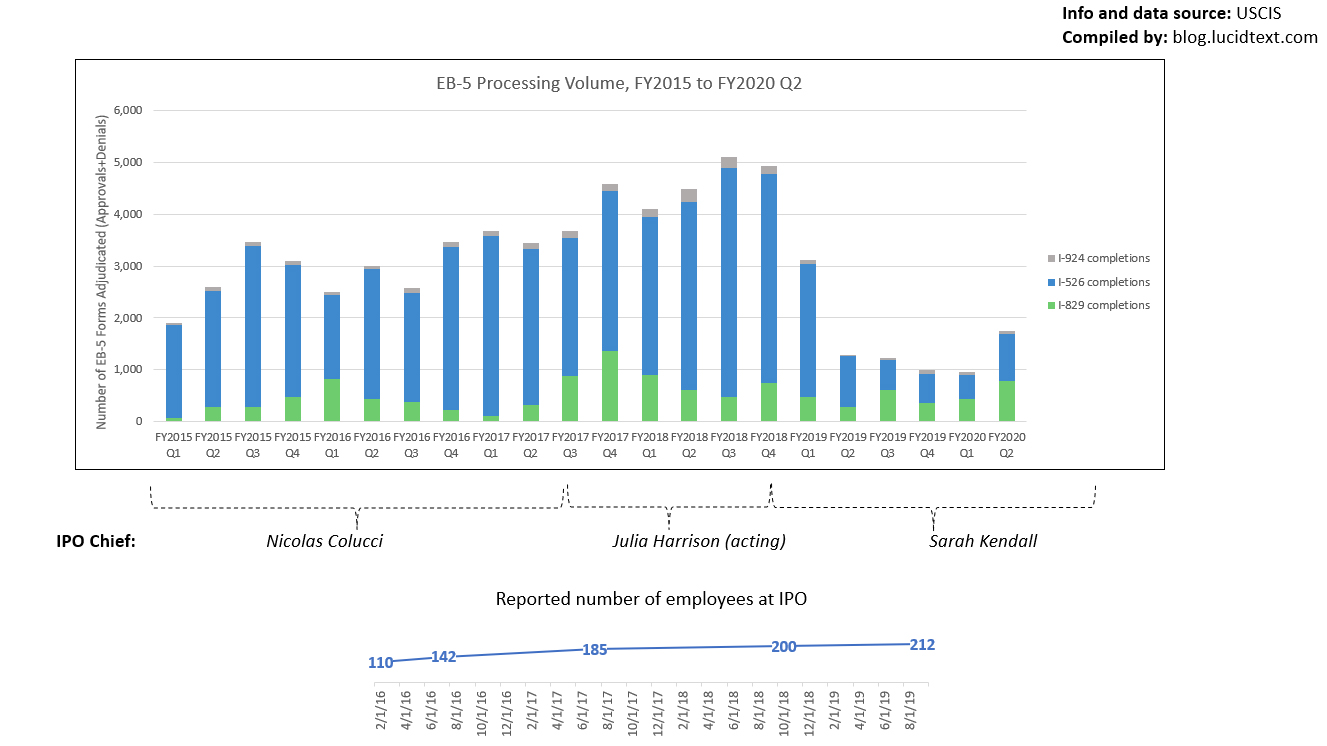
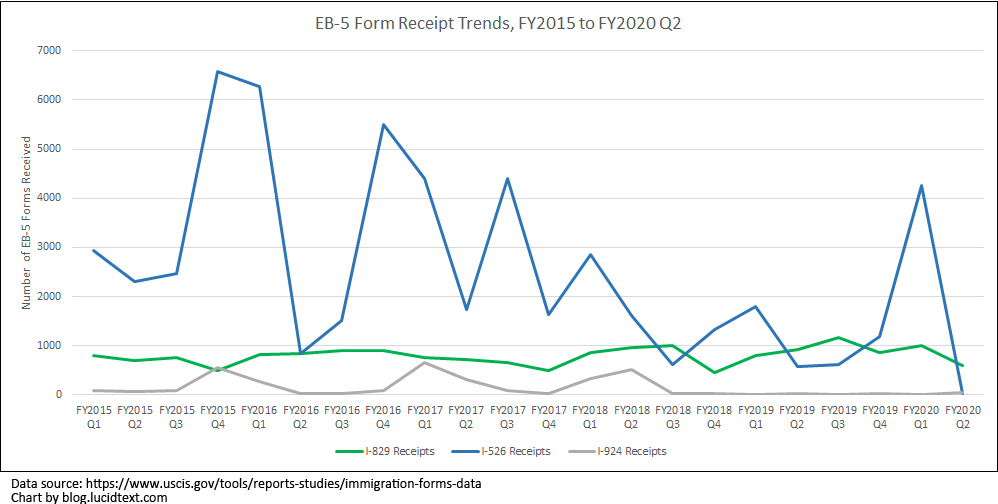

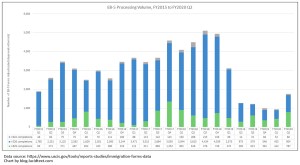
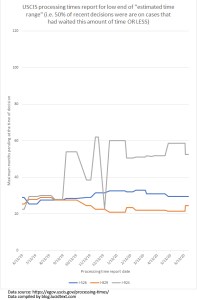
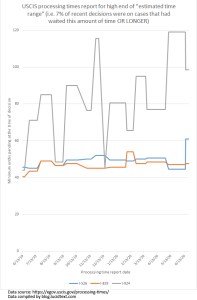
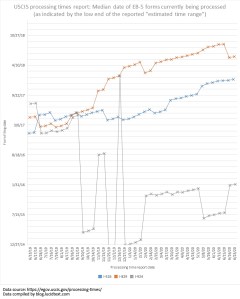

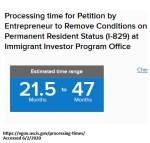
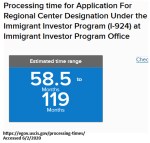

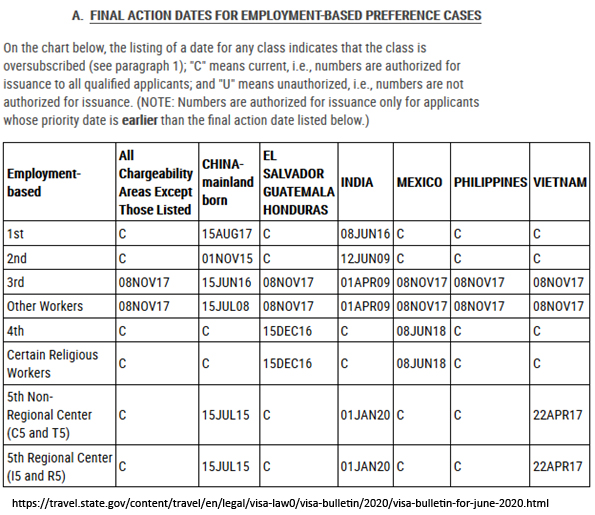

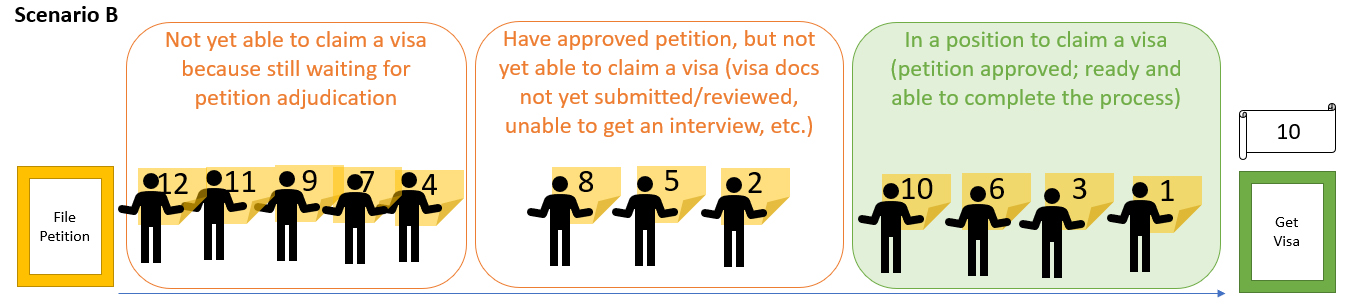

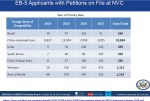

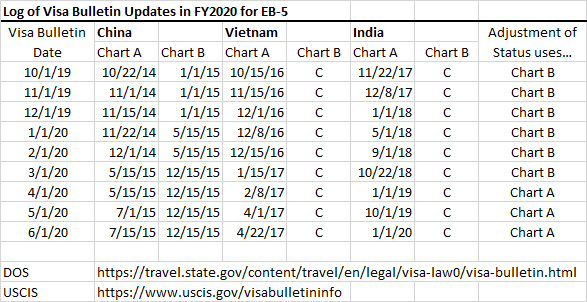
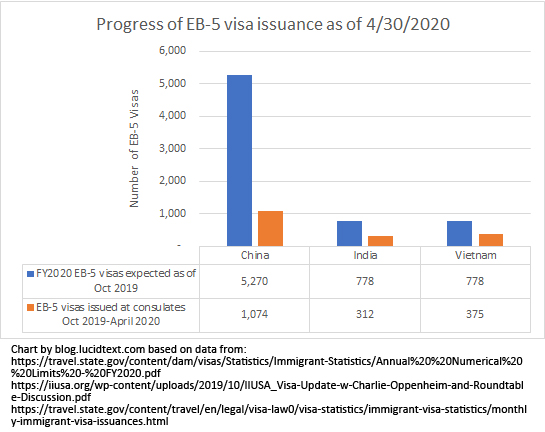

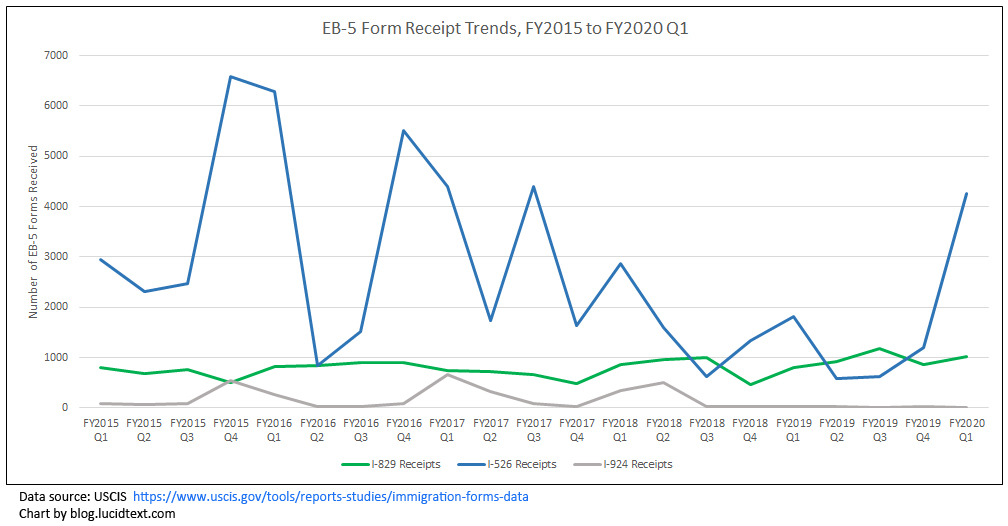
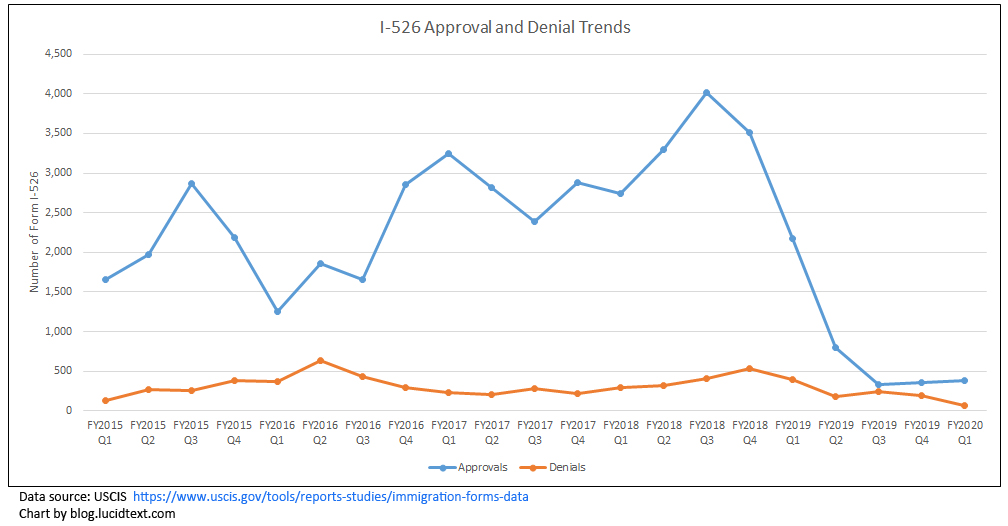
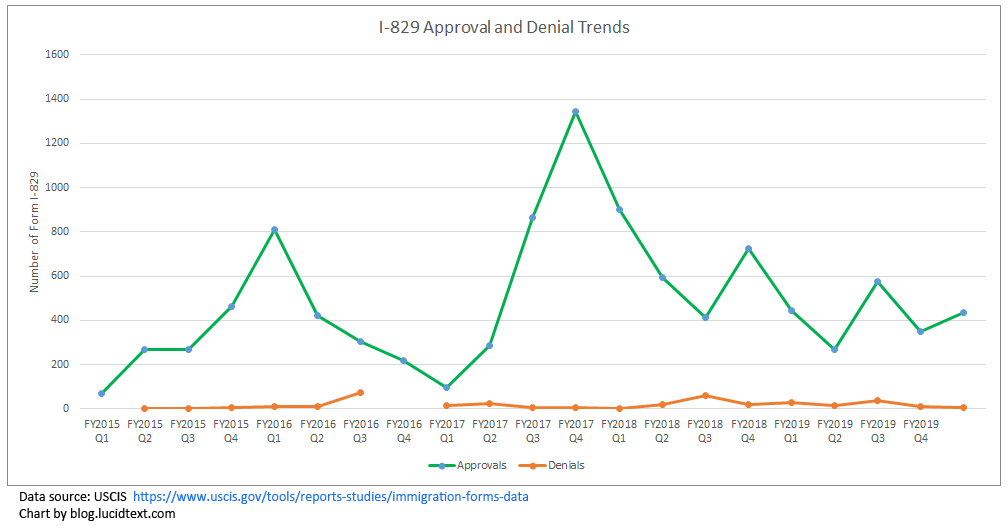
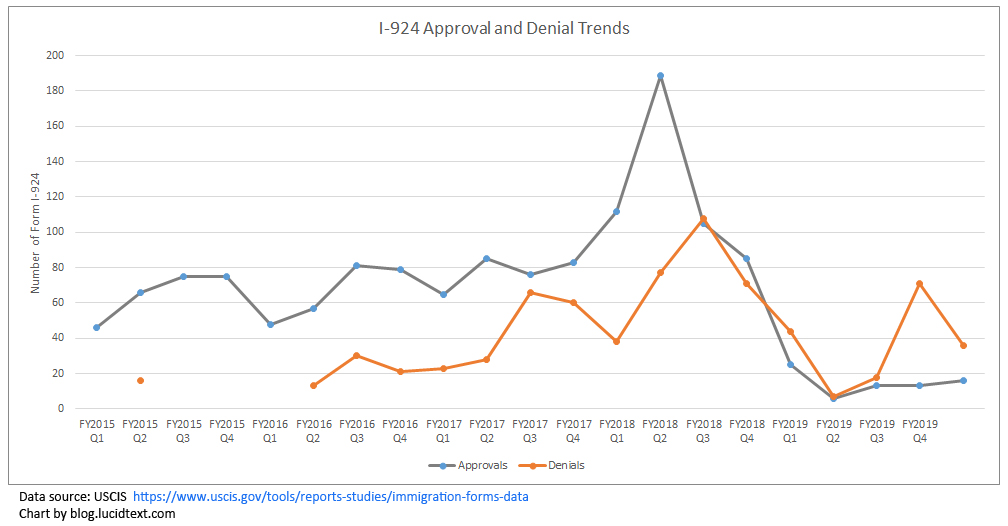

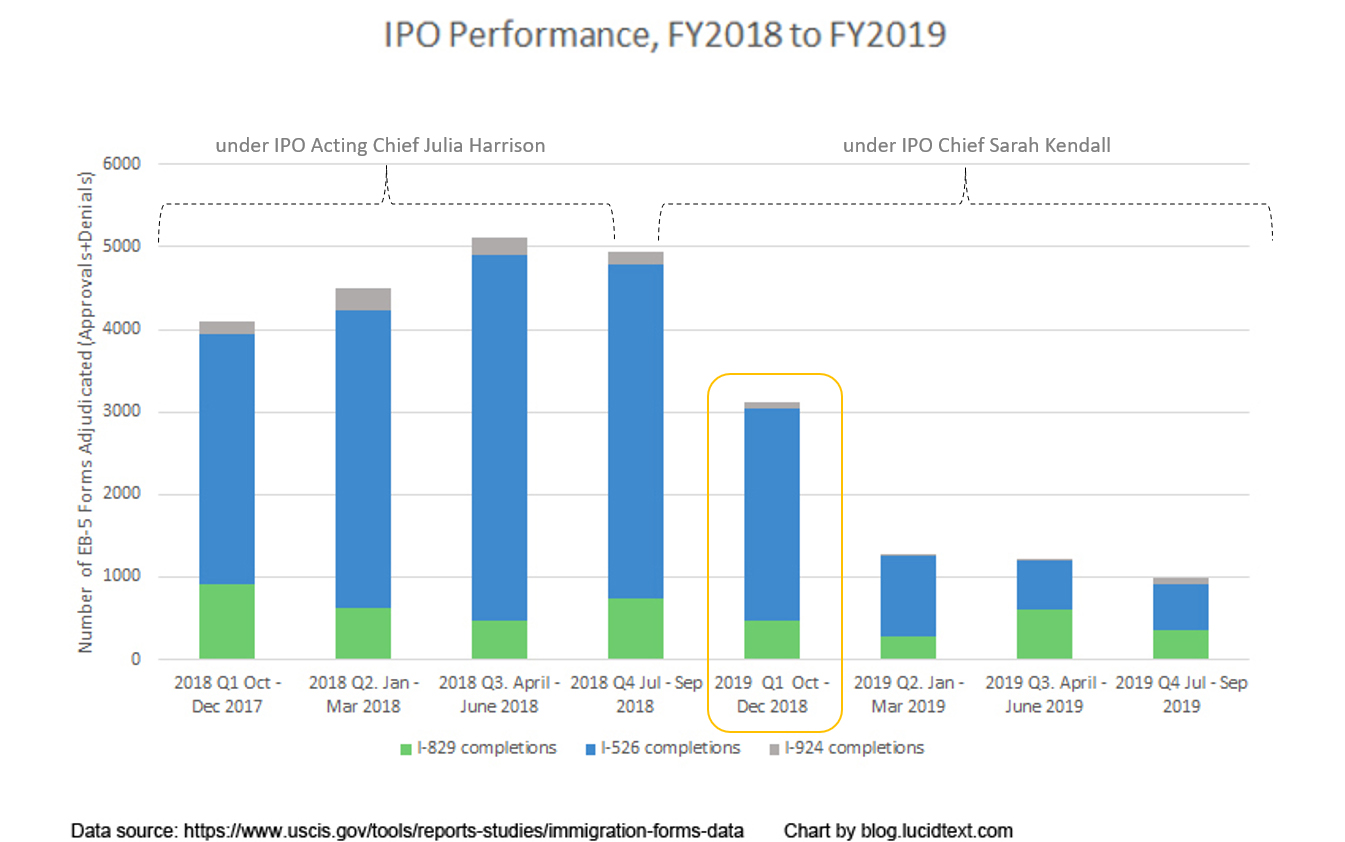
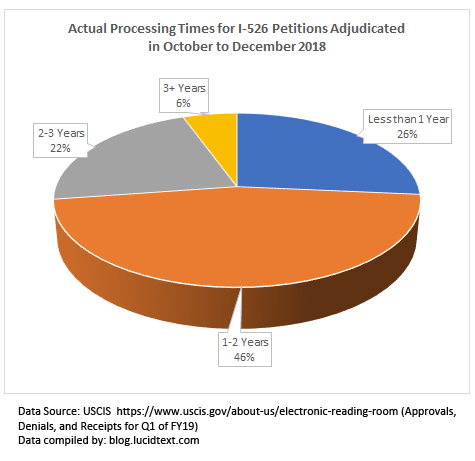

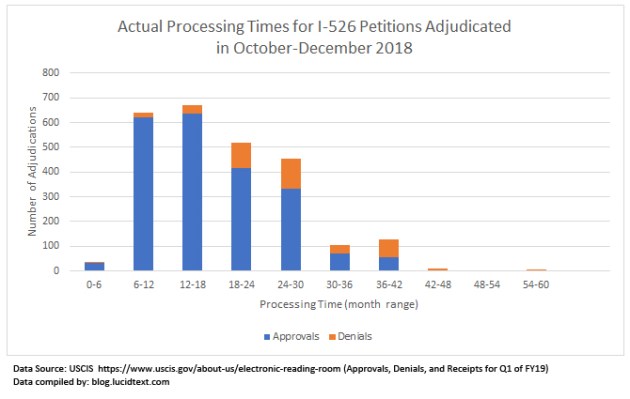
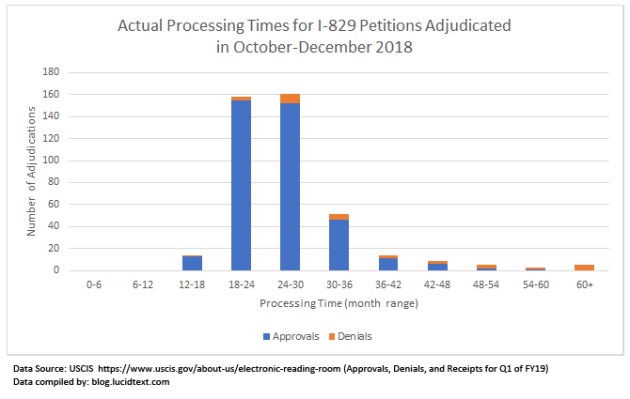
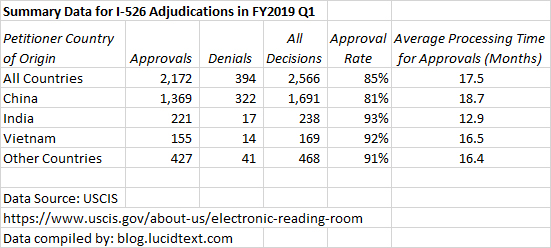


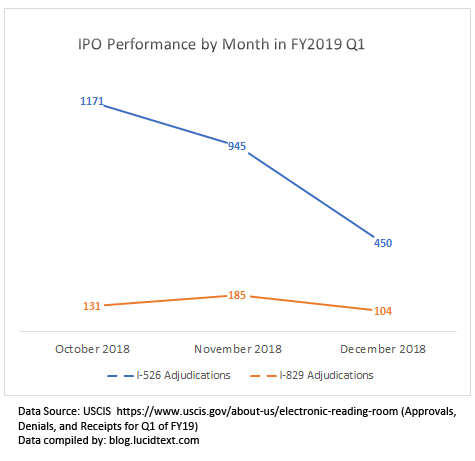

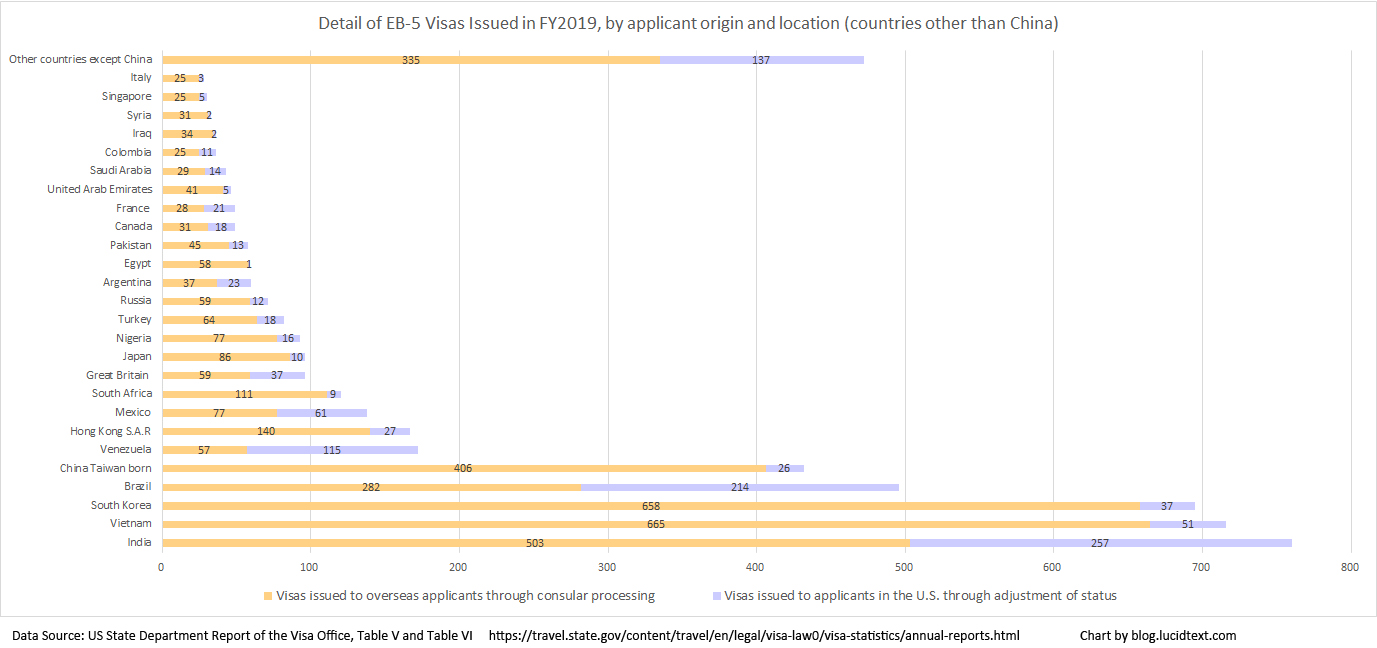

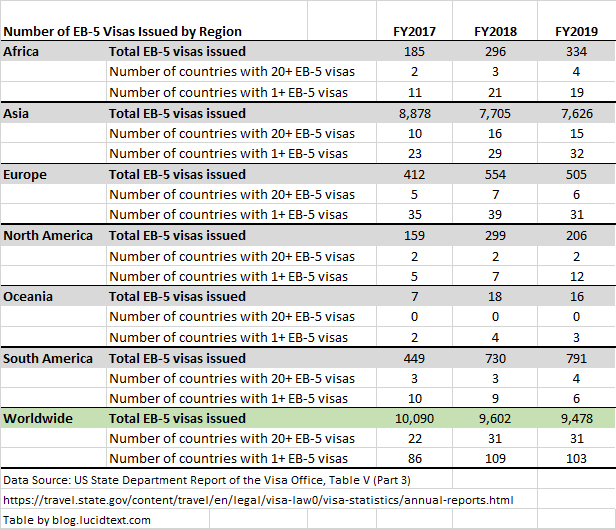

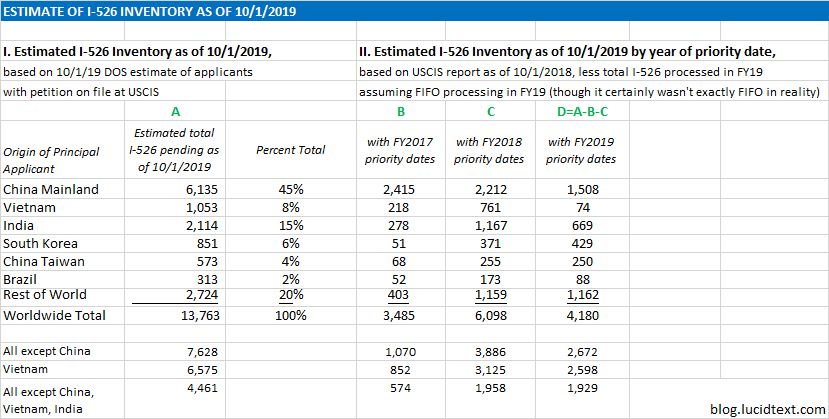

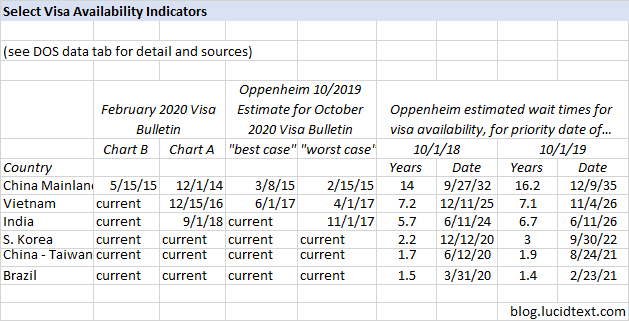
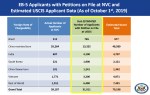


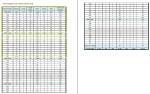
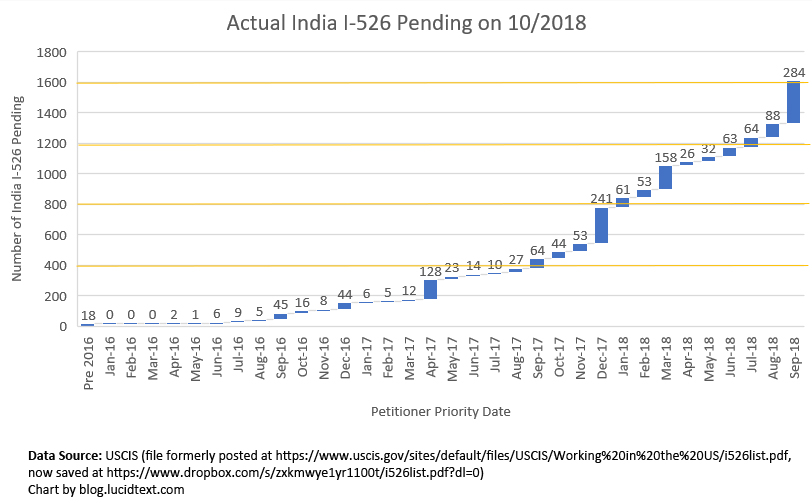
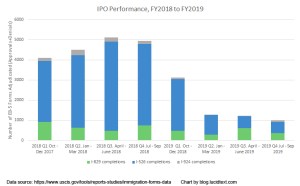
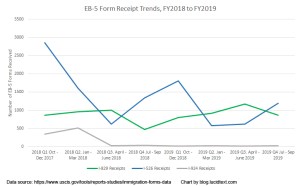
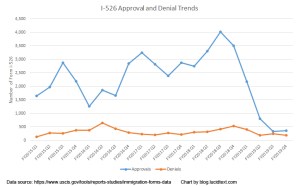
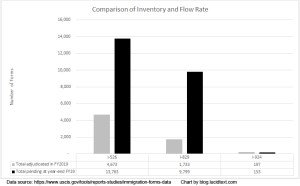
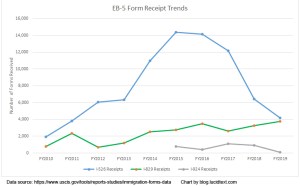
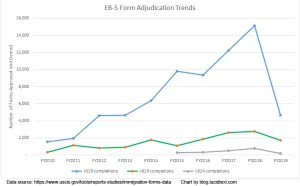
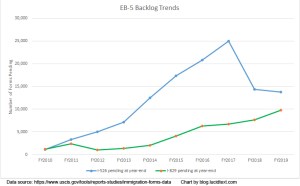
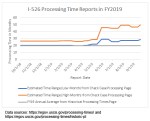
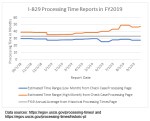
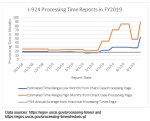

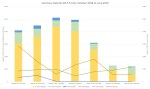
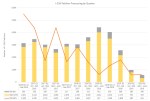
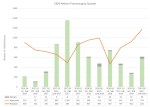
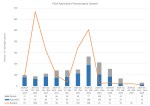
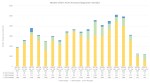
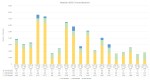
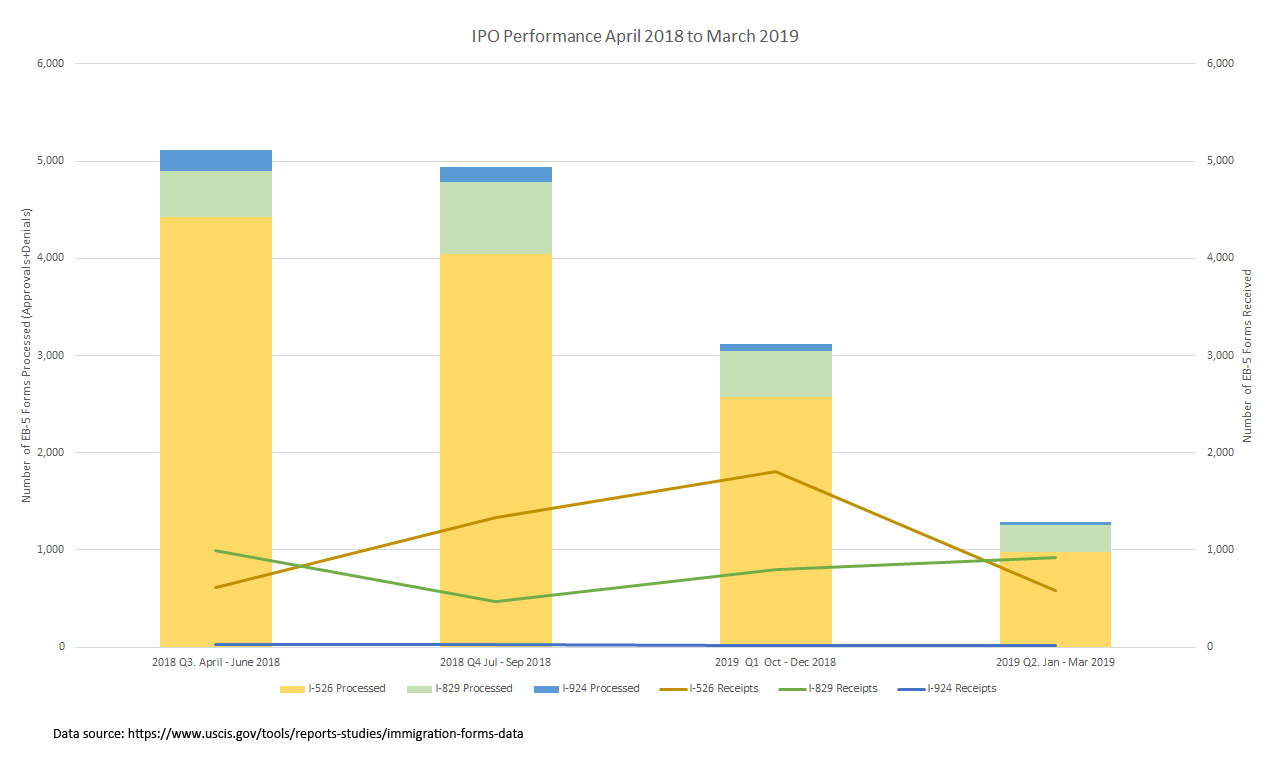

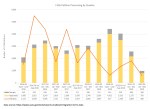


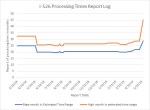


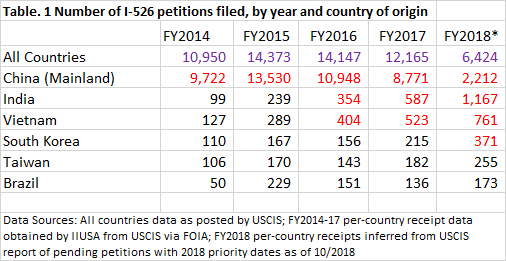

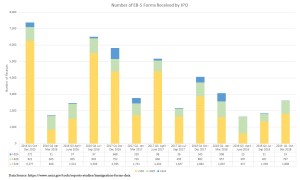
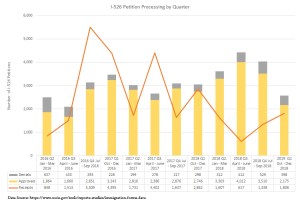
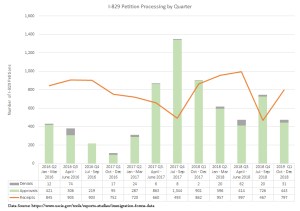
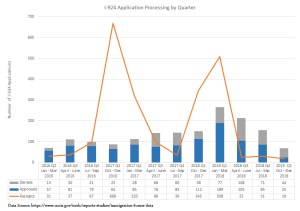

 EB-5 Updates