New Regional Centers (GA, IL), Legislation Updates, ELIS, Due Diligence

The USCIS list of approved Regional Centers has added another three entries (now 46 new centers in 2013).

Georgia
Southeast Foreign Investment Center LLC
http://www.southeastforeignic.com/

Illinois
Chicago Metro Regional Center, LLC
http://www.nyeb5.com/contact.html
Geographic Area: Illinois counties of Cook, Lake, Will and Du Page
Industry Categories: New Multifamily Housing Construction (NAICS 236116), Commercial and Institutional Building Construction (NAICS 23622), Offices of Real Estate Agents and Brokers (NAICS 53121), Fitness and Recreational Sports Centers (NAICS 71394), Convenience Stores (NAICS 44512)
Approval Notice

Chicago Regional Center
http://www.chicagorc.net/

(Note: See my Regional Center directory page for my most updated listings for all RCs. And please email me if you would like to provide additional information regarding your RC.)

Chicago Metro Regional Center has the first designation letter that I’ve seen come out of the new Washington DC office, signed by Daniel Renaud as Acting Chief of the Immigrant Investor Program rather than by the California Service Center. Congratulations! I’m interested in the “Job Creation” sections of recent approval letters, and how they discuss economic model approvals, hypothetical vs. I-526 review, and deference. I also wonder about the significance of NAICS code lists appearing twice in recent approval letters, once under the “Regional Center Designation” heading and once under the “Job Creation” heading. Could this distinction open the possibility for Regional Center codes to be relatively general, even as 4-digit+ codes are used in the economic model? I hear rumors that USCIS may be hammering out a new statement on industry category requirements that loosens the highly restrictive trend toward granular industry approvals.

In other EB-5 news, Congress is continuing to discuss immigration reform legislation that includes significant EB-5 provisions. USCIS is working on implementing electronic filing for I-526 petitions, and held a conference call on 5/23 to discuss logistics and solicit feedback. And due diligence continues to be a hot topic of EB-5 conversation.

More DC news, CA TEA update, IIUSA conference, New RCs (AR, CA, MS, MD)

A few more important posts from this week:

Also, additions to the USCIS Regional Center list bring the total new centers approved in 2013 to 43.

Arkansas and Mississippi
Liberty South Regional Center
http://www.libertysouthusa.com/

California
San Gabriel Valley Regional Center
http://sangabrielvalleyrc.com/

Maryland
Maryland Area Regional Center, LLC
http://goeb5visa.com/

(Note: See my Regional Center directory page for my most updated listings for all RCs. And please email me if you would like to provide additional information regarding your RC.)

EB-5 transitions and DC move

Thanks to H. Ronald Klasko for his post yesterday on EB-5: What to Expect in the Coming Months. I’m particularly interested in these paragraphs, which provide an update on the EB-5 program office move (based on information from Rob Silvers at the AILA EB-5 conference in Miami on May 2):

Things are clearly changing, hopefully for the better. The transition of EB-5 adjudications from California to Washington is in progress. The new facility housing the EB-5 unit in Washington is open. Adjudicators of I-924s and EB-5 projects will be handled not by traditional CIS adjudicators but rather by newly hired economists. Some of the economists have already been hired, and some are being actively recruited. The DC unit, staffed by GS15 economists (very high level government employees) will first handle I-924s, then I 526s and then I-829s. For some period of time, the DC unit and the California Service Center EB-5 adjudicators will work concurrently. Eventually, the California Service Center will be phased out, and all of the applications will be handled by the EB-5 unit in Washington. This unit will be headed by Dan Renaud, Acting EB-5 Program Chief, and Robert Cox, the Acting EB-5 Deputy Chief.

The new EB-5 office in Washington will be staffed solely or mostly by new hires. The good news is that adjudications in the new office will be handled by economists rather than USCIS adjudicators and generally higher level economists than those previously hired into the EB-5 program. The bad news is that these new hires will be new to the EB-5 program, will have to be trained and likely will take some time to be completely up to speed. In my experience, new hires tend to be slower in making decisions and often wary to issue approvals until they are secure in their positions. Hopefully, this either will not occur or will be a short transition period. Also, new economists may have new positions on economic methodologies, which could be good or bad news.

For further detail on the new Washington DC office and other clarifications and updates provided by Ron Silvers at the AILA meeting, see the remainder of Ron Klasko’s update. See also the meeting report by Jennifer Hermansky on the EB-5 Insights blog.

I hesitate to comment on the EB-5 aspects included in the Senate’s comprehensive immigration reform bill (S. 744) currently under discussion, but encourage those of you with lobbying interests and suggestions for change to get involved. IIUSA posts regular updates. Senator Leahy this week proposed an amendment to the bill that would involve major changes for EB-5 — many aimed at fraud prevention. I have heard privately a number of astute suggestions for program improvements, and plan to feature them here for discussion.

Tenant Occupancy Saga Continues (NOID Chapter)

The 12/20/2012 Guidance Memo from USCIS on “Operational Guidance for EB-5 Cases Involving Tenant-Occupancy” offered to give closure about when/how it’s possible to attribute tenant jobs to an EB-5 investment in real estate development. But now the California Service Center is issuing notices that suggest additional concerns and remaining questions.

Possibly mirroring the flood of “tenant occupancy Requests for Evidence” (RFE) from February 2012, we’re now seeing tenant occupancy Notices of Intent to Deny (NOID). This week I’ve read two very similar NOID both dated 4/30/2013, and heard of more. (Anyone else have examples to show? Anyone by chance get an approval for a case involving tenant occupancy? Thank you John Anderson for sharing your experience in your comment to this blog entry.)

The RFEs issued in February last year gave I-924 applicants a choice: 1) give up trying to count tenant jobs, or 2) jump through some hoops, and maybe your tenant occupancy proposal can be accepted as reasonable. Most applicants that I know who received one of those RFEs simply gave up claiming tenant jobs (though the practice had long been a staple of the EB-5 program), but a few tried to jump the hoops. They filed RFE responses in April and May 2012 with evidence demonstrating constraint on the supply of appropriate commercial space and excess demand for such space, arguments for nexus between construction investment and tenant job creation, and strategies for how tenant jobs would be assessed as new or relocated. And then those applicants waited.

Now this week, a year after the RFE responses, and four months after USCIS published the operational guidance memo, I see NOID that give a familiar ultimatum: 1) give up trying to count tenant jobs, or 2) jump through more hoops, and maybe your tenant occupancy proposal can be accepted as reasonable. The hoops in the NOIDs that I’ve read so far (issued on cases that tried to make a facilitation argument) are not quite the same as those in the 2/2012 RFE or in the 12/2012 Guidance Memo from USCIS. It’s not even obvious that the NOID writers are aware of the Guidance Memo — the NOIDs in front of me don’t reference the Memo, and sometimes contradict it. For example:

  • The Memo states that, in principle, “tenant-occupancy methodology can satisfy the EB-5 program requirement of presenting a ‘reasonable methodology’ that is ‘supported by economically or statistically valid forecasting tools.’” An NOID before me indicates that an economic model input corresponding to the unrelated tenants of commercial space is per se unacceptable, even if the method for quantifying the tenant jobs is transparent and up-to date.
  • The Memo says that applicants relying on a facilitation-based approach (showing removal of a market-based constraint) do not need to also show capital investment in the tenant business. An NOID before me states that the applicant using a facilitation-based approach must also show significant capital investment in tenant businesses.
  • The Memo states that the applicant may show facilitation of tenant jobs by the EB-5 enterprise through demonstrating constraint on the supply of appropriate commercial space or of excess demand for such space. The NOIDs before me grant that the applicant has demonstrated constrained supply/excess demand for particular commercial space, but go on to require the applicant to show unmet demand and/or limited supply for the services to be offered by the tenant businesses, and to show that the tenant jobs would not have been created in the absence of construction activity.
  • The Memo allows for identifying tenants by industry category at the I-924 stage (rather than identifying specific tenants), and allows for the possibility that leasing plans (and the particular assumptions used as an input to the economic model) may change between I-924 and I-526. The NOIDs before me do not accept analysis based on market trends and potential tenant types identified by four-digit NAICS industry category, but rather ask the I-924 to provide evidence and demonstrations regarding “specific tenant businesses.”

Here’s the message that I get from these NOIDs. I-924 Applicant: “Can I use the previously-accepted EB-5 practice of foreseeing tenant jobs among the impacts of my real estate development?” USCIS: “Sure. You just need to identify and analyze actual businesses likely to become tenants in your future/hypothetical development while also demonstrating that these currently-identifiable prospective tenants won’t (and couldn’t) be in business until some point in the future when you’re finally approved and can go ahead with a real project.”

But maybe I exaggerate. For reference, here is a portion of the common (non-case-specific) language shared by the 4/30/2013 NOIDs that I’ve seen. (The case-specific commentary in the NOIDs is more revealing, and at points contradicts even this language, but is not mine to share.) I wonder if these repeated words reflect the CSC’s own Operational Guidance for EB-5 Cases Involving Tenant Occupancy.

Quoted from 4/30/2013 Notices of Intent to Deny I-924 Applications

USCIS is willing to consider counting the jobs created by tenants occupying the commercial space built by the EB-5 capital as indirect jobs.  However, there are three issues of concern to USCIS in counting tenant jobs as indirect jobs which require additional justification when reviewing Regional Center project proposals. First, there is a concern that the tenants will not be there to lease the space when the construction project is finished. That is, there is concern that once a shopping mall or office building is finished, the space will be largely vacant. Second, the counting of tenant jobs relies on the assumption that these jobs are not simply jobs relocated from commercial space somewhere else. Third, the estimated number of tenant jobs for the commercial space must be supported by a detailed, verifiable, and transparent methodology that estimates industry-specific tenant employment levels.

Thus, to count tenant jobs for job creation purposes, the RC must establish by a preponderance of the evidence that these newly created jobs would not have been created in the geographical region but for construction of the project. The evidence currently presented in your application is insufficient to show that the space supplied by the EB-5 development capital is more likely than not to be occupied by tenants, that the tenant jobs are not merely relocated, and that the estimated number of tenant jobs to be created is probably true.

The applicant has two options:

  1. To remove tenant jobs from the job creation counts, or
  2. To submit additional evidence that shows that it is more likely than not that the tenants will be there to occupy the commercial space when the construction project is finished, that the tenant jobs are not merely relocated from another commercial space within the same geographical area, and that the estimated number of tenant jobs is a reasonable estimate.

Evidence that tenants are likely to occupy the commercial space:

The applicant may present one or more of the following types of evidence to show that the construction project will be attracting tenants from within the region who were not able to operate prior to the commercial construction project or attracting new tenants from another geographical region. Below are examples of evidence that can be presented to support tenant occupancy and job creation:[This is not meant to be an exhaustive list of the types of evidence that can be presented.]

  • 1. A description of the products and services to be provided, a detailed market analysis, and a marketing plan as discussed in Matter of Ho, 22 I&N Dec. 206, 213 (Assoc. Cmm’r 1998), to be part of the comprehensive business plan and which provides support of new tenant occupancy in the region. First, Matter of Ho already requires the business plan to include “a description of the business, its products and/or services”. In this case, this should include a description of the office or commercial space and its characteristics that will result from the construction project. Second,  Matter of Ho states:

The plan should contain a market analysis, including the names of competing businesses and their relative strengths and weaknesses, a comparison of the competition’s products and pricing structures, and a description of the target market/prospective customers of the new commercial enterprise.  Matter of Ho, 22 I&N Dec. 206, 213 (Assoc. Cmm’r 1998)

A satisfactory market analysis that helps to support the fact that new tenants will occupy the space built by the applicant should include: the current size of the market; historic trends and developing trends and projected growth rate; the target market and number and purchase of potential customers; distinguishing characteristics of the target market and why potential tenants are likely to come to this new building/mall; existing competitors in the market and distinguishing features in relation to existing competitors. The market analysis may include data collected on trends and size and purchases in the target market as well as market test results from potential tenants who were contacted and interviewed.

Lastly, information on “the marketing strategy of the business,” as discussed in Matter of Ho, should also be included to support new tenant occupancy in the Regional Center.

  • 2. Evidence on lack of appropriate space in the geographical region where the applicant is constructing its commercial space. The following are examples of evidence of lack of appropriate space:
  • Evidence of low vacancy rates of commercial space within the geographical region where the project is located.
  • Evidence that, even if vacancy rates of general commercial space are high, there is a lack of suitable commercial space, such as space with the amenities and specialized facilities required for the tenants that are expected to lease from the commercial enterprise. Supporting materials showing available and suitable commercial space in the region and the characteristics of the commercial space which makes it unfit to satisfy t he ability to set up the types of businesses and outlets indicated in the business plan.
  • The applicant can provide responses from surveys of employers (a minimal sample size of 50 is recommended) in the geographic region indicating that lack of appropriate space is a main constraint towards setting up a business in this geographic region.
  • A detailed letter from a state of local governmental official, such as the Mayor of the city where the development will occur or an official of an economic development agency in the area, describing and providing supporting evidence of the availability of suitable space or lack thereof. For example, supporting evidence may include a study conducted on behalf of the city addressing constraints on business development in the area.
  • Evidence that the new commercial space will bring substantial cost savings to the tenants who lease space there. The following types of evidence can be useful in this regard:
    1. Evidence of lower operational and/or maintenance costs to the lessee in the commercial space.
    2. Tax benefits, rebates, or other subsidies to the lessee.
    3. Evidence that demand for commercial space is growing in the geographical area where the RC is constructing commercial space. Evidence of growing demand for leasing space includes:
      1. Evidence that lease prices for commercial spaces are increasing.
      2. Evidence of increased demand in the area through population growth, income growth and consumption growth in the area.
      3. Evidence that new tenants and customers will be attracted to the commercial space due to the construction of the project. This may be particularly relevant in the case of Targeted Employment Areas, whether they are high unemployment areas or rural areas. Examples of evidence that can be useful to show that the EB-5 project is more likely than not to attract new tenants and customers includes:
          1. Evidence that an anchor tenant (e.g. a tenant that will occupy one of the largest available spaces within the development) has already been attracted or is likely to sign a lease for this commercial space. In this case, the applicant can provide verifiable evidence in the form of the actual lease or a previous relation and previous leases with the anchor tenant in similar projects from the commercial enterprise.
          2. Evidence of new businesses coming into the geographical area for the first time and locating in the commercial development, offering products or services that were not otherwise available in that market, as well as agreements or letters of intent from actual or potential new businesses.
          3. Support letter from the local government showing preferred status for this economic development area indicating that funds are being invested in the area in the form of roads, bridges or other infrastructure.

        Confirmation that the tenant jobs will be “new” jobs and not “merely relocated”:

        The jobs that become located within the tenant space of the project should be shown to be more likely than not a result of an expansion in specific services driven by the project as opposed to merely tenant shifting and/or re-location of already existing jobs. Please explain how it will be verified that the jobs that will become located within the tenant space of the project can be considered “new” jobs.

        Evidence that the job creation estimates are reasonable:

        If the applicant is able to show that it is more likely than not that the economic conditions of the local area and the specific benefits provided by the proposed commercial space will cause new tenant businesses to start operations in that commercial space, the applicant must also present a detailed, verifiable,  and transparent methodology that estimates industry-specific tenant employment levels. For tenant job estimate purposes, the applicant should prepare employment estimates using detailed, verifiable, and transparent methodologies with supporting data. USCIS encourages you to provide information regarding the specific industry of projected tenants as well as the projected revenue/square footage metrics that are used in the input-output model to support the number of projected tenant jobs.

        Option to remove tenant jobs from the job creation counts:

        Alternatively, the applicant is afforded an opportunity to provide business plans and an economic impact analysis for any industry categories and NAICS codes to demonstrate employment creation which is not based on tenant occupancy.

New RCs (CT, FL, MA, NY, PR) and TEA Resources

Regional Centers
The number of new Regional Centers approved by USCIS this year is up to 40, as the USCIS Regional Center list has added five new entries.

Connecticut
New England Regional Center

Florida
Gardens Regional Center, LLC

Massachusetts
Arundel Capital Partners
Website: http://arundel-group.com/
Geographic Area: Suffolk County, MA
Industry Categories: Commercial and Institutional Building Construction (NAICS 236220), Lessors of Nonresidential Buildings (NAICS 531120)
Designation Letter

New York
American Regional Center for Entrepreneurs
Email: info@arcfe.com
Geographic Area: New York, Bronx, Queens, Kings, Nassau, and Westchester Counties, NY
Industry Categories: Nonresidential Building Construction (NAICS 2362), Residential Property Managers (NAICS 531311)

Puerto Rico
Omega Puerto Rico Regional Center, LLC
Website: http://omegaregionalcenters.com/

(Note: See my Regional Center directory page for my most updated listings for all RCs. And please email me if you would like to provide additional information regarding your RC.)

Targeted Employment Area (TEA) Resources
Impact Data Source has published useful resources related to TEAs. For analysis of newly-released unemployment data from the US Bureau of Labor Statistics, a list of state agencies responsible for TEA designations, and an awesome interactive map of unemployment rates nationwide, see:

Blog Post discussing finalized average annual 2012 unemployment data – http://www.impactdatasource.com/2013-tea-data/

EB-5 TEA Map web page – http://www.impactdatasource.com/eb-5/tea/

Full Screen EB-5 TEA Map – www.impactdatasource.com/map

List of State Agencies Certifying TEAs – http://www.impactdatasource.com/eb-5/state-agencies-teas/

Determining the unemployment rate of a given area is one element in the process of determining TEA qualification. It’s also necessary to strategize about how to define the boundaries of the area to be designated, to consider the timing of designation, and to understand how the process works at the state level. As usual, Kate Kalmykov has a useful post on this topic: Determining if Your EB-5 Project is Located in a Targeted Employment Area (TEA). See also the following recent guidance from USCIS regarding TEA designation.

from p. 7-8 of the 5/30/2013 EB-5 Adjudications Policy Memorandum
a. “Targeted Employment Area” Defined

The statute and regulations governing the EB-5 Program defines a “targeted employment area” as, at the time of investment, a rural area or an area that has experienced unemployment of at least 150 percent of the national average rate. A “rural area” is defined as any area not within either a metropolitan statistical area (as designated by the Office of Management and Budget) or the outer boundary of any city or town having a population of 20,000 or more (based on the most recent decennial census of the United States). 8 U.S.C. § 1153(b)(5)(B)(ii), (iii); 8 C.F.R. § 204.6(e). In other words, a rural area must be both outside of a metropolitan statistical area and outside of a city or town having a population of 20,000 or more.

Congress expressly provided for a reduced investment amount in a rural area or an area of high unemployment in order to spur immigrants to invest in new commercial enterprises that are principally doing business in, and creating jobs in, areas of greatest need. In order for the lower capital investment amount of $500,000 to apply, the new commercial enterprise into which the immigrant invests or the actual job creating entity must be principally doing business in the targeted employment area.

For the purpose of the EB-5 Program, a new commercial enterprise is “principally doing business” in the location where it regularly, systematically, and continuously provides goods or services that support job creation. If the new commercial enterprise provides such goods or services in more than one location, it will be deemed to be “principally doing business” in the location that is most significantly related to the job creation. Factors to be considered in making this determination may include, but are not limited to, (1) the location of any jobs directly created by the new commercial enterprise; (2) the location of any expenditure of capital related to the creation of jobs; (3) where the new commercial enterprise conducts its day-to-day operation; and (4) where the new commercial enterprise maintains its assets that are utilized in the creation of jobs. Matter of Izummi, 22 I&N Dec. at 174.

As discussed fully below, investments through the Immigrant Investor Program can be made through regional centers and the new commercial enterprise may seek to establish indirect job creation. In these cases, the term “principally doing business” will apply to the job-creating
enterprise rather than the new commercial enterprise. See 8 C.F.R. § 204.6(j)(6); Matter of Izummi, 22 I&N Dec. at 171-73 (discussing the location of commercial enterprises to which the new commercial enterprise made loans).

The immigrant investor may seek to have a geographic or political subdivision designated as a targeted employment area. To do so, the immigrant investor must demonstrate that the targeted employment area meets the statutory and regulatory criteria through the submission of: (1) evidence that the area is outside of a metropolitan statistical area and outside of a city or town having a population of 20,000 or more; (2) unemployment data for the relevant metropolitan statistical area or county; or (3) a letter from the state government designating a geographic or political subdivision located outside a rural area but within its own boundaries as a high unemployment area. 8 C.F.R. § 204.6(j)(6).

b. A State’s Designation of a Targeted Employment Area

The regulation provides that a state government may designate a geographic or political subdivision within its boundaries as a targeted employment area based on high unemployment. Before the state may make such a designation, an official of the state must notify USCIS of the agency, board, or other appropriate governmental body of the state that will be delegated the authority to certify that the geographic or political subdivision is a high unemployment area. The state may then send a letter from the authorized body of the state certifying that the geographic or political subdivision of the metropolitan statistical area or of the city or town with a population of 20,000 or more in which the enterprise is principally doing business has been designated a high unemployment area. 8 C.F.R. § 204.6(i).

Consistent with the regulations, USCIS defers to state determinations of the appropriate boundaries of a geographic or political subdivision that constitutes the targeted employment area. However, for all TEA designations, USCIS must still ensure compliance with the statutory requirement that the proposed area designated by the state in fact has an unemployment rate of at least 150 percent of the national average rate. For this purpose, USCIS will review state determinations of the unemployment rate and, in doing so, USCIS can assess the method or methods by which the state authority obtained the unemployment statistics. Acceptable data sources for purposes of calculating unemployment include U.S. Census Bureau data (including data from the American Community Survey) and data from the Bureau of Labor Statistics (including data from the Local Area Unemployment Statistics).

There is no provision that allows a state to designate a rural area.

Q&A from USCIS’s Executive Summary of the 5/1/2012 EB-5 Quarterly Stakeholder Engagement

Q: Will a single or multiple contiguous census tracts be considered as a geographic subarea?

A: USCIS encourages that standard Bureau of Labor Statistics (BLS) estimation methodology be used. In the event that subareas for which Local Area Unemployment Statistic estimates are not regularly produced, such as census tracts, the TEA applicant should be aware of the following: (1) the census-share technique be used ONLY where inputs for the preferred BLS methodology are not available and (2) only household-only inputs be used, in order to eliminate the impact of the Census 2000 Group Quarters processing error. More information regarding this answer can be found at the Bureau of Labor Statistics webpage at: http://www.bls.gov/bls/empsitquickguide.htm

Q: Can a qualifying census tract with unemployment 150% of the national rate be certified as a TEA?

A: Yes, but designation will depend on the quality and timeliness of the data used to support the 150% of the national average rate of unemployment claim. Acceptable data sources for purposes of calculating unemployment include Local Area Unemployment Statistics produced by a government agency, U.S. Census Bureau data, and data from the American Community Survey.

Q: Has there been any progress on further defining an acceptable vs. gerrymandered TEA? Will USCIS be providing additional guidance?

A: This issue is being examined in the context of the draft memorandum, which will be posted for comment in the near future. [See pages 6-8 of 2/14/2013 version of the draft EB-5 policy memorandum.]

And a final reminder: A Targeted Employment Area is not the same as a Regional Center. Non-Regional Center investors can invest in TEAs at the $500,000 level. Regional Centers can cover areas that are not designated TEAs. It’s a common misconception that Regional Center investments are $500,000 and direct/non-regional center investments must be $1 million. That’s not the case. The amount of EB-5 capital that must be invested depends simply on whether or not the new commercial enterprise is principally doing business and creating jobs in a “targeted employment area” defined “as, at the time of investment, a rural area or an area that has experienced unemployment of at least 150 percent of the national average rate.” Whether the investment is within a Regional Center or not makes no difference to the TEA qualification and qualifying investment amount.
Processing Backlog, Meeting Summary, Best Practices

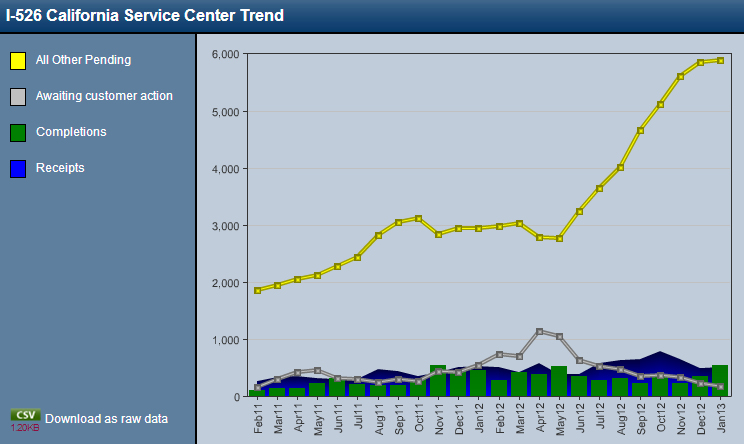
The USCIS Processing Time information from the California Service Center shows that as of 4/3/2013, the last I-526 processed had a filing date of 3/16/2012. The Case Status section of the USCIS website illustrates the dire backlog situation for Form I-526.
I526trend
Wow. 5,887 I-526 petitions pending. I’m so glad that I’m not an adjudicator. The trend line for I-829 looks more promising, though still reflecting a significant backlog.
I-829

Thank you to IIUSA for publicizing the processing backlog, as well as the pointing out the Executive Summary of 3/5/2013 CIS Ombudsman EB-5 Immigrant Investor Program Stakeholder Meeting. I also recommend IIUSA’s Comments to USCIS on the EB-5 Adjudications Memo, which give a good summary of the hot questions in EB-5.

Thank you also to Catherine Holmes, Victor Shum and Angelique Brunner for an excellent contribution to the effort to define best practices for Regional Centers. See the aricle Protecting the integrity of the EB-5 investment market through the adoption and use of due diligence best practices. So long as you’re on the Hotel Law blog, you may also want to check out their useful posts on SEC compliance, partnering with a Regional Center, and EB-5 investment in an existing business.

More New RCs (AL, FL, LA, MS, NY, TX, WV)

The number of new Regional Center approvals in 2013 is now up to 35, as the USCIS list of approved Regional Centers continues to be updated. West Virginia is now represented on the list for the first time thanks to Mid Atlantic EB5 Regional Center. Gulf States Regional Center is remarkable for being the first approval I’ve seen of an RC application filed in 2012, and for having achieved approval of a wide-ranging geographic area and industry categories defined by two and three digit NAICS codes, including NAICS 44-45 for Retail Trade. Many Requests for Evidence issued by USCIS in 2011-2012 sought to severely limit RC geographic area (strictly interpreting the mandate that “A regional center shall have jurisdiction over a limited geographic area”) and demanded minimum four-digit NAICS codes as a matter of principle. This new approval shows that case-specific (or adjudicator-specific) variations are possible. It’s a good reminder not to treat what appear to be general policy statements in Requests for Evidence as actual policy statements, and to realize that USCIS is serious about its case-specific approach to EB-5 adjudications. Congrats to these new centers on having navigated the review process so (relatively) quickly.

Alabama, Florida, Louisiana, Mississippi, Texas
Gulf States Regional Center, LLC
Geographic Area: Alabama counties of Mobile and Baldwin
Florida counties of Escambia, Santa Rosa, Okaloosa, and Walton
Louisiana counties of Orleans, St. Bernard, Plaquemine, Jefferson, Terrebonne, Lafourche, Vermillion, Iberia, St. Mary, Lafayette, Cameron, and Calcasieu
Mississippi counties of Jackson, Harrison, and Hancock
Texas counties of Orange, Jefferson, Chambers, Galveston, Brazoria, Matagorda, Nueces, Calhoun, Refugio, Aransas, San Patricio, Kleberg, Kenedy, Willacy, Cameron
Industry Categories: Food Services and Drinking Places (NAICS 722), Accommodation (NAICS 721), Retail Trade (44-45), Nursing and Residential Care Facilities (NAICS 623), Construction (NAICS 23)
Designation Letter

New York
U.S. Immigration Fund N-Y
http://www.visaeb-5.com/new-york-regional-center-usifund

West Virginia
Mid Atlantic Regional EB5 Regional Center LLC
http://midatlanticeb5.com/

(Note: See my Regional Center directory page for my most updated listings for all RCs. And please email me if you would like to provide additional information regarding your RC.)

New RCs (CA, MD, MI, MO, PA, TX, WA)

The USCIS list of approved Regional Centers has been updated again, for a total of 32 new Regional Center approvals so far in 2013. Good work chipping away at that backlog, EB-5 team. I look forward to seeing the designation letter for each of these new RCs.

California
Southern California Investment Center, LLC
Geographic Area: California counties of Monterey, Madera, Kings, Tulare, Kern, Santa Barbara, Los Angeles, Riverside, San Diego, Fresno, Inyo, Mono, San Luis Obispo, San Bernardino, Ventura, Orange, and Imperial
Industries: Continuing Care Retirement Communities (NAICS 623311) and Commercial and Institutional Construction (NAICS 23622)
Designation Letter

Maryland, Pennsylvania
Three Streams Mid-Atlantic Regional Center
http://threestreamsinvestments.com/

Michigan
Michigan Renaissance Regional Center
http://www.transinns.com/

Missouri
Gateway to the Midwest Investment Center, Inc.
http://www.stlouiseb5.com
Geographic Area: St. Louis City, St. Louis County, St. Charles County in Missouri
Industries: Residential Building Construction (NAICS 2361), Nonresidential Building Construction (NAICS 2362), Furniture Merchant Wholesalers (NAICS 423210), Traveler Accommodation (NAICS 7211)
Designation Letter

Texas
Texas Regional Fortune Center, LLC
http://txregionalfortunecenter.com/

Washington
Washington State Regional Center

(Note: See my Regional Center directory page for my most updated listings for all RCs. And please email me if you would like to provide additional information regarding your RC.)

New Regional Centers (CA, FL, IN, NJ, NY, PA, SC, TX, WA)

New entries are still appearing on the USCIS list of approved regional centers. USCIS has approved 26 new centers already in 2013, versus 19 approvals in all of 2012.  Sure would be nice if USCIS would publish the designation letters so that the public knows what each center is licensed to do. I look forward to receiving details about each of these new centers, including web address/contact info, details of approved geographic area and industries, and designation letter.

California
American Sun Regional Center

Florida
American Liberty Regional Center, LLC
Website: http://www.americanlibertyeb5.com/

Indiana
Global Investment Consulting, Inc.
news story

New Jersey
Pennsylvania
New Jersey EB-5 Regional Center
Linked-In

New York
Advantage America New York Regional Center, LLC
Website: www.aaeb5.com
Contact: jpark@aaeb5.com
Geographic Scope: Queens County, Kings County, New York County, Bronx County, Westchester County, Nassau County.
Industries: Commercial and Institutional Building Construction; Traveler Accommodation; Full-Service Restaurant
Designation Letter

South Carolina
Coastal Carolina Regional Center

Texas
American Regional Center, LLC

Washington
Dream Harbor Regional Center
Website: http://dreamharboreb5.com/

(Note: See my Regional Center directory page for my most updated listings for all RCs. And please email me if you would like to provide additional information regarding your RC.)

New RCs (CA, ID, FL, NE, NY, NM, NY, OK, PA, TX), New NAICS, IIUSA Meeting, Visa Numbers, SEC Issues

A brief post to catch up on a very busy few weeks.

Processing Update and New Regional Centers: The EB-5 team at USCIS has been busy issuing approvals! I hear rumors of I-526s being adjudicated in record time, and twelve new names have appeared on the USCIS list of approved Regional Centers. Kudos to the adjudicators and leadership who have prioritized improved processing times. My enthusiasm is somewhat mitigated by the discovery that some of these new centers are in the dark so far as the Internet is concerned. Thank you to the centers with website for letting us know who you are and what you plan to do. I look forward to seeing more information about all these centers.

California

Harris Investment Immigration Fund, LLC

Idaho

Idaho Global Investment Center, LLC   http://idahogic.com/

Florida

American EB-5 Centers   http://www.americaneb5centers.com/

Leaf Fisher Investment Group LLC

Omega Florida Regional Center http://omegaregionalcenters.com/omega-designation

Orlando EB-5 Investments Regional Center http://www.orlandoeb5investments.com/

Nebraska

NuNebraska Regional Center, LLC

New Mexico

Allied Artist High Desert EB5 Regional Center
Geographic Area:New Mexico Counties of San Bernalillo, San Miguel, and Santa Fe
Industry Focus:Motion Picture and Video Industries (NAICS 5121), Advertising and Related Services (NAICS 5418)
Designation Letter

New York, New Jersey, Pennsylvania

New York Federal Regional Center

New York

Real Estate Immigration Fund, LLC  http://www.reifrc.com

Oklahoma

Briight Partners Regional Center http://www.briight.com/

Texas

Civitas Texas Regional Center http://www.civitascapital.com

(Note: See my Regional Center directory page for my most updated listings for all RCs. And please email me if you would like to provide additional information regarding your RC.)

New NAICS Codes: I belatedly noticed that the 2012 NAICS codes released by the U.S. Census Bureau include a few significant differences from the 2007 NAICS codes. For example, the 2012 codes combine full service and limited service restaurants under one four-digit code, though they had been separated by the 2007 codes. The six-digit codes for restaurants have been changed accordingly. The code 6233 that used to be called “Community Care Facilities for the Elderly” is now defined as “Continuing Care Retirement Communities and Assisted Living Facilities for the Elderly.” And so on. These changes shouldn’t be a major issue, but Regional Centers should be aware of the updates to the definitions for their industry categories.

EB-5 Meetings: Be sure to register for the 3rd Annual IIUSA EB-5 International Investment & Economic Development Forum Association to Invest In the USA (IIUSA) on Wednesday, June 19, 2013 at 4:30 PM – Friday, June 21, 2013 at 12:00 PM (PDT) in Las Vegas, NV. This is the best and most comprehensive EB-5 event of the year. USCIS hasn’t yet announced dates for 2013 EB-5 stakeholder meetings, but don’t forget the CIS Ombudsman EB-5 stakeholder meeting on 03/05/2013.

Visa Numbers and SEC Issues: The EB-5 Insights blog by GreenbergTraurig continues to publish valuable posts. EB-5 Retrogression for China Unlikely in 2013 reports that “According to Charles Oppenheim of the Department of State Visa Office, EB-5 usage has dropped in recent months. As a result, it is no longer expected that China will reach its per country limit in 2013.” The Myths of Retrogression of the Visa Numbers in the EB-5 Program further explains what retrogression does (and does not) mean. Addressing concerns with securities compliance highlighted by the recent SEC action against a Regional Center, Steve Anapoell has published useful articles on EB-5 Program Securities Offerings: Considerations for the Drafting Process and EB-5 Program Securities Offerings: Preparing Appropriate Disclosure Documents. The IIUSA blog has also been posing valuable resources related to securities compliance.

New Regional Centers (MD, MT, NY)

Ladies and Gentlemen, Regional Center applications are being approved! Three more new centers appeared on the USCIS Regional Center list this week, for a total of six new approvals so far in 2013 (versus 19 approvals in all of 2012). Maybe your application will be next.

Maryland
Washington Center for Foreign Investment, LLC
http://www.wcffi.com/
Geographic Scope: Frederick, Montgomery, Carroll and Washington Counties in Maryland
Target Industry Economic Categories: Multifamily Housing Construction (NAICS 236116), Commercial and Institutional Building Construction (NAICS 23622), Architectural, Engineering and Related Services (NAICS 5413), Lessors of Real Estate (NAICS 5311)

Montana
Yellowstone Montana Regional Center, LLC
http://www.centuryamericanrc.com/about-us/executive-team
Geographic Scope: Missoula and Ravalli Counties in Montana
Economic Activity: Loans to 3rd party enterprises
Target Industry Economic Categories: Traveler Accommodation (NAICS 7211), Commercial and Institutional Building Construction (NAICS 236220)
Designation Letter

New York
Lam NYC EB-5 Fund Regional Center, LLC
http://lamnyceb5.com/

(Note: See my Regional Center directory page for my most updated listings for all RCs. And please email me if you would like to provide additional information regarding your RC.)

EB-5 to move from CA to DC

5/10/2013 Update: As of 4/29/2013, the Washington DC EB-5 office is open, hiring is underway, and cases are beginning to be transitioned to the new office. There has not yet been an official public announcement or instructions to change the filing process. Details on the progress of the transition were given by Rob Silvers in a presentation to AILA on May 2.

USCIS Director Mayorkas sent an email last July announcing that USCIS would create a new office to oversee administration of the EB-5 program, and he discussed the proposal with stakeholders in December. I didn’t comment much at the time because the talk sounded preliminary and I didn’t expect to see action any time soon. But there has been action, as well as more talk, and I’m taking the plan seriously. Here are notes on what I know so far about the proposal. The details come from the 07/18/2012 Public Engagement email, the 12/03/2012 Conversation with the Director, and the 01/15/2013 National Stakeholder Engagement.

  • USCIS proposes a “realignment of responsibilities” for administration of the EB-5 Immigrant Investor program to a new EB-5 Program Office to be located in Washington DC.
  • Once operational, the office will deal with I-924 applications and I-526 and I-829 petitions. Only the I-485 will be handled elsewhere.
  • The agency intends to accomplish the realignment very swiftly, with the goal to have the new EB-5 program office up and running and evaluating cases by June 2013. Applicants and petitioners will continue to work with the California Service Center until the shift occurs.
  • The new office will be led by a new Chief of Immigrant Investor Programs. The program chief will have significant experience in the business world and will assume responsibility for ensuring that the program is administered efficiently, with integrity, with predictability, and with an understanding of today’s business realities. The chief of new EB-5 program office will report directly to Deputy Director of the agency. Robert Cox of the USCIS Office of Chief Counsel has been named as acting chief of the immigrant investor program during the bridge period.
  • The new EB-5 program office will be staffed with personnel with economic, business, and legal expertise and experience. This includes the adjudicators themselves as well as policy personnel.
  • The staff will include dedicated staff drawn from other components within agency, including full-time public engagement resources, legislative affairs resources, and personnel from fraud protection and national security.
  • It hasn’t been decided yet whether there will be there be specialized adjudicators, counterparts to “the economist,” the “lawyer,” the “business specialist” and so on. Director Mayorkas likes the idea of a team specializing in project-eligibility and another team specializing in client eligibility. The question is how precisely to divide the specializations, and which areas of the adjudication process would most benefit from dedicated specialists. (The EB-5 team at the CSC currently has over 50 dedicated staff, including 40 service officers and supervisors, eight economists, and two securities attorneys.)
  • The new program office will incorporate channels of direct communication with the review board team. Email is expected to be the primary channel. The hope is “to divorce ourselves from the static institutional model of communication” between adjudicators and applicants and to achieve a greater fluidity of communication.
  • Director Mayorkas has in mind a goal of reaching 90-120 day processing times, including for I-924 applications.

The Ombudsman’s office is holding an engagement on March 5th that will discuss the “new EB-5 adjudication unit in Washington, D.C.” among other matters. Stakeholders are invited to submit written comments by February 15th.

With comprehensive immigration reform on the table, the EB-5 program may be up for changes even beyond the realignment of responsibilities to Washington DC. See:
President Obama Addresses the EB-5 Regional Center Program
Legislative Update: Prospects for Immigration, and EB-5 Program, Reform

New Regional Centers (GA, SC, WA)

The USCIS list of approved regional centers has added two new entries.

Georgia & South Carolina
USHoldings Regional Center (www.usholdingssc.com)

Washington
Tri-Cities Investment District, LLC  (http://www.tricitiesid.com)
Geographic Scope: Washington Counties of Benton and Franklin
Investment Focus: Loans and equity investments to 3rd party enterprises in the NAICS categories of residential building construction (2361), commercial building construction (2362), lessors of real estate (5311), room and boarding houses (7213), and hotels and motels (72111).

(Note: See my Regional Center directory page for my most updated listings for all RCs. And please email me if you would like to provide additional information regarding your RC.)

It’s great to see I-924 applications getting approved!

National Stakeholder Engagement with Director Mayorkas

I listened in today on the National Stakeholder Engagement with Director Alejandro Mayorkas and have a few items of EB-5 interest to report:

  • USCIS is actively working on a new comprehensive Policy Manual, which will eventually include a section on EB-5. The USCIS Policy Manual aims to provide a centralized online repository for USCIS’s immigration policies and will ultimately replace the Adjudicator’s Field Manual (AFM), the USCIS Immigration Policy Memoranda site, and other policy repositories. The call suggested that the manual will also include some new or at least clarified policy. So far only the section on Citizenship & Naturalization has gone online, but the concept is fantastic and I applaud the courage of those who launched this monumental task and who are still pushing it forward. I’ll be less marketable as a living EB-5 encyclopedia when the EB-5 section finally goes online, combining in one place the multifarious EB-5 guidance, and I’m okay with that. Hooray for democracy, transparency, consistency, and public information!
  • I believe I heard Director Mayorkas say that a new iteration of the draft EB-5 policy memo (previous version here) will be distributed “in a week or two.”
  • Director Mayorkas is still “fully engaged” in plans for the new EB-5 program office, to be located in Washington DC, and reiterated his aspirations for this office as described in the December 3 conversation with EB-5 stakeholders. He also announced that Robert Cox of the USCIS Office of Chief Counsel has been named as acting chief of the immigrant investor program during the “bridge period.”

Listening to the call, which touched on issues ranging from deferred action for childhood arrivals to H1-B visa challenges to adoption to security concerns and more, reminded me that EB-5 stakeholders are greedy fish in a very big and crowded pond. People trying to take advantage of the EB-5 category have business deals and money and family futures on the line. Sure they deserve attention — but really which person with an immigration issue doesn’t have his or her career/family/life invested in the outcome. Kudos to the USCIS adjudicators who have to work under the pressure of all these individual stories and potential for personal tragedy even as they try to administer benefits justly.

New Regional Center (CNMI)

The USCIS list of approved Regional Centers has been updated with the first new entry of 2013:

Name: Marianas EB-5 Regional Center
Location: Commonwealth of Northern Marianas Islands
Scope: I have not yet found the designation letter, but you can read about the center in the Saipan Tribune.

I’ll be interested to see how the USCIS Regional Center list changes this year. 2012 (calendar year) saw just 19 new regional centers added to the list, as compared to 74 new centers in 2011. USCIS statistics for I-924s (initial and amendment applications) in FY2012 report 240 applications received and 98 processed (35 approved and 63 denied). One hopes that the new guidance memo will result in decisions being made on many pending applications.

New EB-5 Guidance Memo

In January 2012, I wrote a post about the Regional Center applications reported to be “on hold at USCIS headquarters pending resolution of an issue.” Now it’s January 2013, and many of those same applications are still on hold. We know the issue now, or some of the issues, but can we see a resolution? What can we take from the guidance memo recently released by USCIS?

It appears to me that the 12/20/2012 “Operational Guidance for EB-5 Cases Involving Tenant-Occupancy” is a formal  presentation of the message that USCIS gradually released through Requests for Evidence and stakeholder meetings throughout the year. Specifically: An enterprise that invests EB-5 capital in commercial real estate development may count tenant employees as created jobs provided that it demonstrates a “reasonable causal link between the EB-5 enterprise and the job creation.” The causal link may be 1) financial (based on significant investment in the job-creating tenants), or 2) “facilitation-based” (based on removing a significant market-based constraint to the tenant job creation). In either case, the jobs must be new, not merely relocated. The memo allows that the I-924 application may analyze potential tenants by industry category rather than identifying specific tenants. It also grants that modifications to tenant arrangements between I-526 and I-829 do not necessarily constitute a material change. The underlying message is that USCIS did not change any policy or object to anything in principle (i.e. don’t sue us), but is only raising fact-specific questions about tenant job counts.

If you followed RFEs and stakeholder meetings last year, then you already know the basic principles presented in the guidance memo. What’s new? The memo clarifies that the options for showing nexus between investment and tenant jobs are either/or options rather than both/and requirements. “For applicants and petitioners that seek to utilize a facilitation-based approach, USCIS will not require an equity or direct financial connection between the EB-5 capital investment and the employees of prospective tenants.” The memo includes a form of the facilitation approach appropriate for a high unemployment area (which the tenant occupancy RFE omitted to do). The flexibility on I-924 application detail and material change are also new concessions.

I appreciate that USCIS has issued a formal, public statement about the question of counting tenant jobs. The memo articulates general policy, and states that “whether an applicant or petitioner has demonstrated that an EB-5 enterprise caused the creation of indirect tenant jobs will require determinations on a case by case basis and will generally require an evaluation of the verifiable detail provided and the overall reasonableness of the methodology as presented.” The memo leaves the adjudicators and us to figure out what constitutes overall reasonableness. I’d like to know how adjudicators understand the guidance to look for “evidence backed by reasonable methods that map a specific amount of direct, imputed, or subsidized investment to such new jobs.” (p 10-11 in the 5/1/2012 stakeholder meeting summary provide some detail, but I don’t know whether that Q&A reflects current USCIS thinking). I’d like to see examples of applicants succeeding at the task “to project the number of newly created jobs that would not have been created but for the economic activity of the EB-5 commercial enterprise.” I’d like to see to what extent applicants must go to “demonstrate that the economic benefits provided by a specific space project will remove a significant market-based constraint.” I want to know whether it’s possible to take advantage of the theoretical flexibility to not identify a tenant at the I-924 stage when one has to demonstrate in verifiable detail how many new jobs that unidentified tenant will create, and state a minimum four-digit NAICS code for the industry type. I want to know details on the settlement of Courtney Carlsson, et al v. United States Citizenship and Immigration Services, and whether USCIS compromised on any issues raised in the Complaint on behalf of American Life investors whose I-526 petitions were denied in 2012.

The new guidance memo assures us (probably with Ira Kurzban in mind) that USCIS does not object in principle to counting jobs generated by tenants. That’s nice (and politic), but what I really want to know is whether it’s possible to count such jobs in practice. Based on the guidance provided, I can visualize an approve-able business plan for investment in a building that will house a new restaurant tenant that will receive start-up assistance. Certain build-to-suit scenarios in constrained markets also look do-able. I don’t think it’s clear yet how/whether the retail centers and office buildings that were a staple of EB-5 for years can now fit back into the equation.  Developers are welcome to try to show “verifiable evidence”  for “the number of newly created jobs that would not have been created but for the economic activity of the EB-5 commercial enterprise.” It remains to be seen whether economists and writers will be up for the challenge, and what adjudicators will make of our fact-specific arguments.

I think of applicants who filed Regional Center applications in 2011 and RFE responses back in Spring 2012, and who are still waiting to hear back from USCIS. We wrote many pages describing scenarios such as joint venture arrangements with identified tenants or funds for start-up expenses for prospective tenants. Responses included detailed market studies showing excess demand and constrained supply for specific types of commercial real estate in the local area, letters from identified tenants describing need for specialized space, and even pleas from local  economic development officials detailing how proposed projects would fill an existing investment void in the area to generate new demand for the tenant business. When USCIS starts giving feedback on such responses, then I will start to get excited. So long as those applications continue to sit while someone figures out how to apply principles in practice, I consider that the “tenant occupancy” issues remain technically “unresolved at headquarters” despite the nice new memo.

May 2013 Update: USCIS responded to the tenant occupancy applicants that I mentioned above, and the result is not pretty. For details, see my post Tenant Occupancy Saga Continues (NOID Chapter).

Operational Guidance for EB-5 Cases Involving Tenant Occupancy

From: Public Engagement [mailto:Public.Engagement@uscis.dhs.gov]
Sent: Friday, December 28, 2012 2:47 PM
Subject: Operational Guidance for EB-5 Cases Involving Tenant-Occupancy

Dear Stakeholders,

In May 2012, USCIS published operational guidance on EB-5 adjudications involving the tenant-occupancy methodology which explains how USCIS policy on deference to prior EB-5 adjudications applies in the context of determinations regarding the reasonableness of an economic methodology. Since this guidance was issued, USCIS has carefully considered responses to Requests for Evidence (RFEs) as well as input from other relevant government agencies and has issued further operational guidance to govern the adjudication of these cases.  This guidance will be applied to pending cases involving the tenant-occupancy methodology, as well as cases filed on or after the date of this guidance.

For more information, please see   “Operational Guidance for EB-5 Cases Involving Tenant-Occupancy” on the USCIS.gov website http://www.uscis.gov/memoranda.

Kind Regards,

U.S. Citizenship and Immigration Services (USCIS)

See the following post for my comments on the new EB-5 guidance memo.

RC designation letters

I’ve been complaining ever since USCIS reformatted its list of approved Regional Centers to list names only, with no contact information and no details about approved industries and geographic area for each center. I believe that everyone benefits from transparency about who is behind the Regional Centers and what they are designated to do. But now I’m happy, because USCIS has released letters of designation for nearly all the approved Regional Centers. A file with all the letters in alphabetical order can be found in the Electronic Reading Room on the USCIS website. I have also updated my Regional Center list with links to individual letters. (I’m still troubleshooting the format. If my link doesn’t take you to the correct page the first time, go back and try again.) I also recommend Lincoln Stone’s article analyzing “Trends in Approvals of Regional Centers in the EB-5 Investor Visa Program” based on these letters.

10/16 USCIS EB-5 Stakeholder Meeting

Unfortunately I was not able to be in Washington DC for today’s EB-5 Stakeholder Engagement with USCIS, but I did listen in by teleconference and have uploaded my recording of the call. The most significant update is that “next month” promises another “Conversation with the Director” including Director Mayorkas and Rob Silvers that will tell us what we really want to know: what’s happening with “tenant occupancy” and the EB-5 policy memo.  Today’s engagement deferred those topics, but did provide substantive comment on a number of issues. We heard a detailed description of the work flow process and staffing in the EB-5 adjudicative team and confirmation of the rumor that USCIS is working with the SEC to investigate some regional center activities. The panelists responded to questions regarding NAICS codes, construction timeline and job counts, job preservation for a troubled business, timeline for sustaining investment, conditions for use of bridge loans, and investment return in the form of real estate, among other issues. Ears pricked up when the panelists revealed some reasons that I-526 may be put on “operational hold” (e.g. all I-526 for one project on hold while the first is adjudicated, and I-526 for a Regional Center on hold while an amendment is adjudicated for that RC). I learned several things, though I’m never sure what I can take to the bank from a stakeholder meeting. Will the adjudicator who gets my I-526 with a new economic methodology be impressed when I play my recording of Blake Gotto at the 10/16 meeting saying that nothing precludes me from doing this instead of filing an amendment? Can I count on Kevin’s statement that a troubled business does not need to save the same positions that were in place prior to investment, so long as the head count remains the same, including FT/PT positions? I’ll have to listen again to the recording and re-read Matter of Hsiung. This meeting did not include a presentation, but I look forward to the eventual executive summary. I see that EB-5 Center has posted some notes on the meeting, and I will link here to other comment as it emerges. I’m also eager to hear reports from the IIUSA conference this weekend, which I am sorry to have missed as well.

7/26 EB-5 Stakeholder Engagement

Today’s EB-5 stakeholder engagement was very substantive, with the USCIS panelists providing detailed answers to many questions submitted in advance of the call. I encourage you to review my recording if you weren’t able to join the teleconference. Robert Silvers, Senior Counselor to the Director, took an active role in this call and seemed well-prepared and genuinely engaged, upholding the standard set by Director Mayorkas.

Rob Silvers discussed process enhancements for EB-5, including the new EB-5 program office, new hires, case specialization, and the forthcoming review board for I-924 applications recommended for denial. He also suggested that a new draft of the EB-5 policy memorandum will be published in the next four weeks, and that movement on the “tenant occupancy” cases can be expected “very soon.”

Stakeholder questions addressed in the call included questions related to the requirements for sustaining investment, evidence requirements for I-924 petitions and amendments, metrics for determining acceptable geographic boundaries for a Regional Center, RFE practices, acceptable evidence of non-EB-5 capital commitments, acceptability of investor returns and distributions during the CPR period, acceptability of investors receiving real estate as a return on investment, counting jobs in business acquisition scenarios, and the issue of deference to prior approvals. For more detail see  the detailed summary of the call posted by the EB-5 Center blog, or review my recording of the call.