Running ahead in the January 2024 Visa Bulletin

The January 2024 Visa Bulletin has holiday cheer for some EB-5 applicants, with final action date movement for Unreserved EB-5 to December 8, 2015 for China and to December 1, 2020 for India. I read this move as good news for all Chinese with pre-12/8/2015 priority dates, a lucky break or at least a nail-biting possibility for the 1,000 Indians with pre-12/2020 priority dates who fortuitously happen to be closest to visa interview/I-485 adjudication right now, and a blow to the 2,000+ Indians with pre-12/2020 priority dates who will watch others get visas while they remain mired in slow I-526 and visa processing.

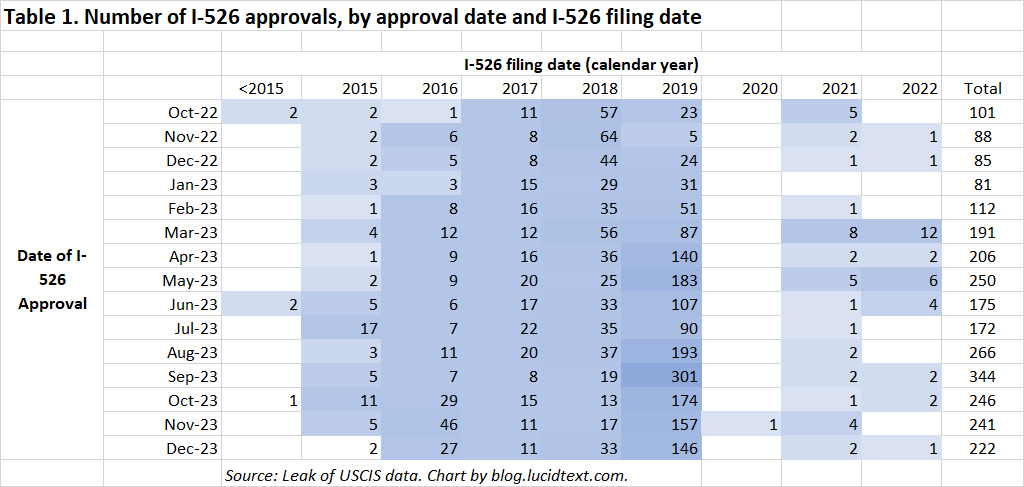
I interpret visa bulletin movement against the background of I-526 filings by month, because that’s what VB dates represent: priority dates from people who started the process by filing I-526, and now signaled by filing date at the visa stage. When the VB moves final action dates from Date A to Date B to Date C, I count up the I-526 filed between those dates, look at visas issued and available, and think. (To assist everyone else in the same exercise, here’s my Excel with the needed data and example analysis.)

One could assume that a visa bulletin Final Action move from Date B to Date C means “Department of State must have finished issuing visas to priority dates between A and B, and must expect everyone  between B and C to get visas shortly.” With regard to the dates for filing, one assumption is “DOS must expect that the current filing date will become the final action date within a year.” To check those assumptions, I consult I-526 filing numbers. The interpretations are reasonable if expected visa applicants (I-526 principals less denials plus family) are plausibly consistent with recent visas issued and/or near-term visas available. If not, then we consider the alternate possible interpretation of visa bulletin movement: “A lot of people between Date A and Date C must be tied up in slow I-526 processing, and reaching the visa stage out of priority date order, with the result that some but not all priority dates up to C are documentarily qualified and may get visas shortly, while Date C will retrogress when the remaining applicants in those dates eventually become qualified. Meanwhile, the filing date must have been set to stimulate more qualified applicants but unlikely to become the final action date any time soon, considering how many applicants in the pipeline would qualify within the filing date movement.”

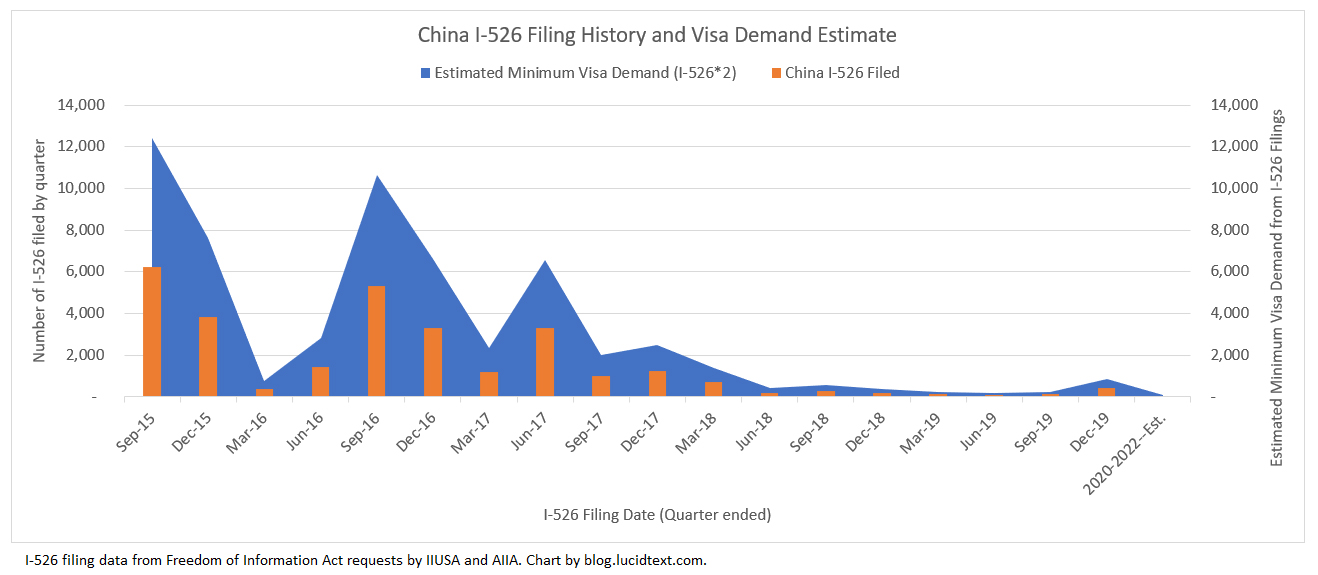
About 1,600 Indians filed I-526 between December 2018 and December 2020 (the India Visa Bulletin movement this year), and about 3,000 Chinese filed I-526 between October 1 and December 8, 2015 (the China VB movement). Adding assumptions about denial rates and family sizes, that could generate about 3,000 Indian visa applicants and at least 4,000 Chinese applicants. FY2024 has about 1,000 EB-5 unreserved visas available to India, and possibly up to 9,000 available to China. Against this background, it’s plausible that every Chinese with a pre-12/8/2015 priority date who still wants an EB-5 visa might possibly get one in FY2024. For India, evidently less than half of pre-12/1/2020 priority dates could possibly fit into this year’s visa availability, even if DOS had already cleared the backlog of pre-12/1/2018 Indian priority dates (which it can’t have done, considering the previous NVC waiting list and visa issuance, and dates on still-pending I-526). The difference between China and India is backlog location. Chinese with priority dates before 2016 are nearly all out of I-526 processing and thus on the visa bulletin radar, while many Indians with priority dates in 2019 and 2020 are still awaiting I-526 adjudication or not yet documentarily qualified (and thus not yet possible for the visa bulletin to consider).

If I’m an Indian with a November 2019 EB-5 priority date (one of the 745 Indians who filed I-526 in November 2019), how likely am I to get a visa this year? It depends on whether I happen to be already documentarily qualified at the visa stage now, and on I-526 processing volume and order for other Indians. Resorting again to a transit analogy, it’s like being passenger #20 on the standby list for a flight with 10 seats remaining to be allocated. If all 20 standby passengers were at the gate ready to board, I’d have no hope. But let’s say that only five passengers are at the gate, while the rest are caught up in traffic and security screening lines or decided to stay home or catch another flight.  The five already at the gate have a chance for seat assignment just because they’re on the spot, regardless of list priority – provided that not too many others on the list can eventually make it through security and come sprinting down the concourse in time to claim seats before the flight has to depart. There’s even some hope for the passenger #20 still currently stuck in security screening – if only he can count on unfair queue times advancing him while holding others back, such that only he and four other passengers will reach the gate in time for seat assignment. The situation can play out this way in EB-5, as low-volume and non-FIFO I-526 processing advances Indians to the visa stage in dribs and drabs, and out of priority date order, so that visa allocation can come joyfully earlier for some and sadly later for others than a FIFO calculation would anticipate. Meanwhile, the EB-5 context also has analogues to standby passengers who end up just staying home (giving up on immigration) or catching another flight (e.g. EB-1 or EB-2), thus relieving wait times for those who persist in trying to catch an EB-5 visa.

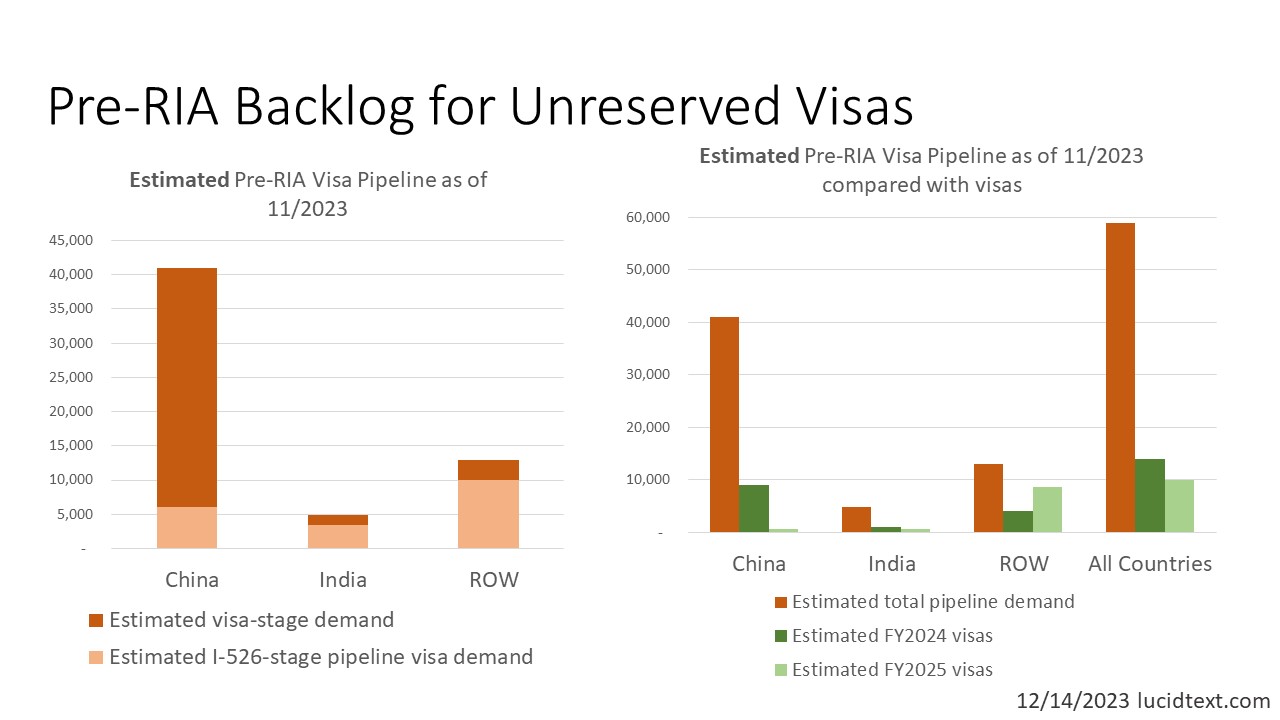
As further background and material for prediction, here is my estimate of the current size and location of the pipeline for unreserved EB-5 visas (assuming an average two visa applicants resulting from pending I-526, and guessing about country distribution of I-526 adjudicated since last year). I’ll be able to update the estimate once Department of State updates the NVC waiting list, and USCIS publishes more recent I-526 approval numbers.

Analyzing the demand/supply balance for rural and high unemployment set-aside visas

EB-5 is an investor visa program. The promise of visa eligibility is what attracts an EB-5 investment, and visas are subject to numerical limits. EB-5 has nothing to sell beyond those limits except empty promises, so we have strong reason to track pipeline visa demand and inventory.

Like promoters for a general admission stadium concert, regional centers and issuers should know the number of seats in the stadium (EB-5 visas available) and number of tickets already sold for each section (I-526 filed by visa category). EB-5 inventory tracking is stressful considering multiple parties offering tickets, small supply, enthusiastic demand that’s historically exceeded stadium capacity, and a government that resists disclosing the status of ticket sales. But we do our best, because self-interest depends on it. I don’t only care to avoid the fraud of investor visa offerings without visas. I want to assess potential market size and predict how long EB-5 business can last.

The best post-RIA EB-5 inventory intel to date is from an AIIA Freedom of Information Act request, which got data for I-526 and I-526E filings through April 2023, itemized by TEA category and investor country. I previously linked to AIIA’s article on the data, and the AIIA member webinar was published today on Youtube for anyone to watch.  I recommend the webinar for a good collection of data slides, and for discussion by a panel including yours truly, Halston Chavez (Galati Law), Joseph Barnett (WR Immigration) and Charles Oppenheim (formerly of the Visa Control Office at Department of State, now at WR Immigration). We talked about translating I-526 receipt numbers into visa demand calculations, and analyzed supply factors including how carryovers and country caps work. The webinar is a great chance to hear from experts who approached the topic from different angles and without trying to sell anything or feed a message, just aiming to empower listeners. Thanks to AIIA for organizing, and to Galati Law for helping to obtain the data from USCIS.

This post is another attempt at the tough task of simplifying/explaining a complex picture. Table 1 summarizes the FOIA data, and Table 2 offers a big-picture visa supply/demand comparison. The headline: pipeline demand for the high unemployment set-aside category was already entering backlog territory as of April 2023, the rural category had some demand but still well below foreseeable visa supply, and the infrastructure category remained untouched.

Table 1. Number of I-526 and I-526E filed April 1, 2022 to April 30, 2023, by TEA Category and Country of Chargeability (summarized from data in the USCIS response to FOIA request by AIIA)

CategoryChinaIndiaRest of WorldTotal% Total
Rural247577337724%
High Unemployment4291804811,09069%
Infrastructure0%
Not TEA2315751137%
Rural and High Unemployment2350%
Total7012526321,585100%
% Total44%16%40%100%

Table 2. Estimated Pipeline Demand for High Unemployment and Rural Visas Compared with Supply

AB≈A*2CDE
Input Fact: Total HU I-526 filings up to 4/30/2023 (mostly filed 9/2022-4/2023)Estimated pipeline HU visa demand as of 4/30/2023 (if visa demand I-526*2.0 )Estimated allocation of HU Visa Supply by CountryApproximate HU Visa Supply in Carryover Year 1Approximate HU Visa Supply Without Carryover
Total1,0902,180Total2,0001,000
China429858Minimum 7%140+70+
India180360Minimum 7%140+70+
Rest of world481962Maximum 86%1,720860
Input Fact: Total Rural I-526 filings up to 4/30/2023 (mostly filed 9/2022-4/2023)Estimated pipeline rural visa demand as of 4/30/2023 (if visa demand ≈ I-526*2.0 )Estimated allocation of Rural Visa Supply by CountryApproximate Rural Visa Supply in Carryover Year 1Approximate Rural Visa Supply Without Carryover
Total377754Total4,000             2,000
China247494Minimum 7%280+                140+
India57114Minimum 7%280+                140+
Rest of world73146Maximum 86%3,440             1,720

Summary of conclusions from Table 2 estimates:

  • Table 2 is designed to facilitate big-picture/ballpark estimates of how close we were as of April 30, 2023 to maxing out visa availability in EB-5 set-aside categories. Column B gives a pipeline visa demand estimate calculated from I-526 filings, while Columns D and E show approximate annual visa supply.
  • When I look at Table 2, I first look at the totals in B and D. When Total D > Total B in a category, then we’re not looking at backlog risk for the first tranche of Chinese or Indian applicants in that category. If Total D < Total B, then I start looking down at country-specific supply/demand numbers and thinking about backlogs/wait times. Column D represents a year fattened with carryover visa supply; once the first tranche of applicants absorbs those visas, subsequent years (Column E) will have half the supply and even greater backlog risk.
  • The Rural category was looking good as of April 2023, with over 4 visas available in a carryover year and over 2 visas available in a normal year for every one applicant estimated to be in the pipeline at that time.
  • The High Unemployment category appears already approaching the danger zone as of April 2023, with total pipeline visa demand sufficient to exceed total annual supply even in a year with extra carryover visas. That level of demand would be twice available supply in a normal year, and place China and India far beyond their assured visa supply under country caps. Relatively high “rest of the world” demand represents a limit on the number of visas that could be left unused (i.e. available for China/India), and also a signal that even Rest of World could exceed visa availability and face wait times. I could see the existing high unemployment set-aside backlog risk being averted if I-526E denial rates prove very high (which could well happen if a few big projects get rejected), if a significant number of people who filed for the high unemployment set-aside are actually issued an unreserved visa (which could possibly happen as a result of multiple classifications on approvals), or if it turns out that demand for high unemployment set-aside investments tanked after April 2023. Absent widespread denials or diversions, however, the market for high unemployment set-asides (especially from Chinese and Indians) can’t afford to continue at the rate exhibited up to April 2023.
  • Table 2 gives a pipeline demand estimate as of April 30, 2023 based on about eight months of I-526 filings. To estimate where we are today, about eight months later, you could more or less double the figures in Column A and B — depending on whether you guess that demand for each category has been more or less brisk through the end of this year. The following are notes on the numbers and assumptions in Table 2, column by column, and examples of how to use Table 2 for calculation.

Column A: I-526 input

  • The input fact in Table 2 is total number of I-526 and I-526E filings for set-aside categories from when the set-aside categories become available in 2022 up through April 2023. USCIS reported the categories checked by petitioners on Form I-526 and I-526E. The classification assigned by USCIS on approval, which is what really matters for the visa, may vary.  (USCIS might not approve the requested TEA, or might choose to approve the I-526E in more than one visa category.)
  • The data AIIA received is monthly, and indicates an fairly even volume of receipts September 2022 to April 2023. If you guess similar volumes after April, then double the numbers in Column A to ballpark estimate totals as of today. Or if you sense that the investment/filing pace picked up or slowed down after April 2023, for rural and/or high unemployment categories, then adjust the multiplier accordingly to estimate total filings as of today. (AIIA has already filed an updated FOIA for more recent data, but pending response we have to guess.)

Column B: visa pipeline demand estimate

  • The pipeline visa demand estimate comes from estimating how many successful visa applications will result from I-526/I-526E filings by investors. This estimate considers the fact that not every petition/application will be approved, and that the investors counted on I-526 will later be joined by family members at the visa stage. I tend to multiply I-526 receipts by 2 for a rough estimate — for simplicity and assuming a 25% denial/attrition rate and average family size of 2.8. Those numbers are basically consistent with EB-5 history, but use a smaller or larger multiplier if you guess that future denial/attrition rates or actual average family size will be higher or lower.
  • I call the Column B estimate “pipeline” visa demand because these people are nearly all awaiting petition processing at USCIS, and thus not visa applicants yet. But they are in the pipeline queue. The high unemployment applicant with May 1, 2023 priority date could look at the total in Column B as the estimated size of the queue ahead. If people associated with priority dates up to April 30 will claim 2,180 visas, then the May 1 applicant would wait for the 2,181th high unemployment visa.  If another 2,000 high unemployment applicants have come in since April 30, then today’s high unemployment investor would expect to wait for over 4,000 other applicants to claim high unemployment visas in advance of him. (The reality is more complicated because country cap limits eventually trump priority date order, but this is the general idea.)

Column C: Visa supply allocation

  • So long as total supply for high unemployment visas exceeds total qualified demand, there’s no need for traffic control, and the visa bulletin and country caps don’t get involved. In a low-demand scenario, available visas simply get issued in priority date order to those ready to take them, regardless of country. In a year with fewer than 800 total applicants for over 4,000 total visas available, all applicants could expect a visa regardless of country of origin. On the other hand, if a year has 2,200 applicants vying for 2,000 visas, then the visa bulletin will activate to hold back 200 applicants. And the first applicants to be held back will be from countries exceeding the country cap.
  • Of the country-cap limited countries (named in every Visa Bulletin Section A.3, usually and currently “CHINA-mainland born, INDIA, MEXICO, and PHILIPPINES”), only China and India also have high EB-5 demand, which is why I itemize only those countries in Tables 1 and 2. Vietnam, South Korea, and Taiwan are other countries with relatively high EB-5 demand, but the visa bulletin does not apply country caps to them because their total demand across EB+FB categories is not excessive. (As a reminder for how country caps work within categories and to whom they apply, review Section A in any Visa Bulletin, the EB-4 Federal Register explanation, this handy slide visual from the AIIA webinar, and Charles Oppenheim’s explanation from the AIIA webinar. Vietnam is a marginal case because it has appeared on the visa bulletin A.3 list in the past, starting in 2018, but it hasn’t been listed since 2021. China and India, on the other hand, have consistently been excess demand countries on the visa bulletin list every year since 2005.)
  • When qualified visa demand exceeds supply, then people from country-cap-limited countries get limited to 7% of available visas plus whatever is left after rest-of-world demand. 7% is not a ceiling for China or India – it’s a baseline that can be increased to the extent that visa demand outside those two countries takes less than 86% of category supply that year. For example, what if the estimated high unemployment applicants in Table 2 Column B (2,180 total, 858 Chinese, 360 Indians, 962 Rest of World), were all qualified together in a year with 2,000 visa available. How many visas would be issued to Chinese that year? My best guess would be about 730, calculated as 140 (7% of supply) plus a share the difference between 1,700 ROW visas available and 962 ROW visas demanded.  Chinese and Indian applicants should pay attention to the Rest of World demand number even more than the 7% supply number, because ROW demand is what ultimately constrains the visa availability for China/India.  
  • Can countries unlimited by the 7% country cap still potentially run short on visas? Yes, as evidenced by the visa bulletin, which currently has cut-off dates for everyone in EB-2, 3, and 4. EB-5 historically avoided this risk, because EB-5 demand used to be so concentrated in China and visa availability wasn’t so fragmented. But today, with about 40% of EB-5 demand coming from “rest of the world,” and supply numbers within each set-aside category relatively small, “rest of the world” also finds itself on the backlog radar. For example, what if pipeline high unemployment visa demand has reached 2,000 by now, and what if all those applicants reach the visa stage in FY2025? In a year with 2,000 ROW applicants for at most about 1,700 visas available to ROW (2,000 minus 7% each to China and India), the visa bulletin would have to use dates to hold back the 300 excess ROW applicants until the next year’s new supply can accommodate them.

Column D and E:

  • TabIe 2 uses supply numbers rounded to the thousand to facilitate eyeball estimates. For detail of how annual supply gets calculated, with nuances from falling post-COVID EB limits and carryover as a function of usage, see Table 3 below. Considering processing times, I expect that we won’t see pipeline demand for EB-5 set-asides reaching the visa stage in a big way until FY2025. So I’m assuming few set-aside visas issued in FY2024 and thus maximum carryover numbers in FY2025. But I would love to see many set-aside visas issued this year, taking advantage of an unusually high limit and reducing pressure on future supply.

Table 3: EB-5 Visa Supply Detail

EB Annual VisasEB-5 Annual (7.1% EB)Rural Annual (20% EB-5)Rural Carryover UnusedRural Total Annual Visas AvailableRural Visas Used
2022281,50719,9873,9973,9970
2023197,09113,9932,7993,9976,7960
2024161,00011,4312,2862,7995,085<2,799
2025140,0009,9401,9882,2864,274?
2026140,0009,9401,988?1,988?
EB Annual VisasEB-5 Annual (7.1% EB)High Unemployment Annual (10% EB-5)HU Carryover UnusedHigh Unemployment Total Annual VisasHU Visas Used
2022281,50719,9871,9991,9990
2023197,09113,9931,3991,9993,3980
2024161,00011,4311,1431,3992,542<1,399?
2025140,0009,9409941,1432,137?
2026140,0009,940994?994?

Demand for EB-5 Set-aside Categories

Thanks to persistence by AIIA and litigation by Galati Law, we finally have a first installment of data to discuss relative to demand for the new EB-5 set-aside categories. USCIS responded to AIIA’s Freedom of Information Act request, and reported I-526 and I-526E receipts by month from April 2022 to April 2023, itemized by category (including rural and high unemployment) and by petitioner country (including China and India). See AIIA FOIA Series: I-526E Inventory Data for Backlog Assessment for a summary of this extremely consequential information. The article includes an invitation to a webinar on November 15, 2023 at 6:00 PM ET, where I’ll join AIIA, Galati Law, Joseph Barnett, and Charles Oppenheim to discuss the data and implications for reserve visa availability.

I-956F EB-5 Business Plan Objectives and Best Practices

Every year since 2016, industry colleagues have honored me with their vote as one of the Top 5 Business Plan writers in the EB5 Investors Magazine poll. I appreciate the votes of confidence through the years and especially now, as the work of a business plan writer feels particularly challenging.

I spoke recently with an entrepreneur who is a business planning veteran in his own right, with decades of experience as a founder and executive. He already has a beautiful pitch deck for venture capital investment, and asked “what more do I need for EB-5?” and “where can I go to read about the requirements and what works for a business plan in the EB-5 space?” We had a long conversation, because much of what an entrepreneur practically needs to know about EB-5 isn’t written down anywhere. I usually blog about industry developments rather than my day job, but conversations like this remind me of the need to also write about business plans.

The major context for an EB-5 business plan today is the Form I-956F Application for Approval of Investment in a Commercial Enterprise, which requires “a comprehensive business plan for a specific capital investment project.” The USCIS Policy Manual Chapter 5(B) specifies that “A project application must include a credible and comprehensive business plan that contains, at a minimum, a description of the business, its products or services (or both), and its objectives.” Policy Manual Chapter 2(B) further defines a comprehensive business plan based on the precedent decision Matter of Ho.

The official USCIS guidance provides, at least, a partial content checklist for an EB-5 business plan. But a good EB-5 plan needs more than an appropriate table of contents. Strategy requires thinking about what the document needs to accomplish, and organizing content and presentation around those objectives.

I-956F EB-5 Business Plan Objectives and Best Practices

Objective 1: To describe a business proposal that works for EB-5.

Business plan best practice: Before putting pen to paper, discuss the business proposal with respect to the key EB-5 requirements for investment of capital, new commercial enterprise, job creation, targeted employment areas, and regional center sponsorship. The most beautiful presentation cannot salvage a plan to do something that EB-5 can’t do. The AAO record of EB-5 denials is littered with plans describing a debt arrangement with the NCE, direct job creation by an affiliate or third-party management company, and job creation by acquisition, for example – all valid plans from a business perspective but not a fit with technical EB-5 requirements. An informed and honest business plan writer knows the EB-5 requirements and their practical application, can identify potential challenges and dealbreaker issues upfront for a specific proposal, and will not write up a plan with no chance of EB-5 success.

Objective 2: To provide a document that is appropriate for filing with the Form I-956F, to support project approval by USCIS.

Business plan best practices: Know the USCIS I-956F adjudication checklist, and organize the EB-5 plan document with summaries and content headings to flag content responsive to that checklist. (The checklist is partially based on Matter of Ho, as expanded with items disclosed in Requests for Evidence.) Know the evidence expectations baked into the Matter of Ho standard, and help to organize third-party evidence in support of the business plan. Write and format the business plan for how it will be read: printed out on letter-size paper in the hands of a civil servant who is pressed for time and easily confused, not required to have any business or financial background, not able to easily request clarification, and predisposed to disbelieve the plan except as validated by independent evidence that he can verify in exhibits and on the Internet. And consider the timing context. I used to write I-526 plans with an eye on the likelihood that they would be read by USCIS at least two years in the future. Today, I write I-956F plans with an eye on the probability of review within a year.

Objective 3: To avoid content that could cause the I-956F project application to be denied by USCIS.

Business plan best practice: Work carefully to avoid discrepancies, the most common document problem behind EB-5 denials.  The EB-5 plan should ideally avoid internal discrepancies, discrepancies with other parts of the application including economic impact report and offering documents, mismatch with EB-5 requirements, and mismatch with how things will eventually turn out.  Business plans in the wild are dynamic, and it takes care and discipline to freeze a moment-in-time picture that’s consistent throughout application documents. An important part of my process is to seek out apparent discrepancies and preemptively iron them out before USCIS has a chance to seize on them as faults casting doubt on the credibility of the entire package. This is also a reason for the “lucid” in Lucid Professional Writing, because one method for avoiding discrepancies is to minimize repetition.

Objective 4: To lay a roadmap that will be feasible to follow.

Business plan best practices: Present the most conservative feasible scenario when it comes to schedule, budget, and financial projections. Strategize about areas in which the business plan is most liable to change, and bake flexibility where possible into those aspects of the business plan presentation (avoiding unnecessary detail and mentioning caveats and alternatives). Think about the evidence that will need to be provided in support of projections, and shape the plan as needed to support the evidence that will be practically possible.  The EB-5 plan should ideally set the client up to over-deliver on promises, avoid the need to file expensive amendments, avoid fatal material change, and avoid impossible evidence requests.

Objective 5: To tell a coherent story that fits the EB-5 plot and will be compelling to EB-5 investors and USCIS.

Business plan best practices: Know the story that an EB-5 plan needs to tell – a story about EB-5 capital deployed to create jobs and support an immigration opportunity. Understanding the EB-5 plot, tell that story with bright lights around the answers that EB-5 investors and USCIS need to find about use of investment, basis of job creation, and how the proposal lines up with immigration considerations. EB-5 investors and USCIS adjudicators approach documents with very different questions than are in the mind of a venture capital investor or institutional lender. A good EB-5 plan differs from a pitch deck or SBA plan for the same proposal because it is responsive and relevant to EB-5-specific questions and considerations.

Are good EB-5 plans worth the effort and investment?

The EB-5 space is full of sloppy business plans – 80-page cut-and-paste collages of undigested content that don’t bother to tell a clear or relevant story, but still succeed when the reader just accepts the plan because that’s easier than reading it. The snow job strategy is particularly advisable for a proposal with questionable EB-5 fit, because it’s difficult to question a mountain of disorganized information. And an EB-5 plan can coast on a nice cover so long as investors aren’t necessarily given the chance and USCIS adjudicators don’t always take the time to open and read the plan. But I still believe in the value of a tight, well-drafted EB-5 plan. Good projects deserve professional documents – for the sake of first impressions on the front end and protection on the back end. No one wants to wait for a nasty RFE or litigation to find out that the business plan, now suddenly Exhibit A, is unintentionally full of sloppy errors, omissions, and misrepresentations. And attractive, relevant documents can play an important role in supporting investment decisions and immigration approvals.

Future articles will discuss the EB-5 business plan content section by section, and FAQ on what works from a practical business perspective. I should also replicate these articles for E-2 and L-1, visa categories with their own particular considerations for the business plan.

FY2024 Set-Aside Visa Availability Update

As an update to previous posts, I note additional pieces of information that have become available about forthcoming EB-5 visa availability in the set-aside/reserve categories.

FY2024 Quota: Department of State has published the Annual Numerical Limits for Fiscal Year 2024, indicating that the Employment-Based visa limit for the year is 161,000 – a bit lower than USCIS had estimated last month, but still well above the base allocation of 140,000. This means another unusually high number of new visas allocated to EB-5 this year, in addition to carryover of unused reserved visas.

Reserve Visa Carryover: At the Department of State/AILA Liaison Committee Meeting October 5, 2023 AILA asked “in FY2024, will DOS first use up reserved visas carried over from FY2023, and only once such numbers are exhausted, use the numbers made available under the FY2024 annual reserved limit?” DOS answered “Yes… the set-aside visas from FY2023 will be added to the same set-aside categories for FY2024 and will be used before the regularly allocated set-aside numbers.” This decision is significant because it maximizes the potential number of reserved visas year-to-year. A new FY24 rural visa can be carried over as FY25 rural visa if unused; the carryover FY24 rural visa must be used this year or else be lost to the category, becoming a FY25 unreserved visa. And so DOS is choosing to allocate carryovers first. (There’s unfortunately no mechanism for unused unreserved visas to carry over to another year, regardless of if they originated from reserve visas carryover, as DOS also confirmed in the AILA Q&A. But I have some hope that consulates and USCIS will work overtime to issue the 14,000+ unreserved EB-5 visas available this year, considering that all available unreserved EB-5 visas were issued in FY2023.)

Reserve Visa Issuance: Department of State also engaged with the IIUSA Leadership Circle in October, and provided additional insights in a report available to IIUSA members. I was particularly interested to hear the confirmation that DOS did not use any reserved EB-5 numbers in FY2023, but does anticipate issuing reserved visas by late FY2024 (considering that USCIS has started to approve I-526E petitions in recent months).

Reserve Visa Availability: Combining the above sources, the following table shows how I now expect EB-5 rural and high unemployment visa availability to look going forward. FY2024 carryover is known, and I expect another full carryover in FY2025. This is based on the assumption that, regardless of how many people have filed I-526E by now, processing constraints mean that USCIS/DOS can’t manage to get over 2,800 rural applicants and/or over 1,400 high unemployment applicants qualified plus interviewed by September 2024 (as would be necessary to exhaust this year’s carryover visas and start touching new visas). The reserve carryover train will continue until the number of category visas possible to issue in a year (thanks to sufficient qualified applicants ready at the visa stage that year) meet or exceed visas available that year. But note that reserved visa availability is not exactly cumulative; if the reserved visas available in a year aren’t issued, only a portion (the new, not the carryover) can remain available for use in the same category in the next year.

EB Annual VisasEB-5 Annual (7.1% EB)Rural Annual (20% EB-5)Rural Carryover from previous yearTotal Annual Visas Available to RuralNumber of Rural Visas Issued
AB=A*.07C=B*.20 (Rural) or B*.10 (HU)DE=C+DF<E if low demand/slow process
2022281,50719,9873,9973,9970
2023197,09113,9932,7993,9976,7960
2024161,00011,4312,2862,7995,085Estimate <2,799 (assuming low demand/slow process)
2025140,000+9,940+1,988+2,286 (assuming not used in FY24)4,274+? (depends on demand and approval timing)
2026140,000+9,940+1,988+? (up to 1,988+)1,988 + any carryover 
EB Annual VisasEB-5 Annual (7.1% EB)High Unemployment Annual (10% EB-5)HU CarryoverTotal Annual Visas Available to HU Number of HU Visas Issued
2022281,50719,9871,9991,9990
2023197,09113,9931,3991,9993,3980
2024161,00011,4311,1431,3992,542Estimate <1,399 (assuming slow process)
2025140,000+9,9409941,143 (assuming not used in FY24)2,137? (depends on demand and approval timing)
2026140,000+9,9409940 if all 2025 visas used, or up to 994994 + any carryover 

When will visa-stage rural and high unemployment applicants first exceed the visa availability outlined above, thus triggering the visa bulletin and country cap limits? This is where we try to estimate:

  • how many investors need to file I-526E to end up with about 4,000 rural visa applicants or 2,000 high unemployment visa applicants (I’d divide visa applicants by about 2, based on guesses about family sizes and approval rates)
  • how long will USCIS take to stock the visa stage by approving over 1,500 rural or over 750 high unemployment I-526E (considering a historical average around 36% of principal applicants in EB-5 visas issued), and
  • how many rural and high unemployment investors can manage to get visas with their families in FY2024, thus reducing demand pressure against the visa supply available in FY2025 and beyond.

Reserve Visa Demand:  So how much demand has accumulated for the new EB-5 reserved visas — and why is this such a hard question to get answered? In Monday’s CIS Ombudsman EB-5 engagement, IPO Chief Alissa Emmel explained why USCIS considers it difficult to share usable data.

Quoted from Minute 50-52 of The CIS Ombudsman’s Webinar Series: Engagement with USCIS on the EB-5 Immigrant Investor Program
Gary Merson, CIS Ombudsman Chief of Staff
Changing topics slightly. We’re hearing from stakeholders who would like to see the agency publish more data on the pending inventory of petitions so that would be investors have a better sense of the visa queues for infrastructure, rural and high employment projects. Can you give us a sense of the challenges in doing so and what options USCIS may be considering to address this issue?

Alissa Emmel, IPO Chief
Sure. I appreciate stakeholder requests for more data, and as an economist and somebody who values data driven decisions, I understand the value that a report on the pending inventory form I-526 and I-526E petitions broken down by visa category could provide to investors. IPO is actively involved in discussions with offices across USCIS to determine how best to present EB-5 data. USCIS strives to make as much data about various aspects of our operations available to the public as possible. We do so to increase transparency and improve public understanding of the immigration system and our role in it. Currently, USCS is working through how best to report Form I-526 and I-526E information, as there are several variables that may impact overall accuracy and therefore the usefulness of such a report. Similar to the rest of the agency, information provided on our paper forms are reported by the applicant, petitioner or requester, or the representative or preparer, so there may be errors on the forms when USCIS receives them. For example, a petitioner may erroneously select the wrong class, preference, or benefit type they are requesting. However unique to the EB-5 program, petitioners may file a form I-526E petition before their associated form I-956F is approved.  As such, at the time of filing the I-526E, the petitioner may not know which visa categories their project may be approved for. Further, some petitioners may be eligible for multiple visa categories, including unreserved visas. These factors are some of the nuances with developing a report prior to the final adjudication of the form I-526 and I-526Es. In addition, it’s important to note that while USCIS always strives to ensure that the data in our electronic systems is accurate, data errors do occur because we transfer data from paper forms to electronic systems manually. I hope it’s helpful to understand some of the considerations that the agency is taking into account while we look at how to best provide information that would be useful for our stakeholders.

As we try to get a handle on EB-5 demand by interpreting I-526E reports from USCIS quarterly reports (available through June 2023 so far) and FOIA requests (coming soon), or by attempting an educated guess from what we see in the market, let’s keep these nuances in mind. We cannot predict exactly how many applicants will eventually reach the end of the visa process and when, even if USCIS would be transparent about the distribution of petitioners starting the process. But I still encourage USCIS to promptly share the TEA investment categories self-reported on I-526E filings. Let the public interpret and discuss that limited data point while adding their own assumptions about human error, denial rates, processing times.

CIS Ombudsman EB-5 Engagement (Oct. 30)

In more good news for future EB-5 process improvements, the CIS Ombudsman has focused attention on the EB-5 program. The CIS Ombudsman’s mission is to “assist individuals and employers in resolving problems experienced when seeking immigration benefits from USCIS; identify trends and areas in which individuals and employers have problems dealing with USCIS; and recommend changes in USCIS’ administrative practices to mitigate problems and enhance processes.” Having recently met with IIUSA, AILA, and AIIA about EB-5, the CIS Ombudsman now invites all EB-5 stakeholders to The CIS Ombudsman’s Webinar Series: Engagement with USCIS on the EB-5 Immigrant Investor Program on Monday, October 30, 2023, from 2 to 3 p.m. Eastern Time.

UPDATE: Here is my recording of the CIS Ombusdman webinar, featuring Ombudsman Chief of Staff Gary Merson asking questions of IPO Chief Alissa Emmel. The discussion covered treatment of pre-RIA investors following regional center termination, policy for the investment sustainment period, and a variety of questions and filing tips. The discussion seemed to show that Mr. Merson had listened intelligently to stakeholder concerns, and that Ms. Emmel was making good faith attempt to engage with and not just deflect the questions. The Ombudsman will be publishing remarks and Q&A from the call, and I’ll link those documents here as soon as I see them.

Complete USCIS Policy Manual EB-5 Update

On October 26, 2023, the USCIS Policy Manual EB-5 section (Volume 6 Part G) received its first complete update since the EB-5 Reform and Integrity Act of 2022 (RIA) was enacted 18 months ago. I have been waiting eagerly for RIA changes to be translated into policy, or at least discussed in one place for ease of reference, and welcome the policy manual update.

Until yesterday, the Policy Manual featured a mix of current content (Chapters 1-2, updated in October 2022), and outdated content (Chapters 3-6, not revised since July 2021, before the law change). As of today, the entire USCIS Policy Manual EB-5 section has been brought up to date, with three chapters significantly revised, two all-new chapters added, and one chapter deleted.

Here’s my summary of the changes, together with links to document comparisons that redline differences between the October 26, 2023 version and the previous October 2022/July 2021 versions. (I typically do a document comparison of the whole volume, but compared individual sections in this case because USCIS reorganized the chapters. For reference, here is the folder I keep of all Policy Manual iterations.)

Summary of the October 26, 2023 update to the USCIS Policy Manual Vol. 6 Part G

Chapter 1 Purpose and Background and Chapter 2 Eligibility Requirements

  • These chapters were previously updated on October 7, 2022 in response to RIA, and the October 26, 2023 version is nearly unchanged. (Here for reference is my Chapter 1-2 redline, showing the minor tweaks between the 10/2022 and 10/2023 versions.)

Chapter 3: Immigrant Petition Adjudication

Chapter 4: Regional Center Applications

  • This new chapter has extensive revisions to the previous Chapter 3 on Regional Center Designation. See my redline of changes.

Chapter 5: Project Applications

  • The Project Applications chapter is all-new to the Policy Manual, and covers eligibility, documents and evidence, adjudication, and amendments to I-956F Applications for Approval of an Investment in a Commercial Enterprise. The content has some overlap with Chapter 2 on Eligibility Requirements.

Chapter 6: Direct and Third Party Promoters

  • The Promoters chapter is all-new to the Policy Manual, and rehearses I-956K requirements. (The previous Chapter 6, on the topic of deference, has been deleted from the Policy Manual, but much of its content folded into the I-526 chapter.)

Chapter 7: Removal of Conditions

  • This new chapter has minor revisions to the previous Chapter 5 on I-829 adjudication. See my redline of changes.

I haven’t had time yet to read everything in detail, but I expect to be surprised less by what is there (more quoting the law and forms than interpreting the law, at first glance) than by what isn’t there (which will take some time and thought to identify).

Top things I learned from the October 11, 2023 EB-5 Questions and Answers from USCIS

Since the EB-5 Reform and Integrity Act of 2022 (RIA) was enacted, stakeholders have had urgent open questions about the status and treatment of pre-RIA investors and regional centers, and about how to interpret RIA provisions related to the investment period and redeployment.

In the April 25, 2023 EB-5 stakeholder engagement, IPO Chief Alyssa Emmel said: “While we’re unable to discuss the regional center operations and investment period topics today, please rest assured that USCIS is engaged in ongoing efforts at the immigrant investor program office and across the agency to ensure that when we do have updates, we’re equipped to provide the EB-5 stakeholder community with clear guidance.Now we have a substantial first installment of that promised guidance, with the EB-5 Questions and Answers (updated Oct. 2023), published on the USCIS website on October 11, 2023.

I appreciate that this Q&A engages with stakeholder questions, and dares to provide some interpretation. I can tell that whoever wrote the Q&A read the feedback on regional center operations and investment period sent to USCIS in advance of that April meeting, including from IIUSA and AIIA. And the Q&A sticks its head out to provide specific some guidance, not only giving safe cop-out responses that rephrase what we already know – a brave move, considering that any new interpretation is going to displease someone and probably inspire litigation.

I also appreciate the spirit of the Q&A, which expresses an intent to protect both regional centers and investors from adverse retroactive impacts from the new law. To my welcome surprise, the Q&A seems to be trying to say “we care, and here’s our best effort to be clear, generous, and fair and to avoid harming anyone.” Or to give an actual quote from the Q&A: “After a consideration of reliance interests and potential retroactive impacts, we believe the interpretations and guidance explained above provide flexibility and lessen the burdens on EB-5 entities.” It’s important to account for that spirit and expressed intent as we respond to any interpretations that we find to be unclear, ungenerous, unfair, retroactive, or burdensome in fact.

Here are my top takeaways the Q&A.

  1. Grandfathering: The Q&A suggests that USCIS broadly interprets the investor grandfathering provision in RIA Section 105(c), such that it not only protects future investors from expiring legislation (the literal language of the law), but also protects pre-RIA investors from retroactive impacts of RIA. (The Q&A interprets this to be the spirit of the law with reference to Senator Grassley’s quote: “the bill allows petitions filed by immigrant investors under the old pilot program to continue to be adjudicated under the law as it existed when they were filed.”) I am not sure how far this will apply in practice, but delighted to see the intent by USCIS to be generous and fair with grandfathering for pre-RIA investors.
  2. Good faith investors: USCIS interprets the RIA provision for “treatment of good faith investors following program noncompliance” (INA 203(b)(5)(M)) to apply to pre-RIA investors. This surprises me, and I’m trying to think whether it’s good news.  For investors with regional center or project problems, pre-RIA policy had the disadvantage of no change options for pre-green card investors, but the advantage of protections and flexibility during Conditional Permanent Residence. Subsection M offers change options, but they’re fraught, and subsection M presupposes no protection from CPR status. More analysis to come once I’ve had more chance to consider and discuss this. (See also Robert Divine’s analysis.) One major concession that USCIS already makes in the Q&A, in attempt to make the subsection M recourse more usable, is to change the deadline for investor action following a regional center termination or NCE debarment.
  3. Regional Center Termination Impact: The Q&A expresses USCIS intent to mark out a path to eligibility for pre-RIA investors in terminated regional centers, which is good news for regional centers. In my previous post on the Integrity Fee and I-956G, I concluded that regional centers would be forced into expensive compliance just for the sake of protecting past investors, regardless of their own EB-5 activity or plans. If USCIS does offer investors a viable option to support eligibility apart from regional center sponsorship, then otherwise inactive regional centers face much less pressure. (I say “if,” because so far I’m more sure of the USCIS intent than the practical outcome. But I’m cautiously optimistic.)
  4. Regional Center Termination Likelihood: USCIS expects that “there is a large volume of investors that could be affected by terminations of previously designated regional centers based solely on noncompliance with certain new administrative requirements added by the RIA” considering that “Before March 15, 2022, there were 632 regional centers and as of June 30, 2023, we have received only 357 Form I-956, Application for Regional Center Designation, applications or amendments for previously designated regional centers, and only 250 of previously designated regional centers have paid the Integrity Fund Fee.” So, again, it’s good to hear that “We interpret the RIA in a manner we hope permits good faith investors of terminated regional centers to retain their eligibility.” (Also, I note that USCIS has yet to officially say whether filing I-956 is an administrative requirement for a regional center that wishes to avoid termination.)
  5. Status of Previously-Approved Regional Centers: USCIS states a position that the new RIA provisions and requirements apply equally to all regional centers, regardless of whether the regional center was designated before or after RIA, and regardless of whether the regional center intends to promote new projects for new investors under RIA. This has been the subject much litigation over the past year.
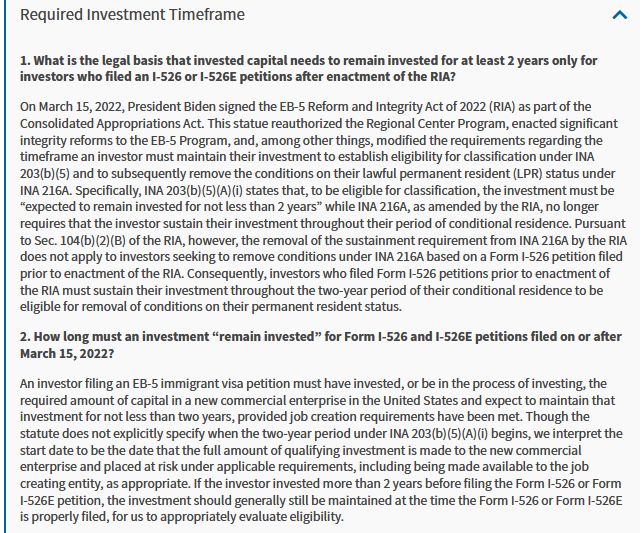
  6. Investment Period: USCIS confirms its interpretation that RIA does change the minimum investment period for post-RIA investors. Instead of being required to sustain their investment throughout the period of conditional permanent residence (the pre-RIA law), investors who filed I-526 or I-526E post-RIA are expected to maintain investment at least two years from the time that investment was made available to the job-creating entity (plus at least until I-526 filing, and at least until the job creation requirement is satisfied). I would’ve expected USCIS to also say that the investment at least needs to be sustained until the I-526 is adjudicated, but no – USCIS agrees that post-RIA investors could theoretically have return of capital even before I-526 approval so long as they met the two-year investment and job creation requirements. As before, the USCIS-required investment period is only a minimum – the Q&A reminds us that USCIS does not control the maximum time that EB-5 investment can be held. Post-RIA investors are also still subject to the redeployment requirement — but decoupling the investment period from unpredictably-long immigration times almost eliminates redeployment risk. The investment period change will have a seismic effect on the industry, and will no doubt be targeted by litigation. (Again, see Robert Divine’s analysis.)
  7. Redeployment: The Q&A focuses on RIA interpretation and does not address other longstanding questions around redeployment for pre-RIA investors, such as whether the “at risk” requirement actually justifies/forces serial investments decoupled from any job creation requirement. The Q&A does convey some sympathy when it recognizes “the burden on the investor to keep their investment in place for an extended period, due to circumstances beyond the investor’s or the NCE’s control, such as visa backlogs or other such circumstances.” The redeployment conversation will continue, drawn by the established reliance by regional centers on redeployment policy and the rebellion by investors against that policy.
  8. Practical questions: The Q&A answers some technical questions and provides filing tips for a number of EB-5 forms. (Robert Divine’s analysis also covers this nicely.)

USCIS posts Q&A addressing many EB-5 questions

Today USCIS published a page of EB-5 Questions and Answers (updated Oct. 2023), with the most extensive guidance to date on USCIS interpretation of the EB-5 Reform and Integrity Act. For historical reference, here are images as the Q&A posted on October 11, 2023, in case the content is subsequently challenged and revised.

USCIS Provides Additional Guidance (sustainment, termination)

UPDATE: This post now copies the version of the USCIS email sent out at 11:30, which seems to be a correction to the email sent at 10:45. This content is also now posted in the USCIS Newsroom.

From: U.S. Citizenship and Immigration Services <uscis@public.govdelivery.com>
Sent: Wednesday, October 11, 2023 11:39 AM
Subject: USCIS Guidance: EB-5 Reform and Integrity Act of 2022

USCIS Guidance: EB-5 Reform and Integrity Act of 2022

On Oct. 11, we issued additional guidance on our interpretation of changes to the EB-5 Immigrant Investor Program in the Immigration and Nationality Act (INA) made by the EB-5 Reform and Integrity Act of 2022 (RIA).

This guidance clarifies the required investment timeframe for EB-5 investors who file Form I-526, Immigrant Petition by Standalone Investor, or Form I-526E, Immigrant Petition by Regional Center Investor, on or after enactment of the RIA (March 15, 2022), as outlined in the RIA. This guidance also clarifies our interpretation of INA 203(b)(5)(M), regarding investors who are associated with a terminated regional center.

Background
On March 15, 2022, President Biden signed the RIA as part of the Consolidated Appropriations Act. Among other things, the RIA modified the required investment timeframes for investors who file petitions for classification Form I-526, Immigrant Petition by Standalone Investor, or Form I-526E, Immigrant Petition by Regional Center Investor, after enactment and to subsequently remove the conditions on their lawful permanent resident status. The RIA also added other provisions to the INA permitting good faith investors to maintain eligibility in the event their regional center is terminated.

For investors seeking to remove conditions on their permanent resident status under INA 216A based on an EB-5 immigrant visa petition filed on or after enactment of the RIA (post-RIA investors), the RIA removed the requirement that the investor must sustain their investment throughout their conditional residence.

The RIA also modified INA 203(b)(5)(A)(i) (the general requirement for classification to invest or be actively in the process of investing the requisite amount of capital in a new commercial enterprise) by adding new language that the investment required by INA 203(b)(5)(A)(i) must be expected to remain invested for at least two years.

Key Points
Because these changes made by the RIA, investors filing petitions for classification after enactment of the RIA no longer need to sustain their investment throughout their conditional residence, which may be many years in the future and dependent on factors outside the investor’s control, such as visa availability.

Instead, the INA now requires only that the investment must be expected to remain invested for at least two years, provided job creation requirements have been met. Although the statute does not explicitly specify when the two-year period under INA 203(b)(5)(A)(i) begins, we interpret the start date as the date the requisite amount of qualifying investment is made and believe this interpretation is consistent with the statutory language. In other words, we will use the date the investment was contributed to the new commercial enterprise and placed at risk in accordance with applicable requirements, including being made available to the job-creating entity. If invested more than two years before filing the I-526 or I-526E petition, the investment should still remain at the time the I-526 or I-526E is properly filed so we can appropriately evaluate eligibility.

Before enactment of the RIA, the termination of a regional center would have been considered a material change to eligibility for investors who had not yet obtained conditional permanent resident status and, consequently, would likely have resulted in denial or revocation of associated investor petitions. The RIA added a new provision at INA 203(b)(5)(M) that permits good faith investors associated with terminated regional centers to retain eligibility in certain circumstances. Because the statute does not explicitly specify whether it applies only to post-RIA investors or also to pre-RIA investors, we are providing guidance on how we interpret this new provision for pre-RIA investors upon regional center termination:

  • We interpret INA 203(b)(5)(M) to apply to pre-RIA investors associated with a terminated regional center (or debarred new commercial enterprise or job-creating entity). However, rather than strictly applying the notification timeframes at INA 203(b)(5)(M)(ii) and (iii)(I), we will extend the deadline for pre-RIA investors to respond to a regional center termination notification until the agency adjudicates their Form I-526 petition. If needed, we may issue a Request for Evidence or Notice of Intent to Deny for the investor to establish continued eligibility.
  • We may use the procedural flexibilities provided under INA 203(b)(5)(M) to extend the response deadline of 180 days for notices of continued eligibility. The extension will decrease the likelihood of operational burdens and expand the intent of the statute to permit good faith investors of terminated regional centers to retain their eligibility.
  • When a regional center is terminated for purely administrative noncompliance, we may determine that the termination would generally not adversely affect a pre-RIA investor’s basic eligibility under INA 203(b)(5) (including the ability to continue to claim indirect jobs), because their investment and resulting job creation would likely remain undisturbed.
  • We may choose not to extend applicable response deadlines when a regional center is terminated for substantive reasons that may affect continued eligibility of their associated investors.

More Information
For more information on the EB-5 Immigrant Investor Program or USCIS, please visit uscis.gov or follow us on Twitter, Instagram, YouTube, Facebook, and LinkedIn.

Integrity Fees and I-956G Annual Report in 2023 (Who really has to file, and why)

10/11/2023 UPDATE: USCIS has now published a Q&A that discusses the impact on investors of regional center termination, beginning with the statement that “Given the large volume of investors that could be affected by terminations of previously designated regional centers based solely on noncompliance with certain new administrative requirements added by the RIA, such as paying the annual Integrity Fund fee, we interpret the RIA in a manner we hope permits good faith investors of terminated regional centers to retain their eligibility.” Please refer to the USCIS Q&A before reading my post, which I will need to revise as time permits.

[ORIGINAL POST]

Since the EB-5 Reform and Integrity Act (RIA) passed in March 2022, there’s been some confusion and dispute about how RIA applies to regional centers and EB-5 investments that pre-date RIA. After all, RIA creates new rules and procedures primarily for capital raising activities. How do these reasonably apply to regional centers with no post-RIA capital raising activities? Do regional centers that were designated and investments made pre-RIA get any different treatment post-RIA?

After a year and half of conflicting notices on the USCIS website, industry comments, litigation, and other bits and pieces of guidance (more on that below), one point has become clear: USCIS expects every regional center without distinction to pay the annual Integrity Fee of $10,000 or $20,000 and to file the I-956G Annual Report. In 2023, every regional center must pay two years of Integrity Fees (for both FY2023 and FY2024) and also file I-956G, or else be terminated in 2024.

If a regional center has no post-RIA project plans anyway, why jump these expensive hoops and why care about termination? But the regional center’s past investors must care. An EB-5 investor’s continued eligibility depends on having a regional center sponsor in good standing throughout the investor’s EB-5 process, however long that process may take. According to INA 203(b)(5)(M), a regional center termination will be followed by denials, revocations, and conditional permanent residence status terminations for all of the regional center’s past investors, unless the investors can manage to affiliate with another regional center. (Separate article coming shortly on this topic.) [UPDATE: the 10/11 USCIS Q&A contradicts this point.]

Here are the instructions, followed by the background of ambiguities and arguments around these requirements.

  • Regional Center Integrity Fee: The latest USCIS “Alert” on Integrity Fee payments, published on September 29, 2023, can be found here: https://www.uscis.gov/IntegrityFund. The Alert acknowledges that “information about the due dates and penalties might not have been clear” but gives another chance for payment with the bold-face warning that “we will take steps to terminate any regional center that, on or before Dec. 30, 2023, has not paid the required EB-5 Integrity Fund fees for FY 2023 and FY 2024. NOTE: We will reject Integrity Fund fee payments for FY 2023 and FY 2024 we receive after Dec. 30, 2023, including those made in response to a Notice of Intent to Terminate.” (To avoid the FY2024 late fee, pay before October 31, 2023.) 
  • Regional Center Annual Report: The latest I-956G annual report form, dated as of July 2023, can be found here https://www.uscis.gov/i-956g. Unlike the initial I-956G edition of July 2022, which asked for reporting specific to post-RIA NCEs (I-956F), the current form explicitly covers pre-RIA activity and NCEs. It asks the regional center to report on “each capital investment project undertaken by such NCE with active EB-5 investors (i.e. those who are seeking classification under INA 203(b)(5) or who have obtained conditional permanent resident status and not yet filed for removal of conditions),” and to provide data not only for recent activity but “over the lifespan of the project.”

In theory, RIA’s new rules should apply prospectively, not retroactively, but it’s complicated. Regional centers with only pre-RIA capital raises are still asked to grapple with Form I-956G and its questions about compliance with new rules for post-RIA capital raises. Regional centers with no new capital raises are still asked to pay $10,000 or $20,000 every year to fund oversight for new capital raises. EB-5 investors who started the process pre-RIA are still dependent on their sponsor’s ongoing eligibility post-RIA.

How did we get here, and what arguments have been made along the way?

Initially, USCIS interpreted RIA as creating a new regional center program and terminating the previous program — meaning a clear break between past and future. Under that interpretation, pre-RIA regional centers were no longer designated and had no grounds to file annual certifications or amendments (according to the April 2022 Q&A on the USCIS website), while pre-RIA investors were protected as a function of the protections around expiring legislation. But Behring Regional Center filed suit to challenge that interpretation, instead fighting for continuity between pre-RIA and post-RIA regional center designation. The litigation ended in August 2022 with a Settlement Agreement in Behring’s favor. The Settlement specified that “previously approved regional centers sponsoring new projects or new investors under the Integrity Act will comply with all the requirements of the Integrity Act” and “if a previously approved regional center fails to file a Form I-956 application or amendment by December 29, 2022, it may no longer engage in any activities under the Integrity Act, including sponsoring I-526E visa petitions or the development of new projects.” Sadly, the Settlement Agreement was silent on the question of what happened to previously approved regional centers NOT sponsoring new projects or new investors under the Integrity Act, but merely needing to stay designated for the sake of past investor eligibility.

USCIS told Behring plaintiffs on October 14, 2022 that “USCIS has not determined what will happen to regional centers that choose not to file Form I-956. Specifically, it has not decided whether such regional centers will be terminated, whether they will have to file I-956H, whether they will have to file annual statements, or whether any of the RIA requirements apply to them.”

On December 23, 2022, USCIS published an “Alert” on the website (which remains on the site to this day), that “Dec. 29, 2022, is no longer the deadline to file Form I-956, Application for Regional Center Designation, amendments, as required by the Behring Settlement, and Form I-956G, Regional Center Annual Statement. USCIS is extending this deadline until we publish guidance that clarifies the requirements of these forms.”

Also in December 2022, USCIS slipped a file called I-956-001 NEW 60-Day Public Comment Response Matrix 20221207 among the Federal Register supplementary documents for Form I-956. This deeply buried file is the most extensive available Q&A on the various I-956 forms, with 126 responses by USCIS to public comments. For example, Q&A #90 addresses a comment by Ron Klasko who suggested “that a regional center that wishes to continue to exist solely to meet its contractual and fiduciary obligations relating to pre-RIA projects, but does not intend to file form I-956 to sponsor new post-RIA projects, should not be required to file Form I-956G, which requests information and references forms that do not apply to these regional centers.” USCIS did not take this fine point, but simply responded to Klasko that “Each approved regional center must file Form I-526G.” Q&A #51 addresses a I-956G comment from AILA arguing that “regional centers designated prior to the RIA that still choose to operate under the RIA are not required to provide data for fiscal years prior to the RIA passage.” USCIS disagreed in its response: “The statute does not distinguish between capital invested before or enactment of the RIA (EB-5 Reform and Integrity Act of 2022) for purposes of reporting under INA 203(b)(5)(G).” (AILA then shot back with a follow-up letter arguing in detail that some I-956G questions retroactively apply RIA requirements, and why that’s wrong, but AILA’s suggested changes to I-956G still did not make it into the revised form.)

In January 2023, USCIS announced a stakeholder meeting where “We will discuss issues related to regional center operations,” including “those who do not wish to solicit investments for new projects under the RIA.” USCIS received so much written feedback that they first delayed the meeting, to give more time to review all the feedback, and then cut the meeting agenda.  As IPO Chief Alyssa Emmel said in the April 25th meeting: “While we’re unable to discuss the regional center operations and investment period topics today, please rest assured that USCIS is engaged in ongoing efforts at the immigrant investor program office and across the agency to ensure that when we do have updates, we’re equipped to provide the EB-5 stakeholder community with clear guidance.

In meeting with the Behring plaintiffs on May 1, 2023, USCIS reiterated that “Form I-956 and I-956G filing date deadlines still not set. These deadlines continue to be pushed back until the agency publishes guidance clarifying the requirements of these forms.”

The promised “guidance that clarifies the requirements of these forms” has not yet been published, so far as I know.  But I believe that I-956G, at least, nevertheless has a real deadline for all regional centers in December 2023, and that the Integrity Fee requirement is being applied to all regional centers this year without exception. I believe this from the latest fee and form instructions, and because USCIS has yet to grant the rationales for making any exceptions. [10/11 UPDATE: the new USCIS Q&A is part of the promised guidance.]

Everyone agrees that regional centers designated and active under the new law must tick all the compliance boxes under the new law, including filing I-956G annual reports and paying the Integrity Fee. The open question has been over which compliance boxes reasonably apply to regional centers that were designated under the old law and not taking any more investors under the new law. But so far, USCIS has not entertained that question because it has not granted any distinction between types of regional centers. This comes out in USCIS response to litigation. In Sunshine State Reg’l Ctr., Inc. v. Jaddou (23-cv-60795), “Plaintiff alleges that the Act distinguished between those Regional Centers created before the Act was passed, ‘Legacy-Regional Centers,’ and those after the Act was passed, ‘RIA-Regional Centers.’” But both USCIS and ultimately the judge disagreed. To quote the Opinion of May 30, 2023, “Plaintiff has not shown that it is likely to succeed on the argument that the statute unambiguously distinguishes between Regional Centers created before and after the Act for purposes of the Integrity Fund Fee.” In Gulf States Regional Center, LLC v. USCIS (2:2023cv01354), “Gulf States attempts to distinguish between the phrases ‘each regional center designated under subparagraph (E)’ and ‘any regional center’ used throughout the RIA,” (the logic that I also used in my February 2023 suggestion to USCIS about fairly applying RIA requirements).  But USCIS disagreed (as of Doc 49-1 filed 9/13/2023) that “subparagraph (E) is not limited to regional centers approved after the RIA’s enactment, but governs all regional centers in existence, regardless of their time of designation.” At least in litigation, USCIS has not entertained any ground of distinction that would allow treating regional centers differently depending on the time of designation and whether or not they choose to raise new EB-5 investment under RIA. Did the Behring Settlement force this position? Anyway, it seems to be the reality.

Back in October 2022, USCIS said it had then “not determined what will happen to regional centers that choose not to file Form I-956” to sponsor new projects and investors under RIA, including “whether such regional centers will be terminated, whether they will have to file I-956H, whether they will have to file annual statements, or whether any of the RIA requirements apply to them.” USCIS has not yet published a revision to this statement as of October 6, 2023. But based on the above sources, I gather that USCIS has, at least, firmly decided that the requirement to file I-956G and pay the Integrity Fee apply universally this year — and prepared to terminate regional centers that do not comply. Regional centers should prepare accordingly for Integrity Fee(s) due by the end of this month and annual reports due by the end of December. (And let me know if there are other court cases or buried sources of USCIS guidance that I should cite in this post.) [UPDATE: See EB-5 Questions and Answers as of October 11, 2023.]

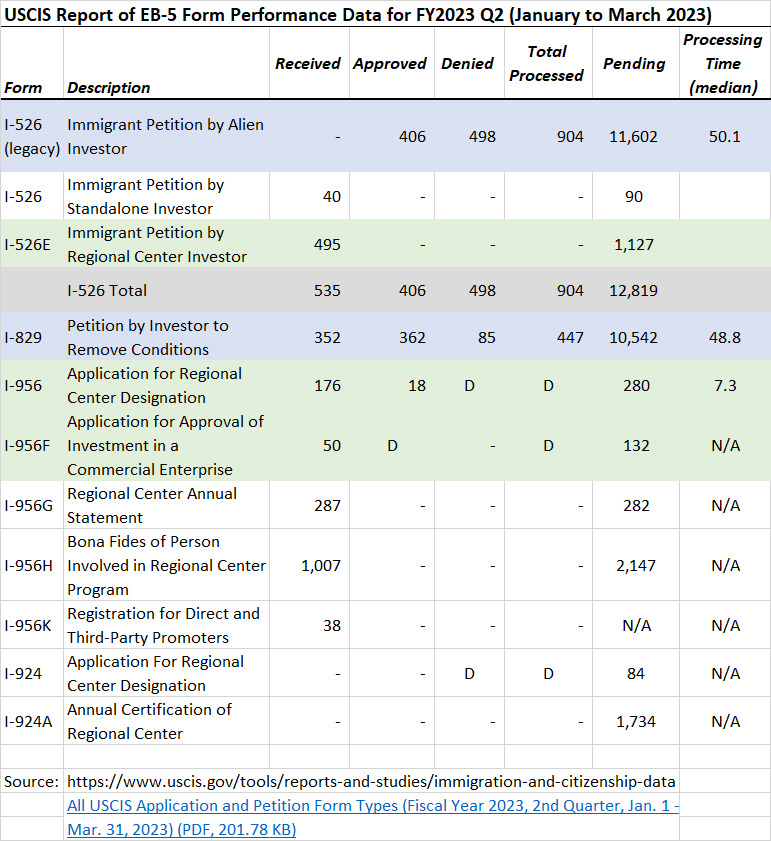
EB-5 Form Processing Update through FY2023 Q3 (June 2023)

USCIS has updated the Immigration and Citizenship Data page with reports for forms filed and processed through June 30, 2023.

Highlights from EB-5 Data in The Q3 All USCIS Application and Petition Form Types report

  • I-956 and I-956F Processing Times: The report states median processing times for Form I-956 (10.8 months) and Form I-956F (11.1 months), which should help people inquiring with USCIS and considering Mandamus actions. (This is useful reference because the Processing Times page does not report yet on I-956 or I-956F. The USCIS-reported times are practically meaningless for prediction, since they’re calculated as the median processing time only of the ≈77 I-956 and the “D” I-956F processed to date, with no adjustment for the waiting time of the hundreds of applications NOT processed. But pending applicants can still use the USCIS-reported times to their advantage when communicating with USCIS.)  
  • Post-RIA EB-5 Demand and Processing: The report shows steady uptick in the number I-526 and I-526E filings, with a total 1,898 post-RIA investor I-526 and I-526E pending as of June 30, 2023. That represents enough EB-5 investors under the new law as of June to claim anywhere from 3,000 to 6,000 visas, depending on approval rates and family size. How we would like to know the country and TEA category distribution of this accumulating visa demand! We’d also like to know whether any of these applicants will be able to claim some of the plentiful FY2024 visas, or if we can expect them to reach the visa stage in future years with smaller visa availability. The number of I-526/I-526E adjudications was still too small to report as of June 30, and processing time listed as “N/A”.
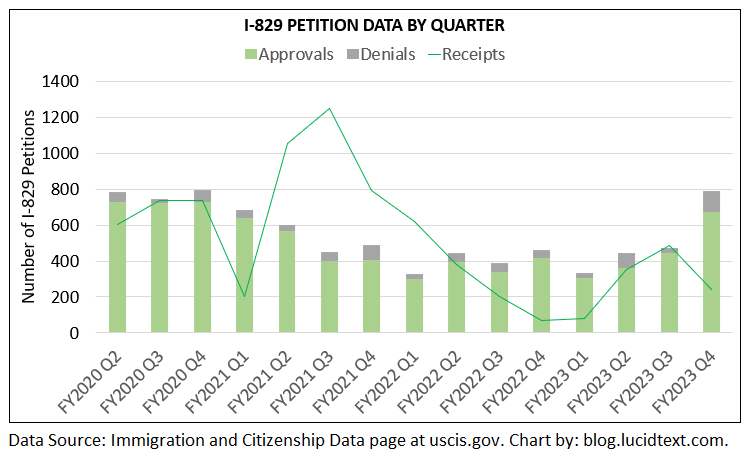
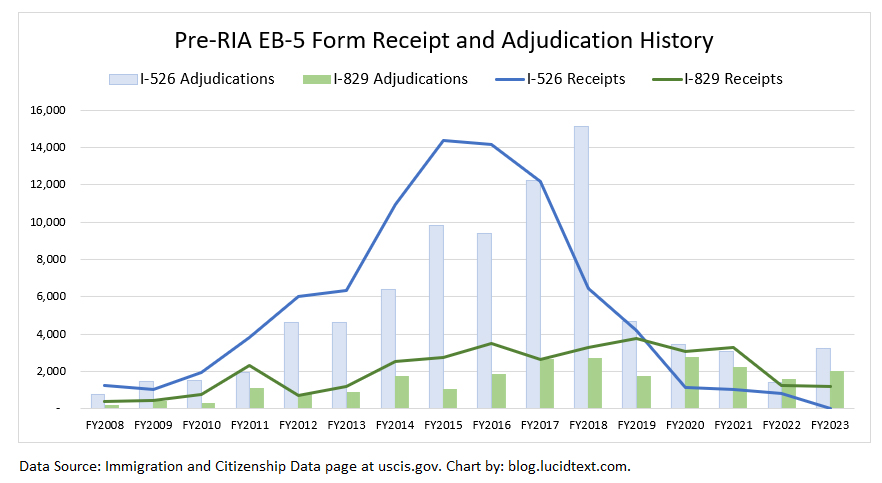
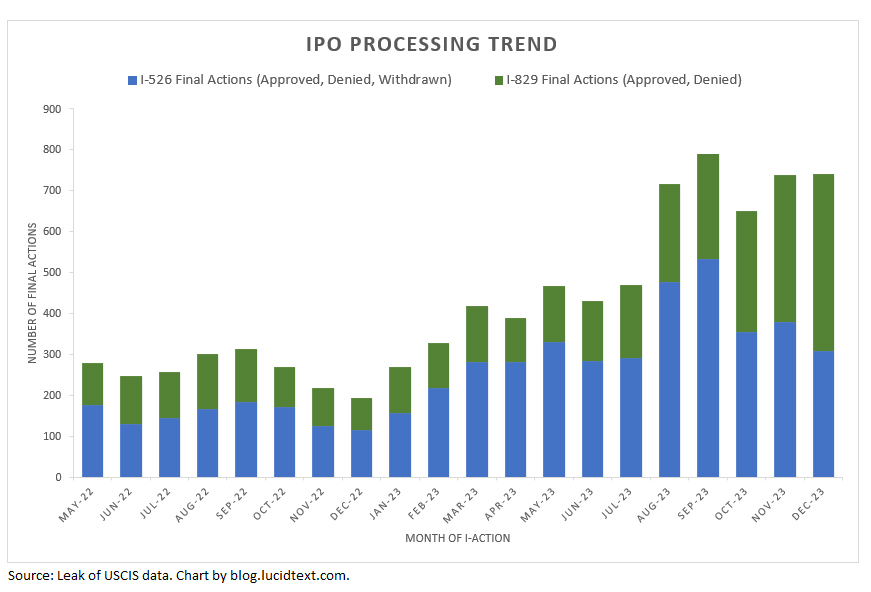
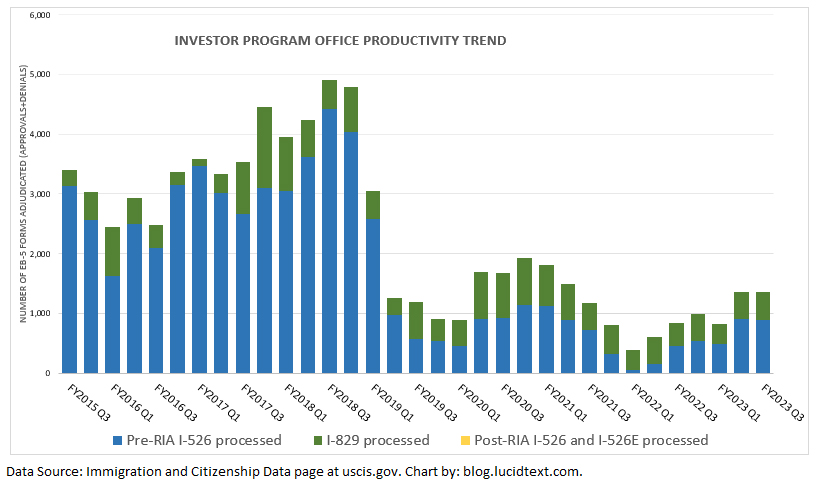
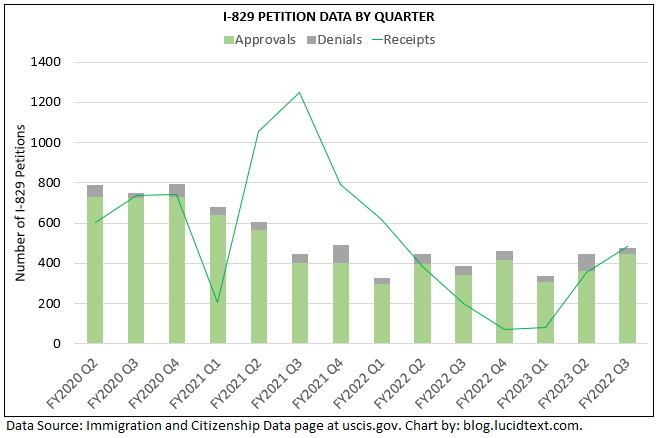
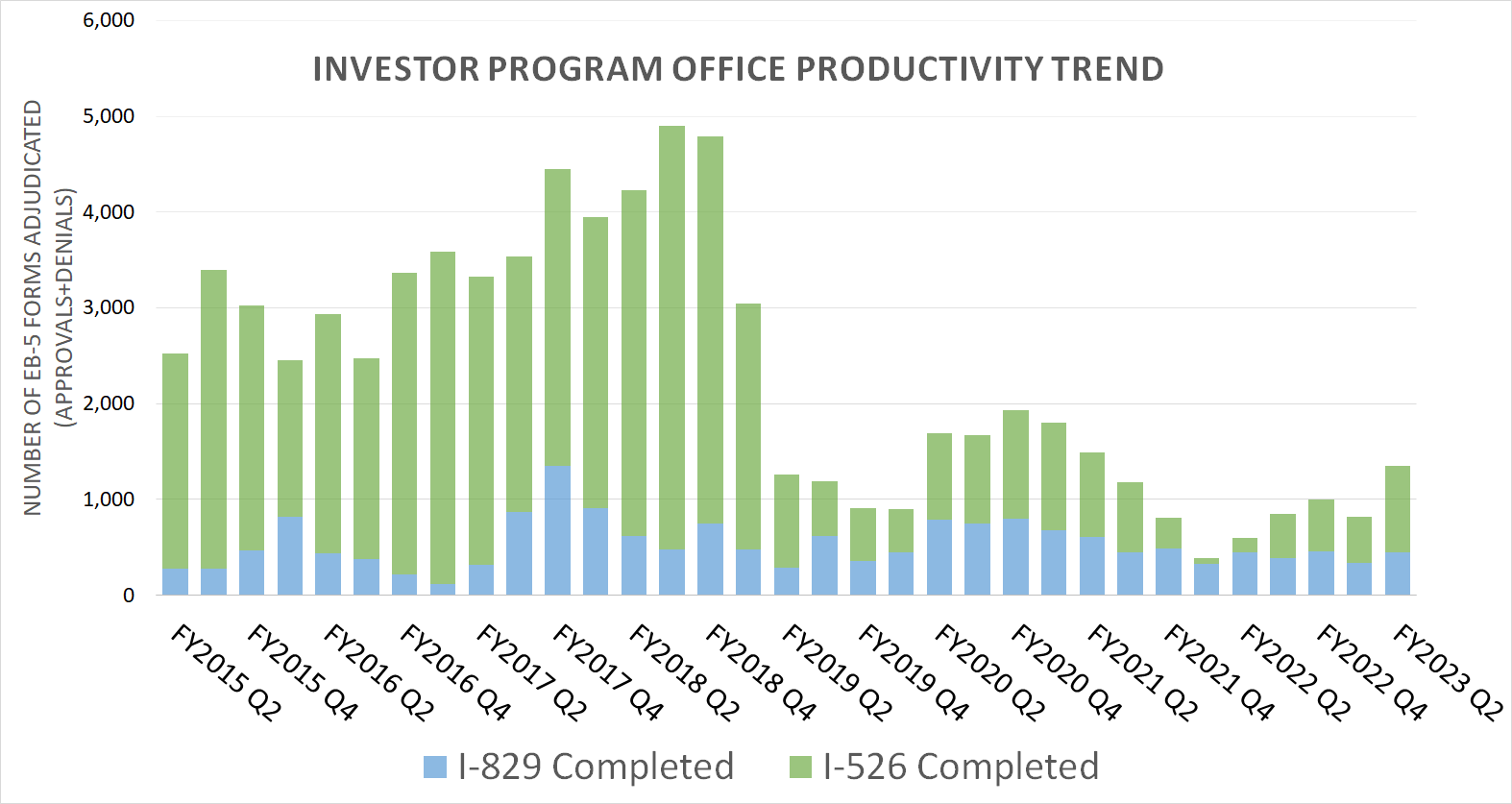
  • Pre-RIA Petition Adjudication: In Q3, USCIS reported processing slightly fewer I-526 and slightly more I-829 than in the previous quarter. Overall, the processing volume in Q3 looks like great improvement if compared to last year, but still bad if compared to any other time period. The improvement so far is very welcome, but must escalate to get IPO out of its deep processing hole. Dividing petitions pending at the end of Q3 by petitions processed during Q3, I get the following equations for time to clear the backlog if USCIS continued processing at the same rate as in Q3. I-526: 10,802/888=12 quarters to clear the I-526 backlog.  I-829: 10,507/474=22 quarters to clear the I-829 backlog. (See my Processing Data page for charts illustrating how adjudications have been spread across filing dates.)
  • Denial Rates: Denial rates in Q3 were thankfully lower than in recent quarters: 28% for I-526 and 6% for I-829.
  • Errata: Comparing the Q3 year-to-date report and pending numbers with previous data reports, I find once more that USCIS is either regularly overestimating and then correcting previously-reported numbers, or regularly losing petitions from the inventory. My charts make the assumption that Q3 numbers are correct where they conflict with previous reports.

EB-5 Form Data from FY2023 Q3 Data Report (April 1, 2023 to June 30, 2023)

FormReceivedApprovedDeniedTotal ProcessedPendingProcessing Time
I-526 (Pre-RIA)63725188810,80248.2
I-52650N/AN/AN/A137N/A
I-526E649N/AN/AN/A1,761N/A
I-8294844443047410,50748.6
I-9564148DH27310.8
I-956F61DD18711.1
I-956G12276N/A
I-956H4932,635N/A
I-956K258N/AN/A

Report of EB-5 Forms Processed and Pending FY2023 to date from FY2023 Q3 Data Report

FormTotal Processed October 1, 2022 to June 30, 2023Total Pending at June 30, 2023
I-526 (Pre-RIA)1,93010,802
I-526 N/A137
I-526E N/A1,761
I-8291,25210,507
I-956 H273
I-956F D187
I-956G –  276
I-956H –  2,635
I-956K –   N/A
I-924 D40
I-924A –  1,734

EB-5 Visa Status Report for 2023/2024

Fiscal Years 2023 and 2024 are good years for EB-5 visa availability, with mixed outlook for visa issuance.  I assess the picture by looking at EB-5 quota limits, EB-5 dates in the October 2023 Visa Bulletin and prior visa bulletins, I-526 filing trends associated with visa bulletin dates, the NVC waiting list, monthly visa issuance, and I-526 and I-526E processing trends. The picture that emerges from all this data shows winners and losers created primarily by the processing capacity of USCIS and Department of State. I begin with comments, followed by charts and tables. (9/29 UPDATE: This post has been revised to add monthly data for August 2023 and a revised FY2024 EB visa limit estimate.)

Winners in 2023/2024 EB-5 visa issuance

Win for unreserved EB-5 visa applicants generally

Department of State reports that “most” 2023 employment-based visas available were actually used in 2023 – making this the first year since 2019 without major EB visa loss. And 2024 could be an even better year for unreserved visa issuance, contingent on USCIS and DOS processing capacity. Unreserved EB-5 gets a windfall in 2024 of the 6,400 reserved EB-5 visas not used in 2022, on top of its regular 68% allocation of an unusually high EB-5 limit, for a total of over 14,000 unreserved visas available in FY2024. (See Table 1 below.) If only USCIS and consulates can manage to issue that many visas! Any unreserved FY2024 visas not used in FY2024 will be permanently lost to EB-5.

Win for unreserved visa applicants from India

India continues to be subject to country cap limits, but Mumbai has been issuing EB-5 visas aggressively and efficiently, and the adjustment of status process is working. As result, Indians have received as many as or more than the number of EB-5 visas technically available to Indians in 2022 and 2023 (see charts and tables below).

And the Visa Bulletin is being very generous to India. The October 2023 Visa Bulletin has already moved the India Final Action Date to December 15, 2018, from its pre-retrogression date of June 2018 – thus already releasing more Indian applicants for final action in 2024 than visas available to India in 2024, by my calculation. (My estimate considers the 773 I-526 filed by Indian investors from June 2018 to December 2018, and the about 1,000 unreserved EB-5 visas available in FY2024 under the country cap for investors plus family.) And even more generously, the October 2023 Visa Bulletin gives India EB-5 a Filing Date in April 2022. This allows all Indians in the queue for unreserved EB-5 visas to file I-485 and apply for advance parole and travel benefits — even though EB-5 green cards may not be available for post-2019 Indian priority dates until the end of the decade, absent a large number of dropouts from the current queue. (See my backlog data file for detail, or AIIA’s calculator tool.)

Wins for some unreserved visa applicants from China

Poor performance by many consulates worldwide has meant that rest-of-world EB-5 visa issuance has remained fairly low — below rest-of-world EB-5 demand. This failure benefits Chinese applicants by increasing the number of “otherwise unused” EB-5 visas left available for allocation to the oldest priority dates – i.e. to China-born applicants. EB-5 visa issuance to China in 2023 exceeded what I had expected looking at the waiting list from other countries. (See Table 2 below.) If only the Guangzhou consulate can keep up, the large number of unreserved EB-5 visas available in 2024 should significantly benefit the oldest Chinese priority dates. But it depends on the Guangzhou consulate managing unusually high-volume EB-5 interview scheduling this year.

Another mixed blessing comes from discriminatory policies resulting in high denial rates for Chinese I-526 and visa applications. As hundreds of Chinese keep falling out of the EB-5 backlog due to denials/revocations/withdrawals, those who do remain in the process keep advancing hundreds of spaces closer to getting a visa. The October 2023 Visa Bulletin advances the China EB-5 Date for Filing a whole year — from January 2016 (where the date had lingered since early 2020) to January 2017. This unprecedented large leap potentially allows at least 20,000 more Chinese EB-5 visa applications on the table – or so one would think, knowing that Chinese filed 10,450 I-526 petitions between January 2016 and December 2016. But Department of State must be counting on a large percentage of those 10,450 Chinese EB-5 investors who started in 2016 having subsequently dropped out, or lost their spouses and children, such that their actual visa applications won’t in practice overwhelm the near-term visas available to China. (Depending on rest-of-world visa issuance and Guangzhou capacity, China could get at most up to 10,000 EB-5 visas in 2024.)

Win for a fraction of reserved EB-5 visa applicants

USCIS has recently approved some I-526E, both for rural and high-unemployment projects. Not 100s or 1000s of approvals from what I’ve heard, but at least multiples of 10. USCIS is under pressure to show they are implementing the new law, so they have to adjudicate at least some I-526E instead of just leaving them to wait fairly behind the older I-526 backlog. I’m sure that USCIS can’t possibly manage the 3,000 or so I-526E approvals that would be needed very soon to use the 8,000+ reserve visas available in 2024 (if indeed that many I-526E have even been filed yet). But it’s going to be great for the portion of I-526E petitions that do get approved and advanced in 2024 – they’ll be swimming in visa availability. I-526E that remain pending in 2024 will face narrower visa availability when they reach the visa stage in future years.

Losers in 2023/2024 EB-5 visa issuance

Losses for EB-5 applicants from Vietnam, South Korea, Hong Kong, and Other Countries

Due to USCIS and DOS processing issues, actual EB-5 visa issuance has been lower than demand for many countries with no country cap limit. The National Visa Center had over 5,000 EB-5 applicants registered in November 2022 from countries other than China and India (the only countries with a country cap limit for EB-5). And yet by the end of August 2023, DOS had issued fewer than 3,000 EB-5 visas to those rest-of-world applicants. What’s your EB-5 problem, consulates? You had over 5,000+ EB-5 visas available in 2023 that could’ve gone to those 5,000+ applicants – why not allocate them? (And the problem does seem to be EB-5-specific, since consulates performed pretty consistently overall in 2023 across IV categories.)

Applicants from Hong Kong received fewer than 100 EB-5 visas in 2023 even though over 600 Hong Kong EB-5 applicants were registered and waiting at NVC. What’s the excuse? Why did Ho Chi Minh City issue only 527 EB-5 visas in the first 11 months of 2023, although the year started with over 1,500 Vietnamese registered at NVC (and no country cap limit for Vietnam this year per the Visa Bulletin)? Why do the monthly visa issuance statistics show that many consulates only got going with EB-5 interviews near the end of the year, instead of working consistently throughout the year as they’re supposed to do (or instead of working aggressively at the beginning of the year, as Mumbai did)? In particular, consulates in Seoul, Montreal, Rio de Janeiro, and Bogota did little EB-5 work the start of 2023. Let’s not repeat this pattern in 2024.

There’s a non-trivial risk that unreserved EB-5 could have Visa Bulletin cut-off dates for every single country (as is the case for EB-1 to EB-4) in 2025 or 2026. This could happen if DOS continues to let rest-of-world visa demand pile up from year to year while USCIS keeps adding to the NVC waiting list by approving I-526 from a variety of countries. The investor association AIIA has consular processing problems on its agenda, and we should support efforts to investigate and address this important problem area.

Losses for EB-5 investors who can’t get I-526 or I-526E approval shortly

The Investor Program Office has significantly increased I-526 processing volume in recent months (see my regularly-updated Processing Data page), so I have some hope for visa issuance in 2024. But this great trend must continue and escalate, because 2024 visa availability is only good for qualified visa applicants. People with I-526 or I-526E pending can’t move. The charts on my processing data page reflect the chaotic nature of I-526 processing activity, with some recent cases adjudicated while other older cases get left pending for unknown reasons. The longer I-526 and I-526E remain pending, the more they risk limited visa availability and visa-stage crowds once they finally do reach the visa stage. We depend on you, IPO, to keep increasing processing volume so that EB-5 visas can get issued before they’re lost!

Table 1. EB-5 Visa Availability

EB-5 Visas Available FY2023FY2024
ABase EB-5 Allocation (=7.1% of annual EB)13,99311,715*
Unreserved EB-5 Visas AvailableFY2023FY2024
BBase Allocation for Unreserved (=68% of A)9,5167,966
CCarryover Unused Reserve (from 2 years previous)06,396
DTotal Unreserved Visas Available (=B+C)9,51614,362
ETotal available under Country Cap (=D*7%)6661,005
FAverage visas available per month (=B/12)7931,197
GAverage visas per country per month (=E/12)5684
Reserved EB-5 Visas AvailableFY2023FY2024
HBase Allocation for Reserved (=32% of A)4,4783,749
ICarryover Unused Reserve (from previous year)6,3964,478
JTotal Reserved Visas Available (=H+I)10,8748,227
Visas IssuedFY2023FY2024
KUnreserved Visas Issued9,516 (estimate)TBD
LReserved Visas Issued0 (estimate)TBD
Visas LostFY2023FY2024
MUnreserved Visas Lost (rolled up to EB-1/EB-2)0 (estimate)TBD
NReserved Visas Lost (carried over to unreserve)6,396 (estimate)TBD
*Note: Table revised on 9/22 to reflect the USCIS estimate that the EB limit in FY2024 is 165,000 — higher than the typical 140,000.

Table 2. FY2023EB-5 Unreserved Visa Issuance through Consular Processing

Country of chargeabilityTotal EB-5 Applicants Registered at NVC as of November 2022Actual EB-5 Visa Issuance Through Consular Processing October 2022 to August 2023*
China – mainland born38,8745,627
India1,362676
Vietnam1,534527
Korea, South560407
Hong Kong S.A.R.68885
All Others2,4801,034
Total45,4988,356
*Note: In FY2023, DOS should theoretically have issued 666 visas to India (its limit under the 7% country cap), visas to everyone on the NVC waiting list for Vietnam, South Korea, Hong Kong, and other countries (since they have no country limit), and then about 3,500 visas to China (because that’s the difference between rest-of-world demand and the 9,500 visas available in 2023). But in fact, it appears that India and China received more and Rest-of-World countries received fewer visas in 2023 than I would have expected. Table 2 covers visas issued through consular processing only (and only through August 2023), not adjustment of status.

Posts like this take so much time to research and write, and yet can still only answer a fraction of the questions that you may have. I am available to provide additional data and more detailed explanation, and to address individual questions. Just email me at suzanne@lucidtext.com to schedule a paid consultation. I have also made data available on the EB5 Timing and Processing Data pages. For visa wait time predictions, note that AIIA has combined my data library with their FOIA data and created an automated Pre-RIA Visa Wait Time Calculator. The AIIA tool is nice because it’s built around a core of known fact — how many EB-5 investors per country started the EB-5 process by filing I-526 — and then allows the user add assumptions about unknown visa-demand variables such as future family size and denial rates. Note also that IIUSA has a nice article on the topic of FY2023 consular processing, including comparison with previous years: IIUSA Data Analysis: EB-5 Visa Issuance Monthly Data Updates for FY2023 (September 2022 – July 2023).

FY2023 Q3 Processing Data, I-956 data, I-526E litigation

Yesterday, USCIS finally published performance data for January to March 2023, including — for the first time — receipt and processing data for the new EB-5 forms created a year and a half ago. I’ve copied a summary chart at the base of the post.

Insights from the FY2023 Q2 data report

  • USCIS now realizes that pre-Integrity Act I-526 and post-Integrity Act I-526 and I-526E are each fundamentally different forms that need to be reported separately. Thank you USCIS! I’m also happy to see USCIS finally starting to count all the new I-956 forms.
  • Despite my pleas, USCIS data reporting still does not include any information about I-526/I-526E filings by TEA category and country of origin — data without which it’s impossible for the public to monitor and preempt potential visa backlogs in the new EB-5 visa categories. (But good news: champion litigator Matt Galati came out this week with sword swinging in the cause of transparency, and filed a lawsuit on behalf of the investor organization AIIA to sue USCIS to provide the data. I am happy to see the EB-5 community working together and taking action to avoid repetition of the backlog problems facilitated by USCIS opacity and obstruction in the past.)
  • The USCIS report shows that most EB-5 adjudications in FY2023 have been of forms filed prior to the Integrity Act. This is only fair to the pre-Integrity Act backlog, and also unfortunate for Integrity Act implementation. EB-5 processing volume in Q2 was 66% better overall than the previous quarter (yay!), but still 20% worse than even at the height of the Pandemic (sigh), and still almost four times lower than what IPO processed with fewer employees prior to 2019. It’s great to see a near-term volume trend in the right direction, but the lift is still so small in context of what IPO could and should be doing. Failure rates also continue to be disturbingly high, with a shocking 55% of I-526 completions and 19% of I-829 completions being denials or withdrawals. Matt Galati and AIIA are also pursuing litigation to get at the reasons behind the increasing number of denials.
  • USCIS has received approximately 1,217 I-526E and I-526 investor petitions since the new EB-5 law passed in March 2022, and reports processing exactly “N/A” of these forms to date, with N/A defined as “not available.” I interpret N/A as signifying zero. This is unsurprising, considering that investor I-526E cannot be processed until the associated I-956F and I-956 have been processed for project and regional center approval, and 956 adjudications are proceeding slowly. Also, considering the 11,206 pending I-526 with earlier filing dates before the law change. But what if USCIS does pick up steam and processes all those 1,217 pending post-Integrity Act I-526? If a thousand petitioners arrive at the visa stage, each bringing a spouse and child, that would translate into demand for 3,000+ EB-5 visas — about the number of EB-5 reserve visas available in a typical year. So we are correct to start thinking already about potential backlogs and try to get the data needed to track/avoid them. (Update: I have now heard of three I-526E approvals, including this one.)
  • USCIS reports receiving just over 132 I-956F Applications for Approval of Investment in a New Commercial Enterprise since the new regional center program’s inception in May 2022. USCIS had processed exactly “D” of these forms as of March 2022, with D representing a number that USCIS considers too small to report. (See the base of this post for a list of the I-956F approvals that I’ve seen reported online.) I-956F approvals are critical, as the signal that I-526E processing could move forward.
  • It appears that about 300 regional centers have committed to activity under the new Integrity Act regional center program by filing a I-956 application for program compliance and I-956G annual report. Meanwhile the USCIS Regional Center List continues to show 640 regional centers, with no hint as to which are simply legacy shepherds of pre-Integrity Act investment and which have taken the necessary steps to comply and raise funds under the new program. So confusing! How can we tell which regional centers out in the market are in compliance?
  • Since October 2022, USCIS reports approving 28 I-956 regional center applications. Some of these are pre-Integrity Act regional centers reaffirming designation, while others are new. The USCIS Regional Center List appears to mark RCs that are new post-Integrity Act with a new style of ID number beginning with the letters RC. From examining post-Integrity Act RCs, I learn that the “regional” in “regional center” has a loose definition, with 3+ states being the standard “limited geographic area” for the purpose of pooling EB-5 capital.
  • The USCIS report includes a “Processing Time” column that gives a figure representing the median age of forms processed during that period. It’s important to realize that this number is not general or predictive. For example, Form I-956 shows a “processing time” of 7.3 months. This only means that among the 18 I-956 approved last quarter, the median processing wait was 7.3 months — saying nothing about the wait for unprocessed forms. For prediction, it’s more relevant to look at the number of I-956 pending — 280 — and how long it would take to process that many if IPO continues at the rate of 18 approvals per quarter or 6 per month. 280/6=47 months — yikes! Keep stepping up your game, USCIS!
  • Once again, I notice that reported numbers rarely quite add up. Last quarter’s period-end pending plus this quarter’s receipts minus this quarter’s processed rarely equals this quarter’s period-end pending. Q1 receipts reported a few months ago do not match the Q1 receipts implied in this quarter’s report of Q2 and fiscal year total receipts. So take each report with a bit of salt. USCIS needs better technology. And if reports can’t be more clean, as least they might be more prompt. It’s July, and we’re only now finding out a bit of what’s been happening with EB-5 forms since January.
FY2023 Q2 Data
FormDescriptionReceivedApprovedDeniedTotal ProcessedPendingProcessing Time (median months)
I-526 (legacy)Immigrant Petition by Alien Investor               –           406        498            90411,60250.1
I-526Immigrant Petition by Standalone Investor            40                 –             –                 –90
I-526EImmigrant Petition by Regional Center Investor          495                 –             –                 –1,127 
 I-526 Total          535           406        498            90412,819 
I-829Petition by Investor to Remove Conditions          352           362          85            44710,54248.8
I-956Application for Regional Center Designation          176              18  D   D 2807.3
I-956FApplication for Approval of Investment in a Commercial Enterprise            50  D              –  D 132 N/A
I-956GRegional Center Annual Statement          287                 –             –                 –282 N/A
I-956HBona Fides of Person Involved in Regional Center Program       1,007                 –             –                 –2,147 N/A
I-956KRegistration for Direct and Third-Party Promoters            38                 –             –                 – N/A N/A
I-924Application For Regional Center Designation               –                 –  D   D 84 N/A
I-924AAnnual Certification of Regional Center               –                 –             –                 –1,734 N/A

I-526 processing update

Today, USCIS published a new page titled Update to Visa Availability Approach for Form I-526. I’m quoting the page in full below, for the record in case the content changes. In short, USCIS announces a plan to assign I-526 for the same NCE to the same adjudicator(s), for the sake of efficiency considering overlap in project documents. USCIS has long had a three-queue I-526 system in place, with the third queue reserved for I-526 with projects already reviewed and visas available. Today’s change appears to be that I-526 in this third queue will now be officially assigned based on project groupings rather than simply in first-come-first-served order by filing date to the first available examiner. (You can see my log of USCIS announcements to compare today’s process description with previous very similar process descriptions.) Despite the title, the announcement specifies no change to the visa availability approach. Today’s announcement is just a new admission that USCIS can/will group I-526 by project when assigning petitions. Individual I-526 petitioners and projects will benefit or suffer from the change depending on whether their NCE gets assigned earlier or later than others, and to a solid or faulty adjudicator.

We shall see whether efficiencies result from today’s announcement. I-526 in a queue where the project had already been reviewed should never have been getting duplicative project review with each petition, regardless of who reviewed each petition associated with a previously-approved project. If duplicative review has happened in the past with multiple adjudicators, that was a deference problem. But if USCIS can’t teach its adjudicators deference, at least grouping projects by adjudicator should reduce the time wasted in second-guessing decisions.

The real headline behind this announcement is that USCIS has progressed to the point of assigning I-526 filed in November 2019 for adjudication. (You also know this if you follow the charts I post on my Processing Data page.) November 2019 is nearly the end of the line for the pre-Integrity Act I-526 backlog (after that, the price increase, Pandemic, and regional center program shutdown flattened demand, meaning few I-526 filings in 2020-222). USCIS unfortunately still isn’t close to clearing the I-526 backlog, since so many I-526 with early filing dates have been left behind, but this progress to the last filing surge in November 2019 at least gives hope and strengthens arguments regarding unreasonable delay.

Today’s announcement gives no hint regarding queue management and prioritization for I-526 and I-526E filed since the Integrity Act. Nor does the announcement touch on I-829, which could likewise benefit from project grouping for adjudication. (See Ignacio Donoso’s brilliant idea: I-829X – A Proposal for Project Approvals for Job Creation Compliance.)

USCIS Update to Visa Availability Approach for Form I-526 (quoted as of July 18, 2023)

U.S. Citizenship and Immigration Services (USCIS) is announcing an update to the visa availability approach to managing the inventory of Form I-526, Immigrant Petition by Alien Investor. The visa availability approach applies to pre-EB-5 Reform and Integrity Act of 2022 Form I-526 petitions and prioritizes the assignment of such petitions for investors with an available visa or a visa that will be available soon. The USCIS Immigrant Investor Program Office (IPO) manages this Form I-526 petition inventory through workflow queues factoring in whether: a visa is available (or will be available soon) and the underlying project has been reviewed. Workflow queues are generally managed in first-in, first-out (FIFO) order when a visa is available or will be available soon. Effective July 2023, IPO will update this approach by grouping petitions by new commercial enterprise (NCE) with filing dates on or before Nov. 30, 2019, within the workflow queue of petitions where the project has been reviewed and there is a visa available or soon to be available, to gain greater processing efficiencies.

Purpose

The purpose of updating the visa availability approach is to enable USCIS to increase productivity and more efficiently process Form I-526 petitions. As described in more detail below, IPO will group petitions in the third queue by NCE with filing dates on or before Nov. 30, 2019, because adjudicators can process Form I-526 petitions more efficiently when they are working multiple petitions associated with the same NCE given the overlap in project documents and issues presented.

Updated Process Description and Rationale

Under the visa availability inventory management approach, IPO determines visa availability and queues up the Form I-526 inventory into three workflows on a monthly basis as discussed here (PDF, 238.48 KB).

  • The first queue contains Form I-526 petitions where a visa is not yet available and not soon to be available and is ordered first-in, first-out.
  • The second queue contains petitions related to projects that IPO has not previously reviewed and have a visa immediately available or soon to be available. IPO reviews projects in the second queue in order from oldest to newest.
  • The third queue contains Form I-526 petitions that have an available (or soon to be available) visa and either a reviewed project or “non-pooled” (single investor) standalone project. This queue is organized by receipt date of the Form I-526 petition (from oldest to newest). This is the queue from which Form I-526 petitions are assigned to officers for adjudication. Form I-526 petitions have generally been assigned to officers in first-in, first-out order.

The update to the visa availability approach is effective July 18, 2023. IPO will group petitions by NCE with filing dates on or before Nov. 30, 2019, within the third queue. These petitions will be assigned by NCE using a FIFO methodology, namely, by date of the earliest filed petition in that queue for each NCE. Given the large volume of petitions filed shortly before the EB-5 modernization rule had taken effect in November 2019 and because the project documents are often the same, assigning multiple petitions associated with the same NCE to the same adjudicator(s) will enable IPO to gain greater processing efficiencies, reduce the backlog and Form I-526 completion times, and support consistency and accuracy in adjudications, while maintaining fairness given the closeness in the filing dates of these petitions.

USCIS is committed to reducing its Form I-526 petition backlog and completion times and has determined that this update to the visa availability approach will help the agency achieve this goal. 

IPO is hiring! (Insights from job postings)

Post last updated: July 11, 2023

How and when will EB-5 processing improve?  Good news: the USCIS Immigrant Investor Program Office is expanding its workforce. I am encouraged by the 21 alerts that I’ve received since August 2022 from USAjobs.gov for job openings at IPO, and to see that new job descriptions include words like “achieve efficiency,” “provide customer service,” and “respond to inquiries.” EB-5 processing times exploded in recent years primarily because IPO has had fewer people working less productively on EB-5 forms. Recent job postings provide hope that a larger staff and process improvements will eventually result in improved outcomes.

Job descriptions offer a view into the workings of an organization. They describe activities that the organization plans to undertake, reflect priorities, and provide insight into internal processes. They’re also helpful as a picture of the audience for EB-5 documents. As I write business plans to be reviewed by adjudication officers, it helps to know the officer’s qualifications, job description, and organizational context.

To facilitate analysis, I compiled and am sharing a compilation of IPO job postings in 2022/2023. My document lists all open positions during the past year, with duties and qualifications for each, and links to the original job postings (as saved in my files, since most are no longer live at USAjobs.gov). You’re welcome.

For this post, I’ll comment on a few questions that can be addressed with reference to recent job postings.

  • What are IPO’s growth plans and priorities?

Hiring in 2022/2023 shows that IPO is pursuing plans to increase the number of adjudicators, improve records management, explore process efficiencies, formulate new policies and procedures, respond to more inquiries, and address regional center compliance.

Job descriptions in 2022/2023 show that “integrity” remains a dominant value at IPO, with adjudicator job duties and qualifications focused on fraud detection and prevention. However, the words “efficiency” and “productivity” also appear several times, and four positions even include “customer service” among the required competencies.

  • What change can we expect from IPO?

If the job duties described in the 2022/2023 IPO job postings are actually performed, then we can expect a number of developments.

We will have policy for regional center compliance. (This promises to take time, since the three positions responsible to oversee and supervise regional center compliance and develop regional center compliance policy are all newly recruited in the past six months. But at least job postings show wheels in motion.)

IPO will have a wealth of recommendations for operating procedures. Eleven of the advertised positions include this among the job duties. Also, a vast quantity of research will be generated and turned into internal reports and briefings that may eventually translate into improvements. I’m particularly cheering for the Management and Program Analyst tasked “to improve productivity and increase the quality of work directed.”

IPO will have a better handle on its records and be better able to make reports and respond to inquiries. Five of the advertised positions are primarily occupied with records management. These positions might be needless if only IPO had halfway decent IT and database systems, but expensive humans are better than nothing.

Customer service may marginally improve. IPO has recruited one person for an “inquiry management unit” tasked to “resolve customer and organizational issues including applying and interpreting advanced knowledge of immigration laws, regulations, and policies using USCIS systems and mailboxes” – which sounds like it should mean more than repeatedly cutting and pasting “Good afternoon, Your inquiry has been forwarded for review, Thank you,” as the current mailbox staff does. IPO has also recruited for several staff devoted to FOIA requests, and for a quality manager whose duties include “providing customer service to internal and external customers.”

IPO’s in-person office – the one that’s apparently hardly used since all employee positions are telework eligible – will be nice and secure thanks to two new employees who will make over $100,000 a year each to manage physical security, facilities planning, fleet management, and health and safety.

  • What’s missing in the 2022/2023 IPO job postings? What’s unlikely to change, according to the job postings?

The newly-staffed IPO promises no more real world experience and no more legal or financial expertise than it has today. None of the advertised positions asked for any educational qualifications in immigration law, securities law, business, or finance. None asked for experience with business or investment. The only position with any educational qualification was Economist, and even that could satisfy the math component with three semester hours of calculus. With the exception of a low-level clerical position, none of the positions posted was open to the public. Many jobs were posted as open exclusively to current USCIS employees, and all (except the secretaries) were limited to current or former federal employees, with some flexibility for veterans, military spouses, and Peace Corps. USCIS is taking care to protect the ivory tower of IPO from practical EB-5 experience or industry involvement. “Organizational awareness” was explicitly mentioned as a required competency in some job descriptions, and a clear priority throughout. IPO is evidently not trying to bring a bit of Commerce, the Small Business Administration, or the SEC under the USCIS umbrella, though that would help to handle the investment component of immigrant investment. USCIS is evidently still only trying to be itself – an agency that grants immigration benefits and hires specifically for experience with applying and enforcing immigration law. This fact limits how much sophistication or effectiveness we can expect from IPO when it comes to evaluating EB-5 investor petitions or overseeing the regional center industry.

EB-5 Reform and Integrity Act implementation does not dominate recent IPO job postings. IPO advertised a “few” vacancies for adjudicators to judge regional center applications, and for three managers to work with regional center compliance. But generally, the advertised job openings are not obviously specific to new processes or requirements associated with RIA. There’s no evidence in the job postings that IPO is creating new divisions specific to the new EB-5 forms, or significantly increasing policy staff.  At best, this lack might mean that USCIS has already reallocated existing experienced staff to handle new RIA tasks.

IPO organization has been heavily weighted with administrative and ancillary staff. As of October 2022, IPO reported 216 employees, of which about 40 were assigned to I-526 and 35 to I-829, while the remaining 65% of EB-5-fee-funded employees bustled about doing things other than adjudicate investor petitions. New job postings likewise offer plenty of non-adjudicative work. IPO is not quite the hospital with 300 busy administrative staff and no doctors or medical service as described in Yes Minister, but it’s on the spectrum. In theory, IPO exists to process EB-5 forms, just as a hospital exists to heal the sick. In practice, IPO processing output has been very low for an office with 200+ employees mostly earning $100,000+ per year each. I hope that in the future, we will increasingly see IPO employees and job duties involved with adjudication.

Overview of job openings at the USCIS Investor Program Office September 2022 to the present (See my compilation document for detail and links to the original job postings. Note that I will continue to update this document as I am alerted to additional job postings.)

Position titleJob PostingPrimary duty
Management and Program AnalystTwo vacancies posted June 2023Administrative support: asset management, facilities
Auditor“Few” vacancies posted June 2023 Enforcement: Audit regional centers
Program Manager1 vacancy posted June 2023Administrative support: provide financial, human capital, and administrative oversight
Program Manager1 vacancy posted June 2023Adjudication Support: Oversee adjudications
Adjudication Officer“Many” vacancies posted March 2023 and May 2023Adjudication: Grant or deny petitions
Adjudication Officer (Regional Center)“Few” vacancies posted January 2023Adjudication: Grant or deny regional center applications
Adjudication Officer (Quality Assurance)1 vacancy posted January 2023Adjudication support: Review adjudicative decisions
Economist“Few” vacancies posted May 2023Adjudication support: Conduct and apply economic research
Supervisory Adjudication Officer1 vacancy posted December 2022Adjudication support: Supervise adjudicators
Adjudication Officer (Inquiry Management)1 vacancy posted June 2023Customer service: Oversee and resolve case inquiries
Immigration Services Analyst“Few” vacancies posted May 2023Customer service: Handle FOIA request response
Program Manager (Compliance)1 vacancy posted December 2022Policy: Oversee the development of policies for regional center compliance.
Supervisory Adjudication Officer1 vacancy posted January 2023Policy: Supervise a team responsible for developing policy, serve as subject matter expert
Supervisory Adjudication Officer1 vacancy posted April 2023Policy: Oversee the division developing regional center compliance.
Management and Program Analyst (Quality)2 vacancies posted January 2023Administrative support: Analyze processes to improve productivity and increase quality.
Management and Program Analyst (Data)1 vacancy posted June 2023Administrative support: Work on data integrity and process improvements
Supervisory Records and Information Management Specialist2 vacancies posted October 2022Administrative support: Provide direction for records and information management
Immigration Services Analyst3 vacancies posted June 2023Administrative support: Work with records (handling data, project management)
Immigration Services Analyst: Office Automation“Many” vacancies posted September 2022Administrative support: Clerical duties
Supervisory Management and Program Analyst (Facilities)1 vacancy posted September 2022Administrative support: Work on facilities and physical plant issues
Management and Program Analyst (Facilities)1 vacancy posted December 2022Administrative support: Work on facilities and physical plant issues

An Open Letter to Kevin Muck at IPO about I-526 data and avoiding EB-5 backlogs

*******************************

Dear Kevin Muck,

You introduced yourself in the October 2022 EB-5 stakeholder meeting as I-526 Division Chief at IPO, with ten years of experience as an IPO economist preceded by eight years of service at the Bureau of Economic Analysis.

With your background and status, you should be capable and informed about the EB-5 process. But you said something ignorant and dangerous in today’s EB-5 stakeholder engagement.

A question was asked about reporting I-526/I-526E receipt data by TEA category/country, for the purpose of monitoring and avoiding backlogs in the new TEA categories. You responded that stakeholders should consult the Visa Bulletin, and see that the current Visa Bulletin reports TEA categories as “current.”

Think about it, Kevin. Do EB-5 backlogs not exist until they appear at the visa stage/in the visa bulletin? Do you believe that someone filing I-526E today gets visa availability based on the dates in today’s Visa Bulletin?

If you think that, try to look in the face of an Indian who filed I-526 in December 2020, and say “You didn’t need to know about the 2,300+ other Indian I-526 we already had on file at USCIS in December 2020, but didn’t disclose except through FOIA years later.” Try to tell him: “The December 2020 visa bulletin when you filed I-526 said that India EB-5 was current so obviously you were good to go — no backlog for you to worry about when you invested! The visas available to India back when you filed I-526 must still be available to you now, right? Oh… wait… you can’t actually apply for a visa now because India EB-5 now shows as backlogged to mid 2018 in today’s visa bulletin. But how could anyone have guessed? Those visa bulletin dates appear out of nowhere! Surely nothing to do with the number of Indians who filed I-526 in 2018/2019, or our rate of adjudication! Surely IPO was right to ignore Suzanne when she wrote over and over to the IPO Customer Service Mailbox, begging for backlog-relevant I-526 data to enable backlog/wait time prediction! Why would anyone need to ask how many people are entering and lingering in the back of the queue at USCIS, when the Visa Bulletin reports conditions just fine at the terminus of the queue at Department of State?”

Think about it: in a situation where unlimited tickets can be sold for limited seats, why might prospective ticket buyers possibly want to inquire about how many tickets have already been sold?

In a situation where I-526 filing numbers turn into future priority dates for visa issuance, why might anyone possibly want to ask about filing numbers? Do you say — sorry, just wait ’til you all reach the visa application stage and then find out from the visa bulletin?

Kevin Muck, think about today’s prospective investor from China who is considering EB-5 investment with a rural project. With the 20% rural allocation and 7% country cap, that investor can count certainly on competing for one of about 140 visas per year (about 10,000*20%*7%) – anything above that depends on the unknowns of current/future rest-of-world demand and carryover timing. With such limited availability, why might that prospective investor want to know how many Chinese have already filed I-526 for rural projects, whether 80 or 800? Why could that prospect want timely data to show whether/when I-526 volume overall is sufficient to max out the category and activate country caps once the demand reaches the visa stage? Why might she want the receipt data necessary to estimate whether the rural queue already formed at the I-526 stage is of a size to take two years or 10 years to make it past the visa window? And it’s not only investors who want to estimate their investment and immigration horizon at the time of investment — issuers and projects and regional centers require this for their planning as well. And the government also has an interest.

Think about it: what’s the word for soliciting investment with an incentive that might not actually be available? When the U.S. government offers an investor visa incentive, at the same time making it impossible for the investor or issuers to estimate visa availability at the time of investment, I’d call that fraud by the government. It rests on IPO to keep the U.S. government out of such embarrassment by reporting on the I-526 filings that drive EB-5 visa demand and availability.

I have requested this so many times from USCIS, but I know your name and your face now, Kevin Muck, and the size of your salary, and I appeal to you personally. Now that you’ve applied your economist brain to the situation and realize the importance of this data for program integrity, please help make it happen! Here is the report that we need to have USCIS start publishing, at minimum quarterly and at minimum with data no less than three months old. (Even better if we can get monthly reports with data only one month old, but truly anything will be an improvement over current blank silence. USCIS already provides monthly reporting internally to the visa bulletin working group, so adding public reporting should not be a great reach.)

Number of I-526 receipts by country and category for the period ______    
 Rural TEAHigh Unemployment TEAInfrastructure TEAUnreserved
All countries    
China    
India    
Vietnam    
Mexico    

*Note: It seems that we need only these countries in the report, since the Federal Register notice RIN 1400–ZA27 clarified that the per-country limit is only triggered when demand exceeds 7% of all FB and EB visas. Which historically means that only China, India, Vietnam, Mexico, Philippines and Dominican Republic are in the country cap danger zone overall, and the last two can safely be disregarded for this report since they’ve never been remotely significant in EB-5.

That’s all for now Kevin. Thank you for putting yourself out to be faced with challenges like these. I depend on you to talk USCIS out of its practice of concealing I-526/I-526E filing information.

Sincerely,

Suzanne

(For more background and explanation, see also AIIA’s well-researched article How does the Visa Bulletin Work? And for such EB-5 demand data as I have managed to collect by hook or by crook, see my regularly updated Processing Data page and the Excel file I keep linked to the top of my EB-5 Timing Page.)

April 25, 2023 Stakeholder Engagement

The April 25, 2023 “EB-5 Stakeholder Engagement” had a Microsoft Teams webinar format, with IPO staff speaking on video and a chat box where the public had a chance to type questions viewable to admins only. I cannot disprove the hypothesis that all of us were sitting there watching pre-recorded video, and typing questions into the void.

The engagement managed to fill 1.5 hours with exactly no significant content. I won’t publish a recording. The meeting was 95% technical clarifications on Form I-956K – the regional center promoter registration form that functions to feed paper to the black vaults of USCIS, which neither adjudicates the form nor (at least so far) makes it actionable by divulging form compliance or non-compliance to prospective/current investors or regional centers. If USCIS cares about Form I-956K and the additional instructions and technical clarifications that they provided on today’s call, then they can publish said instructions and clarifications somewhere findable by the public.  USCIS announced that no transcript or talking points would be provided for today’s call. I will not waste time transcribing information that USCIS apparently does not consider reliable enough to record or publish themselves.

Alissa Emmel kicked off today’s engagement by announcing that speakers would not address two significant issues that the engagement was called in January 2023 to address: the critical questions of investment period (“the new requirement under the EB-5 Reform and Integrity Act of 2022 (RIA) that capital must be expected to remain invested for at least two years”) and regional center operations (“in particular those who wish to withdraw from the program and terminate their status and those who do not wish to solicit investments for new projects under the RIA”).  Both of these issues are hugely consequential. USCIS’s answer on the investment period will make the difference between whether Chinese, Indians, and Vietnamese who risk an EB-5 investment today can expect to exit the investment after as little as two years (the artificial sustainment period apparently in the Reform and Integrity Act) or as long as over a decade (the time it could take investors to reach the I-829 stage considering current processing time/volume trends and the visa backlog risk in categories with small per-country visa availability under TEA percentages and country caps). Regional centers who love the profits of redeployment and investors who hate the risks of redeployment both snowed USCIS in conflicting passionate feedback on this topic. (For example see IIUSA’s letter here, the joint industry letter here, and AIIA’s letter here.) I’m guessing that USCIS first delayed the stakeholder meeting (originally scheduled for March) and then finally avoided the topic today because they’re rationally afraid that whatever they say about the investment sustainment period will immediately occasion a lawsuit. The Regional Center operations questions are less divisive among EB-5 stakeholders, but a huge open question with USCIS. Are thousands of good faith investors about to start seeing their I-526 and I-829 denied and their residence status revoked through no fault of their own, and for no fault in the investment or job creation, but simply because their good faith regional center sponsor decided to go passive (instead of choosing to solicit new investment under the Integrity Act, with compliance steps specifically relevant to soliciting new investment)? It’s dreadful that this question remains open.  

In addition to avoiding two of the three agenda topics previously announced for the engagement, the IPO speakers also provided no update on IPO operations or staffing, no update on form processing or procedures, and no estimated delivery dates for the many initiatives IPO ought to have in hand, including policy publication, regulations, timely processing study, website updates, or digitization. At the same time, the speakers all put on a good face, as if they believed they were doing a good job, engaging substantively, and answering questions. Surely it’s not possible to be that clueless and incompetent? Could I at least have the hope of believing that today’s non-engagement was an act of intentional malice by people who know what they’re doing? Or maybe we and the IPO speakers on today’s call are equally victims of a system that paralyzes communication by subjecting every decision and talking point to a thousand steps and checks.

RIA Implementation Status, one year later

On March 15, 2022, the EB-5 Reform and Integrity Act of 2022 (RIA) became law as part of the Consolidated Appropriations Act, 2022 (Public Law No: 117-103).  One year later, how far have we come? How much of the law has been implemented?

The following bullet points give status as of March 31, 2023 for steps that need to be taken to implement RIA.

Updating policy, forms and guidance based on the new law

  • USCIS Policy Manual: Incomplete. On October 7, 2022, USCIS updated only the introductory Chapters 1-2 of the Policy Manual EB-5 section 6G, while EB-5 Chapters 3-6 remain untouched. The chapters still still not updated with RIA-compliant policy cover I-526 adjudication, I-829 adjudication, and regional center designation and reporting requirements.
  • USCIS website: Incomplete.  Some new EB-5 content has been added to the USCIS website over the course of the year, and some outdated content remains in the mix. It’s still impossible to go to the USCIS website to find out which regional centers are approved or active under the new law.
  • EB-5 forms: In Process. All EB-5 forms required by the new law have been published or revised but remain subject to change. (Indeed, new versions of all I-526 and I-956 were just published today.) USCIS has yet to respond to (and for I-956, even to post) the second round of public comments to the Federal Register on I-526E and I-956.

Prescribing regulations required by the new law

  • Regulation for parameters on capital redeployment: Not done. (RIA does not state a deadline for this regulation.)
  • Regulations prohibiting foreign involvement in a regional center: Not done. (The RIA deadline, 270 days after the date of enactment, has passed.)
  • Regulation to ensure that EB-5 capital is not used on publicly available bonds: Not done. (RIA does not state a deadline.)

Monitoring and enforcing regional center compliance with new requirements

  • Clarify how RIA requirements apply to previously-approved RCs not active under RIA: Not done.  The EB-5 stakeholder meeting previously scheduled for March 20, then delayed to April 25 is slated to address this question. (UPDATE: The April 25 meeting did not after all address expectations for regional centers with pre-RIA but not post-RIA investors.)
  • Review and approve regional center compliance procedures: Status Unknown. USCIS has not reported any decisions on I-956 Regional Center Applications. (We hear anecdotally about approvals received, but USCIS does not report I-956 approvals or denials on the USCIS Regional Center page or the USCIS Immigration and Citizenship data page.)
  • Vetting and background checks of persons involved with regional centers: Status Unknown. USCIS has not reported any decisions on I-956H forms.
  • Review Regional Center Annual Statements and Certifications: Not done.  Form I-956G were not filed for 2022 because “USCIS is extending this deadline until we publish guidance that clarifies the requirements of these forms.”  Such guidance has yet to be published.
  • Review regional center projects: Status Unknown. USCIS has not reported any decisions on I-956F Applications for NCE approval.
  • Review registrations by direct and third party promoters: Status Unknown. USCIS has not reported any decisions on I-956K registrations, and has not made any lists publicly available.

Implementing visa availability changes

  • Reshuffle visa availability to reserve visas for new TEA investment: In process. The Visa Bulletin and Annual Report of the Visa Office show new visa categories as required by RIA. Zero reserved visas were issued in FY2022, due to slow USCIS processing.
  • Carryover of unused reserved visas: In process. The FY2023 Annual Limit report says cryptically “The employment chart (above) does not include numbers carried over from the previous fiscal year in the EB-5 category.” (UPDATE: the April 26, 2023 DOS/AILA Liaison meeting (question 22) confirms intent to carry over visas.)

Other requirements

  • Timely Processing Fee Study: Not done. (RIA gave a deadline of 1 year from the date of enactment to complete a study of fees levels required to achieve timely processing goals, and this study has yet to be published. The USCIS Fee Study does not address timely processing for EB-5.)
  • Announce appropriate channels of communication: Done.  The bottom of the EB-5 Support page has been updated with Channels of Communication.
  • Publish Log of communications: Not done. The FOIA page for USCIS does not show a log of communications with Congress regarding EB-5.
  • Transparency regarding Publication of Information: Mixed. (For example, we know that USCIS is having court-ordered quarterly meetings with litigation plaintiffs. So far one set of meeting minutes has been published, and publication happened more than 30 days after the meeting.)

Other questions

  • Other Rule-Making: Not done. In response to I-956 comments in the Federal Register, USCIS indicated in December 2022 that it could not yet answer questions about but “may consider rule-making to address” each of the following issues:
    • Evidence to establish regional center geography;
    • Whether regional center policies and procedures need to be provided or only described;
    • What circumstances require an I-956F amendment;
    • Whether stand-alone investors need to use fund administration;
    • The definition of an infrastructure project;
    • Whether regional center annual reports need to cover funds raised prior to RIA.
  • Implementing the RIA change to the sustainment requirement and investment period: Not done, but the USCIS April 25 stakeholder meeting is slated to discuss the topic. (UPDATE: USCIS stated at the 4/25 meeting that they were after all “unable to discuss” the topic yet, while “USCIS is engaged in ongoing efforts at the immigrant investor program office and across the agency to ensure that when we do have updates, we’re equipped to provide the EB-5 stakeholder community with clear guidance.”)

FY2022 Annual Report of the Visa Office for EB-5 visas issued by country

The Department of State has finished publishing its Report of the Visa Office 2022. The report covers EB-5 visas issued from October 2021 to September 2022, with breakdown by country of origin, path (consular processing or status adjustment), and category (direct, regional center, TEA, reserved, unreserved). I’ve been waiting anxiously for the report, wondering about visa wastage, Integrity Act implementation, and impacts on the visa backlog and EB-5 visa wait times for China, India, and Vietnam.

This post comments on highlights, followed by data tables summarized from the reports.

FY2022 EB-5 Visa Issuance and Wastage

USCIS actually issued 10,885 of the unusually-high 19,987 EB-5 visas available in 2022.   Of the 9,102 EB-5 visas that didn’t get issued in FY2022, 6,396 couldn’t have been issued because segregated in newly-created set-aside categories. (The unused set-asides should carry over in future years, though the FY23 visa limits report doesn’t show the carryover.) The remaining 2,706 unused EB-5 visas in FY2022 were permanently lost to EB-5. (FY2022 is still much better than FY2021, when EB-5 lost 15,673 total visas, and FY2020, when EB-5 lost 7,498 visas.)

Visa wastage particularly affected countries with mostly regional center applicants using consular processing. For example, South Koreans got 695 EB-5 visas in 2019 (the most recent “normal” year) but only 396  visas in 2022 (86% by consular processing), despite the fact that 909 South Korean EB-5 applicants were ready and registered at the National Visa Center at the start of 2022. Hong Kong likewise suffered, with only 142 EB-5 visas issued in FY2022 despite 866 Hong Kong applicants ready at NVC at the start of the year. Meanwhile Indians, many adjusting status in the U.S., managed to get a record 1,381 visas in 2022 – even more than technically available to them under the year’s unreserved visa limit.

Reasons for FY2022 EB-5 Visa Wastage

EB-5 visa issuance in FY2022 was as low as it was largely due to the unfortunately protracted regional center program expiration, and the policy that prevented visas from being issued to regional center applicants from October 2021 to May 2022. (I wish that policy could be litigated on behalf of the over 18,000 EB-5 visas lost during the expiration.) Monthly visas statistics show that all regional center visas issued in FY2022 were packed into just four months: June to September 2022.  

The government had the entire year to issue direct EB-5 visas, but only issued 621, likely constrained by low demand (i.e. few direct I-526 filed and even fewer making it through I-526 processing to the visa stage). By comparison, 414 direct EB-5 visas were issued in the last normal year of FY2019.

Consular processing numbers were also depressed overall compared with FY2019, reflecting on-going struggles with post-COVID backlogs. For color on why the steps in consular processing remain so slow and problematic, see questions and answers in the Department of State/AILA Liaison Committee Meeting February 9, 2023, the NVC Immigrant Visa Backlog report (look at trends in the number of interview appointments, and compare appointment volume with backlog size), and the October 2022 Update on Worldwide Visa Operations. Those in or approaching consular processing should be aware of the NVC Timeframes page, with information on process status and times. The bright side is that consular problems affect not only EB-5 but also family-based visa issuance, and EB-5 benefits in 2023 from a share in FB visas that went un-issued in 2022 (as reflected in 2023’s unusually high EB visa limit).

High Volume of EB-5 Status Adjustments in FY2022

EB-5 visa issuance in FY2022 was as high as it was thanks to an unprecedented high number of status adjustments (37% of the total, as compared with 17% in 2019). For example comparing 2022 with 2019 visa issuance, China got fewer visas last year through consular processing but five times as many visas through status adjustment. 

The unusually high AOS numbers reflect the fact that USCIS got political pressure and made herculean efforts at the end of FY2022 to step up work on employment-based status adjustments, even as consular processing continued to struggle post-COVID.  

Direct EB-5 (and the visa bulletin even briefly becoming Current for China direct EB-5) did not contribute much boost. China ended the year with only 199 direct EB-5 visas issued – not much higher than usual, and not explaining the unexpected thousands of Chinese who adjusted status in 2022.

RIA Implementation, Reserved Visas, and Country Caps

Report of the Visa Office 2022 does segregate EB-5 visas into “5th Unreserved” and “5th Set-Aside” categories, reflecting changes to visa availability made by the EB-5 Reform and Integrity Act enacted March 15, 2022. Of course, no visas were issued in 2022 in the “5th Set-Aside” categories, since no applicants who filed I-526 after March 15, 2022 could have reached the visa stage in time. And according to Department of State interpretation, all EB-5 applicants with pre-March 2022 priority dates can only now qualify for a visa in the new 68% unreserved category, regardless of whether they invested in a TEA that matches new definitions. (I think this interpretation can and ought to be challenged, at at least one lawsuit by DRVC is challenging it, but it’s the fact for now.)

In theory, country caps further restrict availability within each category. Thus pending applicants from any one country can only expect up to 7% of the 68% unreserved EB-5 visas (with “otherwise unused” unreserved numbers going to the oldest priority dates i.e. Chinese).

In 2022, this theory held true for Vietnam but not for India. While both countries have excess demand for unreserved visas, and large NVC backlogs, the government in fact issued 815 EB-5 visas to Vietnam (about 7% of unreserved EB-5 visas) and 1,381 EB-5 visas to India (about 7% of total EB-5 visas). Hmmm…

Was this different treatment of Indians and Vietnamese an oversight, with the government remembering the unreserved limit in the new law for Vietnam while forgetting it for India? 2022 was naturally confusing for the Visa Office, which had to deal with a mid-year law change and leadership change. Or did many Indians get lucky just because they happened to be in the US, unlike most Chinese and Vietnamese EB-5 applicants with earlier priority dates? I wonder if maybe Indians got assigned “otherwise unused” numbers at the end of the year that should’ve gone by right to earlier Chinese priority dates, but practically couldn’t because the consulate in China lacked capacity to hold more interviews in time while the California Service Center had capacity to complete more I-485 and help avoid wastage. (I also wonder if a difference between consular and USCIS capacity to issue visas at the end of the year could explain the unusually high number of Chinese regional center applicants who were able to adjust status in FY2022 — more applicants than one would expect from priority date order.)

Country Diversity

FY2022 was similar to previous years in terms of countries claiming the most EB-5 visas. As in 2019, the top users in 2022 were (in descending order): China, India, Vietnam, South Korea, Brazil, and Taiwan. Meanwhile, Mexico, Canada, Russia, and Iran moved a few notches up the list in 2022, while Venezuela, South Africa, Great Britain, and Japan moved a few notches down. I was surprised mainly by the number of Canadians on this year’s list (why, Canada?) and Iranians (considering the often arduous source of funds path).

Visa Demand Context

For a reminder of the size of the visa queue before FY2022 visa issuance,  see the presentation by Charles Oppenheim for IIUSA in November 2021. At that time, Oppenheim estimated the EB-5 backlog (including applicants already registered at NVC and potential future applicants associated with I-526 pending at USCIS) at 57,253 visa applicants for China, 7,418 for India, 3,954 for Vietnam, and 18,054 for other countries  (see Slide 10).

Visas issued in 2022 reduced those queues by 6,125 visas to China, 1,381 visas to India, and 815 visas to Vietnam. (I assume that I-526 filings in 2022 didn’t grow the queues very much, unless it turns out that most of the 829 receipts last year came from Indians).  

The future wait times associated with that scary queue depend on (1) how many petitioners/applicants in the queue will ultimately give up/lose eligibility before they can clam a visa (likely a large number given the untenable wait times looming for Chinese and Indians near the end of the queue), and (2) how many EB-5 visas will be issued per year from now on, with the base case being 9,940 EB-5 visas * 68% unreserved * 7% country cap = up to 473 to applicants of each country. The actual number of visas available per-country in a given year can be significantly higher than the 473 base case based on carryover of family-based visas (as happened in FY2022 and happening again in FY2023 due to COVID-19), carryover of reserved visas (as should happen in 2024 and 2025 assuming law compliance and continued slow I-526 processing), and unreserved visas leftover after country caps (which should increasingly benefit China in coming years).  But even with the most optimistic assumptions on future visa availability, Chinese who filed I-526 from October 2016-March 2022 and Indians who filed I-526 from November 2019-March 2022 could face five or more years of waiting just for conditional permanent residence. Or would face that wait, except that it exceeds what many applicants (not to mention their RCs, projects, and investments) can practically bear, predictably leading to many queue-shortening drop-outs/failures. Meanwhile, new investors in reserved categories have to sweat over limited availability (with just 20%, 10% or 2% of visas available in each new lane, further restricted under the 7% country cap) and guessing the time for I-526 filings to invisibly build and max out that limited availability. I’ll write more about unreserved and reserved visa availability and wait time issues in separate articles.

The bottom line is that EB-5 suffers from a supply problem. EB-5 needs more visa numbers in order to accomplish what regional centers, investors, and public policy all require: a stable and predictable immigration opportunity that can accommodate new investors plus prevent a despairing rush for the exits for past investors/investment.

Tables based on the Annual Report of the Visa Office