The Department of State has finished publishing its Report of the Visa Office 2022. The report covers EB-5 visas issued from October 2021 to September 2022, with breakdown by country of origin, path (consular processing or status adjustment), and category (direct, regional center, TEA, reserved, unreserved). I’ve been waiting anxiously for the report, wondering about visa wastage, Integrity Act implementation, and impacts on the visa backlog and EB-5 visa wait times for China, India, and Vietnam.
This post comments on highlights, followed by data tables summarized from the reports.
FY2022 EB-5 Visa Issuance and Wastage
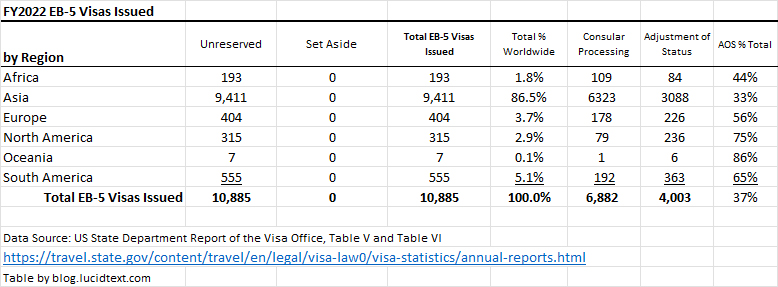
USCIS actually issued 10,885 of the unusually-high 19,987 EB-5 visas available in 2022. Of the 9,102 EB-5 visas that didn’t get issued in FY2022, 6,396 couldn’t have been issued because segregated in newly-created set-aside categories. (The unused set-asides should carry over in future years, though the FY23 visa limits report doesn’t show the carryover.) The remaining 2,706 unused EB-5 visas in FY2022 were permanently lost to EB-5. (FY2022 is still much better than FY2021, when EB-5 lost 15,673 total visas, and FY2020, when EB-5 lost 7,498 visas.)
Visa wastage particularly affected countries with mostly regional center applicants using consular processing. For example, South Koreans got 695 EB-5 visas in 2019 (the most recent “normal” year) but only 396 visas in 2022 (86% by consular processing), despite the fact that 909 South Korean EB-5 applicants were ready and registered at the National Visa Center at the start of 2022. Hong Kong likewise suffered, with only 142 EB-5 visas issued in FY2022 despite 866 Hong Kong applicants ready at NVC at the start of the year. Meanwhile Indians, many adjusting status in the U.S., managed to get a record 1,381 visas in 2022 – even more than technically available to them under the year’s unreserved visa limit.
Reasons for FY2022 EB-5 Visa Wastage
EB-5 visa issuance in FY2022 was as low as it was largely due to the unfortunately protracted regional center program expiration, and the policy that prevented visas from being issued to regional center applicants from October 2021 to May 2022. (I wish that policy could be litigated on behalf of the over 18,000 EB-5 visas lost during the expiration.) Monthly visas statistics show that all regional center visas issued in FY2022 were packed into just four months: June to September 2022.
The government had the entire year to issue direct EB-5 visas, but only issued 621, likely constrained by low demand (i.e. few direct I-526 filed and even fewer making it through I-526 processing to the visa stage). By comparison, 414 direct EB-5 visas were issued in the last normal year of FY2019.
Consular processing numbers were also depressed overall compared with FY2019, reflecting on-going struggles with post-COVID backlogs. For color on why the steps in consular processing remain so slow and problematic, see questions and answers in the Department of State/AILA Liaison Committee Meeting February 9, 2023, the NVC Immigrant Visa Backlog report (look at trends in the number of interview appointments, and compare appointment volume with backlog size), and the October 2022 Update on Worldwide Visa Operations. Those in or approaching consular processing should be aware of the NVC Timeframes page, with information on process status and times. The bright side is that consular problems affect not only EB-5 but also family-based visa issuance, and EB-5 benefits in 2023 from a share in FB visas that went un-issued in 2022 (as reflected in 2023’s unusually high EB visa limit).
High Volume of EB-5 Status Adjustments in FY2022
EB-5 visa issuance in FY2022 was as high as it was thanks to an unprecedented high number of status adjustments (37% of the total, as compared with 17% in 2019). For example comparing 2022 with 2019 visa issuance, China got fewer visas last year through consular processing but five times as many visas through status adjustment.
The unusually high AOS numbers reflect the fact that USCIS got political pressure and made herculean efforts at the end of FY2022 to step up work on employment-based status adjustments, even as consular processing continued to struggle post-COVID.
Direct EB-5 (and the visa bulletin even briefly becoming Current for China direct EB-5) did not contribute much boost. China ended the year with only 199 direct EB-5 visas issued – not much higher than usual, and not explaining the unexpected thousands of Chinese who adjusted status in 2022.
RIA Implementation, Reserved Visas, and Country Caps
Report of the Visa Office 2022 does segregate EB-5 visas into “5th Unreserved” and “5th Set-Aside” categories, reflecting changes to visa availability made by the EB-5 Reform and Integrity Act enacted March 15, 2022. Of course, no visas were issued in 2022 in the “5th Set-Aside” categories, since no applicants who filed I-526 after March 15, 2022 could have reached the visa stage in time. And according to Department of State interpretation, all EB-5 applicants with pre-March 2022 priority dates can only now qualify for a visa in the new 68% unreserved category, regardless of whether they invested in a TEA that matches new definitions. (I think this interpretation can and ought to be challenged, at at least one lawsuit by DRVC is challenging it, but it’s the fact for now.)
In theory, country caps further restrict availability within each category. Thus pending applicants from any one country can only expect up to 7% of the 68% unreserved EB-5 visas (with “otherwise unused” unreserved numbers going to the oldest priority dates i.e. Chinese).
In 2022, this theory held true for Vietnam but not for India. While both countries have excess demand for unreserved visas, and large NVC backlogs, the government in fact issued 815 EB-5 visas to Vietnam (about 7% of unreserved EB-5 visas) and 1,381 EB-5 visas to India (about 7% of total EB-5 visas). Hmmm…
Was this different treatment of Indians and Vietnamese an oversight, with the government remembering the unreserved limit in the new law for Vietnam while forgetting it for India? 2022 was naturally confusing for the Visa Office, which had to deal with a mid-year law change and leadership change. Or did many Indians get lucky just because they happened to be in the US, unlike most Chinese and Vietnamese EB-5 applicants with earlier priority dates? I wonder if maybe Indians got assigned “otherwise unused” numbers at the end of the year that should’ve gone by right to earlier Chinese priority dates, but practically couldn’t because the consulate in China lacked capacity to hold more interviews in time while the California Service Center had capacity to complete more I-485 and help avoid wastage. (I also wonder if a difference between consular and USCIS capacity to issue visas at the end of the year could explain the unusually high number of Chinese regional center applicants who were able to adjust status in FY2022 — more applicants than one would expect from priority date order.)
Country Diversity
FY2022 was similar to previous years in terms of countries claiming the most EB-5 visas. As in 2019, the top users in 2022 were (in descending order): China, India, Vietnam, South Korea, Brazil, and Taiwan. Meanwhile, Mexico, Canada, Russia, and Iran moved a few notches up the list in 2022, while Venezuela, South Africa, Great Britain, and Japan moved a few notches down. I was surprised mainly by the number of Canadians on this year’s list (why, Canada?) and Iranians (considering the often arduous source of funds path).
Visa Demand Context
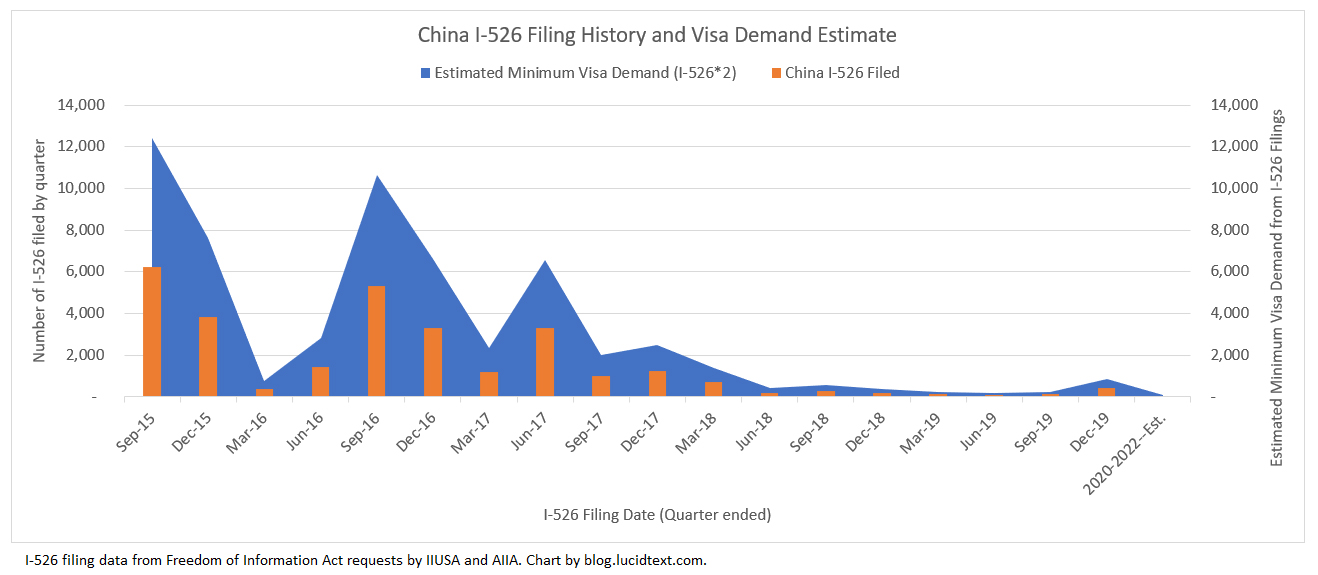
For a reminder of the size of the visa queue before FY2022 visa issuance, see the presentation by Charles Oppenheim for IIUSA in November 2021. At that time, Oppenheim estimated the EB-5 backlog (including applicants already registered at NVC and potential future applicants associated with I-526 pending at USCIS) at 57,253 visa applicants for China, 7,418 for India, 3,954 for Vietnam, and 18,054 for other countries (see Slide 10).
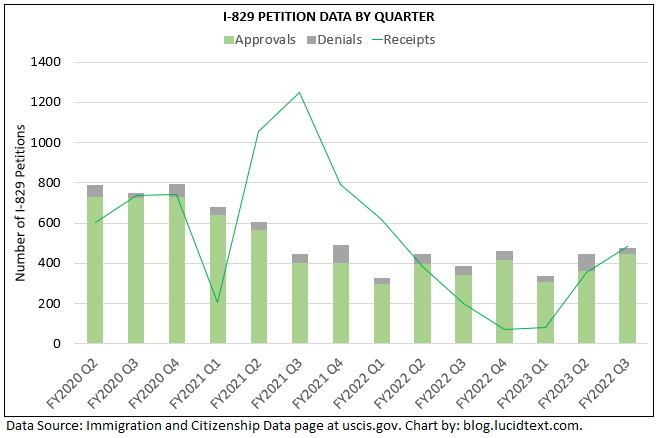
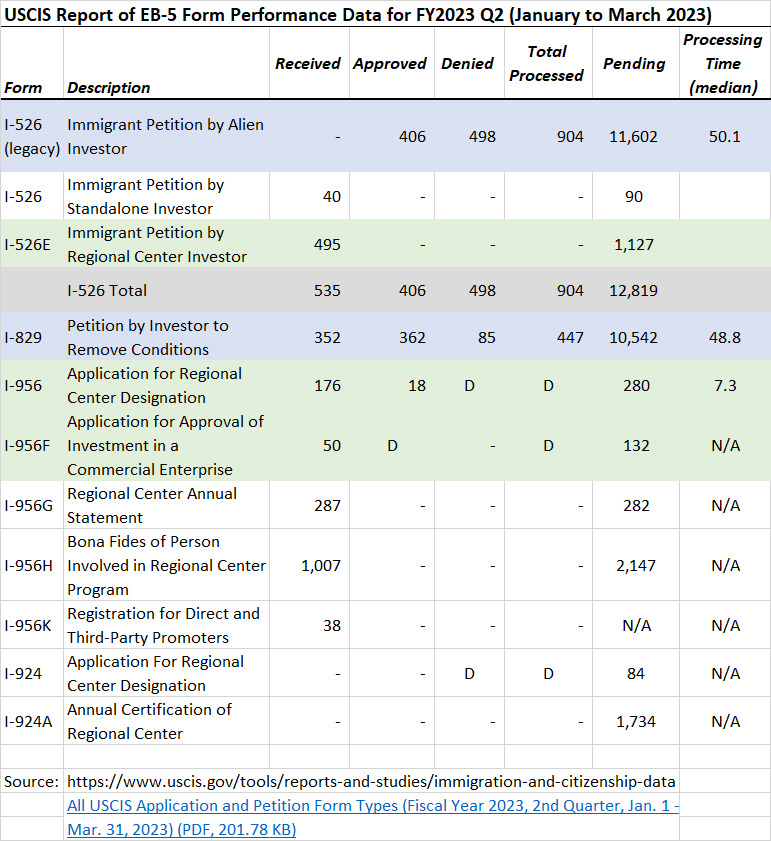
Visas issued in 2022 reduced those queues by 6,125 visas to China, 1,381 visas to India, and 815 visas to Vietnam. (I assume that I-526 filings in 2022 didn’t grow the queues very much, unless it turns out that most of the 829 receipts last year came from Indians).
The future wait times associated with that scary queue depend on (1) how many petitioners/applicants in the queue will ultimately give up/lose eligibility before they can clam a visa (likely a large number given the untenable wait times looming for Chinese and Indians near the end of the queue), and (2) how many EB-5 visas will be issued per year from now on, with the base case being 9,940 EB-5 visas * 68% unreserved * 7% country cap = up to 473 to applicants of each country. The actual number of visas available per-country in a given year can be significantly higher than the 473 base case based on carryover of family-based visas (as happened in FY2022 and happening again in FY2023 due to COVID-19), carryover of reserved visas (as should happen in 2024 and 2025 assuming law compliance and continued slow I-526 processing), and unreserved visas leftover after country caps (which should increasingly benefit China in coming years). But even with the most optimistic assumptions on future visa availability, Chinese who filed I-526 from October 2016-March 2022 and Indians who filed I-526 from November 2019-March 2022 could face five or more years of waiting just for conditional permanent residence. Or would face that wait, except that it exceeds what many applicants (not to mention their RCs, projects, and investments) can practically bear, predictably leading to many queue-shortening drop-outs/failures. Meanwhile, new investors in reserved categories have to sweat over limited availability (with just 20%, 10% or 2% of visas available in each new lane, further restricted under the 7% country cap) and guessing the time for I-526 filings to invisibly build and max out that limited availability. I’ll write more about unreserved and reserved visa availability and wait time issues in separate articles.
The bottom line is that EB-5 suffers from a supply problem. EB-5 needs more visa numbers in order to accomplish what regional centers, investors, and public policy all require: a stable and predictable immigration opportunity that can accommodate new investors plus prevent a despairing rush for the exits for past investors/investment.








 EB-5 Updates