Visa Numbers Update (Vietnam, India), TEA Reform Proposal, RC Audit Change

Visa Numbers Update (Vietnam, India)

We heard some updated EB-5 numbers this week from Charles Oppenheim, the Chief of the Immigrant Visa Control and Reporting within the U.S. Department of State. Bernard Wolfsdorf gives highlights from the presentation in 5 Things I Learned from Charlie Oppenheim at the IIUSA 7th Annual EB-5 Industry Forum. The major news is Mr. Oppenheim’s prediction that Vietnam will have enough demand to be subject to a cut-off date in 2018, and India may need a cut-off date by 2020. Cut-off dates happen when a visa category is oversubscribed and a country demands more than its rightful 7% of available visas in that category. A cut-off date holds back applicants from oversubscribed countries long enough to let any other applicants from undersubscribed countries get first chance at available visa numbers.  China is so far over the limit that it’s in an indefinite cut-off date situation with slow forward movement. Vietnam and India are just barely approaching the limit, and don’t have that much competition from other countries, so their cut-off dates would likely be temporary and hardly perceptible unless demand explodes.

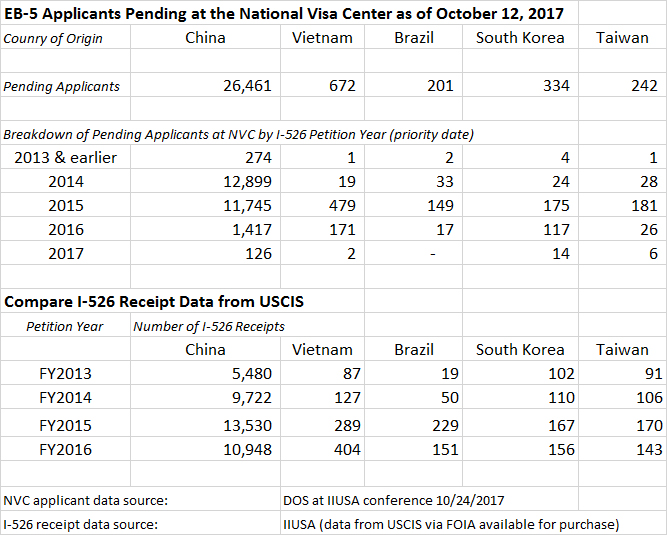
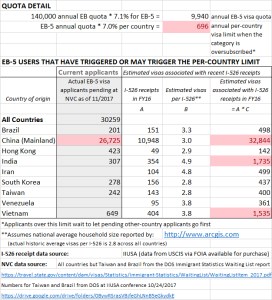
I most appreciated the slide from the Mr. Oppenheim’s IIUSA presentation that gives a breakdown of pending applicants at the National Visa Center by country of origin (for the top five countries) and priority date. I added data from the slide to my Excel file of EB-5 backlog-related info, and correlate it with per-country I-526 receipt data from USCIS. I’m copying below a couple tables that illustrate (1) how we might forecast future cut-off-date-countries from information on I-526 receipts and approvals, and (2) that life is not fair. (Note: see below for updated tables.)
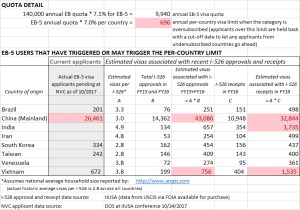
Since the IPO Processing Times report indicates that USCIS has only gotten to processing I-526 filed in November 2015, one wouldn’t expect to see applicants with 2016 and 2017 priority dates already in the visa queue. But Department of State reports nearly 2,000 applicants from the top five countries with priority dates after 2015, which means that USCIS must have processed over 600 petitions out of date order. Of course the number of pending visa applicants with priority dates 2015-2017 is still very small compared with the number of I-526 receipts in those years, so a majority of petitioners are getting held up in slow I-526 processing. I am surprised at the number of applicants with early priority dates still pending at NVC, considering that the China cut-off date progressed to mid-2014 this year (per the Visa Bulletin) and the other countries don’t have a cut-off date.

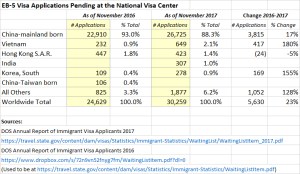
12/11/2017 UPDATE: The Department of State has provided updated numbers for pending visas in its Annual Report of Immigrant Visa Applicants in the Family-sponsored and Employment-based preferences Registered at the National Visa Center as of November 1, 2017. Here are updated charts based on the new data.
TEA Reform Proposal

Industry discussion about potential legislation has focused on the House-Judiciary Chair EB-5 Reform Proposal, a one-page term sheet with notes for potential future legislation. The term sheet proposes replacing the current Targeted Employment Area (TEA) system with a R/UD system. R/UD stands for Rural or Urban Distressed – two areas that would be incentivized for EB-5 investment with a slightly lower investment amount and fees, reduced job creation requirement, and – most potent of all – set-aside visas.

A couple major questions to consider: which projects would qualify for incentives under the R/UD proposal, and who’d be the winners and losers, were the term sheet to become legislation and then law?

  • The term sheet briefly defines Urban Distressed criteria: “must meet 2 out of 3 of the New Market Tax Credit Criteria.” The NMTC program has several sets of criteria, but we’ll assume the staffers mean the NMTC criteria for “severe distress” (since that’s the criteria referenced in previous EB-5 draft legislation): Poverty rate greater than 30 percent; median family income not exceeding 60 percent of statewide median; unemployment rates at least 1.5 times the national average. The term sheet gives this cryptic description of Rural criteria: “Base law + census tracts that would qualify under base law except for the fact that they are located in the outlying counties of MSA’s with population densities of less than 400 psm + Hatch fix.” I believe that means: Rural is an area with a population under 20,000 that is outside a Metropolitan Statistical Area (or a low population/low density area within the outskirts of an MSA). With those definitions in mind, you can get a sense of whether a project location might qualify for R/UD incentives using the CDFI Fund Mapping page provided by the US Department of the Treasury. For urban projects, select the NMTC mapping tool. When you enter the project address, the NMTC tool will bring up a map of census tracts around that address, with relevant NMTC data for poverty rate, income, and unemployment for each census tract. Check these numbers against the NMTC Severe Distress threshold, recalling that the EB-5 proposal would require 2 of 3 criteria to qualify. For rural projects, choose the BEA tool on the CDFI Fund Mapping page. This will bring up a map that lets you search by address and discover whether the address is in a non-metropolitan area, and the local area population. (To be sure of R/UD qualification, you’d need some additional guidance: whether and to what extent it’s allowable to group and average data across more and less distressed urban census tracts, what it means to be “outlying” in the rural context, and what source and date of data would be accepted. The term sheet doesn’t specify this.)
  • To judge winners and losers, we look at proposed incentives for R/UD investment. The term sheet suggests that investments in R/UD areas would be incentivized in these ways: 1,500 annual set-aside visas each for R and UD (with any unused visas rolling over from year to year in the same category), $925,000 minimum investment, reduced job creation requirement (5 indirect), option for exemplar somewhat-premium processing (one year), and exemption from an extra visa fee. Investments outside R/UD areas would have a $1,025,000 minimum investment, compete for the 6,940 annual visas remaining after set-asides, and would be subject to a visa fee of $50,000. The R/UD definitions and visa set-asides would become available on the date of enactment, affecting everyone with a visa pending at that time. The term sheet specifies that people with pending petitions and applications wouldn’t need to increase their investment amount, but they would find themselves in a line suddenly made about 40% longer by set-asides that reduce the generally available visa pool. The term sheet offers this limited relief: “For 1 year after DOE, any unused set-aside visas may be used by investors who had filed petitions pending as of DOE that meet the new definitions of R/UD.” However, I guess that few pending petitions fall in that category. This means that the #1 loser in this proposal is the past investor still waiting on conditional permanent residence. Congressional staffers don’t cry over the past investor, because they’re annoyed by the filing surges that happened in recent years (while they failed to act) and have wanted retroactivity. Self-interested RC lobbyists may also have few tears for past investors, whose money is in the bank and whose presence in the backlog represents the major drag on recruitment of new investors. A small negotiating table could see a win-win in a proposal that could discourage past applicants into clearing out the backlog and smooth the way for new rural/urban distressed investment (effectively incentivized with set-asides) and new prosperous urban investment (still competitive thanks to minor investment amount difference). Industry players who care about past investors and clients exist, and I hope their concern will signify.

Audit and Inspection Change
The page on the USCIS website that formerly explained Regional Center Compliance “Audits” and Site “Inspections” now describes Regional Center Compliance “Review” and Site “Assessments.” It’s interesting that USCIS revised the titles to sound less threatening, though the promised content of the audit/review or inspection/assessment remains almost unchanged.  The one content change I notice on the page is an additional bullet point for Regional Center Compliance Review: “Assess the effectiveness of internal controls related to the regional center’s administration, oversight, and management functions.”

EB-5 Timing Issues and Visa Wait: Process and Data

[2019 Update: My post Forecasting Visa Availability: 5/6 Oppenheim projections and big picture (5/6/2019) provides perhaps a clearer big picture explanation of how the wait line works.  2018 Updates: see also my 4/8/2018 post EB-5 Visa Waiting Line and Visa Allocation and my 4/23/2018 post Visa Numbers (China, Vietnam, India, Brazil, S. Korea, Taiwan)]

How long does it take to get an EB-5 visa? Before we look at numbers, consider this picture illustrating variables in the EB-5 process from initial application to conditional permanent residence.

The investor files an I-526 and receives a priority date, goes through I-526 adjudication, and proceeds along with family members to I-485 status adjustment (if already in the US) or consular processing (if outside the US) in order to get EB-5 visas. The system has two major constraints: USCIS capacity to process petitions, and the annual quota on EB-5 visa numbers. These constraints have produced pile-ups of pending petitions and applications, illustrated by the green bins in the picture.

We have data for many parts of this picture, such as how many people are in each of the pending bins, the historical rate of receipts and approvals and denials, and the annual visa quota. The simplest way to estimate the visa wait line (the time from priority date to green card) is to add up the pending bins and divide that number by the annual quota. As there are currently 90,000+ people associated with the pending bins, and the annual EB-5 visa quota is about 10,000, the current total waiting line is 9+ years long. (Maybe longer, depending on assumptions about the other variables). As recently as mid-2014, the line was only about three years long (as we know from the Visa Bulletin, which indicates that China-born investors with June 2014 priority dates started getting visas in May 2017).

Calculating the actual visa wait time for any given person is complicated. Where is that person in line, relative to other pending petitioners and applicants? Is that person from China (which is oversubscribed and subject to a per-country limit) or from an undersubscribed country that’s free to take the first available visas? How have/will other process variables such as per-country receipts and approval rates change over time and affect calculations?

If I were someone born outside China considering EB-5 now, I’d feel good about the per-country limit that allows me to skip ahead of most China-born applicants in line (i.e. about 87% of the line). For me, the time IPO takes to process I-526 is the major factor in my total wait time.

If I were a China-born prospective investor, I’d look at everyone in line ahead of me, and also try to estimate how many queue-jumping non-Chinese may enter from behind in the time I have to wait. That calculation could add years to the potential wait time, well exceeding 10 years, if the number of non-Chinese investors increases dramatically in the future and IPO processing speeds up. Or future circumstances could quell new EB-5 demand, encourage existing applicants to drop out, or apply the per-country limit to other countries, improving the wait time for China-born investors who stay in the system.

All past investors should consider the significance of the visa quota constraint and the possibility that it will change. Indeed, it could change for the better. For example, if the State Department recognizes that Congress intended the 10,000 visa quota to apply to 10,000 investors, not investors plus family members, this would loosen the constraint and cut about six years from the current visa wait time. Unfortunately, quota reduction is also a live possibility. Industry lobbyists are reportedly considering legislation with visa set-asides that would reduce the generally-available annual EB-5 quota from 10,000 to 7,000. This could be disastrous for past EB-5 applicants, adding about four years to the wait time. Visa set-asides have emerged as a compromise between the Senator Grassley camp, which wants to incentivize rural/urban-distressed investment somehow, and certain regional centers, who resist an incentive based on a significant investment differential that would make their future prosperous urban projects uncompetitive.  Tying the TEA incentive to visa set-asides rather than reduced investment would allow regional centers to keep attractive terms and options for future investors. Their past investors would suffer, but that cost seems not much counted. (My impression of the current legislation discussion comes from this webinar and this article.) Of course, maybe protections for past investors will be added to the legislation, or maybe there won’t be any deal and we’ll get new regulations instead. The regulations could significantly reduce new EB-5 demand, which would hurt the industry but benefit people who stay in the current visa queue.

And now, let’s get to the numbers. I’ve expanded and improved my backlog calculation spreadsheet, which now has multiple tabs that compile all the data I can find on each variable influencing the visa wait time for an EB-5 conditional green card. Keep the spreadsheet link, as I will update it whenever new inputs become available. (For those who don’t face backlog issues, see my posts on I-526 processing times Part I and Part II to help estimate the time between you and conditional permanent residence.)

Summary of EB-5 Visa Wait Time Variables

  1. I-526 petition variables
    • Number of petitions currently pending
    • Future petition filings
    • Number of petitions by country (how many China-born, how many born outside China)
    • Percent of petitions that will be denied or withdrawn
    • Number of family members to be associated with each petition
    • Time USCIS takes to adjudicate petitions
    • Investor’s priority date relative to others with pending petitions
    • The extent to which USCIS follows its first-in-first-out policy when adjudicating petitions
  2. Visa application variables
    • Number of I-485 adjustment of status applications for EB-5 pending at USCIS
    • Number of EB-5 visa applications pending at the National Visa Center
    • Number of pending applications by country (how many China-born, how many other)
    • Percent of applications that will be denied or withdrawn
  3. Political factors
    • Whether the rules and interpretation for the EB-5 visa quota remain unchanged
    • Whether new legislation introduces visa-set-asides that would reduce the annual visa quota generally available
    • Whether the regional center program remains authorized, and the impact of a sunset on investors in line for a visa
    • Whether new regulations or legislation include features that would change demand and/or affect past applications

Additional Reading

Benefit from this blog? Please consider supporting the effort behind it. As the EB-5 industry changes, your contribution can help preserve this space for conscientious and freely-available EB-5 reporting. Donations go to Lucid Professional Writing (a for-profit business) to fund work on this blog. Thank you!

Direct EB-5 FAQ, White House Immigration Principles

Direct EB-5 FAQ
The regional center program dominates EB-5, but the alternate direct EB-5 track remains significant. 846 EB-5 visas went to direct EB-5 investors plus family in FY2016, and this number will likely climb as petitions from the past couple years finally reach the visa stage. Direct EB-5 can be an attractive option for foreign investors and U.S. business owners who wish to avoid the uncertainty surrounding the regional center program. About half the business plans I write these days are for direct EB-5.

There remain, however, lingering misunderstandings about how EB-5 works outside the regional center program. I’ve prepared a new page, Direct EB-5 FAQ, that addresses questions about the nature and practical uses of direct EB-5.

Test your direct EB-5 knowledge.

  1. True or False? The direct EB-5 program will sunset unless re-authorized by Congress.
  2. True or False? A direct EB-5 investor must invest at the $1 million level.
  3. True or False? Real estate developments are the most common direct EB-5 project type.
  4. True or False? A majority of direct EB-5 investors have come from China.
  5. True or False? The direct EB-5 investor must majority-own the enterprise receiving investment.
  6. True or False? The direct EB-5 investor must have day-to-day managerial responsibilities in the enterprise receiving investment.
  7. True or False? If a direct EB-5 investor buys a business, that business and its employees will qualify as new for EB-5 by virtue of the new ownership.
  8. True or False? A new commercial enterprise can use direct EB-5 capital to invest in a separate job-creating enterprise.
  9. True or False? A direct EB-5 investor can count full-time equivalent jobs created by the enterprise.

Each of these statements is false. If you were surprised, then check out the Direct EB-5 FAQ page for direct EB-5 information, policy references, and case citations.

White House Immigration Principles & Policies

Just in time for Columbus Day, President Trump has sent Congress a list of Immigration Principles & Policies that 15th-century Americans could wish they’d had. The White House principles focus on border security and interior enforcement, and repeat the idea that legal immigration should feature a skills-based points system while reducing admissions for relatives, asylum seekers, and refugees. We shall see how Congress reacts to this guidance from the White House. The White House principles look positive for immigrant investment, but the points system would be fatal (at least in the scenario proposed by Tom Cotton, which would eliminate EB-5 and would not allow immigrant investment to support US entrepreneurs, but only immigrant-controlled business).

In the meantime, in honor of voyagers who continue to build our great nation as they bridge continents and pursue their dreams in face of doubt and adversity, I will quote the first paragraph of President Trump’s Columbus Day proclamation.

Five hundred and twenty-five years ago, Christopher Columbus completed an ambitious and daring voyage across the Atlantic Ocean to the Americas.  The voyage was a remarkable and then-unparalleled feat that helped launch the age of exploration and discovery.  The permanent arrival of Europeans to the Americas was a transformative event that undeniably and fundamentally changed the course of human history and set the stage for the development of our great Nation.  Therefore, on Columbus Day, we honor the skilled navigator and man of faith, whose courageous feat brought together continents and has inspired countless others to pursue their dreams and convictions — even in the face of extreme doubt and tremendous adversity.

Washington Updates, Articles, SEC Actions, RC List Changes

Washington Updates
We’re entering FY2018 with another RC program sunset date coming up on December 8, 2017, and new EB-5 regulations waiting for final clearance by the Office of Management and Budget. In a September 28 podcast with Mona Shah, Peter Joseph of IIUSA reports that “Congressional leadership including Senator Cornyn, Majority Leader McConnell, and Speaker Ryan has spent time working with judiciary committee leadership in coming to an agreement. The fact that these parties continue to dedicate time to a legislative solution is a very good sign.” However, “We don’t know the details of what might come out of a Congressional agreement. Investment amounts and other key issues are part of a fluid conversation, and negotiation will continue until there is enough agreement to move to the next stage.” I’m glad to hear that conversations are on-going, with IIUSA taking an active part. I’m also inclined to agree with Mintz Levin’s conclusions in the thoughtful article Lawmakers May Not Spend Political Capital on Standalone EB-5 Bill (September 28, 2017). It’s hard to imagine that Congress will prioritize EB-5 legislation when issues like health care and tax reform are pending, and easy to imagine them deferring responsibility with another content-free short-term RC program extension, or waiting for regulations. If DHS finalizes new EB-5 regulations before Congress gets around to legislation, then Congress doesn’t have to touch donation-losing issues like investment amount increases and TEA reform. Congress must act eventually, because only Congress can authorize the RC program and deal with visa numbers, but we’ll see. Prior to the last couple sunsets I heard whispers that certain lobbyists had secured a gentleman’s agreement with staffers for new legislation that would protect the status quo. (Senator Grassley heard the whispers too, and was not pleased). I’m hearing similar reports this time around, together with protests from other people in communication with the same offices who say no, Congressional leadership is not on board with the status quo proposals (to minimize the investment differential, protect the natural advantage of big-city projects, and generally avoid painful disruption). I’m not sure what to expect. I look forward to listening in to EB-5 Legislation: Where Are We? a free webinar to be hosted on October 4 by Kurt Reuss of EB5 Diligence, with an all-star cast including Stephen Yale-Loehr, Robert Divine, Robert Cornish, Laura Reiff, H. Ronald Klasko, Carolyn Lee, and Douglas Hauer. (10/12 Update: Mona Shah reports on a possible new legislative compromise.)

Interesting Articles

  • NES Financial has published another white paper with EB-5 Trends & Insights based on data from the many regional center transactions they facilitate. NES comments on 2017 trends in EB-5 capital structure, investor markets, escrow terms, and size and location of EB-5 projects.
  • Bloomberg Businessweek recently featured EB-5 in How Rich Chinese Use Visa Fixers to Move to the U.S. (September 14, 2017). I appreciate the article for its clever graphic, and for its old-fashioned vision of Chinese flocking to the smooth path of EB-5, not sweating at home over backlog calculations and the question of whether an EB-5 green card is worth a decade wait on top of investment risk and political uncertainty and capital control complications. CNN Money seems closer to the current situation with its article America’s ‘golden visa’ is losing its luster in China (September 29, 2017). The changing role of Chinese investors in EB-5 will likely define our experience in 2018. Unless, of course, we get good news on legislation and visa numbers.
  • Those involved with EB-5 investors from Iran, and people of conscience generally, will want to keep an eye on the emerging situation with President Trump’s new Presidential Proclamation on Visas. The State Department summarizes the revised travel ban, and how it affects nationals of Chad (?), Iran, Libya, North Korea, Syria, Venezuela, Yemen, and Somalia. (10/24 update: the Supreme Court has dismissed a final attempt to block the ban.)

SEC Actions
The Securities and Exchange Commission continues to highlight the need for investor vigilance. This month brought two new complaints, against Ronald Van Den Heuvel and Green Box NA Detroit (filed September 19, 2017) and Edward and Jean Chen and Home Paradise Investment Center LLC (filed September 20, 2017). I’ve added select details to my log of all SEC actions in EB-5. If we believe the SEC’s version of events, these cases did not involve complex or sophisticated schemes, just daylight theft and open lies enabled by related-party transactions and weak diligence. USCIS wasn’t necessarily taken in (the briefly-posted list of I-526 and I-829 adjudications by RC showed 0 petition approvals for Home Paradise), but quite a few investors were. The market needs to be more careful. The good actors who account for a majority of EB-5 players need to go the extra mile with transparency and account controls to demonstrate their good faith. Meanwhile, we appreciate the SEC putting bad actors on notice that EB-5 is not a free lunch.

Regional Center List Changes
Additions to the USCIS Regional Center List, 8/28/2017 to 10/02/2017

  • American Real Estate Regional Center, LLC (Connecticut, New Jersey, New York)
  • American Stone Energy EB5, LLC (Texas)
  • Broadway Regional Center, LLC (California)

(Additionally Live in America – Carolinas Regional Center LLC, previously removed in error, has been restored to the list of approved regional centers)

New Terminations

  • California Blue Sky Regional Center, LLC (California) Terminated August 29, 2017
  • Arundel Capital Partners (Massachusetts) Terminated August 29, 2017
  • California Economic Development Fund, LLC (California) Terminated September 25, 2017
  • Global Medical Center of Southern California (California) Terminated September 25, 2017