New RC (CA, IL, IN, MT, NC, NJ, PA, TN, UT, WA, WI), EB-5 Statistics, New SEC Rule

The USCIS Ombudsman’s Office 2013 Annual Report to Congress includes an interesting compilation of data on EB-5 petition processing and EB-5 Visa Usage.

EB-5 IMMIGRANT INVESTOR PROGRAM VISA DEMAND
Visas

FILING DATA ON FORM I-526, IMMIGRANT PETITION BY ALIEN ENTREPRENEUR RECEIPTS
I-526

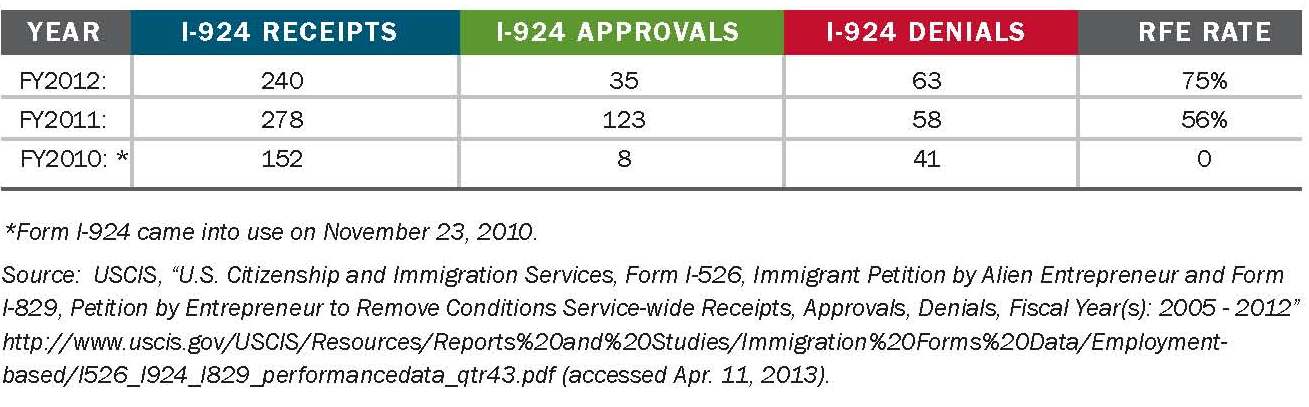
FILING DATA ON FORM I-924, APPLICATION FOR REGIONAL CENTER UNDER THE IMMIGRANT PILOT PROGRAM
I-924

So far, 2013 is looking like a better year for I-924 approvals. Last week USCIS updated its list of approved Regional Centers with 12 new Regional Centers, for a total of 70 new centers approved this year. I suspect that I-924 processing has unclogged in part because the option of approving I-924 applications without granting deference to the I-924 documents allows USCIS to defer serious review and hard decisions to the I-526 stage. USCIS is circumventing its deference policy with a deferrence policy, as it were. However, I’m happy to see some good applications getting approved. Congrats to OIS-NCA LLC for getting Regional Center approval in less than a year without an RFE, to Chicago Healthcare Fund Regional Center for achieving not only I-924 approval but also Exemplar I-526 approval (a rarity these days), and to Utah Invest Regional Center for triumphing over an arduous review process. I would congratulate the rest of you too if I had more information. Please share your approval letters and contact info with the community!

New Regional Centers

California

California Development Regional Center
Website: http://www.caldevrc.com/

OIS-NCA LLC
Website: http://ois-usa.com/
Geographic Area: California counties of Alameda, Contra Costa, San Francisco, San Mateo, and Santa Clara
Industry Categories: Nonresidential Building Construction (NAICS 2362), Traveler Accommodation (NAICS 7211)
Designation Letter

Waylee Investment, LLC

Illinois

Blue Ribbon Regional Center, LLC

Northern Illinois Regional Center
http://www.cabreracapital.com/

Illinois, Indiana, Wisconsin

Chicago Healthcare Fund Regional Center
Website: http://www.eb5chicagohealthcarefund.com/
Email: info@chicagohealthcarefund.com (Managing Director: Ari Weinberger)
Geographic Area:
Illinois counties: Cook, DeKalb, DuPage, Grundy, Kane, Kendall, Lake, McHenry, Will
Indiana counties: Jasper, Lake, Newton, Porter
Wisconsin county of Kenosha
Industry Categories: Assisted Living Facilities for the Elderly (NAICS 623312), Commercial and Institutional Building Construction (NAICS 236220)
Designation Letter

Montana

USA Montana Energy Regional Center
Website: http://usamerc.com/

New Jersey, Pennsylvania

Lion’s Regional Center
Website: http://www.lionspd.com/

North Carolina, Tennessee

Appalachian EB-5 Regional Center

Utah

Utah Invest Regional Center, LLC
Website: http://www.utahinvest.com/
Geographic Area: Utah counties of Box Elder, Cache, Carbon, Daggett, Davis, Duchesne, Emery, Garfield, Grand, Juab, Millard, Morgan, Piute, Salt Lake, San Juan, Sanpete, Sevier, Summit, Toole, Uintah, Utah, Wasatch, Wayne, Weber
Industry Categories: Personal Care Services (NAICS 8121), Motion Picture and Video (NAICS 5121)
Designation Letter

Washington

WRC EB-5 Regional Center, Inc.
Website: http://www.wrceb5.com/

Yareton Investment Funds Regional Center
Website: http://www.yareton.com/

(Note: See my Regional Center directory page for my most updated listings for all RCs. And please email me if you would like to provide additional information regarding your RC.)

Finally, I recommend the article What the SEC’s Elimination of the Prohibition on General Solicitation for Rule 506 Offerings means to the EB-5 Community by John Tishler, posted on the Sheppard Mullin blog on July 12, 2013.

New RCs (CA, LA, TX), RIMS II Cut

The USCIS Regional Center list has been updated with six new centers, for a total of 58 new approvals in 2013.

Louisiana
Continental Americas Regional Center
Website: http://www.carceb5.com/

California
American Greenland Regional Center

American Vantage Regional Center

Golden Bear Regional Center

Lake Elsinore Regional Center

Texas
Ameri-Link Capital Regional Center
Website: http://amerilinkcapital.com/

(Note: See my Regional Center directory page for my most updated listings for all RCs. And please email me if you would like to provide additional information regarding your RC.)

It’s interesting to note that three of the new California centers (American GreenlandAmerican Vantage, and Golden Bear) each filed a suit in California Central District Court on 2/8/2013 against Daniel M Renaud et al.

Also, I’m belatedly aware that the Bureau of Economic Analysis is eliminating RIMS II as part of its sequestration reductions! RIMS II has been one of the most popular methodologies for EB-5 economic impact reports in recent years, and we’ll be sorry to see it go. It’s lucky that USCIS is no longer requiring Regional Centers to file amendments to change economic methodologies. To quote from a 6/19/2013 notice from the BEA:

Regional Input-Output Modeling System (RIMS) – BEA will eliminate its RIMS II product, which currently generates products on demand as events warrant. The RIMS II program will continue to accept and process orders, which are fulfilled on a cost-recovery basis, through the end of the fiscal year. BEA will not build and develop the data needed to update the data set and fulfill orders in future years. RIMS II provides modeled estimates to the private sector and Federal, state, and local governments on the impact of a change in economic activity on a specific region’s economies. For example, RIMS II was used to estimate the economic impacts of Hurricane Katrina and the Deepwater Horizon Event.

2012 AAO EB-5 Decisions Posted

USCIS recently posted a number of 2012 administrative decisions on EB-5 cases. To view them, go to the Administrative Decisions page on the USCIS website and click on categories B7, K1, and K2, then open the 2012 folders. The cases make interesting reading, with plenty of laugh/cry moments. The 2012 decisions include two regional center application denials, one regional center termination, eleven denials of I-526 petitions, and five revocations of I-526 approvals. You’re welcome to take a look at my rough notes on the decisions before digging into the files themselves. The RC application denials deal with questions about “verifiable detail” requirements and appropriate review standard. In my opinion, they reflect a perspective that will likely continue to make genuinely “hypothetical” or “general” RC proposals practically impossible, even if theoretically allowed by the 5/30/2013 EB-5 policy memo. Many of the I-526 petition denials involve problems with source (and especially path) of funds and failure to demonstrate an at-risk investment likely to result in job creation. The revocations of approved I-526s give an example of a USCIS investigation (including a visit by a USCIS officer to the business site). These decisions also state that a business cannot claim indirect job creation simply if it “is located within and falls within the economic scope of a defined regional center” (to quote an ill-considered sentence on page 14 of the 5/30/2013 memo), but must further demonstrate formal affiliation with a regional center.

New EB-5 Resources (CDFA WebCourse, IIUSA Forum, Economic Impact and Analysis, Policy Memo, Best Practices)

Even I learned a lot last week at the 3rd Annual IIUSA EB-5 International Investment & Economic Development Forum in Las Vegas. For those of you not able to attend, here are some key take-aways.

  • The IIUSA Best Practices Committee unveiled a draft form of a “list of best practices to provide guidance to regional centers seeking to conduct business in a manner that will foster the growth and success of the EB-5 program.”  This document represents a year of hard work by a team of A-list players in the EB-5 field. It’s practical and detailed, providing a voice of thoughtful experience on topics from RC oversight and project selection to conflicts of interest, securities issues, escrow, jobs issues, agents and marketing, investor relations, and more. I’ve been dreaming of a best practices document like this, and can hardly wait for IIUSA to finalize and publish it. For now, I believe it’s only available in print in the Forum Handbook (available for purchase in the IIUSA store). Update: the list is now available on the IIUSA blog.
  • Speaking of the Forum Handbook from the IIUSA conference, it also includes the following excellent articles:
    • “Essay on the Search for a Legal, Logical, Economic, or Policy Basis for USCIS’s ‘Tenant Occupancy’ Policy on Selectively Withholding ‘Credit’ for EB-5 Job Creation” by Cletus Weber and Paul Sommers. This scholarly study is a must-read for anyone concerned with analyzing recent output from the USCIS economists. It is still in draft form, but Dr. Sommers invites comments and plans to submit the revised article for journal publication.
    • “USCIS EB-5 Training Materials 2008 to 2011” by Suzanne Lazicki (yours truly). I analyzed over 2,000 pages of materials used by USCIS to train immigration service officers for adjudicating EB-5 cases. The article includes a detailed index to the 2010/2011 training materials as published by IIUSA.
    • “EB-5 I-829 RFEs and Denials: New Analysis of What USCIS Looks for” By Sonia Sujanani, Stephen Yale-Loehr & Robert C. Divine. All regional centers should review this article as a refresher course on what USCIS looks for at the I-829 stage.
    • “EB-5 Financing for hotel development: Using guest expenditures to calculate job creation for hotels” By Jim Butler and the Global Hospitality Group®. A definitive treatment of the guest expenditures topic, and with insights for demand analysis in other industries. This study was also picked up by Hotel News Resource.
  • Anyone involved in advocacy for the EB-5 program should order the IIUSA-commissioned EB-5 Regional Center Program Economic Impact Assessment and Forecast. I was extremely impressed by the summary of sources, methodology and results presented at the forum by David Kay of the Minnesota IMPLAN Group.  For those who need good data and analysis of the recent economic impacts of the EB-5 program, this report is a truly unique and unprecedented source.
  • CDFA (Council of Development Finance Agencies) has organized an Intro EB-5 Finance WebCourse, to be held Sept. 18-19, 2013, 12-5pm daily. The topic line-up looks great, and I’d encourage everyone researching the EB-5 option to sign up. Those interested in development finance generally should also note the CDFA Online Resource Center.
  • I’m intrigued by the “Seven C’s of EB-5 Investing” and the “EB-5 Project Scoring Index” being developed by Greg Pope, who is thinking about EB-5 underwriting from a lending professional’s perspective. I talked to Greg at the conference, and he welcomes feedback from the community.
  • The 5/30/2013 EB-5 Adjudications Policy Memo was a hot topic at the IIUSA Forum, with a tone of cautious optimism prevailing.  For additional commentary on nuances and implications of the memo, I recommend H. Ron Klasko’s recent posts on “New USCIS EB-5 Policy Memorandum Mostly Gets It Right” and “New Ground Forged by the May 30, 2013 EB-5 Policy Memorandum (Part 2)”
  • I was pleased to confirm at the IIUSA Forum that it’s not just my mom and some spammers checking the weblog hundreds of times a day — I actually have real EB-5 fans. To all my loyal blog.lucidtext.com readers, you’re welcome!

New RCs (CA, NC, WA)

The USCIS list of Regional Centers has been updated with more new entries, for a total of 52 new centers approved so far in 2013. The new approval letters do not include the usual note in Section II about an amendment request being required if investment opportunities arise outside the approved geographic area and industry categories.

California
Regional Economic Development & Investment Group
www.redigeb5.com
Geographic Area: California Counties of San Joaquin, Sacramento, and Stanislaus
Industry Categories: Wineries (NAICS 31213), Restaurants & Other Eating Places (NAICS 7225), Commercial and Institutional Building Construction (NAICS 23622), Beer Wine and Liquor Stores (NAICS 44531), RV Parks and Campgrounds (NAICS 721211), Lessors of Nonresidential Buildings (NAICS 53112), Promoters of Performing Arts, Sports, and Similar Events with Facilities (NAICS 71131), Caterers (NAICS 72232)
Designation Letter

North Carolina
Encore Raleigh/Durham Regional Center
http://encoreeb5.com/
Geographic Area: ?
Industry Categories: ?

Washington
Path America KingCo, LLC
http://pathamerica.com/
Geographic Area: ?
Industry Categories: ?

(Note: See my Regional Center directory page for my most updated listings for all RCs. And please email me if you would like to provide additional information regarding your RC.)

New Policy on RFE and NOID

USCIS has just published a new policy memorandum about Requests for Evidence and Notices of Intent to Deny. And it’s wonderful! It seeks to clarify the role of RFE and NOID in all adjudications, not only for EB-5 petitions and applications, but oh how we need this memo in EB-5. I’m quoting much of the memo below because it’s just so clear and rational and encouraging. Listen up, EB-5 team! This is how you adjudicate cases! We appreciate your expertise, but you weren’t hired just to wield theories and scattershot questions until applicants have validated every detail for you beyond a reasonable doubt. You are immigration service officers now. Your job is understand the legal eligibility requirements and review standard that apply to EB-5 cases, and to review evidence accordingly. (PS, Mr. Renaud, don’t you think it would be wise to include at least some people with legal education among your new EB-5 hires? We suffered in 2012 from multiple RFEs fueled by economists who were conscientious about details but seemed to have little sense of the process and standards for adjudication. We need the new EB-5 team in Washington DC to be staffed by people with the skills to understand and apply the general principles articulated in this memo.)

quoted from 6/3/2013 Policy Memorandum on Requests for Evidence and Notices of Intent to Deny
A. General Principles: RFEs and NOIDs
The guidance articulated under this heading is generally applicable. However, there may be special circumstances where the general principles do not apply. In such instances, there will be accompanying special instructions that will provide alternate guidance. In the absence of special instructions, officers must follow these general principles.

In each case, officers must:
• Understand the specific elements required to demonstrate eligibility for the particular application, petition, or request.
• Understand the standard of proof that applies to the particular application, petition, or request. In most instances, the individual has the standard of proving eligibility by a preponderance of the evidence. Under that standard, the individual must prove it is more likely than not that each of the required elements has been met.
• Review all the evidence to determine whether each of the essential elements has been satisfied by the applicable standard of proof. Fraud and national security concerns should be vetted pursuant to FDNS and CARRP protocols.

If all the essential elements have been satisfied by the applicable standard of proof, including any additional requirement to establish that the individual warrants a favorable exercise of discretion, the officer shall approve the application, petition, or request without issuance of an RFE. 8 CFR 103.2(b)(8)(i).

If the totality of the evidence submitted does not meet the applicable standard of proof, and the adjudicator determines that there is no possibility that additional information or explanation will cure the deficiency, then the adjudicator shall issue a denial.

RFEs. If not all of the required initial evidence has been submitted or the officer determines that the totality of the evidence submitted does not meet the applicable standard of proof, the officer should issue an RFE unless he or she determines there is no possibility that additional evidence available to the individual might cure the deficiency.

NOIDs. The issuance of a NOID is required as described under AFM Chapter 10.5(a)(3). A NOID is required before denying any immigration benefit requests submitted on the following forms:
• Form I-800A (relating to adoptions) based on a mandatory denial ground in 8 CFR 204.309(a);
• Form I-800 based on a mandatory denial ground in 8 CFR 204.309(b); or
• Form I-485 filed by a physician under 8 CFR 245.18(i) because the physician failed to comply with the conditions attached to his or her National Interest Waiver.
A NOID is also required when derogatory information is uncovered during the course of the adjudication that is not known to the individual, according to 8 CFR 103.2(b)(16).
The issuance of a NOID is also appropriate in the following circumstances:
• There is little or no evidence submitted (e.g., a “skeletal filing”); or
• The individual has met the threshold eligibility requirements for the requested benefit or action, but has not established that he or she warrants a favorable exercise of discretion (where there is also a discretionary component to the adjudication).

B. Additional Considerations
In some cases, particularly where the response to an RFE opens up new lines of inquiry, a follow-up RFE might prove necessary. However, officers must include in a single RFE all the additional evidence they anticipate having to request. The officer’s careful consideration of all the apparent gaps in the evidence will minimize the need for multiple RFEs.

New RCs (CA, NJ, OR, WA), Processing Statistics

The USCIS Regional Center list has added more new entries, for a total of 49 new centers approved in 2013. Congratulations to Powerdyne for receiving approval of an application filed in May 2012 — comparatively record speed.

California
Powerdyne Regional Center, LLC
http://www.powerdyne.com/
Geographic Area: Riverside and San Bernardino Counties, California
Industry Categories: Boiler, Tank, and Shipping Container Manufacturing (NAICS 3324), Electric Power Generation, Transmission and Distribution (NAICS 2211)
Designation Letter

New Jersey
N U.S. Immigration Fund – NJ, LLC
http://www.visaeb-5.com/

Washington and Oregon
EB5 West LLC

(Note: See my Regional Center directory page for my most updated listings for all RCs. And please email me if you would like to provide additional information regarding your RC.)

As of this week, the approval letters still define the designation by saying: “USCIS approves the applicant’s request to focus, promote economic growth, and offer capital investment opportunities in the following geographic area and industry categories….” I wonder what approval letters will say going forward, now that we have a Policy Memo stating that amendment requests are not necessarily required if investment opportunities arise outside the approved geographic area and industry categories. What if anything defines/limits RC designations now? In his article Key Points from USCIS EB-5 Policy Memo published May 30, 2013, Robert Divine suggests that the new memo brings new value as well as risks to Regional Centers.

IIUSA has obtained statistics for I-526, I-829, and I-924 processing in Q1 and Q2 2013. To summarize:
I-526s: 3,285 received, 1,526 approved, 483 denied
I-829s: 427 received, 467 approved, 24 denied
I-924s (includes amendments and applications for initial designation): 325 received, 65 approved, 13 denied

Implications of Final Policy Memo

For the convenience of those wondering what’s new in the final EB-5 Adjudications Policy Memorandum released today, I have uploaded the previous 02/14/2013 draft version and the final 5/30/2013 memo with significant additions highlighted by me.

Spoiler alert: this final memo has some nice clarifications on issues like escrow outside the US and bridge financing, keeps a few of the mysterious provisions from the previous version (does anyone understand the logic of Section V(D)  on Material Change, or how the author understands “indirect” jobs?), and drops one major bomb regarding the nature of Regional Centers. The new memo tells us the following about Regional Center applications and approvals from now on (see  pages 14-15, 22-27):

  • The I-924 Regional Center application can be a general proposal based on general predictions, and need not include a Matter of Ho-compliant business plan unless project pre-approval is desired;
  • Organizational and transactional documents will not be reviewed for compliance in the I-924 application, unless the applicant specifically requests I-526 exemplar approval;
  • Once having been approved, a Regional Center is free to sponsor investments that are outside its approved industries of focus, outside its previously-presented economic methodologies, and even outside its designated geographic boundaries. (!?!)  Amendments are encouraged but not required.

I’m dazed. The implications of these points are so great that I hardly know how to credit them. Do they reflect considered policy that will actually be implemented, or hasty expression of a general (laudable) desire to promote flexibility? I can’t tell whether the memo author has a vision for what a Regional Center approval does mean, what the Regional Center application/designation process is designed to do, or how/if the requirements of 8 CFR 204.6 (e) or the I-924 Instructions apply to “hypothetical” I-924 filings as described by the memo. I wonder what the adjudicators are going to make of this memo, if they read it.

I will continue to update this post as commentary on the memo emerges around the web.

Final EB-5 Policy Memorandum!

From: U.S. Citizenship and Immigration Services [mailto:uscis@public.govdelivery.com]
Sent: Thursday, May 30, 2013 3:25 PM
Subject: USCIS Stakeholder Message: Final Policy Memorandum EB-5 Adjudications Policy

Dear Stakeholders:

Today, USCIS has published the final policy memorandum on uscis.gov:

PM-602-0083 (May 30, 2013) EB-5 Adjudications Policy

Interim and final policy memos are official USCIS policy documents and effective the date the memos are approved.

We would like to thank stakeholders for the thoughtful and informative comments you provided on previously posted versions of the EB-5 memorandum.

Visit the Feedback Opportunities web page for additional information about our stakeholder comment process.

If you have any comments or questions please contact us at Public.Engagement@uscis.dhs.gov.

Kind regards,

U.S. Citizenship and Immigration Services


New Regional Centers (GA, IL), Legislation Updates, ELIS, Due Diligence

The USCIS list of approved Regional Centers has added another three entries (now 46 new centers in 2013).

Georgia
Southeast Foreign Investment Center LLC
http://www.southeastforeignic.com/

Illinois
Chicago Metro Regional Center, LLC
http://www.nyeb5.com/contact.html
Geographic Area: Illinois counties of Cook, Lake, Will and Du Page
Industry Categories: New Multifamily Housing Construction (NAICS 236116), Commercial and Institutional Building Construction (NAICS 23622), Offices of Real Estate Agents and Brokers (NAICS 53121), Fitness and Recreational Sports Centers (NAICS 71394), Convenience Stores (NAICS 44512)
Approval Notice

Chicago Regional Center
http://www.chicagorc.net/

(Note: See my Regional Center directory page for my most updated listings for all RCs. And please email me if you would like to provide additional information regarding your RC.)

Chicago Metro Regional Center has the first designation letter that I’ve seen come out of the new Washington DC office, signed by Daniel Renaud as Acting Chief of the Immigrant Investor Program rather than by the California Service Center. Congratulations! I’m interested in the “Job Creation” sections of recent approval letters, and how they discuss economic model approvals, hypothetical vs. I-526 review, and deference. I also wonder about the significance of NAICS code lists appearing twice in recent approval letters, once under the “Regional Center Designation” heading and once under the “Job Creation” heading. Could this distinction open the possibility for Regional Center codes to be relatively general, even as 4-digit+ codes are used in the economic model? I hear rumors that USCIS may be hammering out a new statement on industry category requirements that loosens the highly restrictive trend toward granular industry approvals.

In other EB-5 news, Congress is continuing to discuss immigration reform legislation that includes significant EB-5 provisions. USCIS is working on implementing electronic filing for I-526 petitions, and held a conference call on 5/23 to discuss logistics and solicit feedback. And due diligence continues to be a hot topic of EB-5 conversation.

More DC news, CA TEA update, IIUSA conference, New RCs (AR, CA, MS, MD)

A few more important posts from this week:

Also, additions to the USCIS Regional Center list bring the total new centers approved in 2013 to 43.

Arkansas and Mississippi
Liberty South Regional Center
http://www.libertysouthusa.com/

California
San Gabriel Valley Regional Center
http://sangabrielvalleyrc.com/

Maryland
Maryland Area Regional Center, LLC
http://goeb5visa.com/

(Note: See my Regional Center directory page for my most updated listings for all RCs. And please email me if you would like to provide additional information regarding your RC.)

EB-5 transitions and DC move

Thanks to H. Ronald Klasko for his post yesterday on EB-5: What to Expect in the Coming Months. I’m particularly interested in these paragraphs, which provide an update on the EB-5 program office move (based on information from Rob Silvers at the AILA EB-5 conference in Miami on May 2):

Things are clearly changing, hopefully for the better. The transition of EB-5 adjudications from California to Washington is in progress. The new facility housing the EB-5 unit in Washington is open. Adjudicators of I-924s and EB-5 projects will be handled not by traditional CIS adjudicators but rather by newly hired economists. Some of the economists have already been hired, and some are being actively recruited. The DC unit, staffed by GS15 economists (very high level government employees) will first handle I-924s, then I 526s and then I-829s. For some period of time, the DC unit and the California Service Center EB-5 adjudicators will work concurrently. Eventually, the California Service Center will be phased out, and all of the applications will be handled by the EB-5 unit in Washington. This unit will be headed by Dan Renaud, Acting EB-5 Program Chief, and Robert Cox, the Acting EB-5 Deputy Chief.

The new EB-5 office in Washington will be staffed solely or mostly by new hires. The good news is that adjudications in the new office will be handled by economists rather than USCIS adjudicators and generally higher level economists than those previously hired into the EB-5 program. The bad news is that these new hires will be new to the EB-5 program, will have to be trained and likely will take some time to be completely up to speed. In my experience, new hires tend to be slower in making decisions and often wary to issue approvals until they are secure in their positions. Hopefully, this either will not occur or will be a short transition period. Also, new economists may have new positions on economic methodologies, which could be good or bad news.

For further detail on the new Washington DC office and other clarifications and updates provided by Ron Silvers at the AILA meeting, see the remainder of Ron Klasko’s update. See also the meeting report by Jennifer Hermansky on the EB-5 Insights blog.

I hesitate to comment on the EB-5 aspects included in the Senate’s comprehensive immigration reform bill (S. 744) currently under discussion, but encourage those of you with lobbying interests and suggestions for change to get involved. IIUSA posts regular updates. Senator Leahy this week proposed an amendment to the bill that would involve major changes for EB-5 — many aimed at fraud prevention. I have heard privately a number of astute suggestions for program improvements, and plan to feature them here for discussion.

Tenant Occupancy Saga Continues (NOID Chapter)

The 12/20/2012 Guidance Memo from USCIS on “Operational Guidance for EB-5 Cases Involving Tenant-Occupancy” offered to give closure about when/how it’s possible to attribute tenant jobs to an EB-5 investment in real estate development. But now the California Service Center is issuing notices that suggest additional concerns and remaining questions.

Possibly mirroring the flood of “tenant occupancy Requests for Evidence” (RFE) from February 2012, we’re now seeing tenant occupancy Notices of Intent to Deny (NOID). This week I’ve read two very similar NOID both dated 4/30/2013, and heard of more. (Anyone else have examples to show? Anyone by chance get an approval for a case involving tenant occupancy? Thank you John Anderson for sharing your experience in your comment to this blog entry.)

The RFEs issued in February last year gave I-924 applicants a choice: 1) give up trying to count tenant jobs, or 2) jump through some hoops, and maybe your tenant occupancy proposal can be accepted as reasonable. Most applicants that I know who received one of those RFEs simply gave up claiming tenant jobs (though the practice had long been a staple of the EB-5 program), but a few tried to jump the hoops. They filed RFE responses in April and May 2012 with evidence demonstrating constraint on the supply of appropriate commercial space and excess demand for such space, arguments for nexus between construction investment and tenant job creation, and strategies for how tenant jobs would be assessed as new or relocated. And then those applicants waited.

Now this week, a year after the RFE responses, and four months after USCIS published the operational guidance memo, I see NOID that give a familiar ultimatum: 1) give up trying to count tenant jobs, or 2) jump through more hoops, and maybe your tenant occupancy proposal can be accepted as reasonable. The hoops in the NOIDs that I’ve read so far (issued on cases that tried to make a facilitation argument) are not quite the same as those in the 2/2012 RFE or in the 12/2012 Guidance Memo from USCIS. It’s not even obvious that the NOID writers are aware of the Guidance Memo — the NOIDs in front of me don’t reference the Memo, and sometimes contradict it. For example:

  • The Memo states that, in principle, “tenant-occupancy methodology can satisfy the EB-5 program requirement of presenting a ‘reasonable methodology’ that is ‘supported by economically or statistically valid forecasting tools.’” An NOID before me indicates that an economic model input corresponding to the unrelated tenants of commercial space is per se unacceptable, even if the method for quantifying the tenant jobs is transparent and up-to date.
  • The Memo says that applicants relying on a facilitation-based approach (showing removal of a market-based constraint) do not need to also show capital investment in the tenant business. An NOID before me states that the applicant using a facilitation-based approach must also show significant capital investment in tenant businesses.
  • The Memo states that the applicant may show facilitation of tenant jobs by the EB-5 enterprise through demonstrating constraint on the supply of appropriate commercial space or of excess demand for such space. The NOIDs before me grant that the applicant has demonstrated constrained supply/excess demand for particular commercial space, but go on to require the applicant to show unmet demand and/or limited supply for the services to be offered by the tenant businesses, and to show that the tenant jobs would not have been created in the absence of construction activity.
  • The Memo allows for identifying tenants by industry category at the I-924 stage (rather than identifying specific tenants), and allows for the possibility that leasing plans (and the particular assumptions used as an input to the economic model) may change between I-924 and I-526. The NOIDs before me do not accept analysis based on market trends and potential tenant types identified by four-digit NAICS industry category, but rather ask the I-924 to provide evidence and demonstrations regarding “specific tenant businesses.”

Here’s the message that I get from these NOIDs. I-924 Applicant: “Can I use the previously-accepted EB-5 practice of foreseeing tenant jobs among the impacts of my real estate development?” USCIS: “Sure. You just need to identify and analyze actual businesses likely to become tenants in your future/hypothetical development while also demonstrating that these currently-identifiable prospective tenants won’t (and couldn’t) be in business until some point in the future when you’re finally approved and can go ahead with a real project.”

But maybe I exaggerate. For reference, here is a portion of the common (non-case-specific) language shared by the 4/30/2013 NOIDs that I’ve seen. (The case-specific commentary in the NOIDs is more revealing, and at points contradicts even this language, but is not mine to share.) I wonder if these repeated words reflect the CSC’s own Operational Guidance for EB-5 Cases Involving Tenant Occupancy.

Quoted from 4/30/2013 Notices of Intent to Deny I-924 Applications

USCIS is willing to consider counting the jobs created by tenants occupying the commercial space built by the EB-5 capital as indirect jobs.  However, there are three issues of concern to USCIS in counting tenant jobs as indirect jobs which require additional justification when reviewing Regional Center project proposals. First, there is a concern that the tenants will not be there to lease the space when the construction project is finished. That is, there is concern that once a shopping mall or office building is finished, the space will be largely vacant. Second, the counting of tenant jobs relies on the assumption that these jobs are not simply jobs relocated from commercial space somewhere else. Third, the estimated number of tenant jobs for the commercial space must be supported by a detailed, verifiable, and transparent methodology that estimates industry-specific tenant employment levels.

Thus, to count tenant jobs for job creation purposes, the RC must establish by a preponderance of the evidence that these newly created jobs would not have been created in the geographical region but for construction of the project. The evidence currently presented in your application is insufficient to show that the space supplied by the EB-5 development capital is more likely than not to be occupied by tenants, that the tenant jobs are not merely relocated, and that the estimated number of tenant jobs to be created is probably true.

The applicant has two options:

  1. To remove tenant jobs from the job creation counts, or
  2. To submit additional evidence that shows that it is more likely than not that the tenants will be there to occupy the commercial space when the construction project is finished, that the tenant jobs are not merely relocated from another commercial space within the same geographical area, and that the estimated number of tenant jobs is a reasonable estimate.

Evidence that tenants are likely to occupy the commercial space:

The applicant may present one or more of the following types of evidence to show that the construction project will be attracting tenants from within the region who were not able to operate prior to the commercial construction project or attracting new tenants from another geographical region. Below are examples of evidence that can be presented to support tenant occupancy and job creation:[This is not meant to be an exhaustive list of the types of evidence that can be presented.]

  • 1. A description of the products and services to be provided, a detailed market analysis, and a marketing plan as discussed in Matter of Ho, 22 I&N Dec. 206, 213 (Assoc. Cmm’r 1998), to be part of the comprehensive business plan and which provides support of new tenant occupancy in the region. First, Matter of Ho already requires the business plan to include “a description of the business, its products and/or services”. In this case, this should include a description of the office or commercial space and its characteristics that will result from the construction project. Second,  Matter of Ho states:

The plan should contain a market analysis, including the names of competing businesses and their relative strengths and weaknesses, a comparison of the competition’s products and pricing structures, and a description of the target market/prospective customers of the new commercial enterprise.  Matter of Ho, 22 I&N Dec. 206, 213 (Assoc. Cmm’r 1998)

A satisfactory market analysis that helps to support the fact that new tenants will occupy the space built by the applicant should include: the current size of the market; historic trends and developing trends and projected growth rate; the target market and number and purchase of potential customers; distinguishing characteristics of the target market and why potential tenants are likely to come to this new building/mall; existing competitors in the market and distinguishing features in relation to existing competitors. The market analysis may include data collected on trends and size and purchases in the target market as well as market test results from potential tenants who were contacted and interviewed.

Lastly, information on “the marketing strategy of the business,” as discussed in Matter of Ho, should also be included to support new tenant occupancy in the Regional Center.

  • 2. Evidence on lack of appropriate space in the geographical region where the applicant is constructing its commercial space. The following are examples of evidence of lack of appropriate space:
  • Evidence of low vacancy rates of commercial space within the geographical region where the project is located.
  • Evidence that, even if vacancy rates of general commercial space are high, there is a lack of suitable commercial space, such as space with the amenities and specialized facilities required for the tenants that are expected to lease from the commercial enterprise. Supporting materials showing available and suitable commercial space in the region and the characteristics of the commercial space which makes it unfit to satisfy t he ability to set up the types of businesses and outlets indicated in the business plan.
  • The applicant can provide responses from surveys of employers (a minimal sample size of 50 is recommended) in the geographic region indicating that lack of appropriate space is a main constraint towards setting up a business in this geographic region.
  • A detailed letter from a state of local governmental official, such as the Mayor of the city where the development will occur or an official of an economic development agency in the area, describing and providing supporting evidence of the availability of suitable space or lack thereof. For example, supporting evidence may include a study conducted on behalf of the city addressing constraints on business development in the area.
  • Evidence that the new commercial space will bring substantial cost savings to the tenants who lease space there. The following types of evidence can be useful in this regard:
    1. Evidence of lower operational and/or maintenance costs to the lessee in the commercial space.
    2. Tax benefits, rebates, or other subsidies to the lessee.
    3. Evidence that demand for commercial space is growing in the geographical area where the RC is constructing commercial space. Evidence of growing demand for leasing space includes:
      1. Evidence that lease prices for commercial spaces are increasing.
      2. Evidence of increased demand in the area through population growth, income growth and consumption growth in the area.
      3. Evidence that new tenants and customers will be attracted to the commercial space due to the construction of the project. This may be particularly relevant in the case of Targeted Employment Areas, whether they are high unemployment areas or rural areas. Examples of evidence that can be useful to show that the EB-5 project is more likely than not to attract new tenants and customers includes:
          1. Evidence that an anchor tenant (e.g. a tenant that will occupy one of the largest available spaces within the development) has already been attracted or is likely to sign a lease for this commercial space. In this case, the applicant can provide verifiable evidence in the form of the actual lease or a previous relation and previous leases with the anchor tenant in similar projects from the commercial enterprise.
          2. Evidence of new businesses coming into the geographical area for the first time and locating in the commercial development, offering products or services that were not otherwise available in that market, as well as agreements or letters of intent from actual or potential new businesses.
          3. Support letter from the local government showing preferred status for this economic development area indicating that funds are being invested in the area in the form of roads, bridges or other infrastructure.

        Confirmation that the tenant jobs will be “new” jobs and not “merely relocated”:

        The jobs that become located within the tenant space of the project should be shown to be more likely than not a result of an expansion in specific services driven by the project as opposed to merely tenant shifting and/or re-location of already existing jobs. Please explain how it will be verified that the jobs that will become located within the tenant space of the project can be considered “new” jobs.

        Evidence that the job creation estimates are reasonable:

        If the applicant is able to show that it is more likely than not that the economic conditions of the local area and the specific benefits provided by the proposed commercial space will cause new tenant businesses to start operations in that commercial space, the applicant must also present a detailed, verifiable,  and transparent methodology that estimates industry-specific tenant employment levels. For tenant job estimate purposes, the applicant should prepare employment estimates using detailed, verifiable, and transparent methodologies with supporting data. USCIS encourages you to provide information regarding the specific industry of projected tenants as well as the projected revenue/square footage metrics that are used in the input-output model to support the number of projected tenant jobs.

        Option to remove tenant jobs from the job creation counts:

        Alternatively, the applicant is afforded an opportunity to provide business plans and an economic impact analysis for any industry categories and NAICS codes to demonstrate employment creation which is not based on tenant occupancy.

New RCs (CT, FL, MA, NY, PR) and TEA Resources

Regional Centers
The number of new Regional Centers approved by USCIS this year is up to 40, as the USCIS Regional Center list has added five new entries.

Connecticut
New England Regional Center

Florida
Gardens Regional Center, LLC

Massachusetts
Arundel Capital Partners
Website: http://arundel-group.com/
Geographic Area: Suffolk County, MA
Industry Categories: Commercial and Institutional Building Construction (NAICS 236220), Lessors of Nonresidential Buildings (NAICS 531120)
Designation Letter

New York
American Regional Center for Entrepreneurs
Email: info@arcfe.com
Geographic Area: New York, Bronx, Queens, Kings, Nassau, and Westchester Counties, NY
Industry Categories: Nonresidential Building Construction (NAICS 2362), Residential Property Managers (NAICS 531311)

Puerto Rico
Omega Puerto Rico Regional Center, LLC
Website: http://omegaregionalcenters.com/

(Note: See my Regional Center directory page for my most updated listings for all RCs. And please email me if you would like to provide additional information regarding your RC.)

Targeted Employment Area (TEA) Resources
Impact Data Source has published useful resources related to TEAs. For analysis of newly-released unemployment data from the US Bureau of Labor Statistics, a list of state agencies responsible for TEA designations, and an awesome interactive map of unemployment rates nationwide, see:

Blog Post discussing finalized average annual 2012 unemployment data – http://www.impactdatasource.com/2013-tea-data/

EB-5 TEA Map web page – http://www.impactdatasource.com/eb-5/tea/

Full Screen EB-5 TEA Map – www.impactdatasource.com/map

List of State Agencies Certifying TEAs – http://www.impactdatasource.com/eb-5/state-agencies-teas/

Determining the unemployment rate of a given area is one element in the process of determining TEA qualification. It’s also necessary to strategize about how to define the boundaries of the area to be designated, to consider the timing of designation, and to understand how the process works at the state level. As usual, Kate Kalmykov has a useful post on this topic: Determining if Your EB-5 Project is Located in a Targeted Employment Area (TEA). See also the following recent guidance from USCIS regarding TEA designation.

from p. 7-8 of the 5/30/2013 EB-5 Adjudications Policy Memorandum
a. “Targeted Employment Area” Defined

The statute and regulations governing the EB-5 Program defines a “targeted employment area” as, at the time of investment, a rural area or an area that has experienced unemployment of at least 150 percent of the national average rate. A “rural area” is defined as any area not within either a metropolitan statistical area (as designated by the Office of Management and Budget) or the outer boundary of any city or town having a population of 20,000 or more (based on the most recent decennial census of the United States). 8 U.S.C. § 1153(b)(5)(B)(ii), (iii); 8 C.F.R. § 204.6(e). In other words, a rural area must be both outside of a metropolitan statistical area and outside of a city or town having a population of 20,000 or more.

Congress expressly provided for a reduced investment amount in a rural area or an area of high unemployment in order to spur immigrants to invest in new commercial enterprises that are principally doing business in, and creating jobs in, areas of greatest need. In order for the lower capital investment amount of $500,000 to apply, the new commercial enterprise into which the immigrant invests or the actual job creating entity must be principally doing business in the targeted employment area.

For the purpose of the EB-5 Program, a new commercial enterprise is “principally doing business” in the location where it regularly, systematically, and continuously provides goods or services that support job creation. If the new commercial enterprise provides such goods or services in more than one location, it will be deemed to be “principally doing business” in the location that is most significantly related to the job creation. Factors to be considered in making this determination may include, but are not limited to, (1) the location of any jobs directly created by the new commercial enterprise; (2) the location of any expenditure of capital related to the creation of jobs; (3) where the new commercial enterprise conducts its day-to-day operation; and (4) where the new commercial enterprise maintains its assets that are utilized in the creation of jobs. Matter of Izummi, 22 I&N Dec. at 174.

As discussed fully below, investments through the Immigrant Investor Program can be made through regional centers and the new commercial enterprise may seek to establish indirect job creation. In these cases, the term “principally doing business” will apply to the job-creating
enterprise rather than the new commercial enterprise. See 8 C.F.R. § 204.6(j)(6); Matter of Izummi, 22 I&N Dec. at 171-73 (discussing the location of commercial enterprises to which the new commercial enterprise made loans).

The immigrant investor may seek to have a geographic or political subdivision designated as a targeted employment area. To do so, the immigrant investor must demonstrate that the targeted employment area meets the statutory and regulatory criteria through the submission of: (1) evidence that the area is outside of a metropolitan statistical area and outside of a city or town having a population of 20,000 or more; (2) unemployment data for the relevant metropolitan statistical area or county; or (3) a letter from the state government designating a geographic or political subdivision located outside a rural area but within its own boundaries as a high unemployment area. 8 C.F.R. § 204.6(j)(6).

b. A State’s Designation of a Targeted Employment Area

The regulation provides that a state government may designate a geographic or political subdivision within its boundaries as a targeted employment area based on high unemployment. Before the state may make such a designation, an official of the state must notify USCIS of the agency, board, or other appropriate governmental body of the state that will be delegated the authority to certify that the geographic or political subdivision is a high unemployment area. The state may then send a letter from the authorized body of the state certifying that the geographic or political subdivision of the metropolitan statistical area or of the city or town with a population of 20,000 or more in which the enterprise is principally doing business has been designated a high unemployment area. 8 C.F.R. § 204.6(i).

Consistent with the regulations, USCIS defers to state determinations of the appropriate boundaries of a geographic or political subdivision that constitutes the targeted employment area. However, for all TEA designations, USCIS must still ensure compliance with the statutory requirement that the proposed area designated by the state in fact has an unemployment rate of at least 150 percent of the national average rate. For this purpose, USCIS will review state determinations of the unemployment rate and, in doing so, USCIS can assess the method or methods by which the state authority obtained the unemployment statistics. Acceptable data sources for purposes of calculating unemployment include U.S. Census Bureau data (including data from the American Community Survey) and data from the Bureau of Labor Statistics (including data from the Local Area Unemployment Statistics).

There is no provision that allows a state to designate a rural area.

Q&A from USCIS’s Executive Summary of the 5/1/2012 EB-5 Quarterly Stakeholder Engagement

Q: Will a single or multiple contiguous census tracts be considered as a geographic subarea?

A: USCIS encourages that standard Bureau of Labor Statistics (BLS) estimation methodology be used. In the event that subareas for which Local Area Unemployment Statistic estimates are not regularly produced, such as census tracts, the TEA applicant should be aware of the following: (1) the census-share technique be used ONLY where inputs for the preferred BLS methodology are not available and (2) only household-only inputs be used, in order to eliminate the impact of the Census 2000 Group Quarters processing error. More information regarding this answer can be found at the Bureau of Labor Statistics webpage at: http://www.bls.gov/bls/empsitquickguide.htm

Q: Can a qualifying census tract with unemployment 150% of the national rate be certified as a TEA?

A: Yes, but designation will depend on the quality and timeliness of the data used to support the 150% of the national average rate of unemployment claim. Acceptable data sources for purposes of calculating unemployment include Local Area Unemployment Statistics produced by a government agency, U.S. Census Bureau data, and data from the American Community Survey.

Q: Has there been any progress on further defining an acceptable vs. gerrymandered TEA? Will USCIS be providing additional guidance?

A: This issue is being examined in the context of the draft memorandum, which will be posted for comment in the near future. [See pages 6-8 of 2/14/2013 version of the draft EB-5 policy memorandum.]

And a final reminder: A Targeted Employment Area is not the same as a Regional Center. Non-Regional Center investors can invest in TEAs at the $500,000 level. Regional Centers can cover areas that are not designated TEAs. It’s a common misconception that Regional Center investments are $500,000 and direct/non-regional center investments must be $1 million. That’s not the case. The amount of EB-5 capital that must be invested depends simply on whether or not the new commercial enterprise is principally doing business and creating jobs in a “targeted employment area” defined “as, at the time of investment, a rural area or an area that has experienced unemployment of at least 150 percent of the national average rate.” Whether the investment is within a Regional Center or not makes no difference to the TEA qualification and qualifying investment amount.

Processing Backlog, Meeting Summary, Best Practices

The USCIS Processing Time information from the California Service Center shows that as of 4/3/2013, the last I-526 processed had a filing date of 3/16/2012. The Case Status section of the USCIS website illustrates the dire backlog situation for Form I-526.
I526trend
Wow. 5,887 I-526 petitions pending. I’m so glad that I’m not an adjudicator. The trend line for I-829 looks more promising, though still reflecting a significant backlog.
I-829

Thank you to IIUSA for publicizing the processing backlog, as well as the pointing out the Executive Summary of 3/5/2013 CIS Ombudsman EB-5 Immigrant Investor Program Stakeholder Meeting. I also recommend IIUSA’s Comments to USCIS on the EB-5 Adjudications Memo, which give a good summary of the hot questions in EB-5.

Thank you also to Catherine Holmes, Victor Shum and Angelique Brunner for an excellent contribution to the effort to define best practices for Regional Centers. See the aricle Protecting the integrity of the EB-5 investment market through the adoption and use of due diligence best practices. So long as you’re on the Hotel Law blog, you may also want to check out their useful posts on SEC compliance, partnering with a Regional Center, and EB-5 investment in an existing business.

Comment on USCIS SEC Engagement

Today’s EB-5 Engagement with the Securities and Exchange Commission and USCIS featured representatives from the SEC Division of Corporate Finance, Division of Trading and Markets, Division of Investment Management, and Division of Enforcement. The panelists discussed EB-5 offerings as securities and conditions for exemption from securities registration, individuals involved in EB-5 as broker-dealers or investment advisers and associated registration issues and exemptions, and SEC enforcement with particular reference to the recent Chicago case. Two passing comments from Barbara of the Division of Investment Management stand out to me as a summary of the call: “you need to be worried,” and “it does get very complicated.” As a non-attorney I would have liked to hear “just do it this way and you’re safe” but instead I heard something like: here are some of the many lines to avoid crossing, and if in doubt you’re probably not compliant, but the issues are fact-specific so  consult a good lawyer. Rob Silvers opened the call by noting that USCIS has been engaging with the SEC at the programmatic and case-specific level, but did not comment on the results of this engagement.  The call declined to tell us whether this joint review of actual cases has identified endemic or repeated practices in the EB-5 program that are problematic from the SEC perspective (though Robert Divine did ask the question). I hope that USCIS and/or the SEC and/or securities attorneys in the EB-5 industry can come up with a set of basic practical “dos and don’ts” that focus on the positive (how to get it right) and also highlight the relative black and white amidst all the grey areas. Panelists at meetings like this tend to hedge their statements so much that we non-attorneys can get lulled into thinking that the fine print rules are too ambiguous to be a serious guide or threat. We struggle to distinguish between practices that may raise issues in 15% of situations and those that are problematic 99.9% of the time. Obviously false statements and schemes to defraud are always wrong, but beyond that what do offerors most need to know when structuring and promoting investments? Who will help us identify and publicize any commonly-used practices  in EB-5 deal structure and marketing that are almost certainly problematic, securities-wise? Or reassure us about what is most likely okay, for that matter?  We want to keep our job-creating American business people safe from litigation. We don’t want EB-5 to become the new asbestos, or to fade based on unfounded fears.

That said, the call was substantive and helpful, and I would recommend it to everyone involved in an EB-5 offering. You are welcome to download my recording of the call from Dropbox.

Update: USCIS has published an Executive Summary of the call.

Update: See also “Investor Alert: Investment Scams Exploit Immigrant Investor Program” (10/1/2013). Published at http://www.sec.gov/investor/alerts/ia_immigrant.htm.

Update: I’ve added a section of securities compliance links to my Resources page.

More New RCs (AL, FL, LA, MS, NY, TX, WV)

The number of new Regional Center approvals in 2013 is now up to 35, as the USCIS list of approved Regional Centers continues to be updated. West Virginia is now represented on the list for the first time thanks to Mid Atlantic EB5 Regional Center. Gulf States Regional Center is remarkable for being the first approval I’ve seen of an RC application filed in 2012, and for having achieved approval of a wide-ranging geographic area and industry categories defined by two and three digit NAICS codes, including NAICS 44-45 for Retail Trade. Many Requests for Evidence issued by USCIS in 2011-2012 sought to severely limit RC geographic area (strictly interpreting the mandate that “A regional center shall have jurisdiction over a limited geographic area”) and demanded minimum four-digit NAICS codes as a matter of principle. This new approval shows that case-specific (or adjudicator-specific) variations are possible. It’s a good reminder not to treat what appear to be general policy statements in Requests for Evidence as actual policy statements, and to realize that USCIS is serious about its case-specific approach to EB-5 adjudications. Congrats to these new centers on having navigated the review process so (relatively) quickly.

Alabama, Florida, Louisiana, Mississippi, Texas
Gulf States Regional Center, LLC
Geographic Area: Alabama counties of Mobile and Baldwin
Florida counties of Escambia, Santa Rosa, Okaloosa, and Walton
Louisiana counties of Orleans, St. Bernard, Plaquemine, Jefferson, Terrebonne, Lafourche, Vermillion, Iberia, St. Mary, Lafayette, Cameron, and Calcasieu
Mississippi counties of Jackson, Harrison, and Hancock
Texas counties of Orange, Jefferson, Chambers, Galveston, Brazoria, Matagorda, Nueces, Calhoun, Refugio, Aransas, San Patricio, Kleberg, Kenedy, Willacy, Cameron
Industry Categories: Food Services and Drinking Places (NAICS 722), Accommodation (NAICS 721), Retail Trade (44-45), Nursing and Residential Care Facilities (NAICS 623), Construction (NAICS 23)
Designation Letter

New York
U.S. Immigration Fund N-Y
http://www.visaeb-5.com/new-york-regional-center-usifund

West Virginia
Mid Atlantic Regional EB5 Regional Center LLC
http://midatlanticeb5.com/

(Note: See my Regional Center directory page for my most updated listings for all RCs. And please email me if you would like to provide additional information regarding your RC.)

New RCs (CA, MD, MI, MO, PA, TX, WA)

The USCIS list of approved Regional Centers has been updated again, for a total of 32 new Regional Center approvals so far in 2013. Good work chipping away at that backlog, EB-5 team. I look forward to seeing the designation letter for each of these new RCs.

California
Southern California Investment Center, LLC
Geographic Area: California counties of Monterey, Madera, Kings, Tulare, Kern, Santa Barbara, Los Angeles, Riverside, San Diego, Fresno, Inyo, Mono, San Luis Obispo, San Bernardino, Ventura, Orange, and Imperial
Industries: Continuing Care Retirement Communities (NAICS 623311) and Commercial and Institutional Construction (NAICS 23622)
Designation Letter

Maryland, Pennsylvania
Three Streams Mid-Atlantic Regional Center
http://threestreamsinvestments.com/

Michigan
Michigan Renaissance Regional Center
http://www.transinns.com/

Missouri
Gateway to the Midwest Investment Center, Inc.
http://www.stlouiseb5.com
Geographic Area: St. Louis City, St. Louis County, St. Charles County in Missouri
Industries: Residential Building Construction (NAICS 2361), Nonresidential Building Construction (NAICS 2362), Furniture Merchant Wholesalers (NAICS 423210), Traveler Accommodation (NAICS 7211)
Designation Letter

Texas
Texas Regional Fortune Center, LLC
http://txregionalfortunecenter.com/

Washington
Washington State Regional Center

(Note: See my Regional Center directory page for my most updated listings for all RCs. And please email me if you would like to provide additional information regarding your RC.)

New Regional Centers (CA, FL, IN, NJ, NY, PA, SC, TX, WA)

New entries are still appearing on the USCIS list of approved regional centers. USCIS has approved 26 new centers already in 2013, versus 19 approvals in all of 2012.  Sure would be nice if USCIS would publish the designation letters so that the public knows what each center is licensed to do. I look forward to receiving details about each of these new centers, including web address/contact info, details of approved geographic area and industries, and designation letter.

California
American Sun Regional Center

Florida
American Liberty Regional Center, LLC
Website: http://www.americanlibertyeb5.com/

Indiana
Global Investment Consulting, Inc.
news story

New Jersey
Pennsylvania
New Jersey EB-5 Regional Center
Linked-In

New York
Advantage America New York Regional Center, LLC
Website: www.aaeb5.com
Contact: jpark@aaeb5.com
Geographic Scope: Queens County, Kings County, New York County, Bronx County, Westchester County, Nassau County.
Industries: Commercial and Institutional Building Construction; Traveler Accommodation; Full-Service Restaurant
Designation Letter

South Carolina
Coastal Carolina Regional Center

Texas
American Regional Center, LLC

Washington
Dream Harbor Regional Center
Website: http://dreamharboreb5.com/

(Note: See my Regional Center directory page for my most updated listings for all RCs. And please email me if you would like to provide additional information regarding your RC.)

What’s right with EB-5

To close a week of complaining about what’s wrong with the EB-5 program, I’d like to conclude with pointing out that the EB-5 program has been functioning, despite the challenges.  Even in 2012, when many of the processing problems that we complain about came to a head, USCIS still approved 3,677 new EB-5 immigrant petitions and verified successful job creation and granted permanent residence to 736 investors. (See my FY2012 stats post for detail.)  Those numbers represent half a million to a million dollars per investor going into US businesses and 10+ verified jobs created per investor. Those numbers are not small, despite all the problems. You’ll recall that the US Department of State issued a record total of 7,641 EB-5 visas to investors and their families in FY2012, prompting fears that EB-5 visa usage might approach its limit for the first time ever. Plenty of complaints are possible, yet the numbers demonstrate that there are still businesses successfully raising funds and creating jobs, and there are still investors successfully navigating the immigration process. The media has jumped on reports of problems and abuses, but it has also featured many positive stories about the EB-5 program. Celebrate Friday by going over to the IIUSA blog and reading the linked news stories from major media outlets profiling some of the businesses (and investors) who report that they have used and benefited from the EB-5 program. You can sober up on Monday with the Feb 2013 Newsletter from EB5Info.com, which includes excellent articles on what’s working and not in the world of EB-5.