New Regional Centers (MD, MT, NY)

Ladies and Gentlemen, Regional Center applications are being approved! Three more new centers appeared on the USCIS Regional Center list this week, for a total of six new approvals so far in 2013 (versus 19 approvals in all of 2012). Maybe your application will be next.

Maryland
Washington Center for Foreign Investment, LLC
http://www.wcffi.com/
Geographic Scope: Frederick, Montgomery, Carroll and Washington Counties in Maryland
Target Industry Economic Categories: Multifamily Housing Construction (NAICS 236116), Commercial and Institutional Building Construction (NAICS 23622), Architectural, Engineering and Related Services (NAICS 5413), Lessors of Real Estate (NAICS 5311)

Montana
Yellowstone Montana Regional Center, LLC
http://www.centuryamericanrc.com/about-us/executive-team
Geographic Scope: Missoula and Ravalli Counties in Montana
Economic Activity: Loans to 3rd party enterprises
Target Industry Economic Categories: Traveler Accommodation (NAICS 7211), Commercial and Institutional Building Construction (NAICS 236220)
Designation Letter

New York
Lam NYC EB-5 Fund Regional Center, LLC
http://lamnyceb5.com/

(Note: See my Regional Center directory page for my most updated listings for all RCs. And please email me if you would like to provide additional information regarding your RC.)

EB-5 to move from CA to DC

5/10/2013 Update: As of 4/29/2013, the Washington DC EB-5 office is open, hiring is underway, and cases are beginning to be transitioned to the new office. There has not yet been an official public announcement or instructions to change the filing process. Details on the progress of the transition were given by Rob Silvers in a presentation to AILA on May 2.

USCIS Director Mayorkas sent an email last July announcing that USCIS would create a new office to oversee administration of the EB-5 program, and he discussed the proposal with stakeholders in December. I didn’t comment much at the time because the talk sounded preliminary and I didn’t expect to see action any time soon. But there has been action, as well as more talk, and I’m taking the plan seriously. Here are notes on what I know so far about the proposal. The details come from the 07/18/2012 Public Engagement email, the 12/03/2012 Conversation with the Director, and the 01/15/2013 National Stakeholder Engagement.

  • USCIS proposes a “realignment of responsibilities” for administration of the EB-5 Immigrant Investor program to a new EB-5 Program Office to be located in Washington DC.
  • Once operational, the office will deal with I-924 applications and I-526 and I-829 petitions. Only the I-485 will be handled elsewhere.
  • The agency intends to accomplish the realignment very swiftly, with the goal to have the new EB-5 program office up and running and evaluating cases by June 2013. Applicants and petitioners will continue to work with the California Service Center until the shift occurs.
  • The new office will be led by a new Chief of Immigrant Investor Programs. The program chief will have significant experience in the business world and will assume responsibility for ensuring that the program is administered efficiently, with integrity, with predictability, and with an understanding of today’s business realities. The chief of new EB-5 program office will report directly to Deputy Director of the agency. Robert Cox of the USCIS Office of Chief Counsel has been named as acting chief of the immigrant investor program during the bridge period.
  • The new EB-5 program office will be staffed with personnel with economic, business, and legal expertise and experience. This includes the adjudicators themselves as well as policy personnel.
  • The staff will include dedicated staff drawn from other components within agency, including full-time public engagement resources, legislative affairs resources, and personnel from fraud protection and national security.
  • It hasn’t been decided yet whether there will be there be specialized adjudicators, counterparts to “the economist,” the “lawyer,” the “business specialist” and so on. Director Mayorkas likes the idea of a team specializing in project-eligibility and another team specializing in client eligibility. The question is how precisely to divide the specializations, and which areas of the adjudication process would most benefit from dedicated specialists. (The EB-5 team at the CSC currently has over 50 dedicated staff, including 40 service officers and supervisors, eight economists, and two securities attorneys.)
  • The new program office will incorporate channels of direct communication with the review board team. Email is expected to be the primary channel. The hope is “to divorce ourselves from the static institutional model of communication” between adjudicators and applicants and to achieve a greater fluidity of communication.
  • Director Mayorkas has in mind a goal of reaching 90-120 day processing times, including for I-924 applications.

The Ombudsman’s office is holding an engagement on March 5th that will discuss the “new EB-5 adjudication unit in Washington, D.C.” among other matters. Stakeholders are invited to submit written comments by February 15th.

With comprehensive immigration reform on the table, the EB-5 program may be up for changes even beyond the realignment of responsibilities to Washington DC. See:
President Obama Addresses the EB-5 Regional Center Program
Legislative Update: Prospects for Immigration, and EB-5 Program, Reform

New Regional Centers (GA, SC, WA)

The USCIS list of approved regional centers has added two new entries.

Georgia & South Carolina
USHoldings Regional Center (www.usholdingssc.com)

Washington
Tri-Cities Investment District, LLC  (http://www.tricitiesid.com)
Geographic Scope: Washington Counties of Benton and Franklin
Investment Focus: Loans and equity investments to 3rd party enterprises in the NAICS categories of residential building construction (2361), commercial building construction (2362), lessors of real estate (5311), room and boarding houses (7213), and hotels and motels (72111).

(Note: See my Regional Center directory page for my most updated listings for all RCs. And please email me if you would like to provide additional information regarding your RC.)

It’s great to see I-924 applications getting approved!

National Stakeholder Engagement with Director Mayorkas

I listened in today on the National Stakeholder Engagement with Director Alejandro Mayorkas and have a few items of EB-5 interest to report:

  • USCIS is actively working on a new comprehensive Policy Manual, which will eventually include a section on EB-5. The USCIS Policy Manual aims to provide a centralized online repository for USCIS’s immigration policies and will ultimately replace the Adjudicator’s Field Manual (AFM), the USCIS Immigration Policy Memoranda site, and other policy repositories. The call suggested that the manual will also include some new or at least clarified policy. So far only the section on Citizenship & Naturalization has gone online, but the concept is fantastic and I applaud the courage of those who launched this monumental task and who are still pushing it forward. I’ll be less marketable as a living EB-5 encyclopedia when the EB-5 section finally goes online, combining in one place the multifarious EB-5 guidance, and I’m okay with that. Hooray for democracy, transparency, consistency, and public information!
  • I believe I heard Director Mayorkas say that a new iteration of the draft EB-5 policy memo (previous version here) will be distributed “in a week or two.”
  • Director Mayorkas is still “fully engaged” in plans for the new EB-5 program office, to be located in Washington DC, and reiterated his aspirations for this office as described in the December 3 conversation with EB-5 stakeholders. He also announced that Robert Cox of the USCIS Office of Chief Counsel has been named as acting chief of the immigrant investor program during the “bridge period.”

Listening to the call, which touched on issues ranging from deferred action for childhood arrivals to H1-B visa challenges to adoption to security concerns and more, reminded me that EB-5 stakeholders are greedy fish in a very big and crowded pond. People trying to take advantage of the EB-5 category have business deals and money and family futures on the line. Sure they deserve attention — but really which person with an immigration issue doesn’t have his or her career/family/life invested in the outcome. Kudos to the USCIS adjudicators who have to work under the pressure of all these individual stories and potential for personal tragedy even as they try to administer benefits justly.

New Regional Center (CNMI)

The USCIS list of approved Regional Centers has been updated with the first new entry of 2013:

Name: Marianas EB-5 Regional Center
Location: Commonwealth of Northern Marianas Islands
Scope: I have not yet found the designation letter, but you can read about the center in the Saipan Tribune.

I’ll be interested to see how the USCIS Regional Center list changes this year. 2012 (calendar year) saw just 19 new regional centers added to the list, as compared to 74 new centers in 2011. USCIS statistics for I-924s (initial and amendment applications) in FY2012 report 240 applications received and 98 processed (35 approved and 63 denied). One hopes that the new guidance memo will result in decisions being made on many pending applications.

New EB-5 Guidance Memo

In January 2012, I wrote a post about the Regional Center applications reported to be “on hold at USCIS headquarters pending resolution of an issue.” Now it’s January 2013, and many of those same applications are still on hold. We know the issue now, or some of the issues, but can we see a resolution? What can we take from the guidance memo recently released by USCIS?

It appears to me that the 12/20/2012 “Operational Guidance for EB-5 Cases Involving Tenant-Occupancy” is a formal  presentation of the message that USCIS gradually released through Requests for Evidence and stakeholder meetings throughout the year. Specifically: An enterprise that invests EB-5 capital in commercial real estate development may count tenant employees as created jobs provided that it demonstrates a “reasonable causal link between the EB-5 enterprise and the job creation.” The causal link may be 1) financial (based on significant investment in the job-creating tenants), or 2) “facilitation-based” (based on removing a significant market-based constraint to the tenant job creation). In either case, the jobs must be new, not merely relocated. The memo allows that the I-924 application may analyze potential tenants by industry category rather than identifying specific tenants. It also grants that modifications to tenant arrangements between I-526 and I-829 do not necessarily constitute a material change. The underlying message is that USCIS did not change any policy or object to anything in principle (i.e. don’t sue us), but is only raising fact-specific questions about tenant job counts.

If you followed RFEs and stakeholder meetings last year, then you already know the basic principles presented in the guidance memo. What’s new? The memo clarifies that the options for showing nexus between investment and tenant jobs are either/or options rather than both/and requirements. “For applicants and petitioners that seek to utilize a facilitation-based approach, USCIS will not require an equity or direct financial connection between the EB-5 capital investment and the employees of prospective tenants.” The memo includes a form of the facilitation approach appropriate for a high unemployment area (which the tenant occupancy RFE omitted to do). The flexibility on I-924 application detail and material change are also new concessions.

I appreciate that USCIS has issued a formal, public statement about the question of counting tenant jobs. The memo articulates general policy, and states that “whether an applicant or petitioner has demonstrated that an EB-5 enterprise caused the creation of indirect tenant jobs will require determinations on a case by case basis and will generally require an evaluation of the verifiable detail provided and the overall reasonableness of the methodology as presented.” The memo leaves the adjudicators and us to figure out what constitutes overall reasonableness. I’d like to know how adjudicators understand the guidance to look for “evidence backed by reasonable methods that map a specific amount of direct, imputed, or subsidized investment to such new jobs.” (p 10-11 in the 5/1/2012 stakeholder meeting summary provide some detail, but I don’t know whether that Q&A reflects current USCIS thinking). I’d like to see examples of applicants succeeding at the task “to project the number of newly created jobs that would not have been created but for the economic activity of the EB-5 commercial enterprise.” I’d like to see to what extent applicants must go to “demonstrate that the economic benefits provided by a specific space project will remove a significant market-based constraint.” I want to know whether it’s possible to take advantage of the theoretical flexibility to not identify a tenant at the I-924 stage when one has to demonstrate in verifiable detail how many new jobs that unidentified tenant will create, and state a minimum four-digit NAICS code for the industry type. I want to know details on the settlement of Courtney Carlsson, et al v. United States Citizenship and Immigration Services, and whether USCIS compromised on any issues raised in the Complaint on behalf of American Life investors whose I-526 petitions were denied in 2012.

The new guidance memo assures us (probably with Ira Kurzban in mind) that USCIS does not object in principle to counting jobs generated by tenants. That’s nice (and politic), but what I really want to know is whether it’s possible to count such jobs in practice. Based on the guidance provided, I can visualize an approve-able business plan for investment in a building that will house a new restaurant tenant that will receive start-up assistance. Certain build-to-suit scenarios in constrained markets also look do-able. I don’t think it’s clear yet how/whether the retail centers and office buildings that were a staple of EB-5 for years can now fit back into the equation.  Developers are welcome to try to show “verifiable evidence”  for “the number of newly created jobs that would not have been created but for the economic activity of the EB-5 commercial enterprise.” It remains to be seen whether economists and writers will be up for the challenge, and what adjudicators will make of our fact-specific arguments.

I think of applicants who filed Regional Center applications in 2011 and RFE responses back in Spring 2012, and who are still waiting to hear back from USCIS. We wrote many pages describing scenarios such as joint venture arrangements with identified tenants or funds for start-up expenses for prospective tenants. Responses included detailed market studies showing excess demand and constrained supply for specific types of commercial real estate in the local area, letters from identified tenants describing need for specialized space, and even pleas from local  economic development officials detailing how proposed projects would fill an existing investment void in the area to generate new demand for the tenant business. When USCIS starts giving feedback on such responses, then I will start to get excited. So long as those applications continue to sit while someone figures out how to apply principles in practice, I consider that the “tenant occupancy” issues remain technically “unresolved at headquarters” despite the nice new memo.

May 2013 Update: USCIS responded to the tenant occupancy applicants that I mentioned above, and the result is not pretty. For details, see my post Tenant Occupancy Saga Continues (NOID Chapter).

Operational Guidance for EB-5 Cases Involving Tenant Occupancy

From: Public Engagement [mailto:Public.Engagement@uscis.dhs.gov]
Sent: Friday, December 28, 2012 2:47 PM
Subject: Operational Guidance for EB-5 Cases Involving Tenant-Occupancy

Dear Stakeholders,

In May 2012, USCIS published operational guidance on EB-5 adjudications involving the tenant-occupancy methodology which explains how USCIS policy on deference to prior EB-5 adjudications applies in the context of determinations regarding the reasonableness of an economic methodology. Since this guidance was issued, USCIS has carefully considered responses to Requests for Evidence (RFEs) as well as input from other relevant government agencies and has issued further operational guidance to govern the adjudication of these cases.  This guidance will be applied to pending cases involving the tenant-occupancy methodology, as well as cases filed on or after the date of this guidance.

For more information, please see   “Operational Guidance for EB-5 Cases Involving Tenant-Occupancy” on the USCIS.gov website http://www.uscis.gov/memoranda.

Kind Regards,

U.S. Citizenship and Immigration Services (USCIS)

See the following post for my comments on the new EB-5 guidance memo.

RC designation letters

I’ve been complaining ever since USCIS reformatted its list of approved Regional Centers to list names only, with no contact information and no details about approved industries and geographic area for each center. I believe that everyone benefits from transparency about who is behind the Regional Centers and what they are designated to do. But now I’m happy, because USCIS has released letters of designation for nearly all the approved Regional Centers. A file with all the letters in alphabetical order can be found in the Electronic Reading Room on the USCIS website. I have also updated my Regional Center list with links to individual letters. (I’m still troubleshooting the format. If my link doesn’t take you to the correct page the first time, go back and try again.) I also recommend Lincoln Stone’s article analyzing “Trends in Approvals of Regional Centers in the EB-5 Investor Visa Program” based on these letters.

FY2012 EB-5 Petition and Visa Statistics

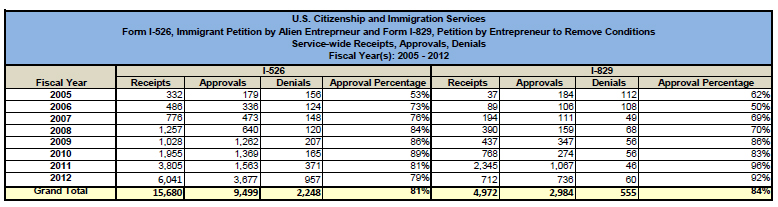
IIUSA has published the EB-5 processing statistics through Q42012 recently released by USCIS to AILA. The report shows that USCIS has been particularly busy with I-526 petitions, of which it received 6,041 and processed an impressive 4,634 in FY2012 (ending 9/30/2012). This year saw a record number of I-526 approvals and a record number of I-924 denials. The approval percentages for investor petitions fell slightly from FY2011, down to 79% for I-526 and 92% for I-829, while approvals for Regional Center applications and amendments tanked to an average 36%.


Source: USCIS

IIUSA has also published FY2012 EB-5 visa statistics released by the US Department of State. These numbers are significant because they show that EB-5 visas are, for the first time, threatening to exceed the annual allocation of about 10,000 visas. The State Department’s Visa Bulletin for December 2012 notes that “It appears likely that a cut-off date will need to be established for the China Employment Fifth preference category at some point during second half of fiscal year 2013. Such action would be delayed as long as possible, since while number use may be excessive over a 1 to 5 month period, it could average out to an acceptable level over a longer (e.g., 4 to 9 month) period. This would be the first time a cut-off date has been established in this category, which is why readers are being provided with the maximum amount of advance notice regarding the possibility.”


Source: IIUSA

IIUSA  has published an article on “THE IMPACT OF CHINESE QUOTA RETROGRESSION ON EB-5 INVESTORS AND EB-5 INVESTMENTS” by Tammy Fox-Isicoff and H. Ronald Klasko.

I also recommend Kate Kalmykov’s blog post on Understanding the Implications of Retrogression in the EB-5 Category and her follow-up post EB-5 Retrogression for China Unlikely in 2013, According to Department of State.

Also note that the State Department website now has an informative EB-5 page.

Help with I-924A

Alert all approved Regional Centers: Do not forget to file a Form I-924A with USCIS by December 29! This form is used to demonstrate a Regional Center’s continued eligibility for designation, and must be filed annually. If you forget, USCIS will send you a Notice of Intent to Terminate. It’s important to not only file the form but to prepare it carefully, since USCIS can review the information provided to judge whether or not your center continues to be eligible. The Form and Instructions are not very clear, but note that USCIS has published an FAQ about I-924A. Joseph Whalen has published a useful article on Addressing USCIS Form I-924A Instructions. Also note that  IIUSA has announced a webinar (November 9th 2pm Eastern) that will include a panel of experts discussing Strategies for Form I-924A Annual EB-5 Regional Center Reporting in 2012.

10/16 USCIS EB-5 Stakeholder Meeting

Unfortunately I was not able to be in Washington DC for today’s EB-5 Stakeholder Engagement with USCIS, but I did listen in by teleconference and have uploaded my recording of the call. The most significant update is that “next month” promises another “Conversation with the Director” including Director Mayorkas and Rob Silvers that will tell us what we really want to know: what’s happening with “tenant occupancy” and the EB-5 policy memo.  Today’s engagement deferred those topics, but did provide substantive comment on a number of issues. We heard a detailed description of the work flow process and staffing in the EB-5 adjudicative team and confirmation of the rumor that USCIS is working with the SEC to investigate some regional center activities. The panelists responded to questions regarding NAICS codes, construction timeline and job counts, job preservation for a troubled business, timeline for sustaining investment, conditions for use of bridge loans, and investment return in the form of real estate, among other issues. Ears pricked up when the panelists revealed some reasons that I-526 may be put on “operational hold” (e.g. all I-526 for one project on hold while the first is adjudicated, and I-526 for a Regional Center on hold while an amendment is adjudicated for that RC). I learned several things, though I’m never sure what I can take to the bank from a stakeholder meeting. Will the adjudicator who gets my I-526 with a new economic methodology be impressed when I play my recording of Blake Gotto at the 10/16 meeting saying that nothing precludes me from doing this instead of filing an amendment? Can I count on Kevin’s statement that a troubled business does not need to save the same positions that were in place prior to investment, so long as the head count remains the same, including FT/PT positions? I’ll have to listen again to the recording and re-read Matter of Hsiung. This meeting did not include a presentation, but I look forward to the eventual executive summary. I see that EB-5 Center has posted some notes on the meeting, and I will link here to other comment as it emerges. I’m also eager to hear reports from the IIUSA conference this weekend, which I am sorry to have missed as well.

What doesn’t work for Regional Centers

I’ve been too busy recently for much comment but want to at least link several important documents that deserve your attention.

The USCIS website recently posted three AAO Decisions affirming denial of Regional Center applications.

  • The decision dated January 18, 2011 affirms that a Regional Center application should not be approved if it applies for a geographic area without demonstrating how proposed investments will affect that area, requests industry categories without giving examples of investments in those categories, and declines to demonstrate that its “hypothetical” plans are realistic. The case centers on the question of what level of detail ought to be provided at the I-924 stage. The AAO argues that USCIS is right to ask for evidence to support job creation claims, especially since the agency is under pressure to accept projections approved at the regional center stage when it is adjudicating Form I-526 petitions. The decision does not preclude basing an application on hypothetical plans, but such plans  “must be sufficiently detailed and credible pursuant to 8 C.F.R. §§ 204.6(m)(3)(iv) and (v) if USCIS is to approve the regional center proposal…. While a general proposal as contemplated by Congress may include hypothetical plans, they may not rely on investment costs and direct employment numbers that have no basis in reality.” I recommend Joe Whalen’s analysis of this decision, the issues involved, and the applicant’s mistakes.
  • The decision dated November 10, 2010 dissects problems with an economic impact report and its attempts to calculate job creation through DOE estimates for number of employees per square foot. If your reports use a similar methodology, read this case and ensure that your economist isn’t making mistakes like the ones that doomed this application. If you haven’t laughed and cried enough after reading the decision itself, read Joe Whalen’s analysis of the November 10 and November 23 decisions.
  • The decision dated November 23, 2010argues that USCIS does indeed have the right to hold applicants accountable to the current regulations at 8 C.F.R. § 204.6(m), which have not been overturned by Federal Court or Congress. Repeating a point that has often been made of late:
      The regulation at 8 C.F.R. § 204.6(m)(3)(ii) requires the applicant to provide “verifiable” detail as to how the jobs will be created. Nothing in the 2002 amendments to the pilot program suggests that the general proposal need not have verifiable detail at to how the jobs will be created pursuant to 8 C.F.R. § 204.6(m)(3)(ii). Rather, the Congressional language expresses that the regional center proposal may be based on a general proposal rather than a specific project. “General,” however, does not have the same meaning as “vague.” The proposal, while general in nature in that it may cover several potential industries, must still provide verifiable detail as to how the jobs will be created in each industry proposed.

Not all frustrated petitioners and applicants take their cases to the AAO; others sue in court. The most prominent recent complaint was brought by no less than Ira Kurzban on behalf of a group of investors who had I-526s denied or revoked when USCIS found fault with the investment — an American Life real estate renovation/leasing project in the time-honored American Life model. The case is a must-read for existing Regional Centers who are nervous about how much their prior approvals mean now and how to deal with emerging issues such as tenant occupancy and NAICS code requirements. You’ll find a cautionary tale and eloquent arguments that you might try in your defense. Again, I recommend that you keep an eye on http://www.slideshare.net/BigJoe5 if you are interested in the unfolding of this and other EB-5 litigation.

But don’t abandon Lucid Text altogether, as I have two major additions cooking: a page with collected guidance from recent I-924 RFEs (“the real I-924 instructions,” I’m thinking of calling it, since the official instructions don’t tell you everything you need to know to get approved), and an informational page on stand-alone/direct EB-5 (as I’ve noticed increasing interest in and misinformation about this EB-5 option).

RC Program Extended to 2015

IIUSA reports that that U.S. House of Representatives today passed S. 3245 (412-3) – which includes a three year re-authorization of the EB-5 Regional Center Program through September 2015.  Having been passed by the Senate on August 2, the bill is now on its way to President Obama for signature – likely later this week.

September 28 update: President Obama has signed S. 3245, and the EB-5 Regional Center Program is now extended until September 30, 2015.

EB-5 Visa Stats by Country

The U.S. Department of State website has finally published the Report of the Visa Office 2011. The data is old news by now, but I still enjoy looking at the table that details EB-5 visas and status adjustments by country and type of investment. Now we know that in all the world in FY2011, only one Chinese investor and up to four Dutch took advantage of a Regional Center offering at the $1 million level. During the same period, there were over three thousand visas/adjustments in connection with Regional Center TEA/$500,000  investments. Stand-alone (non-Regional Center) EB-5 investments included a relatively large percentage at the $1 million level, with 230 visas associated with investments outside of TEAs as compared with 152 visas associated with TEA/$500,000 investments. Props to the lone Australian who is the only person in all of Oceania to have gotten an EB-5 visa in FY2011, and who didn’t even add spouse/children to the visa count. The total number of EB-5 visas issued nearly doubled between 2010 and 2011 and is projected to nearly double again in 2012 according to a State Department estimate. The annual limit for EB-5 is approximately 10,000 visas (7.1% of the total 140,000 employment-based immigrant visas.) Changing the visa allocation would require an Act of Congress.

The following charts summarize data from the FY2010 and FY2011 reports from the State Department Visa Office as well as the preliminary data for FY2012 reported to AILA in July 2012.

EB-5 visas issued and adjustments of status, by region
FY 2012 as of 06/2012 FY 2011 FY 2010
Asia

4,220

3,035

1,358

Europe

211

289

North America

89

111

South America

82

81

45

Africa

46

58

Oceana

1

24

Grand Total

(Estimate for FY 2012: 6,200)

3,463

1,885

EB-5 visas issued and adjustments of status, by foreign state chargeability
Country FY 2011
China-mainland born

2,408

Korea, South

254

China-Taiwan born

122

Iran

117

Great Britain

57

Mexico

53

Venezuela

46

India

37

Russia

30

Vietnam

26

Canada

26

Netherlands

26

Japan

20

Turkey

20

South Africa

19

Italy

16

Brazil

16

Germany

15

Egypt

12

France

10

All other countries

133

Total

3,463

Action to Reauthorize RC Program

IIUSA has  posted welcome news about solid action on the part of the Senate toward re-authorization of the Regional Center aspect of the EB-5 program (see S.3245) . Now let’s see if we can get the House to take up this matter before September 30th, when the current authorization is set to expire.

Senate acts to reauthorize EB-5 Regional Center Program for three years
IIUSA is thrilled to be present in DC to support Senate action yesterday to reauthorize the EB-5 Regional Center Program for three years via unanimous consent. The House is expected to do the same in September after August Congressional recess.
The bipartisan support of this Program should come as no surprise since its explicit purpose is U.S. job creation without adding a dime to the deficit (in fact, it contributes to deficit reduction through tax revenue generation by driving economic activity and adding high net worth individuals to U.S. taxrolls). IIUSA will continue to advocate for prompt action by the House in September to make sure this Program can continue its growing contribution to the U.S. economy, on track for over $2.0BILLION and 40,000 U.S. jobs in FY2012. Congressional action to reauthorize will allow FY2013 to account for even more economic impact.
With today’s jobs report ticking unemployment up to 8.3%, it is gratifying to know that Congress understands the importance of reauthorizing an emergent source of reliable, job-creating capital.

7/26 EB-5 Stakeholder Engagement

Today’s EB-5 stakeholder engagement was very substantive, with the USCIS panelists providing detailed answers to many questions submitted in advance of the call. I encourage you to review my recording if you weren’t able to join the teleconference. Robert Silvers, Senior Counselor to the Director, took an active role in this call and seemed well-prepared and genuinely engaged, upholding the standard set by Director Mayorkas.

Rob Silvers discussed process enhancements for EB-5, including the new EB-5 program office, new hires, case specialization, and the forthcoming review board for I-924 applications recommended for denial. He also suggested that a new draft of the EB-5 policy memorandum will be published in the next four weeks, and that movement on the “tenant occupancy” cases can be expected “very soon.”

Stakeholder questions addressed in the call included questions related to the requirements for sustaining investment, evidence requirements for I-924 petitions and amendments, metrics for determining acceptable geographic boundaries for a Regional Center, RFE practices, acceptable evidence of non-EB-5 capital commitments, acceptability of investor returns and distributions during the CPR period, acceptability of investors receiving real estate as a return on investment, counting jobs in business acquisition scenarios, and the issue of deference to prior approvals. For more detail see  the detailed summary of the call posted by the EB-5 Center blog, or review my recording of the call.

EB-5 Stats up to Q3 FY2012

USCIS has released EB-5 statistics through the third quarter of FY2012 in advance of  the 7/26 EB-5 Stakeholder Engagement teleconference. Please read the linked document for all the details. A few points of interest to me:

  • Approval rates for I-526 and I-829 have remained fairly high in FY2012 though slightly below the 2011 average (79% approval percentage for I-526 compared to 81% last year, and 94% for I-924 compared to 96% last year)
  • USCIS received 69% fewer I-829 in the first three quarters of 2012 than in the first three quarters of FY2011
  • USCIS received (and also processed) 38% more I-526 in Q1-3 2012 than it did in the first three quarters of FY2011
  • 60% of the I-924 Regional Center applications and amendments processed in Q1-Q3 2012 were denied
  • There are currently 209 approved Regional Centers, up from 174 in FY11, 114 in FY10, 72 in FY09, 25 in FY08, and 11 in FY07.

New EB-5 Program Office

USCIS has just emailed a Message from Director Mayorkas on staffing and organizational changes for the USCIS EB-5 program team. These changes show how much USCIS is willing to invest in the quality and also the survival of the EB-5 program.

Dear Stakeholder,

I am pleased to announce that U.S. Citizenship and Immigration Services (USCIS) will be creating a new office to oversee our administration of the EB-5 Immigrant Investor program.

The EB-5 program has spurred the creation of tens of thousands of new jobs and the injection of billions of dollars into the U.S. economy since Congress created the program in 1990. Interest in the EB-5 program has grown exponentially in recent years, both from domestic project developers seeking capital and foreign investors who have the capital that can fuel economic growth. USCIS has met this unprecedented growth and interest with a corresponding dedication of resources. USCIS has approved more than 3,100 Form I-526 petitions in Fiscal Year 2012 to date, more than triple the number approved in all of Fiscal Year 2009. Since 2009, we have quadrupled the size of the EB-5 adjudications team and brought on board eight expert economists dedicated to the EB-5 program to ensure that EB-5 cases are handled expeditiously and with appropriate expertise. In the next month, two full-time attorneys with substantial transactional experience will enter on duty as new additions to the USCIS EB-5 program team. And by the end of July, a special Review Board consisting of two Supervisory Immigration Services Officers and one economist will review every pending application for regional center designation for which a denial has been recommended, with applicants receiving the opportunity to discuss their cases in-person before any final adverse decision is rendered.

By now creating a dedicated program office, we will build on these steps toward ensuring that this important and complex program is appropriately resourced and managed under a single leadership structure.

I am also excited to announce that the new office will be led by a new Chief of Immigrant Investor Programs, and that an advertisement for this new leadership position will be posting today. Our new program chief will have significant experience in the business world and will assume responsibility for ensuring that the program is administered efficiently, with integrity, with predictability, and with an understanding of today’s business realities.

We understand that more work needs to be done to further improve our administration of the EB-5 program. We are committed to this work. USCIS welcomes and appreciates your input as we stand up our new EB-5 Program Office.

Thank you.

Alejandro N. Mayorkas
Director
U.S. Citizenship and Immigration Services

5/1 Engagement Mega Executive Summary! (Tenant Occupancy! TEAs! Bridge Financing! RC Sunset! More!)

Many people left the California Service Center disappointed after the Quarterly EB-5 Stakeholder Engagement on 5/1/2012, but now USCIS has made up for telling us little in person by publishing an amazing 17-page Executive Summary that covers what they didn’t say at the meeting. I’ll probably be commenting on this summary for weeks. Particularly note the Q&A on tenant occupancy, which is less ambiguous and more restrictive than the guidance from Chief Economist John Rodgers. I’m copying a few of the hottest new releases below, and I encourage you to download and review the full document.

Selected Q&A from USCIS’s Executive Summary of the 5/1/2012 EB-5 Quarterly Stakeholder Engagement

NAICS Codes
Q: In a regional center application, kindly confirm that two digits of North American Industry Classification System (NAICS) codes are considered sufficient with the industry cluster specified and economic report elaborating the same. The rationale behind this is because in a retail and office setting, three digit code tenants are not ascertained at the time of filing the I-924.
A: This is not acceptable. Even within clusters and projects that incur similarities, USCIS requires four digit NAICS codes at a minimum.

Permissible Expenditures
Contingencies
Q: Any reasonable budget will include line items for “contingencies” and “operating capital” which are required in order to sustain a business successfully during the development process. Some business plans have been approved with such lines (as they should be) while others have been rejected specifically citing these budget lines as “not being job creating activities”. Please confirm that such expenditures are permissible – no business plan is believable without such budget lines.
A: Whether a particular line item in a budget presented in support of an EB-5 petition is appropriate cannot be confirmed in general, but must be analyzed in the context of the instant case. However, USCIS does agree that a credible business plan should contain a reasonable budget that outlines the prospective expenses of the business.

Real Estate Acquisition
Q: One of the most effective ways to attract investors is for the business into which they are going to invest to buy and own the real estate in which they will operate the business, rather than merely lease it. This makes the investor feel that the business is more likely to succeed, or, if it fails, the real estate could perhaps be used to establish a second business. Therefore, where part of the investment expenditure is spent on real estate in which the business is to be operated, is it correct that such expenditure is a job creating expenditure for which appropriate job creation credits can be obtained. For example, if an investor invests $1million to acquire a building for $500,000 and then spend another $500,000 to renovate and equip as well as fund operating capital for a restaurant, would the entire $1million be considered an appropriate EB5 investment, assuming it otherwise qualifies.
A: This is a simple transfer of real estate with renovations occurring subsequent to the purchase. The renovation and outfitting of the facility will create temporary jobs, and it is possible that a trivial number of jobs could be created by the fees charged for the real estate transfer. Summarily, yes—the $1 million could be considered an appropriate EB-5 investment—assuming that the other requirements of the EB-5 regulations are satisfied.

Bridge Financing
Q: Under what circumstances will USCIS approve bridge financing? Will the memo address this? This does not appear to be covered with adequate specificity in the last iteration of the policy memo. Stakeholders are not aware of any written guidance on bridge financing other than am AAO decision on the Victorville case, and this is an extreme example with specific facts. Of the two memos in 2009 (June and December) on construction, the December 2009 memo superseded the June memo, but stakeholders continue to receive RFEs referencing the June memo.
A: Pursuant to 8 C.F.R § 204.6(j)(4)(i), the new commercial enterprise, not the EB-5 investors, must create the requisite employment. As such, it is acceptable for the developer or the principal of the new commercial enterprise, either directly or through a separate job-creating entity, to utilize interim, temporary or bridge financing – in the form of either debt or equity – prior to receipt of EB-5 capital. If the project commences based on the bridge financing prior to the receipt of the EB-5 capital and subsequently replaces it with EB-5 capital, the new commercial enterprise still gets credit for the job creation under the regulations.
This policy will be issued in the forthcoming EB-5 policy memo in Section C, the Creation of Jobs section:
“It is important to recognize that while the immigrant’s investment must result in the creation of jobs for qualifying employees, it is the new commercial enterprise that creates the jobs. This distinction is best illustrated by an example:
Ten immigrant investors seek to establish a hotel as their new commercial enterprise. The establishment of the new hotel requires capital to pay financing costs, purchasing the land, developing the plans, obtaining the licenses, building the structure, taking care of the grounds, staffing the hotel, and the many other types of expenses involved in the development and operation of a new hotel. The immigrant’s investments can go to pay part or all of any of these expenses.”

Verifying RC Job Creation
Q: Can expenditure models based on RIMs II Final Demand Multipliers, if they project adequate number of jobs to satisfy the 10 full time job requirement per investor, satisfy the job creation requirement and proof of such expenditure submitted with the I-829 in accordance with the business plan submitted with the I-526?
A: This is an acceptable methodology if the structure of the business entities precludes the acquisition of tax documents or other evidence of employment for the components projected to be involved in direct job creation. USCIS would require a detailed explanation as to why the use of a model projection as opposed to evidentiary proof is necessary.

TENANT OCCUPANCY!
Q: In a case where the EB-5 business is a real estate development, which leases space to tenant businesses who then hire employees, do the following factors increase the likelihood that those tenant’s jobs can count toward satisfying the job requirements of the development’s EB-5 investors:
a. The tenant business is a new business which did not merely move from another location
b. The tenant business received cash from the development for tenant improvements
c. The tenant business received a loan from the development
d. The tenant received free rent or rent reductions
e. The tenant received an equity investment from the development
A:
a. The tenant business is a new business which did not merely move from another location
This is not acceptable. None of the EB5 capital would be flowing to the jobs created by the tenant.
b. The tenant business received cash from the development for tenant improvements
This is not acceptable. The tenants would still be responsible for creating the jobs. The EB-5 capital would simply be improving/outfitting/customizing the structure already owned by EB-5 capital.
c. The tenant business received a loan from the development
This is acceptable with caveats. This effectively represents the co-mingling of capital. Similar to the quid pro quo expenditure agreement referenced above, however, this will render the agency vulnerable to fraud because the tenants could form an agreement beyond the adjudicative scope of USCIS to funnel the funds back to the developer. In addition, USCIS would need to define the constraints of the loan amounts and duration. Otherwise, the developer could loan $0.01 to a tenant to take credit for any jobs created. Finally, the tenant business must verify that the jobs are new jobs not transferred from elsewhere.
d. The tenant received free rent or rent reductions
This is acceptable with caveats. Similar to (b) above, this effectively represents the co-mingling of capital as the free rent/rent reductions acts as a loan. The same caveats apply here as in (b) above. In addition, this will cause a significant decrease in rental income for the EB-5 NCE, which should be an investment at-risk, not at-loss. USCIS would still need to define the constraints of the rental discount required, which effectively serves as a loan. It is highly unlikely, however, that the free rent or rent reduction over a 2.5-year period would sum to a total amount that could be considered a substantial investment in the tenant business.
e. The tenant received an equity investment from the development
This is acceptable with caveats. Again, this effectively represents the co-mingling of capital as in (b) above. The same caveats apply here.

TEA Designations and Census Tracts
Q: Will a single or multiple contiguous census tracts be considered as a geographic subarea?
A: USCIS encourages that standard Bureau of Labor Statistics (BLS) estimation methodology be used. In the event that subareas for which Local Area Unemployment Statistic estimates are not regularly produced, such as census tracts, the TEA applicant should be aware of the following: (1) the census-share technique be used ONLY where inputs for the preferred BLS methodology are not available and (2) only household-only inputs be used, in order to eliminate the impact of the Census 2000 Group Quarters processing error. More information regarding this answer can be found at the Bureau of Labor Statistics webpage at: http://www.bls.gov/bls/empsitquickguide.htm

Q: Can a qualifying census tract with unemployment 150% of the national rate be certified as a TEA?
A: Yes, but designation will depend on the quality and timeliness of the data used to support the 150% of the national average rate of unemployment claim. Acceptable data sources for purposes of calculating unemployment include Local Area Unemployment Statistics produced by a government agency, U.S. Census Bureau data, and data from the American Community Survey.

Q: Has there been any progress on further defining an acceptable vs. gerrymandered TEA? Will USCIS be providing additional guidance?
A: This issue is being examined in the context of the draft memorandum, which will be posted for comment in the near future.

Profit Requirements
Q: At the end of the two year period, to remove the restriction, does the business created have to make profits? Or can the business lose money as long as the ten job creation requirement is satisfied?
A: There is no “profit” requirement in the statue or regulations. As long as the investment has been made and is at risk of loss and the required jobs have been created there is no additional profitability requirement.

USCIS Staffing
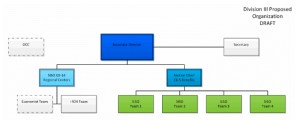
Q: What will the USCIS EB5 unit organizational chart look like once hiring is complete?
A: We can only provide a generalized org chart, without specific staffing numbers.
Non-Profit Organizations
Q: How can non-profits benefit from this program? Can they receive a direct investment from an EB-5 investor or do they need to work through a regional center?
A: An EB-5 investment must be in a for-profit entity, so a direct investment in a non-profit probably does not meet program requirements. EB-5 promoters may be able to advise on structuring specific investment opportunities, but the premise of the EB-5 program is investment in for profit activities. Job creation is the same, but premise of program is for for-profit commercial entities.

EB-5 Sunset
Q: What is the status of the EB-5 “sunset” scheduled for September 30, 2012, and how might this affect current and future applications and projects?
A:
The EB-5 Immigrant Investor Pilot Program is scheduled to end or “sunset” at the end of the current fiscal year, on September 30, 2012.
Without Congressional reauthorization, the Immigrant Investor Pilot Program will end on September 30, 2012. Congress may choose to end or extend the program.
If Congress does not reauthorize the Immigrant Investor Pilot Program, all existing regional center designations will expire automatically.
Following the sunset of the Immigrant Investor Pilot Program, USCIS will no longer possess authority to approve a regional center designation.
USCIS will continue to monitor Congressional actions pertaining to the EB-5 Immigrant Investor program, and will keep stakeholders informed as new information becomes available.
Q&A from USCIS on Economic Methodologies

Well, well. We ask and USCIS answers! I regret not emailing my questions to the USCIS public engagement mailbox, as it appears that public.engagement@uscis.gov is not a black hole after all. USCIS has already responded to two stakeholder questions arising from the conversation with USCIS Economist John Rodgers on June 22. Thank you to Stephen Yale-Loehr for pointing this out to me.

From the USCIS website:
Questions and Answers: EB-5 Economic Methodologies
On June 22, 2012, USCIS hosted a public engagement featuring two economists who work on the EB-5 Immigrant Investor program.  Following that engagement, some stakeholders sought clarification as to certain points raised by the economists.  USCIS is now pleased to provide clarification as to two of the primary questions raised.

EB-5 Projects Involving Hotel or Resort Development

Q:  When an EB-5 project involves the development of a hotel or resort, when is it economically reasonable to input projected funds spent by visitors into economic models to project indirect and induced job creation resulting from the spending of these potential hotel occupants (e.g. on rental cars, dining, etc.)?

A:  In general, job credit based on “visitor spending” is appropriate only where the applicant or petitioner can show by a preponderance of the evidence that the development of the EB-5 project or resort will result in an increase in visitor arrivals or spending in the area.  Applicants or petitioners should provide reasonable estimates of how new visitor spending and tourism demand is driven by the specific project that is the subject of the application or petition.  If the applicant or petitioner presents a reasonable case that the visitor spending and demand for tourism generated by a project is new then it may be reasonable to conclude that the specific project has generated an increase in demand, and thus, has generated increased employment in the region resulting from the projected increase in visitor spending.  If the applicant or petitioner meets this burden and the application or petition can otherwise be considered reasonable, new visitor spending revenue can be considered an eligible input to an appropriate regional input-output model.

Regardless of whether visitor spending is shown to be attributable to a particular project, jobs created from construction (lasting over two years), management, and operation of the hotel or resort, including hotel revenues, can be considered eligible inputs to an appropriate regional input-output model assuming that the application or petition can otherwise be considered reasonable.

Acquiring Real Estate

Q:  May a regional center use funds from EB-5 investors to acquire real estate?

A:  In general, yes, subject to the requirement of Matter of Izummi, 22 I & N Dec. 169 (Comm’r 1998), that the “full amount of money must be made available to the business(es) most closely responsible for creating the employment upon which the petition is based.”  For example, a job-creating enterprise may propose to allocate some EB-5 funds to purchasing land and allocate other EB-5 funds to developing and operating a business on the purchased land, and the jobs created by the enterprise can be apportioned among all the EB-5 investors.  It is important to note, however, that real estate acquisition is not generally recognized as a job-creating activity in and of itself.  Thus, it is not generally reasonable to treat funds spent on real estate acquisition as inputs to an employment impact model.  Where some EB-5 funds will be used for real estate acquisition, such apportionment should be detailed in the business plan.

USCIS does recognize that certain soft costs directly related to real estate transactions may reasonably be counted as valid job-creating expenditures and inputs to regional input-output models.  In addition, soft costs related to the development and construction of EB-5-supported projects on designated land parcels may be considered on a case-by-case basis.  If the input-output model utilized in the economic impact analysis provides specific categories for the soft costs, the multiplier categories specific to these costs should be used instead of bundling such costs under general construction expenditures.