Limiting the RC geographic area

2016 Update: This post no longer applies. Since 2013 USCIS has regularly approved Regional Centers with expansive, multi-state geographic areas. The economic impact report filed with Form I-924 must still justify the area requested, but USCIS is liberal in the justifications it will accept. The AAO decision Matter of R-T-E-R-C-, LLC (JUL152016_01K1610) discusses current requirements and the economic impact analysis used by one applicant to apply for all of Texas and part of New Mexico based on seven hypothetical projects.

[Original Post]

Until recently, I saw Regional Center proposals and amendments approved with geographic areas much larger than the impact area of the initial projects specified in the application. But apparently those days are over.

I previously pointed out that Slide 35 of the 9/15/2011 EB-5 Stakeholder meeting seemed to indicate a new restrictiveness regarding Regional Center geographic area:

–A Regional Center must demonstrate in the Form I-924 that its activities will focus on the requested geographic region, and not simply on isolated and unrelated areas within the region
–It may be more appropriate for the Regional Center to initially request a geographic area that is in keeping with the economic impacts of the existing project, and then subsequently file an amendment request for an expanded geographic area as the details and location of future projects become known

Now I’m seeing RFEs that not only suggest but seem to require that Regional Centers must initially request only the geographic area that’s in keeping with the economic impacts of their existing projects. For example, see this text from a recent RC application RFE:

The proposal does not include data, analysis, and narrative discussing the economic growth for the requested geographic area of ___ contiguous counties of ___, ___, ___,etc. … [The applicant] may wish to narrow its requested geographic scope if the impacts of the anticipated capital investment projects will not realistically impact all counties listed in the geographic area.

2012 Update: I-924 RFEs have become more insistent on the issue of justifying geographic area. See for example this section of an RFE issued in July 2012:
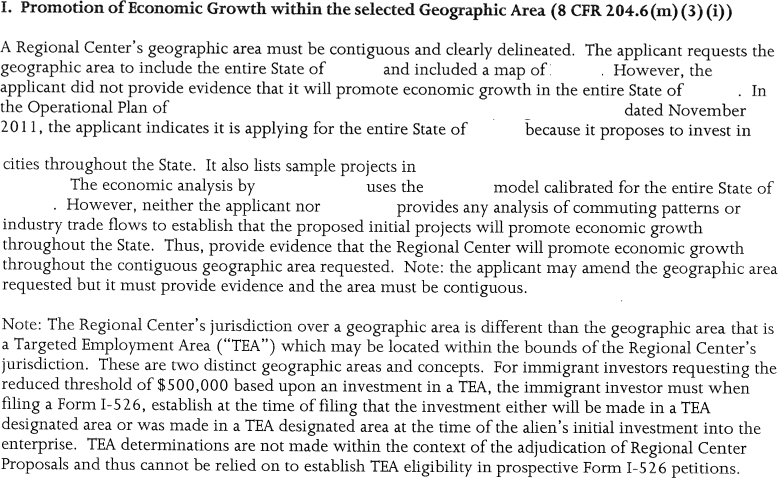
Pay attention everyone out there preparing to file an I-924 form! The form and instructions only say you need to provide a map delineating the desired geographic area, but note that USCIS is actually looking for more, including “data, analysis, and narrative discussing the economic growth for the requested geographic area” plus capital investment projects that will realistically impact all the counties for which you wish to apply. Before my clients only needed to pay me for business plans covering each industry; now apparently I need to write up enough projects to ensure that we reasonably cover all desired counties/areas as well.

I’m not sure how I feel about these more specific guidelines. Obviously applicants with one little project who apply for a whole-state Regional Center just because they can are not in the spirit of the EB-5 program, which is designed to concentrate investment in limited geographic areas. But Congress probably didn’t intend either that USCIS treat Regional Centers as synonymous with immediate individual projects. By saying that an RC geographic area can only be as big as the impact of the RC’s initial project, the service seems to assume that the RC is just established and approved for that one project, not mandated for on-going business including facilitating subsequent investments in a variety of projects in a wider contiguous area. Does USCIS want to make the I-924 form basically just a pre-approval I-526 with indirect job creation, and discourage the RC from going beyond the scope of its initial project?

Form I-924A due 12/29

UPDATE: See my 2015 I-924A Reminder post for the latest information.  (The post below is from 2011.)

Approved regional centers should should start thinking about the annual reports to USCIS that they’ll be filing with the Form I-924A. (Click here for the form and instructions).

The Form I-924A, Supplement to Form I-924, is the Form for approved regional centers to use for the yearly RC reporting requirement in 8 CFR 204.6(m)(6). Each approved RC is now required to file the I-924A to report RC-related activities for the preceding fiscal year within 90-days of the end of the fiscal year (on or before December 29th of the calendar year in which the fiscal year ended.) The filing of Form I-924A will be required for all approved RCs for Fiscal Year 2011 on or before December 29, 2011.

Update: see the I-924a Questions and Answers published on 12/06/11 by USCIS

Can EB-5 Portfolio Investment Work?

[Post updated 1/19/2017] This post discusses the possibility and practicality of deploying an EB-5 investment across a portfolio of businesses. Packaging multiple projects or businesses within one EB-5 offering can be attractive. Diversification can mitigate investment risk and the risk of insufficient job creation. Increasing the size of an offering improves economies of scale and can make the offering more marketable. However, a portfolio or fund investment must navigate limiting provisions in the EB-5 regulations and deal with the human nature of USCIS adjudicators who struggle with complexity.

Here are issues to consider:

  1. An EB-5 investor must always place the full amount of his or her qualifying investment in a single commercial enterprise. An investor can never qualify by placing $300,000 in one commercial enterprise and $200,000 in a separate commercial enterprise. However, the single commercial enterprise that receives EB-5 equity may be able to allocate the capital among multiple job-creating projects/entities.
  2. What an enterprise can do with EB-5 capital depends on whether or not it’s associated with a regional center. If not associated with a regional center, the enterprise must deploy the capital internally — within a single entity, or a portfolio of businesses each wholly owned by that one entity. Qualifying direct EB-5 investment and job creation may not be divided among businesses that aren’t united by a wholly-owned subsidiary relationship. If the enterprise is associated with a regional center, then it is free to deploy the capital across a portfolio of related or unrelated businesses or projects. For example, the regional center enterprise receiving $500,000 of EB-5 investment could deploy $300,000 in one business and $200,000 in another business, and those businesses need not be under common ownership. (See my post What is the difference between direct EB-5 and regional center EB-5? for discussion of the differences in possible investment structures between direct and regional center investment. See 6 USCIS-PM G Chapter 2 (A) subsection 3 “Required Amount of Investment” and 6 USCIS-PM G Chapter 2 (D) subsection 2 “Multiple Job-Creating Entities” for policy statements on portfolio investments. For exemplar I-526 approvals for regional center portfolio projects, see for example Texas Golden Pacific, Citizens Regional Center of Florida.)
  3. A portfolio investment can have special challenges in showing compliance with the following requirements that apply to all EB-5 investments:
    • The job-creating business must be located within a targeted employment area (TEA) in order for a petitioner to be eligible for the reduced minimum capital requirement. If a TEA portfolio includes job-creating businesses at multiple locations, each and every location must qualify as a TEA. (Matter of Izummi)
    • The job-creating business must be located within the geographic limits of the regional center that sponsors the investment. If a portfolio includes job-creating businesses at multiple locations, each and every location must fall within the regional center’s designated area. (Matter of Izummi)
    • The full requisite amount of capital must be made available to the business(es) most closely responsible for creating the employment on which the petition is based. If a portfolio investment involves multiple layers and multiple entities, then the EB-5 investment needs to be deployed entirely and only in those layers and entities that create jobs. USCIS will definitely question EB-5 investor funds being allocated to the expenses of holding companies and parent companies (Matter of Izummi) and may question EB-5 funds allocated to any business within a portfolio that’s not expected to contribute to job creation. (e.g. see p. 7 of 1/23/2012 Stakeholder Engagement. Non-precedent decisions that object to inclusion of passive or non-job-creating investments in a portfolio include Mar172009_03B7203, Mar062009_01B7203, Nov032008_01B7203, APR212005_01B7203.) EB-5 rules aren’t very clear on the level of nexus required between EB-5 investment and job creation, and individual adjudicators vary in what they expect. It’s not officially required to trace a clear line from X investment dollar to Y job, but (judging from anecdotal evidence) some USCIS adjudicators want to see such a line and will make trouble for portfolio investments where such a line is impossible. For official policy, see 6 USCIS-PM G Chapter 2 (D) subsection 2 “Multiple Job-Creating Entities,” and 6 USCIS-PM G Chapter 2 (A) “Investment” (particularly the “Made Available” subsection).
    • The I-526 business plan is required to show that job creation is likely to have occurred within 2.5 years of I-526 filing. For a portfolio with multiple job-creating businesses, the plan needs to show that all of them will have created sufficient jobs within the theoretically required time. (If there are also multiple investors/multiple I-526 filing dates, the plan needs to correlate the investors’ timelines with the business timelines.)
    • The job-creating business must create new jobs while sustaining any preexisting jobs (unless it qualifies as a troubled business). These requirements apply to each of the job-creating businesses in a portfolio investment. (Q&A from the 3/17/2011 stakeholder meeting with USCIS, slides 52-58). (However if the portfolio is a regional center investment, the job-creating businesses do not themselves have to qualify as “new,” per non-precedent decision MAR252016_02B7203.)
    • EB-5 is not an attestation-based program, and a petitioner must establish eligibility at the time of filing I-526. Prospective job creation must be demonstrated at the Form I-526 petition, when USCIS reviews and approves the business plan and associated economic analysis for the actual capital investment projects that will receive the immigrant investor’s capital. If a portfolio includes multiple job-creating businesses, all of these need to be identified and analyzed within the Form I-526 petition. I-526 petitions may not be approved for investments (or loans) to businesses that will not be identified or selected until after the approval of the petition. This is according to Q&A from the 3/17/2011 stakeholder meeting with USCIS, slides 52-58, and a number of non-precedent AAO decisions that discount investment into any businesses identified only after I-526 petition filing (e.g. JUN112013_01B7203, MAY172013_01B7203, FEB162005_01B7204). Some people report that USCIS approves I-526 petitions that do not specifically identify and provide complete business plans for each business foreseen in a portfolio or fund investment. But I suspect the truth is that such proposals have been optimistically filed, not that (m)any have been approved. The litigation around the Quartzburg Gold Company LP case gives a detailed autopsy and arguments and counterarguments in a denied portfolio investment case. To quote from USCIS’s 5/2016 response, “because the NCE was not able to specifically identify the JCEs, there was no way for USCIS to determine whether the business plan is credible and will result in the requisite job creation. Plaintiffs therefore failed to satisfy their burden of showing job creation.”
  4. Some attorneys report receiving RFE and NOID from USCIS that required the petitioner to firmly link and trace X dollar to Y job in Z location, and refused to accept the very idea of distributing X investment among identified location Z1, Z2, and Z3 and then crediting the combined Z1-Z3 jobs to that investment. I think that here we are in the realm of human nature that just likes things simple, and that such RFE/NOID have no regulation/policy ground to stand on. But sometimes you don’t want a fight with USCIS, even if it’s a fight you have every right to win, and in that case may be advised to avoid deals with any kind of diversification complexity.


Published RC Decisions

As another in my series of “handy reference” additions to this blog, I’ve created a page summarizing and linking to  AAO decisions on Regional Center cases, including Regional Center investor petitions (I-526 and I-829)  and Regional Center applications (I-924).  These cases aren’t new and I’ve commented on each before, but I refer back to them often enough that it’s useful for me to link them in one place. For all of you out there searching for “sample EB-5 petition” or “example Regional Center application,” here’s your chance to look behind the scenes at how someone else assembled a petition and how USCIS judged it.

What is a “direct” job?

7/12/2015 UPDATE: I have a more recent post on this topic here: The basics: Regional Center investment structure and direct and indirect job creation

Now for a confession. After all this time working with EB-5 I’m still confused about how to use the word “direct job” in the Regional Center context. Here are the issues to reconcile:

  1. Most regional center investments do not count job creation at the level of the “commercial enterprise” (the entity that raises EB-5 investment) but at the level of an “investment project” (the entity that deploys the EB-5 investment).
  2. In discussing “direct” and “indirect” jobs, USCIS sources use “direct” to mean a job at the commercial enterprise level and “indirect” to indicate a job at the project level.  USCIS sources also use “direct” to mean an identifiable job that’s verified by payroll records and subject to 8 CFR requirements and “indirect” to mean a job that’s based on calculations by the economist. For example:

    “Direct jobs are those jobs that establish an employer-employee relationship between the commercial enterprise and the persons that they employ. Regional centers typically use the RIMS II or IMPLAN economic models to determine the number of indirect jobs that will be created through investments in the regional center’s investment projects.” Adjudicator’s Field Manual Chapter 22.4 (2)(A)

    “Direct jobs are actual identifiable jobs for qualified employees located within the commercial enterprise into which the EB-5 investor has directly invested his or her capital.
    Indirect jobs are those jobs shown to have been created collaterally or as a result of capital invested in a commercial enterprise affiliated with a regional center by an EB-5 investor.”
    June 16, 2010 Stakeholder Meeting Presentation

    The concept of what qualifies as a “direct” job for EB-5 purposes can be complicated. 1. For non-RC affiliated capital investments, job creation may only be credited through the creation or preservation of jobs that are directly within the commercial enterprise in which the EB-5 Investor made his or her investment. 2. For RC-affiliated capital investments, job creation may be credited through the creation of jobs directly within the commercial enterprise in which the EB-5 investor made his or her investment, but can also be credited with indirect job creation through equity investments or loans to other organizations, or through indirect job creation based upon an econometric model supported by a detailed business plan and associated economic analysis.3. The concept of a what a direct job is within econometric modeling differs slightly from a direct job described in #1 or #2 above, as a direct job in this context is a job that can be directly attributed to the economic impact of the capital investment in order to derive estimates of indirect job creation.
    Dec. 16, 2010 Stakeholder Meeting Presentation

  3. I regularly see USCIS approving economic analyses that treat the Regional Center “investment project” only and use economic methodologies to calculate direct as well as indirect jobs created at the project level. In these analyses, “direct” jobs are part of a total calculation based various methodologies and don’t indicate jobs to be verified by payroll records.

It appears that in practice USCIS accepts that economists have a specialized definition of “direct,” and that the economist’s “direct job” is a subset of USCIS’s “indirect job.” Is this the solution, and does anyone have a clearer statement from USCIS on the issue? Do I dare use the word “direct” in my Regional Center business plans? How can the adjudicators tell when the word “direct job” means “ask for payroll records” and when it doesn’t? Several questions at stakeholder meetings have addressed the question (see particularly the 3/17/2011 meeting), but the published answers are not conclusive. And we need clarity because a lot of Regional Centers out there are counting on theoretical “direct jobs” for their projects, and don’t want to be hit with requests for W-2s and I-9s at the I-829 stage. Can anyone untangle this for me?

2011 UPDATE: Perspectives from other EB-5 commentators.

Joseph Whalen, who has experience as a USCIS adjudicator, writes in his essay on The Business Plan and the Economic Analysis in Support Of the Form I-924:

When the Economic Analysis bases and ties its projection as to indirect job creation on a base level of newly created jobs attributable to the alien’s investment in a particular commercial enterprise rather than simply to the dollar amount of the investment, it is critical to differentiate between “direct employees” on the alien’s payroll vs. “direct employees” of a third party who are “indirect employees” for EB-5 purposes. Third party direct employees used as “direct jobs” in terms of input into the Econometric Model may be termed as “hypothetical” or “base jobs” or some other terminology that clearly distinguishes them as not on the alien’s payroll. This is critical at the I-829 stage as to the evidence that will be required to lift conditions on residence. The classic and easiest example that illustrates this is “mall tenants’ employees” while another could be “factory workers” when the alien is loaning money to an industrialist in order to let that other person or entity build, convert, or expand a factory.

And attorney H. Ronald Klasko includes the following among his Top 10 Lessons Experience Has Taught Me about EB-5:

9. There is a difference between a direct job as defined by USCIS and a direct job as defined by an economist.
–USCIS defines a direct job as being a W-2 employee of the new commercial enterprise in which the investor invests. Economists define direct jobs as direct employees of the job creating enterprise or the construction company, as opposed to indirect or induced employment.
10. It is better to rely on indirect and induced jobs, rather than direct jobs.
–reliance on direct jobs could result in condition removal denial if there are less direct jobs than projected or if some of the employees can’t be proven to be U.S. citizens or permanent residents. Relying on indirect or induced jobs, such as through an economic model that relies on expenditures, may result in the regional center having more control over proving the required facts for condition removal.

2013 UPDATE: The 5/30/2013 EB-5 Adjudications Policy Memo includes the following paragraph (page 17):

Due to the nature of accepted job creation modeling practices, which do not distinguish whether jobs are full- or part-time, USCIS relies upon the reasonable economic models to determine that it is more likely than not that the indirect jobs are created and will not request additional evidence to validate the job creation estimates in the economic models to prove by a greater level of certainty that the indirect jobs created, or to be created, are full-time or permanent. USCIS may, however, request additional evidence to verify that the direct jobs will be or are full-time and permanent, which may include a review of W-2s or similar evidence at the Form I-829 stage.

The confusion continues. When the memo says “direct job,” is it referring to direct jobs as calculated by an economic model, even if such jobs are “indirect” with respect to the EB-5 commercial enterprise and not an input to the model? Since Regional Centers often invest in businesses whose payroll records they have no right to access, this is an urgent question.

Stakeholder Meeting Q&A

USCIS has promised to publish “Frequently Asked Questions” for EB-5, but I haven’t seen this yet. However the documents released in conjunction with the EB-5 stakeholder meetings include many valuable questions and answers. I consult them often — sometimes paging through all those presentations one by one trying to remember which meeting included the answer I’m looking for. Now I have compiled all the Q&A in table form and added a page to this blog (EB-5 Q&A) to share the result. This list doesn’t include the unpublished Q&A, but does include material from the published executive summaries. I’ve sorted the questions according to topic as follows:

EB-5 Q&A with USCIS since 12/14/2009 by Topic:

You’re welcome.

USCIS Announces “Entrepreneurs in Residence” Initiative

I can’t tell if today’s press release from USCIS is announcing immediate implementation of any practical steps, but it’s nice to see these intentions reiterated:

USCIS will launch the “Entrepreneurs in Residence” initiative with a series of informational summits with industry leaders to gather high-level strategic input. Informed by the summits, the agency will stand up a tactical team comprised of entrepreneurs and experts, working with USCIS personnel, to design and implement effective solutions. This initiative will strengthen USCIS’s collaboration with industries, at the policy, training, and officer level, while complying with all current Federal statutes and regulations.

The initiative builds upon USCIS’s August announcement of efforts to promote startup enterprises and spur job creation, including enhancements to the EB-5 immigrant investor visa program. Since August, USCIS is:

  • Conducting a review of the EB-5 process
  • Working with business analysts to enhance the EB-5 adjudication process
  • Implementing direct access for EB-5 Regional Center applicants to reach adjudicators quickly; and
  • Launching new specialized training modules for USCIS officers on the EB-2 visa classification and L-1B nonimmigrant intra-company transferees.

Public Law 107-273 resolution proposed!

USCIS has published a proposed rule in the Federal Register dealing with “Treatment of Aliens Whose Employment Creation Immigrant (EB-5) Petitions Were Approved After January 1, 1995 and Before August 31, 1998.”  This rule effects only a small group of people: investors whose Form I-829 petitions were pending at the time of the enactment of Public Law 107-273 in 2002.   That this issue is finally being addressed indicates progress in the agency.

Click here for AILA comments on the proposed rule.

Regional Center News

I found the August 2011 newsletter from EB5info.com especially interesting. It includes a nice overview of this summer’s USCIS updates and is rich with news and links to stories — positive and negative — about current Regional Center activities and projects. I particularly appreciated “Sweet EB-5 Visa Deal Turns Sour For Investors, Missouri State Officials,” a detailed analysis of a cautionary tale that emphasizes the importance of due diligence on EB-5 projects.

CSC Processing Times Update

USCIS promised in its meetings last week that posted processing times for EB-5 would be updated to better reflect reality. According to the most recent report from the California Service Center (9/16), I-526 processing is at 8 months, I-485 is 4 months, and I-829 is 6 months. The list still doesn’t post estimates for the I-924.  However I have noticed some improvement, with one recent client’s I-924 approved in 6 months and another in 4 months, and both without an RFE.

Congressional Hearing on EB-5

The Judiciary Committee has posted a video recording of the Hearing on: “The Investor Visa Program: Key to Creating American Jobs” from 9/14/2011. The speakers included several praising EB-5 and several supporting the proposed start-up visa, and no negative voices.

9/15 Stakeholder Meeting

In case you missed the 9/15/11 stakeholder meeting with USCIS, you can get a copy of the presentation here, and listen to audio that I recorded today by clicking on the media player at the base of this post.

The Q&A period included a number of interesting technical points. The panelists gave advice and made statements more generously then they usually do, but keep in mind that “it depends” is probably really the correct answer to most of the questions, even if the panel was too nice this time to fall back on that response. I’d caution everyone to keep context in mind and not latch on to sentences from a conference call as the final word on any issue. For example, I doubt you can file an I-829 showing that not all EB-5 investment in a new commercial enterprise has been actually put to use in any project, with the argument “remember that call when Kevin Cummins said…” Or count on “but that one time Sasha Haskell said…” when you file an amendment to industries by “just filling out the form”  and then get an RFE pointing out that you failed to provide sufficient detail to show in verifiable detail how capital investment offerings in the requested industry will create jobs.

The presentation includes one extremely useful section: a list of the common reasons for Requests For Evidence and denials on I-924 cases. You can find this on slides 14-17 of the presentation, and I’ve also reproduced the content on my page of advice for applicants.  The list really captures the few points I see repeated over and over on RFEs.  It’s not hard to avoid an RFE; read this list and get your application right the first time.

Also note the topic of appropriate geographic areas for Regional Centers. The current I-924 form doesn’t really ask for anything on geographic area beyond a map with borders marked, and nothing prevents applicants from doing what, in fact, they do: apply for the location of their proposed project(s) plus as many surrounding counties as they dare — either because they might ever do something in those areas or (usually) to look big and assist marketing efforts. And a review of recently-approved centers shows that applicants are increasingly ambitious, with more and more full state and even multi-state centers approved. Probably this doesn’t matter since RC areas aren’t exclusive, but it isn’t what Congress had in mind when it specified that “A Regional Center may be granted jurisdiction over a limited geographic area for the purpose of concentrating pooled investment in defined economic zones.” I haven’t heard the issue raised much before, but now USCIS may be planning to crack down in this area.  According to slide 35 of the presentation:
–A Regional Center must demonstrate in the Form I-924 that its activities will focus on the requested geographic region, and not simply on isolated and unrelated areas within the region
–It may be more appropriate for the Regional Center to initially request a geographic area that is in keeping with the economic impacts of the existing project, and then subsequently file an amendment request for an expanded geographic area as the details and location of future projects become known
I’m hoping that the forth-coming revised I-924 Form will offer more guidance on appropriate geographic areas and how exactly USCIS wants applicants to demonstrate the geographic focus of their activities.

This conference call also impressed me that the leadership at least is serious about receiving feedback through the EB-5 inquiry mailbox (for case-specific issues outside the new direct email communication) and the Office of Public Engagement email address (for policy issues).  It seems that problems reported (and documented) in emails to OPE have actually been reviewed even by Director Mayorkas and used in training adjudicators, and that problems (for example in Regional Center approval letters) have actually been dealt with following emails to the EB-5 inquiry email address. And of course there’s the new direct email communication for all pending I-924 cases.

Audio recording of the 9/15 stakeholder meeting:

FY 2011 EB-5 Statistics

Here are EB-5 statistics reported in the 9/15/2011 EB-5 Stakeholder’s Meeting Presentation.

Current Regional Center Stats as of 9/15/2011

# of Active Regional Centers 173
# of Pending Initial RC Proposals
# of Pending RC Amendments

Stats on Initial Regional Center Proposal Filings

FY 2010

(Oct 2009 – Sept 2010)

FY 2011 Q1 – Q3

(Oct 2010 – Sept 2011)

# of Initial RC Proposal Filings

110

176
# of Amended RC Proposal Filings 42 73
% of Initial RC Proposals Denied 45% 33%
% of RC Amendments Denied 29% 16%

Statistics I-526 and I-829 Petitions

(Recall that petitions are not necessarily adjudicated in the year in which they are received)

# of I-526 Received # of I-526 Approvals % of I-526 Approved
FY11 Q1 – Q3 2608 999 82%
FY10 1955 1369 89%
FY09 1028 1262 86%
FY08 1257 640 84%
FY07 776 473 76%
FY06 486 336 73%
FY05 332 179 53%
# of I-829 Received # of I-829 Approvals % of I-829 Approved
FY11 Q1 – Q3 1753 426 93%
FY10 768 274 83%
FY09 437 347 86%
FY08 390 159 70%
FY07 194 111 69%
FY06 89 106 64%
FY05 37 184 62%

EB-5 Visa Statistics

Total EB-5 Visas Issued
FY11 Q1 – Q3 3,706*
FY10 1,885
FY09 4,218
FY08 1,360
FY07 806
FY06 744

* preliminary estimate

Note that USCIS did not this time provide numbers for pending applications, and also didn’t report estimated processing times. They are currently revising the formula for calculating processing times (the previous formula estimated time to an adjudicator’s desk, not time to completion). The next CSC processing times report should include the more realistic estimates.

Conversation with Director Mayorkas

Today’s Conversation with Director Mayorkas proved to be very interesting. I liked the forum — an open conversation with 25 attendees chosen on a first-come-first-serve basis. We heard some familiar voices and familiar soapboxing, but generally the meeting format allowed for genuine discussion and for extended follow-up and interaction on important issues. Director Mayorkas once again came out looking good — knowledgeable about the program, pro-active, serious, sympathetic, and sensible. No issues were resolved in the context of this discussion, but a few noteworthy items:

  • The Director chose to make EB-5 the topic of his first “Conversation” because it is of high importance to the country and a high priority for USCIS.
  • “Premium processing” for EB-5 is a goal that will take a lot of time to implement (involving creation of new forms, OMB clearance, and a Federal Registry posting). This process is being accelerated as much as possible, and in the meantime the Director is taking steps for more immediate improvement through seeking ways to expedite processing outside of premium processing. These steps include implementing direct communication with adjudicators, hiring new staff including an economist and business analysts, and gathering input from the community on current problems for use in training adjudicators.
  • USCIS will provide a response to the AILA EB-5 Committee questions “as fast as possible,” but this will take time. The Director noted that there isn’t unanimity on these issues even among EB-5 stakeholders present.
  • USCIS is finalizing a revised “overarching” policy memo that will address issues that have arisen over previous memos and incorporate feedback and questions from stakeholders at this and future meetings. Items addressed will include the issue of child protection for EB-5 investor dependents in case I-526 has to be refiled.
  • USCIS is changing the formula for calculating the I-526 and I-829 processing times so that they better reflect actual average times (time to completion rather than just time to the adjudicator’s desk).

Most of the meeting time was given to participants and their opinions and suggestions. The group united in calling for increased consistency, and divided on whether USCIS should be more or less vigilant. Here are a few minutes of audio from what I consider a highlight of the call, including the most thrilling for-against more regulation exchange and the best organizational suggestion (from about 24 minutes in):

Processing Changes Begin! (Direct Email Communication)

I just received this email from the USCIS Office of Public Engagement:

USCIS Begins Implementation of Enhancements to the EB-5 Program

Dear Stakeholder-

USCIS is implementing the first phase in a series of proposed enhancements to the EB-5 program. Beginning today, Form I-924 applicants will be able to communicate directly with USCIS adjudicators via e-mail in an effort to streamline the process and quickly raise and resolve issues and questions that arise during the adjudication process. The Form I-924 is the Application for Regional Center Under the Immigrant Investor Pilot Program. Information on how direct e-mail communication will work can be found in the attached Question and Answer document and by clicking here.

USCIS intends to monitor the progress of this new line of communication to assess whether changes are needed and to implement any required changes on a real-time basis. If you have feedback in response to your use of the direct line of communication for the Form I-924, please submit your comments to opefeedback@uscis.dhs.gov.

USCIS is eager to implement all of the proposed enhancements to the EB-5 program that it first announced on May 19, 2011. USCIS is currently exploring how it can accelerate the implementation of premium processing, which customarily takes months due to the need to revise the applicable forms. USCIS is currently hiring economists and other experts that will enhance and accelerate the adjudication process and also help constitute the Decision Board that was first described on May 19.

Implementation of enhancements to the EB-5 program is a high priority for USCIS. Director Alejandro Mayorkas will provide more information about the status of the proposed enhancements and other action items for this program in his first Conversation with the Director this Wednesday, September 14, and in the national stakeholder engagement on Thursday, September 15.

Regards,

Office of Public Engagement
U.S. Citizenship and Immigration Services
www.uscis.gov

Note once again the reminder that USCIS is working hard to make premium processing a reality, and that it will take “months” at least.

Fall 2011 EB-5 Events — Update

The EB-5 community has the usual lineup of events to look forward to: a USCIS stakeholder meeting, an AILA EB-5 training event for attorneys, IIUSA advocacy events, and a Brian Su marketing forum.

There’s also a surprise addition: a “Conversation with Director Mayorkas” on the EB-5 investor program, open to all by teleconference and in person to a select first-come-first serve group of 25 people.

Here are the details:

September 14, 2011, 3:30 pm ET Washington DC
A Conversation with Director Mayorkas: EB-5 Immigrant Investor Program
RSVP to USCIS to participate by teleconference or (for a lucky few) in person in Washington DC.

September 14-15, 2011 Washington DC
IIUSA EB-5 Regional Center Advocacy Conference
9/14, 1:30 pm: EB-5 Congressional Hearing with House Judiciary Committee
9/14, 5:30-8:00 pm: EB-5 Regional Center Economic Development Rooftop Reception (mixer for EB-5 stakeholders and public officials)
9/15, 7:30 am -12:00 pm: IIUSA conference on USCIS engagement and advocacy strategy

September 15, 2011, 1-4 pm ET, Washington DC
EB-5 Stakeholder Meeting with USCIS
RSVP to USCIS to participate by teleconference or in person in Washington DC

Sept. 30, 2011, 8:30 am to 5 pm ET, Orlando, FL
The National Commercial Real Estate EB-5 Finance & Investment Forum
Speakers: Brian Su, Robert Divine, Ronnie Fieldstone, Ed Beshara, Jo Ann Clarke,  Hong Yu

October 20-21, 2011, San Antonio, TX
AILA 2011 Fall EB-5 CLE Conference
EB-5 Investors & Regional Centers-Navigating Through New Challenges and Building a Sound Practice

Conversation with Director Mayorkas and Processing Changes Update

Today I listened in on the first teleconference in the “Conversations with the Director” series focusing on Opportunities for Business Entrepreneurs within the U.S. Immigration System. Director Mayorkas participated the call, along with representatives from the Office of Policy and Strategy, Service Center Operations, and Office of Chief Counsel. The call included almost two hours of public Q&A, largely focusing on the L-1, E-2, and H1-b programs. It proved mainly a forum for the public to air concerns about adjudication problems, and for the leadership to listen sympathetically and say they’d look into it. A few points of interest for the EB-5 community:

Status of EB-5 Processing Changes. Director Mayorkas provided the following update:

  • USCIS has finished reviewing 177 pages of comments on the proposed processing changes
  • USCIS will publish a final reformed process “in the next few weeks”
  • In September, USCIS will implement one of the proposed changes: direct communication with the adjudicative team.
  • USCIS is moving forward “as quickly as possible” on implementing premium processing, but this will take time. USCIS is currently revising its proposal, and there will also need to be  significant operational steps including revising the forms and Federal Register changes before premium processing will be a reality.

Adjudicator Training. The leadership is undertaking adjudicator training in an attempt to address problems and inconsistencies, and several callers were encouraged to send their problem RFEs to the Office of Public Engagement (public.engagement@dhs.gov) for use in the training.

RC initial proposal and I-485 processing

Yes, I did note that the USCIS list of approved regional centers was updated on 7/11 and 7/18, but not with any new centers. I spoke last week with a company that filed its application in November and just received an RFE. In the 6/30 EB-5 presentation, USCIS reported “target processing time” of 4 months and “current processing time” of 4.5 months for RC initial designation proposals. However Sasha Haskell clarified on the call that by “processing time,” USCIS means the time the proposal waits before review starts, not the time to complete review. She said that “turnaround times” are too case-specific to estimate, but I can estimate 7-9 months based on my recent observation of RC initial proposal processing.

The USCIS Office of Public Engagement announced today the availability of new performance data for a number of petitions, including the I-485 (which is the follow-up to I-526 for EB-5 investors who are currently in the US on a different visa). Here is a summary of the data reported so far for employment-related I-485.

I-485 Employment Application Data
Approvals Denials Pending
2009 16,496 5,310 30,652
2010 19,841 4,752 20,243
2011 (Q1 & Q2) 6,551 1,544 3,810

Source: USCIS

I’m not sure how to read this data.  The file doesn’t provide “receipt” data for the employment-related I-485, and doesn’t clarify what the “pending” column means.  It could appear that a whole bunch of pending petitions disappeared between 2010 and 2011, but I’ll assume that’s not the case.

What does “restructure and reorganize” mean?

[Post updated 4/18/2017] “The purchase of an existing business and simultaneous or subsequent restructuring or reorganization such that a new commercial enterprise results” is one of the ways to satisfy the EB-5 requirement to invest in a “new” commercial enterprise. (See my post on Options for investing in an existing business to see the whole range of options. The “restructuring/reorganization”option is relevant when the purchased business was originally established before November 29, 1990.)

The USCIS Policy Manual Volume 6 Part G Chapter 2 (C) (1) explains,

A new commercial enterprise also includes a commercial enterprise established on or before November 29, 1990, if the enterprise will be restructured or expanded through the immigrant’s investment of capital.

Purchase of an Existing Business that is Restructured or Reorganized

The immigrant investor can invest in a business that existed on or before November 29, 1990, provided that the existing business is simultaneously or subsequently restructured or reorganized such that a new commercial enterprise results. [50] Cosmetic changes to the décor, a new marketing strategy, or a simple change in ownership do not qualify as restructuring.

However, a business plan that modifies an existing business, such as converting a restaurant into a nightclub or adding substantial crop production to an existing livestock farm, could qualify as a restructuring or reorganization.

As explained (unofficially) in training materials for USCIS adjudicators,

This part of the regulations allows for the alien to purchase a business that was already in operation as long as it was changed to such a degree that one could consider the resulting business as completely new and different from the one that existed previously. For example, if an alien purchases a budget hotel and continues to operate it under a different business name, we would require more evidence of reorganization and restructuring. Look for real changes in modes of operation, products and services offered, business structure, organization of personnel, and other aspects which would indicate that a new business has resulted. Note that it is not enough that an entity merely be reorganized or restructured. It must be reorganized or restructured to such an extent that a new business has resulted.  (quoted from p. 752-753 of IIUSA DOC0042012 USCIS EB5 Training Materials – Oct 2012)

Each NCE is different and will require different evidence and analysis. If an investor has purchased an existing business, he or she must provide evidence of when that original business was created. Evidence of a business that has been in operation for many years and has only recently changed names or reopened after being closed for a short time may also be relevant. (quoted from p. 348 of USCIS EB5 Training Materials – April 2015)

The following cases have been mentioned as examples that do or do not qualify as the kind of restructuring and reorganization contemplated by the regulations (with sources – all unofficial/non-precedent except the Policy Manual and Matter of Soffici — in parentheses)

Examples that may meet the standard

Examples judged not sufficient to meet the standard

  • Putting a Howard Johnson’s Motor Lodge under new ownership, making some changes to the hotel décor, and implementing a new marketing strategy (Matter of Soffici)
  • Incorporating what used to be a division within a larger company (Mar312006_01B7203)
  • Bringing a hotel back from foreclosure (Jan282009_01B7203)
  • Renovating a hotel facility (adding miniature golf, fitness center, business center) and adding new services (free breakfast) (Mar272009_02B7203)
  • Purchasing a dairy farm and switching to higher-producing cows, changing distributors, and adding feed production (Jul282009_01B7203)
  • Reorganizing a dairy from a corporation to a partnership, but keeping the same employees, equipment, and cows. (EB-5 Training Materials)
  • Changing the name of a taxi service changes and adding a new limousine to its fleet (EB-5 Training Materials)

Note that the “restructure/reorganize”option is particularly relevant to direct EB-5 investors, who must invest in a “new” commercial enterprise that is also the job-creating business owner. Regional Center investors have the option to invest in an entity that’s separate from the job-creating enterprise, and that separate JCE is not required to qualify as “new.” The non-precedent decision MAR252016_02B7203 on a regional center case clarifies that “In Izummi, when determining what constituted a ‘new commercial enterprise,’ we reviewed the date of creation of the entity in which a petitioner had invested or intended to invest, not the job creating entity where the funds were ultimately to be deployed.”

Options for investing in an existing business

[Post updated 7/21/2021] By far the easiest and most common scenario for EB-5 involves investment in a start-up business or brand new project, but investment in an existing business can qualify under certain conditions. I’ve divided this post into three sections: rules, application, and examples.

THE RULES

To quote USCIS Policy Manual, 6 USCIS-PM G (November 30, 2016) : “The EB-5 Program requires three main elements: (1) an investment of capital, (2) in a new commercial enterprise, (3) which creates jobs.” Investment in an existing business can color compliance with each of these three basic requirements.

The investment of capital requirement

The requirement to invest capital has many facets, but two particularly may become issues in existing business scenarios:

  • The regulations state that investment is a contribution of capital, not simply a failure to remove money from the enterprise. (This means that a petitioner wanting to apply for EB-5 based on his own existing business still needs to show a contribution of new capital, not just demonstrate that he has reinvested $500,000 or $1 million worth of proceeds back into the business over the years.)
  • To count as “invested,” the full amount of EB-5 capital must be placed at risk (i.e. deployed in and by the new commercial enterprise for job creation). (This means that if a petitioner invests to acquire an existing business, she must be sure to channel the acquisition and capital through the NCE – arrangements directly between the petitioner and former owner do not count. And the NCE had better allocate some portion of the investment to its own start-up and capital costs, not only to acquisition costs, to emphasize that the investment is linked to job creation by the NCE.)

The new commercial enterprise requirement

Since 2002, EB-5 investors are not required to personally establish a new commercial enterprise. They can invest in an enterprise formed by someone else some time ago. But the enterprise they invest in has to be technically “new,” and EB-5 policy provides exactly three ways to satisfy this requirement (see 6 USCIS-PM G Chapter 2(C) “New Commercial Enterprise”).

  • The enterprise is “new” because its business was originally established after November 29, 1990; or
  • The enterprise is “new” because its business, though established before 11/29/1990, has been restructured or reorganized to such an extent that a new enterprise results (I have a post about what this means); or
  • The enterprise, though established before 11/29/1990, has been or will be “substantially expanded” (with new investment resulting in at least a 40% increase to the net worth or number of employees).

Which enterprise in the EB-5 deal needs to qualify as “new”? The EB-5 precedent decision Matter of Soffici clarifies that in a direct EB-5 case: “It is the job creating business that must be examined in determining whether a new commercial enterprise has been created.” For example, if the immigrant invests in Entity B which purchases Hotel C, then Hotel C needs to qualify as “new” since it’s the job-creating business.  The precedent decision Matter of Izummi clarifies that for a regional center case, only the entity in which a petitioner invested needs to qualify as a “new commercial enterprise,” not the job creating entity where the funds were ultimately to be deployed. So for a regional center case where EB-5-funded Entity A makes a loan to Entity B which purchases Hotel C, only Entity A would have to qualify as “new,” not Hotel C.

The job creation requirement

The options available within the EB-5 job creation requirement can be summarized as follows:

  1. Ten new qualifying jobs per EB-5 investor, in the case of a brand new business with no pre-investment employees; or
  2. Ten new qualifying jobs per EB-5 investor, over and above preservation of all pre-investment jobs, if expanding an existing business originally formed post-11/29/1990; or if investing in a pre-11/29/1990 business that has been restructured/reorganized; or
  3. Ten new qualifying jobs per EB-5 investor above pre-investment employment level, and simultaneous overall 40% increase in the total number of jobs, if seeking to qualify as substantial expansion of employment in a pre-11/29/1990 business; or
  4. Ten preserved jobs per EB-5 investor, while not allowing total employment to sink below pre-investment levels, if the enterprise qualifies as a “troubled business” as defined in the EB-5 regulations. (A business that “has incurred a net loss four accounting purposes … during the twelve or twenty-four month period prior to the priority date on the alien entrepreneur’s Form I-526, and the loss for such period is at least equal to twenty percent of the troubled business’s net worth prior to such loss….”)

In this list, #1 is the simple option, and that’s why the majority of EB-5 investment goes into brand new enterprises and projects – into businesses that didn’t have any job creation prior to EB-5 investment. If EB-5 investors enter an enterprise mid-stream, then it’s generally necessary to look backward as well as forward, and to document and discount the jobs in place prior to EB-5 investment before counting those resulting from/following after EB-5 investment. EB-5 investors may be able claim credit for jobs created before the enterprise received EB-5 funds if there is a good nexus argument — for example, if a bridge financing agreement shows that EB-5 investment was contemplated, even though not actually received, before job creation occurred. Or EB-5 investors may claim credit for preserving existing jobs, rather than creating new jobs, if they can show that the enterprise meets the narrow regulatory definition of a “troubled business.” But be aware that the EB-5 “troubled business” definition is very narrow and precise (see 6 USCIS-PM G Chapter 2(D) subsection 4 “Measuring Job Creation/Troubled Business”) and doesn’t cover all types of business that may be failing or losing money prior to EB-5 investment. (In the above list, note that options #1 and #4 apply to a regional center job-creating enterprise but #2 and #3 do not, since the regional center JCE is not required to be new itself, only to create new jobs.)

It’s important to keep in mind that “invest in a new commercial enterprise” and “create jobs” are two separate requirements, and both have to be satisfied. Showing that a business has been “substantially expanded” takes care of the NCE requirement but is not an exemption to the job creation requirement. Showing that a business qualifies as “troubled” affects the job creation requirement but is not an exemption to the NCE requirement.

APPLICATION

Direct EB-5: If you’re considering using direct EB-5 investment to acquire/expand/rescue a business that’s been around for a while and already has employees, then consider the following questions:

  • Can I document when this business was first established? (If the business history is undocumented, or if the business was definitely around before 11/29/1990, even if under another name and other ownership, then USCIS will not accept it as a “new” business absent fundamental changes in the form of restructuring/reorganization or substantial expansion – both of which options can be tough to accomplish.)
  • Can this business support creating 10 new jobs/investor plus preserving all existing jobs? If not, is it possible to show that the business meets USCIS’s narrow and troublesome definition of a “troubled business”?
  • Do I have access to detailed payroll records that document employment prior to EB-5 investment, including evidence showing which positions were full time?
  • Do I have access to financial records that give the detail needed to support a “substantial expansion” or “troubled business” case, if required?
  • If I’m acquiring and expanding a business, will my qualifying investment cover significant costs associated with the job-creating expansion?
  • Can I bypass the above complications by showing that I’m merely acquiring some assets from a defunct business, not taking over an existing business, or that my investment commitment preceded job creation? (See Question 4 in the 2/26/2014 Stakeholder Engagement notes for discussion. The key sentence: “The nature, timing, and extent of the asset purchase will be evaluated to determine if this is simply an asset purchase in the course of operating and growing the new commercial enterprise, or if the asset purchase is more likely the acquisition of an existing business.”)

Regional Center EB-5: If you’re considering using regional center EB-5 investment to acquire/expand/rescue a business that’s been around for a while and already has employees, then consider the following issues:

  • It doesn’t matter when the job-creating business was first established, so long as EB-5 investors first put their money into a new entity that then makes an investment in the existing business. In a regional center deal, only the NCE has to qualify as “new,” not the JCE.
  • It does matter that the job-creating business had jobs prior to EB-5 investment. Consider how it’s possible to count and document pre-EB-5 investment jobs (this will be required), and whether the business can (1) support creating 10 new jobs per investor plus preserving all existing jobs, or (2) meet USCIS’s narrow definition of a “troubled business,” or (3) argue that investment just purchased assets, not an existing job-creating business.

EXAMPLES

The following are examples of decisions on EB-5 cases that involved an existing business.

Examples from Precedent Decisions

  • Matter of Soffici: In 1997 the direct EB-5 petitioner invested in Ames Management Inc., a company incorporated in 1997. That same year, Ames Management purchased a Howard Johnson’s Motor Lodge that had been in operation about 24 years and was an on-going business at the time of purchase. The petition was denied in part because “A few cosmetic changes to the decor and a new marketing strategy for success do not constitute the kind of restructuring contemplated by the regulations, nor does a simple change in ownership. Therefore, it cannot be concluded that the petitioner has created a new commercial enterprise.” Furthermore: “A petitioner who acquires a pre-existing business must show that the investment has created, or at least has a reasonable prospect of creating, 10 full-time positions, in addition to those existing before acquisition. The petitioner must, therefore, present evidence concerning the pre-acquisition level of employment. Simply maintaining the pre-acquisition level of employment is not sufficient, unless the petitioner shows that the pre-existing business qualifies as a ‘troubled business.’”
  • Matter of Izummi: The regional center EB-5 petitioner invested in AELP credit company (an enterprise established in 1996) that made loans to a variety of small export companies (job-creating enterprises).  When applying the “new commercial enterprise” requirement in this case, USCIS looked at AELP only, not at the job creating entities where the funds were ultimately deployed. (As an aside, also Izummi concluded that the petitioner should have been personally involved in establishing the business but this requirement was later removed.)

Examples from Non-Precedent Decisions on Direct EB-5 Cases

  • Mar312006_01B7203: In 1999 the petitioner invested in FME, incorporated in 1999. However, prior to incorporation, FME was a division established in 1989 within a larger company. USCIS was “unable to determine whether, by incorporating FME, the petitioner expanded, reorganized or restructured the FME division.”
  • Mar302007_01B7203: The petitioner purchased a property to start a horse breeding business. In reviewing the evidence, USCIS concluded that the petitioner had purchased an existing farm and would need to provide evidence of employment at the farm prior to the sale in addition to the creation of 10 new jobs above those already working at the farm at the time of sale. The petitioner responded by providing a letter from the previous owner of the farm, who stated that she only sold the property to the petitioner, and moved her own business to a different location. The sales contract included the property only, no equipment or horses and did not reference any good will, any assumptions of liabilities of the previous business, or employees. The AAO accepted that the record was consistent with the petitioner’s claims, and the AAO withdrew USCIS’s finding that the petitioner purchased an existing business (though still denied the case for other reasons).
  • Jan162009_01B7203: In 1997 the petitioner invested in Finatex International, incorporated in 1996. The original business now operated by Finatex was established in 1987, but the petitioner failed to submit any evidence that Finatex’s net worth or employment has expanded by 40 percent, or that anyone reorganized the business.
  • Jan282009_01B7203: In 1993, the petitioner’s company purchased an operational hotel out of foreclosure. USCIS found evidence that the hotel had been in operation since at least 1981, declined to credit that bringing a hotel back from foreclosure must automatically qualify as restructuring or substantial increase to net worth, and insisted on specific documentary evidence to support eligibility.
  • Mar272009_02B7203: The petitioner’s company purchased an operational hotel and renovated it, including adding a miniature golf course, fitness center, business center, and free breakfast. The petitioner claimed that he had “reorganized” the hotel, but USCIS found that “While these renovations may have expanded the services the hotel offered its guests, it is not clear that these renovations reorganized the business such that a new commercial enterprise resulted; the hotel remained a hotel.”
  • Mar302009_01B7203: The petitioner invested in a company that purchased an operational motel, and is converting the motel into condominiums. USCIS agreed that this conversion sufficiently reorganizes the business such that a new enterprise results, but found that the petitioner failed to show how the business would generate new employment or even maintain current employment.
  • Jul282009_01B7203: The petitioner invested in Kuiper Dairy, a newly-formed entity that purchased assets from Cross Timbers, an existing dairy. Looking at the asset purchase agreement, which included operating data as well as supplies and equipment from Cross Timbers, and which revealed that Cross Timbers was an on-going business at the time of purchase, USCIS questioned whether Kuiper was really an original business (even though Kuiper did not assume all the rights, duties, and obligations of Cross Timbers). Changes such as switching to higher-producing cows, changing distributors, and adding feed production were not judged to constitute significant restructuring or reorganization of the dairy. And even if the record had shown a new commercial enterprise, it failed to show employment creation. “Nothing in the regulations suggests that the creation of a new commercial enterprise through the restructuring, reorganization or expansion of an existing business allows the petitioner to count the preexisting jobs as ‘new’ even if the employees themselves are replaced. The petitioner may only rely on employment maintenance if reconstructing, reorganizing or expanding a troubled business.”
  • Mar152010_01B7203: The petitioner invested in an enterprise incorporated in 1995 that acquired an hotel built in the 1950s. “The record does not establish whether or not it was an operational hotel at the time of purchase by the commercial enterprise at issue in this matter. Without further documentation, we cannot conclude that the petitioner has invested in a ‘new’ commercial enterprise…”
  • APR162013_02B7203: The petitioner purchased a bank-owned hotel. However, USCIS did not accept this as a “troubled business” because the petitioner had limited access to the previous owner’s financial records and couldn’t document the specific net loss and net worth figures required to satisfy the regulatory definition of a troubled business. “The mere fact that the hotel was operating at a loss is insufficient to establish that it constituted a troubled business under the regulation.” Furthermore, even if the hotel had qualified as a troubled business, it was constructed between 1963 and 1981 and therefore does not constitute a “new” commercial enterprise, absent restructuring/reorganization or substantial expansion. And even if the hotel had constituted a troubled business, the petitioner “failed to show that he meets the statutory employment creation requirement, because he has failed to provide evidence that the number of existing employees is being or will be maintained at no less than the preinvestment level for a period of at least two years.”
  • MAY122014_01B7203: In 2012, the petitioner invested in an existing auto parts business (founded in 2011?) that had seven employees at the time of his investment, and anticipated five or six more jobs following investment. He did not claim the NCE as a troubled business. USCIS/AAO agreed that the petitioner did not meet the employment creation requirement because (1) he did not anticipating creating at least 10 jobs in addition to pre-investment employment and (2) the petition was missing “required initial evidence” of Form I-9 for pre-investment employees.
  • MAY032016_01B7203: The petitioner purchased two gas stations through bankruptcy court following the previous owner’s Chapter 11 bankruptcy liquidation, reopened them under his new company, and claimed this as creation of a new business with new job creation. USCIS/AAO declined to credit the business or jobs involved as “new” despite purchase from bankruptcy, because the purchase documents did not unambiguously show that the business was non-operational prior to sale, and that the petitioner merely purchased assets, not a business.
  • AUG162016_01B7203: In 2012, the petitioner organized a new limited liability company and purchased an existing truck stop for which the establishment date was unknown. However, the petitioner was able to document that the truck stop had at least not existed as recently as 1996, and therefore the enterprise was accepted as “new” i.e. post-dating 11/29/1990.  However, the petitioner failed the job creation requirement. “Although the Petitioner states on appeal that the property was vacant at the time of purchase, she did not provide sufficient documentary evidence to support that contention. The record does not resolve whether the gas station was operational at the time of sale. Even with a break for renovations, any jobs at the renovated station would not necessarily be new. …As the record does not resolve how many employees the prior station had, the Petitioner has not demonstrated the creation of 10 new jobs.” Furthermore, AAO questioned whether funds were really made available to the NCE. “Petitioner has not shown that the purchase of someone’s business interest from that individual necessarily involves making the investment available to the job creating entity” and “The Petitioner has not documented that the NCE ever received the Petitioner’s investment and used those funds for start-up or other capital costs.”
  • FEB012017_01B7203: In 2013, the Petitioner invested in a holding company that had started doing business in 2003. The company operated several retail stores prior to her investment, and opened another store following her investment. The Petitioner claimed the jobs associated with the new store. USCIS denied the I-526 petition, because the record wasn’t clear about which jobs were really new. “For the purposes of calculating job creation, that particular __ store is not legally distinct from the other stores that were already owned and in operations by the NCE … Although the record contains payroll documentation for the NCE which show that it employed a number of individuals in 2013, the Petitioner has not documented which positions were pre-existing prior to the Petitioner’s transfer of funds to the NCE.” USCIS also noted that while the new store may have created new employment, the NCE’s total payroll across all stores fell between 2013 and 2014, and thus “it appears that the number of individuals employed by the NCe decreased, not increased, after the Petitioner’s transfer of funds to the NCE.” When the Petitioner offered a plan for the NCE to open yet another store to reach the required employment, USCIS responded that this would be an impermissible material change.
  • FEB282018_01B7203: The Petitioner invested in an enterprise that purchased a golf course. USCIS looked at the golf course website, which indicated that the course was originally built in 1989 — thus not apparently a “new” in the sense of having been formed since 1991. The Petitioner submitted the sales contract, which specified that the golf course was in receivership and “currently not in operation” at the time of sale. The former owner affirmed that it employed only two or three maintenance workers at the time of sale. “While the purchase of property from a defunct business does not preclude a finding that the ultimate commercial enterprise is “new:’ the Petitioner has not met his burden on this issue. At the outset, the record does not resolve when the course closed and the sales agreement indicates that the NCE will assume the seller’s tangible property, including food, goods and inventory, licenses, and name. Thus, the Petitioner has not created an original business. 8 C .F.R. § 204.6(h)(l ). In addition. the Petitioner has not claimed and the record does not establish that the NCE restructured or reorganized the golf course such that a new commercial enterprise resulted. 8 C.F.R. § 204.6(h)(2). Rather, the job-creating business remains a golf course. See Soffici, 22 I&N Dec. at 166 (holding that making cosmetic improvements and changing ownership was insufficient restructuring or reorganization to establish a new commercial enterprise). Finally, for the reasons discussed below with respect to job creation, the Petitioner has not sufficiently documented that he has expanded the net worth or number of employees by the necessary amount. 8 C.F.R. § 204.6(h)(3). …Given that two or three employees were already working at the golf course, the NCE would need to employ at least 22 full-time employees total. The record does not document more than 19 full-time employees at any one time, and that number decreased to two in the most recent payroll records.”
  • AUG142018_02B7203: The Petitioner incorporated a new entity in November 2014, and filed I-526 based on his investment in that entity as a “new commercial enterprise.” The I-526 filing did not disclose that the initial investment was used to purchase a preexisting business, but USCIS figured it out and denied the I-526. Upon further investigation, AAO decided that the purchased business did at least qualify as “new” (referencing Articles of Incorporation from 1995), and that the “invest” requirement was met because the petitioners funds were being used in the business. However, the petition was still denied, because “the record lacks payroll, taxes, and other data to establish how many individuals [previous business owner] employed at the time of the NCE’s purchase. The Petitioner, therefore, has not demonstrated how many full-time positions he must maintain in addition to the ten he must create.”

Examples from Non-Precedent Decisions on Regional Center EB-5 Cases

  • MAR252016_02B7203: The petitioner invested in a limited partnership formed in 2013 that deployed capital in a hospital established in the 1960s. In its denial, USCIS cited Matter of Soffici and indicated that the NCE requirement wouldn’t be met unless the hospital were restructured or substantially expanded. (Soffici deals with a new enterprise’s purchase of an old hotel and says “It is the job creating business that must be examined in determining whether a new commercial enterprise has been created”.) AAO countered that: “We disagree with the Chief’s analysis. Soffici, unlike this case, did not involve a regional center project.” AAO argues that the relevant precedent is rather Matter of Izummi, which did deal with a regional center case, and “In Izummi, when determining what constituted a ‘new commercial enterprise’, we reviewed the date of creation of the entity in which a petitioner had invested or intended to invest, not the job creating entity where the funds were ultimately to be deployed.”