9/10 EB-5 Stakeholder Meeting

U.S. Citizenship and Immigration Services (USCIS) invites you to participate in a stakeholder teleconference on Wednesday, Sept. 10, from 2:30–4 p.m. (Eastern) to discuss the EB-5 Immigrant Investor Program. During this teleconference, USCIS officials will share EB-5 Immigrant Investor Program updates and respond to your questions. Visit the USCIS Public Engagement registration page to confirm your participation.

RIMS II Update, 5/31 Processing Times, New RCs (AZ, CA, FL, NV, TX)

News from the Bureau of Economic Analysis regarding RIMS II:

BEA to Release Modified Regional Input-Output Model in 2015
The Bureau of Economic Analysis plans to release in 2015 a modified economic model to replace the original Regional Input-Output Modeling System (RIMS II). Cost savings will be realized because the modified model will be updated less frequently.
Much like RIMS II, the modified model will produce regional “multipliers” that can be used in economic impact studies to estimate the total economic impact of a project on a region.
However, the modified model will be updated with new input-output (I-O) data only for benchmark years. That is — years ending in 2 and 7. The modified model will become available to customers in 2015 and incorporate 2007 benchmark I-O data and 2012 regional economic data.
Last year, as a result of budget sequestration and reduced funding levels, BEA discontinued updates to RIMS II. Orders for RIMS II multipliers, however, have continued to be accepted because the cost of fulfilling these orders is covered by a nominal processing fee.
After investigating ways to continue to meet the analytical needs of our customers but do so at a lower cost to BEA, the bureau decided to make a modified economic model available. Until the modified model is available in 2015, customers may continue to buy RIMS II multipliers.

USCIS has updated Processing Time Information for the Immigrant Investor Program Office. Average processing times for EB-5 petitions as of 5/312014 were 13.2 months for I-526, 7.9 months for I-829, and 5.4 months for I-924 (the previous report showed 12.4, 8.7, and 4.4 months respectively). The USCIS Regional Center page explains that the estimated time for I-924 processing went way down last month because USCIS stopped including I-924A in the average (and due to increased efficiency).

Additions to the USCIS Regional Center List, 6/24/2014 to 7/8/2014

  • RCI Arizona Regional Center, LLC (Arizona)
  • Encore California RC, LLC (California): encoreeb5.com
  • Front Burner Restaurants Regional Center – Southern California (California)
  • SoCal Regional Center, LLC (California)
  • EB5 Affiliate Network State of Florida Regional Center, LLC (Florida): www.eb5affiliatenetwork.com
  • EB5 Affiliate Network State of Nevada Regional Center, LLC (Nevada): www.eb5affiliatenetwork.com
  • Renewable Texas Energy Regional Center (Texas): texaseb5rc.com

New RCs, New AAO decisions, I-924 checklist, RC project list

A few recent items of note in EB-5-world.

  • USCIS has added a document enticingly titled “EB-5 Adjudication Manual” to the EB-5 section of the Electronic Reading Room for documents released in response to FOIA requests. I assume that the document was supposed to include all the materials used in an April 2014 two-week training course for new Investor Program Office Staff, but unfortunately it only gives us only the outline of that course (PDF page 123-126) and a lot of materials for Day 3 (a fairly uninteresting general introduction day). One bit of pay dirt in this file is a checklist for items to look for in an I-924 filing (PDF page 102). IIUSA, which made the FOIA request, is going back to request the full set of IPO training materials, which should be very useful.
  • I regularly get emails from people who found my Regional Center list and ask me about getting a list of Regional Center projects. My standard response is that such a list does not exist and probably couldn’t exist because it would be so hard to create and administer and so unlikely to be comprehensive enough or disinterested enough to be useful. But the proliferation of Regional Centers, many of which have no activity, intensifies the demand for someone to sort down to a short list of active investment opportunities, and I note that USAdvisors is attempting to meet that demand with the launch of its website  https://eb5projects.com. So far the site reports listing 306 projects, including from 101 Regional Centers and some direct EB-5 offerings.
  • USCIS continues to upload 2014 AAO decisions on EB-5 petitions. In my opinion the most significant are still the May 27th cases 01 and 02, which set a high bar for the level of “meaningful business activity” and “meaningful concrete action” that must have been undertaken prior to I-526 filing in order for funds to be considered at risk. Grounds for upholding denial in this case include the fact that the initial I-526 didn’t include documentary evidence of commitments for 100% of the funds (in addition to the petitioner’s) needed to fill out the capital stack (evidence submitted in response to RFE was not accepted as supporting eligibility at the time of filing), and the fact that the petition showed that the NCE had entered into service contracts but not that performance under those contracts had already occurred. USCIS seems to be taking an unreasonably hard line. Long processing times and use of escrow can mean that an investor files I-526 at least year before the NCE can expect to use the EB-5 funds. If the investment actually — as the EB-5 program intends — has a substantial role in launching the NCE’s new job-creating activities, then I-526s will naturally be filed at an early stage in business development before all details are confirmed, and the NCE will inevitably have limited activities prior to I-526 filing.

Additions to the USCIS Regional Center List, 6/10/2014 to 6/24/2014


Updates from the IIUSA Economic Development Advocacy Conference

This year’s IIUSA annual meeting in Washington DC on May 7-9 was remarkable not so much for what was said but for who spoke. At the IIUSA Washington DC meeting back in 2011, the mood was depressed and we were lucky to get prominent attorneys on the podium. Now in 2014, EB-5 is booming and we were honored by the presence of dignitaries including three members of Congress; top executives from USCIS, the State Department, the SEC, FINRA, the Department of Commerce, and even CBS; and chairpersons from eight of China’s provincial entry-exit associations.

A few things I learned from the conference:

  • USCIS Immigrant Investor Program Office Director Nicholas Colucci did not break any major news in his speech – appropriately, I think, given the private context. But his presence was a generous and appreciated gesture. [UPDATE: You can now read exactly what Mr. Colucci said, as his prepared remarks have been published on the USCIS website.] He reiterated that the Washington DC office is still ramping up on personnel, with a goal to reach 100+ staff by the end of the fiscal year; is investing additional resources in customer service through the immigrant investor program mailbox; and is taking care to provide expert training in areas including business organization and documents, SEC issues, money-laundering, decision-writing, and customer service. One of his new ISOs sat at my table and presented herself very nicely – with just the bright, collected, solicitous manner and edge of East Coast hustle that you’d want in the adjudicator for your case. I have to say that she impressed me much more than the aggrieved-looking examiners lurking at the back of the room at the California Service Center in-person EB-5 engagement in 2010. I suppose that not having to work in a Cold War bunker is good for morale. She is one of the ISOs who is new to EB-5 but not new to DHS. Mr. Colucci noted that his office has developed a 4-6 week certification process for ISOs hired from other departments, with the goal to get adjudications up to speed as quickly as possible – and at least to have the number of decisions exceed the number of receipts each week. Mr. Colucci gave us several things to look forward to: draft regulations revisions by September 15, filing tips based on analysis of RFEs, and – a surprise treat – a FY2014 Annual Report planned. Finally, he offered a few filing tips focused on economic impact analysis. He reminded economists to clearly explain economic model inputs used and to exclude ineligible inputs (e.g. some construction soft costs). He also emphasized a requirement that I haven’t previously heard made explicit by USCIS – that the economist must in all cases distinguish model direct and indirect components, not just provide an aggregate total. Economists are also reminded to break down the number of jobs associated with each distinct model input. We’re not sure how much to make of the fact that Mr. Colucci twice referenced examples of reasonable economic models and each time said “IMPLAN, REMI, and REDYN” and either accidentally or on purpose did not mention RIMS II – a model that’s currently not being updated by BEA but still very popular in EB-5 and still useable for now and being approved by USCIS, so far as we know.
  • Department of State Visa Controls Office Chief Charles Oppenheim discussed the intricacies of EB-5 visa availability and handed down his prediction that China retrogression will likely not occur until Summer 2015, with a May 2013 cut-off date possible at that time. He repeatedly advised the audience to only credit official information in the State Department Visa Bulletin and not to listen to bloggers. Apparently some of my kind have been panicking about immanent multi-year backlogs, so the audience was happy to hear from Mr. Oppenheim that we’re probably only looking at a 2-year backlog for Chinese investors (not too painful, considering that I-526s have been taking 1+ year to process anyway) and that this probably won’t occur until later next year. Mr. Oppenheim said that he would try to give 2-3 month’s notice of any new developments, and that otherwise we may expect news in the June 2015 Visa Bulletin. For those who are still confused about how the visa numbers process works, you may want to read articles on the Visa Office’s Immigration Statistics page and Ron Klasko’s simplified FAQ on the subject. For those who would like this problem to just be eliminated by an increase in the number of visas allocated to EB-5, call your Congressman and advocate.
  • SEC Division of Enforcement Chief Steve Cohen gave a speech that gently but pointedly emphasized the breadth of the SEC’s jurisdiction and enforcement interest in the EB-5 program.  While the SEC’s actions have so far focused on egregious fraud, Mr. Cohen noted that fraud is fraud whether egregious or not, that the SEC is concerned by any kind of misstatement (with its attention particularly drawn by Regional Center websites that state or imply that “approval by USCIS” means that the federal government provides a cloak of integrity to the Regional Center’s activities), and that SEC will attend not only to fraud but also to failure to comply with registration requirements. Rumor at the conference confirmed that some Regional Centers have recently been contacted by the SEC regarding registration issues.   To remind yourself about the requirements involved, you can review materials and posts around the USCIS/SEC joint conference call.  Regarding the SEC’s enforcement philosophy, Mr. Cohen stated that ignorance is not a defense, that the agency will take into account good faith compliance efforts and does not want to eviscerate the program, and that you’re strongly advised to approach the SEC for help to fix problems before the SEC comes to you to tell you that you have a problem.
  • FINRA Directory of Emerging Regulatory Affairs Kavita Jain joined Mr. Cohen and discussed how to get on the right side of registration requirements. Ms. Kavita noted that FINRA has been seeing an increase in applications related to EB-5 players and activities, and listed areas of concern for FINRA including due diligence, risk disclosures, suitability analysis, and finder’s fees.
  • Other notes. See IIUSA’s post on highlights from the Advocacy Conference for a more comprehensive summary and links to resources provided at the conference.
  • Mark your calendars. IIUSA is hosting its annual Trade Mission to China September 6-10, 2014 and the 4th annual EB-5 International Investment & Economic Development Forum in San Francisco on October 22-24, 2014.  Details here.

Coburn letter

The buzz this week has been over a letter sent by U.S. Senator Tom A. Coburn (R. Oklahoma) to all Regional Centers with content as follows:

As Ranking member of the US Senate Homeland Security and Governmental Affairs Committee, which has oversight over the Department of Homeland Security, I am writing to learn more about ___ Regional Center’s participation in the EB-5 immigrant investor program. Every Regional Center approved by USCIS will receive a similar request to help the Committee better understand the EB-5 program. To understand more about ___ Regional Center, please provide the following information by March 13, 2014 in an electronic format:

  • Any approval from USCIS to participate in the EB-5 program regarding the regional center and its business plan, including any subsequent recertification;
  • The total annual amount of investment and the number of individuals by country of origin making investments through the regional center since it has been in operation;
  • The name, address, and a description of each business in which the regional center has made an investment of funds and the number of jobs created by each investment;
  • Any fees charged to EB-5 applicants or received by the regional center, including amount and description;
  • A list of any current or former corporate officers of the regional center, including title, position, and dates of employment, and
  • The name and address of any individual or entity- either foreign or domestic- that the regional center has an agreement with to provide legal, accounting, recruiting or consulting services, as well as a description of the service provided.

Feelings are mixed about this. It’s nice to see Congressional concern and attention, and I’m a long-time advocate of transparency about Regional Center backers. But one wonders why Senator Coburn decided to circumvent USCIS, which implemented the I-924a annual reporting process to collect similar information from Regional Centers to report to stakeholders such as Congress. Also, what Senator Coburn, not being a well-known friend of immigration, intends to do with the responses he receives. IIUSA has referred its members to two relevant articles: “MINORITY RULES: WHY COMPANIES SHOULD TAKE SERIOUSLY THE INCREASING TREND OF MINORITY PARTY-LED CONGRESSIONAL INVESTIGATIONS” by Steven R. Ross, Raphael A. Prober, and Megan L. Greer, Akin Gump Strauss Hauer & Feld LLP, and A Client’s Guide to Congressional Investigations Akin Gump Strauss Hauer & Feld LLP. Also see Ron Klasko’s post on this topic.

New RCs (CA, CNMI, DC, FL, MD, NJ, NY, PA, OR, VA, WA), Brookings Report

New entries to the USCIS Regional Center List 1/22 to 2/6/2014:

The Brookings Institution has released a report on “Improving the EB-5 Investor Visa Program: International Financing for U.S. Regional Economic Development.” The report was carefully researched (and even cites me), provides a very nice overview of the EB-5 program’s history and current status, and has awesome graphics. To me its conclusions and recommendations seem theoretically reasonable but practically innocent, making the report not as significant as it might have been. But it’s still a worthwhile reference.

2014 Events, EB-5 Stats, New AAO Decisions, New RCs (CA, CO, FL, GU, MD)

EB-5 Events
It’s time to sign up for the best EB-5 event of the year: IIUSA 7th Annual EB-5 Regional Economic Development Advocacy Conference in Washington, D.C. May 7-9, 2014. I look forward to seeing you there! Also notice the IIUSA 2014 Webinar Series, with monthly webinars on topics including industry advocacy, securities laws, due diligence, retrogression, economic impact analysis, EB-5 in the capital stack, adjudication trends, TEAs, I-924a, and escrow and fund administration. The IIUSA webinars last year were substantive and timely, and I look forward to this new series.

EB-5 Statistics
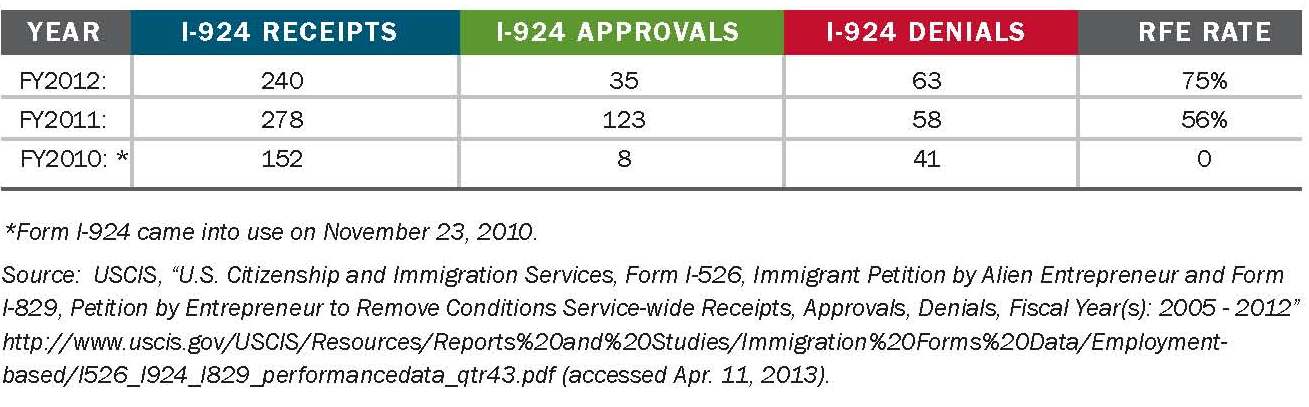
If you’re interested in trends in receipts, approvals, and denials of EB-5 petitions, see: “IIUSA Obtains I-526/829/924 Adjudication Data for FY2013, Releases Comprehensive Dataset (1991-2013).” The FY2013 data shows a growth in receipts over 2012 of 8% for I-526 petitions, 71% for I-829 petitions, and 82% for I-924 applications. USCIS already doubled the number of approved Regional Centers in FY2013 by approving 220 applications, and – unless many of those 436 new I-924s received in 2013 were amendments – RCs will be facing a very crowded field moving forward. We’re on track to hit the annual EB-5 visa allocation cap of around 10,000 based on filings, with the only uncertainty being whether USCIS can manage to process enough I-526s in one year to make that happen (and whether processing times will speed up enough that Chinese investors would even notice being retrogressed). As with most things in EB-5, this issue is complicated. If you want to read more, see “Department of State Predicts EB-5 Visa Retrogression for China” on the EB-5 Insights Blog and “FAQs on EB-5 Quota Backlog” by Ron Klasko.

New AAO Decisions
Since last time I checked, USCIS has uploaded 18 new 2013 AAO decisions on I-525 cases. (May 24 to June 18, and September 23 to November 15). Besides RFEs, which aren’t public, AAO decisions are my best chance to see what’s going on behind the scenes with adjudications and current policy applications. For me, the most interesting decisions in this batch are SEP232013_01B7203, which addresses a Regional Center’s attempt to claim deference to prior approvals, refers extensively to the 5/30 policy memo, and considers what amendments mean; JUN052013_01B7203, which withdraws the director’s assessment of a business plan’s credibility; and MAY242013_01B7203, which discusses which business activities prior to I-526 filing will help the investment to qualify as “fully invested and placed at risk.” Nearly all AAO decisions on I-526 cases include a section on source of funds problems. People involved in that area may particularly want to read JUN182013_03B7203, which goes into detail on what went wrong with a typical China source of funds scenario involving real estate. Or for comedy, you can review MAY242013_02B7203, which treats a petition for investment in a business that will trade in healthcare products and/or operate a restaurant and/or import textiles and/or export fly traps and avocado oil.

New RCs
New entries to USCIS’s Regional Center list 12/30/2013 to 1/22/2014
Live in America-California Regional Center (California)
U.S. Gateway Regional Center, LLC (California)
InvestAmerica EB-5, LLC (Colorado)
My Florida Regional Center, LLC (Florida)
E Development Corporation dba EDC (Guam)
Birch MD BioPark Regional Center (Maryland) USCIS Approval Letter

New RCs (CA, FL, IL, WA), retrogression, program assessments, due diligence

By my unofficial count, USCIS approved 213 Regional Centers in calendar year 2013. This brings the current number of Regional Centers to 424 – double the number this time last year. We can thank the EB-5 program office in Washington DC, which opened in April and has been handling I-924 applications, and the May 30th EB-5 Policy Memo, which brought new clarity and flexibility to Regional Center adjudications.

New RCs added to the USCIS list 12/11/2013 to 12/23
Global Investment Regional Center (California)
U.S. Golden Pacific Regional Center, LLC (California)
Valley Inception Regional Center (California)
EB-5 South Florida Regional Center, LLC (Florida)
Illinois Valley Regional Center (Illinois)
Great Ocean Regional Center (Washington)
West Washington United, LLC (Washington)

The California Service Center has been working hard on I-526 petitions but still faces an enormous backlog, with 7,083 petitions pending or awaiting customer action as of October 2013. (To see the trends, use the “Check My Case Status” tool on the USCIS website.) Even with the processing delays, a record 8,567 EB-5 visas were used in FY2013, approaching the annual quota of around 10,000 visas. For analysis of what this means and issues we can expect in 2014, see US Dept. of State Statistics on EB-5 Visa Usage Indicate Backlog in FY2014 is Likely (IIUSA Blog, 12/23/2013) and THE IMPACT OF CHINESE QUOTA RETROGRESSION ON EB-5 INVESTORS AND EB-5 INVESTMENTS by Tammy Fox-Isicoff and H. Ronald Klasko.

2013 has been a year of intense scrutiny for the EB-5 program. Significant new entries in the log of criticisms and defense include Robert Divine’s December 23rd article in The Hill Immigration service’s investment program is a winner, and the DHS Office of Inspector General report on the EB-5 program (see The Office of the Inspector General Releases Report Critical of the USCIS Administration of the EB-5 Regional Center Program by Laura Foote Reiff and IIUSA Statement on EB-5 Program Report by the DHS OIG).

A common theme through the highs and lows of 2013 has been the importance of due diligence. So as the year closes, here are links to some of my favorite due-diligence-related articles and resources from the year.

IIUSA Alert, New AAO Decisions, New RCs (AL, CA, FL, HI, IA, LA, MS, NC, NE, NJ, NY, OH, OR, PA, SC, TX, WA)

The sensational EB-5 stories proliferating on the Internet inspire Ms. Boring Verifiable Detail here to get back in gear. IIUSA has issued a notice reacting to the hype funded by opposition to President Obama’s nomination for DHS deputy secretary, and I encourage you to read the IIUSA Member Alert here. I’ll leave you to the Washington Post if you want spicy whispers suggesting that EB-5 is an unchecked den of iniquity, but if you want the dull details of what actually happens to people who try to game the EB-5 system, note that USCIS has uploaded more AAO decisions on I-526 cases. (The February, May, September, and October decisions in the Decisions Issued in 2013 folder are new since last time I checked.) The decisions give a behind-the-scenes look at USCIS’s efforts to scrutinize and challenge EB-5 petition detail, and to deny any filings that don’t toe the line of clean money fully invested in business activities that can create qualifying jobs. I’m particularly interested in MAY072013_01B7203, which discusses investment and job creation timing and nexus; MAY172013_01B7203, a decision on a New Orleans RC case that overturns challenge to a state TEA designation but confirms the need for a portfolio investment to identify specific fund uses at the I-526 stage; and SEP052013_03B7203, which explains the options for an I-526 petition when the sponsoring RC has been terminated. The later decisions include an opening reminder that: “This is a non-precedent decision. The AAO does not announce new constructions of law nor establish agency policy through non-precedent decisions.” Nevertheless, we get so few official policy announcements that I take what I can get of hints, and am quoting below a whole section from the 5/7/2013 decision’s discussion of what has the burden to create jobs: the “new commercial enterprise” or the individual EB-5 investment. This is the theoretical issue at the heart of the extremely significant question of which job creation an investor can claim, and how the timing of capital release affects job counts. The 5/7 AAO decision emphasizes the individual investment, and treats investment/job creation nexus as “before/after” issue rather than allowing a “but for” argument. We often see RFEs from adjudicators struggling to see any factors in causation besides chronology, but this is the first time I remember seeing the AAO wax theoretical on the matter. Any thoughts from the attorneys out there?

Section quoted from MAY072013_01B7203, AAO decision on an I-526 petition for direct investment.
…On November 7, 2012, the petitioner filed an appeal with U.S. Citizenship and Immigration Services (USCIS). On appeal, counsel asserts: (1) the three jobs created prior to the petitioner’s initial investment should be attributed to the petitioner; (2) the two jobs created between the petitioner’s initial investment and the maturation of the NCE’s certificate of deposit should be attributed to the petitioner…
1. Employees Hired Prior to Investment
Regarding the three employees hired prior to the petitioner’s initial investment, counsel’s appellate brief asserts that these individuals’ jobs should be considered to have been created due to the petitioner’s investment. Counsel characterizes the hiring of personnel prior to an investor’s infusion of capital as common and a business reality. At issue, however, is not whether the order of events constitutes a normal business-related process, but whether, by following this order of events, the petitioner has established that his investment is responsible for any earlier job creation. Counsel’s appellate brief also states: ”The Regulations merely state that to qualify, it must be shown that the new commercial enterprise (not ‘the investment’) will create full-time employment for not fewer than 10 qualifying employees.” Counsel further asserts that had Congress intended to “require that employment creation strictly follow the date of an alien investor’s investment transfer, it would have specifically required proof that ‘the investment will create not fewer than ten (10) full-time positions …. ‘ But as written, the statutory language focuses on the ‘new commercial enterprise’ instead.” The language counsel quotes does not specifically address situations involving multiple investors. The regulation at 8 C.F.R. § 204.6(g), however, does specifically addresses businesses for which there are multiple investors. Significantly, 8 C.F.R. § 204.6(g)(l) allows for a pooled investment with other EB5 investors “provided … each individual investment results in the creation of at least ten full-time positions for qualifying employees.” (Emphasis added.) Thus, in situations involving multiple investments, the regulatory language focuses on the “investment” as creating the jobs rather than the NCE. Furthermore, under the initial evidence requirements, the regulation at 8 C.F.R. § 204.6(j) states: “A petition submitted for classification as an alien entrepreneur must be accompanied by evidence that the alien has invested or is actively in the process of investing lawfully obtained capital in a new commercial • enterprise in the United States which “Will create full-time positions for not fewer than 1 0 qualifying employees;” (Emphasis added.) The emphasized language implies that an alien has already invested or committed capital to the NCE, and that subsequent to this investment the required employment creation will result. Significantly, the regulations do allow for job preservation, but only where the petitioner invests in a troubled business. 8 C.F.R. §§ 204.6(e) (definition of troubled business), (j)(4)(ii). The petitioner does not claim to have invested in a troubled business. Counsel also references proposed policy guidance which states that an immigrant investor is not required to have already invested his or her capital in the NCE, as long as the investor establishes that he or she is actively in the process of investing the required capital. To be actively in the process of investing the required capital, the investor must demonstrate that his or her funds are actually committed to the NCE. 8 C.F.R. § 204.6(j)(2). The petitioner has not demonstrated any actual commitment of his funds prior to September 1, 2011. Regardless, the issue of whether the petitioner is actively in the process of investing is a separate question from whether USCIS will credit the petitioner with jobs in existence at a business other than a troubled business when the petitioner began investing. In light of the above, USCIS will not credit the petitioner with the employees hired prior to his investment. …
ii. Subsequently Hired Employees
Regarding the two jobs created after the petitioner’s initial investment but before the certificate of deposit matured, the AAO does recognize these jobs as being attributable to the petitioner’s investment as he had relinquished control of the funds to the NCE. It was the NCE that elected to invest the funds rather than to allow them to sit dormant in a bank account.

Also, a belated updated on new Regional Centers. In 2013 USCIS has approved about 205 new RCs, by my count, bringing the total number of RCs to 417 as of 12/11. I look forward to being able to link to the USCIS approval letters for each of these centers. In these days of rumors and misinformation, we really need basic transparency about the identity and mandate of all Regional Centers.

New RCs added to the USCIS list 11/18/2013 to 12/11/2013
New Orleans & Gulf Coast Regional Center, LLC (Alabama, Florida, Louisiana, Mississippi)
American California Regional Center (California)
North America Wind Power LLC (California)
San Diego Regional Investment Center, LLC (California)
American Builders Regional Center (Florida)
Florida Gateway Regional Center, LLC (Florida)
Live in America – Florida, LLC (Florida)
Eight Islands Regional Center, LLC (Hawaii)
Liberty Nebraska Regional Center, LLC (Iowa, Nebraska)
Ohio Regional Center, LLC (Ohio, Indiana, Kentucky) Approval Notice
Live in America – Northwest Regional Center, LLC (Oregon, Washington)
Global City Regional Center, LLC (New Jersey, Pennsylvania)
Related New York City Metro Regional Center, LLC (New Jersey, New York, Pennsylvania)
Birch North Carolina Regional Center (North Carolina)
Southeastern Higher Education Regional Center (South Carolina)
Civitas Laredo Regional Center, LLC (Texas)
Houston EB 5 Regional Center (Texas)
ACIC Management, Inc. Regional Center (Washington)
UPDATE: The name “Midwest EB-5 Regional Center LLC” was changed on the USCIS list to add a comma, not removed from this list as I previously reported in error.

New RCs (CA, CO, FL, NC, TX, VA, WA, WV), CSC complaints

New Regional Centers
Additions to the USCIS list of approved Regional Centers from 10/31 to 11/18

EB-5 in the News
The most buzzed-about EB-5 article this week is a Washington Times piece: “Immigration staffers pressured to rush visas for wealthy investors” (Nov. 18, 2013). The story provides an interesting look behind the scenes of EB-5 adjudications at the California Service Center. Those who have waited months upon months and then years upon years for paperwork to be reviewed may find it hard to believe that the ISOs could feel rushed, or that finally appealing to supervisors/Congressman to help move things along could backfire by pushing those rushed ISOs into resentment and suspicion. This article gives disgruntled insiders’ views, and may encourage us to have more sympathy for adjudicators in their complex task — and perhaps to share their suspicion when some groups appear to succeed in orchestrating preferential treatment.

Another cautionary tale (SD)

I work with Regional Centers on the project side, and I personally don’t see much drama. Not lawsuits, not backstabbing and sabotage, not FBI agents pounding the door, and certainly not murder. I can witness that EB-5 includes a whole world of solid, ordinary businesses working hard to put capital together to get projects done, unexceptionable immigrants putting money into those projects, and new business ventures resulting in job creation and profit for investors. But there are soap operas to be had. If you are a public agency thinking about partnering with a Regional Center, a Regional Center considering a relationship with an investor recruiter, an investor recruiter wondering how many pounds of flesh you can get away with taking, or if you just like a good juicy drama with all the fixings, you’ll want to keep up with the ongoing saga of South Dakota International Business Institute Regional Center. This case is poignant because it apparently involves many sincere and well-intentioned parties and no obvious fraud, and yet it’s a dramatic example of how partnerships can go very wrong. A true cautionary tale.

I quote a summary of the story from an article in today’s Argus Leader, the daily newspaper of Sioux Falls, South Dakota:

The Northern Beef story so far
CONCEPT: The Northern Beef Packers plant was an ambitious attempt to bolster South Dakota’s economy by slaughtering the state’s cows in Aberdeen instead of shipping them out of state.
FOREIGN INVESTORS: Through years of development and false starts, most of Northern Beef’s funding came from more than 100 foreign investors under the federal EB-5 program, where foreigners could get green cards for investing $500,000 in American businesses.
EB-5: The state of South Dakota worked closely with the EB-5 program. It was promoted by Richard Benda, who then was secretary of Tourism and State Development and oversaw overseas investors. State official Joop Bollen also created private companies to manage EB-5 investments. Bollen resigned the same day he signed a contract for his own business to handle the state’s EB-5 program.
INVESTIGATIONS: State and federal officials are investigating Northern Beef, its handling of the EB-5 program, and South Dakota’s economic development office.
BENDA DEATH: Meanwhile, Benda died in late October from a gunshot wound. His death is being examined by authorities.

KELO, the CBS-affiliated television station in Sioux Falls, South Dakota, has a useful summary of the issues involved: Five Questions In State Development Investigation.

UPDATE: See EB5news.com for detailed analysis of this story. “The Rise and Fall of South Dakota: A Cautionary Tale for EB-5 Public Private Partnerships Part I”
(November 07, 2013)

New I-526 form, new I-RIMS product, I-924a, new RCs (AL, AZ, CA, DE, FL, GA, ID, IL, KS, LA, MS, MT, NH, NJ, NV, NY, OR, PA, RI, TX, WA, WI)

October has been a busy month in the business plan department; apologies to frequent blog visitors. Here’s what I think you should know of recent happenings.

New I-526
USCIS has issued a new version of the I-526 form and instructions (09/24/13 edition). Previous versions of the form will only be accepted through the end of this year, so bookmark http://www.uscis.gov/i-526 instead of using what you have on file. If you accidentally use an old form, you’ll file in the wrong place. (The new I-526 instructions don’t give a filing address but direct petitioners to consult the USCIS website for an address – currently the Dallas Lockbox facility). Otherwise, the new I-526 doesn’t look dramatically different from the previous editions.

New I-RIMS Product
The IMPLAN Group, creator the IMPLAN methodology used by many RC economic impact studies, has stepped up to create a new product that works like the BEA’s now-discontinued RIMS II system, only using IMPLAN data sets. This looks like good news for the many RCs that liked RIMS II and hoped to continue using familiar methodologies even as the BEA is no longer providing updated data sets. For more information, see the IMPLAN Group page on 2011 I-RIMS Data, and an article on the IIUSA blog “New IMPLAN “I-RIMS” Product Introduced & Available as Alternative to RIMS II.” To refresh your memory about what happened to RIMS II, see the BEA’s notice on Impact of Sequestration Reductions on the Availability and Quality of Data from the Bureau of Economic Analysis.

I-924a Reminder
Approved Regional Centers, don’t forget that the clock is ticking for you to file a Form I-924a for fiscal year 2013. See http://www.uscis.gov/i-924a and http://www.uscis.gov/forms/questions-and-answers-form-i-924a. If you don’t file by December 29, USCIS will contact you in the Spring with a nice letter threatening to terminate your RC. IIUSA has had a chance to see the I-924as filed in 2011 and 2012, and is hosting what should be a very useful webinar on 11/19/2013 on
“3rd Year of Regional Center Annual Reporting on Form I-924A.” To participate, sign up at
http://eventcallregistration.com/reg/index.jsp?cid=41196t11

Other useful items

  • IIUSA has another promising webinar on Tuesday, November 12, 2013 at 1pm on the subject of “EB-5 Bridge Financing & Escrow Options.” Register at: http://eventcallregistration.com/reg/index.jsp?cid=41195t11
  • Those of you concerned with keeping securities registration exemptions may benefit from Steven Anapoell’s helpful article on “Determining Whether a Potential Investor is a Resident or Non-Resident for Securities Law Purposes”
  • Speaking of keeping on the right side of the SEC, if you are a Regional Center principal, please pick up the phone right now and make two calls: one to your website designer to temporarily disable your RC’s website, and one to your favorite attorney to review the website content before it can go back up again. I recently checked a lot of websites in process of refreshing my Regional Center directory, and was torn between suspicion of the mysterious RCs with no web presence and sorrow on behalf of those RCs whose websites are full of content that could get them into trouble. I can see that websites are often left to innocents in the marketing department who have no idea which pretty pictures, useful information, and careless word choice could derail the RC and all its offerings. Don’t let that happen to you!

New Regional Centers
I have decided to quietly update my Regional Center directory as I receive new information, and to announce new RC names only in occasional posts. If I have contact info or other detail about these Regional Centers, you’ll find it in my directory. I also started a log of recent Regional Center approval letters to track information of interest to me (the length of I-924 processing times, the number of approvals based on actual vs. hypothetical projects, the economic methodologies being approved, and so on). To date I am only able to link to letters for 46 of the 179 Regional Centers approved (by my count) so far in 2013, but I will continue to update the log as I get additional information. Maybe one day these public licenses will all be made publicly available! Thank you to Regional Centers that have shared their letters. Note also that the IIUSA Regional Center Directory includes relatively comprehensive listings for all IIUSA-member RCs.

New entries to the list of approved Regional Centers at www.uscis.gov/eb-5centers from 9/24/2013 to 10/28/2013

EB-5 Event, New RCs (AL, CA, CT, FL, GA, IN, KY, MS, NC, NJ, NY, PA, PR, SC, TN, VA), New AAO Decisions, TO Training

EB-5 Event Reminder
If you are reading this blog as a way to investigate the EB-5 program, save yourself time by making sure that you have the CDFA Intro EB-5 Finance WebCourse on your calendar (Sept. 18-19). The Council of Development Finance Agencies has organized one of the very few EB-5 events whose number one purpose is to educate, not to sell products and services, and the line-up of topics and contributors looks great.  If you have something to learn in EB-5, I don’t think you can find a more solid, comprehensive, and time-efficient introduction than this course.

New Regional Centers
New entries to the USCIS list of Regional Centers from 8/16 to 9/6/2013:

168 America Regional Center, LLC (California)

FutureCare Regional Center of Southern California, Inc. (California)

HT Asset Holding Inc. (California)
http://www.htassetholding.com/

San Francisco EB-5 Regional Center, LLC (California)
http://www.sfeb5rc.com/
Designation Letter

South Florida EB-5 Regional Center, LLC (Florida)
www.southfloridaeb5rc.com/

Southern Film Regional Center, LLC (Georgia)

Civitas Indiana Regional Center (Indiana)
http://www.civitascapital.com/

CP Southern Regional Center (Alabama, Kentucky, Mississippi, Tennessee, Virginia)
www.cphomes.net
Designation Letter

Encore Mississippi Regional Center (Mississippi)
http://encore.bz/

New York Metropolitan Regional Center (New Jersey, New York, Pennsylvania)

US EB5 New York City Regional Center (Connecticut, New Jersey, New York, Pennsylvania)

U.S. Business Regional Center Inc. (New York)
http://www.usabrc.com/

Carolina Global Regional Corporation(North Carolina, South Carolina)
Designation Letter

North Carolina – East Coast RC (North Carolina, South Carolina)
www.progfs.com

Reside in America Puerto Rico, LLC (Puerto Rico)
c/o The LCP Group, White Plains NY. Ph: (212) 692-7228
USCIS Designation Letter

Dominion Mid-Atlantic Associates, Inc. (Virginia)
http://www.dmaarc.com/

(Note: See my Regional Center directory page for my most updated listings for all RCs. And please email me if you would like to provide additional information regarding your RC.)

2013 AAO EB-5 Decisions

I-924 Decisions (see Request for Participation as a Regional Center Decisions Decisions Issued in 2013)
Issues: geographic area, industry focus, “general proposals,” “hypothetical” projects and approvals

In 2011-2012, we saw a trend toward increasing granularity in Regional Center approvals, with USCIS insisting that RCs submit to the mandate to “focus on a limited geographic area,” and to strictly define their industry focus down to at least the 4-digit NAICS code level.  I had wondered whether the 5/30/2013 EB-5 policy memo would effectively blow the lid off such limitations, and it seems that it has. I definitely didn’t report new five-state Regional Centers last year, but recent new approvals include many with expansive geographic areas.  The AAO decisions published in 2013 on I-924 cases both cite the 5/30 policy memo to overturn USCIS’s decisions to deny cases for being too general.  JUN122013_01K1610 discusses a Regional Center amendment that sought to add the whole of five states plus four industry categories defined at the 2-digit NAICS level. USCIS predictably denied this request, but the AAO withdrew the USCIS’s denial.  The AAO determined that:  “The record contains a general proposal based on Census Bureau and other data and general predictions concerning the kinds of commercial enterprises that will receive capital, the direct and indirect jobs that will be created as a result of such capital investments based on RIMS II data and  multipliers, and other positive economic effects. Thus, the AAO withdraws the director’s concerns. While the amendment request is approved, it is based on hypothetical projects and, therefore, is not  due any deference in future filings.”  JUL192013_01K1610 likewise indicates considerable leeway for what can approved at the I-924 stage, provided that the approval has a “hypothetical” basis.  USCIS’s denied the I-924 initial application because “The director determined that the applicant had not provided a business plan with verifiable detail regarding how the proposal will create sufficient jobs.” The AAO disagreed, determining that “The record contains a general proposal based on general predictions concerning the kinds of commercial enterprises that will receive capital, the jobs that will be created as a result of such capital investments based on RIMS II data and multipliers, and other positive economic effects. As the record contains a general proposal, the applicant is not required to submit letters of intent or commitment from the prospective sources of matching funds for regional center designation.”

I welcome the openness to general industry categories and hypothetical projects, but would caution new applicants about wide-ranging geographic area. If a course doesn’t make sense, the powers that be will eventually realize that it doesn’t make sense and change course.  I see the concept of limited geographic focus at the very core of the Regional Center program — its impetus and defining feature. Congress instituted the Regional Center program based on the economic concept that the synergies that result from pooling investment in a region give more bang for the buck than the separate effects of  individual investments here and there, as occurs with the traditional/direct EB-5 program. When a “Regional Center” covers the whole of five states, I don’t even know what the title means anymore.  I don’t want to return to the granularity of 2012, when USCIS likewise departed from Congressional intent by defining Regional Center designation so restrictively that it essentially just meant approval to pursue one project. But neither extreme restriction nor extreme flexibility are good for the program, and I hope and believe that we’ll soon find ourselves back to a reasonable middle ground, especially with respect to the key question of target geographic area.

I-526 Decisions (see Form I-526 and Form I-829  Decisions Issued in 2013)
Issues: “at risk,” “meaningful concrete action,” “overcapitalized,” “inconsistencies”

The 2013 investor petition decisions all involve I-526 petitions, and all but APR172013_01B7203 are for direct EB-5 cases. I’m interested to note that whoever’s now writing AAO decisions is highly detail-oriented and influenced by the precedent decision Matter of Ho. (In contrast to last year’s writer, who was all about Matter of Izummi and who didn’t bother with microscopic rehearsals of detail from the record.) In re Ho is best known for its paragraph definition of the comprehensive business plan, but our AAO writer repeatedly returns to the decision’s treatment of the “at risk” requirement. According to Matter of Ho: “Simply formulating an idea for future business activity, without taking meaningful concrete action, is similarly insufficient for a petitioner to meet the at-risk requirement. Before it can be said that capital made available to a commercial enterprise has been placed at risk, a petitioner must present some evidence of the actual undertaking of business activity; otherwise, no assurance exists that the funds will in fact be used to carry out the business of the commercial enterprise. This petitioner’s de minimis action of signing a lease agreement, without more, is not enough.” For the first time that I’ve noticed, the AAO repeatedly harps on the issue of “meaningful concrete action,” to the point of requiring the petitioner to provide evidence of funds already spent in the business, contracts already executed, and employees already hired prior to I-526 filing. I kept thinking I must be reading I-829 cases, but no. Take warning, direct EB-5 investors: if you have primary control over your business’s bank account, USCIS may require you to show evidence at I-526 that you not only invested $500K/$1 million but that your business has already spent or was irrevocably/contractually committed to spending that amount before you even filed the I-526 petition.
I wonder if the AAO is going overboard with its application of Matter of Ho, and will be interested to hear the lawyers’ take on this new batch of cases. Is it fair to deny a case because the petitioner provided, in RFE, a copy of a lease that post-dated I-526 filing? Because the petitioner, prior to I-526 approval, spent only a few hundred thousand of the one million invested in his business? It seems to me that the distinction between I-526 and I-829 is a key feature of the EB-5 program, and that we’re seeing a negative trend toward pushing I-829 requirements into the I-526 stage. I-526 is the plan review stage, and gives USCIS opportunity to shut down non-compliant proposals (and the investor the opportunity to change course, if EB-5 turns out not to be an option). I-829, then, is the stage where the petitioner demonstrates that he implemented his USCIS-approved business plan. I think it doesn’t make sense to require the I-526 petitioner to prove that he already did what he hasn’t yet been approved to do. 2013 AAO decisions that approach the at-risk requirement through Matter of Ho include APR012013_01B7203, APR032013_02B7203, APR152013_01B7203, APR152013_02B7203, APR162013_01B7203.
Besides the new focus on “meaningful concrete action,” our 2013 AAO writer is concerned that EB-5 enterprises may be “grossly overcapitalized” (not proving that their job-creating activities require the full amount of EB-5 investment). The decisions also devote pages to dissecting apparent inconsistencies in the record, and repeat the warning that “Any attempt to explain or reconcile such inconsistencies will not suffice unless the petitioner submits competent objective evidence pointing to where the truth lies.”

More on Tenant Occupancy
IIUSA has obtained and published a presentation used by USCIS to train adjudicators on “tenant occupancy” cases. I note that the disclosed material does not discuss the requirement to demonstrate whether tenant jobs would be new or relocated – the issue that emerged as the final deal-breaking issue in several recently-denied cases. But maybe this issue is just so juicy that it explains the many pages redacted from the presentation.

IIUSA Recommended Best Practices

IIUSA has finally published its Recommended Best Practices for EB-5 Regional Centers! Designed to provide guidance to Regional Centers seeking to conduct business in a manner that will foster the growth and success of the EB-5 program, this list of best practices represents a year of hard work by a team of A-list players in the EB-5 field. The recommendations are practical and detailed, providing a voice of thoughtful experience on topics from RC oversight and project selection to conflicts of interest, securities issues, escrow, jobs issues, agents and marketing, investor relations, and more.

What does Matter of Ho-compliant mean?

[Updated 2/24/2017] “Matter of Ho-compliant” means “satisfying requirements for an EB-5 business plan.” The phrase refers to the precedent EB-5 decision Matter of Ho, which in 1998 defined what constitutes a comprehensive business plan as contemplated by the EB-5 regulations. Today, we needn’t refer back to the precedent decision because the new USCIS Policy Manual chapter on EB-5 incorporates the old Matter of Ho definition.

Quoted from 6 USCIS-PM G Chapter 2(B)
B. Comprehensive Business Plan

A comprehensive business plan should contain, at a minimum, a description of the business, its products or services (or both), and its objectives.

The plan should contain a market analysis, including the names of competing businesses and their relative strengths and weaknesses, a comparison of the competition’s products and pricing structures, and a description of the target market and prospective customers of the new commercial enterprise. The plan should list the required permits and licenses obtained. If applicable, it should describe the manufacturing or production process, the materials required, and the supply sources.

The plan should detail any contracts executed for the supply of materials or the distribution of products. It should discuss the marketing strategy of the business, including pricing, advertising, and servicing. The plan should set forth the business’s organizational structure and its personnel’s experience. It should explain the business’s staffing requirements and contain a timetable for hiring, as well as job descriptions for all positions It should contain sales, cost, and income projections and detail the basis of such projections.

Most importantly, the business plan must be credible.

USCIS reviews business plans in their totality. An officer must determine if it is more likely than not that the business plan is comprehensive and credible. A business plan is not required to contain all of the detailed elements, but the more details the business plan contains, the more likely it is that the plan will be considered comprehensive and credible.

As indicated by the Policy Manual definition, EB-5 requires a business plan that is comprehensive (covering typical business plan content from business description down to financial projections) and also credible.

What “comprehensive” means
The Policy Manual definition gives a handy rundown of content categories that should be in a business plan. The Manual states that an EB-5 plan is not required to contain all of the detailed elements, but in practice the plan had better address each element or risk a Request for Evidence. It is only safe to omit manufacturing and production process and supply and distribution contracts (if such content is inapplicable to the subject business). Regional center plans that rely on indirect job creation can omit discussion of staffing requirements, and instead discuss inputs to the economic model. Otherwise, cleave closely to the USCIS definition of a comprehensive business plan. Business plans are most likely to be judged not comprehensive if they have insufficient market analysis (particularly if they fail to identify the target market and provide a competitor pricing comparison) or insufficient financial information (particularly if they fail to explain the assumptions behind the income projections). Market and financial analysis help make the difference between a mere business description and a business plan, and are also essential to establishing credibility. The Policy Manual says that generally “the more details the business plan contains, the more likely it is that the plan will be considered comprehensive and credible.” The emphasis is on detail, not length. USCIS identifies “all rhetoric, no substance” as one of the most common EB-5 business plan deficiencies (IPO Training p. 53). A good business plan is concise, and avoids unnecessary detail that slows review and obscures essential detail.

What “credible” means
USCIS adjudicators have three main questions in mind when assessing the credibility of an EB-5 business plan: Is the business feasible? Are the assumptions described in the business plan reasonable? Is it more likely than not that the NCE will create 10 qualifying jobs per investor? (IPO Training p. 47)

To be judged feasible, the business plan should be coherent and supported by evidence that the business has the necessary resources and permissions to develop as predicted. USCIS focuses particularly on schedule and permitting detail and personnel experience to assess feasibility.

Demonstrating reasonable assumptions requires evidence. The market analysis and the financial projections should be well-footnoted with reference to verifiable market and industry data. Sources may be data available online or third party exhibits.

To demonstrate job creation potential, a direct EB-5 plan must include a detailed staffing section that defines full-time positions, provides job descriptions, and gives a hiring schedule. To be credible, the staffing section must be consistent with the plan as a whole. USCIS will issue a Request for Evidence if the staffing levels, hours, wages, and job descriptions are not consistent with the business description, size of the facility, development schedule, or financial projections.

A regional center EB-5 plan provides inputs (usually expenditures and revenues) for an economic analysis of job creation. To show the credibility of these inputs, the plan presents the logic, assumptions, corroborating evidence, and schedule behind the development budget and revenue projections. The business plan references job numbers estimated by the economic impact report, and correlates job creation with the planned EB-5 investment amount.

Additional Considerations
Policy specifically requires the EB-5 business plan to establish prospective job creation, but business plan content is also relevant to other EB-5 requirements. For example, in determining whether capital has been placed “at risk”, USCIS will look to the business plan for evidence of business activity, evidence that EB-5 investment will be used for expenditures related to job creation, and any red flags suggesting impermissible loan agreements or guaranteed returns. (IPO Training p. 52) The business plan describes the flow of EB-5 capital to the enterprise, explains the sense in which the enterprise qualifies as “new,” and identifies the EB-5 investor’s role in the enterprise.

More Information
See also my post Reviewing EB-5 Business Plans, and my website www.lucidtext.com, which describes my business plan writing services.

EB-5 in the news

President Obama has nominated current USCIS Director Alejandro Mayorkas for a top Department of Homeland Security Post – a mixed honor for him, considering the environment in Washington these days. Luckily for those eager to block the President’s nominations, they have found in Director Mayorkas’s past God’s gift to screamer headlines: the EB-5 program. Who needs a sex scandal when there exists such a potent tool for whipping up anti-business, xenophobic, and lingering Cold War sentiments. The investigation officially involves “allegations that (1) USCIS managers and counsel directed employees to obstruct an OIG audit and (2) a (unnamed) USCIS Director personally facilitated and assisted an applicant/petitioner with an EB-5 visa approval after the petitioner was initially found to be ineligible for the program,” and has plenty of purple insinuations tagging along in the wake. I like investigations because I like information, and I look forward to getting some facts to judge. I don’t like pre-investigation smear, and the rhetoric around this case is getting on my nerves. To summarize the messages I’ve gotten from news reports on the investigation (paraphrased):

  • News flash! We have allegations that one government agency wasn’t fully cooperative with another government agency! Good heavens!
  • You’ll be shocked to hear that we asked USCIS to handle something, and get the impression that they’re obstructing. No one else ever felt like that before. There must be a conspiracy!
  • It is alleged that a Director reconsidered and overturned the decision of subordinates! How could someone in a Director position do such a thing?
  • It has come to our attention that some business people have crazy ideas and take ambitious risks and try new things. Entrepreneurs risk failure! Investors who choose to bet on business ventures can lose money! What a scandal!
  • Psst… Clinton … there’s a Clinton connection in the wings, and you know what to think about that, wink wink.
  • We have exposed the shocking fact that those people who are putting cash into US businesses because they want to move their families here and get on a path to US citizenship – why many of those people are coming from… CHINA!! Maybe they’re COMMUNISTS!!!! Maybe they’re SPIES!!!!! ALERT! The Chinese are coming! The Chinese are coming! We’ve got to get organized! We’ve just got to get organized!

I’m exaggerating, of course. Or am I? It’s sad to realize that messages like this could do actual damage regardless of the outcome to the investigation. I don’t know what Director Mayorkas did for the EB-5 program beyond hosting a lot of public stakeholder meetings, but I appreciated his patience and courtesy at those events and I hope that his other activities get a careful investigation and just assessment. The EB-5 program needs leaders who are committed to the core values of the EB-5 program – real investment leading to real job creation and real economic development — who can see the forest for the trees, and who are willing to stand up to subordinates when decisions stray from the program’s vision. Washington needs to have an environment with accountability and with honor for political courage. America needs an environment where business people may take disclosed and calculated risks, where business failure does not of itself constitute fraud. EB-5 investments need serious due diligence and underwriting at some level — and this function shouldn’t just be left to interested immigration agents or inexperienced immigration lawyers and USCIS service officers. We all need to treat immigration with reasonable caution, but without acting like Fendall Hawkins. Let’s be part of the solution.

New RC (CA, IL, IN, MT, NC, NJ, PA, TN, UT, WA, WI), EB-5 Statistics, New SEC Rule

The USCIS Ombudsman’s Office 2013 Annual Report to Congress includes an interesting compilation of data on EB-5 petition processing and EB-5 Visa Usage.

EB-5 IMMIGRANT INVESTOR PROGRAM VISA DEMAND
Visas

FILING DATA ON FORM I-526, IMMIGRANT PETITION BY ALIEN ENTREPRENEUR RECEIPTS
I-526

FILING DATA ON FORM I-924, APPLICATION FOR REGIONAL CENTER UNDER THE IMMIGRANT PILOT PROGRAM
I-924

So far, 2013 is looking like a better year for I-924 approvals. Last week USCIS updated its list of approved Regional Centers with 12 new Regional Centers, for a total of 70 new centers approved this year. I suspect that I-924 processing has unclogged in part because the option of approving I-924 applications without granting deference to the I-924 documents allows USCIS to defer serious review and hard decisions to the I-526 stage. USCIS is circumventing its deference policy with a deferrence policy, as it were. However, I’m happy to see some good applications getting approved. Congrats to OIS-NCA LLC for getting Regional Center approval in less than a year without an RFE, to Chicago Healthcare Fund Regional Center for achieving not only I-924 approval but also Exemplar I-526 approval (a rarity these days), and to Utah Invest Regional Center for triumphing over an arduous review process. I would congratulate the rest of you too if I had more information. Please share your approval letters and contact info with the community!

New Regional Centers

California

California Development Regional Center
Website: http://www.caldevrc.com/

OIS-NCA LLC
Website: http://ois-usa.com/
Geographic Area: California counties of Alameda, Contra Costa, San Francisco, San Mateo, and Santa Clara
Industry Categories: Nonresidential Building Construction (NAICS 2362), Traveler Accommodation (NAICS 7211)
Designation Letter

Waylee Investment, LLC

Illinois

Blue Ribbon Regional Center, LLC

Northern Illinois Regional Center
http://www.cabreracapital.com/

Illinois, Indiana, Wisconsin

Chicago Healthcare Fund Regional Center
Website: http://www.eb5chicagohealthcarefund.com/
Email: info@chicagohealthcarefund.com (Managing Director: Ari Weinberger)
Geographic Area:
Illinois counties: Cook, DeKalb, DuPage, Grundy, Kane, Kendall, Lake, McHenry, Will
Indiana counties: Jasper, Lake, Newton, Porter
Wisconsin county of Kenosha
Industry Categories: Assisted Living Facilities for the Elderly (NAICS 623312), Commercial and Institutional Building Construction (NAICS 236220)
Designation Letter

Montana

USA Montana Energy Regional Center
Website: http://usamerc.com/

New Jersey, Pennsylvania

Lion’s Regional Center
Website: http://www.lionspd.com/

North Carolina, Tennessee

Appalachian EB-5 Regional Center

Utah

Utah Invest Regional Center, LLC
Website: http://www.utahinvest.com/
Geographic Area: Utah counties of Box Elder, Cache, Carbon, Daggett, Davis, Duchesne, Emery, Garfield, Grand, Juab, Millard, Morgan, Piute, Salt Lake, San Juan, Sanpete, Sevier, Summit, Toole, Uintah, Utah, Wasatch, Wayne, Weber
Industry Categories: Personal Care Services (NAICS 8121), Motion Picture and Video (NAICS 5121)
Designation Letter

Washington

WRC EB-5 Regional Center, Inc.
Website: http://www.wrceb5.com/

Yareton Investment Funds Regional Center
Website: http://www.yareton.com/

(Note: See my Regional Center directory page for my most updated listings for all RCs. And please email me if you would like to provide additional information regarding your RC.)

Finally, I recommend the article What the SEC’s Elimination of the Prohibition on General Solicitation for Rule 506 Offerings means to the EB-5 Community by John Tishler, posted on the Sheppard Mullin blog on July 12, 2013.

New RCs (CA, LA, TX), RIMS II Cut

The USCIS Regional Center list has been updated with six new centers, for a total of 58 new approvals in 2013.

Louisiana
Continental Americas Regional Center
Website: http://www.carceb5.com/

California
American Greenland Regional Center

American Vantage Regional Center

Golden Bear Regional Center

Lake Elsinore Regional Center

Texas
Ameri-Link Capital Regional Center
Website: http://amerilinkcapital.com/

(Note: See my Regional Center directory page for my most updated listings for all RCs. And please email me if you would like to provide additional information regarding your RC.)

It’s interesting to note that three of the new California centers (American GreenlandAmerican Vantage, and Golden Bear) each filed a suit in California Central District Court on 2/8/2013 against Daniel M Renaud et al.

Also, I’m belatedly aware that the Bureau of Economic Analysis is eliminating RIMS II as part of its sequestration reductions! RIMS II has been one of the most popular methodologies for EB-5 economic impact reports in recent years, and we’ll be sorry to see it go. It’s lucky that USCIS is no longer requiring Regional Centers to file amendments to change economic methodologies. To quote from a 6/19/2013 notice from the BEA:

Regional Input-Output Modeling System (RIMS) – BEA will eliminate its RIMS II product, which currently generates products on demand as events warrant. The RIMS II program will continue to accept and process orders, which are fulfilled on a cost-recovery basis, through the end of the fiscal year. BEA will not build and develop the data needed to update the data set and fulfill orders in future years. RIMS II provides modeled estimates to the private sector and Federal, state, and local governments on the impact of a change in economic activity on a specific region’s economies. For example, RIMS II was used to estimate the economic impacts of Hurricane Katrina and the Deepwater Horizon Event.

2012 AAO EB-5 Decisions Posted

USCIS recently posted a number of 2012 administrative decisions on EB-5 cases. To view them, go to the Administrative Decisions page on the USCIS website and click on categories B7, K1, and K2, then open the 2012 folders. The cases make interesting reading, with plenty of laugh/cry moments. The 2012 decisions include two regional center application denials, one regional center termination, eleven denials of I-526 petitions, and five revocations of I-526 approvals. You’re welcome to take a look at my rough notes on the decisions before digging into the files themselves. The RC application denials deal with questions about “verifiable detail” requirements and appropriate review standard. In my opinion, they reflect a perspective that will likely continue to make genuinely “hypothetical” or “general” RC proposals practically impossible, even if theoretically allowed by the 5/30/2013 EB-5 policy memo. Many of the I-526 petition denials involve problems with source (and especially path) of funds and failure to demonstrate an at-risk investment likely to result in job creation. The revocations of approved I-526s give an example of a USCIS investigation (including a visit by a USCIS officer to the business site). These decisions also state that a business cannot claim indirect job creation simply if it “is located within and falls within the economic scope of a defined regional center” (to quote an ill-considered sentence on page 14 of the 5/30/2013 memo), but must further demonstrate formal affiliation with a regional center.

New EB-5 Resources (CDFA WebCourse, IIUSA Forum, Economic Impact and Analysis, Policy Memo, Best Practices)

Even I learned a lot last week at the 3rd Annual IIUSA EB-5 International Investment & Economic Development Forum in Las Vegas. For those of you not able to attend, here are some key take-aways.

  • The IIUSA Best Practices Committee unveiled a draft form of a “list of best practices to provide guidance to regional centers seeking to conduct business in a manner that will foster the growth and success of the EB-5 program.”  This document represents a year of hard work by a team of A-list players in the EB-5 field. It’s practical and detailed, providing a voice of thoughtful experience on topics from RC oversight and project selection to conflicts of interest, securities issues, escrow, jobs issues, agents and marketing, investor relations, and more. I’ve been dreaming of a best practices document like this, and can hardly wait for IIUSA to finalize and publish it. For now, I believe it’s only available in print in the Forum Handbook (available for purchase in the IIUSA store). Update: the list is now available on the IIUSA blog.
  • Speaking of the Forum Handbook from the IIUSA conference, it also includes the following excellent articles:
    • “Essay on the Search for a Legal, Logical, Economic, or Policy Basis for USCIS’s ‘Tenant Occupancy’ Policy on Selectively Withholding ‘Credit’ for EB-5 Job Creation” by Cletus Weber and Paul Sommers. This scholarly study is a must-read for anyone concerned with analyzing recent output from the USCIS economists. It is still in draft form, but Dr. Sommers invites comments and plans to submit the revised article for journal publication.
    • “USCIS EB-5 Training Materials 2008 to 2011” by Suzanne Lazicki (yours truly). I analyzed over 2,000 pages of materials used by USCIS to train immigration service officers for adjudicating EB-5 cases. The article includes a detailed index to the 2010/2011 training materials as published by IIUSA.
    • “EB-5 I-829 RFEs and Denials: New Analysis of What USCIS Looks for” By Sonia Sujanani, Stephen Yale-Loehr & Robert C. Divine. All regional centers should review this article as a refresher course on what USCIS looks for at the I-829 stage.
    • “EB-5 Financing for hotel development: Using guest expenditures to calculate job creation for hotels” By Jim Butler and the Global Hospitality Group®. A definitive treatment of the guest expenditures topic, and with insights for demand analysis in other industries. This study was also picked up by Hotel News Resource.
  • Anyone involved in advocacy for the EB-5 program should order the IIUSA-commissioned EB-5 Regional Center Program Economic Impact Assessment and Forecast. I was extremely impressed by the summary of sources, methodology and results presented at the forum by David Kay of the Minnesota IMPLAN Group.  For those who need good data and analysis of the recent economic impacts of the EB-5 program, this report is a truly unique and unprecedented source.
  • CDFA (Council of Development Finance Agencies) has organized an Intro EB-5 Finance WebCourse, to be held Sept. 18-19, 2013, 12-5pm daily. The topic line-up looks great, and I’d encourage everyone researching the EB-5 option to sign up. Those interested in development finance generally should also note the CDFA Online Resource Center.
  • I’m intrigued by the “Seven C’s of EB-5 Investing” and the “EB-5 Project Scoring Index” being developed by Greg Pope, who is thinking about EB-5 underwriting from a lending professional’s perspective. I talked to Greg at the conference, and he welcomes feedback from the community.
  • The 5/30/2013 EB-5 Adjudications Policy Memo was a hot topic at the IIUSA Forum, with a tone of cautious optimism prevailing.  For additional commentary on nuances and implications of the memo, I recommend H. Ron Klasko’s recent posts on “New USCIS EB-5 Policy Memorandum Mostly Gets It Right” and “New Ground Forged by the May 30, 2013 EB-5 Policy Memorandum (Part 2)”
  • I was pleased to confirm at the IIUSA Forum that it’s not just my mom and some spammers checking the weblog hundreds of times a day — I actually have real EB-5 fans. To all my loyal blog.lucidtext.com readers, you’re welcome!