New Info from USCIS 12/16 EB-5 Stakeholder Meeting

USCIS has posted a very informative PowerPoint Presentation for the 12/16 EB-5 Teleconference.  Here is an outline of the topics covered.

  • Regional Center Statistics
  • Regional Center Filing Receipts and Final Case Actions FY10
  • EB-5 Individual Petition Filing Receipts for FY05-FY10
  • Form I-526 Petition and Final Actions for FY05-FY10
  • Form I-829 Petition and Final Actions for FY05-FY10
  • EB-5 Visa Usage
  • FY10 EB-5 Visa Usage by Country
  • EB-5 Case Processing
  • EB-5 Data Reporting
  • Up-coming revisions to Form I-526 and I-829
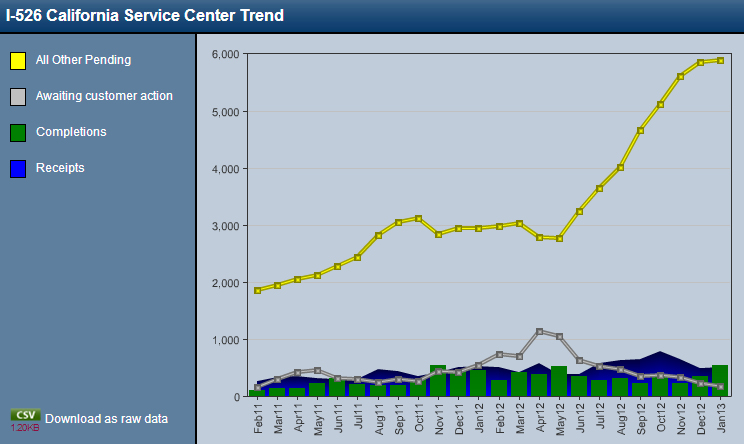
  • EB-5 Staffing Increase at the CSC
  • Future Posting of 2010 EB-5 Training Materials and EB-5 FAQ
  • About Maintaining Jobs in a Troubled Business
  • Issues with Office of Foreign Assets Control and investors from Iran
  • Issue of Sustaining the Capital Investment (new guidance here!)
  • EB-5 Status Issues
  • TEA Issues

Nearly 200 new RC applications/amendments pending?

I just received this sobering update through IIUSA, an EB-5 trade organization:

A CSC Case Officer has reported, via response to the EB-5 Program e-mailbox, that over 100 Regional Center applications/amendments were received by the CSC prior to the 11/23/10 deadline to avoid the new filing fee.

At the 10/14 EB-5 stakeholder’s meeting, USCIS reported 83 RC proposals and 11 amendment requests pending. If these “over 100” applications received by 11/23 are in addition to those 94 pending, that’s a lot of applications! What is this going to do to processing times? What will happen to the market? We already have over 100 approved regional centers. How many more offerings can the market take? Are there enough wealthy risk-tolerant potential immigrants to go around? I also wonder about the quality of all those proposals rushed in under the deadline. Can I look forward to doing a brisk business in helping people respond to RFEs, or should I retreat to grant-writing assuming an EB-5 bust on the horizon? California Service Center, how would you like to hire an EB-5 business plan expert as an adjudicator? Make me an offer!

Quarterly Update from USCIS

Today 10/14 the USCIS Office of Public Engagement hosted its quarterly EB-5 Immigrant Investor Program Stakeholder Meeting by teleconference. Please consult the meeting presentation prepared by USCIS for the event, which includes useful updates and information about the EB-5 program, including the following statistics:

Regional Center Statistics

  • There are currently 114 approved Regional Centers (RCs), operating in 34 states, inclusive of the District of Columbia and Guam.
  • There are approximately 83 initial designation RC Proposals and 11 RC Proposals that request amendments to previously approved designation proposals pending with USCIS.
  • The “target processing time” for RC designation proposals is four months while the current processing time is five months.  Considering the proposal backlog, “additional resources” including one additional EB-5 supervisor and a “substantial” number of new Immigration Services officers will be dedicated to the EB-5 team at the California Service Center. New staff are to begin training this fall.

Investor Petition and Visa Statistics

Approximately 90% of the individual Form I-526 petitions filed each year are filed by Alien Investors who are investing in RC affiliated commercial enterprises.

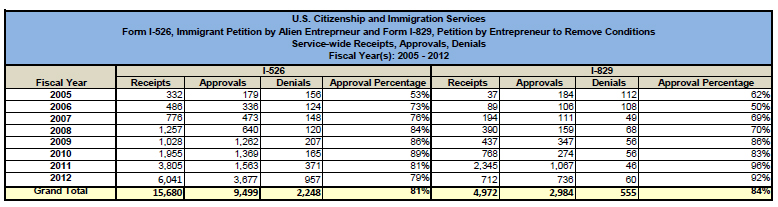
EB-5 Individual Petition Filing Receipts FY05-FY10*
Fiscal Year Form I-526 Petition Form I-829 Petition
FY 2010 (preliminary)* 1727 690
FY09 1028 437
FY08 1257 390
FY07 776 194
FY06 486 89
FY05 332 37

*The fiscal year runs from 10/1 to 9/30. FY2010 figures are for the full fiscal year, but not yet finalized by the relevant departments.

EB-5 Visa Usage
Fiscal Year Total EB-5 Visas Issued
FY10 (Preliminary) 1,886*
FY09 4,218
FY08 1,360
FY07 806
FY06 744

*The USCIS representatives on the call did not know why this number is so much lower than FY09, considering the steadily-growing number of petition approvals. On average, there are 2.5 visas approved per investor.

Don’t forget Koreans

I was just listening to the panel on “Country-Specific Issues” from the August 2010 AILA EB-5 Investor CLE conference, and reminded of the significance of Korea for EB-5. Most new Regional Centers are rushing to China for investors, but keep in mind that 2009 was only China’s first year at the top of the list of EB-5 investors by country, a position formerly held for years by Korea. Fiscal Year 2009 still saw 903 EB-5 visas issued to Koreans, a significant number. Compared to the other markets discussed by the AILA panel — China, Iran, and Russia — Korea appears attractively simple, with fewer funds transfer, funds documentation, and consular issues to worry about. Marketers may want to note the Korea International Emigration and Investment Fair coming up in Busan (Sept 30) and Seoul (Oct 2-3).

EB-5 Statistics 6/16/2010

The following statistics related to the EB-5 program were reported by USCIS at the EB-5 stakeholder meeting on 6/16/2010:

  • There are currently 94 approved Regional Centers (RCs), operating in 34 states, inclusive of the District of Columbia and Guam.
  • Approximately 90-95% of the individual Form I-526 petitions filed each year are filed by Alien Investors who are investing in RC-affiliated commercial enterprises.
  • There are approximately 65 RC Proposals pending with USCIS.

Statistics for EB-5 visas reflect the increasing popularity of the program, and a relatively high rate of approval.

Individual EB-5 Petition Statistics Oct – May FY 2010
Receipts Approvals Denials
Form I-526 Petition 1,100 955 113
Form I-829 Petition 438 188 33
Individual EB-5 Petition Statistics FY 2009
Receipts Approvals Denials
Form I-526 Petition 1,028 966 163
Form I-829 Petition 437 335 55
EB-5 Visa Usage
Fiscal Year Total EB-5 Visas Issued
FY10 (Oct-May) 1,494 (32% I-485, 68% DS-230)
FY09 4,218 (24% I-485, 76% DS-230)
FY08 1,360
FY07 806
FY06 774

“Pay to stay” news story

IIUSA brought to my attention this useful article published a couple weeks ago, which discusses the EB-5 program in some depth with special reference to Regional Centers in California. The article also cites these important-to-keep-in-mind stats on the breakdown of EB-5 visas issued in 2009:

    China: 1,979
    South Korea: 903
    Britain: 326
    Canada: 85
    Japan: 84
    India: 72
    Russia: 60
    Netherlands: 38
    Mexico: 33
    South Africa: 31

See the U.S. State Department website for complete EB-5 visa statistics.

More Mainland China Investors

Ivener & Fullmer LLP has issued a press release on the EB-5 program that includes this interesting statistic: “According to Beijing Entry and Exit Service Association, applicants for the [EB-5] program doubled at the end of last year compared to the previous year, with the numbers jumping from about 500 in 2008 to 1000 in 2009.”

EB-5 Q&A with USCIS

USCIS has posted Q&A from the December 14, 2009 EB-5 conference call on their website. The questions (posed by the AILA EB-5 committee and Invest in the USA) were excellent and the USCIS answers mostly predictable (we can’t answer that question so we’ll answer a different one; we’re not going to tell you because there’s a memo on that subject forthcoming at an unknown date; we have an inapplicable precedent to refer you to; we have no general guidelines only case by case reactions). At least USCIS had prepared answers this time and some valuable information was shared.  Of particular interest to me:

  • There were “less than 50” regional center applications pending at USCIS as of 12/14/09.
  • USCIS highlighted the importance of business plans. The movement of funds from one job-creating business to another is acceptable in principle with no need to amend the I-526 petition provided that the approved I-526 business plan allows for such movement. Job creation based on capital infusion can be demonstrated at the I-829 stage simply by referring to economic data in support of the I-526 petition provided that “the infusion of capital occurs according to the approved business plan and economic analysis, and the capital investment scheme comes to fruition in the manner outlined in the business plan.”
  • USCIS made a strong statement about TEA designation, saying that they consider unacceptable “state-sanctioned attempts to ‘gerrymander’ a finding of high unemployment that is not in accordance with the statutory requirement, through the cobbling together of various portions of political subdivisions so that an investment in a commercial enterprise in a location that is not a high unemployment area would ultimately qualify as one.” While recognizing that states have the authority to designate TEA, USCIS emphasized that this designation must be in accordance with the statutory requirements for TEA: that the area is rural or has an unemployment rate 150% of the national average. Historically USCIS has accepted some creative TEA designations by states, but it seems that this will no longer be the case.
  • USCIS emphasized that Regional Centers can only get credit for indirect jobs/impacts created within the geographic boundaries of the Regional Center.
  • A project that has received traditional EB-5 investment may apply for designation as a regional center, so long as the economic analysis doesn’t “double-count” the jobs already allocated to the traditional EB-5 investors.
  • USCIS confirmed that an investor can be counted as investing in a “new” commercial enterprise so long as that enterprise was established after 11/29/1990, and that such an investment will qualify without the need to show that the investor was involved in establishing, expanding, or reorganizing the business.
  • The Q&A repeatedly cites this newly released document: Adjudication Field Manual Update AD09-38. Click here for the full text Adjudicator’s Field Manual.