We know about recent cases in which USCIS has questioned state-designated TEAs, specifically designation of individual census tracts and groups of census tracts. And we were curious to see how they’d explain that in the 6/30 EB-5 Stakeholder’s Meeting. Here’s what went down. (With time references to my MP3 recording of the second half the meeting, as posted below.)
[minute 29] Kevin Cummings of the Office of Policy and Strategy acknowledged current frustrations regarding inconsistency and unpredictability in TEA designations. “We’re examining a couple of different options in this regard, things we can do to make the TEA designation more predictable. But it’s something we’ll probably have to discuss at a senior level. And I expect that we’ll probably be able to discuss that with our senior leadership during the month of July.”
[minute 45] Q:Can my state give me a designation of a TEA area per their calculations?
Kim Atteberry: I would suggest that it should be a reasonable, transparent, and reproduceable methodology.
[minute 48] Q: The 2009 memo talks about USCIS not having the authority to question the governor’s designation of TEA status, but then within just a couple of lines it implies that USCIS does have that authority. So I’d like to get an answer if possible about whether USCIS has and can question a governor’s designation of a TEA.
Kevin Cummings: Like I said earlier, we are examining the TEA issues and that is one of the aspects that we’re taking a real close look at right now. So I’m not prepared to further comment on that right now at this time. But hopefully we will, um, resolve some of these issues within the next several weeks.
Q: Okay, has USCIS questioned, has USCIS overturned something in the past when there was a designation by the governor’s office?
[silence…whisper whisper whisper… silence]
Mary Herman: Sorry Sir, we’re just consulting.
Kevin Cummings: No, I mean you just have to look at the existing regulations at this time, and the TEA designations do have to be supported by valid methodologies. Um… so… I mean that’s all I can tell you on that at this point.
Q: Uh, okay, thank you.
[minute 50] Q: Regarding TEAs, are you seeing any trends toward using census block groups as qualifying political subdivisions?
[silence]
Sasha Haskell: A census tract or a grouping of census tracts is not a political subdivision. The only means by which a grouping of census tracts could qualify would be as a geographic area.
[silence]
Q: Okay, but my question was about block groups.
Kim Atteberry: Block groups are also just geographic designations, not political.
Q: So there’s neither bias for nor against using block groups?
[silence]
Kim Atteberry: Uh, I don’t think so. I think so long as you know, sound data is supported by you know transparent reasonable methodologies, then, no, that they’re just simply a grouping of census tracts.
Q: Well thank you very much.
[minute 55] Q: A quick follow-up to the discussion that was just had about census tracts. And I just want to be clear about this. So if the governor of a state designates a single census tract as a high unemployment area and that represents the most current data available — let’s say by BEA — that is or is not recognized by USCIS.
Kim Atteberry: I assume that it would be based on the appropriate BLS methodologies, etc. etc.
Q: Yup. It’s 2010 annual data. So it’s the most currently available.
Kim Atteberry: Yeah, I mean, I can’t see why… I mean… as long as methodology is there and you can see what’s going on, I don’t see why that would be a problem.
Q: I only ask because I thought that I heard that someone said that a census tract is neither a legal nor a political boundary.
Sasha Haskell: It is not. A political boundary. A census tract may qualify as being a geographic area but it is not, it doesn’t meet the definition of a political subdivision.
Q: So then we’re qualifying a single census tract under which of these two prongs? It’s either a legal boundary or a geopolitical subdivision?
Sasha Haskell: Well I would look at the regulations…
Q: Hahaha… It says “a single…legal or geo-“– I don’t have it in front of me — all I’m asking is does a census tract qualify for one of those two, if the state says “we designate a high unemployment area.”
[long pause]
Sasha Haskell: Yes, it probably would.
Q: Hahaha…
Sasha Haskell: You know, without seeing specifically what you’re talking about…
Q: This is a single census tract! That’s a period. It’s not like there’s a lot of ambiguity to it–
Mary Herman: Next question–
Q: We’re worried about aggregating or gerrymandering, but we’ve drilled it down to a single census tract–
Sasha Haskell: We’re not talking about gerrymandering. We’re talking about has the state followed the guidelines that are laid down in 204.6(5) by providing the methodology, and if the methodology is in keeping with what our memo says, then most likely if that is followed it would be qualifying. I really don’t know what to say beyond that.
Mary Herman: Thank you Sasha and thank you for your question David. Can we move on to the next question please…
6/2012 Update:See also this Q&A from USCIS’s Executive Summary of the 5/1/2012 EB-5 Quarterly Stakeholder Engagement
Q: Will a single or multiple contiguous census tracts be considered as a geographic subarea?
A: USCIS encourages that standard Bureau of Labor Statistics (BLS) estimation methodology be used. In the event that subareas for which Local Area Unemployment Statistic estimates are not regularly produced, such as census tracts, the TEA applicant should be aware of the following: (1) the census-share technique be used ONLY where inputs for the preferred BLS methodology are not available and (2) only household-only inputs be used, in order to eliminate the impact of the Census 2000 Group Quarters processing error. More information regarding this answer can be found at the Bureau of Labor Statistics webpage at: http://www.bls.gov/bls/empsitquickguide.htm
Q: Can a qualifying census tract with unemployment 150% of the national rate be certified as a TEA?
A: Yes, but designation will depend on the quality and timeliness of the data used to support the 150% of the national average rate of unemployment claim. Acceptable data sources for purposes of calculating unemployment include Local Area Unemployment Statistics produced by a government agency, U.S. Census Bureau data, and data from the American Community Survey.
Q: Has there been any progress on further defining an acceptable vs. gerrymandered TEA? Will USCIS be providing additional guidance?
A: This issue is being examined in the context of the draft memorandum, which will be posted for comment in the near future.
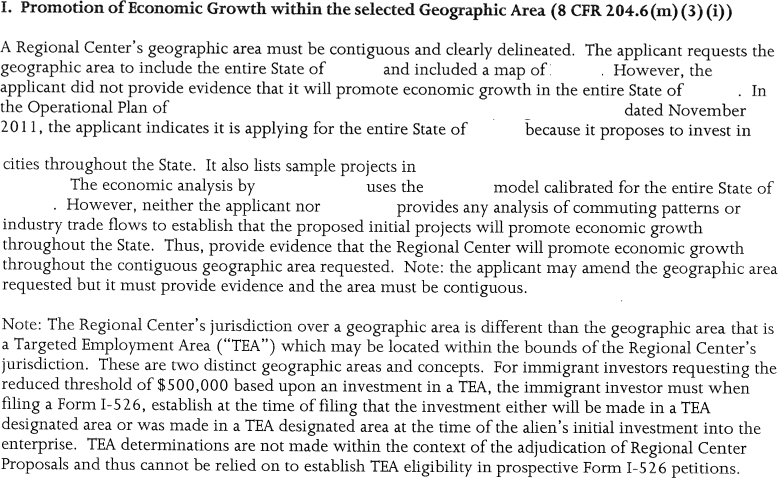
5/30/2013 Update: The information in the 2011 post below is now outdated. Please see pages 7-8 of the 5/30/2013 EB-5 Adjudications Policy Memorandum for USCIS’s current policy on Targeted Employment Area designation.
 EB-5 Updates