USCIS Adjusts Process for Managing EB-5 Visa Petition Inventory

USCIS has officially announced an I-526 priority change I saw coming. People from China, Vietnam, and India with pending I-526: you need to organize to inform IPO how you feel about this. I plan to write about an aspect I doubt IPO recognizes: how USCIS adjudication order can create and skew EB-5 visa availability, with particular reference to the examples of China and India. I also have to go back and revise the new I-526 timing estimate service that I’d been almost ready to post.

From: U.S. Citizenship and Immigration Services <uscis@public.govdelivery.com>
Sent: January 29, 2020 8:33 AM
Subject: USCIS Adjusts Process for Managing EB-5 Visa Petition Inventory

Change Addresses Fairness Issues in Visa Allocation

WASHINGTON— U.S. Citizenship and Immigration Services today announced a process change for Form I-526, Immigrant Petition by Alien Investor, from a first-in, first-out basis to a visa availability approach.

This new operational approach aligns with other visa-availability agency adjudications processes, is more consistent with congressional intent for the EB-5 Immigrant Investor Program, and increases fairness in the administration of the program.

“Changing our approach from a first-in, first-out adjudication process to one that prioritizes petitions connected to individuals from countries where visas are currently available better aligns the EB-5 program with congressional intent and makes it more consistent with other USCIS operations,” said USCIS Deputy Director Mark Koumans. “This new approach increases fairness, allowing qualified EB-5 petitioners from traditionally underrepresented countries to have their petitions approved in a more timely fashion to receive consideration for a visa.”

This operational change is consistent with the agency’s processing of Form I-130, Petition for Alien Relative, in cap-subject categories. The new visa availability approach simply gives priority to petitions where visas are immediately available, or soon available, and will not create legally binding rights or change substantive requirements. Applicants from countries where visas are immediately available will now be better able to use their annual per-country allocation of EB-5 visas. The new visa availability approach will apply to petitions pending as of the effective date of the change. USCIS will implement the visa availability approach on March 31, 2020.

USCIS will hold a public engagement on March 13, 2020, from 11:00 a.m. to noon Eastern, to provide information and answer questions from the public about these operational changes to the management of Form I-526 petition inventory.

10/29 Kendall remarks for IIUSA

The USCIS website has published Immigrant Investor Program Office 2019 IIUSA EB-5 Industry Forum Sarah M. Kendall Remarks October 29, 2019. (I also recorded the remarks, but my recording adds nothing of significance. Kendall followed the script.)  This post highlights what I did and did not learn from Kendall’s remarks.

I-924A Tips

Kendall helpfully offered specific tips for avoiding questions on the Form I-924A Annual Report:

  • Avoid inconsistencies with information previously provided to USCIS (and when something is different, explain)
  • Remember to provide government-issued photo ID for all regional center principals, as required
  • Remember that changes to a Regional Center’s name, ownership, organizational structure, principals, and geographic area must be reported separately with a Form I-924 amendment; RCs cannot simply notify USCIS of such changes on an I-924A.

Processing Times

Sarah Kendall mentioned three factors behind low production and high processing times in 2019: the lapse in regional center program authorization from 12/22 to 1/25 that disrupted processes, a training session for I-526 adjudicators and economists, and a greater focus on program integrity. The first two factors each cost a few isolated weeks of adjudicative time, so presumably the third factor is the major reason for a massive 60% drop in production. “In 2019, IPO focused on enhancing the integrity of the program and working to find ways to protect the program from abusive actors. This has meant greater coordination with agencies in the law enforcement community and with other partners, including at the Securities and Exchange Commission. …We have also invested in building more robust quality assurance and control programs to ensure consistent adjudication practices. …All of this has some impact on processing times.” Kendall referenced “understandable concern in the community” regarding processing times, but did not otherwise apologize for low production or foresee improvement.  And why would she, if the processing slowdown resulted from an enforcement focus that she does not regret? “We have a dedicated and hard-working staff who continue to handle this complex caseload with diligence and integrity. …IPO has made structural changes to ensure continued program integrity. …we continue to place importance on continually assessing and improving of the EB-5 program’s integrity. … Safeguarding the integrity of the EB-5 program is of paramount importance to USCIS and to the public. We seek to effectively administer the program and guard against abuse.” Kendall concluded by stating that “the expectations we have for ourselves are to run this program with efficiency and with integrity.” But the efficiency expectation does not appear anywhere else in her remarks. Nor does Kendall indicate any awareness that efficiency is also an integrity issue. She may not realize that USCIS’s posted 2-5 year processing times serve to attract abusive actors, promising time for fraud to flourish, while discouraging responsible actors who want their projects and investors to succeed.

Other notes

Otherwise, Kendall’s remarks largely follow the principle expressed by that exemplary civil servant Sir Humphrey Appleby: “So long as there is anything to be gained by saying nothing, it is always better to say nothing than anything.”

  • TEA determinations: Kendall restated what’s stated in the regulations, without adding clarification or interpretation.
  • Partial investment before November 21: Kendall restated existing policy related the “actively in the process of investing” option, and reiterated the regulation provision that petitions are subject to the rules effective as of the date they were filed. Her comments did not break any ground on this topic, as discussed in my previous post.
  • Redeployment: Kendall briefly referenced existing guidance in the Policy Manual, and stated that IPO still continues to work on clarifications (with public input still welcome).
  • Protection for innocent investors: Kendall generally summarized policy that constrains the flexibility USCIS is able to offer innocent investors when a regional center or project encounters problems.
  • Regional Center oversight: Kendall argued that requirement for regional centers to engage in monitoring and oversight is not new.
  • Premium processing: As always, USCIS is not considering a premium processing option for I-526.


Conference Rumors (partial investment, visa wait times)

I heard IPO Chief Sarah Kendall and Department of State Visa Control Office Chief Charles Oppenheim speak last week at the IIUSA conference in Seattle.  I’ll blog in detail about these talks and other news and insights from the conference as time permits, but first to quickly address a couple misconceptions that may affect current decision-making.

Rumor credits Kendall’s talk with announcing that it’s now acceptable to file I-526 with less than $500,000 before November 21, and Oppenheim’s talk with announcing that EB-5 backlogs have fallen. These impressions are not quite accurate, in context.

Sarah Kendall confirmed a point related to TEA requirements as they intersect with the “investing or actively in the process of investing” requirement. Her comments did not create or change the “actively in the process of investing” alternative to investing the full amount prior to I-526 filing.  Partial investment remains an option that’s just as available, narrow, and risky as it has always been. For discussion, see Joey Barnett and Vivian Zhu’s article “EB-5 Minimum Investment Amount Increases to $900,000 November 21, 2019 – Can an EB-5 Applicant Invest Less Than the Full $500,000 Now and Still Qualify?” and Robert Divine’s article “Member Perspective: EB-5 Implications from IIUSA Conference Leading up to November 21 Effective Date of Regulations” (and his previous cautionary words about skeletal filings.) Personally, I would not file I-526 with less than $500,000 invested because USCIS makes it so tough on the business side to prove that funds not actually in the enterprise account still qualify as “at risk” in the enterprise, as required. For examples of petitioners who invested less than the minimum amount before I-526 filing, and specific problems that they faced, see: FEB012017_01B7203, Oct262009_01B7203, Apr162009_01B7203, Nov032008_01B7203, OCT072005_01B7203. The official policy is here in the policy manual.

In his presentation on October 29, 2019, Charles Oppenheim estimated EB-5 visa wait times for current investors from China, India, and Vietnam that are shorter than the wait times he had estimated back in April 2019. This reflects a reduced estimate of the total backlog of EB-5 applicants (visa applications+ estimated applicants associated with pending I-526). However, the number of investors in line for an EB-5 visa has likely not fallen since April 2019, considering the number of of I-526 filings and adjudications and visa issuances since then. Oppenheim’s total backlog estimate fell due to revised assumptions about the number of visas to eventually be claimed by those investors. Specifically, he’s now estimating fewer visa applicants associated with pending I-526, because he increased the I-526 denial rate assumption for all countries, and decreased the family size assumption for some countries. I’ll blog and spreadsheet the detail when IIUSA publishes the slides, which Oppenheim promised would include some data not in the conference presentation. But to the bottom line: Oppenheim’s revised estimates are mixed news.  Considering the surge of people starting the race, it’s worrisome to see Oppenheim looking at the finish line and estimating that a reduced number of people will make it to the end to claim a visa.  For EB-5 investors considering risks, they must assume (a) solid success rate with associated long wait times, or (b) shorter wait times predicated on high failure rate. It’s one or the other, considering demand. (B) is unfortunately plausible, considering IPO’s recent behavior, so I don’t necessarily question Oppenheim’s revised predictions with shorter wait times.

Insights from AAO Decisions (debt arrangements, currency swap, diverted capital, regional center activity, project progress)

So far in 2019, the Administrative Appeals Office has published 80 decisions on I-526 appeals and motions, and 16 decisions on I-924 appeals. As someone who prepares documents for USCIS review, I read the AAO decisions to keep up with current adjudication trends and unspoken policy. This post highlights a few EB-5 cases of particular interest.

Debt Arrangements

In MAY302019_01B7203 and MAY302019_02B7203, the AAO reopened previously dismissed appeals and approved the I-526 petitions based on the USCIS Policy Manual October 2018 correction regarding redemption agreements. I wonder if this offers hope for other I-526 that were denied in 2017 and 2018 due to suspected debt arrangements that USCIS has since clarified are acceptable.

Currency Swaps and SOF Investigations

A number of recent appeals focus on the recently-controversial issue of currency swaps. In a currency swap, the EB-5 investor sends local currency to the local account of an intermediary, and the intermediary then wires an equivalent amount in US dollars to the investor’s offshore account.  In late 2016/early 2017 USCIS started questioning this previously-accepted practice, and began requesting source-of-funds documenation for the intermediary (as discussed for example by Hermansky and Klasko). Lawyers questioned USCIS’s reasoning, and embattled cases are now reaching the AAO decision stage. JUL052019_01B7203 is particularly interesting, because AAO sustained the appeal. “Here, the Chief has not questioned the validity of the agreement with ___ nor identified discrepancies or irregularities in the record…. Without any identified negative considerations, we find the evidence in the record sufficient to establish, by a preponderance, that the funds transferred to ___ originated with ___’s lawful business activity, and relatedly, that the Petitioner had invested the minimum amount of required capital.” In the following cases, however, AAO agreed with USCIS that source and path of funds were not sufficiently documented in currency swap scenarios: OCT252019_01B7203, OCT172019_02B7203, OCT152019_01B7203, OCT112019_02B7203, OCT012019_02B7203, SEP192019_01B7203, AUG302019_02B7203. These cases were denied for lack of evidence that the intermediary was legally able to make the exchange, lack of evidence that the intermediary used lawful funds to make the exchange, and timing problems. Distaste over an arrangement “designed to circumvent local banking regulations” also appears to be a factor.

AUG302019_01B7203 is another rather interesting source of funds case, being a denial based on information that emerged when “In October 2017, USCIS officials conducted an overseas investigation during which they interviewed the Petitioner and others regarding the source of funds used in his investment.”

Recovering from Fraud

In the wake of SEC activity to weed bad actors out of EB-5, we’re left with the question of whether viable projects, innocent investors, and any good partners/successors of the bad actors can possibly recover and get back on track after a fraud incident.

OCT172019_01B7203 Matter of W-Z- tests the question of whether a petitioner can, after I-526 filing, make additional investment to replace diverted capital. The petitioner had invested $500,000 in the NCE, but $185,000 of that amount never made it to the project thanks to a rogue principal. With that principal out of the way, the petitioner offers to replace the diverted capital with another $185,000, so that the project has the full amount of investment and can proceed with job creation. But AAO says no, because “the foreign investor must show that his or her investment of at least $500,000, in its entirety, has been made available, without interruption, to the NCE for job creation.” The operative words in this statement are “without interruption.” AAO says that this statement rephrases this Matter of Izummi/policy requirement: “the full amount of funds made available to the businesses most closely responsible for creating the employment upon which the petition is based.”  But that doesn’t look like a simple restatement to me. Is “without interruption” really intrinsic to the Matter of Izummi analysis? The AAO indicates that for the petitioner’s additional $185,000 investment to qualify, he would have to establish that he had invested or was actively in the process of investing that additional amount before he filed I-526. “The replacement of EB-5 capital with other funds does not equate to a return of the original capital attributed to the investor, even if both originate from the same source. His intention to replace the diverted funds, thus, does not establish that $500,000 of his capital has been made available since 2015, without interruption, to the NCE for job creation purposes.” Does the EB-5 “at-risk” requirement actually justify this hard “without interruption” line?  The decision goes on to give additional reasons for denial, but speaks against supplementary investment as if it’s wrong in principle, regardless of other circumstances.

SEP252019_01K1610 Matter of V-A-O-C-A-C-D-R-C- tests the question of whether a regional center with the most reputable of operators (State of Vermont) can recover from the bad actions of previous partners. The state fought hard, on behalf of past investors and on-going projects, to keep designation at least long enough to complete current EB-5 projects and implement an orderly wind-down of operations. But AAO dismisses the appeal of Vermont Regional Center’s termination. Ironically, the determinative reason seems to be the state’s responsible intent to not sponsor any new EB-5 projects. The unspoken rule seems to be, new I-526 filings = promoting economic growth, while no new I-526 filings = no longer continuing to promote economic growth.

Regional Center Activity

USCIS claims that “When determining whether a regional center continues to promote economic growth, we consider the totality of the circumstances, weighing positive and negative factors to reach a conclusion.”

However, as pointed out in one of this year’s termination appeals, it appears that in fact “USCIS has, sua sponte, determined that the only acceptable evidence of promotion of economic growth is the filing of Form I-526 petitions by investors in projects affiliated with a regional center within three years of receiving its designation.” This is evident from my log regional center terminations, which shows that 103 regional centers have been terminated so far for not having had any I-526 filings during a period of time (the metric varies by decision – most often three years, sometimes two, four, or five years). The appeal MAR152019_01K1610 pointed out that “this temporal requirement does not appear in any statute, regulation, or USCIS policy guidance,” which makes it a bit unfair, and that “the statute and regulations related to termination of a regional center’s designation are impermissibly vague.” But the AAO spends no time on this procedural issue, merely saying that the Applicant didn’t make a constitutional point, and if he had, constitutional points are outside AAO jurisdiction.

Instead, the AAO decisions on termination appeals tend to follow this shape: (1) review the applicant’s evidence of activity in developing projects and promoting investment opportunities, and (2) conclude yes, that’s positive activity, but there haven’t been any recent I-526 filings for this regional center.  No investor petitions means no data on EB-5 investment resulting in increased export sales, improved regional productivity, job creation, increased domestic capital investment, or other positive indicia of promotion of economic growth. The regional center is not promoting economic growth in the only way we can measure – I-526 filings – and therefore must be terminated. It starts to feel petty and hyper technical. In AUG302019_01K1610, A-G-C-R-C got terminated (1) because the I-924A filing fee amount was written on the check as “three thousand three hundred thirty five,” not “three thousand thirty five” (and USCIS was not able to accept a check with the corrected lower amount because it post-dated the filing deadline), and (2) because no I-526 had yet been filed within 21 months of the regional center’s designation. A-G-R-C applied to be a regional center in 2014 and didn’t get approved until 2016. USCIS didn’t even give the RC as much time to secure investors as it gave itself to review the application.

Many of the termination appeals in 2019 include this language: “The evidence discussed above demonstrates the Applicant’s pursuit of new projects, an action which in and of itself serves as a positive factor in determining whether the regional center continues to promote economic growth. However, it does not show that these actions resulted in increased export sales, improved regional productivity, job creation, increased domestic capital investment, or other positive indicia of promotion of economic growth.” How to make such a showing remains a challenge for regional centers that are now preparing Form I-924A, and need more time to secure investment. If USCIS doesn’t manage more nuance, its blind three-year metric will end up eliminating all the regional centers that Congress actually wants in EB-5 – the ones in rural/distressed/low-profile areas that will inevitably have relatively low volumes and long lead times. (For additional discussion, see my 2018 post on Preparing to File I-924A.)

Project Delays

Many I-526 decisions in 2018 and 2019 are associated with just a couple regional center projects with many investors who each filed all possible appeals and motions. The Arizona international trading mall case and the cellulose-to-sugar conversion factory case have a simple moral: when a project does not move forward according to plan, instead suffering multi-year delays, it’s tough to demonstrate that the plan was/is reasonable.  AAO dismissed all the appeals, denied all the motions to reopen and reconsider, and went further to revoke I-526 approvals that had been made before  project delays became apparent. I feel sorry for the investors, and envious of the lawyers who earned fees from this blizzard of repetitive AAO activity. (I’m not including links to all the cases, but open a few entries at random in the 2018 or 2019 folders of I-526 decisions, and you’ll encounter them.)

Other decisions

Other decisions that may be of interest to people who follow these topics: JUN062019_02B7203 (bridge financing problem considering the length of the bridge), SEP232019_01K1610 (remands an Exemplar project denial based on USCIS’s unreasoned claims of unreasonableness), JUL222019_01K1610 (makes an issue about source of funds for a regional center applicant), MAR152019_01B7203 (discusses material change specifically as an issue of rectifying a deficiency in the original petition).
9/9 EB-5 Stakeholder Non-Engagement

In today’s EB-5 Immigrant Investor Program Listening Session:

  • IPO Chief Sarah Kendall made a statement that sounded promising in outline (IPO Overview, IPO updates, and comments on implementation of the proposed rule) but that proved insubstantial and unhelpful in fact. The statement was in very general terms, with no specific answers to the specific questions that I at least submitted in advance. Even the single data point — that IPO has 212 dedicated staff as of July 2019 — was unhelpful as Kendall never specified whether these staff are actually working on EB-5, or among those on “temporary assignment to other agency priorities.” The statement then wasted time by regurgitating what’s written in the regulation without telling us anything specific about how IPO interprets or plans to implement the regulation. This ungenerous statement will eventually get posted online. (UPDATE: here it is.)
  • Stakeholders, having been invited before the call to submit written questions that USCIS chose not to answer, were then further invited to press *1 and ask questions live for USCIS to not answer. I do not understand what this was supposed to accomplish. Why have a call at all, if it’s to be like this? The only reason to have a live engagement, instead of just soliciting email input, is if there’s going to be any engagement. There was zero engagement in this call.

USCIS said so little that I must resort to analyzing what was not said. If USCIS had any hope of turning around the catastrophically long and continually worsening processing times, which must have occupied at least half the advance questions, wouldn’t they have expressed such hope or at least intent? If USCIS knew how they would implement the priority date retention and TEA designation process in the new regs (likely the other half of advance questions) wouldn’t they have said something helpful on these topics? But the call offered no such support or encouragement.

Here is my recording of the call. I do not recommend it.

August Updates (IPO Processing, Terminations, Marketing, Regs & Legislation, Visa Bulletin)

USCIS Investor Program Office Updates: There’s evidence of increased activity at IPO.

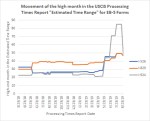
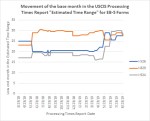
  • Processing Times: The report on the USCIS Processing Time page improved this week for all EB-5 forms, with the “Case Inquiry Date” formula moving forward 76 days for I-526, 62 days for I-829, and 1,097 days for I-924. The months in the “Estimated Time Range” also dropped somewhat, and reduced their spread. I make regular spot checks of the daily report and enter them in this log. Making charts from this log, I note a possible rationale behind the recent fluctuations and slowdowns. Could the USCIS objective be to get all adjudications focused on the same date? Message to USCIS: what we need most of all is predictability within each form type (with productivity maintaining a reliable baseline or trending up). No one would cheer at the odd goal of making I-526, I-829, and I-924 equally slow. We are happy to see processing times finally trending down rather than up, though still with far to go.
  • Regional Center Terminations: In the email to USCIS copied in my last post, I noted that just 11 regional centers had been terminated so far in 2019. But USCIS proceeded to terminate a whopping 62 more regional centers in one week of August. Apparently, the regional center compliance team is back to work with a vengeance, though I-924 volumes remain low.

Other Updates

Regional Center Program Authorization: Regional center program authorization is currently attached to 2018 appropriations that expire on September 30, 2019. It appears likely that Congress will, per usual, fail to finalize 2019 appropriations in advance of the September 30 deadline, and instead defer the deadline with one or more Continuing Resolutions (CR). In the IIUSA Midyear Association Update Webinar, the government affairs panelist said he’d been assured that regional center program authorization will be included in the CR, if there is a CR.

EB-5 Reform/Change Regulations or Legislation: The IIUSA Midyear Association Update Webinar indicated that draft EB-5 legislation continues to circulate among select industry leaders, and to be discussed with Congressional offices. The webinar did not offer any timeframe estimate for such legislation to be advanced toward a vote. IIUSA did state that EB-5 has “Champions in Congress,” though the champions are not yet ready to be named and go public with EB-5 support. EB5 Investors Magazine reports that Senator Rand Paul is trying for a joint resolution that would withdraw the EB-5 regulation – but Senator Paul has not promoted this (or his backlog elimination bill) on hiswebsite. It looks unlikely that there will be any EB-5 program changes before the end of the year, beyond the changes that will result from the EB-5 Modernization Regulation taking effect on November 21, 2019. If only politicians and industry would allow for healthy enhancements and effective reforms for EB-5!

EB-5 Future: How much future does EB-5 have after November 21, 2019, when investment amounts will have increased and when – perhaps more to the point — and there’s no more deadline threat to hustle investment decisions and obscure visa availability and other issues? The industry is divided between people who are making a last mad rush and expecting to abandon the field after November, and people seeking a sustainable path into the future.

EB-5 Marketing and Oversubscription: I hear from multiple sources of significantly increased investment activity from Brazil, South Korea, and Taiwan in recent months, threatening backlogs for those countries. Unfortunately USCIS has not shared any per-country I-526 data since October 2018, so we can only guess at the likelihood that those countries are becoming oversubscribed in 2019. Prospective investors, you’ll want to monitor your markets while keeping in mind this rough metric: an additional year of visa wait for every additional 230 or so EB-5 investors from your country (assuming 700 annual visa cap and a 3:1 ratio of visas demanded to filed I-526). (If you want a more fine-tuned analysis that looks at country-specific historical trends and existing backlog, and explains how to model future waits from current assumptions, my timing estimate service is available.) The visa wait for any given investor is determined by the size of the backlog on the day she invests, so we try our best to estimate current volumes.

Visa Bulletin for India: Section D of the September 2019 Visa Bulletin includes this statement: “There has been a combination of a dramatic change in the USCIS demand pattern for adjustment of status applicants during July, and a larger than anticipated return of unused numbers which had been provided to consular offices for July use.  As a result, it has been possible to advance the Employment First and Second preference September final action dates for most countries, as well as the India Employment Fifth preference. ” The India Final Action Date for EB-5, which hadn’t been expected to move this month, advanced to September 1, 2017.

What does this mean for India EB-5 applicants in line? The Visa Bulletin just tells us that there were fewer-than-expected visas issued through consular processing in July, and different-than-expected demand in July for visas through I-485. I assume that must mean (1) a processing hold-up that resulted in fewer-than-expected people with old priority dates reaching the finish line in time to be able to claim a visa in July, or (2) more denials/withdrawals than expected. If (1), then the future visa claimants are still there, just held up by USCIS/consulate delays, and thus the total backlog picture/timing picture for India doesn’t change much. In that case, the September visa bulletin jump is an anomaly reflecting a temporary phenomenon, not a signal for the future.  If (2), then the total India backlog has actually become smaller, which means that people still in line advance more quickly than expected, with visa bulletin dates moving ahead accordingly.  On a down side, such attrition would signal problems with I-485, visa interviews, or sentiment among past investors.

I’m happy to see that Charles Oppenheim of Department of State Office of Visa Control has consented to speak at the IIUSA EB-5 Industry Forum in Seattle in October.  Let’s try to ask him the right questions.

Regional Center List Updates

Changes to the USCIS Regional Center List, 05/28/19 to 08/27/19.

New Regional Center Approvals


Name Changes

  • Smith Atlantic Regional Center LLC (former name Atlantic Coast Regional Center, LLC) (Connecticut, Delaware, District of Columbia, Maryland, Massachusetts, New Hampshire, New Jersey, New York, Pennsylvania, Rhode Island, Virginia)
  • Smith Central Regional Center LLC (former name Central Western Regional Center LLC) (former name USA Midwest Regional Center LLC) (Illinois, Indiana, Kansas, Kentucky, Michigan, Missouri, Ohio, Pennsylvania, Wisconsin)
  • Smith South Atlantic Regional Center (Florida, Georgia, North Carolina, South Carolina) former name: South Atlantic Coast Regional Center LLC

New Terminations in August 2019
(Too many to list here. Visit the USCIS Regional Center Terminations page and sort by date, or see my Excel file for terminations.)

9/9 Engagement Invitation

USCIS has emailed an invitation to EB-5 Immigrant Investor Program: Listening Session: EB-5 Listening Session_Invite_09092019_PL_OCC GovDel.pdf

EB-5 Regulation Published

The EB-5 Immigrant Investor Program Modernization Regulation (RIN 1615-AC07) has been published today in the Federal Register as a Final Rule. The final rule is effective in 120 days, on November 21, 2019. For every investor who files I-526 on or after November 21, 2019, the required minimum investment amount will be at least $1.8 million, or $900,000 in a Targeted Employment Area, with TEAs being subject to redefined rules. Those are the headlines. The final rule also retains the limited priority date retention provision, I-829 process tweaks, and minor clarifications as proposed in the Notice of Proposed Rulemaking (NPRM) in 2017.

For a solid summary of the rule’s content and implications, I recommend Robert Divine’s 5-page article for IIUSA The Rush is On: New EB-5 Rule Nearly Doubles Minimum Investment in 120 Days (July 23, 2019).

For those concerned to understand the rule and its background in detail, I recommend reading all 61 pages of the final rule itself. The actual regulatory amendments can be found on the final three pages. The rest of the document explains the final rule, how it differs from the NPRM and current regulations, DHS thinking behind the rule, and why the agency did or did not agree with industry comments.

My post will not duplicate Divine’s excellent analysis, or obviate the need to read the rule itself to know what it contains. But I’ll consider a few basic questions.

1. Will this rule actually take effect?

The rule will take effect in November, unless there is litigation against USCIS to stop the regulation, or Congress passes a new EB-5 law that would overrule the regulation. Both litigation and legislation have been bruited in the past. 120 days gives the industry a bit of time to pursue such alternatives, given inclination and opportunity. I guess that inclination depends on a calculation by the regional centers with budgets for lawyers and lobbyists. Their new markets will be damaged by the regulations. But does this matter to them, in light of the damage already resulting from oversubscription and wait times? Do they see sufficient long-term potential for new EB-5 demand to keep fighting for marketable investment amounts supported by TEA flexibility? The opportunity for a successful lawsuit does not look wide, considering the care DHS put into this regulation. I doubt imminent legislation, considering the political climate, and I would not want legislation based on the scandalous so-called industry consensus with TEA set-asides. But I do not discount these possibilities in the next few months, so long as the motivation exists to fight for an alternative to the regulations.

2. Should I hurry to file an I-526 petition before November 21, 2019?

I would ask a couple questions first. (A) Is it important to you that the investment amount is $500,000 rather than $900,000 or $1.8 million? and (B) Is it important to you that the investment result in a visa? If the answer to (A) is yes, then file. If the answer to (B) is also yes, then don’t hurry too much. Skipping due diligence, skimping on source of funds analysis, risking incomplete investment, pushing premature projects, neglecting to consider backlogs and timing issues … these timesavers are likely to leave you with a faulty petition that never results in a visa due to I-526 denial, and/or to visa wait problems not to mention investment problems. So waste no time, but don’t be hustled. Heed experienced lawyers like Robert Divine and Dan Lundy, who warn against skeletal filings. As a business plan writer, I aim to work twice as hard over the coming months to accommodate accelerated deadlines without sacrificing quality.

3. Will it be practically possible to raise EB-5 funds after November 21, 2019?

You know best whether your market has any taste for a $900,000 or $1.8 million investment, under current conditions. The IIUSA TEA mapping tool can help give a general idea of whether your project location could qualify at the $900,000 level going forward. (The tool was designed for the NPRM proposal, but the TEA provisions in the final rule are essentially the same as in the NPRM. A precise determination would require examining the underlying data and guessing how USCIS will implement the rule.) The final rule makes very clear that investment amount and TEA changes apply to all I-526 filed from the rule effective date onward, with no exceptions. (e.g. regardless of whether the project is in the middle of a raise, or has I-924 approval under the old rules). I do not think that EB-5 will die entirely, unless changes to visa allocations make the visa wait unacceptably long for all countries. But certainly, demand has not been and will not be remotely close to the numbers in Figure 1 and Table 3 of the final rule. And new EB-5 investors will want to consider the likelihood that the project they’re investing in will be able to successfully complete the capital raise before November 21, or risk a very tough market after November.

4. What did DHS spend two years doing with the EB-5 rule? Did they listen to industry input? Whose input and interests swayed their thinking?

The discussion in the final rule shows that DHS did indeed read the hundreds of public comments submitted on the NPRM in 2017, and engaged seriously with them. I can judge this because I also read all the comments. Most of the final rule consists of methodical response to the specific points made by the public. Sadly DHS dismissed many good ideas just for lack of supporting data and analysis, but at least they recognized the ideas. The content of the final rule shows that DHS was not manipulated by the much-maligned “powerful moneyed interests”. For example, Related NYC Metro Regional Center submitted over a hundred pages of comments personally and through proxies and had two in-person meetings with OMB about the regulations. The final rule acknowledges the arguments but does not soften any of the TEA restrictions or incentives opposed by Related. On the other hand, the final rule makes a major change from the NPRM – changing the TEA investment amount from $1.35 million to $900,000 – based on good input from someone of no importance. I can judge this, because I wrote the four-page comment that’s extensively cited in the final rule’s discussion of investment differential. (If only I’d written as compellingly about TEA designation! I didn’t occur to me DHS might decide to eliminate both itself and states from the designation business, and just leave petitioners and adjudicators with individual unguided judgment regarding which unemployment data and methodology make most sense.)

5. What does the rule mean for people who filed I-526 prior to November 21, 2019, and still making their way through the immigration process?

Changes to the investment amount and TEA rules do not apply to anyone who filed I-526 prior Nov. 21, 2019. Starting on Nov. 21, people between I-526 approval and conditional permanent residence may be able to take advantage of the rule’s new priority date retention provision. (Update: see my post on this topic.) Starting on Nov. 21, the relatively minor I-829 clarifications/changes will affect anyone reaching the I-829 stage. The rule includes no change to redeployment policy, material change policy, or visa availability.

6. Where do I go with my questions?

Your immigration lawyer and regional center should be there for you. Many webinars will be hosted. For example, Wolfsdorf Rosenthal have a webinar on Thursday, Klasko Law has a webinar on Monday, and ILW has a webinar on Tuesday. I will write additional blog posts as time permits.

And finally FYI, a copy of the email sent out by USCIS.

From: U.S. Citizenship and Immigration Services
Sent: July 23, 2019 10:16 AM
Subject: New Rulemaking Brings Significant Changes to EB-5 Program

Minimum Investments, Targeted Employment Area Designations Among Reforms

WASHINGTON—U.S. Citizenship and Immigration Services (USCIS) will publish a final rule on July 24 that makes a number of significant changes to its EB-5 Immigrant Investor Program, marking the first significant revision of the program’s regulations since 1993. The final rule will become effective on Nov. 21, 2019.

New developments under the final rule include:

  • Raising the minimum investment amounts;
  • Revising the standards for certain targeted employment area (TEA) designations;
  • Giving the agency responsibility for directly managing TEA designations;
  • Clarifying USCIS procedures for the removal of conditions on permanent residence; and
  • Allowing EB-5 petitioners to retain their priority date under certain circumstances.

Under the EB-5 program, individuals are eligible to apply for conditional lawful permanent residence in the United States if they make the necessary investment in a commercial enterprise in the United States and create or, in certain circumstances, preserve 10 permanent full-time jobs for qualified U.S. workers.

“Nearly 30 years ago, Congress created the EB-5 program to benefit U.S. workers, boost the economy, and aid distressed communities by providing an incentive for foreign capital investment in the United States,” said USCIS Acting Director Ken Cuccinelli. “Since its inception, the EB-5 program has drifted away from Congress’s intent. Our reforms increase the investment level to account for inflation over the past three decades and substantially restrict the possibility of gerrymandering to ensure that the reduced investment amount is reserved for rural and  high-unemployment areas most in need. This final rule strengthens the EB-5 program by returning it to its Congressional intent.”

Major changes to EB-5 in the final rule include:

  • Raising minimum investment amounts: As of the effective date of the final rule, the standard minimum investment level will increase from $1 million to $1.8 million, the first increase since 1990, to account for inflation. The rule also keeps the 50% minimum investment differential between a TEA and a non-TEA, thereby increasing the minimum investment amount in a TEA from $500,000 to $900,000. The final rule also provides that the minimum investment amounts will automatically adjust for inflation every five years.
  • TEA designation reforms: The final rule outlines changes to the EB-5 program to address gerrymandering of high-unemployment areas (which means deliberately manipulating the boundaries of an electoral constituency). Gerrymandering of such areas was typically accomplished by combining a series of census tracts to link a prosperous project location to a distressed community to obtain the qualifying average unemployment rate. As of the effective date of the final rule, DHS will eliminate a state’s ability to designate certain geographic and political subdivisions as high-unemployment areas; instead, DHS would make such designations directly based on revised requirements in the regulation limiting the composition of census tract-based TEAs. These revisions will help ensure TEA designations are done fairly and consistently, and more closely adhere to congressional intent to direct investment to areas most in need.
  • Clarifying USCIS procedures for removing conditions on permanent residence: The rule revises regulations to make clear that certain derivative family members who are lawful permanent residents must independently file to remove conditions on their permanent residence. The requirement would not apply to those family members who were included in a principal investor’s petition to remove conditions. The rule improves the adjudication process for removing conditions by providing flexibility in interview locations and to adopt the current USCIS process for issuing Green Cards.
  • Allowing EB-5 petitioners to keep their priority date: The final rule also offers greater flexibility to immigrant investors who have a previously approved EB-5 immigrant petition. When they need to file a new EB-5 petition, they generally now will be able to retain the priority date of the previously approved petition, subject to certain exceptions.

FY2019 Q2 EB-5 Petition Processing Report

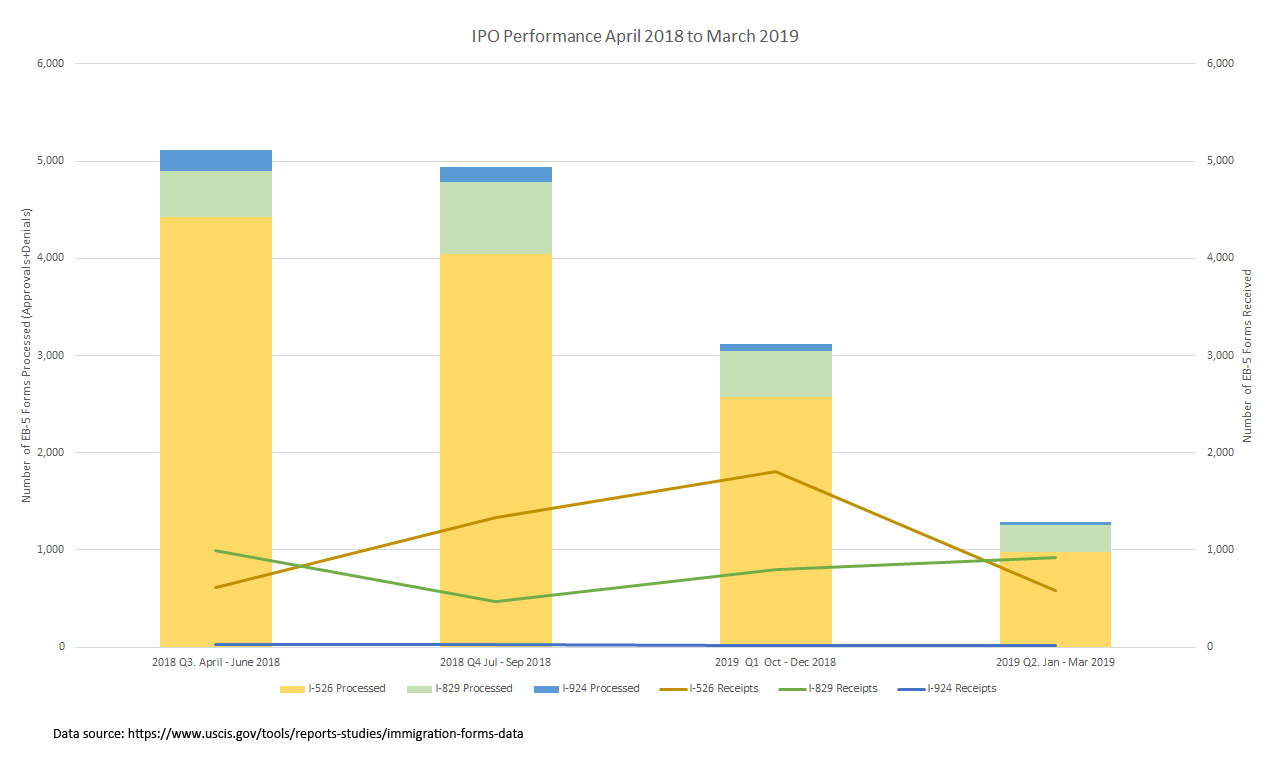
USCIS has updated the Immigration & Citizenship Data page with data for petitions processed in FY2019 Q2 (January to March 2019).

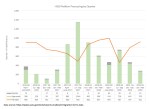
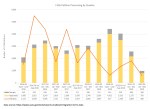
The results are shocking. Instead of recovering from the already-dramatic 37% decrease in processing volume last quarter, IPO processing volume fell another 60% in Q2. To look at raw numbers, IPO was processing over 4,000 I-526 per quarter this time last year, but processed less than a 1,000 I-526 in FY2019 Q2. Four times fewer! USCIS apparently does not deign to hold EB-5 stakeholder meetings anymore, so we do not know what is happening behind the scenes. But a huge reduction in output has a limited number of possible explanations: drastic reduction in staff at IPO, drastic increase in time spent per petition, and/or decision to limit output. Has IPO lost resources in recent months? Is there just a pause on adjudications, for some reason? Perhaps IPO is focused, as it should be, on the oldest case in the backlog, and taking an unconscionable time over those cases?

We care about output, because processing volume determines processing times. If IPO is processing four times fewer petitions per quarter than last year, then obviously the backlog will reduce more slowly than we’d thought in 2018, and processing times will increase accordingly. The following scary chart allows visualizing how many quarters would be required to process the backlog, if FY2019 Q2 volumes were to continue going forward.

Nevermind the 25-40-month range for I-829 in the current USCIS processing times report; the average I-829 filed on top of the backlog in January 2019 would take 93 months to process if FY19 Q2 volumes continue. But surely this exponential output reduction must be an unnatural aberration and cannot continue indefinitely! In all its history, IPO has never shown such meager performance across the board as in the last two quarters. Meanwhile, note that receipts remain low.


See my EB-5 Timing page for links to past reports, and the EB-5 Timing Estimates page for customized timing analysis. Considering recent fluctuations, I’ve updated my estimate templates to facilitate modeling alternate scenarios.

Petition Processing Times Report Change, RC List Updates

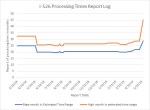
The USCIS page to Check Case Processing Times, which updates at irregular intervals, has just published dramatic new time estimates for EB-5 forms.

  • I-526 Processing: Estimated time range of 29 to 45.5 months (the previous update gave a range of 22 to 28.5 months)
  • I-829 Processing: Estimated time range of 25.5 to 40.5 months (the previous update gave a range of 30 to 38.5 months)
  • I-924 Processing: Estimated time range of 22.5 to 44 months (the previous update gave a range of 16.5 to 21.5 months)

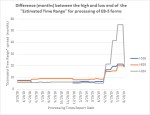
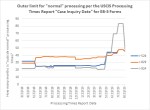
These charts picture the latest update in context of past reports (which I’ve logged in this file since 2014).


What’s the story behind the changes to estimated processing times? I have a few thoughts.

  • All we know for sure is that the report changed. Actual processing times may or may not be changing.
  • The major report change is in the spread between the high and low end of the “estimated time range.” Previous processing time report updates since early 2018 had around a 6-month spread; today’s report shows a 15+ month spread. I guess that USCIS is motivated here to redefine what counts as normal processing times by including outliers in the average. The high end of the estimated time range always roughly corresponds to the “Receipt date for a case inquiry” in the processing report. The report page states this purpose for the case inquiry date: “to show when you can inquire about your case.” By suddenly adding 1-2 years to their estimate of what can be considered “outside normal processing time,” USCIS effectively cuts the number of petitioners who can hassle them with inquiries about overdue petitions. An understandable possible reason, even if the processing speed and backlog have not in fact changed.
  • The new report gives these receipt dates for case inquiry: I-526: 9/15/2015; I-829: 2/2/2016, I-924: 10/25/2015. How many petitions filed before those very old dates could possibly still be in the system? We roughly know the answer for I-526, thanks to a report of forms pending as of 10/2018: up to 412 Form I-526 filed before September 2015 could still be pending. That was only 3% of total pending I-526 (though the number ought to be 0).
  • After several quarters of improvement, IPO reduced processing volume in the last reported quarter (Oct-Dec 2018), with 37% reduction from the previous quarter in number of EB-5 forms adjudicated. Lower adjudication volume drives longer processing times. On the other hand, lower receipt numbers (another recent trend) should eventually result in faster processing times.
  • IPO has not engaged with stakeholders since October 2018, when IPO Chief Sarah Kendall praised IPO’s progress thanks to additional resources, reported that IPO was fully staffed with over 200 personnel, and indicated that IPO would be working toward additional backlog reductions in FY19. (I keep a log of communications related to processing times here.)  There’s been no explanation for the overall processing slowdown evident since that positive report.
  • A May 2019 letter from L. Francis Cissna to Senator Tom Tillis discusses recent processing delays across USCIS, and gives EB-5 one mention. “Another cause for delays in processing can be increased litigation. For example … the USCIS Field Operations Directorate is complying with court orders related to the EB-5 program…” (on PDF p. 7) I assume that refers to the Zhang Class Action. Perhaps IPO is slowing new I-526 adjudications as it backtracks to deal with all the petitions that it denied in error over loan proceeds. And USCIS has been targeted by numerous other lawsuits over questionable denials involving the EB-5 “at-risk” requirement. (In other news, this letter is one of Cissna’s last actions as USCIS Director.)
  • We can see what IPO is not doing since October 2018 – not adjudicating many I-526, and not approving or terminating many regional centers. The question: what is IPO doing? IPO is processing more I-829, if the lower low end of the estimated time range in the new processing report gives any indication. That’s a good thing. I hear that IPO has been issuing lavish RFEs, which potentially doubles the work involved in each form processed. That’s less excusable, especially since many RFEs don’t even target problems, but basically just request that originally-filed documents be resubmitted to reflect developments during the adjudication delay.
  • Back in 2011/2012, a processing slowdown presaged a policy shift. At that time USCIS turned against tenant occupancy methodology, and delayed decisions on affected cases while it figured out how to define its objections. The current slowdown makes me wonder if USCIS is again shelving certain cases while it brews more new policy guidance. (Only the policy won’t be called “new,” when announced, since then it couldn’t apply retroactively to pending cases.)

NOTE: Having written so much about timing issues, I’ve now added a EB-5 Timing page to collect links to data and posts related to processing times, visa wait times, and visa availability and allocation. I’ve also created a new service for people who would rather not wade through all the detail themselves, but want to request my timing estimate for their specific situation. See the EB-5 Timing Estimates Page.

RC List Changes

Speaking of reduced activity at IPO, here’s another sparse regional center list update. Just four regional centers have been terminated so far this year, as compared with 79 terminations in the first five months of 2018, and 38 terminations in the first five months of 2017. Just three new regional centers have been designated since January 2019. Is this a new period of welcome stability after the frantic growth and culling of 2016-2018? Or an unnatural calm?

Additions to the USCIS Regional Center List, 04/20/19 to 5/28/2019

  • No new regional center designations
  • Interestingly, four regional centers that were terminated last year have now been restored to the approved list, demonstrating that it’s possible to overcome a termination: EB5 United West Regional Center, LLC, EB5 Affiliate Network Washington, D.C. Regional Center, LLC, Art District Los Angeles Regional Center, LLC, and Greystone EB5 Southeast Regional Center LLC. (No decision documents have yet been posted for these RCs. For Greystone, USCIS has posted the termination reason but not the sustained appeal.)

New Terminations

  • America Commonwealth Regional Center (terminated 5/10/2019)
  • American Opportunities Regional Center, Inc. (terminated 2/15/2019)

FY2019 Q1 EB-5 Petition Processing Statistics

USCIS has updated the Immigration & Citizenship Data page with data for petitions processed in FY2019 Q1 (October to December 2018).

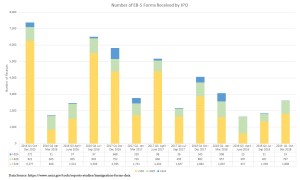
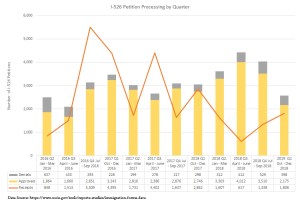
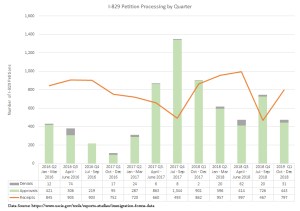
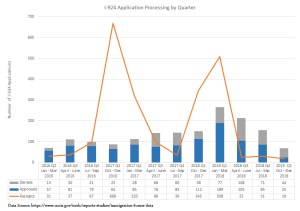
The data shows that the Investor Program Office had an unproductive first quarter, with the fewest EB-5 forms processed since 2016. No wonder processing times remain long. Sometimes the data reflects a workload trade-off (e.g. fewer I-526 but more I-829 processed), but FY19 Q1 just had very low output overall. What’s up, IPO? Are you losing staff? Burning time with extreme-vetting RFEs? I-526 and I-829 receipts were up from the previous quarter, but still relatively low.

The All Forms report is interesting as a reminder of just how small EB-5 is in the grand scheme of employment-based petitions, and because the report now has separate line items for I-924 and I-924A.

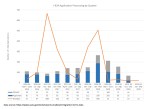
All regional centers that want to remain in good standing should file the I-924A annual report between October and December, yet the report shows only 322 I-924A receipts for Oct-Dec 2018. Did the rest of the 885 currently-approved regional centers decide that designation isn’t worthwhile anymore? Or does the report not capture actual I-924A submissions? Certainly I-924 filings remain very low. No surprise considering the high form fee, the difficulty of operating in the current environment, and the fact that exemplar approvals have no value if they come too late to be usable.

UPDATE: I’ve added a EB-5 Timing page to collect links to data and posts related to EB-5 visa availability, visa allocation, and wait times. If you would like to order a personalized timing estimate, see the EB-5 Timing Estimates Page.

RC List Updates

There has been little activity on the USCIS regional center list since the beginning of the year.

Additions to the USCIS Regional Center List, 12/31/18 to 04/19/19

  • BC East Coast Regional Center LLC (Pennsylvania)
  • EB5 Affiliate Network Washington, D.C. Regional Center, LLC (District of Columbia)
  • Pride Capital, LLC (New York)
  • Greystone EB5 Southeast Regional Center LLC (former name Greystone Florida Regional Center LLC) (Florida) (This RC had previously been terminated for inactivity — termination letter here.)

Removed from the approved list, but not added to the terminated list

  • Three Streams Mid-Atlantic Regional Center (Maryland)

New Terminations

  • San Francisco Regional Center (California) Terminated 2/13/2019
  • Midwest Investment Fund, LLC (Indiana, Kentucky, Ohio) Terminated 2/5/2019

USCIS email: Zhang Class Action

From: U.S. Citizenship and Immigration Services <uscis@public.govdelivery.com>
Sent: February 12, 2019 3:55 PM
Subject: Class Action Member Identification Notice

On Nov. 30, 2018, in Zhang v. USCIS, No. 15-cv-995, the U.S. District Court for the District of Columbia certified a class that includes any individual with a Form I-526, Immigrant Petition by Alien Entrepreneur, that was or will be denied on the sole basis of investing loan proceeds that were not secured by the individual’s own assets. The U.S. District Court for the District of Columbia vacated these denials and ordered USCIS to reconsider the petitions.

If you believe you have received an I-526 denial solely on this ground and would like to identify yourself as a potential class member, please email USCIS.ImmigrantInvestorProgram@uscis.dhs.gov, using the subject line “Zhang Class,” and provide the following:

  1. Name
  2. Alien Number (if any)
  3. Date of birth
  4. I-526 receipt number (if available)
  5. Date of I-526 denial
  6. Copy of I-526 denial (if available)

Note: Identification as a potential class member is subject to USCIS verification and does not grant any immediate rights, as immigrant petitions must meet all eligibility requirements and the court’s decision is presently under consideration for appeal.

USCIS has also posted a notice at https://www.uscis.gov/eb-5

Background:   Zhang et al. v. USCIS et al. addressed whether loan proceeds invested as cash constituted “cash,” as the plaintiffs claimed, or “indebtedness,” as USCIS claimed. The court ruled in favor of the two EB-5 investor plaintiffs, and also agreed to certify a class that comprises all I-526 petitioners who received or will receive I-526 denial solely on the ground that a loan used to obtain invested cash fails the collateralization test created by IPO in a 2015 IPO Remarks announcement. The court vacates USCIS denial of class members’ petitions, and remands the denials to USCIS for reconsideration. For more analysis, see 5 Things to Know About Ira Kurzban’s New “Use of Loan Proceeds for EB-5” Decision by the D.C. District Court (Wolfsdorf, Barnett)

Updates (reauthorization, visa cap, redeployment, AAO decisions)

Reauthorization

There seems to be optimism that Congress and President Trump will agree before February 15 on a deal to fund the government for 2019. I assume and trust that the deal, when unveiled, will include extension of regional center program authorization at least to September 30, 2019. [Update: H.J.Res 31, which became law on 2/15, has regional center program authorization to 9/30/2019 in Division H, Title 1, Sec. 104 (PDF page 463), and no other changes that affect EB-5.]

Luckily for EB-5, the case against it has been taken up by the pariah Rep. Steve King. Last month he introduced H.R.773 – To terminate the EB-5 program, proposing that EB-5 be erased from the INA, and that DHS cease to accept new petitions and dismiss all pending petitions and applications. The bill has gained 0 cosponsors, reflecting what other lawmakers think of this proposal and/or of supporting anything associated with Steve King.

Visa Availability

The per-country cap for EB visas continues to be an issue in the new Congress, with at least two new bills proposing to eliminate it: H.R. 1044 ‘Fairness for High-Skilled Immigrants Act of 2019 and S.386 – A bill to amend the Immigration and Nationality Act. These bills have quite a few cosponsors. This time around, IIUSA has taken a stand on the issue. “While the elimination of per-country caps may make sense for some categories, the elimination of the per-country caps for EB-5 will be to the detriment of the program,” stated IIUSA Executive Director Aaron Grau. [2/18 Update: IIUSA has expanded on its statement. 7/1/2019 Update: See my post on Country Cap discussion.]

EB-5 Activity at USCIS

Here’s what USCIS has done publicly so far for EB-5 in 2019:

  • Not finalized EB-5 regulations (or at least, not yet advanced them to OMB for review)
  • Not approved or terminated any regional centers
  • Not published petition processing data for July-Sept 2018 (I expected this to happen by December 2018)
  • Not held or announced any stakeholder engagements
  • Made a couple tweaks to petition processing time reports, each time adding or subtracting a few days. Currently, petitioners can be considered “outside normal” processing times if they are 796 days from I-526 filing, 1,077 days from I-829 filing, or 715 days from I-924 filing.  Dear me. However, I’m hearing anecdotally of I-526 adjudicated within a year.
  • Published a number of AAO decisions on EB-5 appeals (a few of which I discuss below)

Material Change and Redeployment

I have something to add to the redeployment discussion, as a business plan writer who has spent years grappling with the intersection of EB-5 theory and business practice. But until I have time to actually write the post I have in mind, here FYI are two planks to my thinking on the redeployment issue:

  • Carolyn Lee’s analysis of the EB-5 at-risk requirement and its misapplication in redeployment policy. USCIS, be sure to read this article, which helps explain why applying redeployment policy is so hard for us. When a policy makes sense theoretically, then we don’t have to badger you with questions about how to apply it. Then we can figure it out ourselves with reference to the statue/regs/precedents etc., with the help of our smart lawyers. As it is, we do hassle you with questions because there’s a broken link to the established rules, giving us and you no firm foundation to stand on in applying the policy, and leaving us all vulnerable to capricious case-by-case determinations.
  • A number of redeployment complications and constraints arise from the fact that redeployment policy is a subset of the material change policy. In preparation to discuss that aspect of redeployment, I’ve refreshed my post What is Material Change.  The post discusses the theory and links to most AAO decisions that have addressed material change in specific cases.

USCIS decision-making

AAO decisions on EB-5 appeals shed light on an important question: “If anything goes wrong with an EB-5 investment, is there any way to recover?” What if a principal goes rogue and makes off with some funds, but then there’s new management and funds are recouped and put to work again? What if a regional center was terminated, but currently well-placed to promote economic growth? What if a project did not develop as originally anticipated, but can succeed and create jobs in a new direction? These questions fall in policy grey areas, giving the agency leeway for positive flexibility or reflexive naysaying.  Unfortunately, recent AAO decisions show the later trend, and I hope that there will be pushback.

DEC102018_06B7203 Matter of L-X- is one of two decisions on appeal by investors who put money into an NCE originally managed by Emilio Francisco, who was charged by the SEC in December 2016 with defrauding investors. The NCE and other defendant entities went into receivership, it was determined that a portion of EB-5 investor funds had been diverted, and USCIS denied I-526 petitions for NCE investors. In an attempt to salvage the situation, several EB-5 investors executed an LOI with an institutional investor and amended the NCE’s LP agreement to replace the NCE manager, remove the NCE from receivership, provide necessary funding to the NCE, and complete and operate the project. USCIS/AAO claimed to be “sympathetic to the Petitioner’s situation,” but claimed that the investors still could not satisfy EB-5 requirements. Here’s the USCIS/AAO reasoning:

  • The petitioner could not satisfy the “at-risk” requirement if she replaced diverted capital with additional investment, because that new capital would not be her original capital, and Izummi requires showing that the full amount of “original capital” was made available to the NCE to create jobs. “Petitioner must establish the necessary job creation with capital invested at the time of filing, not based on later infusion of additional funds.” (I don’t quite follow the justification from Izummi, or the “original capital” idea generally. Is the thought that the very dollar bills first passed between the investor and NCE must be the same dollar bills used to pay employee salaries? USCIS sometimes talks about a “path of funds” from investment to job creation – as if cash flowed through a business with each note radio-tagged and leaving a colored path as it goes. In practice, investment goes together into a pool and economic activity and jobs and ROI come out of the pool. A “path of funds” from X original dollar to Y job never exists, and USCIS/AAO should not make demands that presume such a path.)
  • If the investor replaced $182,133.33 of diverted capital with $182,133.33 in additional investment, then the petitioner would be committing impermissible material change because that would effectively increase the minimum investment amount from $500,000 to $682,133.33. (Really, USCIS? How does investing more than the required minimum undermine eligibility?)
  • USCIS couldn’t tell whether the Petitioner had actually invested the additional funds, or only intended to do so. (This is a fair point, but why did USCIS raise this issue if against additional investment in principle?)
  • The Petitioner did not demonstrate that all approvals needed for the proposed NCE restructuring had been obtained, making USCIS doubt whether the restructuring could go forward. (Fair point, if true.)
  • The Petitioner did not file an updated business plan to describe the current status of the project and its current job creation potential. (I wonder if this was fundamentally the most important problem with the Petitioner’s appeal. A business plan is a chance to tell a compelling story about use of investment and job creation, reconcile apparent inconsistencies, argue that changes aren’t material, make an eligibility case, and pre-emptively address questions, doubts, and misconceptions that the reader might have. Don’t miss the prime opportunity to tell your story! As a business plan writer, I’m sensitive to the critical and delicate role of the business plan in presenting changed circumstances to USCIS.)

DEC042018_01K1610 Matter of P-A-K  is AAO’s third decision regarding the designation of  Path America KingCo regional center. This decision was compelled by US District Court, where the regional center filed a complaint after the AAO denied its initial appeal and motions to reopen and reconsider. AAO gives 21 pages this time to reiterate the denial, with arguments that can be summed up in this sentence that the decision quotes from INS v. Abudu: “The INS should have the right to be restrictive.” Path America KingCo presents a compelling case for its current and future potential to promote economic growth, but the AAO finds that this isn’t relevant to its current designation status. AAO rests on this technical claim: that appellate decisions are final, and cannot be reconsidered in light of new evidence, but only reassessed in terms of evidence that existed at the time the decision was made. One might think that Path America KingCo deserves designation if it is continuing to promote economic growth, but AAO says no – the relevant issue is whether it was promoting economic growth at the time it was terminated. A different agency might’ve looked at the fact pattern – a company that has good management (now), good projects, and committed investors dependent on the designation – and found a way to say yes. The so-called “balancing test” discussed in prior terminations claims that “we take into account a variety of factors, both positive and negative, that encompass past, present, and likely future actions.” However, it appears that this test does not apply on appeal, as USCIS does not consider positive present or likely future actions once a termination letter has been issued.

Letter to Senator Collins in the USCIS electronic reading room shows USCIS responding frostily to a plea from Senator Susan Collins regarding a small town in her constituency that planned to use EB-5 investment to rebuild after the catastrophic closing of a paper mill. The scenario sounds like textbook example of what Congress hoped EB-5 could do, but it did not move USCIS, which terminated the regional center purchased for the town before the town had a chance to use it, and just offered Senator Collins the cold comfort of filing an AAO appeal. Is this administering the Immigrant Investor Program in a fair and efficient manner? Fair and efficient, I suppose – the RC was apparently inactive prior to being taken over for Millinocket, Maine. But is the decision in tune with EB-5 program logic and objectives? No.

To be fair, AAO appeals sometimes work. JAN252019_01B7203 is an example of a denial that AAO remanded back to USCIS for more precision in identifying specific problems in credibility and eligibility, and for more rigor in assessing relevant evidence.

And as a reminder that court cases also sometimes work, EB-5 investors have another win on use of loan proceeds for EB-5 investment.

11/19 Stakeholder Meeting with USCIS (redemption, redeployment)

Anyone not already depressed and frustrated is welcome to my recording of today’s EB-5 stakeholder teleconference with USCIS.

A commenter asked: can you please clarify what was expected outcome of this teleconference and what did not go well. That’s an excellent question, and makes me admit that the teleconference was no worse than could have been expected. This was the first public engagement with IPO in over a year, and absence makes the heart forget how public engagements work. Public engagements are not the right venue for delivering new policy guidance, so we can’t expect interesting answers to important questions. IPO can’t limit who asks questions, so much time gets wasted in obvious responses to ignorant inquiries. The call did provide some nice program updates and input that didn’t interest me because I’m well-informed and already knew and previously reported on them. But I can’t blame IPO for repeating the information for the general public.

Here’s what I learned:

  • A few pieces of information:
    • “The agency has considered public comments on USCIS’s Immigrant Investor Program Modernization Regulations (NPRM) and is working to finalize this NPRM soon.” (I-829 Division Chief Tisa Weatherall in minute 15) In follow-up questions, IPO declined give any time estimate for EB-5 regulations, or comment on whether they expect the OMB Fall Agenda estimate of 11/00/2018 to be met. The regulations are “moving forward through the formal process.”
    • IPO will put additional resources on I-829 in FY2019
    • “In terms of redemption agreements, we also received questions regarding new language in the recently published Policy Manual, specifically regarding redemption provisions with respect to those I-526 petitions or immigrant visa applications that have been denied. To clarify, agreements allowing redemptions of investors’ equity whose I-526 petitions or immigrant visa applications have been denied are not permissible are not impermissible.” quoting Division Chief Chris Mason at minute 20-22 of the recording. This resolves an ambiguity pointed out by Carolyn Lee in her incisive comments on the New USCIS EB-5 Redemption Policy Update.
    • Division Chief Ricky Murry clarified that the Policy Manual updates on geographic area amendments and regional center boundaries were intended to be separate updates, and were not intended to impose new requirements. IPO thinks that the addition of the word “contiguous” to the geographic area section of the Policy Manual simply harmonizes with the I-924 Form and Instructions, which have used the word “contiguous” since 2010. (at minute 21-22)
    • When a project is completed before the investor achieves conditional permanent residence, the NCE may, can, but above all must redeploy the capital. (at minute 43)
    • IPO has not seen any recent increase in active criminal investigations, and has noted decrease in Requests for Information from law enforcement partners. But it encourages the public to report any known or suspected fraud or abuse. IPO Chief Sarah Kendall pointed out this page on Combating Fraud and Abuse and email address for tips.
    • FYI here are links to other resources mentioned on the call:
  • IPO’s division chiefs sound fresh and sweet, and capable of reading aloud from the policy manual, the USCIS website, and past stakeholder meeting notes. Additional powers were not on display, except from our old friend Jan Lyons who dared at one point to interpret policy in direct answer to a simple question (starting at minute 37), only to have his comments shut down and thoroughly retracted (several times later in the call).
  • These appear to be the available answers to policy questions: (1) let us read to you the current public written guidance, with no comment on what we think it means; (2) the current statutory scheme and regulatory framework limit our ability to address, clarify, or fix this policy, sorry; (3) we make decisions from the gut on a case-by-case basis, and therefore cannot generally state how policy could apply to a fact pattern, sorry; or (4) send an email to the public engagement mailbox and we’ll think about it.
  • IPO has not publicly clarified its policy on further deployment because IPO itself is not sure how to interpret the policy at this time. IPO has not agreed or decided such basics as whether further deployment needs to be in the same geographic area as the original deployment (within the original regional center geographic area or not), whether it needs to be in the same form as the initial deployment (e.g. whether preferred equity must be followed by preferred equity, or could be followed by a loan), whether the redeployment must be in the same type of project (e.g. whether initial deployment in hotel must be followed by another hotel investment), whether the redeployment must be new money in a project or could replace existing financing, what about municipal bonds makes them an option, and when, and how the sustainment rules apply in case of bankruptcy after the job creation requirement was met. IPO at least clarified on this call that these answers do not yet exist – that they’re all points that they still “need to look into,” and about which they have yet to agree internally. Here’s how the call ended at the one hour mark.
    • Public: So can I make one further comment? So a lot of these redeployment deals, they’re going on now, right. So we would like USCIS to apply whatever policy it comes up with prospectively and not retrospectively. Because we’re redeploying now, because we have no choice. We don’t want all of our investors to later get denied because we guessed wrong about what we thought you were ultimately going to come out with. To the extent that we’re redeploying before you come out with a policy, we would greatly appreciate if you don’t, you know, later deny all of our investors for not meeting the policy that hadn’t been promulgated yet.
    • USCIS: So, duly noted. No promises, but duly noted.

USCIS meeting with IIUSA (regs, redeployment, processing times), Analysis of Litigation

Report on USCIS Meeting with IIUSA

Thank you USCIS for posting a complete transcript of the USCIS Meeting with IIUSA on October 5, 2018. Such transparency is so helpful. Program integrity suffers from general lack of information, and from the industry’s inclination to promote asymmetry for what little info is given.

At the meeting, USCIS Director Cissna spoke about current developments in EB-5, IIUSA representatives described areas of concern for the industry, and new IPO Chief Sarah Kendall commented on IPO performance.

The entire transcript is worth reading, but here are the most newsworthy elements from my perspective:

  • Regulations: Director Cissna, speaking in October, did not make it sound as of the EB-5 Modernization regulations (regarding investment amounts and TEAs) were on the brink of finalization. He said: “So on the main one, the proposed rule that has yet to go final, it is going to go final. We’re just not ready yet. We’re still working on it. You might have seen, I testified in front of the Senate a few months ago, back in June, and I got screamed at because Senator Grassley was wanting that regulation to be final even quicker. So I told him what I’ll tell you is the answer hasn’t changed. We are going to finalize it; just we’re not done yet. It’s a lot of work to finalize a regulation. But that should come soon.” And then later “Well, I think, I mean, you asked, you know, what are our priorities for the next fiscal year. I think, you know, putting aside the regulations which we already discussed, I think the main one is continuing to ensure the integrity of the program. That’s what it’s about. The reg., it might take a while yet before it gets finally published.” This is a grain of salt to go with the “last chance in November 2018” marketing pushes currently fueled by the OMB Fall 2018 Unified Agenda, which estimated 11/00/2018 for a final rule.
  • Redeployment: IIUSA representatives spoke strongly for the need to clarify policy around redeployment. USCIS sounded receptive but vague — not as if they are currently working on redeployment policy. Kathy Neubel Kovarik, Chief of the USCIS Office of Policy and Strategy, threw out a couple ideas:  that the industry might submit suggestions for how to clarify the policy, and what if USCIS published the details of approved redeployments for industry reference. IIUSA pointed out pros and cons.
  • Processing Times/Petition Backlog: The USCIS website has only published EB-5 petition data through March 2018, and we desperately want to know numbers for filing and adjudication volume for the year. This meeting transcript includes charts with completion information at least. The charts show a heartening increase to processing volume across all EB-5 forms in 2018 vs 2017: +21.9% for I-526, +2.5% for I-829, and +72.5% for I-924. Ms. Kendall acknowledged that I-829 (or as the transcriber tellingly heard it, “oh, no, we’re not,” haha) has “a bit of a bump going on.” She indicated that “in the next year we anticipate putting additional resources to the [I-829] so that we can address the needs of that particular line of adjudication.” She reports that IPO is now fully staffed with 200+ personnel, spread across FD&S, Fraud Detection and National Security, and Adjudications Management, plus “an excellent support team.”

I will report further when IPO Chief Sarah Kendall speaks at the AILA/IIUSA conference in Chicago next week.

Litigation in EB-5

I’m behind in reporting on litigation and enforcement actions in EB-5, but Friedland and Calderon have picked up the slack with a paper analyzing the couple SEC actions and flurry of investor-initiated litigation this year. Here is their helpful introduction to the paper.

In December 2017 when we released the first edition of “Understanding EB-5 Securities: NYU Stern Database of SEC EB-5 Securities Enforcement Actions,” we were skeptical as to whether there would be sufficient developments in this area to justify annual updates. However, any doubts were removed during the first 10 months of 2018.

Below is a link to our latest paper, entitled “EB-5 Securities – New Developments and Updated NYU Stern Database – 2018 Edition,” with the updated database as an appendix.

Topics covered by this paper include:

  • The pending litigation in the CMB Century Park Hotel case, with a detailed analysis of the Investment Company Act of 1940 aspects of the case, as well as discussing the relevance to this case of the recent SEC Order against CMB even though the Order relates to unrelated projects
  • The 2018 SEC enforcement action, the DOJ prosecution and the pending bankruptcy auction of the Palm House Hotel where an affiliate of the Related Companies is apparently the stalking horse bidder
  • The immediate impact of the 2017 U.S. Supreme Court decision in SEC v. Kokesh based on recent SEC testimony before Congress
  • The SEC settlement with Ariel Quiros, the mastermind of the Jay Peak fraud; a comparison of the distribution of proceeds with the distribution under the Raymond James Financial settlement; and possible SEC Whistleblower awards
  • The pending litigation against USIF alleging a secret restructure of the EB-5 investors’ capital, in its atypical role as an in-house regional center
  • DOJ criminal prosecutions in 2018, as well as expected future prosecutions
  • Unregistered broker-dealer actions, including the recent enforcement action against an immigration attorney wearing multiple hats, and a 2018 US Supreme Court decision prompting a rehearing of aspects of the Hui Feng decision
  • The pending litigation against People’s United Bank for its role in Jay Peak and its potential impact upon other banks’ willingness to establish and maintain EB-5 subscription escrows
  • Updates to our SEC EB-5 Securities Enforcement Action Database
  • Our dim outlook on the likelihood of enactment of EB-5 integrity reform measures, although a recent announcement by OMB, DHS and USCIS provides a glimmer of hope

Link to new paper: EB-5 Securities – New Developments and Updated NYU Stern Database – 2018 Edition

Link to webpage on NYU Stern CREFR site listing our EB-5 research:
EB-5 Research Papers and Articles by Gary Friedland and Jeanne Calderon

EB-5 Engagement 11/19

From: “U.S. Citizenship and Immigration Services” <uscis@public.govdelivery.com>
Date: October 19, 2018 at 11:05:39 AM PDT
Subject: USCIS: EB-5 Immigrant Investor Program: Public Engagement, November 19, 2018
Dear Stakeholder,

U.S. Citizenship and Immigration Services (USCIS) invites you to participate in a public teleconference on Monday, Nov. 19, from 1 to 2 p.m. (Eastern) to discuss the Immigrant Investor Program, also known as the EB-5 program. This engagement is part of our ongoing efforts to enhance dialogue with the public on the EB-5 program.

During the first part of this engagement, we will provide EB-5 program updates. The second part will be a question-and-answer session. We encourage the public to provide questions and comments on the EB-5 program in advance.

To register for this session, please follow the steps below:

  • Visit our registration page to confirm your participation
  • Enter your email address and select “Submit”
  • Select “Subscriber Preferences”
  • Select the “Event Registration” tab
  • Be sure to provide your full name and organization
  • Complete the questions and select “Submit”

Once we process your registration, you will receive a confirmation email with additional details.

We recommend calling in 10 to 15 minutes before the teleconference begins.

Email public.engagement@uscis.dhs.gov by Thursday, Nov. 1, at 5 p.m. (Eastern) and put “EB-5 Engagement” in the subject line if you would like to:

  • Submit questions in advance; or
  • Request a disability accommodation to participate.

Note to Media: This engagement is not for press purposes. Please contact the USCIS Press Office at 202-272-1200 for any media inquiries.

We look forward to engaging with you!

Ombudsman on new RFE and NOID policy, visa timing, RC list updates

New RFE and NOID Policy
Today is the effective date for the new USCIS policy memorandum on issuance of RFEs and NOIDs. Basically, the memo expands an adjudicator’s discretion to simply deny a petition, without first issuing an RFE or NOID to ask questions or request additional evidence. The policy since 2013 has been that straight denials were only allowed for statutory denials – i.e. when there was no possibility that the deficiency could be cured by submission of additional evidence. The new policy opens new ground for straight denial based on failure to establish eligibility based on lack of required initial evidence. The memo says that this is designed to “encourage applicants, petitioners, and requestors to be diligent in collecting and submitting required evidence,” and is “not intended to penalize filers for innocent mistakes or misunderstandings of evidentiary requirements.”

I listened into a Ombudsman’s teleconference on September 6, and heard representatives from USCIS answer questions about the memo. (UPDATE: Here are official notes from the engagement.) The answers indicated that the Office of Policy and Strategy, at least, seems fuzzy on what constitutes “required initial evidence” and “innocent mistakes or misunderstandings.” “Pages left on the copier” was the one example given of an innocent mistake. No examples of innocent misunderstandings – though USCIS clarified that having an attorney or not wouldn’t be a factor. In general, “required initial evidence” means evidence as required by statute, the regulations, and form instructions. But what does it mean specifically? Certainly in EB-5, we see a lot of variation among lawyers and adjudicators in their interpretation of the specific documents required in various situations to satisfy forms and regulations. Now adjudicators will be free to indulge their discretion to interpret requirements, with no chance for response before denial. Meanwhile, lawyers will likely start clogging the system with kitchen sink petitions that throw in every possible document and page in case it’s something that someone might want to see.

On the Ombudsman call, USCIS confusingly promised that they would be publishing “optional checklists of required initial evidence”(?) on September 11. If that’s happened for EB-5 yet, I can’t find it. Last year, USCIS published a suggested order of documentation for each EB-5 form, and two distinct sets of filing tips for each form. (These are on a phantom Resources page not linked to menus on the USCIS website.) The specific suggestions are helpful but not applicable to every case, so I hope they won’t end up getting treated as optionalrequired evidence. But who knows what adjudicators make of all this guidance. USCIS told the Ombudsman that adjudicators had received one day of training on the new policy, and may or may not have supervisory review for denials under the new policy. As before, adjudicators are supposed to fully explain the reasons for any denial in the denial notice, and petitioners have the same appeals recourse as before.

Response to Policy Manual Updates
Anyone not pleased about the August 24 Policy Manual update on Regional Center geographic area will appreciate the points made forcefully by AILA in its Comments on USCIS Policy Manual Guidance on the Geographic Area of Regional Centers (September 9, 2018). AILA dissects the policy itself and the suboptimal process behind it.

Gap between I-526 approval and visa allocation
I realize that my series of timing posts is missing an important piece: analysis of the steps and time factors (for countries with no cut-off date yet) between receiving the Form I-797, Approval Notice for the I-526 and claiming an EB-5 visa number. Especially Indians are trying to calculate: if I can count on receiving I-526 adjudication in the next few weeks, can I count on getting allocated a visa number in the advance of the Visa Bulletin giving a cut-off date for India? The point at which the visa number actually gets allocated, and the factors/timing between I-526 approval and that point, vary between I-485 and consular processing, and I don’t understand it all yet. But potential investors should include this in discussions with counsel, because delays can be considerable for consular processing anyway. I’m hearing reports of USCIS taking at least 3+ months and even 8+ months just to forward I-526 approvals to the National Visa Center. Ironically, it seems that the faster USCIS adjudicates I-526, the more it drags its feet on advancing that approval to the next stage. But this is a developing situation, and I have limited examples. Here is my background reading list so far FYI. Please email me any additional helpful articles and current timing information.

SEC Action
In recent years, the SEC has set examples by bringing complaints against people who misappropriated and misused EB-5 investor money. In its latest EB-5 action, the SEC reinforces a message that it’s also wrong to aid and abet fraud by others. SEC Charges Former Raymond James Branch Manager for Facilitating a Massive EB-5 Fraud (September 6, 2018)

Regional Center List Changes
Additions to the USCIS Regional Center List, 08/21/2018 to 09/11/18

  • Regional Center of Washington State, LLC (Washington)

New Terminations

  • Encore Pennsylvania RC, LLC (EPRC) (Pennsylvania) Terminated 8/20/2018
  • Gulf Coast Funds Management, LLC (Mississippi) Terminated 8/30/2018
  • The Mid-American Regional Center, LLC (Indiana) Terminated 8/30/2018
  • Citizens Regional Center of Florida (Florida) Terminated 8/24/2018
  • Central Texas Regional Center (Texas) Terminated 8/21/2018
  • California Global Alliance Regional Center c/o Lewis C. Nelson & Sons, Inc. (California) Terminated 8/31/2018
  • Invest Midwest Regional Center (former name Civitas Indiana Regional Center) (Indiana) Terminated 8/21/2018
  • L Global Regional Center, LLC (California) Terminated 8/20/2018

WA Updates, Visa Numbers, Ombudsman, RC List Updates

Washington Updates

August passed with no final rule for EB-5 regulations. OMB has not even received the regulations for review. USCIS Director Cissna told Congress in June that he thought it would be tough to finalize the regs before Sept 30, 2018, and I don’t expect any action soon.

The Regional Center program is currently authorized through 9/30/2018, pursuant to Consolidated Appropriations Act, 2018, Division M—Extensions, Title II—Immigration Extensions (PDF p. 702). The RC program could be extended beyond 9/30 explicitly (if Congress passes a 2019 appropriations act that mentions RC program authorization) or implicitly (if Congresses passes a Continuing Resolution that would postpone the deadline for 2018 appropriations, including the program authorizations in Division M Title II). 9/13 Update: The House has introduced a Continuing Resolution that would extend a number of 2018 authorities and authorizations, including Division M Title II, to December 7, 2018. I’m adding status updates to my Washington Update page.

The 2019 appropriations could be a vehicle for other immigration changes as part of the Department of Homeland Security Appropriations segment. The version of the DHS Appropriations Act 2019 voted out of committee in the House includes the Yoder amendment, which would eliminate the per-country limit for EB-5 visas. The Senate version of 2019 DHS appropriations includes no such provision. It remains to be seen what final version will be negotiated by the House and Senate.

Here’s my understanding of the current status, based on this article: Congress faces September scramble on spending (September 3, 2018) The Hill.

  • Spending legislation comprises 12 individual appropriations bills for different agencies. In 2018 these were all packaged together in one “omnibus” with miscellaneous other content; this year, lawmakers want to avoid an omnibus, instead sending individual bills to the President.
  • Senators have passed 9 out of the 12 individual appropriations bills for 2019, but the House and Senate have yet to sort out in conference any of the differences in their bills.
  • One of the three appropriations bills that has not passed the Senate, and that lawmakers do not want to touch until after the midterm election, is the Department of Homeland Security Appropriations Act (which concerns border wall funding, among other contentious issues). A Continuing Resolution may be passed as a stopgap to defer votes on 2019 DHS appropriations (and likely at least two other spending bills) until after November. The stopgap is likely to go into December, but leadership hasn’t yet worked out the details of a short-term bill. If a CR is passed for DHS appropriations, what would defer a decision on the per-country cap to December. (A CR for DHS appropriations would not affect regional center authorization, since RC program authorization is not in the 2018 DHS appropriations act, but rather in a different part of the 2018 omnibus.)
  • In 2018 appropriations, regional center program authorization is not attached to any of the 12 individual appropriations bills, but is in a 13th section – Division M – devoted to program extensions/authorization. The Hill reports that “In the Senate, Appropriations Committee Chairman Shelby and Vice-Chair Patrick Leahy agreed to keep authorizing language out of the appropriations process.” I’m not sure what that means exactly. Could Division M be folded into a continuing resolution to December, which would also extend the RC program sunset date to December? I look forward to advocacy alerts from IIUSA.

Visa Numbers

USCIS has responded to the lawsuit by Chinese investors over the issue of family members in the EB-5 visa quota. This article discusses and analyses the USCIS response: The Government’s Poor Defense of Counting Derivatives against Immigration Quotas (August 27, 2018) Cato Institute

Meanwhile, people from India have an on-going challenge to try estimating the visa queue and cut-off date timing by tracking news on EB-5 visa demand among Indians. China models a hard lesson: do not wait to be surprised by the Visa Bulletin! The visa wait time for an Indian investor filing I-526 today does not depend on today’s Visa Bulletin but on future Visa Bulletins, which in turn depend on the number of other Indians currently filing and currently waiting for I-526 processing at USCIS. 700 visas/year * 1 investor petition/about 3 visas = about 233 investors that can be accommodated per year per country considering the 7% per-country limit. Two groups active in India — Can Am and LCR Partners – each report having over 200 Indian investors in 2018, which means about two-years-worth of EB-5 visas available to India claimed just this year through just two firms. Something to watch.  The timing for a Visa Bulletin cut-off date for India depends on USCIS’s speed in adjudicating Indian petitions and advancing them to the visa stage. (My post from June explains the process in more detail.)

New RFE and NOID Policy

I plan to listen in on an Ombudsman Teleconference on USCIS Policy Updates on the Issuance of RFEs and NOIDs  September 6, 2018, from 2:00pm to 3:00pm EDT. The policy updates are not specific to EB-5, but significant for those of us who help prepare I-526 paperwork. As background, see USCIS Issues Two New Policy Memoranda on Notices to Appear and Denials in Lieu of RFEs and NOIDs – What This Means for You (July 16, 2018) GT Alert

Due Diligence

I frequently get emails from investors asking for investment advice, which I can’t give. But I will say that I appreciated the points in this article How Transparent are EB-5 Project Managers (July 11, 2018). If I were a prospective EB-5 investor, account transparency, communication, and independent oversight would be major factors in my investment decision. See also Friedland & Calderon’s article EB-5 2.0: Can Account Transparency Save the Program? (Draft December 6, 2016).

Updates from USCIS

After having hosted EB-5 engagements almost quarterly since 2010, USCIS is now on track to go an entire year with no EB-5 stakeholder meeting. Does this relate to leadership turnover at IPO, I wonder? A wish not to discuss the unfinalized regs, unwritten redeployment policy, and fluctuating processing times? One suspects that no news isn’t good news. Please talk to us, IPO. Maybe we can help.

Regional Center List Changes

Additions to the USCIS Regional Center List, 08/02/2018 to 08/21/2018

  • APRC Mesa Verde, LLC (Colorado)

New Terminations

  • APIC Regional Center, LLC (Oregon) Terminated 8/8/2018
  • Build America Capital Partners Regional Center LLC (California) Terminated 7/31/2018
  • Washington State Regional Center (Washington) Terminated 7/31/2018
  • American Bridge Seattle Regional Center, LLC (Washington) Terminated 8/1/2018
  • Saipan Regional Investment Center, LLC (Commonwealth of Northern Marianas Islands) Terminated 8/8/2018
  • American Altin Regional Center (California) Terminated 8/8/2018
  • Great Ocean Regional Center (Washington) Terminated 7/30/2018
  • Future Resources, Inc. (California) Terminated 8/15/2018
  • North American Regional Center (New Jersey, New York, Pennsylvania) Terminated 8/2/2018
  • Build America Fund 1, LLC (California) Terminated 8/9/2018
  • California International Regional Center LLC (California) Terminated 7/10/2018

RC Designation and Terminations, SEC (Palm House), RC List Updates

Regional Center Terminations

USCIS has now posted notices for regional centers terminated through March 2018, and I’ve added them to my termination log. Now we know the reasons behind about two thirds of the 250 regional center terminations to date.

USCIS has framed its activity in terminating regional centers as an integrity measure, but in fact only 11% of terminations so far have been due to integrity problems. The majority of terminations have been because (1) the regional center has not secured EB-5 investment in the past three or more years, and/or (2) USCIS did not receive the regional center’s Form I-924A annual report and fee on time for the most recent year.

The letters themselves are interesting for discussion of a topic not fully explained by the regulations or policy: what does it mean to promote economic growth? What must a regional center do, exactly, to justify its continued existence? How can the definition of “failure to promote economic growth” be stretched to cover the various reasons USCIS might want to terminate a regional center in practice?

A few noteworthy letters from the most recent batch posted on the USCIS website:

  • Some might see Lansing Economic Development Corporation Regional Center as a model of regional center worth: the economic development agency of a distressed city using EB-5 as a tool in its economic development toolkit. This development agency reported that it promoted the EB-5 option in multiple trips to India, China, Italy, and throughout Europe, and offered EB-5 as an option to all development projects in Lansing. However, USCIS found that “While these activities are necessary for the continued operation of any regional center in the EB-5 Program, it does not show that the Regional Center has engaged in activities that promote economic growth as understood under the EB-5 Program. Specifically, these actions have not resulted in increased export sales, improved regional productivity, job creation, or increased domestic capital investment in the Regional Center’s designated geographic area.” Whatever its promotional activities, the regional center had not yet secured any EB-5 investment, and its potential projects did not include a shovel-ready project certain to use EB-5 investment. Therefore “USClS concludes that the Regional Center no longer serves the purpose of promoting economic growth.”
  • Live in America-Midwest Regional Center is an example of an as-yet inactive regional center that’s part of an active network. USCIS issued the RC a Notice of Intent to Terminate for three years of I-924A that did not report any EB-5 investment. The Regional Center countered by pointing to successful projects sponsored by other regional centers in the Live in America network, arguing that this demonstrates LIA’s proven ability to get projects done, and potential to promote economic growth in the regional center geography. The RC indicated that is exploring and actively seeking investment opportunities,  has met with EB-5 project candidates, and has entered into strategic partnerships. USCIS responded that the RC cannot rely on evidence of projects outside its approved geographic area, and that the future plans described are merely “future aspirational goals,” and do not count as “actually engaged in the promotion of economic growth.”  Having an operator that’s been demonstrably successful in promoting economic growth did not save Live in America-Midwest Regional Center from termination. Sorry, Minnesota! The Midwest has had any regional centers at all thanks in part to serial regional center operators who can afford to give low-profile geographies a chance because they also have feet in New York and California. But USCIS appears less willing to give the Midwest a chance. Attract EB-5 investors within three years (or at least, get term sheets and file an I-924 amendment) or thy regional center designation shall be terminated.
  • Charlotte Harbor Regional Center is a cautionary tale of what can happen when a regional center does not have copies of documents submitted by its investors to USCIS in I-526 petitions.
  • USCIS terminated Greater Houston Investment Center, LLC for inactivity, and declined what seems to me a sensible request: the option to reactivate designation if a project opportunity presents itself in the future.
  • America’s Regional Center was terminated in 2017 for lack of activity (no investors in 3 years), but was restored on July 5, 2018 to the list of approved regional centers. No appeal has been published, so I don’t know how the RC overcame the termination decision.
  • Powerdyne Regional Center‘s mistake was to hire a President who turned out to be a wanted man in China.
  • These regional centers presented USCIS with evidence of EB-5 projects in the pipeline, but USCIS argued that the projects were insufficiently advanced or showed insufficient commitment to EB-5 financing. Liberty South Regional Center, EB5 Memphis Regional Center, LLC, North Country EB-5 Regional Center, LLC, Guam Strategic Development Regional Center, Immigration Funds, LLC
  • New Orleans Mayors Office of Economic Development got a 36-page termination notice that fits six termination reasons under the general umbrella of failure to serve the purpose of promoting economic growth. These are: lack of activity (only one project since 2008, and no new job creation/investment since 2013), lack of progress in the construction of the regional center’s one project, doubt about the legitimacy and viability of the portfolio business model used, material misrepresentations that cast doubt on the regional center’s legitimacy (Form I-924A reports that were inconsistent with each other and evidence that USCIS determined independently), improper use of EB-5 capital that casts doubt in investor’s ability with EB-5 requirements, and diversion of EB-5 funds (outside of the regional center geography, and inconsistent with the job creation purpose).  Generally the termination comes as no surprise, since the New Orleans Mayor’s Office made the mistake of hiring operators for their regional center who proceeded to loot investor funds (or so alleged investors as early as 2012 and the Department of Justice in 2018). USCIS did not consider the Mayor’s suggestion that her office might continue to use EB-5 as a tool for job creation and growth in New Orleans under a different operator. The decision includes this paragraph that reads like policy, though it’s not written elsewhere,
    • The reasons why a regional center may no longer serve the purpose of promoting economic growth are varied and “extend beyond inactivity on the part of a regional center.” 75 FR 58962. For example, depending on the facts, a regional center that takes actions that undermine investors’ ability to comply with EB-5 statutory and regulatory requirements such that investors cannot obtain EB-5 classification through investment in the regional center may no longer serve the purpose of promoting economic growth and may subvert a purpose of Section 610(a)-(b) of the Appropriations Act, which provides for regional centers as a vehicle to concentrate pooled investment in defined economic zones by setting aside visas for aliens classified under INA 203(b)(5). Likewise, a regional center that fails to engage in proper monitoring and oversight of the capital investment activities and jobs created or maintained under the sponsorship of the regional center may no longer serve the purpose of promoting economic growth in compliance with the Program and its authorities.

Most of the termination letters have little discussion, but appear to reflect a simple bright line: you didn’t attract an EB-5 investor in three years and thus are not promoting economic growth and lose your designation. This line can look reasonable, but I also see it threatening the regional center program’s basic potential as an economic tool. Consider that according to a list of investor petition approvals by regional center (briefly published by USCIS in June 2017), only 328 out of around a thousand regional centers had had one or more I-526 adjudicated from 2014 to 2017. Of those 328 regional centers, the majority were located in New York, California, Florida, Washington D.C., Atlanta, Chicago, Seattle, or Texas. If USCIS keeps terminating every regional center that’s not immediately popular with investors and active projects, the program will soon be left with few regional centers (and thus little opportunity to use the program) outside New York, California, Florida, Washington D.C., Atlanta, Chicago, Seattle, and Texas. That certainly wouldn’t match Congressional intent for economic impact. And how does it even benefit USCIS? How much would it cost USCIS to keep the generally blameless Economic Development Corporation of Lansing, Michigan on the list of regional centers, even if that RC doesn’t have EB-5 investors yet? (On the other hand, this position paper on regional center terminations makes the case that inactive RCs burden the system and are incompatible with the RC program as defined.)

SEC Action

The SEC has announced its first EB-5 fraud action this year: Securities and Exchange Commission v. Palm House Hotel LLLP, et al., No. 9:18-civ-81038 (S.D. Fla. filed August 3, 2018).  The SEC is rather late to the party, following United States of America v. Robert V. Matthews and Leslie R. Evans (3/14/2018) and a civil suit filed by EB-5 investors in 2016. (Though not as late as USCIS, which has not terminated the regional center involved even as it hustled to terminate Lansing EDC.) The allegations are familiar: misappropriation of investor funds by people who arranged to have unfettered access to those funds. I note that the SEC’s list of defendants is much shorter than the list of defendants in the complaint by investors. The SEC identifies the regional center principals as responsible for misrepresentations, while investors also felt misled by the consultants and service providers involved.

Processing Times

USCIS updated the Processing Times page on August 1, with improvements for all EB-5 forms (-23 days for I-526, -5 days for I-829, and -63 days for I-924).

Washington Updates

As I hear anything new on the Yoder amendment with potential to remove per-country limits for EB-5, I add it to my previous post. Not that I have heard much. Since the explosion of conflicting comment on my post, perhaps others in EB-5 have learned better than to make statements on this topic. (Update: IIUSA has finally made a comment.) I guess that response has also been complicated by the difficulty of reading the amendment text; it appears that even Yoder and the House appropriations committee may not have initially understood what was actually in it. I hear that my reader comments are being noticed and appreciated, and I hope that those comments help inform discussions among the powers that be.

I keep an eye on www.reginfo.gov just in case EB-5 regulations should proceed after all to the review stage in time to be finalized in August 2018. But nothing there yet.

Regional Center List Changes

Additions to the USCIS Regional Center List, 7/16/2018 to 08/02/2018

  • Cypress Regional Center LLC (California)
  • Liberty Harbor Regional Center LLC (Connecticut, New Jersey, New York, Pennsylvania)
  • Lighthouse Regional Center, LLC (Texas)
  • My Life Atlanta Regional Center, LLC (Georgia)
  • Rise Investment Management, LLC (Connecticut, New Jersey, New York)
  • Tinian EB-5 Regional Center, LLC (Commonwealth of Northern Marianas Islands)

New Terminations

  • Northeast Ohio Regional Center (Ohio) Terminated 7/18/2018
  • Nevada Development Fund LLC (Nevada) Terminated 7/12/2018
  • Americas Green Card Regional Center (Maine, Massachusetts, New Hampshire) Terminated 7/12/2018
  • Chicagoland Foreign Investment Group (CFIG) Regional Center (Illinois, Indiana, Michigan, Minnesota, Wisconsin) Terminated 7/16/2018
  • EB5 United West Regional Center, LLC (California) Terminated 7/27/2018
  • Fairhaven Capital Advisors American Samoa Regional Center Corp. (American Samoa)
  • Cal Pacific RC LLC (California) Terminated 7/16/2018

FY2018 Q2 EB-5 Form Processing Statistics

USCIS has updated its Immigration and Citizenship Data page with statistics on forms received, processed and pending in the second quarter of FY2018 (January to March 2018). Form I-526 and I-829 are in the Employment Based subsection, and Form I-924 is in the Forms subsection in the “All Forms Report.”

My charts below summarize FY2018 Q2 data compared with previous quarters, and highlight trends. A few notes:

  • IPO processed a few more forms in FY18 Q2 than ever before. It’s nice to see processing trend in a positive direction, and a new record set. Once could wish for more dramatic improvement. The chart of quarterly processing volume over the past three years shows a very gradual upward trend. I-526 and I-924 volume (approvals+denials) improved significantly in Q2, but net improvement remained low when considering reduced I-829 volume.
  • Form receipts at IPO reflect a gradual downward trend, driven by falling I-526 receipts. However I-526 receipts remain unsustainably high. The 10,000 annual quota of EB-5 visas means that the program can accommodate about 830 I-526 per quarter on average (assuming about 3 visas per investor). FY18 Q2’s unusually low 1,607 I-526 receipts is still almost twice the sustainable average: one quarter’s filings sufficient to claim half a year of visas.
  • Form I-924 receipts and processing were both significantly elevated in FY18 Q2. No wonder I-924 processing times look better than expected. I-924 denial rates remain high.
  • I-829 receipts grew in FY18 Q2, even as processing volume fell again, with fewer I-829 processed in Q2 than in any of the previous three quarters.
  • If we could predict processing times by dividing number of pending forms in Q2 by number forms processed in Q2, then I-526 would take 17 months, I-829 36 months, and I-924 16 months. This prediction differs from the month ranges currently in the USCIS Processing Times Report: 20-26 months for I-526, 30.5-39.5 months for I-829, 19.5-25.5 months for I-924. I tried several equations with the pending and volume numbers, and (unlike last quarter) didn’t find one that neatly replicates the USCIS processing time calculation.
  • In case I-829 petitioners didn’t have enough to worry about already, the I-829 data doesn’t look right. The FY18 Q2 report reviews Q1 data, as follows: 694 receipts, 6,251 pending. But the Q1 report published in May had quite different numbers for Q1: 1,046 receipts, 6,673 pending. To where did those 352 receipts and 422 pending petitions from Q1 disappear? Or maybe they didn’t disappear, but joined other petitions of unknown origin, since the number of petitions reported pending at the end of Q2 (7,447), is higher by almost a thousand than what one would expect from taking Q1 pending petitions plus Q2 receipts minus Q2 approvals and denials. Hope USCIS can soon modernize beyond paper and counting sticks for keeping EB-5 records. Or am I missing something?