3/8 House EB-5 Hearing (TEA & Investment Amounts)

Today’s House Judiciary Committee hearing on The Department of Homeland Security’s Proposed Regulations Reforming the Investor Visa Program focused on changes to the EB-5 investment amount and TEA incentive proposed by USCIS in its Notice of Proposed Rule-making EB-5 Investor Program Modernization (DHS Docket No. USCIS 2016-0006).

The hearing opened with statements from the Congressmen responsible for two of last year’s reform bills – Senators Grassley and Leahy, and Representatives Goodlatte and Conyers. All four expressed support for USCIS’s proposed EB-5 regulations, though Leahy and Conyers also argued that there’s no substitute for a legislative solution. Leahy said that he and Grassley will soon reintroduce their reform legislation (an interesting development); Goodlatte and Conyers did not say anything about sponsoring legislation. All four made almost the same points as in last year’s House and Senate hearings, but sounded a darker note this year – turning “mend it or end it” from a question into a threat. Representatives Sensenbrenner and Lofgren followed with relatively positive statements, listing EB-5 successes and contributions, but both agreed on the need for modernization (higher investment amounts) and reform (TEA adjustments). The Committee then heard testimony from and questioned a panel including the GAO (recapping its Sept. 2016 study on TEA use in EB-5), regional center operators (ably represented by Angelique Brunner and Sam Walls III), an organization that specializes in property revitalization and blight prevention, and an anti-immigration activist. Oddly, USCIS was not represented. (Speaking of which, Colucci’s reponses for the record from last year’s Senate hearing are worth reviewing.)

I don’t have time report on all the details (you can watch the video and read the testimony), but conclude with a few general impressions. Not one of the Representatives who spoke opined that EB-5 is just fine the way it is – all expressed at least one concern, and sounded ready to support mending (if not ending) the RC program.Likewise, no one on the Committee side advocated for canceling the proposed Obama-era regulations – the only question was whether Congress should take back the policy-making ball and act first.  I heard little sympathy for the industry position that USCIS’s proposed investment amounts are too high and its proposed TEA incentive too restrictive. (Lofgren (D-CA) and Nadler (D-NY) spoke out for qualifications considering the urban context and investor demand, Goodlatte noted that he’d been willing to accept less drastic proposals, and Brunner advocated for market-based alternatives.) Goodlatte and Lofgren both raised the specter of retroactivity, which they didn’t call “changing the rules of the game midstream and thus derailing thousands of good-faith investors and projects and job creation” but rather “implementing reform now, instead of postponing it 7-8 years until the backlog is through the system (while not blaming ourselves for the legislative lollygagging that spurred the surges/backlogs)” Even David North was taken aback by the suggestion that Congress could impose a retroactive new investment amount, but apparently Mr. Goodlatte still hasn’t been shown how disastrous and counterproductive such a move would be.  What are you doing, industry advocates, besides earning a bad reputation for obstruction?  This hearing also suggested that Congress isn’t being informed about direct EB-5, and hasn’t considered the impact of investment amount, TEA, and job allocation changes outside the regional center context. Generally, I came away from the hearing with a sense that the House Judiciary Committee agrees about the need for some EB-5 program changes, recognizes program benefits but is more angry than before about flaws, and has progressed little since last year toward refining or agreeing about specific proposals for change.  (However a lobbyist speaking to The Real Deal pointed out that the hearing was not well attended by Judiciary Committee members, so the views expressed may not be representative.) There’s reportedly EB-5 reform legislation cooking behind the scenes, but we didn’t get any preview at this hearing, and the clock to the next regional center program sunset date on April 28 is ticking loudly.

3/3 USCIS EB-5 Stakeholder Engagement (I-829 division, RC geographic area, site visits, filing tips)

Today’s EB-5 Stakeholder Engagement with USCIS provided a number of important updates. (3/20 UPDATE: USCIS has now uploaded copies of prepared statements by Colucci and Harrison.) I have uploaded my recording, and summarized a few highlights.

  • EB-5 Petition Statistics: In October to December 2016, IPO saw a continued surge in petition filings, with 4,395 I-526 petitions received, 752 I-829 receipts, and 184 I-924 receipts. During that quarter, IPO processed 3,583 I-526 petitions (a record high), 112 I-829 petitions (a near-record low), and 88 I-924 petitions. IPO is now reorienting resources toward I-829, after having previously prioritized I-526 and I-924. Mr. Colucci commented that IPO processed more I-829s last month than in all of last quarter.
  • IPO Staffing: IPO is subject to the executive freeze on Federal agency hiring; however, USCIS has requested exemptions for certain “mission-critical” positions, and IPO has received an exemption for its adjudicator position. IPO now has 157 employees (below their target of 171 employees for the end of last year). IPO is authorized to hire up to 247 employees this fiscal year, subject to the hiring freeze and any exemptions. Increased staffing is IPO’s primary strategy for improving processing times.
  • I-829 Processing: In October 2016, IPO created a new division to focus on Form I-829 adjudications and customer service inquiries. The division will have three teams, with eight adjudicators and economists on each team. The most senior member of each team will interview I-829 petitioners, with most interviews conducted remotely with assistance from local field offices. (As previously stated, the I-829 petitioner can bring her counsel, qualified interpreter, and a representative from the regional center if applicable.) IPO expects I-829 adjudication output to improve significantly once this division is fully staffed and trained. There are currently 18 of 24 people on board, including three senior economists and three senior adjudicators who are working to cross-train for improved efficiency.
  • RC Reporting: IPO says that they will “soon” publish regional center termination notices in the USCIS Electronic Reading Room to promote transparency about reasons for termination. They are also planning to publish petition approval and denial statistics for each regional center.
  • Compliance, Audits, Site Visits: IPO has grown its compliance unit to become a division that oversees pooled investments (both regional center and pooled direct investments) with three branches to review I-924A, issue termination notices, and oversee audits (the first of which is scheduled for next month). IPO has trained 13 site inspectors from around the country, and expects to conduct about 250 EB-5 project site visits this year. IPO reassured stakeholders that IPO would interpret any site visit results in context, and would not make decisions based on the info before notifying petitioners through RFE or NOID. There are two types of site visits: for-cause visits triggered by questions about the project, and random visits that are scheduled at some point between I-526 approval and I-829 filing.
  • Policy: IPO plans to publish content related to sustained investment “in the near future” in the USCIS Policy Manual (rather than finalizing the draft August 2015 policy memo). IPO reviewed comments on the Policy Manual but does not plan any changes in response to the comments.
  • Regional Center geographic area expansion must now be approved BEFORE I-526 petitions can be filed: Here is a transcription of what Lori Mackenzie said (starting at minute 25 of the recording):

    UPDATE: These remarks from the meeting have now been superseded by Lori MacKenzie’s published remarks.
    We also received some questions related to the new Policy Manual publication as well as to the new I-924 Form release, which was effective on December 23, 2016, and the question really does relate to an expansion of geographic scope of a regional center. So just to give everyone a little bit of background around that. There is some guidance in the May 2013 Policy Memo that talks about how to expand geographic scope. After that guidance, we published the Policy Manual in November of 2016 which superseded that guidance, and then on December 23 we issued some guidance with respect to the Form I-924 and the instructions for filing the Form I-924. And so the question really relates to ‘if a Regional Center has filed an I-924 amendment requesting an expansion of geographic scope, may concurrent I-526 petitions be filed in the meantime relying on such proposed expanded geography?’ And the response to that is a little tricky, so you might want to take a few notes. We will continue to adjudicate all petitions filed prior to December 23, 2016, which is the effective date of the new Form I-924, under the prior guidance. So the May 2013 policy guidance holds for that. Petitions filed on or after December 23, 2016 must follow the current guidance, which means that Form I-526 petitions based on an area not previously approved will be deniable due to ineligibility at the time of filing. Note that in May 2016, prior to publication of the final revised Form I-924, we did provide the public with an opportunity to comment on this process by publishing the draft form in the Federal Register.

    I had been wondering about this issue, ever since I noticed that the November 2016 USCIS Policy Manual dropped two little words — “geographic area” – out of the May 2013 Policy Manual’s sentence about changes not requiring an amendment. However, both the Policy Manual and the new I-924 Instructions only said that amendments need to be filed, and we didn’t hear until today that IPO also demands that they be approved before investors can file I-526. Stakeholders strongly encouraged IPO to reconsider this surreptitious policy change, which has major implications for in-process projects that relied on previous policy, and which is unworkable considering that USCIS may take over a year to process amendment requests. Robert Divine has published a helpful article that explains the issues and suggests how industry and investors can respond to USCIS’s move:
    USCIS Reneges on Sponsoring Projects Outside Approved RC Area, Claiming it Gave Notice Through “Stealth” Disclosures

  • Filing Tips: IPO noted practices that would facilitate adjudications. They requested that petitions come with a cover letter and table of contents and tab-separated sections; that documents be single-sided, with page-numbers, and not permanently bound; and that copies be clear and legible and come with full translation if applicable. The petition should indicate whether it’s direct or regional center, and whether it’s part of a dual I-924/I-526 filing. I-924 applications need not include organizational and transactional documents unless associated with an Exemplar I-526. If submitting an interfiling with revised documents, highlight changes with yellow highlighter or some other method that is readily noticeable. Petitioners who have decided to abandon the process are requested to notify IPO of the decision to withdraw their petitions.

Washington updates

The article Will EB-5 Survive? (February 23, 2017) in National Real Estate Investor reviews the current status of EB-5 politics.

[See also my more recent post on the 3/8 House Judiciary Committee hearing.]

USCIS EB-5 Training Materials (April 2015)

I just noticed that the FOIA Reading Room on the USCIS website contains a 458-page document with presentations used by IPO in April 2015 to train EB-5 adjudicators. I may be the last person to notice? In case not, I’ve sketched out a Table of Contents and highlights below. The presentations are dated (especially now that the 11/2016 Policy Manual has replaced the 5/2013 Policy Memo and other guidance referenced in this training), but still quite interesting, especially for the examples. Also, because some currently-active adjudicators were trained on this. I’m especially intrigued by the section starting on page 383, which describes a process and checklist used by IPO economists when reviewing regional center I-526 petitions.

Presentation Title Pages Select points of interest (with PDF page numbers)
Capital at Risk 1 – 37 Indebtedness Analysis (6-9), list of red flags for investment (17), comment on shielding risk (20), evidence of business activity (23), comment on construction reserves not at risk (24), examples of redemption agreements and guaranteed returns (25-26), examples of permissible and impermissible escrow conditions and holdback conditions (29-32)
Comprehensive Business Plan 38 – 56 Definition of credibility (47), list of expected supporting documents (48), explanation of labor division between economists and adjudicators in business plan review (50), reminder that IPO reviews the business plan for evidence of capital at risk, not only for job creation (52), list of problems common to business plans not prepared by Suzanne Lazicki (53)
Child Status Protection Act 57 – 76 Explains CSPA age calculation and its effect under visa retrogression
DHS Overview 77 – 99 Discusses coordination with other agencies  (95-96)
Direct Job Creation 100 – 130 Reminder to adjudicators to require evidence of any existing employment at the I-526 stage (121)
EB-5 Overview 131 – 184 Indication that I-924 and I-924A are adjudicated by IPO economists not adjudicators (165-166), stats on petitions received, approved, and denied  and visas issued from 2005 to 2014 (175-178)
Indirect Job Creation for Adjudicators 185 – 210 Clarifies that “economically direct jobs” are one of the three types of indirect job creation estimated by economic models (194); discusses of reasonable inputs (198, 203); comments on model-derived construction jobs (205) and tenant occupancy (206)
Introduction to Standalone I-526 Adjudication 211 – 247 Mainly just summarizes policy
IPO Overview 248 – 281 IPO organizational chart (263) and explanation of IPO roles and duties (264-276)
In-Depth Lawful Source of Capital Issues 282 – 338 Examples of unlawful means (291), examples of income evidence (301-305), how to analyze funds derived from real property (307-312), how to analyze shareholder loans as source of funds (313-315), how to analyze gifts as source of funds (322-325), OFAC and FinCEN
Formation of an NCE and Active Management 339 – 382 Examples of expansion to establish an NCE (350-351), active management example (356-358), ULPA limited partner powers in LP (359) and LLC (370)
Reviewing the Economist Due Diligence Summary 383 – 400 This entire section is extremely interesting, describing how IPO economists review regional center applications and regional center investor petitions. Immigration attorneys may want to pre-emptively structure their case summaries according to the economist checklist described in this presentation
Targeted Employment Area 401 – 423 Comments that state TEA designation letters are usually valid for one year from the date of the letter (414)
USCIS Overview 424 – 458 Just an organizational overview

Articles (Project Oversight, Redeployment, TEA Changes), RC list changes

EB-5 Articles

What to do if you suspect your EB-5 project is in trouble (February 17, 2017) by Catherine DeBono Holmes, Esq., Daniel B Lundy, Esq. and Jeffrey E. Brandlin, CPA, CIRA, CFF
This article gives practical advice for managers and investors in EB-5 investment funds. It offers a checklist of warning signs that an EB-5 project may be in trouble, defines a role for a construction monitor/accountant and lists tasks that person should accomplish, describes monitoring systems that should be in place, suggests steps for investors to take if they are not satisfied with monitoring and reporting, and begins to address the question of what EB-5 investors should do in case of a fraud enforcement action. I particularly recommend this article to EB-5 investors, as a reminder of what they can demand and what they should do after investment. EB-5 managers are not necessarily motivated to meet a high and expensive standard for oversight (a manager affiliated with the project owner may not see the need, an unaffiliated manager may prefer to keep at arms length from the project, and the odd bad actor lives on opacity). EB-5 investors, however, certainly benefit from exercising their rights to active and on-going due diligence. People drafting EB-5 legislation and regulations may also be interested in this article, as they consider appropriate requirements for EB-5 managers.

Standards and Guidelines for Redeployment of EB-5 Investment Funds – A White Paper (February 21, 2017) by Klasko Immigration Law Partners, LLP, Arnstein & Lehr LLP, Jeffer Mangels Butler & Mitchell LLP
This article steps into the grey area that USCIS has left by failing to finalize or replace its DRAFT guidance on the Job Creation Requirement and Sustainment of the Investment for EB-5 Adjudication of Form I-526 and Form I-829 (8/10/1015). At issue is the question of what EB-5 enterprises can do with EB-5 money considering that (1) an EB-5 investor’s funds are required to remain at risk in the enterprise throughout the investor’s conditional residence period, (2) visa backlogs mean that the investor might not be reaching the I-829 stage until up to 10 or more years following the initial investment, and (3) most EB-5 deals involve loans due to be repaid to the enterprise in less than 10 years. The draft guidance memo suggested that “to the extent that all or some portion of the new commercial enterprise’s claim against the job-creating entity is repaid to the new commercial enterprise during the sustainment period, the new commercial enterprise must continue to deploy such repaid capital in an ‘at risk’ activity for the remainder of the sustainment period” and “the capital will not be considered ‘at risk’ if it is merely being held in the new commercial enterprise’s bank account or an escrow account during the sustainment period.” Although this suggestion is questionable, and not final policy, it’s the only indication we have of USCIS’s thinking, and the authors of the above-linked article suggest practical ways to satisfy that standard for sustained investment. The authors explain why investment in publicly-traded or privately-held securities or real estate investment should comply with the “at risk” requirement, and they suggest guidelines for making such investments in a manner that complies with Federal securities laws and state law fiduciary obligations.

EB-5 Proposed Regulations: A Missed Opportunity, Next Steps for Reform (Rev. 2/14/17) by NYU Scholar-in-Residence Gary Friedland, Esq. and Professor Jeanne Calderon, Esq.
In this article, the authors once again address the sticky issue of EB-5 Targeted Employment Areas from an academic rather than industry perspective. They discuss TEA changes in proposed regulations and proposed legislation with reference to their database of EB-5 projects, which is dominated by the kind of large big-city projects that make poster children for TEA reformers. The EB-5 industry will not join the authors in lamenting that the draconian proposed regulations appear doomed by timing, but it should account for and consider effective response to the evidence that the authors present in support of TEA reform.

Regional Center List Changes
Additions to the USCIS Regional Center List, 02/04/2017 to 02/22/2017

  • Invest Guam Regional Center (Guam)
  • Universal Regional Center (California)
  • Discovery Northeast, LLC (New Jersey, New York, Pennsylvania)
  • Star EB5 Group (Connecticut, Delaware, New Jersey, New York, Pennsylvania)

Understanding USCIS Processing Time Reports–Updated

How long does USCIS take to process EB-5 petitions and applications? We have two sources of data relevant to the processing time question: the IPO Processing Time report, which indicates the filing date of petitions currently being processed, and the Forms Data Page, which gives data for the number of received, approved, denied, and pending petitions by quarter. The first source is helpful for past petitioners, while the second source can be better for current/prospective petitioners estimating future processing times.

IPO Processing Time Report
Every month, the USCIS Processing Time Information page updates a chart titled “Average Processing Times for Immigrant Investor Program Office” that looks like this.
chartWhat does this chart mean?
The single unambiguous function of this report is to indicate when petitioners may begin to complain. A stakeholder email from USCIS in January 2017 explained,

We post case processing times on our website as a guide for when to inquire (service request) about a pending case. For the last several years, we have posted case processing times using two different formats: For cases that were within our production goals, we listed processing times in weeks or months; For cases that were outside of our production goals, we listed processing times with a specific date.
Always refer to your I-797C, Notice of Action, and look for “receipt date” to determine when we accepted your case. If the receipt date on the USCIS Processing Times web page is after the date we have listed on your notice, you should expect to hear from us within 30 days. If after those 30 days, you have not heard from us, you may make an inquiry on your case. We recommend using our e-request tool for all case inquiries.

With this in mind, the table can be read to mean “As of November 30, 2016, we were processing at least some I-526 cases filed as of August 7, 2015. If your I-526 petition was filed before 8/7/2015 and you haven’t heard from us, you may start making inquiries.”

The processing report also allows a general conclusion that the I-526 processing time for investors with an August 2015 priority date was 16 months (November 30, 2016 – August 7, 2015 = 16 months).  (Though we know of people who filed I-526 in August 2015 and got earlier decisions or are still waiting, thanks to one or another exception to the first-come-first-served principle.)

The processing report indicates expected times for past petitioners up to a certain date. (I’ve logged processing times/dates for petitions from 2013 to 2015 in this spreadsheet.) The report does not say anything about the future. Since August 2015, IPO capacity has grown and EB-5 demand has grown even faster. The fact that an August 2015 petition had a 16-month processing time does not promise that a 2016 or 2017 petition will have the same time.

Petition Data
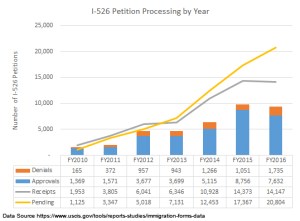
As a prospective EB-5 investor, or someone who filed I-526 in 2016 or 2017, I would look at form filing data to estimate future processing times. For example, see this chart of I-526 data from the USCIS Immigration Forms Data page:

This report provides information commonly used in waiting line models: inventory (pending petitions in the system), arrival rate (petitions received) and flow rate (approved + denied petitions, aka completion rate or throughput).  For an example of how to use this data to make predictions with a simple waiting line model, see the Prediction tab of my I-526 times spreadsheet.

2019 UPDATE: I made an EB-5 Timing page to combine links to articles and resources related to petition processing and visa timing.

S.232 Update, SEC & Attorneys, RC list changes

S.232 Update
Senator Feinstein and Senator Grassley have finally published text for and issued a joint press release on the long-shot S.232 – A bill to terminate the EB-5 Visa Program. The statement from Senator Grassley clarifies what this piece of legislation is really about: “For years, I’ve worked with bipartisan colleagues in good faith to reform it. Unfortunately, despite its many flaws, EB-5 proponents are apparently content with the status quo, and that’s unacceptable. I was hoping that it would not come to this point, but absent serious efforts to bring about reforms, we need to take the necessary steps to wind down the program and completely mitigate fraud, abuse and threats to our security.” S.232 expresses frustration at the progress of EB-5 legislation and makes a hardball negotiating statement: “if you don’t respond to my concerns, here’s what could happen.” The proposal to eliminate EB-5 entirely must be too drastic to gain much support or pass into law, but we should still take the frustration seriously. I can understand why EB-5 industry advocates in Washington DC would settle on a “protect the status quo” platform, that being the path of least resistance to industry consensus, but we cannot afford a reputation for being unserious about reform. We should address each of the concerns that Feinstein and Grassley raise in their press release. We can clarify points that are factually wrong (EB-5 is not green card sale and does not avoid waiting lines, as Feinstein assumes), respond constructively to valid concerns (for example support effective protections in response to past instances of fraud, address questions raised by GAO and Commerce studies on job counts), and have the leadership to offer some considered concessions on the fundamentally divisive issues (such how the targeted employment area incentive should be used, what investment amounts should be). We must not leave oxygen for S.232, or give it excuse to become anything more than a negotiating threat.

SEC Issues for Attorneys
IIUSA has reposted 10 Observations from Reviewing Evidence in an SEC Civil Enforcement Action, an article with good advice for attorneys based on the author’s review of documentary evidence in a civil enforcement action brought by the SEC against an attorney for taking commissions as an unregistered broker-dealer.

RC List Changes
Additions to the USCIS Regional Center List, 12/06/2016 to 02/04/2017

  • Health and Welfare EB-5 Regional Center, LLC (New Jersey, Pennsylvania)

Additions to the list of Terminated Regional Centers:

  • Medical Investment in Texas Regional Center (Texas) Terminated 1/23/2017
  • Pacific Proton Therapy Regional Center, LLC (California) Terminated 1/26/2017

Washington updates

2/6/2017 UPDATE: The news in this post is now all outdated. Please see my Washington Updates page.
–Original Post–
This week Washington has been busy making good on campaign promises and also throwing babies out with the bathwater. Of most significance for EB-5, the President has frozen federal hiring (halting USCIS plans to deal with petition backlogs and improve processing by bringing on more staff) and created two hurdles for new regulations (a regulatory freeze and a make-one-delete two requirement), deferring hopes and fears for the long-awaited modernization of EB-5 regulations. A horrifying new order suddenly suspends whole countries of people from US visas and even entry based on nationality. Senator Dianne Feinstein decided the time was right put her long-running opposition to EB-5 in the form of a bill (S.232) that proposes eliminating EB-5 entirely, both direct investment and the regional center program. I’ll write more about this bill if anything comes of it, but I expect that that the significant legislation will be a forth-coming update to the Goodlatte EB-5 reform bill (last released 12/2/2016). I am going forward with my work as usual under the assumption that reason will prevail eventually and that immigrant investment and the country generally are not, after all, doomed.  But if anyone would like to offer me a chance to move from the immigration business to the walls-and-bunkers business, I’m listening.

Regulations freeze, SEC action (San Francisco), RC List Changes

Progress of Proposed Regulations
As EB-5 stakeholders process proposed new EB-5 regulations, they are thinking (1) how can I dissuade USCIS from the changes that would be most harmful for me personally; (2) how can I take best advantage of this golden opportunity to explain to USCIS how EB-5 works in the real world; and (3) how early could the proposed regulations become final, effective regulations? We know at least that regulations can’t proceed to the next step until after the public comment period closes on April 11, 2017, and now the new administration has put another hurdle in the road.

President Trump’s first Presidential Memorandum is addressed to the Heads of Executive Departments and Agencies with the subject Regulatory Freeze Pending Review (January 20, 2017). It does not put a moratorium on new federal regulations, but does require that any new or pending regulations be presented for review and approval of a Trump-appointed agency head before proceeding any further. This means that proposed new EB-5 regulations will need to go before General John Kelley, the newly-confirmed Secretary of Homeland Security. Would General Kelley allow new EB-5 regulations to move forward? The tireless Senator Grassley met with General Kelley on January 13, and reported that “In addition, we talked about new proposed regulations published by the Department today that would go a long way to restoring the EB-5 immigrant visa program to the way Congress intended it to be used: to help bring much-needed jobs and capital to rural and economically distressed areas. I [Grassley] expressed my strong desire that these rules be kept in place and allowed to go forward to ensure that this program fulfills its original intent.” I don’t know what input General Kelley may get from other directions, or whether the flood of lobbying dollars out of New York will have an impact. IIUSA indicates that its official comment submission to DHS will seek to demonstrate the negative effects that proposed changes would have on the industry.

New SEC Action
People drafting new EB-5 regulations and legislation are motivated, in part, to implement reforms that can help preempt the kind of situations that end in SEC action. When cases appear, we have a post-mortem opportunity to consider: what went wrong here, and how might problems have been prevented or at least detected earlier? Last week the SEC published a complaint against San Francisco Regional Center, Thomas Henderson, and related parties. This case has the usual allegations (commingling, misuse, and misappropriation of funds), but offers a relatively challenging “what-if” analysis. The regional center’s website and offering documents (as quoted in the suit) appear to make all the right representations about account transparency; it just happens that the RC apparently didn’t follow through on these representations, and a third-party co-owner with apparently every right and motivation to monitor proper use of funds had to resort to a lawsuit to claim his right to oversight and eventually apply the breaks. Retrospective armchair due diligence isn’t as easy for this case as for some others. I wonder – what different policy or different industry practices could have contributed to improved policing in this situation?

Regional Center List Changes
Additions to the USCIS Regional Center List, 11/29/2016 to 12/06/2016.

  • Advantage America Seattle Regional Center (Washington): www.aaeb5.com
  • CP Northern Regional Center (Michigan, Wisconsin)
  • California Agricultural Greenhouse Regional Center, LLC (California)
  • California Bond Finance Regional Center, LLC (California)
  • Greystone EB5 Northeast RC, LLC (Connecticut, Delaware, District of Columbia, Maryland, Massachusetts, New Hampshire, New Jersey, New York, Pennsylvania, Rhode Island, Virginia): www.greystoneeb5.com
  • QueensFort Capital Texas Regional Center, LLC (Texas): queensforteb5.com
  • Texas Crown Regional Center, LLC (Texas)

Renamed:

  • Civitas Pacific Northwest Regional Center, LLC (former name Civitas Northwest Regional Center) (Oregon, Washington)

New terminations:

  • American Development and Investment Regional Center (California) Terminated 1/5/2017
  • Bay Area Regional Center LLC (California) Terminated 12/22/2016
  • Path America Sonoco, LLC (Washington) Terminated 11/23/2016

Recap of Major Winter Developments (policy, regulations, legislation, statistics, fees, Commerce study, new AAO, SEC actions, litigation)

The past few months have been packed with important EB-5 news, and it’s hard to keep up with all that’s happening.  As a reminder, here is a summary list of the major developments to keep in focus. (The first five I’ve discussed in previous posts; the last five I haven’t had time to write about yet.)

  1. New Policy: Effective November 30, 2016, USCIS replaced all existing EB-5 policy with a new Policy Manual: USCIS Policy Manual, 6 USCIS-PM G (November 30, 2016). This major event puts the whole program on a new footing (though 6 USCIS-PM G is essentially similar to the policy it replaced, with a few adjustments, additions, omissions, and clarifications as I started to discuss here).
  2. Proposed New Regulations: As I announced this week, USCIS has published notices of proposed EB-5 rule-making in the Federal Register.  Advance Notice #0008 invites stakeholders to give input on possible changes to regional center designations and terminations and the I-924 and project approval process. Notice #0006 gives proposed new rules covering priority dates, investment amounts, and TEA designation, among other things. If the new rules are finalized as proposed, the EB-5 minimum investment amount will increase to $1.8 million (or $1.35 million within a TEA) as calculated from inflation, fewer projects will qualify for TEA status, investors with approved I-526 will have the option to invest in a different project without losing their original priority date, and regional centers may need to get project approval before offering investments. We can expect action toward finalizing regulations at some point after the public comment period closes on April 11, 2017 – maybe shortly or maybe long after, if the comments inspire redrafting and/or if the new administration chooses not to greenlight the regulations.
  3. Proposed New Legislation: Congress was (reportedly) actively working on EB-5 reform legislation before the continuing resolution that passed on December 10 provided the regional center program with a clean extension through April 28, 2017. We have a staff draft of an EB-5 bill dated December 2, 2016, and understand that staffers and lobbyists are still working with this document behind the scenes. If the staff draft were passed as-is, the EB-5 minimum investment amount would decrease to $700,000 (or $650,000 for a TEA investment), with incremental increases up to $1M/$800K, additional TEA categories and incentives (including rolling visa set-asides) would be introduced, and regional centers would  be given hefty new annual fees ($10,000 or $20,000) and relatively gentle new fund administration and reporting requirements. (My bill comparison chart gives a link to the bill text and summarizes the provisions.) We may see action toward passing reform legislation in the coming months before the next regional center sunset date on April 28 – or may not, with so many other matters demanding attention during Trump’s first 100 days in office, and the anti-change lobby.
  4. New Data and Statistics: We got updated numbers from USCIS and the Department of State on EB-5 petition and visa processing and backlogs as of the end of 2016. The numbers show a queue of current and prospective visa applicants about 75,000 people long, which implies an 8-year visa wait for new China-born investors. And unless USCIS improves processing volumes, it will take 2+ years just to process the currently-pending I-526 petitions and 3+ years to just process the currently-pending I-829 petitions. Proposed EB-5 reform legislation and regulations both plan to improve processing times/volumes, but do not offer to increase available visa numbers.
  5. Fee Increases: EB-5 petitions and applications have higher filing fees since December 23, 2016. The new I-924 fee (dramatically increased to $17,785) is likely to curb the burgeoning number of regional centers (perhaps especially new applications from serial operators, which have accounted for an increasing percentage of new RCs) and discourage voluntary filing of amendments.
  6. Department of Commerce EB-5 Impact Analysis: We finally have the long-promised Department of Commerce study commissioned by USCIS: Estimating the Investment and Job Creation Impact of the EB-5 Program (January 2017). The product is a slender report and based on old data from 2012-2013, so the numerical conclusions are of limited interest at this point, but the analysis is still significant and could have political impact. I can see EB-5-critic Senator Grassley seizing on this report and the barriers to good analysis that the authors describe. EB-5 economists should review the formerly common EIR problems identified on p. 9, and ensure that they’re not still repeating them.
  7. New AAO Decisions: In November and December, USCIS published 27 new decisions on I-526 cases and one new decision on a regional center termination appeal.  The termination decision (NOV022016_01K2610) and 15 nearly-identical I-526 decisions (for example DEC142016_07B7203) are related to Path America KingCo, LLC, which lost designation after an SEC action mainly targeting its principal. The regional center appealed its termination based on pursuing active, viable projects under reputable new management. Investors appealed with the argument that their petition denials were premature, coming while the regional center appeal and the SEC case were still unresolved. AAO found that the investor appeals were hopeless due to the issue of material change, and that the regional center appeal was not sufficiently compelling. (But the RC decision interestingly grants the possibility that mitigating, corrective, and restorative actions could potentially compensate for past problems with the regional center or related entities.) Among decisions not related to Path America, I hope to write more about three decisions with good discussion of material change issues (NOV012016_02B7203, NOV072016_01B7203, NOV292016_02B7203) and two that address the level of business activity necessary before filing I-526 (NOV092016_01B7203, NOV292016_01B7203). I’ll particularly highlight NOV292016_01B7203, which explicitly states what I’ve always said – that an investor must not file a TEA-based I-526 before securing a location for the business.
  8. New SEC Actions: On December 27, 2016, the SEC published a complaint brought against California-based attorney Emilio Francisco and associated companies who are charged with diverting and stealing EB-5 investor funds. On December 28, 2016, the SEC announced settlement on a case against AJN Investments LLC/Jason Adam Ogden, who was charged with diverting EB-5 investor funds and wrongly making midstream business model changes.  I’m interested to note that these SEC complaints do not implicate or even identify the regional centers that sponsored the EB-5 investments involved. The SEC holds the project companies and principals exclusively responsible for problems in the offerings, projects, and use of funds. I wonder whether USCIS will pursue the regional center sponsors, holding them responsible for oversight, or whether it will follow the SEC’s lead in considering the sponsors out of the picture. It appears that the regional centers in these cases did not control any NCE bank accounts and were not involved in offering documents or investor promotion. In other news, the SEC has just settled with Path America (a case that did implicate the regional center).
  9. Other litigation: On November 14, 2016, a long list of EB-5 investor plaintiffs brought a civil suit against a long list of defendants associated with the Palm House Hotel EB-5 project. The suit enumerates the lies that the investors believe they were told, calls out every party and service provider allegedly involved in making false representations, and traces alleged misuse of investor funds. The case appears complicated and ambiguous (not the kind of low-hanging fruit that the SEC seems to favor) but full of drama and makes for gripping reading. Another case that’s older now (filed August 2016), but also a colorful Florida story: USA v. Karamchand Doobay, who was charged with perpetrating fraud through his regional center and projects. I’m sure the investors in these cases would unite in one message for the future: do not neglect due diligence before investing! And the defendants would likely encourage care in partnerships and representations.
  10. Good news: Meanwhile, just to keep  perspective, 99% of the 865 regional centers are apparently doing well and good, or avoiding lawsuits and bad press at any rate. At least $10.4 billion dollars of EB-5 investment entered the U.S. economy in 2016, judging by the number of I-526 petitions filed during the year. I was privileged to write business plans last year for 32 new EB-5 deals that look promising for both local communities and foreign investors, and I continue to be encouraged by what I see on the ground on the bright side of EB-5.

(Also note, adding to the festival of updates and feedback opportunities, an in-person EB-5 stakeholder meeting just announced for March 3 in DC.)

Proposed New EB-5 Regs (priority dates, investment amounts, TEAs)

On January 13, the Federal Register is publishing a Notice of Proposed Rule-making titled EB-5 Investor Program Modernization (DHS Docket No. USCIS 2016-0006). The notice proposes and explains the rationale behind new EB-5 regulations on priority dates, investment amounts, and targeted employment areas, among other changes. The Notice gives a comment period ending on April 11, 2017, and the regulation amendments could go live at any time after that point – though I assume not very soon thereafter, since the notice solicits and will presumably receive extensive public comment.

Summary of Proposed Regulation Amendments in DHS Docket No. USCIS-2016-0006

  1. Priority Dates: Allow an EB-5 petitioner to use the priority date of an approved EB-5 petition for any subsequently-filed petition. (In other words, an investor with an approved I-526 in one project could choose to file a new I-526 in a different project while keeping the original priority date. This would benefit investors whose project or regional center has trouble after petition approval, but before the investor receives a visa number. The regulations do not restrict investor reasons for choosing to file a new petition.)
  2. Investment Amounts: Increase the standard minimum investment amount to account for inflation, reduce the differential between standard and TEA investment amounts, and implement automatic increases every five years based on inflation (rounded to the nearest 100,000).  Based on CPI increases since investment amounts were set in 1990, this means that the standard minimum investment would become $1,800,000 in 2017. The TEA amount, set at 75% of the standard, would be $1,350,000 in 2017. The investor would be required to contribute the minimum investment amount that is designated at the time the petition is filed.
  3. Targeted Employment Areas: Eliminate state designation of TEAs, and have DHS determine TEA qualification by applying its own uniform standards to evidence presented by investors and regional centers. For high-unemployment TEAs, DHS would only designate an MSA, county, city, or project tracts. (A project tract TEA is the census tract where the project is located, or a group comprising any or all census tracts that touch the tract where the project is located — but not a group including any indirectly connected census tracts). The regulations do not specify which unemployment data DHS would use or accept. (This document compares TEA regulations in the proposed regulations to current policy and legislative proposals.)
  4. Other technical changes: define a process by which derivatives may file Form I-829 if not included on the principal’s position; provide greater flexibility in selecting the I-829 interview location; remove the requirement that investors report to a district office in order to receive a permanent resident card; miscellaneous other changes (including clarifying that an investor can be sufficiently engaged in an NCE merely by virtue of being an equity holder, without requiring a management or other active role).

The notice goes into extensive detail about USCIS’s thinking and research behind the proposed changes (which is interesting in itself, even apart from context), and invites stakeholders to respond with equally substantial data and analysis. I look forward to IIUSA or others stepping up to help organize a serious stakeholder response. We need to do better than hundreds of individual stakeholders mailing to basically just say “this would hurt” and “we don’t like change.” (Update: Comments can be reviewed at this link.)

The regulators at USCIS and legislators in Congress share similar goals — to modernize the EB-5 program and change certain aspects of the program in need of reform — but so far the draft legislation and proposed regulations suggest quite different changes. I wonder whether Congressional staffers will be influenced by these Notices of Proposed Rule-Making as they continue to refine legislation. (Update: The House Judiciary Committee held a hearing on March 8 to discuss the proposed regulations.) I note that the draft regulations frequently reference Congressional intent as expressed around 1990, but not current discussions in Congress.

EB-5 Regs (Regional Centers), I-924 Process and 2015 Stats, Processing Times

I-924 Approval Data

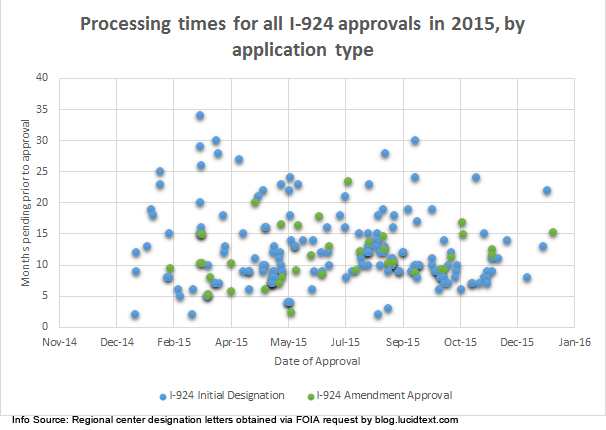
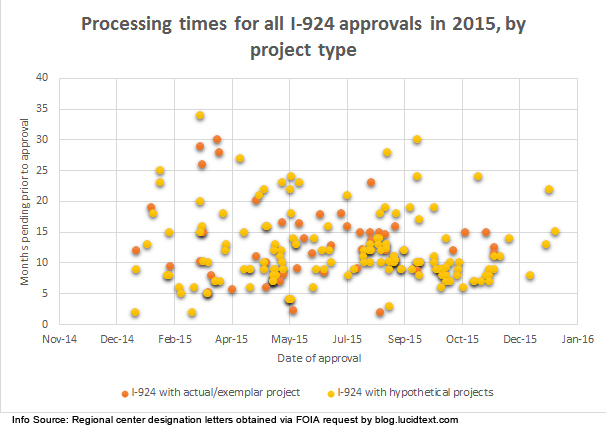
I try to improve the accuracy of my Regional Center List by requesting regional center designation letters from USCIS through the FOIA process. So far I have logged all initial designations and amendments through 2015. I’m sharing summaries of data points gleaned from the most recent letters in my collection (2015 approvals) to help shed light on processing issues.  As we prepare to respond to the ANPRM, let’s think about what’s wrong with the following pictures, and how to improve the situation.

Status of Amended Regulations

USCIS has published an Advance Notice of Proposed Rulemaking (ANPRM) in the Federal Register. This notice “EB-5 Immigrant Investor Regional Center Program” (Docket No. USCIS-2016-0008) does not unveil any revised regulations, but instead generously solicits stakeholder input to help formulate new rules for regional center designation, the exemplar filing process, continued RC participation, and RC termination. (Docket #0008 references a separate notice “EB-5 Immigrant Investor Program Modernization” Docket No. USCIS-2016-0006 that may cover the other EB-5 topics that we expected to see addressed. 1/12 UPDATE: here is Docket No. USCIS-2016-0006, which proposes new regulations for EB-5 investment amount increases, TEA requirements, priority dates, and other EB-5 matters.)

The bad news about notice #0008 is that it suggests USCIS is in a preliminary stage of thinking about new regional center designation rules, hasn’t actually drafted any regulations on this topic, and doesn’t expect to start for at least another 90 days. (Though hustle might be useless anyway, if Trump makes good on his election commitment to issue a temporary moratorium on most new regulations.) The good news is that notice #0008 demonstrates genuine concern to understand and work with regional center reality, presents thoughtful analysis of the issues, and poses excellent questions. Answers prepared for USCIS in response to the ANPRM should be organized and shared with Congressional staffers as well, since draft EB-5 reform legislation covers the same issues that USCIS aims to resolve, and would benefit from the same input.

Processing Times

Speaking of processing times, here is an email that I should have shared last week.

From: U.S. Citizenship and Immigration Services [mailto:uscis@public.govdelivery.com]
Sent: Thursday, January 05, 2017 11:32 AM
Subject: USCIS Now Uses Specific Dates to Show Case Processing Times

Dear Stakeholder,

Starting on Jan. 4, 2017, we will post processing times using a specific date format rather than weeks or months. This is the first step in providing processing times that are timelier and easier to understand.

We post case processing times on our website as a guide for when to inquire (service request) about a pending case. For the last several years, we have posted case processing times using two different formats:

  • For cases that were within our production goals, we listed processing times in weeks or months.
  • For cases that were outside of our production goals, we listed processing times with a specific date.

Always refer to your I-797C, Notice of Action, and look for “receipt date” to determine when we accepted your case. If the receipt date on the USCIS Processing Times web page is after the date we have listed on your notice, you should expect to hear from us within 30 days. If after those 30 days, you have not heard from us, you may make an inquiry on your case.

We recommend using our e-request tool for all case inquiries. In addition, we have many other services and tools at my.uscis.gov

If you move, remember to update your address for each pending case and receipt number at uscis.gov/addresschange.

Kind Regards,
USCIS Public Engagement Division

Note that this change is cosmetic: processing “as of month” and “as of date” are the same information, just in a different form. But the change is helpful to clarify that the report does not give average processing times, but rather a metric for judging when it’s okay to inquire about case status. FYI here is my spreadsheet of historical IPO processing times with columns translating month to date and vice versa. (But whether considering month or date, keep in mind individual deviations as illustrated above in my scatter plot charts of actual I-924 processing in 2015.)

FY2016 Q4 EB-5 Petition Statistics, Visa Backlog

I wish I had a merrier Christmas post for EB-5 world, but it’s my duty to report sobering statistics from USCIS for EB-5 petition processing as of Q4 FY2016 (ending September 30) and the National Visa Center for pending visa applications as of November 1, 2016.

NOTES

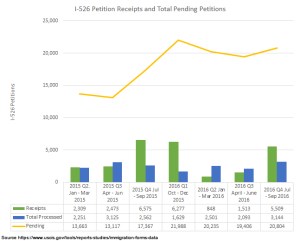
  • I-526 Processing Volume: USCIS sped up considerably in the 4th quarter, processing more I-526 petitions than in prior quarters. 4th quarter decisions were also relatively positive – 91% approvals. However, the 4th quarter was not enough to improve the annual numbers. USCIS still processed fewer and denied more I-526 petitions overall in FY2016 than FY2015.
  • I-526 Receipts and Backlog: The last quarter of 2016 saw another unnatural surge of I-526 filings (thanks for nothing, Congress), further swelling the already huge pool of pending petitions.  If USCIS continues to process about 9,500 I-526s a year (average for 2015/2016), then the 20,805 petitions currently pending will take over two years to process.
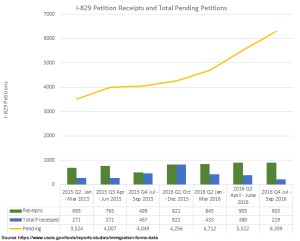
  • I-829 Processing Volume: I-829 processing in FY2016 started well and then fell every quarter, from over 800 petitions processed in the 1st quarter to barely 200 petitions by the 4th quarter. The year was still better than FY2015 overall, with 1.7x more completions. USCIS did not report denying any I-829 petitions in the 4th quarter, and the denial rate for the year is a low 5% (but higher than last year’s 1% overall).
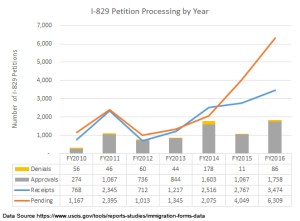
  • I-829 Receipts and Backlog: I-829 receipts grew a few percentage points over the course of the year, even as processing slowed dramatically. USCIS ended the year with 6,309 pending I-829 petitions, which would take three to five years to process at the current rate of adjudication.
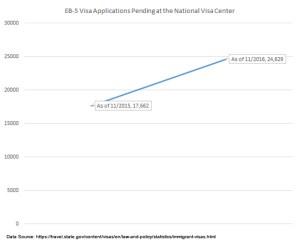
  • Pending EB-5 Petitions and Applications: There are currently about 20,804 I-526 petitions pending at USCIS (each petition representing one investor who may subsequently apply for about three EB-5 visas) plus about 24,629 EB-5 visa applications already pending at the National Visa Center. This means that the queue of current and committed EB-5 visa applicants now is about 75,000 people long and therefore stretches about eight years into the future. (Assuming that DOS can issue only about 10,000 EB-5 visas a year, and that we don’t – though we might — see major changes from investors dropping out or Congress changing its mind about the total numbers or allocation of visas. Here is a link to my spreadsheet with calculations, for anyone who would like to rethink the numbers.) New China-born investors filing today will go to the back of the line of pending petitions and applications, while new applicants from other countries can look forward to skipping ahead of China-born investors once they reach the visa stage. Considering the line, a China-born investor filing I-526 today might receive a green card in 2024 and think about removing conditions and exiting the investment after 2026 (or even later, if future years bring a growing volume of non-China investors), while today’s investor from Brazil may get a green card in 2018 and be ready for exit after 2020. These are unreliable estimates because many possible factors could affect actual timing, but food for thought. I look forward to linking to other commentary and opinions on these numbers.

NOTE: See the comments for additional input and insights


Proposed EB5 investment and TEA changes

The Regional Center program sunset date has been pushed back to April 28, 2017 by Public Law 114-254, but don’t count on the EB-5 status quo remaining unchanged through April. As I reported before, EB-5 filing fees are increasing from next week, there’s a new EB-5 Policy Manual, and Congress and USCIS might be about to unveil major EB-5 rule changes. USCIS signaled intention to post proposed new EB-5 regulations in the coming month, which could (at record speed) mean a final rule as early as March 2017. Congress reportedly came close to finalizing new EB-5 legislation behind the scenes last month and reportedly plans to introduce a new bill shortly. (USCIS has a history of dragging regulation revisions out over months or years or even decades, and Congress has a packed schedule for Trump’s first 100 days without mentioning EB-5. But still, there’s at least a chance of immanent EB-5 action.)

New regulations from USCIS promise to increase the minimum EB-5 investment amount, revise Targeted Employment Area requirements, clarify regional center designation requirements, and consider priority dates. We’ll have to wait for the proposed rule to learn more detail. (UPDATE: here is the detail.) New legislation promises to address those same issues while also adding new rules  for job creation, project pre-approval, investor source of funds, investor vetting and protections, fund administration, and many aspects of regional center operations.  My Bill Comparison Chart summarizes features from various iterations of proposed EB-5 legislation. (2017 UPDATE: I’ve continued to update the bill comparison chart, and also made a comparison of TEA proposals.) This draft is a version of the H.R. 5992 released earlier this summer, with revisions that show the influence of good sense (clearer presentation, no more deadly retroactive effective dates, fewer practically impossible tasks for USCIS and regional centers) as well as good lobbying by large regional centers (lower fees and better incentives for the major players). This staff draft legislation is unofficial (I received the same document separately from three sources, but without much context, and it’s just a redline with many passages marked for further negotiation), but I’m analyzing it because I hear that a bill based on this document may be  introduced early next year.

1/12/2017 UPDATE: DHS has published its proposed changes to investment amounts and TEAs in a Notice of Proposed Rule-making: EB-5 Investor Program Modernization (DHS Docket No. USCIS 2016-0006).

Countdown to reauthorization (CR to 4/28/2017)

The next sunset date for the regional center program is coming up on Friday 12/9, and I’ll update this post with relevant news as I receive it. (See my 9/29/2016 post if you’d like to review the history of RC program authorizations, and my 4/27/2017 post for updates on the more recent reauthorization countdown.)

UPDATES:

  • 12/10/2016: President Obama signed into law H.R. 2028, the “Further and Continuing and Security Assistance Appropriations Act, 2017.” It is now Public Law 114-254. This extends Regional Center program authorization together with government funding and other authorities through April 28, 2017.
  • 12/9/2016: The Senate is up late voting on the CR (HR 2028), and tomorrow should bring the good news of no government shutdown or RC program lapse.
  • 12/8/2016: The Hill reports that the CR passed the House today, and the Senate is expected to vote tomorrow. GOP leaders are confident that it will reach the President by the deadline, though it’s facing some opposition.
  • 12/7/2016: IIUSA has issued an advocacy alert welcoming the CR and the short-term reauthorization of the EB-5 Regional Center Program through April 28. “EB-5 stakeholders and congressional offices have engaged in meaningful discussions all year, particularly over the past few months, to reach consensus and compromise for the healthy future of the Program. With a tight deadline to fund the federal government and address other pressing legislative issues, there was simply not enough time for a reform package to be passed during this Congress. The short-term extension through April 28 will ensure that the industry and legislators will have the opportunity to agree upon a comprehensive reauthorization bill that provides necessary reforms to the Program while allowing the Program to continue to grow, thrive and endure in the long term.”
  • 12/6/2016: Quoted from a House Appropriations Committee Press Release: “House Appropriations Chairman Hal Rogers today introduced a short-term Continuing Resolution (CR) (H.R. 2028) to prevent a government shutdown and continue funding for federal programs and services until April 28, 2017. The legislation also contains funding for emergency disaster relief.  …The CR extends funding for operations for most federal agencies, programs and services until April 28, 2017. It maintains the current budget cap level of $1.07 trillion put into place under the Budget Control Act of 2011. The legislation continues policy and funding provisions included in currently enacted fiscal year 2016 Appropriations legislation. It does not include controversial riders, or major changes in existing federal policy.   ….For the full text of the legislation, please visit: http://docs.house.gov/floor/”  The Appropriations Committee has also posted a nice section-by-section summary.
  • 12/6/2016: Lawmakers haggle over funding bill as shutdown nears, says The Hill
  • 12/5/2016: I hear that Goodlatte and Conyers’ H.R. 5992 EB-5 Reform Act is still under active negotiation behind the scenes. A staff draft of the bill dated 12/2/2016, just forwarded to me by a kind reader, shows significant revisions from the original bill and suggests concessions to industry pressure on TEA definitions, visa set-asides, minimum investment amounts, foreign government involvement, and account transparency requirements. The matter of retroactive effective dates is marked as controversial and “unresolved” in this draft. Provisions on direct jobs, public bonds, and loan restrictions are highlighted as points for discussion. I will be astonished if a substantive EB-5 reform bill gets passed soon, but Congress might exceed expectations. This draft in progress does show a lot of recent work

Policy Manual EB-5 Section: What’s New

The EB-5 program just shifted onto a new and slightly different foundation. USCIS Policy Manual Volume 6, Part G, published today, is now the controlling source for EB-5 policy guidance. Usually we get a review and comment period before new policy goes live, but the effective date for this policy (which I’ll call PM 6G for short) is November 30, 2016.

PM 6G consolidates and replaces (and expands on) the May 2013 EB-5 Policy Memo, EB-5 sections in the Adjudicator’s Field Manual, and other related prior USCIS guidance. It’s intended as a compendium of existing policy, but it’s not identical to the previous guidance. Here are significant points that I notice (based on reading PM 6G side-by-side with the May 2013 Policy Memo, and consulting my memory).

PM 6G introduces a few new petition filing instructions:

  • Chapter 3(B)(3) states that a regional center I-526 petition for a project not previously reviewed by USCIS must identify the project “as an actual project being presented for the first time,” and  “should contain an affirmative statement signed by a regional center principal confirming that the regional center is aware of the specific project being presented for the first time as part of the immigrant investor petition.”
  • Chapter 4(A) states that a regional center I-526 petition for a project previously reviewed by USCIS must submit the previously-approved documentation together with the investor’s documents. This is required even though the regional center previously submitted the documentation with the Form I-924. The petition must also include a copy of the regional center’s most recently-issued approval letter.
  • Chapter 5(B) states that a I-829 petition must include relevant documents previously submitted with the Form I-526, including the comprehensive business plan and economic impact analysis, if the petitioner is relying on such documents to meet his or her burden of proof. “This information is necessary to indicate whether there are material changes that would impact deference.”

PM 6G includes a few items that might be arguable as new policy:

  • Chapter 2(A)1 has a section on “using loan proceeds as capital”
  • Chapter 2(D)4 says that “USCIS may request additional evidence that the indirect jobs created, or to be created, are full time.” (The May 2013 Policy Memo had stated the opposite:Due to the nature of accepted job creation modeling practices, which do not distinguish whether jobs are full- or part-time, USCIS relies upon the reasonable economic models to determine that it is more likely than not that the indirect jobs are created and will not request additional evidence to validate the job creation estimates in the economic models to prove by a greater level of certainty that the indirect jobs created, or to be created, are full-time or permanent.” We need to get PM 6G revised to reflect that reasonable approach.) Chapter 2(D)(4) also confusingly defines direct jobs in the context of regional center job creation and economic analysis as “those jobs that establish an employer-employee relationship between the new commercial enterprise and the persons it employs.” This should be revised or expanded to reflect the alternate meaning of a “direct” job that is in fact used by economic models.
  • Chapter 2(D)6 incorporates the content of the 12/20/2012 Operational Guidance on tenant occupancy
  • Chapter 3(D) says that amendments are optional for changing a regional center’s “industries of focus, business plans, or economic methodologies,” but does not say that amendments are optional for a change in geographic boundaries.  The May 2013 Policy Memo had included geographic boundaries on the list of changes for which an amendment was not required.
  • Chapter 5(B) defines a first-in policy for allocating jobs to EB-5 investors, absent other agreement  (departing from the recent practice of saying no investors get jobs if there aren’t enough for all and there isn’t a job allocation agreement)

PM 6G provides some new examples, clarifications, and re-emphasis:

  • Chapter 2(A)2 lists types of documents that can be used to help demonstrate source of funds
  • Chapter 2(A)2 lists “administrative fees, management fees, attorneys’ fees, finders’ fees, syndication fees” as examples of expenses that will be considered to erode capital made available to the job-creating entity, if paid out of the EB-5 qualifying investment amount
  • Chapter 2(A)5 repeats the old point that TEA qualification is determined for each petitioner based on the  project location’s TEA status at the time of that petitioner’s investment or I-526 filing, while re-emphasizing the implication that the project location is not necessarily a TEA for all time, and just because some early investors qualified for the reduced investment amount isn’t determinative for later investors in the same project
  • Chapter 2(D)3 lists examples of evidence to be provided for a job-sharing arrangement in order to show that it truly involves job share of a full-time position, and not combination of part-time positions
  • Chapter 2(D)5 re-emphasizes that a reasonable economic methodology must be based on reasonable inputs, and gives examples of economic model inputs and relevant documentation to help establish their reasonableness. This discussion is repeated in Chapter 5(B), with odd lack of distinction between evidence required at the I-526 and I-829 stage.
  • Chapter 3(A) describes new detail required of the operational plan filed with the I-924 Application for Regional Center
  • Chapter 3(B)1 suggests specific content for the “general proposals and predictions” in a regional center application relying on hypothetical projects
  • Chapter 3(E) describes the process and issues in regional center termination
  • Chapter 4(C) and 5(C) discuss material change in terms of the same principles but with different language and different examples from the May 2013 Policy Memo. Unlike the memo, the manual discusses and gives examples of changes that would NOT count as material.
  • Chapter 5(B) tries to discuss evidence for regional center job creation at the I-829 stage, but needs more work to clearly address issues specific to regional center as distinct from direct investments, and to differentiate what’s required at I-829 from what’s required at I-526
  • Chapter 5(B)1 gives examples of kinds of construction jobs that do and don’t count as intermittent

What is the significance of PM 6G?  For investors, I guess it doesn’t make much difference because it doesn’t include major policy changes (yet) and basically says what their consultants knew already. It will just be a handy place to find all EB-5 policy, being more comprehensive and better written than the May 2013 memo. Attorneys will want to get busy finding problems and commenting on details that need to be changed.  I’ll have to spend Christmas going through years of blog posts and other documents updating the content and citations to reference PM 6G instead of the various superseded guidance and policy sources (and maybe spend Easter the same way when PM 6G gets revised based on new regulations). I dislike the fluidity of the online Policy Manual, and for myself am copying the content into stable old-fashioned page-numbered documents with navigation.(Here is a link to my folder, which I expect will eventually include many dated versions. You’re welcome to share, keeping in mind that the online manual is the most reliable source for the most current content.)

I look forward to linking to other reactions on the manual here, and may modify my own comments in this post.

Policy Manual EB-5 announcement

From: U.S. Citizenship and Immigration Services [mailto:uscis@public.govdelivery.com]
Sent: Wednesday, November 30, 2016 9:29 AM
Subject: USCIS Message: Policy Manual Available for Comment Employment-Based Fifth Preference Immigrants: Investors

Dear Stakeholder,

USCIS seeks your input on the USCIS Policy Manual item listed below which contains either new or revised policy guidance. Please note that this item is effective as of the date shown below.

Type of Document for Comment: USCIS Policy Manual
Title of Document: Employment-Based Fifth Preference Immigrants: Investors
Related Documents: Policy Alert
Opening & Closing Dates for Comment: November 30, 2016 – December 14, 2016
Effective Date of Policy: November 30, 2016

Please send all comments to publicengagementfeedback@uscis.dhs.gov and be sure to include the following to make your comments clear:

State the title of the relevant volume and section in the subject line of your message;
Refer to a specific portion of the document;
Explain the reason for any recommended change; and
Include data, information, or authority that supports the recommendation.

If you are unable to access the document through the link provided above, please do the following:

  1. Go to www.uscis.gov/outreach
  2. Select “Feedback Opportunities” on the left side of the page
  3. Select “Policy Manual for Comment” on the left side of the page

Kind Regards,

USCIS Public Engagement Division

New EB-5 Regs in 2017?

01/11/2017 Update: USCIS published an Advance Notice of Proposed Rulemaking  “EB-5 Immigrant Investor Regional Center Program” (Docket No. USCIS-2016-0008)  and Notice of Proposed Rule-making EB-5 Investor Program Modernization (DHS Docket No. USCIS 2016-0006).

–ORIGINAL POST–

While we’ve been focused on how Congress might change EB-5, the immigration service is taking action. Since Spring 2015, DHS has published Rule 1615-AC07 (Improvement of the Employment Creation (EB-5) Immigrant Regulations) bi-annually as an agenda item in the Office of Management and Budget’s Rule list. Since the “stage of rule-making” just said “Long-Term Actions,” with no specified timeline, I didn’t actually hope to see action any time soon. But now, the Fall 2016 OMB Rule list has upgraded the status of 1615-AC07 to “Proposed Rule Stage” and has added a timetable date: Notice of Proposed Rulemaking on date 01/00/2017. That means that in just a couple months, we could be getting our chance to read and comment on new regulations that make significant EB-5 program changes (including increased investment amount), and those regulations could go live shortly after the comment period closes. (Or not — my post from June discusses the regulatory process and how it’s played out before.) The Fall 2016 version of the rule notice goes into more detail on what DHS intends to accomplish with the new regulations, and promises to address a point not mentioned in earlier notices: “providing the opportunity to mitigate the harsh consequences of unexpected changes to business conditions through priority date retention in limited circumstances.” While new legislation from Congress might primarily focus on the regional center program, new DHS regulations will affect all EB-5 investors, and this notice concerns everyone in EB-5.

DHS/USCIS RIN: 1615-AC07 Publication ID: Fall 2016
Title: Improvement of the Employment Creation Immigrant Regulations

Excerpted from http://www.reginfo.gov/public/do/eAgendaViewRule?pubId=201610&RIN=1615-AC07

Abstract:
DHS proposes to amend its regulations governing the employment-based, fifth preference (EB-5) immigrant entrepreneur category and EB-5 regional centers to modernize the EB-5 program based on current economic realities and to reflect statutory changes made to the program. DHS is proposing to update the regulations to include the following areas: priority date retention, increases to the required investment amounts, revision of the Targeted Employment Area requirements, clarification of the regional center designation and continued program participation requirements, and further definition of grounds for terminating regional centers.
Statement of Need:
The proposed regulatory changes are necessary to reflect statutory changes and codify existing policies, more accurately reflect existing and future economic realities, improve operational efficiencies to provide stakeholders with a higher level of predictability and transparency in the adjudication process, and enhance program integrity by clarifying key eligibility requirements for program participation and further detailing the processes required. Given the complexities involved in adjudicating benefit requests in the EB-5 program, along with continued program integrity concerns and increasing adjudication processing times, DHS has decided to revise the existing regulations to modernize key areas of the program.
Anticipated Costs and Benefits:
As a result of these amendments and resulting modernized program, DHS believes that regional centers, entrepreneurs, and the Federal each benefit. This rule would benefit regional centers by clarifying the requirements for designation and continued participation in the EB-5 program, making the application process more transparent for regional centers and streamlined to improve DHS operational efficiencies. The rule would benefit entrepreneurs seeking to participate in the program by providing the opportunity to mitigate the harsh consequences of unexpected changes to business conditions through priority date retention in limited circumstances. This rule would also provide a more transparent process for entrepreneurs seeking to participate in the regional center program by providing increased consistency and predictability of adjudications through the clarified regional center continued program participation requirements. These changes will also streamline the adjudication process and improve DHS operational efficiencies, resulting in improved adjudication times. Finally, the Federal Government will benefit from clarifications and enhancements to the EB-5 program to strengthen program integrity, reducing the risk of fraud and national security concerns in the program, as well as improving operational efficiencies to reduce overall program costs.

Election and EB-5 (updated), RC list changes

Political Changes and EB-5
In the new political climate, Regional Center EB-5 has an interesting position: it’s an immigration program whose strongest criticism has been that it unfairly benefits wealthy New York real estate developers. Perhaps we’re about to see EB-5 become an immigration program whose saving grace is its benefits to big developers (including President-elect Trump’s family). Or maybe EB-5 will be crushed between judiciary committee chairmen (still to be Senator Grassley and Rep. Goodlatte in the new Congress) who want reforms and a new administration that may aim to cut down on immigration generally? Maybe the Regional Center program will be simply ignored and punted down the road with more short-term extensions as the lame-duck Congress focuses on bigger spending bill issues and the Judiciary Committees get caught up in Supreme Court hearings? I don’t know. Preliminary comments on the election’s immigration and EB-5 impact: IIUSA letter to members, EB-5 Insights Post-Election Immigration Update, Klasko Law post on the Election Impact on EB-5. In the article Leahy to press ahead with EB-5 reforms in lame duck session (Nov. 16. 2016), VT Digger quotes sources saying that Senators Leahy and Grassley are continuing to push even now for any regional center reauthorization to be accompanied by reforms. However, the impression I get from reading political news is that Congress as a whole is determined to do and decide just as little as possible until Trump is President. House Republicans have already agreed it’s a good idea to extend government funding from December 9, 2016 into 2017 with another short-term spending bill, in order to defer big decisions until next year. It’s probable that the Regional Center program will piggy-back on that additional extension of existing appropriations and authorities, as it did before — if for no other reason than that Congress would have to make extra effort and go out of its way to specially exclude it. (Update: a CR has indeed extended the RC program with government funding through April 28, 2017.)

Regional Center List Changes
Additions to the USCIS Regional Center List, 10/03/2016 to 11/01/2016

  • EB-5 Fund CA, Inc. (California)
  • Home Paradise Texas Regional Center, LLC (Oklahoma, Texas): ushpic.com

Renamed:

  • CanAm Los Angeles County Regional Center, LLC (former name Los Angeles Film Regional Center) (California)
  • Central Southern Regional Center (previously USA South Regional Center) (Louisiana, Oklahoma, Texas)
  • Rural Economic Development Center LLC (former name 1900 Gulf Street Partners Regional Center LLC) (Kansas, Texas)

Removed, but not listed as terminated:

  • Los Angeles County Regional Center (California)
  • Mountain States Center for Foreign Investment (Utah)

New Terminations:

  • Montana Energy Regional Center LLC (former name USA Montana Energy Regional Center) (Montana) Terminated 11/1/2016
  • Dominion Mid-Atlantic Associates, Inc. (Virginia, Virginia) Terminated 10/20/2016
  • Mariana’s Investment Co, LLC (Commonwealth of Northern Marianas Islands) Terminated 10/27/2016
  • Northern Illinois Regional Center (Illinois) Terminated 10/13/2016

I-924A Resources

USCIS has kindly shared IPO Deputy Chief Julia Harrison’s Talking Points IIUSA and AILA Conferences October 2016. There isn’t any breaking news here, but I’ll repeat Ms. Harrison’s first point. “Regional Centers: Don’t forget to file your Form I-924A between October 1 and December 29.” All Regional Centers that were designated as of September 30 this year must file this annual report.

I-924A Resources for Regional Centers

Go to the USCIS website for the Form I-924A and Instructions: https://www.uscis.gov/i-924a. Note that there’s a significantly revised version this year, so don’t reuse last year’s form. USCIS gives additional guidance for completing the form in I-924A Filing Tips (2015) and I-924A Q&A (2011).

The deadline for I-924A filing this year is December 29, but plan to file by December 22 if you want to avoid the new $3,035 filing fee.

Remember that I-924A stakes are high. This form is at the center of an annual review in which USCIS reassesses whether each RC can keep its designation. In preparing to file, consider what we know about the review process. Form I-924A goes to the IPO Compliance Unit at USCIS, which takes the following steps.

  • IPO reviews the info provided in the I-924A for timeliness, accuracy, and completeness
  • IPO considers the Form I-924A responses (and any supplemental narrative and exhibits filed with the form) to determine whether the RC is fulfilling its basic mandate to promote economic growth. If the RC does not have investment or jobs to report in the Form I-924A, IPO will look to see whether the RC makes a compelling case for future activity and mitigating circumstances. (“For example, it is reasonable to provide greater flexibility to a regional center with a more recent USCIS designation whereas a regional center with a longer period of designation that has not shown any economic growth to the geographic area, may receive less flexibility. In addition; the regional center’s progress in developing actual projects should be taken into account, including the steps taken to identify and pursue developmental projects, how the projects have progressed in the pipeline, and the likelihood of those projects promoting economic growth in the immediate future. Moreover, USCIS may consider any reasonable, temporary delays, such as natural disasters or litigation, which may have prevented the regional center from promoting economic growth in a timely manner, and any alternative plans or actions taken as a result of unexpected delays. This flexibility, however, is not an open-ended allowance in which the regional center can indefinitely explore potential projects or remain stagnant on either a hypothetical or actual plan.” See RC Designation: Use it or lose it )
  • IPO checks the numbers and claims reported in the I-924A against other info that it has on file for the RC, and red flags any inconsistencies
  • IPO performs an Internet search and searches internal databases looking for derogatory information related to the RC and its projects and principals
  • IPO investigates the RC’s online presence (the RC’s website, online content from agents and promoters) and looks for any impropriety. IPO particularly looks for use of the DHS seal or USCIS signature; any claims about guaranteed returns, guaranteed approvals, or expedited treatment of petitions; and any language (including entity names) that implies a special relationship with USCIS, DHS, or the US government. Keep in mind Cautions on Names of Regional Centers and Enterprises, and Unauthorized Use of DHS Seal.
  • IPO will issue a Notice of Intent to Terminate if the RC fails to submit required information, or if IPO determines based on its I-924A review that the RC no longer serves the purpose of promoting economic growth, and no longer remains eligible for designation. 70 RC have been terminated so far (54 in 2015/2016 alone), so this is not an idle threat.

(My sources: EB-5 stakeholder meetings on 8/13/2015, 9/17/2015, 2/3/2016; AAO termination appeals in 2015 and 2016; and FOIA material)

A regional center that hasn’t been active and doesn’t see future prospects may consider taking this chance to proactively withdraw from the program, instead of waiting to be terminated.  The recent Fee Rule says that “A regional center may elect to withdraw from the program and request a termination of the regional center designation. The regional center must notify USCIS of such election in the form of a letter or as otherwise requested by USCIS. USCIS will notify the regional center of its decision regarding the withdrawal request in writing.”