RC Sanctioned $1M for Agent Payments

Last December, the Securities and Exchange Commission made examples of several parties (mostly immigration lawyers) found to have violated Section 15(a)(1) of the Exchange Act by acting as unregistered broker-dealers: helping to effect securities purchases in an EB-5 Regional Center, and receiving a commission for each investment they facilitated. Each respondent was ordered to disgorge the fees and interest plus pay a $25,000 fine. (If you’d like to be reminded of the circumstances, you can read the Cease and Desist orders for Bernstein, Wang, Manesh, Khorrami, Kaye, Bander, and Azarmehr). These actions reiterate the message that it’s wrong to act as an unregistered broker dealer. It’s equally impermissible to to pay an unregistered broker-dealer, and the SEC has picked a high-profile target to drive this point home: American Life, which must now pay a civil penalty of one million dollars for transaction-based compensation paid to certain EB-5 agents from 2011 to 2014. American Life has brought in more EB-5 investment and completed more good EB-5 projects than almost any other regional center in history, but the SEC found that it also wrongly “paid or caused to be paid transaction-based compensation to certain domestic EB-5 agents in connection with EB-5 securities, which caused those EB-5 agents’ violations of Section 15(a)(1) of the Exchange Act.” Pay attention, Regional Centers, to this warning shot! To avoid million dollar penalties of your own, be extremely careful about who acts as a finder for your investors, and how. If an immigration lawyer offers to help introduce investors, and expects be compensated accordingly, just say no! You may want to review IIUSA’s Best Practices for Engaging With Intermediaries.

Changes from DHS and/or Congress? RC List Updates

01/11/2017 Update: USCIS published an Advance Notice of Proposed Rulemaking  “EB-5 Immigrant Investor Regional Center Program” (Docket No. USCIS-2016-0008)  and Notice of Proposed Rule-making EB-5 Investor Program Modernization (DHS Docket No. USCIS 2016-0006).

Regulatory Changes

How close are we to getting the revised EB-5 regulations promised by USCIS? My best guess is: pretty close — at least by Spring 2025. The rulemaking process for a federal agency (according to Wikipedia) goes like this:

  1. give advance notice of proposed rulemaking
  2. publish actual proposed regulatory language (“notice of proposed rulemaking” or NPRM) in the Federal Register
  3. public comment period, which may last 30 to 180 days or so
  4. if comments precipitate drastic revisions, a second draft may be published in the Federal Register for further comments
  5. the proposed rule becomes a final rule, with minor modifications and full response to comments submitted by the public
  6. the final rule becomes effective (with most rules becoming effective some time after initial publication to give regulated parties time to come into compliance)

So far, DHS has accomplished Step 1 in this process for new EB-5 regulations, publishing Rule 1615-AC07 in the Office of Management and Budget’s Spring 2015 Rule list (and reposting in Fall 2015 and Spring 2016). The 2015/2016 OMB notice indicates general content areas for revision to EB-5 regulations: create distinct regulations for direct and regional center investors; and make changes to regulations for the designation of Targeted Employment Areas, indirect job creation, the required investment amount, material change’s effect on conditional residency, the regional center designation process, and monitoring for regional center compliance. USCIS held a stakeholder meeting and online feedback session on possible revised regulations in April 2014 and again in April 2016. But that’s all still Step 1, and we have no indication of when the process could progress to Step 2 and beyond. [UPDATES: DHS Secretary Johnson testified on 6/30/2016 that he foresees progressing to Step 2 as early as November 2016. IPO Chief Nicholas Colucci said in the 8/29/2016 EB-5 Stakeholder meeting that his office was actively working on the regulation but had no timeline for publishing it. The Fall 2016 OMB list notice gives a target date of 01/00/2017 for Notice of Proposed Rulemaking]

The entire rulemaking process could theoretically happen within a year, and there’s been plenty of talk about its urgency, but I’m not holding my breath. For context, the regulation dealing with EB-5 petitions approved 1995-1998 (RIN 1615-AA90) has appeared as a proposed rule the OMB agenda biannually since 2003, the proposed regulatory language was finally published in the October 2011 Federal Register, the public comment period was completed in November 2011, and the rule entered the final stage March 2015. It remains to be seen whether the promised new EB-5 regulations can be promulgated in less than thirteen years. We’ve heard since 2014 that USCIS is actively working on them, so two years down, at any rate.

If USCIS drags its feet on regulations, it can also make changes by publishing new policy. For example, you can now provide feedback on a new Interim Policy Memo on the topic (not EB-5 specific, but relevant to EB-5 applications and petitions) of Signatures on Documents Filed with USCIS. (UPDATE: In the 8/29 EB-5 Stakeholder Meeting, IPO reported that they are currently compiling existing policy for the EB-5 chapters for the USCIS Policy Manual, and expect to issue future new policy as amendments to the manual.)

Legislation
How close are we to getting new legislation that affects EB-5? The tidbits and rumors I hear suggest (1) that we’re unlikely to see a substantial reform/reauthorization bill before September 30, considering the few Congressional workdays left and the election, (2) that substantial reform legislation is still in active discussion (Grassley and Leahy staffers met just last week with securities attorneys to discuss a forthcoming edition of the S.1501), (3) that the regional center program will probably get another clean short-term extension beyond September 30, 2016, to give more time for substantial legislation, and (4) that the next short-term extension is likely to be genuinely short, considering that the leaders motivated to insist on urgent program changes have even more ammunition and motivation than they did last year.

The House has a couple new bills with some relevance to EB-5. H.R.5203 – Visa Integrity and Security Act of 2016 would tweak the application and review process for all visa categories (not EB-5-specific, but could affect some EB-5 investors). The EB-5 Insights blog has a summary of key provisions, if you’re interested but don’t want to read the bill. H.R. 5398: Immigration for a Competitive America Act of 2016 doesn’t mention EB-5 but proposes to increase the total number of employment-based visas from 140,000 to 253,000 (+81%), which would effectively increase the EB-5 visa allocation by 81% as well. As of now the bills haven’t gotten far and GovTrack rates them at 0%-3% chance of being enacted, but FYI the proposals are out there.

Regional Center List Updates
Additions to the USCIS Regional Center List, 05/23/2016 to 06/10/2016

  • Deictic Investment Group – California (California)
  • Onefire Healthcare Services, LLC d.b.a. Onefire Regional Center (Oklahoma)
  • Texas First Regional Center, LLC (Texas)
  • Texas Regional Investment Center (Texas): www.texasric.com
  • West Bridge Regional Center, LLC (Texas): www.westbridgeregionalcenter.com
    No longer listed:

  • TriHaven Investment Group Southern California (California)

New Termination

  • Palm Beach Raceway LLC (Florida) Terminated 5/31/2016

EB-5 Petition Processing Q2 2016

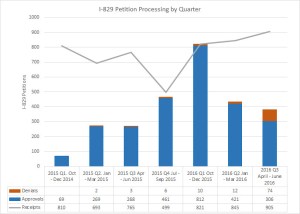
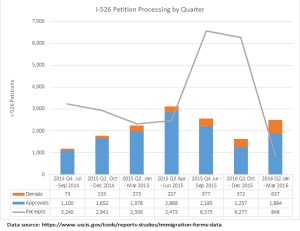
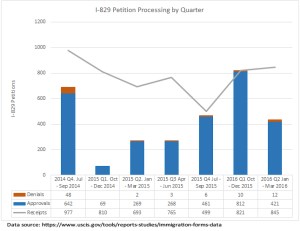
The Immigration and Citizenship Data page on the USCIS website has been updated with official numbers for I-526 and I-829 processing from January to March 2016 (FY2016 Q2). Extraordinarily low I-526 receipt numbers in Q2 balance abnormally high numbers in the previous two quarters. I-829 receipts are back on a normal trajectory after that odd dip in Q4 last year. The number of I-526 petitions processed in Q2 went up while the volume of I-829 processing fell proportionally. The previous quarter shows the same trend in reverse, suggesting that IPO has been allocating resources back and forth between I-526 and I-829. Besides the receipt trend, which is important but old news now, I note the number of I-526 denials. One fourth of the I-526 cases processed last quarter were denied — the most denials we’ve seen since 2013. Meanwhile, the petition backlog was dented but remains daunting.

AAO Decisions, RC List Changes

Newly-Posted AAO Decisions on I-526 Cases (existing business, business plan credibility, material change, indebtedness)

Several interesting 2016 AAO decisions on I-526 cases were uploaded this week to the USCIS website:

  • MAY032016_01B7203: Direct EB-5 case in which the petitioner purchased two gas stations through bankruptcy court following the previous owner’s Chapter 11 bankruptcy liquidation, reopened them under his new company, and claimed this as creation of a new business with new job creation. USCIS/AAO declined to credit the business or jobs involved as “new” despite purchase from bankruptcy, because the purchase documents did not unambiguously show that the business was non-operational prior to sale, and that the petitioner merely purchased assets, not a business.
  • MAY032016_02B7203: Direct EB-5 case in which the petitioner invested in a business (house-flipping) that by its nature would be unlikely create the required number of jobs, submitted a business plan that naturally didn’t make a good job creation case, paid EB-5 document and legal fees from the enterprise, and had a messy expenditure paper trail that didn’t clarify that the costs attributed to the enterprise were actually billed to and paid by the enterprise.
  • MAY052016_01B7203: In which a petitioner attempts to overcome a finding of fraud by claiming that she didn’t willfully misrepresent material facts because she didn’t know about the material facts filed with her petition. The AAO maintained that her stated ignorance related to filings is not reasonable, and supports a finding of deliberate avoidance.
  • MAY102016_01B7203: In this direct EB-5 case, the business plan is judged non-credible based, as usual, on inconsistencies: in this case, inconsistencies between the business plan and how the business subsequently developed.
  • MAY102016_02B7203: This direct EB-5 petitioner did not demonstrate that he was eligible at the time of initial I-526 filing, but committed material change when he filed a revised Form 1-526 that changed the NCE’s name and location and materially altered its industry focus, among other changes.
  • MAY112016_01B7203: This regional center case turns on the issue of indebtedness as source of the petitioner’s investment, and includes extensive discussion of the “USCIS Interpretation of Indebtedness.”
  • MAY112016_02B7203: This is another petitioner in the regional center case involving investment in a troubled hospital. (I discussed this case in detail in my 4/7 post. Also note that the petitioners fought the case with a civil action against USCIS and they won.)

Additions to the USCIS Regional Center List, 05/03/2016 to 05/23/2016.

  • C Chase Hotel & Resort Regional Center LLC (Connecticut, New Jersey, New York, Pennsylvania)
  • Harmonia Regional Center New York (Connecticut, New Jersey, New York): harmoniaeb5.com
  • LA Growth Fund, LLC (California)

New Terminations:

  • US EB5 Nevada Regional Center, LLC (Nevada) Terminated 5/12/2016
  • US EB5 Florida Regional Center (Florida) Terminated 5/9/2016
  • Middle Georgia Regional Center (Georgia) Terminated 5/4/2016
  • Global Investment Consulting, Inc. (Indiana) Terminated 5/3/2016

EB-5 Form Fee Increases, RC List Changes

Proposed Fee Increases
USCIS published a notice of proposed rulemaking in the Federal Register inviting public comment, for 60 days, on the proposed U.S. Citizenship and Immigration Services Fee Schedule: (http://federalregister.gov/a/2016-10297). The rule explains that: “USCIS conducted a comprehensive fee review, after refining its cost accounting process, and determined that current fees do not recover the full costs of the services it provides. Adjustment to the fee schedule is necessary to fully recover costs for USCIS services and to maintain adequate service.” Here are fee changes affecting EB-5 forms (see Table 9 on page 87):

  • Form I-924A (to be titled “Annual Certification of Regional Center”): new $3,035 fee
  • Form I-924 application for regional center designation or amendment: increase from $6,230 to $17,795
  • Form I-526 immigrant petition: increase from $1,500 to $3,675
  • Form I-829 petition to remove conditions: no change (still $3,750)

The public has three months to comment (see pages 1-2 of the proposed rule for directions). The rule specifically invites feedback from regional centers, noting that:

DHS does not have sufficient data on the revenue collected through administrative fees by regional centers to definitively determine the economic impact on small entities that may file Form I-924. DHS requests any data that would help to further assess the impact on small entities in the regional centers. DHS is publishing the initial regulatory flexibility analysis to aid the public in commenting on the small entity impact of its proposed adjustment to the USCIS Fee Schedule. (page 89)

In commenting, consider DHS’s attempt to analyze regional center revenue sources and the potential impact of the proposed I-924 fee increase (page 99-101).

The rationale for fee changes in the proposed rule gives an interesting look behind the scenes at DHS. For example, Table 6 on page 8 lists “Completion Rates per Benefit Request” – meaning “touch time,” or the time an employee with adjudicative responsibilities actually handles a case (not including queue time or time spent waiting for additional evidence or supervisory approval). EB-5 processing times run to months and years, but (prepare to gasp) the average amount of time an employee actually works on EB-5 forms, according to this table: I-526: 6.5 hours; I-829: 5.5 hours; I-924: 40 hours; I-924A: 5 hours. And footnote 61 on page 55 gives more detail than I’ve seen before on compliance efforts for EB-5:

USCIS is committed to strengthening and improving the overall administration of the EB-5 Program. The EB-5 Program encompasses Forms I-526, I-829, I-924, and I-924A. The cost baseline includes $16.0 million in FY 2016 and $15.9 million in FY 2017 for additional staff that would comprise a specialized team of forensic auditors, compliance officers, and other staff, whose primary focus would be to ensure regulatory compliance. This would directly contribute to the integrity of the program by providing the USCIS Investor Program Office with employees who have specialized knowledge required to adjudicate these benefits. In addition to enhanced staffing, USCIS would make additional IT systems investments to make case processing more efficient. USCIS would add $1.7 million in FY 2016 and $1.8 million in FY 2017 to improve the case management system and further develop its risk management strategy to ensure program compliance.

Regional Center List Changes
Additions to the USCIS Regional Center List, 04/25/2016 to 05/03/2016.

  • American Lending Center North Carolina, LLC (North Carolina, South Carolina): usa-rc.com
  • Atlantic Coast Regional Center, LLC (Connecticut, Delaware, District of Columbia, Maryland, Massachusetts, New Hampshire, New Jersey, New York, Pennsylvania, Rhode Island, Virginia): www.eb5acrc.com
  • Excelsior EB-5 Regional Center LLC (Connecticut, New Jersey, New York): excelsioreb5.com

New Terminations

  • Hidalgo McAllen Reynosa Regional Center, LLC (Texas) Terminated 4/26/2016

IDEA Community Invite

From: U.S. Citizenship and Immigration Services [mailto:uscis@public.govdelivery.com]
Sent: Wednesday, April 27, 2016 3:53 PM
Subject: USCIS Message: Idea Community Feedback on Potential EB-5 Regulatory and Policy Changes

Dear Stakeholder,

As mentioned at the EB-5 listening session on April 25, USCIS is considering potential EB-5 regulatory and policy changes and we want to hear from you, our stakeholders. That’s why we hosted the listening session to begin receiving your individual feedback. We want to continue to hear your thoughts and ideas. Specifically, we would like to hear your individual thoughts on the following four topics:
·        Minimum investment amounts;
·        The TEA designation process;
·        The regional center designation process, including, but not limited to, the exemplar process and the designation of the geographic scope of a regional center; and
·        Indirect job creation methodologies.

As you may know, minimum investment amounts have remained constant since 1991.  We would like your feedback on whether these amounts ($1 million or $500,000) should increase and, if so, the methodology and process by which you believe an increase would be most effective.

We’d also like your thoughts on targeted employment areas (or “TEAs”) and the TEA designation process.  We are specifically seeking your feedback on how the process currently works for you and, if improvements can be made, your input for improving it.

Another topic on which we are seeking feedback is the regional center designation process, including, but not limited to, the exemplar process and the designation of the geographic scope of a regional center.  We are seeking stakeholder feedback on how the process currently works for you and, if improvements can be made, your input for improving it.

Finally, we’d like to hear from you on indirect job creation methodologies.

We are using the USCIS Idea Community, an online crowdsourcing tool, as one method for you to submit your individual feedback and input on these four topics.  Please note that we are only seeking individual input.  We are not seeking group or consensus advice.  Participating in the USCIS Idea Community is easy. All you need is an active email address. You can create a profile and submit ideas.

You can visit the USCIS Idea Community to submit your ideas on the four topics listed above until May 11, 2016.

See you in the USCIS Idea Community!

Please do not reply to this message. Contact us at Public.Engagement@uscis.dhs.gov or USCIS-IGAOutreach@uscis.dhs.gov with any questions.

4/25 meeting notes, RC list changes

4/25/2016 Listening Session
Today’s EB-5 stakeholder meeting with USCIS was indeed a listening session — a venue for stakeholder opinions and not for tips and answers from USCIS. In case you’re a lawmaker or regulator and interested in reviewing insightful comments from the public, here is my recording. For the rest of us, who are mainly just curious about what USCIS has to say, here are a few tidbits that came out in the meeting:

  • USCIS will be initiating an IDEA community campaign to collect additional input on EB-5 regulation/policy changes. When that goes live, I’ll post a notice here.
  • I-829 interviews will begin this year, at first virtually, and interviewees may bring counsel, Regional Center representatives, and Regional Center counsel.
  • An audit program for regional centers is being implemented this year, and site visits are being expanded for direct and regional center projects.
  • IPO is up to 126 staff and on track to have 171 employees by year end.
  • IPO did not give any hints about the anticipated content of or timeline for revised regulations or new policy.
  • IPO will work closely with Congress up to the next deadline for regional center program reauthorization (September 30, 2016), and just in case will prepare “what if” guidance for two sunset scenarios: if the Regional Center program lapses but Congress apparently intends to reauthorize it, or if Congress indicates its desire to end the program.
  • IPO Chief Nicolas Colucci reported some preliminary processing data. Q2 2016 receipts: 849 (I-526), 886 (I-829), 40 (I-924). Completions from October 2015 to March 2016 (Q1-Q2 2016): 4,141 (I-526), 1,255 (I-829), 135 (I-924). The big story in these numbers is I-526 receipts, as illustrated in the following figure.
    Q22016I526

Regional Center List Changes
Additions to the USCIS Regional Center List, 04/19/2016 to 04/25/2016

  • Regional Center of the Pacific (California)

Additions to the USCIS list of terminated regional centers:

  • WRC EB-5 Regional Center, Inc. (Washington) Terminated 4/13/2016

4/25 Meeting Questions, Program Changes, New RCs

Discussing EB-5 Changes with USCIS

Next Monday 4/25 USCIS will hold an EB-5 listening session to give stakeholders a chance “to provide feedback on potential EB-5 regulatory and other policy changes.” This week USCIS emailed “a list of topics that we would like your input on,” as follows: “Minimum investment amounts; The TEA designation process; The regional center designation process, including, but not limited to, the exemplar process and the designation of the geographic scope of a regional center; and Indirect job creation methodologies.” This list gives us an interesting tip of the hand on the areas USCIS plans to address in forthcoming revised regulations and new policy.

So what are the potential changes? I’ve summarized issues and proposals that are on the table in these four categories, with special reference to Secretary Jeh Johnson’s legislative wish list as expressed in his April 2015 letter to Senators Grassley and Leahy, and provisions that have been included in EB-5 reform bills. All these items were put on the table for Congressional action, and I’m not entirely clear about how much USCIS has power to change through regulation and policy, absent legislation. And I don’t hold my breath for USCIS much more than for Congress to get things done. But I hope to hear more on Monday about what USCIS has in the pipeline, and this list may help spur your thinking on feedback you’d like to give during the meeting.

— Minimum investment amounts —
What DHS suggested to Congress:
— Increase both the TEA and base investment amounts, considering that they haven’t been adjusted in 25 years. And link minimum thresholds to inflation indices going forward. (Jeh Johnson letter)
Proposals from EB-5 legislation:
— Leahy & Grassley: base amount $1.2M, $800K in TEA, and CPI adjustments every five years
— Lofgren & Gutierrez: base amount $2M, $1M in TEA
— Flake, Polis, Paul, Schock: no change proposed
Other notes:
— In an IIUSA member poll, 72% thought raising the TEA level to $800K workable for their business; 15% thought the $2M/$1M level workable.
— Judiciary committee hearings have all mentioned the need to raise investment amounts. The Senate TEA hearing discussed Congressional intent for the base amount to be the norm and TEA investment an exception to incentivize a limited number of projects.
— The US investor visa amount is indeed rather low compared with other major investor visa programs. (Migration Policy Institute report.)

— The TEA designation process —
What DHS suggested to Congress:
— Prevent jerrymandering by limiting TEAs to a specified number of contiguous census tracts. Also include closed military bases. (Jeh Johnson letter)
Suggestions from legislative proposals:
— Leahy & Grassley: new set-asides, new NMTC-inspired categories, limit gerrymandering, USCIS designates rather than states, TEA designation valid for 2-year period
— Flake, Polis, Paul, Schock: no change
Other notes:
— In an IIUSA poll, 59% percent thought the 12-census tract California model viable for the industry, 36% thought the NMTC-modeled category could work.
— Judiciary committee hearings have expressed strong and divisive opinions about what types of projects should be incentivized and which type of geographic areas privileged, what types of incentives would be effective, and who should designate TEAs.
— Some interesting analysis has been done on the potential impact of TEA change proposals, including by Friedland & Calderon.

— The regional center designation process, including, but not limited to, the exemplar process and the designation of the geographic scope of a regional center
What DHS suggested to Congress:
— Require RC principals to be US citizens or permanent residents with records free of certain criminal and civil violations. Require exemplar filing (business plan and organizational documents) in advance of individual investor filings. (Jeh Johnson letter)
Suggestions from legislative proposals:
— Most 2015 bills include a provision requiring exemplar I-526 filing for project pre-approval, and include a provision prohibiting foreign RC ownership.
Other notes:
— I haven’t noticed other people talking about regional center geographic scope as a sensitive issue, and interested to see this point raised now. I’ve been remarking since late 2013 on the many multi-state regional centers getting designated, and wondering what IPO thinks “regional center” means. The law establishing the program specifies that “a Regional Center shall have jurisdiction over a limited geographic area, which shall be consistent with the purpose of concentrating pooled investment in defined economic zones” (Section 610(a) of the Departments of Justice and Related Agencies Appropriations Act 1993).

— Indirect job creation methodologies —
What DHS suggested to Congress:
— I can’t recall USCIS proposing changes in indirect job creation methodologies.
Suggestions from legislative proposals:
— The Leahy & Grassley bill proposed adding a requirement that at least 10% of RC project jobs be verifiable direct jobs. (Their original bill would also limit EB-5 investor credit for job creation based on percentage of their investment in the enterprise and says that at least 50% of all indirect jobs in a TEA project must be created within the TEA.)
Other notes:
— In an IIUSA poll, 39 respondents agreed with a 10% direct jobs requirement.
— Speakers at both House and Senate judiciary committee hearings questioned whether it’s fair to let EB-5 investors count all the jobs in a project when they provided only a small portion of funding needed for that project. I don’t resonate with this concern (after all, it’s common for a small piece of the capital stack to be a piece without which that whole project could not proceed), but apparently it’s fixed in the Congressional imagination as a concern. But I don’t know whether it’s in USCIS’s possible policy/regulation reach.
— There have been suggestions in the past about getting other agencies (ie Department of Commerce) involved in vetting and/or setting rules for EB-5 economic analysis, but I haven’t heard this bruited recently. I wonder whether this is the indirect jobs issue currently on USCIS’s radar.

Articles on Proposed Changes
The latest edition of the Regional Center Business Journal has a valuable article by Peter Joseph discussing the schedule between now and September 30, 2016 and what may happen in Congress during that time (page 19), and also a roundtable of EB-5 experts discussing the possibilities for changes through policy and regulation (p 38).

Regional Center List Changes
Additions to the USCIS Regional Center List, 04/13/2016 to 04/19/2016

  • EB5 International III LLC (Oregon, Washington)
  • Global Alliance Carolina Regional Center, LLC (North Carolina)

4/13 Senate Hearing Notes, RC Research, SEC Case (VT), RC List Changes

Senate TEA Hearing
You can now review video of the 4/13 hearing on EB-5 targeted employment areas on the Senate Judiciary Committee website (be patient, the video does start eventually), or download my audio recording. My main take-away from the hearing is that Senate leaders are on a long-term path to EB-5 reform and Regional Center reauthorization. They discussed very substantive potential changes in a very preliminary manner and sounded no-where near ready to sit down and agree on legislation. This is worrisome, considering that only a handful of Congress workdays remain before the 9/30/2016 Regional Center sunset date (what with conventions and vacation and holidays) – hardly enough time to hammer out the issues and questions that this hearing raised as important. The TEA issue is a thorny one because it comes down to a question of what kind of projects Congress wants to see incentivized, and our representatives don’t agree about that, much less on the question of what type and method of incentive would effectively focus on such projects.

EB-5 Project Research
Listening to Gary Friedland testify at the Senate Hearing reminded me that I’ve been remiss in reporting on the latest EB-5 research that Mr. Friedland and Professor Calderon have posted at the NYU Center for Real Estate Finance Research. Their paper EB-5 Mezzanine Financing: A Real World Example (3/23/2016) presents and analyzes an actual term sheet for a large EB-5 regional center deal, and will be very interesting for people seeking examples of EB-5 documents and deal terms. EB-5 Capital Project Database: Revisited and Expanded (3/29/16) follows up on last year’s paper A Roadmap to the Use of EB-5 Capital: An Alternative Financing Tool for Commercial Real Estate Projects (5/24/2015) by adding details of 27 additional EB-5 projects. The number 27 is small – representing a minority of EB-5 projects – and yet these few projects alone involve over $5.6 billion in EB-5 capital, which means over 11,000 EB-5 investors and almost three years of the total EB-5 visas available. I have to hope that Senators and journalists don’t examine the NYU database, because these few projects claiming so many dollars and visas could provide ammunition for criticism that EB-5 TEA investments have become a subsidy for luxury developments in tier one cities, a benefit for mega-developers and Chinese developers, an opportunity to replace existing financing rather than a source of needed capital, and a minor contribution to job creation. As a business plan writer I work with EB-5 projects that could be attractive poster children for the regional center program, but such modest projects usually don’t make the research papers or the news and their fate may depend on how the big players are seen to use EB-5.

New SEC Case (VT)
Also in the category of the last thing we need when facing a fight for Regional Center reauthorization: a venerable figure in the RC program is now subject of fraud charges and an asset freeze. According to today’s press release: SEC Case Freezes Assets of Ski Resort Steeped in Fraudulent EB-5 Offerings. The State of Vermont has filed a concurrent suit. The SEC Complaint does not name Vermont Regional Center, but it does call out Ariel Quiros, William Stenger, and a whole list of Jay Peak companies. I read the SEC complaint ready to make allowances, since I know that in real life it’s extremely difficult to produce documents that are completely free from omissions and misleading statements or that perfectly anticipate what subsequently happens, and I think one should be very hesitant to cry fraud. Sadly the SEC complaint leaves little room for charitable interpretation, and this situation looks like a mess likely to pass beyond Jay Peak and their investors to leaders who have been regional center program champions. Senator Leahy concluded his comments on the enforcement action by saying: “Given the significant problems plaguing this program, I will continue to push for meaningful reform. Without reform, I believe the time has come for the program to end.” Hurry up, reformers!

Additions to the USCIS Regional Center List, 04/05/2016 to 04/13/2016

  • America FX Regional Center, LLC (California)
  • EB5 International II, LLC (California)
  • Hawaiian Ohana Regional Center (Hawaii)
  • Luichi, Inc. (Nevada)
  • Manhattan Metropolitan Regional Center (Connecticut, New Jersey, New York)
  • Watercrest Florida Regional Center, LLC (Florida)

Removed from the list

  • Deictic Investment Group LLC (California)

4/13 Hearing, 2016 AAO Decisions (NCE requirement), RC List Changes

Senate Judiciary Committee Hearing Rescheduled 4/13
The Senate Judiciary Committee’s provocatively titled hearing on The Distortion of EB-5 Targeted Employment Areas: Time to End the Abuse has been rescheduled for Wednesday April 13th.  The hearing will be streamed live at the above link.

AAO Decisions: Regional Center NCE, Jobs Allocation, At Risk Requirement
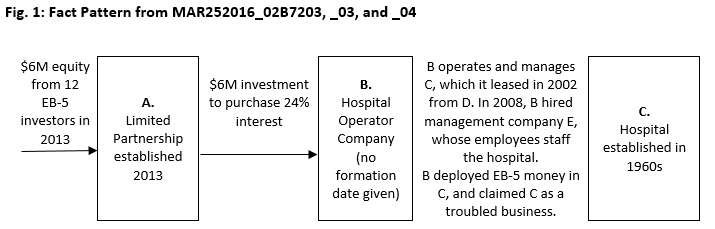
Several 2016 AAO decisions on I-526 cases have been posted on the USCIS website. I’m particularly interested in MAR252016_02B7203 (and the nearly identical _03 and _04), which deal with a regional center investment. Here’s what I’m particularly surprised or intrigued to hear AAO saying in the MAR252015 cases:

  • In the Regional Center context, the job-creating entity’s history and creation date are not relevant to the question of whether EB-5’s “new” commercial enterprise requirement has been met. When the regional center investment involves a new commercial enterprise and a separate job-creating enterprise, only the NCE has to qualify as “new.” In making this point, AAO argues against a position commonly taken by USCIS. In the MAR252016 case, the petitioner invested in a limited partnership formed in 2013 that deployed capital in a hospital established in the 1960s. In its denial, USCIS predictably cited Matter of Soffici and indicated that the NCE requirement wouldn’t be met unless the hospital were restructured or substantially expanded. (Soffici deals with a new enterprise’s purchase of an old hotel and says “It is the job creating business that must be examined in determining whether a new commercial enterprise has been created”.) AAO countered that: “We disagree with the Chief’s analysis. Soffici, unlike this case, did not involve a regional center project.” AAO argues that the relevant precedent is rather Matter of Izummi, which did deal with a regional center case, and “In Izummi, when determining what constituted a ‘new commercial enterprise’, we reviewed the date of creation of the entity in which a petitioner had invested or intended to invest, not the job creating entity where the funds were ultimately to be deployed.”
  • A petitioner can’t get credit for any jobs created by the project if the project didn’t create enough jobs for all EB-5 investors in the project (unless there is an agreement among all investors about how jobs will be allocated). In the MAR252016 case, AAO wouldn’t consider whether any of the 61 new jobs finally claimed could be credited to the petitioner, since there were 11 other EB-5 investors in the project and no job allocation agreement on file. This is not new policy, but an important reminder. Make and file a job allocation agreement, just in case!
  • An EB-5 investment does not meet the “at risk” requirement if the business plan does not “present a comprehensive analysis of the potential net profit available for distribution to each of the limited partners” and therefore fails to “sufficiently establish that there is a reasonable chance for gain, especially in the foreseeable future.” This is not technically a new point (the full “at risk” requirement is “at risk for the purpose of generating a return on the capital placed at risk”), but I haven’t seen AAO/USCIS focus on insufficient profit analysis as a basis for denial.

I’ll let you read the MAR252016 decisions for yourself to get the rest of the story. The case also involves the hot issues of troubled business qualification and the separation of ownership, management, and employment among multiple entities, and AAO doesn’t raise all the questions or reach all the conclusions I would’ve expected. What AAO doesn’t say in this case may be as significant as the points that are made. To assist in following the case, I’ve done my best to illustrate the fact pattern (reading around redactions, so mistakes are possible).
Fig-1UPDATE: You can read more about this case in a civil suit filed by the petitioners. (Update: the petitioners won the suit.)

AAO Decisions: Search Function
The Administrative Appeals Office has launched a search tool for most non-precedent decisions since 2005. Just enter a search term in the box under “AAO Non-Precedent Decision Repository” and poof – links to all AAO decisions where that term is mentioned, with sorting options. I love it. (And now regret that weekend spent downloading EB-5 decisions one by one to make my own searchable master file.)

Regional Center List Changes
Additions to the USCIS Regional Center List, 03/21/2016 to 04/05/2016

Terminations

  • Path America KingCo, LLC (Washington), Terminated 3/23/2016
  • MCIG Regional Center (Florida) Terminated 3/29/2016
  • Velocity Regional Center (California), Terminated 3/24/2016

Q1 2016 Petition Processing Stats, RC List Changes

Petition Processing Trends

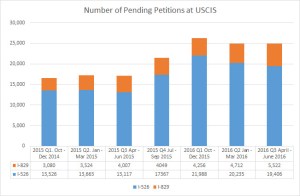
The USCIS Citizenship and Immigration Data page has been updated with data on I-526 and I-829 petition processing in the first quarter of fiscal year 2016 (aka October to December 2015).  The numbers are not heartening. Investor Program Office petition processing volume peaked in April-June 2015, and progressively lost ground over the following quarters.  In Q1 2016, IPO processed 355 more I-829 petitions but 933 fewer I-526s than in the previous quarter.  The I-829 gains are nice, but then the I-829 backlog is only a dire 4,000+ petitions while the I-526 backlog is an extremely dire near-22,000 petitions. IPO cannot afford to be processing fewer and fewer I-526s, or fewer EB-5 petitions overall. The number of I-526 receipts is also striking. We expected the surge in July to September 2015, in advance of the possible September 30th Regional Center Program sunset date, but the numbers show that the surge continued through December. That’s two quarters in a row with over 6,000 I-526 filings each. The program can’t handle many quarters like that, considering that only about 10,000 EB-5 visas are available per year for investors plus family members (not to mention the fact that IPO has only managed to process about 3,000 I-526s a quarter at best). In addition to slowing I-526 processing over the course of the year, IPO got tougher, denying 8% of I-526 petitions processed in Q3 2015, 15% in Q4 2015, and 23% in Q1 2016.
I526q12016
I829q12016
pendingq12016

Regional Center List Updates

Additions to the USCIS Regional Center List, 03/01/2016 to 03/21/2016.

  • American Lending Center Ohio, LLC (Ohio): usa-rc.com
  • American National Regional Center Southern California (California)
  • Discovery Florida, LLC (Florida)
  • East West Global Regional Center (California)
  • Fairhaven Capital Advisors Regional Center (Colorado)
  • MCFI Mississippi / Louisiana (Mississippi): www.mcfiusa.com
  • MCFI New York / New Jersey / Connecticut (Connecticut, New Jersey, New York): www.mcfiusa.com
  • Midwestern Investments For America, LLC (Ohio)
  • Nevada Regional Center Enterprises (Nevada)
  • New York Renaissance Regional Center, LLC (Connecticut, New Jersey, New York)
  • Reliant Regional Center (Minnesota): www.relianteb5.com
  • Socal Investment Regional Center (California)
  • Southwest Florida Regional Center, LLC (Florida)
  • TriHaven Investment Group Southern California (California)

Name Changes:

  • Southern California Commercial Regional Center LLC (former name US Commercial Regional Center) (California)
  • Charter Investor Financial (former name Charter USA Financial LLC) (Florida)

2015 Visa Statistics by Country, RC list changes

2015 Visa Statistics
The US Department of State has finally published Section V. of Report of the Visa Office 2015, so we now have figures by country for all EB-5 visas issued in FY2015. (Last December I reported numbers from Section VI of the report, which only reflects EB-5 visas issued at consulates.) Here is my updated summary table.
2015visastats
DOS issued over 10,000 EB-5 visas in 2014, and fewer than 10,000 in 2015. China continues to dominate the list of countries, but with a smaller percentage of total visas in 2015 than 2014. Vietnam topped the list of countries claiming an increased number of visas in 2015, while China, South Korea, and Mexico showed significant decrease between 2014 and 2015. It’s interesting to note the number of visas issued to applicants from islands (including British and French territories) and wonder how many of these may be for applicants originally from more difficult countries who got intermediate citizenship. In terms of use, visas for regional center investments (98.4% of total) and TEA investments (99.2% of total) were even more dominant in 2015 than 2014. I assume that visa numbers for 2015 mainly reflect investments made in 2012-2014 (considering processing and wait times) by about 4,440 investors (assuming average 2.2 visas per investor). FYI here is my post with summary table for the 2014 Visa Office report. And note that IIUSA has a handy Investor Origin Map showing EB-5 investments by country.

Regional Center List Updates

Changes to the USCIS Regional Center List, 2/10/2016 to 03/01/2016

New Approvals:

  • EB-5 Bonds Texas-Oklahoma, LLC (Oklahoma, Texas)
  • Future Resources, Inc. (California): fureinc.com
  • Index Regional Center, LLC (Florida)
  • Rainier Valley RC LLC (Washington)

Name Changes:

  • Florida First Regional Center, LLC (former name USEGF Florida Regional Center) (Florida)

Terminations:

  • Luca Energy Fund Regional Center (Louisiana, Texas): Terminated 2/2/2016
  • U.S. Investment Regional Center, LLC (Arizona): Terminated 2/22/2016

Senate TEA Hearing

Update: the Senate hearing on EB-5 Targeted Employment Areas has been postponed.

The Senate Judiciary Committee is more serious about EB-5 than I expected, and already has another hearing scheduled for next week, on Wednesday March 2, with the provocative title The Distortion of EB-5 Targeted Employment Areas: Time to End the Abuse. Senator Grassley is making good on his vow in December for Continued Push to Reform EB-5 after Fixes Ignored in Omnibus Spending Bill. Senator Grassley is concerned that “the status quo will not benefit Middle America. It benefits New York City and other affluent areas at the expense of areas in Iowa, Kentucky, Wisconsin, and Vermont,” and he is disturbed by reports such as Wall Street Journal’s September 2015 article How a U.S. Visa-for-Cash Plan Funds Luxury Apartment Buildings. On the other hand, Senators representing coastal America are likely to point out that big cities also struggle with unemployment and economic distress, and that it’s not right to make the TEA issue into a regional fight or impose a rural model on urban areas. If you’d like to review arguments on various sides in advance of this hearing, consider Jeanne Calderon’s research on the history and current use of the TEA incentive and impact of potential changes, Carolyn Lee’s 2014 article on State Designations of EB-5 Targeted Employment Areas (explaining the logic of current practice), and Jeff Campion’s 2015 article Targeted Employment Areas: Where Are We Now (giving the urban perspective). The proposed new TEA provisions in last year’s draft legislation were awkward and confusing, probably the result of too many contradictory compromises, but maybe all these hearings can result in a more reasonable reform proposal.

How long does I-924 take?

01/2017 Update: I have newer charts with data through January 2016 here.

–ORIGINAL POST–

USCIS reports a 8.5-month processing time for the Form I-924 Application for Regional Center as of December 31, 2015 (per the February 2016 IPO processing times report). This number does not distinguish between initial applications and amendment requests, and does not hint at the possible range of actual processing times. It has some base in averaged reality, but we don’t know how it’s calculated.

For more perspective, compare the average times USCIS reported from March 2014 to March 2015 (recorded from past IPO processing time reports) with the times for actual I-924 approvals from the same period (recorded from available regional center designation letters, which show approval date, filing date, and application type).

i924comp

The numbers from designation letters suggest that I-924 amendments in 2014/early 2015 were processed much more quickly and predictably than initial designation requests (although USCIS has said there’s no separate workflow or special treatment for amendments), and that actual processing times have often far exceeded what one would expect from reported averages. The trend from 2014 into 2015 looks somewhat positive. A scatterplot of approvals shows an increasing number of approvals coming in under 10 months (but also that USCIS was still working on applications that had been in the pipeline for 2-3 years). I will be interested to see how the numbers change when I have more letters to add to the data set. USCIS designated 208 new regional centers in FY2015, and there were 902 Form I-924 applications pending at USCIS as of January 2016 (as reported by Mr. Colucci in statements on 2/2 and 2/3). I guess that many of the pipeline I-924s are amendments/Exemplar I-526 filed in mid-2015 ahead of anticipated program changes, not new RC applications, but still 902 is a big number. Regional center applicants filing Form I-924 today should not be too alarmed by the processing time outliers in 2014/2015 (many of those 2-3 year cases were caught up and delayed in the confusion over tenant occupancy, which has been cleared now), but they also shouldn’t count on finishing the process in nine months, considering the backlog and IPO’s past performance.

i924timeplot

Portfolio investments, existing business

Noticing traffic to old articles about EB-5 investments that involve diversification and existing business, I’ve re-written the following posts with reference to more recent official and unofficial guidance from USCIS.

EB-5 business plan matrix

I’m preparing for a webinar next week that will discuss “What goes into an EB-5 business plan?” This is a good question, and depends on the further questions “What does the business plan need to accomplish?” and “In what context will the business plan be used?” The following matrix helps visualize the goals and contexts that can affect EB-5 business plan content.

BPmatrix

People who talk about EB-5 plans tend to focus on just one quadrant – 1A, positive standards for success in USCIS review – and especially on Matter of Ho-compliance. But if you study examples of EB-5 plans gone wrong (AAO denial decisions, lawsuits, unfunded projects), you know that it’s not enough to simply follow the business plan definition in the EB-5 precedent decision Matter of Ho. A plan can be beautifully detailed, covering all the Matter of Ho points from business description down to income projections, but still fail USCIS review due to inconsistencies with external evidence or to mismatch with program requirements (for example describing an enterprise that isn’t “new” or jobs that aren’t “qualifying” as defined by the EB-5 regulations). A perfunctory, formulaic business plan written to satisfy bare minimum requirements can pass USCIS review, but that document will never reach USCIS if it needs to and fails to attract investors. USCIS won’t table a plan for being an ungainly document, or ignore it because the proposal isn’t sufficiently appealing, or cite it in a lawsuit for being misleading. Investors may well do all those things. In my documents detailing direct and regional center EB-5 business plan standards (linked from my service website), I consider factors in each quadrant of the above matrix of goals and contexts. Investor review is not always an issue (not all investors look to the EB-5 business plan to introduce the business), and review outside USCIS takes different forms depending on the advisors involved. But it’s generally wise to look beyond the Matter of Ho box when writing or reviewing an EB-5 business plan.

H.R.4530, Resources, RC List Update

H.R.4530 Introduced
Even as Representatives Goodlatte, Conyers, Issa, and Lofgren (who worked with Senators Leahy and Grassley on their legislation last year) were speaking in yesterday’s House EB-5 hearing about how they think EB-5 incentives are misused and need to be re-oriented, representatives Polis and Amodei introduced H.R.4530-EB-5 Integrity Act of 2016, a bill that proposes to keep current EB-5 incentives in place. I’ve added the bill to my comparison chart, but you don’t need to read it; H.R.4530 is a carbon copy of Senator Flake’s S.2415 (and FYI entirely different from the H.R. 616 American Entrepreneurship and Investment Act of 2015 introduced by Polis and Amodei last January). I don’t know whom to cheer in this legislative mix. The Grassley/Leahy camp bill included at least one provision that would touch and could hurt (sometimes even fatally) each segment of the regional center world, while the Flake/Polis camp bill is crafted to ensure that the current winners don’t get their boats rocked and keep winning, with TEA incentives and the investment amount the same and the kind of integrity measures that conveniently double as anti-competitive measures. Diversity in the regional center world can be a problem, because fragmented markets are hard to work with and small-scale players have a relative probability of being unprofessional if not rogue and causing trouble. On the other hand, diversity means that EB-5 is relatively likely to fund the kind of projects that Congressional representatives want to see to help justify the regional center program — the hotels in third tier cities, the logistics companies in blighted industrial areas, the affordable housing, the entertainment and agricultural projects in rural areas, and so on. If regional center investment becomes all small safe loans to luxury developments in gateway cities, then immigrant investors will benefit but the American public, media, and Congress may turn against what looks like essentially a low-bar green card purchase transaction plus jobs-neutral government subsidy for attractive projects that would’ve proceeded anyway, just more expensively without the green card incentive to lower capital costs. On the other hand, the cause of integrity would not be advanced by deciding to limit the regional center program to unattractive projects entirely dependent on hapless foreign investors, or providing too much leeway for issuers that lack resources to operate professionally. If I were called to testify, I don’t know what changes I’d suggest to maximize EB-5’s potential benefits and minimize risks.

Resources
This quarter’s editions of the Regional Center Business Journal and EB-5 Investors Magazine (so far just out in paper form, but to be posted here soon) both have a number of great articles. In RCBJ, I particularly appreciated “What we Learn From SEC Investigation” by Ronald Fieldstone and Jay Rosen, who provide a comprehensive review of the types of violations that get investigated by the SEC, the specific activities that are focus of investigations, and the SEC investigation process from subpoena through discovery, deposition, negotiation and settlement. Lili Wang writes helpfully in RCBJ about the question we all ask “What Do Chinese Migration Agents Really Want?”, and EB-5 Investors Magazine also takes up this theme with two interesting migration agent interviews. Gregory White, Mark Katzoff and Angelo Paparelli authored an article for v.3.3 EB5 Investors Magazine (that I hope will soon be available online) on the important topic of “Avoiding the Inadvertent Investment Company.” The article describes how a regional center or issuer may avoid (and what will happen if it doesn’t avoid) being tagged as an investment company, including possible rescission, ineligibility to satisfy the EB-5 “at risk” capital rules and a duty to register as an investment advisor. EB5 Diligence also had a webinar this week on the topic Are Regional Centers Acting As Unregistered Investment Advisors? Another hot topic is the “rent-a-center” model for regional center investment, which has become increasingly popular and has also appeared in the cross-hairs of some legislative reform proposals. Rohit Kapuria has posted a thoughtful article Is the EB-5 Regional Center “Pure” Rental Model Sustainable?, and EB5 Projects will host a free webinar on 2/23 concerning Immigration & Securities Issues with Renting Buying & Selling an EB-5 Visa Regional Center.

USCIS Engagement Notes
USCIS has updated the 2/3 EB-5 Stakeholder invitation page with copies of the written opening statements made by Nicholas Colucci, Julia Harrison, and Lori MacKenzie. Also FYI I keep a master directory of USCIS EB-5 stakeholder meetings and a handy searchable PDF compilation of all published meeting notes (for those times when you can remember USCIS discussing a topic but forget where and when).

Processing Times
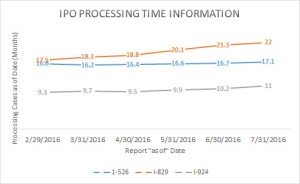
Not that we put much stock in IPO processing time averages (at least not without keeping a 10-month or so standard deviation in mind), but USCIS Processing Time Information has been updated as of 12/31/2016: 16 months for I-526, 16.2 months for I-829, and 8.5 months for I-924 (all up about 0.5 months from the previous report).

Regional Center List Changes
Additions to the USCIS Regional Center List, 01/28/2016 to 2/10/2016.

  • Bluegrass International Fund, LLC (Indiana, Kentucky): www.bluegrass-fund.com
  • East Coast Regional Center, LLC (New Jersey, New York)
  • Howard Hughes Hawaii Regional Center, LLC (Hawaii)
  • Mid-Atlantic Regional Center (Connecticut, Delaware, Maryland, New Jersey, New York, Pennsylvania): aseb5.com
  • Yellow Rock Regional Center of Washington, LLC (Washington)

Renamed:

  • Florida East Coast EB5 Regional Center LLC (former name United States Growth Fund, LLC) (Florida)
  • Prosperity Regional Center (former name U.S. Prosperity Regional Center) (Florida)
  • Investus LLC (former name New Mexico Foreign Investments LLC) (New Mexico)
  • New York Dream Regional Center LLC (former name Tri-State USA Regional Center) (New York)

2/11 House Hearing Detail

You can now review video, testimonies, and statements from today’s House Judiciary Committee Hearing “Is the Investor Visa Program an Underperforming Asset?” (FYI, I’ve also uploaded my audio recording.)

In the written testimony, IPO Chief Nicholas Colucci essentially reiterates his Senate testimony, GAO Director Rebecca Gambler discusses the GAO’s August 2015 study of the EB-5 program and USCIS’s slow progress toward implementing GAO recommendations for better risk assessment and reporting, NYU Professor Jeanne Calderon discusses her program research and the history and use of the Targeted Employment Area incentive, and Matt Gordon advocates for maximizing the social value of EB-5 and making program changes that would benefit his direct-EB-5-focused company.

The hearing began with opening statements by Committee Chairman Bob Goodlatte (R-VA), Ranking Member John Conyers (D-MI), and Zoe Lofgren (D-CA), who agreed that the regional center program has good potential but needs significant reform, particularly in practices that have departed from Congressional intent to incentivize investment in needy urban and rural areas. Targeted Employment Area issues were a focus throughout the hearing, including the question period that brought in Darrell Issa (D-CA), Louie Gohmert (R-TX), Jackson Lee (D-TX), Trey Gowdry (R-SC), and Judy Chu (D-CA). Most speakers deplored gerrymandering and TEA incentives for luxury real estate developments, and emphasized the need to increase the minimum EB-5 investment amount (focusing on areas of reform that were part of the Leahy/Grassley legislation but excluded from the Flake bill). Job creation was an additional focus area in this hearing, with Conyers, Calderon, Gambler, and Gordon regretting the limited data on regional center job creation, and Goodlatte and Issa questioning whether it makes sense to let EB-5 investors count the total jobs created by the project they invest in, even if their investment accounts for a small percentage of the capital stack. The issue of effective dates was raised several times, with Goodlatte arguing that reforms would need some retroactivity in order to be effective (considering that there are 6+ years of investors already in the backlog pipeline, and this could defer program reforms 6+ years if they only applied to new investors filing after enactment). Colucci indicated that regulatory changes being formulated by USCIS (to TEA procedures and the investment amount) would be forward-looking per tradition, not retroactive. He did not say when USCIS will come out with proposed changes to the regulations or how much USCIS would increase the investment amount (though he mentioned they are considering the legislative proposals as a reference point). The hearing brought up a number of questions that the witnesses lacked the background to answer, and I found myself wishing that the roster had included someone with direct regional center experience. Darrell Issa did request that a letter from IIUSA be included in the hearing record, and this may provide additional perspective.

In sum, the House hearing’s answer to the question “Is the investor visa program an underperforming asset?” seemed to be “Yes, it is underperforming Congressional intent to attract investment to and create jobs in areas of greatest need.” This hearing did not have much to say about anti-fraud/abuse measures or increased oversight (the focus of the Senate hearing), but expressed concern that EB-5 isn’t getting the best “bang for the buck” because investor funds aren’t being directed for maximum economic and job creation benefit.

2/3 USCIS EB-5 Stakeholder Engagement

2/12 UPDATE: You can now visit the USCIS’s 2/3 engagement page and download copies of the opening statements by Nicholas Colucci, Julia Harrison, and Lori MacKenzie, which were the most informative part of this engagement. Ron Klasko and Jessica DeNisi have a good summary on the IIUSA blog of significant content.

I’ve uploaded my recording of today’s EB-5 Immigrant Investor Program Stakeholder Engagement with USCIS, though I do not particularly recommend it. If you want an interesting and information-rich update, look at IPO Chief Colucci’s written testimony for yesterday’s judiciary committee hearing. We appreciate having stakeholder engagements with open Q&A, and practitioners will benefit from reviewing the updates and the answers that were given and withheld, but overall I didn’t learn much from the meeting. The next EB-5 engagement will be held on April 25 in Washington DC, with opportunity for in-person attendance.

2/2 Senate Hearing Detail

If you are involved in the regional center program, you should review what happened today in the Senate Judiciary Committee Hearing on “The Failures and Future of the EB-5 Regional Center Program: Can it be Fixed?” We heard testimony from IPO Chief Nicholas Colucci and SEC Division of Enforcement Associate Director Stephen Cohen, statements by Senators Grassley, Leahy, and Feinstein, and an extensive question and answer period that brought in Senators Cornyn, Schumer, Flake, Blumenthal, Tillis, Sessions, Perdue, and Klobuchar. The judiciary committee website link above currently has video of the hearing and written statements by Grassley, Leahy, Colucci, and Cohen. (After watching the video be sure to read the statements, as they are very informative and include content beyond what their authors said in the hearing.) In case the video disappears, I’ve also uploaded my audio recording of the hearing. (Also, see this post for more on the letter from DHS Secretary Jeh Johnson, which was frequently referenced in the hearing.)

I don’t know whether Senator Grassley came away from this hearing with further clarity on the character and prospects of regional centers, but we definitely get a fascinating view of the thinking and activities going on behind the scenes now at USCIS, at the SEC, and in Congress relative to the RC program. The senators present largely advocated for fixing not nixing (or mending not ending) the program (except for Senator Feinstein, who called for an end and also pressed her odd belief that USCIS and the SEC should specially investigate the victims in a fraud case). The senators expressed general commitment to reform while differing in their diagnosis of the nature and magnitude of problems, and in their visions for what the RC program should be. Perhaps most interesting, the senators drew out Chief Colucci to discuss specific integrity measures and program changes that are already in place and in the pipeline at USCIS, regardless of legislation.