The basics: investment+job creation (draft policy memo comment)

Reading the new draft EB-5 policy memo Guidance on the Job Creation Requirement and Sustainment of the Investment for EB-5 Adjudication of Form I-526 and Form I-829, I see why USCIS delayed the release for a year. The memo has good and bad points in the details, but I’ll leave those for the experts and just point out the big issue: that the memo is fundamentally out of sync with the basic logic of the EB-5 program.

The foundation and organizing principle of the EB-5 program is the nexus between investment and job creation. A petitioner doesn’t get EB-5 benefits just by committing $1,000,000 or just by creating 10+ jobs. Rather, EB-5 eligibility arises at the intersection between investment and job creation – when capital is made available for and results in job creation. Eligibility requirements for investment and job creation are intimately intertwined in the EB-5 regulations and precedent decisions: a qualifying investment is one that’s linked to qualifying job creation, and vice versa.

Astonishingly, the new draft policy memo decouples investment and job creation, and treats them without coherence as separate eligibility grounds independently affected by visa retrogression.

The memo was written to address the retrogression situation: the fact that unavailability of visas effectively adds years to the theoretical 2.5-year window that’s between an investor’s I-526 and I-829 (and accordingly to the window between investment and investor exit). We want the memo to tell us how that expanded timeframe affects EB-5 eligibility requirements.

The draft memo’s answer is that USCIS will not require jobs resulting from the investment to still be in existence at I-829, provided that they were created and sustained for 2+ years, but that USCIS will require the investment to be still deployed at I-829, even if it was sustained for 2+ years and resulted in the qualifying job creation. If the original business plan was accomplished before investors reach I-829, the draft memo says, then the new commercial enterprise must re-deploy the capital in a new “at risk” activity throughout the petitioner’s permanent residence period. (Note that “at risk” in EB-5-world means actually invested and not just promised (per 8 CFR 204.6(j)(2)), made available for purposes of job creation (per Matter of Izummi) and associated with the actual undertaking of business activity (per Matter of Ho).)

The new draft memo doesn’t just mean that investors can’t be paid back personally before they reach I-829 (we expected that), but that an EB-5-funded loan can’t be repaid to the new commercial enterprise unless the NCE promptly turns around and makes a new loan to another project – even though the new loan would have no nexus with the qualifying job creation. The memo states that “to the extent that all or some portion of the new commercial enterprise’s claim against the job-creating entity is repaid to the new commercial enterprise during the sustainment period, the new commercial enterprise must continue to deploy such repaid capital in an ‘at risk’ activity for the remainder of the sustainment period” and “the capital will not be considered ‘at risk’ if it is merely being held in the new commercial enterprise’s bank account or an escrow account during the sustainment period.”

Project companies will not complain about this draft memo because a business generally wants to redeploy capital and not let it sit around, and even better when that redeployment has no job creation or other EB-5 eligibility strings attached plus the investor exit can be unspecified upfront and extended indefinitely. But I don’t like to see theoretical mishmash, and I also feel for investors. If this draft becomes policy, then EB-5 offerings will have to say here is the project you’re investing in, but be aware that your funds may be redeployed in an unspecified number of other future projects that you can’t review now because we don’t know now what they will be – we just know that your capital is required to stay in circulation even after this business plan is accomplished and after your job creation requirements have been met until your immigration paperwork finally grinds to its conclusion.

New Draft EB-5 Policy Memo

From: U.S. Citizenship and Immigration Services [mailto:uscis@public.govdelivery.com]
Sent: Monday, August 10, 2015 10:43 AM
Subject: USCIS Message: Policy Memorandum, PM-602-0121

Dear Stakeholder,
USCIS has posted the following draft policy memorandum for your review:

Comment Process: Please email all comments to ope.feedback@uscis.dhs.gov by Tuesday, September 8, 2015. Please include the following to make your comments clear:
·        State the title of the relevant memo in the subject line of your message;
·        Refer to a specific portion of the memo;
·        Explain the reason for any recommended change; and
·        Include data, information, or authority that supports the recommendation.

For complete information on the comment process, visit the Feedback Opportunities section of www.uscis.gov.

If you are unable to access the memorandum through the links provided above, please do the following:

  1. Go to www.uscis.gov/outreach
  2. Select “Feedback Opportunities” on the left side of the page

Kind Regards,
USCIS Public Engagement Division

RC Reauthorization Status, New RCs

Reauthorization Status
The current authorization of the Regional Center program is set to expire after September 30, 2015, and timely reauthorization is looking doubtful what with our representatives being on vacation much of the time between now and then, and with none of the proposed/pending legislation looking advisable to pass without discussion and revision. What will happen on October 1 if Congress hasn’t acted in time? We also asked this question in 2012, last time the program was up for reauthorization, and got vague answers from USCIS (“This as a question that will just have to be addressed when and if it occurs, and the Service does not have a response at this time” was the message at the 1/23/2012 EB-5 stakeholder meeting. The 5/1/2012 EB-5 stakeholder meeting executive summary stated that all existing regional center designations would expire automatically and that USCIS would not approve new Regional Center designations, but did not comment on what would happen with Regional Center-associated investor petitions.). We’ll see what USCIS has to say in next week’s engagement (8/13/2015). In the meantime, advocacy groups (IIUSA, EB5 Coalition) are still pressing for timely action, and we may after all get a bill passed at around 11:58 pm on the 30th, as has happened before. Here are the proposals on the horizon, so far as I know.

    • S.1501 – American Job Creation and Investment Promotion Reform Act of 2015. Sponsored by Senator Leahy (D-VT) and Senator Grassley (R-IA). Introduced in the Senate on June 3, 2015, referred to committee, and much analyzed and largely panned since then by the EB-5 community. The bill’s good aspects – that it extends (by five years) and seeks to improve the Regional Center program and is sponsored by important people – seem outweighed by its problems – that its provisions would drastically redirect and severely curtail the scope of the RC program (discouraging large raises, large projects and urban development in favor of small EB-5-dominated projects in rural areas), and that it brands the RC program as a hotbed of corruption and proposes ham-fisted measures that wouldn’t necessarily forestall bad actors, who can be glibber than most in attesting virtue, but would place an unwieldly regulatory burden and risk on people actually trying to do things right. IIUSA reports that they continue to have close discussions with the bill’s drafters – and other relevant Senate offices – as alternative language is considered by the sponsoring offices.
    • H.R.3370 – To amend the Immigration and Nationality Act to promote innovation, investment, and research in the United States, and for other purposes. Sponsored by Representatives Zoe Lofgren (D-CA) and Luis Gutierrez (D-IL). Introduced in the House on July 29, 2015, and referred to committee. I think this is a pretty good bill (aside from being nearly unreadable in bill form – read Rep. Lofgren’s section summary first before you try the legislation itself or you’ll get confused). The bill proposes a couple new EB visa categories in Title I (I don’t see the proposed EB-6 category being used much, as VC risk/unpredictability and immigration aren’t a great mix, but in any case it wouldn’t take visas away from or otherwise affect the EB-5 program) and discusses the EB-5 Regional Center program in Title II (starting on p. 17). The bill would permanently authorize the RC program, double the qualifying EB-5 investment amount (which is a leap, but not unreasonable considering investor visa thresholds in other countries), open the possibility of doubling the annual EB-5 visa allocation, and make other changes that I think would generally improve the footing of the EB-5 program. The proposals regarding TEAs and job creation (p. 38-41) strike me as particularly well-considered and reasonable. The concurrent filing and premium processing provisions would be very popular (though with a fee of only $5000, I believe that 100% of EB-5 petitioners would go for premium processing, making the service impossible to deliver in practice). The proposals for improved program integrity in this bill look serious but largely reasonable and justifiable rather than punitive and alarmist, as in S.1501. I’m just concerned that this bill, like S.1501, charges USCIS to regulate – and holds RCs responsible for keeping in line – a constellation of people who we’d all like to see controlled but who are not necessarily amenable to control by either RCs or USCIS. USCIS is supposed to work with the FBI to conduct background checks of and Regional Centers may be heavily sanctioned based on the behavior of anyone who can be considered “involved” with a regional center or an associated commercial enterprise (i.e. “if he or she is the principal, representative, administrator, owner, officer, board member, manager, executive, general partner, fiduciary, marketer, promoter, director, or other similar position of substantial authority for the operations, management, or promotion of the regional center or associated commercial enterprise, respectively”). In practice, does this mean that FBI agents have to show up at the offices of licensed migration agents in China who happen to be sourcing investors for Regional Centers and say okay hands out everybody, we’re taking fingerprints? How will the Chinese government feel about the US coming in to lay down the law in a domain that it is concerned to regulate itself and to protect from foreign influence? Considering that most EB-5 offers are made entirely abroad, and often by independent third parties who owe first allegiance to their own local regulations, how would Regional Centers handle the requirement “to monitor and supervise all offers and sales of securities which are made by associated commercial enterprises to ensure compliance with the securities laws of the United States, and to maintain records, data, and information relating to all such offers and sales of securities”? Certainly the selling and investor recruitment process is a major challenge, complication and source of confusion and vulnerability for the EB-5 program and for Regional Centers and deserves to be addressed, but easier said than done.
    • H.R. 616 American Entrepreneurship and Investment Act of 2015. Sponsored by Representative Polis (D-CO) and Amodi (R-NV), and now with 22 co-sponsors. Introduced in the House January 28, 2015, referred to committee March 17, 2015. This bill proposes permanently authorizing the Regional Center program without overhauling it, and briefly suggests a few modest and generally-welcome clarifications and improvements. I don’t know why this bill hasn’t gained more traction – possibly because the general mood seems to be that the program needs some significant changes if it’s to be made permanent.
    • Rumor has it that Judiciary Committee Chairman Bob Goodlatte (R-VA) and Representative Darrel Issa (R-CA) plan to introduce legislation in early September that will be similar to their SKILLS Act (HR2131) proposal from last year, with some additions. As originally written, this bill proposed new EB-6 and EB-7 categories (defined differently from Lofgren’s), tweaked a bunch of visa categories, and had one line about the Regional Center program, proposing to make it permanent. The new version will reportedly include some additional EB-5 program changes, but less drastic than those in S.1501.

Carolyn Lee has assembled a handy bill comparison chart. See also Pat Hogan’s letter on the mood in Washington as of Sept. 2015.

New Regional Centers
Additions to the USCIS Regional Center List, 6/23/2015 to 8/3/2015

  • American Coast Regional Center (California)
  • EB-5 Impact Capital Regional Center, LLC (California and Nevada)
  • EB5 International, LLC (California): www.eb5international.com
  • EB5 Affiliate Network Washington, D.C. Regional Center, LLC (District of Columbia, Maryland, Virginia, West Virginia): eb5affiliatenetwork.com
  • Maryland Global Regional Center, LLC (District of Columbia, Maryland, Virginia, West Virginia): www.cgrc.info
  • Civitas Northern Florida Regional Center (Florida): www.civitascapital.com
  • EB5 Financing Management Company, LLC (Florida)
  • Civitas Illinois Regional Center (Illinois): www.civitascapital.com
  • EB5 Affiliate Network State of Hawaii Regional Center, LLC (Hawaii): eb5affiliatenetwork.com
  • Massachusetts Wealth and Happiness Regional Center, Inc. (Massachusetts)
  • EB5 Affiliate Network State of North Carolina Regional Center, LLC (North Carolina): eb5affiliatenetwork.com
  • Ocean Pacific Regional Center, LLC (Oregon)
  • Harmonia Regional Center, LLC (Texas): harmoniaeb5.com
  • Name Change: Gotham City Regional Center, LLC changed to Silverstein Properties Regional Center LLC (Connecticut, New Jersey, New York, Pennsylvania): silversteinrc.com

USCIS Website
I also note that USCIS has done a little revamp of the EB-5 section of its website, separating what used to be the main page into two pages, one about the EB-5 program and one about the EB-5 visa but still mysteriously (pointedly?) omitting the informational page that used to be there about the Regional Center program. They do slap a nice big forbidden icon on the link to the list of terminated Regional Centers, a list already with plenty of indignity for the subset of centers that landed there not by fault but by choosing not to continue with the program.

White House Report, SEC Oil&Gas, I-829

EB-5 Program Changes To Be Initiated by USCIS and DOS
The White House released a report Modernizing & Streamlining our Legal Immigration System for the 21st Century (July 2015) that summarizes recommendations from various agencies for how to streamline and modernize the immigration system, as directed in the President’s executive actions of November 2014. “The recommendations in this report reflect actions that agencies will take to modernize our system for efficiency and applicant accessibility, streamline legal immigration avenues, and strengthen our humanitarian system.” The lack of buzz around this report makes me think that the public doesn’t expect the recommendations to turn into action any time soon, but nevertheless keep in mind two recommendations that reflect commitments by USCIS and the Department of State to make changes that affect the EB-5 program:

Recommendation 1: Update standards for the EB-5 Program. By enhancing program integrity and updating eligibility requirements, this program can better serve our nation. DHS intends to pursue rulemaking to achieve those goals, including by requiring conflict-of-interest disclosures by Regional Center principals, enhancing background checks and public disclosure requirements, and increasing the minimum qualifying level of investment. DHS will also take steps to improve the adjudication and approval of Regional Center applications.
Recommendation 2: Clarify options for potential EB-5 investors to obtain visitor visas. State will amend its guidance in the Foreign Affairs Manual to clarify that potential EB-5 investors can obtain visitor visas to examine or monitor potential qualifying investments if they otherwise qualify for the visitor visa.

SEC Charges Oil Company and CEO
SEC Charges Oil Company and CEO in Scheme Targeting Chinese-Americans and EB-5 Investors, reads the SEC’s press release. The SEC charged a Bay Area oil and gas company and its CEO with running a $68 million Ponzi-like scheme and affinity fraud that targeted the Chinese-American community in California and investors in Asia, including some solicited as part of the EB-5 Program. The scheme was conducted primarily outside the EB-5 program (EB-5 investor funds accounted for a just $8 million of the $68 million involved), and it’s hardly surprising when a new company promising 20-30% returns for oil and gas exploration gets charged with fraud, but the case is still interesting from an EB-5 perspective because it involves technical selling and registration issues. Seyfarth Shaw LLP has a good article on this topic: SEC charges EB-5 fund operators and finders. As the article points out: “The SEC’s actions against various participants in EB-5 transactions make it clear that, whether or not an offering involves alleged fraud, offerors of EB-5 project securities and other persons participating in the promotion of such projects must be careful to comply with all aspects of the applicable securities laws, including either registering or securing exemptions for the offering of the securities and complying with the broker-dealer and investment adviser rules.”

New Form I-829
People preparing to file the Form I-829 should keep in mind that USCIS has posted a new version with significant updates that particularly affect Regional Center investors. An EB-5 Insights blog post summarizes the changes.

TEAs and Multipliers
The July 2015 Regional Center Business Journal includes some very good articles. I particularly appreciated two articles discussing the logic of TEAs and Scott Barnhart’s aptly titled article “Economic Multipliers in the EB-5 Arena: Voodoo Economics or Sound Economic Practice?”

I-526 Backlog
The CIS Ombudsman’s 2015 Annual Report to Congress, has a section on the EB-5 program, including this sobering chart.
I526volume

The basics: Who are EB-5 investors, what are Regional Centers, what are EB-5 offerings?

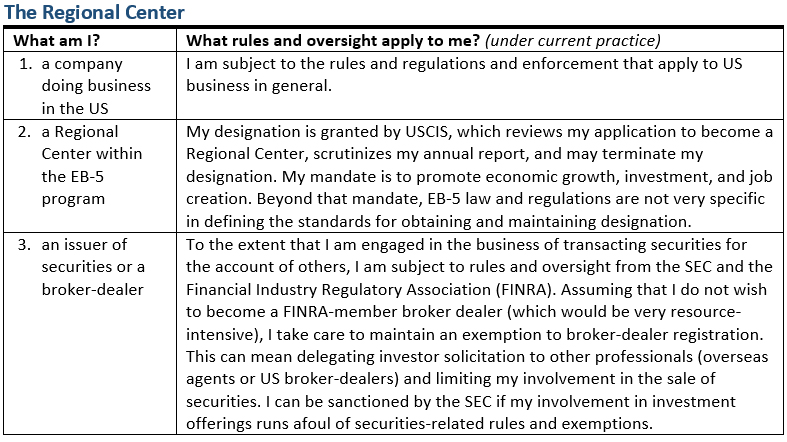
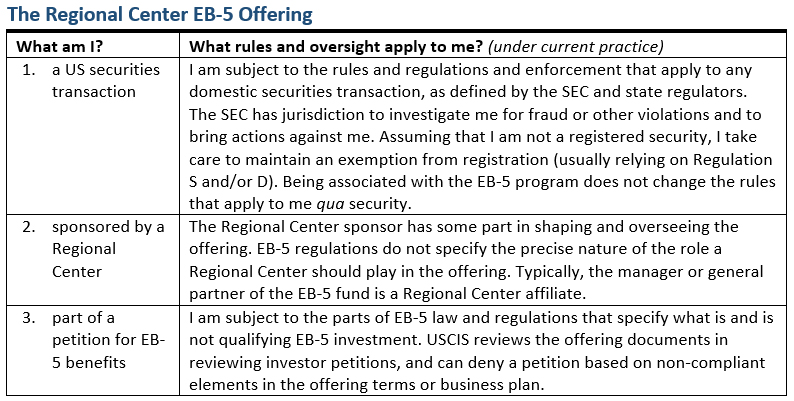
Making good policy for EB-5 requires understanding what EB-5 is. I made the tables below to help people think about what EB-5 investors, Regional Centers, and EB-5 offerings are, and what place they occupy in the world. Panicky journalists (and recently, panicky legislation) appear to assume that EB-5 exists in its own special, isolated world where EB-5 regulations or lack thereof are the only rules and USCIS policing or lack thereof provides the only enforcement. If this assumption were valid, then Senators Leahy and Grassley would be right to propose burdening USCIS with extensive responsibilities for the securities compliance issues, investor market integrity factors, foreign direct investment issues, and national security considerations that could potentially be associated with an EB-5 investment. If EB-5-world were isolated from the jurisdictions of the SEC, OFAC, FINRA, the FBI, the State Department, and so on, then the Investor Program Office at USCIS would indeed need to hire lots more staff and make lots more regulations to compensate. USCIS would need to create in-house EB-5-world versions of those agencies and their regulations and oversight and enforcement activities. The job-creation impact would be huge – not only duplicating federal agencies but creating new categories of specialists in the private sector (the expert in USCIS EB-5-world securities regulations as distinct from the SEC’s securities regulations for everyone else, the expert in EB-5-world foreign investment limitations as distinct from regular-world foreign investment limitations, and so on.) But all this is unnecessary if the EB-5 investor, Regional Center, and EB-5 offering in fact belong to the wide world. And clearly, they do. “I am a petitioner for EB-5 benefits” is one descriptor of an EB-5 investor, and he’s unique to EB-5 and under USCIS’s watch to that extent. “I am an investor in a US business” is another statement he can make, and that puts him in a larger group under the SEC’s range of expertise and OFAC and FinCEN and such limitations as applicable. “I am an immigrant,” he will also say, and that makes him the State Department’s baby and subjects him to DOS’s specialization and resources related to national security. As a foreign investor, he’s a foreign investor like other foreign investors, and as an immigrant, he’s an immigrant like other immigrants – not unique to EB-5 in those capacities, not a greater or lesser security risk because of EB-5, and not isolated from the factors that apply to other investors and other immigrants generally. I argue that policy makers who want to improve EB-5 should focus on what’s unique to EB-5. Where a “who am I?” or “what am I?” statement below is particular to EB-5, the corresponding rules/oversight should involve USCIS and may be an area where USCIS or the EB-5 regulations can improve. If the characteristic isn’t EB-5-specific, neither should the policy be.
investor
RegionalCenter
offering
To read more about securities law applications to EB-5 investors, regional centers and offerings, see the notes from the USCIS/SEC engagement and articles on the Investment Law Blog, EB-5 Diligence, and EB-5 Insights. This IIUSA article describes levels of screening for EB-5 investors. I welcome corrections and additions to my tables.

SEC Ireeco, State Dept, Economists, New & Removed RCs

I have a sleeve full of urgent articles on the nature of the Regional Center program, inspired by legislation debates, and also a desk full of yet more urgent business plans for clients worried about the legislation debates and eager to get their deals filed. So this blog is getting neglected, but here are a few updates.

SEC Action
The SEC has announced charges against a firm for acting as an unregistered broker for EB-5 investors. See the SEC’s press release SEC Charges Unregistered Brokers in EB-5 Immigrant Investor Program. Michael Homeier emailed some helpful commentary on this case and Cathy Holmes has written a helpful article. This kind of action is not a surprise. The rules are clear and the SEC has repeatedly stated that it has its eye out for unlicensed persons receiving placement fees for introducing investors to investment offerors. EB-5 is a good place to hunt for this kind of offender, since the field includes many players who know more about immigration than about investment and are thus vulnerable to tripping up on securities issues. This case does not involve fraud, just failure to register, but the consequences are still serious and a good wake-up call for everyone. Ignorance of the law is no excuse! Talk to your counsel and make sure that nothing you’re doing could put you afoul of registration requirements. And recall that paying an improper fee can be just as wrong as receiving it. People who allege that EB-5 is a free-for-all should also take note of this SEC announcement, which reflects the fact that EB-5 investments are indeed regulated just like any other security.

State Department Update
The cut-off date for mainland China-born EB-5 visa applicants moved from May 1, 2013 to September 1, 2013, as of the July Visa Bulletin. This is good news, and means more Chinese investors who’ve passed I-526 can get in the queue to receive visas.

USCIS Updates
USCIS has posted notes from the June 4 stakeholder engagement with economists. The most recent update to IPO processing times (posted July 15) shows a fractional dip in I-526 times (to 13.4 months) and slight increase to I-829 and I-924 times (to 13.1 and 12.2 months respectively). USCIS has officially suspended its Electronic Immigration System (ELIS) for Form I-526, and the Regional Center Document Library is now inactive — not a surprise, considering feedback from the people who struggled to use these tools. Also note that there’s a new and significantly expanded edition of the Form I-829 (dated 5/7/2015).

New and Removed RCs
Additions to the USCIS Regional Center List, 6/08/2015 to 6/23/2015

Additions to the USCIS Terminated Regional Center List 5/7/2015 to 6/9/2015

  • SZNW (California)
  • EB-5, MRC LLC (Michigan)

S.1501 legislation introduced; USCIS engagement on job creation

USCIS Engagement with Economics
Today USCIS held its “EB-5 Interactive Series: Expenses that are Includable (or Excludable) for Job Creation.” Here is my recording of the call. When USCIS publishes its summary, and when economists make comments, I’ll link to them here. I didn’t hear anything ground-breaking except for one point that looks inconsistent with written policy, and should eventually be recognized as wrong, so I’ll reserve my comments.
UPDATE: USCIS has posted “talking points” from this engagement.

New legislation introduced into the re-authorization debate
Senate Judiciary Committee Chairman Charles Grassley (R-Iowa) and Ranking Member Patrick Leahy (D-Vt.) have introduced S. 1501 (American Job Creation and Investment Promotion Reform Act of 2015), legislation to reauthorize and reshape the EB-5 Regional Center program, and to change some aspects of the EB-5 program generally. UPDATE: Yesterday I posted a hasty rant on this bill, which I’ve decided to take down as reader response has encouraged me to look more carefully at the provisions before commenting. Take a look at the bill for yourself and see what you think. I may continue to revise this post with additional commentary.
Probably the best commentary so far on the bill is Two Key Senators Introduce Bill to Extend and Improve EB-5 Program By Stephen Yale-Loehr.

NYU article, 2015 Q2 Processing Stats, May 5 AAO Killer, New RCs

NYU Article
We now have a final version of the paper “A Roadmap to the Use of EB-5 Capital: An Alternative Financing Tool for Commercial Real Estate Projects” (May 22, 2015) by Professor Jeanne Calderon, Esq. and Guest Lecturer Gary Friedland, Esq. of the NYU Stern School of Business. For real estate developers considering EB-5, this paper is valuable for the database of examples alone, not to mention 70 pages that carefully explain how the program can work for real estate projects. The authors tell me that their project database with ongoing updates will be posted on the NYU Stern School of Business site.

2015 Q2 Processing Stats
USCIS has finally posted official EB-5 petition processing stats for Q2 2015. It’s wonderful to see that IPO is getting up to speed on I-829 processing while also increasing I-526 volumes. Meanwhile, note that volume of petition receipts has fallen each quarter this year.

2015 AAO Decisions on I-526 Cases
So far USCIS has posted four 2015 AAO decisions on appeals of denied I-526 petitions, including three sleepers and a bombshell. APR012015_01B7203 briefly remands the appeal to IPO in light of a court settlement, APR032015_01B7203 comes to an apparently reasonable conclusion that the business plan was not credible and waxes for several pages on “material misrepresentations” and their consequences, MAY082015_01B7203 dissects source of funds problems, and MAY052015_01B7203 pursues a blindly doctrinaire line on the requirement that “the petitioner must demonstrate eligibility for the visa petition at the time of filing.” In the MAY052015_01B7203 case, the offering memorandum filed with the original I-526 had a sentence that USCIS judged an impermissible redemption agreement. All investors signed and submitted an Agreement of Waiver to remove that sentence, and USCIS/the AAO didn’t dispute that the OM+waiver was now compliant but said that the petition still needed to be denied because the waiver post-dated I-526 filing and therefore the petitioner wasn’t technically eligible at the time of filing. This point is fair to the letter of the law, but one wonders, why decide to pound this technicality?  The petitioner did not include evidence of non-EB-5 capital commitments in the first petition filed in 2012, but duly provided the evidence when USCIS got around to requesting it in 2013. But USCIS/the AAO declined to credit the commitment letters provided in part because they post-dated the original I-526 filing. If this standard were applied fairly to all EB-5 cases – if no petitioner could file unless all other funding had been documented as raised before he filed – then multiple-EB-5 investor deals (most of the EB-5 program) would become next to impossible. Further, EB-5 would be limited to the projects that can and are willing to get all the conventional funding they need in the bank one to two years before they can hope to receive EB-5 investment (considering USCIS’s long I-526 processing times, and the common use of EB-5 escrows contingent upon I-526 approvals). In other words, EB-5 would be limited to projects that don’t need EB-5; that can take out their bank loans and go to work right away before investors even file I-526 and regardless of what happens with the I-526 petitions. The AAO decision hammers this point even further in the section that tries to apply the standard that “simply formulating an idea for future business activity, without taking any meaningful concrete action, is similarly insufficient for a petitioner to meet the at-risk requirement.” Specifically, the AAO/USCIS decided that the petitioner had not placed the required amount of capital at risk in part because the contractors who had been engaged to build the subject assisted living facility had not actually started work before the investor filed I-526. Naturally the petitioner needs to show more than a general idea for a future business, but this decision seems arbitrary and unreasonable in its application of the requirement. The business owner says “yes, here are the meaningful concrete actions we have taken” and the AAO lawyer says “no, I don’t think those qualify as a meaningful concrete action; you should’ve gone further” – what is this but an arbitrary judgment made by someone with no clear metric and no claim to qualification to assess the stages in establishing various types of business? And where is the acknowledgement of the one to two-year spanner that USCIS review puts into any development plan? And what would this mean, if applied fairly to all? Again, EB-5 would be limited to 1) projects that don’t actually need EB-5 investment, since they would be required to fully mature prior to/without it; and/or 2) investors who don’t really care about the EB-5 visa, such that they can develop projects well in advance of and independent of the fate of their EB-5 petitions. I think I’m upset about this case partly because it appears to involve the kind of business that many people would like the EB-5 program to support. EB-5 petitioners were providing about half of the capital needed to fund small assisted living facilities in Texas – a business that looks like it could have provided jobs in areas of genuine need and might not have gone forward without the EB-5 investment. Why press interpretations of the regulations that knock out this kind of investment, while further privileging deals that just use EB-5 to take out a few million of existing financing for some multimillion building project that was going ahead anyway? Someone is not thinking very carefully.

New Regional Centers
Additions to the USCIS Regional Center List, 5/21/2015 to 6/1/2015

  • U.S. Investment Regional Center, LLC (Arizona): usirceb5.com
  • Alexico Los Angeles Regional Center, LLC (California)
  • California Blue Sky Regional Center, LLC (California): Designation Letter
  • California Investment Regional Center, LLC (California): www.eb5-circ.com
  • Economic Development & Investment Group LLLP (California)
  • Gateway California Regional Center (California): www.gatewayeb5.com
  • Western Pacific Regional Center, LLC (California, Oregon, Washington)
  • USEGF Florida Regional Center (Florida)
  • Advantage America Hawaii Regional Center, LLC (Hawaii): www.aaeb5.com
  • GO USA EB-5 Regional Center, LLC (Illinois): www.gousaeb5.com
  • American Regional Center-Las Vegas, LLC (Nevada)
  • Century New York City Regional Center (New York): www.centurynyceb5.com
  • Land of Sky Regional Center, LLC (North Carolina, Tennessee): www.landofskyregionalcenter.com
  • Ohio Lakeside Regional Investment Center (Ohio): www.uslakesideeb5.com
  • The Lawrence Economic Development Corporation (Ohio): www.lawrencecountyohio.org
  • JMIR Texas Mega Metro Regional Center, LLC (Texas)
  • Washington Foreign Investment Management Group, LLC (Washington): www.eb5wfimg.com

IIUSA Day 1 (USCIS, DOS, SEC, FINRA)

I’m at the IIUSA EB-5 Advocacy and Leadership Conference in Washington D.C., where the mood is mixed. The proposed legislation and congressional champions that we applauded at last year’s conference are now gone. Journalists who get paid for sensation and senators who didn’t get their way in confirmation hearings have had a heyday with EB-5, and there’s every incentive for the news to get worse as other officials with tangential EB-5 connections (e.g. Hilary Clinton) stand for election/roasting. (EB-5 makes a great political weapon if it looks inherently bad, so purple insinuation pays.) A few real-life scandals have happened besides the political mirage ones, not helping matters. Despite this gathering gloom, however, the tone here at the conference is not that depressed. The ballroom is full of people who are continuing to raise capital, who are seeing their own projects and investors succeeding and economic development happening in their own areas, and who know enough to put media reports in context. With this concentration of positive personal experience in the room, it’s easy to forget what’s outside. But we can’t be complacent, because the general public isn’t in our conference room, and scandal-mongering sounds louder than boring business success. Former DHS Secretary Michael Chertoff discussed the Regional Center program’s vulnerability and emphasized the need to convey a message that will give people confidence that EB-5 is good for America – a message that can be supported by solid and understandable job creation metrics, rigorous vetting of people and investments in the program, quality control in overseas marketing, and cooperation with local development agencies. (PS Membership Committee: This is also a time to push to increase IIUSA membership, aligning a greater number of concerned people with the best practices and education and message of IIUSA and broadening the financial base accordingly, not a time to redefine the association as an exclusive Big Boys Club effectively limited to those who make the most money from EB-5 Regional Centers.)

A few notes from today’s conference presentations…

USCIS Updates
The USCIS Investor Program Office did not provide a representative to this year’s meeting, but we did receive updates from Maria Odom and Fredrick Troncone from the CIS Ombudsman’s office. The Ombudsman is independent of USCIS but they liaise frequently with USCIS, have more power to extract information from the agency than we do, and ask the kind of questions we’d want asked. We got a preview of statistics that will be included in the Ombudsman’s annual report to Congress (forthcoming in June) and comments on staffing and retrogression. (The following are my notes from the live presentation, and I may need to correct some details after I can review a recording.)

  • 329 I-924 Regional Center applications are currently pending at USCIS.
  • I-526 investor petition filings showed a 50% increase in 2014 over 2013 (which had about as many receipts as 2012).
  • In FY2015, USCIS received over 5,200 I-526 petitions by the end of March.
  • As of the end of March, USCIS had 585 I-526 petitions with a Request for Evidence pending, 629 petitions with decision pending after response to RFE, and over 400 I-526 petitions with an outstanding Notice of Intent to Deny.
  • USCIS currently averages, per month, about 800 I-526s received and 630 I-526s processed. That means that the backlog of I-526s awaiting adjudication — already at a faint-worthy 13,027 petitions – is growing as receipts regularly exceed decisions.
  • USCIS’s plan to address the backlog, as reported to the Ombudsman, involves adding staff and approving overtime. Ms. Odom said that IPO presently has 54 adjudicators, 18 economists and 12 program analysts, and plans to add 25 more staff by the end of the year. (She also commented that this plan hardly seemed equal to really addressing the backlog). Ms. Odom noted the effect of USCIS’s Quality in the Workplace initiative, which replaced quantitative with qualitative goals – a good move for employee morale but creating challenges for setting goals related to number of petitions adjudicated.
  • USCIS’s promised policy memo related to retrogression is reportedly in final process, but apparently, mysteriously, the memo will not focus on the specifics of retrogression but rather on the issue of what constitutes material change. Oh well, material change is an important issue too. Ms. Odom’s understanding is that the much-questioned 2.5 year job creation window, stated in the May 30, 2013 policy memo, will be reiterated in the forthcoming memo. No word on whether the new memo may cover questions related to sustaining the capital investment or priority dates and child status issues.
  • We are reminded that the CIS Ombudsman serves as “an office of last resort” when there are EB-5 case problems. If you have a case that’s pending 60 days over posted processing times (or presents special issues) and you’ve already tried contacting USCIS about the problem, you can go to the Ombudsman. See http://www.dhs.gov/case-assistance.

DOS Updates
Charles Oppenheim, Chief of the Department of State’s Visa Controls Office, announced a May 1, 2013 cut-off date for mainland China-born EB-5 visa applicants. (You can also read this news, with commentary, in the Visa Bulletin for May 2015.) Per-country limits kick in when DOS foresees running out of visa numbers for the year – a new problem for the EB-5 program, which historically didn’t get close to using its annual allocation of around 10,000 visas. Now demand is up and we have our first cut-off date (affecting mainland China-born applicants, because they use a disproportionate number of EB-5 visas). Starting next month if you (and your spouse) were born in Mainland China and you get approval of an I-526 petition filed sometime after May 1, 2013, you can’t move forward in the visa stage of the process until DOS advances the cut-off date. (Everyone else is not affected.) Mr. Oppenheim anticipates advancing the cut-off date gradually, at least in conjunction with the new visa allocation that will come with the new fiscal year starting in October. It’s also possible that he might move the cut-off date back (which I learned is the only part of this process that’s accurately termed “retrogression”) if visa numbers prove even more limited than expected (which might happen if USCIS does improve its processing speed and volume). We’re encouraged to keep an eye on Item D in the monthly Visa Bulletin for periodic updates on movement of the cut-off date. The current cut-off date involves a wait of about two years (not terribly onerous, considering how long people have to wait for I-526 processing anyway), and demand trends suggest a wait of more like three years by the end of 2016. Panelists David Hirson and Bernard Wolfsdorf (and Robert Divine) pushed for clarification on procedural questions related to securing priority dates for child status protection, and Mr. Oppenheim promised that his legal department would be addressing such questions in a memo to be released in the next few days. (He may also have answered the question himself, but you’ll have to ask Mr. Hirson to translate into English!) Mr. Oppenheim also mentioned that visa usage is about 45% principals (investors) and 55% derivatives (spouse/children) – rather different from the 1/3 to 2/3 breakdown that I’ve heard previously. He warned specifically against trusting bloggers for visa advice, but nevertheless I’m repeating links to posts that I found helpful from Robert Divine and Ron Klasko.

SEC and FINRA
We got nice presentations from C. Joshua Felker (SEC Enforcement Division Assistant Director) and James Wrona (FINRA VP and Associate General Counsel) on the relevance of their agencies for EB-5 – but no breaking news that I could perceive. Felker mentioned five EB-5 enforcement actions but only named the three from 2013/2014. He did not discuss the forthcoming action involving some fee-taking immigration attorneys (see EB-5 Analytics for discussion of this important topic). The issue of whether/when a Regional Center may need to register as an investment adviser was also not really addressed (see Holmes & Shum’s recent article for discussion of this important topic). We got the usual reminders that SEC enforcement interests do cover registration issues as well as fraud, and that something that acts like a security is a security (and that acts like a broker, is a broker) regardless of what they’re called. I learned from Wrona that FINRA currently has about 60 broker-dealers engaged in EB-5 activity, a marked increase from previous years. The number of broker-dealers at the conference reflect this welcome trend. As we know, FINRA guidelines that particularly overlap with EB-5 include the suitability rule (which must consider both investment and immigration suitability for EB-5 per the Trustmont letter), the advertising rule, Bank Secrecy Act issues, and anti-fraud issues.

I-526 Business Plan Evidence (7/29 AAO Decision)

Last month, the Administrative Appeals Office upheld denial of Regional Center-affiliated I-526 petitions based on EB-5 investment “to fund the development, production, sale, and eventual manufacture of alcoholic gelatin shots” (JUL292014_01B7203 and JUL292014_02B7203). I read that far and guessed that problems would be focused on the business plan, and sure enough. The investors also had some source of funds issues, and the cake was iced by the fact that the escrow agreement stipulated return of capital upon I-526 denial, which effectively terminated the investment before the petitioner had a chance to appeal the denial. But USCIS/the AAO focus on the business plan. To quote:

First, in the RFE, the director indicated that the petitioner did not source and itemize all pro forma financial data. … On appeal, the petitioner claims that she complied with the submission of a comprehensive business plan set forth in Matter of Ho and cites to sections of the business plan. The petitioner must submit a comprehensive business plan. 8 C.F.R. § 204.6U)(4)(i)(B).To be “comprehensive,” a business plan must be sufficiently detailed to permit the Service to draw reasonable inferences about the job-creation potential. Matter of Ho, 22 I&N Dec. at 213. Mere conclusory assertions do not enable USCIS to determine whether the job-creation projections are any more reliable than hopeful speculation. Id. The business plan does not reflect the source of the pro form financial data, and the petitioner did not submit detailed and itemized pro forma financial data that would meet the elements of a “comprehensive” business plan. Although the chiefs decision indicated that the petitioner did not submit detailed and itemized pro forma financial data, the petitioner does not submit the information on appeal.

Second, in the RFE, the director indicated that the petitioner did not demonstrate that the sales projections and the production and marketing costs were reasonable when compared to industry standards, and the input parameter was not reliable because the sales forecasts and pro forma financial statements do not demonstrate whether the sales projections are reasonable to the current market environment or when compared to industry standards. In response, the petitioner indicates that the sales projections and production and marketing costs were prepared by _______ and that ______ President, based the projections on actual industry experience. The chief determined that the petitioner did not submit any financial documents to support Mr. ____ claims, and the petitioner did not provide any evidence demonstrating a contractual agreement of to distribute the alcoholic gelatin shots.

I have no personal knowledge of this case, but it’s interesting to me as a business plan writer. Could I have helped prepare a plan that USCIS would have approved? Or is USCIS demanding evidence that excludes this type of proposal? Imagining that our alcoholic gelatin shot developer, Mr. X, had called me first for the business plan, I went out to look for sources of evidence to validate his sales forecasts and financial projections.

If Mr. X had a real estate-based proposal he could commission an appraisal report, and if he were in a well-organized industry such as hospitality he’d have good options for a third party market/feasibility study to corroborate his projections. USCIS sees a lot of real estate-related and hotel deals, and is accustomed to seeing such studies attached to the business plan. A reliable-looking third party study is the easiest way to assure USCIS’s comfort level with market and financial projections. Assuming that there is no name-brand source for a market study relevant to developing alcoholic gelatin products, I consider whether it’s possible for me to help make the business plan’s internal analysis strong enough to stand on its own. Does Mr. X’s business resemble other businesses for which financial information is available for comparison? Who collects industry data relevant to this business? When a business falls squarely within a NAICS code that groups similar businesses, then I can help support business plan projections with reference to published data for that NAICS category (for example from the Economic Census and Risk Management Association Annual Statement Studies). When a publicly traded company handles a similar product, I can reference data from annual reports and investor presentations. When a business is in an industry that’s covered by an active trade association or that’s of interest to economic development agencies, there we have more promising data sources. In Mr. X’s case, “development, production, sale, and eventual manufacture of alcoholic gelatin shots” involves activities that span several NAICS codes, and the NAICS categories lump businesses that may be operationally quite different from the subject, so NAICS category data may not be very helpful. The Internet leads me to product and pricing information for several competitors, which would help support sales estimates, and yields some data on industry trends and growth (and locates a Kickstarter for another alcoholic gelatin shot producer, in case you regretted missing your chance to invest). However I didn’t find sources to support a strong estimate of market size or potential penetration. Presumably Mr. X has tested and measured the market through his contacts, but USCIS will want more than his word to back up his conclusions.

I’d have had to call Mr. X back and say “I’m sorry, I don’t think I have the sources to handle this plan for EB-5. You could still consider EB-5 if you’re far enough along to have evidence for actual sales and financial performance (e.g. sales contracts, historical financials). But this may not work if you’re still at the estimate and projection stage, because I don’t know where we’re going to find evidence that will support your estimates and projections to USCIS’s satisfaction. I’m not saying that your product and proposal aren’t great – I just wonder whether EB-5 will work for you, since you’re not on a well-beaten path. But thank you anyway for calling me, and please think of EB-5 again if you have a restaurant or assisted living facility or other vanilla proposal that’s easier to sell to a nervous industry outsider like USCIS.” And indeed, I have phone calls like this several times a month. How many bright entrepreneurs and innovative products have I discouraged from EB-5! Yes, I’m pessimistic, but then funding is a matching game. EB-5 naturally won’t match every promising business, just like VC funds or bank loans or tax credits won’t match every proposal, and I wish I could’ve spared Mr. X an uphill battle.

The questions that USCIS asked Mr. X were reasonable, even if unfairly difficult to answer for this proposal. But I do have a complaint: that USCIS excludes experience as evidence. Here USCIS might learn from the Small Business Administration. SBA examiners have told me that their analysis of viability considers “is this proposal reasonable when compared to industry standards?” and also “how reliable are the people behind this proposal?” The SBA will assess the track record, credit, and relevant experience of the principals as critical factors in the credibility of a business plan. USCIS does not have a tradition of doing that. Our AAO decision doesn’t treat Mr. X’s experience and qualifications as relevant, and only asks for third party evidence to bolster his projections. Has Mr. X ever successfully launched a food/beverage product? Has he managed a business? What experience does he have in the industry? What’s his track record in financial matters? These are obviously relevant questions. I daresay USCIS would weed out more wishful-thinkers and frauds by focusing on verifiable answers to such questions than by simply fixating on third party references to support projection numbers. Recognizing experience as one pillar of business plan credibility would also potentially put more openness to innovation in the EB-5 program. Otherwise, EB-5 will be effectively limited to proposals that can show their reasonableness by demonstrating that they’re as similar as possible to what everyone else is doing.

More AAO decisions and New RCs (CA, CO, DC, DE, GA, IL, IN, MD, MN, NJ, PA, PR, TX, WI)

AAO Decisions

USCIS continues to upload 2014 AAO decisions on EB-5 petitions (with the May 27th decisions being newly added as of today). Joseph Whalen has summarized highlights.

Additions to the USCIS Regional Center List, 6/3/2014 to 6/9/2014

FY2014 Q2 EB-5 Petition Data, Material Change AAO Decisions, New RCs (AR, CA, CT, DC, FL, ID, IL, IN, MD, MI, NJ, NV, NY, PA, TN, TX, VA, WV, UT, WI)

The USCIS Immigration and Citizenship Data page has been updated again with data for I-526 and I-829 Petitions processed in the second quarter of Fiscal Year 2014 (January to March). Once again, here are my little charts illustrating how the numbers compare with previous quarters.
1526q2 I829q2
I-526 processing volumes show modest increase overall, but below last quarter’s spike and still nowhere near Mr. Colucci’s goal of having the number of processed petitions at least exceed the number of petitions received each week. I-829s, on the other hand, flew off the shelf in Q2 – maybe because they’re all the California EB-5 team has to work on as of February? We’ll see how the processing story continues to unfold in coming quarters.

USCIS continues to post 2014 Administrative Appeals Office decisions on EB-5 cases. APR232014_01B7203 and MAY122014_01B7203 are interesting as case studies of the much-misunderstood material change issue. People tend to panic that “material change” means that one can’t at any time deviate from any point of a business plan submitted to USCIS. The May 30, 2013 EB-5 Policy Memo and Matter of Izummi don’t say that, however. USCIS policy focuses on the period prior to I-526 approval and the problem of petitioners who, having filed an I-526 Petition that doesn’t demonstrate eligibility for EB-5 visa benefits, respond to Requests for Evidence with a new set of facts, materially changing the proposal under which the original petition attempted to qualify. The USCIS position is that the petitioner must demonstrate eligibility for the visa petition at the time filing, the petitioner cannot secure a priority date based on future events, and USCIS cannot consider facts that only came into being subsequent to the filing of the petition. For example, the petitioner in APR232014_01B7203 invested through a loan model with indirect job creation, which a non-Regional Center investor may not do, and then, in response to an RFE, tried to change track and present USCIS with a new and different business structure and investment terms. The AAO agreed that: “Purchase and termination of ___ in response to the director’s request for evidence in order to meet the direct job creation requirements reflects a material deviation from the business structure claimed at the initial filing of the petition. The business structure change constitutes an effort to make an apparently deficient petition conform to users and regulatory requirements. Therefore, users must analyze the petition only on the basis of the original claims.” In the MAY122014_01B7203 case, the petitioner’s problem was that “at the time of filing, he had invested only $105,000 and had not, at that time, properly committed the balance of the required investment with a secured note or agreement.” The moral of the material change story is to get your ducks in a row before filing an I-526 Petition. Don’t just throw something together and file it, assuming that the worst case scenario is that USCIS will send Requests for Evidence giving you a chance to go back and forth supplying new information and fixing problems until the petition is finally approvable. The worst case scenario is that the content of that original I-526 would need such material changes to become approvable that USCIS will say (to paraphrase): Forget it. This filing was crap, and if you have new facts and a new story now then you can go back to square one and file a new petition for us to consider. (For the official statement, see pages 24 to 27 of the EB-5 Adjudications Policy memo.)

The USCIS Regional Center list continues to expand by leaps and bounds, reflecting hard work by the USCIS Investor Program Office and adding to a crowded field. We’re continuing to see many multi-state RCs and many RCs associated with operators who control multiple RCs.

Additions to the USCIS Regional Center List 5/6/2014 to 5/27/2014

Updates from the IIUSA Economic Development Advocacy Conference

This year’s IIUSA annual meeting in Washington DC on May 7-9 was remarkable not so much for what was said but for who spoke. At the IIUSA Washington DC meeting back in 2011, the mood was depressed and we were lucky to get prominent attorneys on the podium. Now in 2014, EB-5 is booming and we were honored by the presence of dignitaries including three members of Congress; top executives from USCIS, the State Department, the SEC, FINRA, the Department of Commerce, and even CBS; and chairpersons from eight of China’s provincial entry-exit associations.

A few things I learned from the conference:

  • USCIS Immigrant Investor Program Office Director Nicholas Colucci did not break any major news in his speech – appropriately, I think, given the private context. But his presence was a generous and appreciated gesture. [UPDATE: You can now read exactly what Mr. Colucci said, as his prepared remarks have been published on the USCIS website.] He reiterated that the Washington DC office is still ramping up on personnel, with a goal to reach 100+ staff by the end of the fiscal year; is investing additional resources in customer service through the immigrant investor program mailbox; and is taking care to provide expert training in areas including business organization and documents, SEC issues, money-laundering, decision-writing, and customer service. One of his new ISOs sat at my table and presented herself very nicely – with just the bright, collected, solicitous manner and edge of East Coast hustle that you’d want in the adjudicator for your case. I have to say that she impressed me much more than the aggrieved-looking examiners lurking at the back of the room at the California Service Center in-person EB-5 engagement in 2010. I suppose that not having to work in a Cold War bunker is good for morale. She is one of the ISOs who is new to EB-5 but not new to DHS. Mr. Colucci noted that his office has developed a 4-6 week certification process for ISOs hired from other departments, with the goal to get adjudications up to speed as quickly as possible – and at least to have the number of decisions exceed the number of receipts each week. Mr. Colucci gave us several things to look forward to: draft regulations revisions by September 15, filing tips based on analysis of RFEs, and – a surprise treat – a FY2014 Annual Report planned. Finally, he offered a few filing tips focused on economic impact analysis. He reminded economists to clearly explain economic model inputs used and to exclude ineligible inputs (e.g. some construction soft costs). He also emphasized a requirement that I haven’t previously heard made explicit by USCIS – that the economist must in all cases distinguish model direct and indirect components, not just provide an aggregate total. Economists are also reminded to break down the number of jobs associated with each distinct model input. We’re not sure how much to make of the fact that Mr. Colucci twice referenced examples of reasonable economic models and each time said “IMPLAN, REMI, and REDYN” and either accidentally or on purpose did not mention RIMS II – a model that’s currently not being updated by BEA but still very popular in EB-5 and still useable for now and being approved by USCIS, so far as we know.
  • Department of State Visa Controls Office Chief Charles Oppenheim discussed the intricacies of EB-5 visa availability and handed down his prediction that China retrogression will likely not occur until Summer 2015, with a May 2013 cut-off date possible at that time. He repeatedly advised the audience to only credit official information in the State Department Visa Bulletin and not to listen to bloggers. Apparently some of my kind have been panicking about immanent multi-year backlogs, so the audience was happy to hear from Mr. Oppenheim that we’re probably only looking at a 2-year backlog for Chinese investors (not too painful, considering that I-526s have been taking 1+ year to process anyway) and that this probably won’t occur until later next year. Mr. Oppenheim said that he would try to give 2-3 month’s notice of any new developments, and that otherwise we may expect news in the June 2015 Visa Bulletin. For those who are still confused about how the visa numbers process works, you may want to read articles on the Visa Office’s Immigration Statistics page and Ron Klasko’s simplified FAQ on the subject. For those who would like this problem to just be eliminated by an increase in the number of visas allocated to EB-5, call your Congressman and advocate.
  • SEC Division of Enforcement Chief Steve Cohen gave a speech that gently but pointedly emphasized the breadth of the SEC’s jurisdiction and enforcement interest in the EB-5 program.  While the SEC’s actions have so far focused on egregious fraud, Mr. Cohen noted that fraud is fraud whether egregious or not, that the SEC is concerned by any kind of misstatement (with its attention particularly drawn by Regional Center websites that state or imply that “approval by USCIS” means that the federal government provides a cloak of integrity to the Regional Center’s activities), and that SEC will attend not only to fraud but also to failure to comply with registration requirements. Rumor at the conference confirmed that some Regional Centers have recently been contacted by the SEC regarding registration issues.   To remind yourself about the requirements involved, you can review materials and posts around the USCIS/SEC joint conference call.  Regarding the SEC’s enforcement philosophy, Mr. Cohen stated that ignorance is not a defense, that the agency will take into account good faith compliance efforts and does not want to eviscerate the program, and that you’re strongly advised to approach the SEC for help to fix problems before the SEC comes to you to tell you that you have a problem.
  • FINRA Directory of Emerging Regulatory Affairs Kavita Jain joined Mr. Cohen and discussed how to get on the right side of registration requirements. Ms. Kavita noted that FINRA has been seeing an increase in applications related to EB-5 players and activities, and listed areas of concern for FINRA including due diligence, risk disclosures, suitability analysis, and finder’s fees.
  • Other notes. See IIUSA’s post on highlights from the Advocacy Conference for a more comprehensive summary and links to resources provided at the conference.
  • Mark your calendars. IIUSA is hosting its annual Trade Mission to China September 6-10, 2014 and the 4th annual EB-5 International Investment & Economic Development Forum in San Francisco on October 22-24, 2014.  Details here.

Regulatory changes, processing times, retrogression, ELIS, articles, new RCs (CA, CT, DC, FL, GA, IL, MA, MD, NJ, NY, PA, TX, VA, WV)

Highlights of recent EB-5 activity:

  • Feedback on regulatory changes: On 4/23, USCIS hosted a “Regulatory Changes Listening Session” to solicit stakeholder input into the process of revising the EB-5 regulations, and invited the public to contribute additional suggestions through the USCIS Idea Community. You can get a recording of the listening session from IIUSA (post here) and log into the USCIS Idea Community any time through May 8 to provide your feedback and vote on suggestions made by others. Comments made so far include a few informed, constructive recommendations focused on the greater good and many that are either based on basic ignorance about what’s within the scope of regulatory changes or motivated by narrow interests such as trying to reduce competition or divert risk/responsibility or even shut down the Regional Center program entirely. I admit that I fall among those who are not motivated to offer disinterested input and take on some of the sheer hard work of drafting much-needed improvements to the current regulations. But I’m logged into the Idea Community and ready to vote for anyone who is so broadminded and generous with his or her time and expertise!
  • Processing times: USCIS updated IPO processing times (as of 3/31, posted 5/1) that show improvement overall, with 13.2 months for I-526, 8.9 months for I-829, and 10.6 months for I-924.
  • Retrogression: Mr. Charlie Oppenheim of the Department of State’s Visa Office is quoted as saying on April 21 that “retrogression for China EB-5 in the 2015 fiscal year [10/01/2014-09/30/2015] seems almost inevitable, as there are over 7,000 I-526 applications pending and 80% are from China.” For more detail, see “Update on EB-5 Visa Numbers” by Jennifer Hermansky. (For background on the retrogression issue, see FAQs on EB-5 Quota Backlog by H. Ronald Klasko.)
  • ELIS: Martin Lawler has written a useful account of his firm’s experience filing EB-5 petitions through USCIS’s new ELIS system. See “ELIS – Not the Island – Issues with Electronic Filing of I-526 Petitions” on the IIUSA blog.
  • Other articles: AILA and IIUSA have published a glossy report titled “Basic Background About the EB-5 Program” that can be used as an advocacy tool. The EB-5 Insights blog has a couple interesting posts by William Mack on Fee-based foreign finders and SEC/FINRA registration requirements and Suitability and AML Concerns for Broker/Dealers Engaged in the Offering and Sale of EB-5 Investments.

New Regional Centers

Additions to the USCIS Regional Center list 4/3/2014 to 4/28/2014:

New AAO Decisions, Processing Update, New RCs (AR, AZ, FL, MI, NM, PA)

New AAO Decisions
USCIS has started uploading AAO decisions to the folder for I-526 and I-829 Decisions issued in 2014. The decisions continue to show granular analysis of source of funds problems and continue to scold USCIS on the issue of deference in the wake of the 5/30/2013 EB-5 policy memo. Both FEB102014_01B7203 (a direct case) and FEB102014_02B7203 (a Regional Center case) appear from the AAO’s fact summaries to have been very faulty filings, yet the AAO nevertheless states that USCIS “did not properly deny the petition” because (in the direct case) “the director has not articulated to the petitioner in this matter why the business plan for the first investor was sufficient and the same business plan for the petitioner was insufficient or why deference was not applied to the petitioner’s business plan,” while in the Regional Center case: “the director never explained in writing, as an initial assessment, why the business plan, the business plan addendum, and the economic impact analysis filed in support of the instant petition were not due deference, either because of a material change in the underlying facts or otherwise.” Unfortunately for the direct EB-5 investor, the AAO still dismissed her appeal because her investment amount was $499,955, not $500,000, and therefore did not meet the threshold of a qualifying investment. A good reminder for all to pay attention to those bank fees.

Processing Times Update
An April 3rd update to USCIS Processing Time Information for the Immigrant Investor Program Office indicates that, as of 2/282014, USCIS was working on I-526 filed 5/18/2013, I-829 filed 4/9/2013, and I-924 filed 1/25/2013.

Regional Center Approvals
New Additions to the USCIS Regional Center List 3/19/2014 to 4/2/2014

What’s New (processing times, statistics, legislation, AAO deference decision, and new RCs in CA, FL, ME, NY, WA, WI)

Processing Times: As promised in the 2/26 EB-5 stakeholder meeting, a new section has been added to the USCIS Processing Time Information page. Now, instead of selecting “CSC – California Service Center” from the dropdown menu at the bottom of the page, select “IPO Processing Dates” button to see processing times for I-526 and I-829 (with I-924 promised to appear any day now). The news still isn’t good (indicating that as of January, IPO was working on I-526s filed April 2013 and I-829s filed May 2012), but at least it’s easy to check.

EB-5 Petition and Visa Statistics: This week USCIS updated its Immigration and Citizenship Data page with reports on I-526 and I-829 adjudications through Q4 2013. The stats show that USCIS made decisions on fewer EB-5 petitions overall in FY2013 than it did in FY2012, despite an increasing number of receipts. On the bright side, the second half of FY2013 had a significantly higher volume than the first half, particularly for I-526 adjudications, so we can hope for a continuing upward trend. On the dark side, pending petitions topped 7,000 for I-526 in 2013. For visa statistics, note that the State Department has reorganized its website, with the annual Report of the Visa Office from 2000 to 2013 now collected on one Visa Statistics page. To see the EB-5 visa numbers (itemized by Country of investor origin) for any year, open that year’s report and visit Section V. Part 3. For statistics related to the volume, use, and impacts of EB-5 investment, note that IIUSA has published a sneak peek of data highlights from the IIUSA-commissioned 2012 Economic Impacts Report, and will be featuring exclusive new program data in its forthcoming edition of the Regional Center Business Journal.

Legislation: The House is talking about EB-5 again, with a new bill proposed this month (The American Entrepreneurship and Investment Act of 2014) that would permanently authorize and make some modifications to the EB-5 program. See Laura Reiff’s post “House Member Introduces Bi-Partisan Immigration Legislation to Enhance and Augment the EB-5 Regional Center Program

New AAO Decision: USCIS has uploaded another 2013 AAO decision (DEC302013_01B7203) on a Regional Center case in which “the AAO remands the matter to the chief for a new decision that explains its compliance with the May 30, 2013 Policy Memorandum.” The AAO found that “the chief did not explain why the economic impact analyses filed in support of the instant petition were not afforded due deference.” The decision requires USCIS to support its determination that deference is not warranted by providing examples of underlying change to material facts between the impact analyses supporting the approved Regional Center application and the denied I-526 petition. (See also SEP232013_01B7203, another deference-related decision on a different Regional Center case.)

New Regional Centers 3/6/2014 to 3/18/2014

New RCs (AK, AZ, CA, FL, GA, IL, KY, MA, NH, NC, NJ, NV, NY, PA, RI, TN, TX, WA), FINRA, AAO Decisions

New Regional Centers
New entries to the USCIS list of Regional Centers from 9/6 to 9/23/2013:

Alaska Gold & Mining Regional Center, LLC (Alaska)

Optima Arizona Regional Center, LLC (Arizona)
http://www.optimaweb.com/

California Pacific Regional Center, Inc. (California)
http://californiapacificregionalcenter.com
Designation Letter

CMB Southeast Regional Center, LLC (Florida, Georgia)
http://www.cmbeb5visa.com

American YiYo Regional Center (Georgia)
http://yiyo.net/

DMI Real Estate Chicago (Illinois)

Live in America – Boston Regional Center LLC (Massachusetts, New Hampshire, Rhode Island)
http://www.liveinamerica.us/

Live in America – New York Regional Center LLC (New Jersey, New York, Pennsylvania)
http://www.liveinamerica.us/

Nevada Development Fund LLC (Nevada)

Carolina EB-5 RTP Regional Center, LLC (North Carolina)
http://www.carolinaeb5.com/

American Oil Regional Center (Pennsylvania)

Pangaea Regional Center, LLC (Kentucky, Tennessee)
Contact: Joe Gillas (409) 370-1553
USCIS Designation Letter with project approval

Central Texas Regional Center (Texas)
http://brassfunds.com/

American Opportunities Regional Center, Inc. (Washington)

Puget Sound RC, LLC (Washington)

(Note: See my Regional Center directory page for my most updated listings for all RCs. And please email me if you would like to provide additional information regarding your RC.)

FINRA Suitability Rule
The Financial Industry Regulatory Authority (FINRA) has issued new guidance as to how broker-dealers should take into account aspects of the EB-5 Program when determining whether an investment is suitable. For analysis of this guidance and its implications, see:

FINRA Issues Guidance on Suitability Rule for EB-5 Securities Transactions
By Jackie G. Prester, Shareholder, & Robert C. Divine (IIUSA Vice President), Head of Global Immigration Practice, Baker Donelson, Bearman, Caldwell & Berkowitz, P.C. September 23, 2013

FINRA Raises the Bar on Due Diligence by Broker Dealers Involved in EB-5
By Dawn Lurie of Sheppard Mullin on September 19, 2013

New AAO Decisions

Since my last post, USCIS has uploaded new AAO decisions from January to March 2013 to its website folder for Form I-526 and Form I-829  “Decisions Issued in 2013.” Most of these new additions are couple-page dismissals of improper filings, but a few include detailed case analyses interesting to those of us who specialize in the technicalities of EB-5.

Background to AAO Decisions
Joseph Whalen has published a useful article explaining the types of AAO decisions, varieties of cases before the AAO, and points involved in case preparation and presentation. See “Quality of Case Preparation and Presentation Counts for Immigrant Investors or Entrepreneurs” (September 24, 2013)

EB-5 Event, New RCs (AL, CA, CT, FL, GA, IN, KY, MS, NC, NJ, NY, PA, PR, SC, TN, VA), New AAO Decisions, TO Training

EB-5 Event Reminder
If you are reading this blog as a way to investigate the EB-5 program, save yourself time by making sure that you have the CDFA Intro EB-5 Finance WebCourse on your calendar (Sept. 18-19). The Council of Development Finance Agencies has organized one of the very few EB-5 events whose number one purpose is to educate, not to sell products and services, and the line-up of topics and contributors looks great.  If you have something to learn in EB-5, I don’t think you can find a more solid, comprehensive, and time-efficient introduction than this course.

New Regional Centers
New entries to the USCIS list of Regional Centers from 8/16 to 9/6/2013:

168 America Regional Center, LLC (California)

FutureCare Regional Center of Southern California, Inc. (California)

HT Asset Holding Inc. (California)
http://www.htassetholding.com/

San Francisco EB-5 Regional Center, LLC (California)
http://www.sfeb5rc.com/
Designation Letter

South Florida EB-5 Regional Center, LLC (Florida)
www.southfloridaeb5rc.com/

Southern Film Regional Center, LLC (Georgia)

Civitas Indiana Regional Center (Indiana)
http://www.civitascapital.com/

CP Southern Regional Center (Alabama, Kentucky, Mississippi, Tennessee, Virginia)
www.cphomes.net
Designation Letter

Encore Mississippi Regional Center (Mississippi)
http://encore.bz/

New York Metropolitan Regional Center (New Jersey, New York, Pennsylvania)

US EB5 New York City Regional Center (Connecticut, New Jersey, New York, Pennsylvania)

U.S. Business Regional Center Inc. (New York)
http://www.usabrc.com/

Carolina Global Regional Corporation(North Carolina, South Carolina)
Designation Letter

North Carolina – East Coast RC (North Carolina, South Carolina)
www.progfs.com

Reside in America Puerto Rico, LLC (Puerto Rico)
c/o The LCP Group, White Plains NY. Ph: (212) 692-7228
USCIS Designation Letter

Dominion Mid-Atlantic Associates, Inc. (Virginia)
http://www.dmaarc.com/

(Note: See my Regional Center directory page for my most updated listings for all RCs. And please email me if you would like to provide additional information regarding your RC.)

2013 AAO EB-5 Decisions

I-924 Decisions (see Request for Participation as a Regional Center Decisions Decisions Issued in 2013)
Issues: geographic area, industry focus, “general proposals,” “hypothetical” projects and approvals

In 2011-2012, we saw a trend toward increasing granularity in Regional Center approvals, with USCIS insisting that RCs submit to the mandate to “focus on a limited geographic area,” and to strictly define their industry focus down to at least the 4-digit NAICS code level.  I had wondered whether the 5/30/2013 EB-5 policy memo would effectively blow the lid off such limitations, and it seems that it has. I definitely didn’t report new five-state Regional Centers last year, but recent new approvals include many with expansive geographic areas.  The AAO decisions published in 2013 on I-924 cases both cite the 5/30 policy memo to overturn USCIS’s decisions to deny cases for being too general.  JUN122013_01K1610 discusses a Regional Center amendment that sought to add the whole of five states plus four industry categories defined at the 2-digit NAICS level. USCIS predictably denied this request, but the AAO withdrew the USCIS’s denial.  The AAO determined that:  “The record contains a general proposal based on Census Bureau and other data and general predictions concerning the kinds of commercial enterprises that will receive capital, the direct and indirect jobs that will be created as a result of such capital investments based on RIMS II data and  multipliers, and other positive economic effects. Thus, the AAO withdraws the director’s concerns. While the amendment request is approved, it is based on hypothetical projects and, therefore, is not  due any deference in future filings.”  JUL192013_01K1610 likewise indicates considerable leeway for what can approved at the I-924 stage, provided that the approval has a “hypothetical” basis.  USCIS’s denied the I-924 initial application because “The director determined that the applicant had not provided a business plan with verifiable detail regarding how the proposal will create sufficient jobs.” The AAO disagreed, determining that “The record contains a general proposal based on general predictions concerning the kinds of commercial enterprises that will receive capital, the jobs that will be created as a result of such capital investments based on RIMS II data and multipliers, and other positive economic effects. As the record contains a general proposal, the applicant is not required to submit letters of intent or commitment from the prospective sources of matching funds for regional center designation.”

I welcome the openness to general industry categories and hypothetical projects, but would caution new applicants about wide-ranging geographic area. If a course doesn’t make sense, the powers that be will eventually realize that it doesn’t make sense and change course.  I see the concept of limited geographic focus at the very core of the Regional Center program — its impetus and defining feature. Congress instituted the Regional Center program based on the economic concept that the synergies that result from pooling investment in a region give more bang for the buck than the separate effects of  individual investments here and there, as occurs with the traditional/direct EB-5 program. When a “Regional Center” covers the whole of five states, I don’t even know what the title means anymore.  I don’t want to return to the granularity of 2012, when USCIS likewise departed from Congressional intent by defining Regional Center designation so restrictively that it essentially just meant approval to pursue one project. But neither extreme restriction nor extreme flexibility are good for the program, and I hope and believe that we’ll soon find ourselves back to a reasonable middle ground, especially with respect to the key question of target geographic area.

I-526 Decisions (see Form I-526 and Form I-829  Decisions Issued in 2013)
Issues: “at risk,” “meaningful concrete action,” “overcapitalized,” “inconsistencies”

The 2013 investor petition decisions all involve I-526 petitions, and all but APR172013_01B7203 are for direct EB-5 cases. I’m interested to note that whoever’s now writing AAO decisions is highly detail-oriented and influenced by the precedent decision Matter of Ho. (In contrast to last year’s writer, who was all about Matter of Izummi and who didn’t bother with microscopic rehearsals of detail from the record.) In re Ho is best known for its paragraph definition of the comprehensive business plan, but our AAO writer repeatedly returns to the decision’s treatment of the “at risk” requirement. According to Matter of Ho: “Simply formulating an idea for future business activity, without taking meaningful concrete action, is similarly insufficient for a petitioner to meet the at-risk requirement. Before it can be said that capital made available to a commercial enterprise has been placed at risk, a petitioner must present some evidence of the actual undertaking of business activity; otherwise, no assurance exists that the funds will in fact be used to carry out the business of the commercial enterprise. This petitioner’s de minimis action of signing a lease agreement, without more, is not enough.” For the first time that I’ve noticed, the AAO repeatedly harps on the issue of “meaningful concrete action,” to the point of requiring the petitioner to provide evidence of funds already spent in the business, contracts already executed, and employees already hired prior to I-526 filing. I kept thinking I must be reading I-829 cases, but no. Take warning, direct EB-5 investors: if you have primary control over your business’s bank account, USCIS may require you to show evidence at I-526 that you not only invested $500K/$1 million but that your business has already spent or was irrevocably/contractually committed to spending that amount before you even filed the I-526 petition.
I wonder if the AAO is going overboard with its application of Matter of Ho, and will be interested to hear the lawyers’ take on this new batch of cases. Is it fair to deny a case because the petitioner provided, in RFE, a copy of a lease that post-dated I-526 filing? Because the petitioner, prior to I-526 approval, spent only a few hundred thousand of the one million invested in his business? It seems to me that the distinction between I-526 and I-829 is a key feature of the EB-5 program, and that we’re seeing a negative trend toward pushing I-829 requirements into the I-526 stage. I-526 is the plan review stage, and gives USCIS opportunity to shut down non-compliant proposals (and the investor the opportunity to change course, if EB-5 turns out not to be an option). I-829, then, is the stage where the petitioner demonstrates that he implemented his USCIS-approved business plan. I think it doesn’t make sense to require the I-526 petitioner to prove that he already did what he hasn’t yet been approved to do. 2013 AAO decisions that approach the at-risk requirement through Matter of Ho include APR012013_01B7203, APR032013_02B7203, APR152013_01B7203, APR152013_02B7203, APR162013_01B7203.
Besides the new focus on “meaningful concrete action,” our 2013 AAO writer is concerned that EB-5 enterprises may be “grossly overcapitalized” (not proving that their job-creating activities require the full amount of EB-5 investment). The decisions also devote pages to dissecting apparent inconsistencies in the record, and repeat the warning that “Any attempt to explain or reconcile such inconsistencies will not suffice unless the petitioner submits competent objective evidence pointing to where the truth lies.”

More on Tenant Occupancy
IIUSA has obtained and published a presentation used by USCIS to train adjudicators on “tenant occupancy” cases. I note that the disclosed material does not discuss the requirement to demonstrate whether tenant jobs would be new or relocated – the issue that emerged as the final deal-breaking issue in several recently-denied cases. But maybe this issue is just so juicy that it explains the many pages redacted from the presentation.

2012 AAO EB-5 Decisions Posted

USCIS recently posted a number of 2012 administrative decisions on EB-5 cases. To view them, go to the Administrative Decisions page on the USCIS website and click on categories B7, K1, and K2, then open the 2012 folders. The cases make interesting reading, with plenty of laugh/cry moments. The 2012 decisions include two regional center application denials, one regional center termination, eleven denials of I-526 petitions, and five revocations of I-526 approvals. You’re welcome to take a look at my rough notes on the decisions before digging into the files themselves. The RC application denials deal with questions about “verifiable detail” requirements and appropriate review standard. In my opinion, they reflect a perspective that will likely continue to make genuinely “hypothetical” or “general” RC proposals practically impossible, even if theoretically allowed by the 5/30/2013 EB-5 policy memo. Many of the I-526 petition denials involve problems with source (and especially path) of funds and failure to demonstrate an at-risk investment likely to result in job creation. The revocations of approved I-526s give an example of a USCIS investigation (including a visit by a USCIS officer to the business site). These decisions also state that a business cannot claim indirect job creation simply if it “is located within and falls within the economic scope of a defined regional center” (to quote an ill-considered sentence on page 14 of the 5/30/2013 memo), but must further demonstrate formal affiliation with a regional center.

Implications of Final Policy Memo

For the convenience of those wondering what’s new in the final EB-5 Adjudications Policy Memorandum released today, I have uploaded the previous 02/14/2013 draft version and the final 5/30/2013 memo with significant additions highlighted by me.

Spoiler alert: this final memo has some nice clarifications on issues like escrow outside the US and bridge financing, keeps a few of the mysterious provisions from the previous version (does anyone understand the logic of Section V(D)  on Material Change, or how the author understands “indirect” jobs?), and drops one major bomb regarding the nature of Regional Centers. The new memo tells us the following about Regional Center applications and approvals from now on (see  pages 14-15, 22-27):

  • The I-924 Regional Center application can be a general proposal based on general predictions, and need not include a Matter of Ho-compliant business plan unless project pre-approval is desired;
  • Organizational and transactional documents will not be reviewed for compliance in the I-924 application, unless the applicant specifically requests I-526 exemplar approval;
  • Once having been approved, a Regional Center is free to sponsor investments that are outside its approved industries of focus, outside its previously-presented economic methodologies, and even outside its designated geographic boundaries. (!?!)  Amendments are encouraged but not required.

I’m dazed. The implications of these points are so great that I hardly know how to credit them. Do they reflect considered policy that will actually be implemented, or hasty expression of a general (laudable) desire to promote flexibility? I can’t tell whether the memo author has a vision for what a Regional Center approval does mean, what the Regional Center application/designation process is designed to do, or how/if the requirements of 8 CFR 204.6 (e) or the I-924 Instructions apply to “hypothetical” I-924 filings as described by the memo. I wonder what the adjudicators are going to make of this memo, if they read it.

I will continue to update this post as commentary on the memo emerges around the web.