Changes from DHS and/or Congress? RC List Updates

01/11/2017 Update: USCIS published an Advance Notice of Proposed Rulemaking  “EB-5 Immigrant Investor Regional Center Program” (Docket No. USCIS-2016-0008)  and Notice of Proposed Rule-making EB-5 Investor Program Modernization (DHS Docket No. USCIS 2016-0006).

Regulatory Changes

How close are we to getting the revised EB-5 regulations promised by USCIS? My best guess is: pretty close — at least by Spring 2025. The rulemaking process for a federal agency (according to Wikipedia) goes like this:

  1. give advance notice of proposed rulemaking
  2. publish actual proposed regulatory language (“notice of proposed rulemaking” or NPRM) in the Federal Register
  3. public comment period, which may last 30 to 180 days or so
  4. if comments precipitate drastic revisions, a second draft may be published in the Federal Register for further comments
  5. the proposed rule becomes a final rule, with minor modifications and full response to comments submitted by the public
  6. the final rule becomes effective (with most rules becoming effective some time after initial publication to give regulated parties time to come into compliance)

So far, DHS has accomplished Step 1 in this process for new EB-5 regulations, publishing Rule 1615-AC07 in the Office of Management and Budget’s Spring 2015 Rule list (and reposting in Fall 2015 and Spring 2016). The 2015/2016 OMB notice indicates general content areas for revision to EB-5 regulations: create distinct regulations for direct and regional center investors; and make changes to regulations for the designation of Targeted Employment Areas, indirect job creation, the required investment amount, material change’s effect on conditional residency, the regional center designation process, and monitoring for regional center compliance. USCIS held a stakeholder meeting and online feedback session on possible revised regulations in April 2014 and again in April 2016. But that’s all still Step 1, and we have no indication of when the process could progress to Step 2 and beyond. [UPDATES: DHS Secretary Johnson testified on 6/30/2016 that he foresees progressing to Step 2 as early as November 2016. IPO Chief Nicholas Colucci said in the 8/29/2016 EB-5 Stakeholder meeting that his office was actively working on the regulation but had no timeline for publishing it. The Fall 2016 OMB list notice gives a target date of 01/00/2017 for Notice of Proposed Rulemaking]

The entire rulemaking process could theoretically happen within a year, and there’s been plenty of talk about its urgency, but I’m not holding my breath. For context, the regulation dealing with EB-5 petitions approved 1995-1998 (RIN 1615-AA90) has appeared as a proposed rule the OMB agenda biannually since 2003, the proposed regulatory language was finally published in the October 2011 Federal Register, the public comment period was completed in November 2011, and the rule entered the final stage March 2015. It remains to be seen whether the promised new EB-5 regulations can be promulgated in less than thirteen years. We’ve heard since 2014 that USCIS is actively working on them, so two years down, at any rate.

If USCIS drags its feet on regulations, it can also make changes by publishing new policy. For example, you can now provide feedback on a new Interim Policy Memo on the topic (not EB-5 specific, but relevant to EB-5 applications and petitions) of Signatures on Documents Filed with USCIS. (UPDATE: In the 8/29 EB-5 Stakeholder Meeting, IPO reported that they are currently compiling existing policy for the EB-5 chapters for the USCIS Policy Manual, and expect to issue future new policy as amendments to the manual.)

Legislation
How close are we to getting new legislation that affects EB-5? The tidbits and rumors I hear suggest (1) that we’re unlikely to see a substantial reform/reauthorization bill before September 30, considering the few Congressional workdays left and the election, (2) that substantial reform legislation is still in active discussion (Grassley and Leahy staffers met just last week with securities attorneys to discuss a forthcoming edition of the S.1501), (3) that the regional center program will probably get another clean short-term extension beyond September 30, 2016, to give more time for substantial legislation, and (4) that the next short-term extension is likely to be genuinely short, considering that the leaders motivated to insist on urgent program changes have even more ammunition and motivation than they did last year.

The House has a couple new bills with some relevance to EB-5. H.R.5203 – Visa Integrity and Security Act of 2016 would tweak the application and review process for all visa categories (not EB-5-specific, but could affect some EB-5 investors). The EB-5 Insights blog has a summary of key provisions, if you’re interested but don’t want to read the bill. H.R. 5398: Immigration for a Competitive America Act of 2016 doesn’t mention EB-5 but proposes to increase the total number of employment-based visas from 140,000 to 253,000 (+81%), which would effectively increase the EB-5 visa allocation by 81% as well. As of now the bills haven’t gotten far and GovTrack rates them at 0%-3% chance of being enacted, but FYI the proposals are out there.

Regional Center List Updates
Additions to the USCIS Regional Center List, 05/23/2016 to 06/10/2016

  • Deictic Investment Group – California (California)
  • Onefire Healthcare Services, LLC d.b.a. Onefire Regional Center (Oklahoma)
  • Texas First Regional Center, LLC (Texas)
  • Texas Regional Investment Center (Texas): www.texasric.com
  • West Bridge Regional Center, LLC (Texas): www.westbridgeregionalcenter.com
    No longer listed:

  • TriHaven Investment Group Southern California (California)

New Termination

  • Palm Beach Raceway LLC (Florida) Terminated 5/31/2016

AAO Decisions, RC List Changes

Newly-Posted AAO Decisions on I-526 Cases (existing business, business plan credibility, material change, indebtedness)

Several interesting 2016 AAO decisions on I-526 cases were uploaded this week to the USCIS website:

  • MAY032016_01B7203: Direct EB-5 case in which the petitioner purchased two gas stations through bankruptcy court following the previous owner’s Chapter 11 bankruptcy liquidation, reopened them under his new company, and claimed this as creation of a new business with new job creation. USCIS/AAO declined to credit the business or jobs involved as “new” despite purchase from bankruptcy, because the purchase documents did not unambiguously show that the business was non-operational prior to sale, and that the petitioner merely purchased assets, not a business.
  • MAY032016_02B7203: Direct EB-5 case in which the petitioner invested in a business (house-flipping) that by its nature would be unlikely create the required number of jobs, submitted a business plan that naturally didn’t make a good job creation case, paid EB-5 document and legal fees from the enterprise, and had a messy expenditure paper trail that didn’t clarify that the costs attributed to the enterprise were actually billed to and paid by the enterprise.
  • MAY052016_01B7203: In which a petitioner attempts to overcome a finding of fraud by claiming that she didn’t willfully misrepresent material facts because she didn’t know about the material facts filed with her petition. The AAO maintained that her stated ignorance related to filings is not reasonable, and supports a finding of deliberate avoidance.
  • MAY102016_01B7203: In this direct EB-5 case, the business plan is judged non-credible based, as usual, on inconsistencies: in this case, inconsistencies between the business plan and how the business subsequently developed.
  • MAY102016_02B7203: This direct EB-5 petitioner did not demonstrate that he was eligible at the time of initial I-526 filing, but committed material change when he filed a revised Form 1-526 that changed the NCE’s name and location and materially altered its industry focus, among other changes.
  • MAY112016_01B7203: This regional center case turns on the issue of indebtedness as source of the petitioner’s investment, and includes extensive discussion of the “USCIS Interpretation of Indebtedness.”
  • MAY112016_02B7203: This is another petitioner in the regional center case involving investment in a troubled hospital. (I discussed this case in detail in my 4/7 post. Also note that the petitioners fought the case with a civil action against USCIS and they won.)

Additions to the USCIS Regional Center List, 05/03/2016 to 05/23/2016.

  • C Chase Hotel & Resort Regional Center LLC (Connecticut, New Jersey, New York, Pennsylvania)
  • Harmonia Regional Center New York (Connecticut, New Jersey, New York): harmoniaeb5.com
  • LA Growth Fund, LLC (California)

New Terminations:

  • US EB5 Nevada Regional Center, LLC (Nevada) Terminated 5/12/2016
  • US EB5 Florida Regional Center (Florida) Terminated 5/9/2016
  • Middle Georgia Regional Center (Georgia) Terminated 5/4/2016
  • Global Investment Consulting, Inc. (Indiana) Terminated 5/3/2016

4/25 meeting notes, RC list changes

4/25/2016 Listening Session
Today’s EB-5 stakeholder meeting with USCIS was indeed a listening session — a venue for stakeholder opinions and not for tips and answers from USCIS. In case you’re a lawmaker or regulator and interested in reviewing insightful comments from the public, here is my recording. For the rest of us, who are mainly just curious about what USCIS has to say, here are a few tidbits that came out in the meeting:

  • USCIS will be initiating an IDEA community campaign to collect additional input on EB-5 regulation/policy changes. When that goes live, I’ll post a notice here.
  • I-829 interviews will begin this year, at first virtually, and interviewees may bring counsel, Regional Center representatives, and Regional Center counsel.
  • An audit program for regional centers is being implemented this year, and site visits are being expanded for direct and regional center projects.
  • IPO is up to 126 staff and on track to have 171 employees by year end.
  • IPO did not give any hints about the anticipated content of or timeline for revised regulations or new policy.
  • IPO will work closely with Congress up to the next deadline for regional center program reauthorization (September 30, 2016), and just in case will prepare “what if” guidance for two sunset scenarios: if the Regional Center program lapses but Congress apparently intends to reauthorize it, or if Congress indicates its desire to end the program.
  • IPO Chief Nicolas Colucci reported some preliminary processing data. Q2 2016 receipts: 849 (I-526), 886 (I-829), 40 (I-924). Completions from October 2015 to March 2016 (Q1-Q2 2016): 4,141 (I-526), 1,255 (I-829), 135 (I-924). The big story in these numbers is I-526 receipts, as illustrated in the following figure.
    Q22016I526

Regional Center List Changes
Additions to the USCIS Regional Center List, 04/19/2016 to 04/25/2016

  • Regional Center of the Pacific (California)

Additions to the USCIS list of terminated regional centers:

  • WRC EB-5 Regional Center, Inc. (Washington) Terminated 4/13/2016

4/25 Meeting Questions, Program Changes, New RCs

Discussing EB-5 Changes with USCIS

Next Monday 4/25 USCIS will hold an EB-5 listening session to give stakeholders a chance “to provide feedback on potential EB-5 regulatory and other policy changes.” This week USCIS emailed “a list of topics that we would like your input on,” as follows: “Minimum investment amounts; The TEA designation process; The regional center designation process, including, but not limited to, the exemplar process and the designation of the geographic scope of a regional center; and Indirect job creation methodologies.” This list gives us an interesting tip of the hand on the areas USCIS plans to address in forthcoming revised regulations and new policy.

So what are the potential changes? I’ve summarized issues and proposals that are on the table in these four categories, with special reference to Secretary Jeh Johnson’s legislative wish list as expressed in his April 2015 letter to Senators Grassley and Leahy, and provisions that have been included in EB-5 reform bills. All these items were put on the table for Congressional action, and I’m not entirely clear about how much USCIS has power to change through regulation and policy, absent legislation. And I don’t hold my breath for USCIS much more than for Congress to get things done. But I hope to hear more on Monday about what USCIS has in the pipeline, and this list may help spur your thinking on feedback you’d like to give during the meeting.

— Minimum investment amounts —
What DHS suggested to Congress:
— Increase both the TEA and base investment amounts, considering that they haven’t been adjusted in 25 years. And link minimum thresholds to inflation indices going forward. (Jeh Johnson letter)
Proposals from EB-5 legislation:
— Leahy & Grassley: base amount $1.2M, $800K in TEA, and CPI adjustments every five years
— Lofgren & Gutierrez: base amount $2M, $1M in TEA
— Flake, Polis, Paul, Schock: no change proposed
Other notes:
— In an IIUSA member poll, 72% thought raising the TEA level to $800K workable for their business; 15% thought the $2M/$1M level workable.
— Judiciary committee hearings have all mentioned the need to raise investment amounts. The Senate TEA hearing discussed Congressional intent for the base amount to be the norm and TEA investment an exception to incentivize a limited number of projects.
— The US investor visa amount is indeed rather low compared with other major investor visa programs. (Migration Policy Institute report.)

— The TEA designation process —
What DHS suggested to Congress:
— Prevent jerrymandering by limiting TEAs to a specified number of contiguous census tracts. Also include closed military bases. (Jeh Johnson letter)
Suggestions from legislative proposals:
— Leahy & Grassley: new set-asides, new NMTC-inspired categories, limit gerrymandering, USCIS designates rather than states, TEA designation valid for 2-year period
— Flake, Polis, Paul, Schock: no change
Other notes:
— In an IIUSA poll, 59% percent thought the 12-census tract California model viable for the industry, 36% thought the NMTC-modeled category could work.
— Judiciary committee hearings have expressed strong and divisive opinions about what types of projects should be incentivized and which type of geographic areas privileged, what types of incentives would be effective, and who should designate TEAs.
— Some interesting analysis has been done on the potential impact of TEA change proposals, including by Friedland & Calderon.

— The regional center designation process, including, but not limited to, the exemplar process and the designation of the geographic scope of a regional center
What DHS suggested to Congress:
— Require RC principals to be US citizens or permanent residents with records free of certain criminal and civil violations. Require exemplar filing (business plan and organizational documents) in advance of individual investor filings. (Jeh Johnson letter)
Suggestions from legislative proposals:
— Most 2015 bills include a provision requiring exemplar I-526 filing for project pre-approval, and include a provision prohibiting foreign RC ownership.
Other notes:
— I haven’t noticed other people talking about regional center geographic scope as a sensitive issue, and interested to see this point raised now. I’ve been remarking since late 2013 on the many multi-state regional centers getting designated, and wondering what IPO thinks “regional center” means. The law establishing the program specifies that “a Regional Center shall have jurisdiction over a limited geographic area, which shall be consistent with the purpose of concentrating pooled investment in defined economic zones” (Section 610(a) of the Departments of Justice and Related Agencies Appropriations Act 1993).

— Indirect job creation methodologies —
What DHS suggested to Congress:
— I can’t recall USCIS proposing changes in indirect job creation methodologies.
Suggestions from legislative proposals:
— The Leahy & Grassley bill proposed adding a requirement that at least 10% of RC project jobs be verifiable direct jobs. (Their original bill would also limit EB-5 investor credit for job creation based on percentage of their investment in the enterprise and says that at least 50% of all indirect jobs in a TEA project must be created within the TEA.)
Other notes:
— In an IIUSA poll, 39 respondents agreed with a 10% direct jobs requirement.
— Speakers at both House and Senate judiciary committee hearings questioned whether it’s fair to let EB-5 investors count all the jobs in a project when they provided only a small portion of funding needed for that project. I don’t resonate with this concern (after all, it’s common for a small piece of the capital stack to be a piece without which that whole project could not proceed), but apparently it’s fixed in the Congressional imagination as a concern. But I don’t know whether it’s in USCIS’s possible policy/regulation reach.
— There have been suggestions in the past about getting other agencies (ie Department of Commerce) involved in vetting and/or setting rules for EB-5 economic analysis, but I haven’t heard this bruited recently. I wonder whether this is the indirect jobs issue currently on USCIS’s radar.

Articles on Proposed Changes
The latest edition of the Regional Center Business Journal has a valuable article by Peter Joseph discussing the schedule between now and September 30, 2016 and what may happen in Congress during that time (page 19), and also a roundtable of EB-5 experts discussing the possibilities for changes through policy and regulation (p 38).

Regional Center List Changes
Additions to the USCIS Regional Center List, 04/13/2016 to 04/19/2016

  • EB5 International III LLC (Oregon, Washington)
  • Global Alliance Carolina Regional Center, LLC (North Carolina)

4/13 Senate Hearing Notes, RC Research, SEC Case (VT), RC List Changes

Senate TEA Hearing
You can now review video of the 4/13 hearing on EB-5 targeted employment areas on the Senate Judiciary Committee website (be patient, the video does start eventually), or download my audio recording. My main take-away from the hearing is that Senate leaders are on a long-term path to EB-5 reform and Regional Center reauthorization. They discussed very substantive potential changes in a very preliminary manner and sounded no-where near ready to sit down and agree on legislation. This is worrisome, considering that only a handful of Congress workdays remain before the 9/30/2016 Regional Center sunset date (what with conventions and vacation and holidays) – hardly enough time to hammer out the issues and questions that this hearing raised as important. The TEA issue is a thorny one because it comes down to a question of what kind of projects Congress wants to see incentivized, and our representatives don’t agree about that, much less on the question of what type and method of incentive would effectively focus on such projects.

EB-5 Project Research
Listening to Gary Friedland testify at the Senate Hearing reminded me that I’ve been remiss in reporting on the latest EB-5 research that Mr. Friedland and Professor Calderon have posted at the NYU Center for Real Estate Finance Research. Their paper EB-5 Mezzanine Financing: A Real World Example (3/23/2016) presents and analyzes an actual term sheet for a large EB-5 regional center deal, and will be very interesting for people seeking examples of EB-5 documents and deal terms. EB-5 Capital Project Database: Revisited and Expanded (3/29/16) follows up on last year’s paper A Roadmap to the Use of EB-5 Capital: An Alternative Financing Tool for Commercial Real Estate Projects (5/24/2015) by adding details of 27 additional EB-5 projects. The number 27 is small – representing a minority of EB-5 projects – and yet these few projects alone involve over $5.6 billion in EB-5 capital, which means over 11,000 EB-5 investors and almost three years of the total EB-5 visas available. I have to hope that Senators and journalists don’t examine the NYU database, because these few projects claiming so many dollars and visas could provide ammunition for criticism that EB-5 TEA investments have become a subsidy for luxury developments in tier one cities, a benefit for mega-developers and Chinese developers, an opportunity to replace existing financing rather than a source of needed capital, and a minor contribution to job creation. As a business plan writer I work with EB-5 projects that could be attractive poster children for the regional center program, but such modest projects usually don’t make the research papers or the news and their fate may depend on how the big players are seen to use EB-5.

New SEC Case (VT)
Also in the category of the last thing we need when facing a fight for Regional Center reauthorization: a venerable figure in the RC program is now subject of fraud charges and an asset freeze. According to today’s press release: SEC Case Freezes Assets of Ski Resort Steeped in Fraudulent EB-5 Offerings. The State of Vermont has filed a concurrent suit. The SEC Complaint does not name Vermont Regional Center, but it does call out Ariel Quiros, William Stenger, and a whole list of Jay Peak companies. I read the SEC complaint ready to make allowances, since I know that in real life it’s extremely difficult to produce documents that are completely free from omissions and misleading statements or that perfectly anticipate what subsequently happens, and I think one should be very hesitant to cry fraud. Sadly the SEC complaint leaves little room for charitable interpretation, and this situation looks like a mess likely to pass beyond Jay Peak and their investors to leaders who have been regional center program champions. Senator Leahy concluded his comments on the enforcement action by saying: “Given the significant problems plaguing this program, I will continue to push for meaningful reform. Without reform, I believe the time has come for the program to end.” Hurry up, reformers!

Additions to the USCIS Regional Center List, 04/05/2016 to 04/13/2016

  • America FX Regional Center, LLC (California)
  • EB5 International II, LLC (California)
  • Hawaiian Ohana Regional Center (Hawaii)
  • Luichi, Inc. (Nevada)
  • Manhattan Metropolitan Regional Center (Connecticut, New Jersey, New York)
  • Watercrest Florida Regional Center, LLC (Florida)

Removed from the list

  • Deictic Investment Group LLC (California)

4/13 Hearing, 2016 AAO Decisions (NCE requirement), RC List Changes

Senate Judiciary Committee Hearing Rescheduled 4/13
The Senate Judiciary Committee’s provocatively titled hearing on The Distortion of EB-5 Targeted Employment Areas: Time to End the Abuse has been rescheduled for Wednesday April 13th.  The hearing will be streamed live at the above link.

AAO Decisions: Regional Center NCE, Jobs Allocation, At Risk Requirement
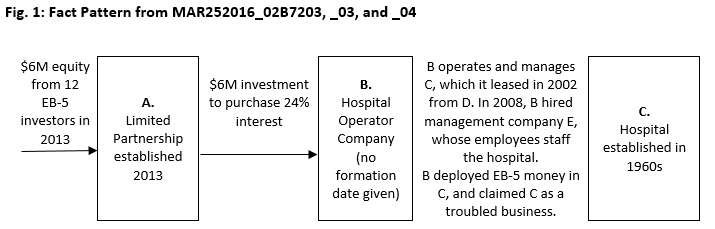
Several 2016 AAO decisions on I-526 cases have been posted on the USCIS website. I’m particularly interested in MAR252016_02B7203 (and the nearly identical _03 and _04), which deal with a regional center investment. Here’s what I’m particularly surprised or intrigued to hear AAO saying in the MAR252015 cases:

  • In the Regional Center context, the job-creating entity’s history and creation date are not relevant to the question of whether EB-5’s “new” commercial enterprise requirement has been met. When the regional center investment involves a new commercial enterprise and a separate job-creating enterprise, only the NCE has to qualify as “new.” In making this point, AAO argues against a position commonly taken by USCIS. In the MAR252016 case, the petitioner invested in a limited partnership formed in 2013 that deployed capital in a hospital established in the 1960s. In its denial, USCIS predictably cited Matter of Soffici and indicated that the NCE requirement wouldn’t be met unless the hospital were restructured or substantially expanded. (Soffici deals with a new enterprise’s purchase of an old hotel and says “It is the job creating business that must be examined in determining whether a new commercial enterprise has been created”.) AAO countered that: “We disagree with the Chief’s analysis. Soffici, unlike this case, did not involve a regional center project.” AAO argues that the relevant precedent is rather Matter of Izummi, which did deal with a regional center case, and “In Izummi, when determining what constituted a ‘new commercial enterprise’, we reviewed the date of creation of the entity in which a petitioner had invested or intended to invest, not the job creating entity where the funds were ultimately to be deployed.”
  • A petitioner can’t get credit for any jobs created by the project if the project didn’t create enough jobs for all EB-5 investors in the project (unless there is an agreement among all investors about how jobs will be allocated). In the MAR252016 case, AAO wouldn’t consider whether any of the 61 new jobs finally claimed could be credited to the petitioner, since there were 11 other EB-5 investors in the project and no job allocation agreement on file. This is not new policy, but an important reminder. Make and file a job allocation agreement, just in case!
  • An EB-5 investment does not meet the “at risk” requirement if the business plan does not “present a comprehensive analysis of the potential net profit available for distribution to each of the limited partners” and therefore fails to “sufficiently establish that there is a reasonable chance for gain, especially in the foreseeable future.” This is not technically a new point (the full “at risk” requirement is “at risk for the purpose of generating a return on the capital placed at risk”), but I haven’t seen AAO/USCIS focus on insufficient profit analysis as a basis for denial.

I’ll let you read the MAR252016 decisions for yourself to get the rest of the story. The case also involves the hot issues of troubled business qualification and the separation of ownership, management, and employment among multiple entities, and AAO doesn’t raise all the questions or reach all the conclusions I would’ve expected. What AAO doesn’t say in this case may be as significant as the points that are made. To assist in following the case, I’ve done my best to illustrate the fact pattern (reading around redactions, so mistakes are possible).
Fig-1UPDATE: You can read more about this case in a civil suit filed by the petitioners. (Update: the petitioners won the suit.)

AAO Decisions: Search Function
The Administrative Appeals Office has launched a search tool for most non-precedent decisions since 2005. Just enter a search term in the box under “AAO Non-Precedent Decision Repository” and poof – links to all AAO decisions where that term is mentioned, with sorting options. I love it. (And now regret that weekend spent downloading EB-5 decisions one by one to make my own searchable master file.)

Regional Center List Changes
Additions to the USCIS Regional Center List, 03/21/2016 to 04/05/2016

Terminations

  • Path America KingCo, LLC (Washington), Terminated 3/23/2016
  • MCIG Regional Center (Florida) Terminated 3/29/2016
  • Velocity Regional Center (California), Terminated 3/24/2016

Senate TEA Hearing

Update: the Senate hearing on EB-5 Targeted Employment Areas has been postponed.

The Senate Judiciary Committee is more serious about EB-5 than I expected, and already has another hearing scheduled for next week, on Wednesday March 2, with the provocative title The Distortion of EB-5 Targeted Employment Areas: Time to End the Abuse. Senator Grassley is making good on his vow in December for Continued Push to Reform EB-5 after Fixes Ignored in Omnibus Spending Bill. Senator Grassley is concerned that “the status quo will not benefit Middle America. It benefits New York City and other affluent areas at the expense of areas in Iowa, Kentucky, Wisconsin, and Vermont,” and he is disturbed by reports such as Wall Street Journal’s September 2015 article How a U.S. Visa-for-Cash Plan Funds Luxury Apartment Buildings. On the other hand, Senators representing coastal America are likely to point out that big cities also struggle with unemployment and economic distress, and that it’s not right to make the TEA issue into a regional fight or impose a rural model on urban areas. If you’d like to review arguments on various sides in advance of this hearing, consider Jeanne Calderon’s research on the history and current use of the TEA incentive and impact of potential changes, Carolyn Lee’s 2014 article on State Designations of EB-5 Targeted Employment Areas (explaining the logic of current practice), and Jeff Campion’s 2015 article Targeted Employment Areas: Where Are We Now (giving the urban perspective). The proposed new TEA provisions in last year’s draft legislation were awkward and confusing, probably the result of too many contradictory compromises, but maybe all these hearings can result in a more reasonable reform proposal.

H.R.4530, Resources, RC List Update

H.R.4530 Introduced
Even as Representatives Goodlatte, Conyers, Issa, and Lofgren (who worked with Senators Leahy and Grassley on their legislation last year) were speaking in yesterday’s House EB-5 hearing about how they think EB-5 incentives are misused and need to be re-oriented, representatives Polis and Amodei introduced H.R.4530-EB-5 Integrity Act of 2016, a bill that proposes to keep current EB-5 incentives in place. I’ve added the bill to my comparison chart, but you don’t need to read it; H.R.4530 is a carbon copy of Senator Flake’s S.2415 (and FYI entirely different from the H.R. 616 American Entrepreneurship and Investment Act of 2015 introduced by Polis and Amodei last January). I don’t know whom to cheer in this legislative mix. The Grassley/Leahy camp bill included at least one provision that would touch and could hurt (sometimes even fatally) each segment of the regional center world, while the Flake/Polis camp bill is crafted to ensure that the current winners don’t get their boats rocked and keep winning, with TEA incentives and the investment amount the same and the kind of integrity measures that conveniently double as anti-competitive measures. Diversity in the regional center world can be a problem, because fragmented markets are hard to work with and small-scale players have a relative probability of being unprofessional if not rogue and causing trouble. On the other hand, diversity means that EB-5 is relatively likely to fund the kind of projects that Congressional representatives want to see to help justify the regional center program — the hotels in third tier cities, the logistics companies in blighted industrial areas, the affordable housing, the entertainment and agricultural projects in rural areas, and so on. If regional center investment becomes all small safe loans to luxury developments in gateway cities, then immigrant investors will benefit but the American public, media, and Congress may turn against what looks like essentially a low-bar green card purchase transaction plus jobs-neutral government subsidy for attractive projects that would’ve proceeded anyway, just more expensively without the green card incentive to lower capital costs. On the other hand, the cause of integrity would not be advanced by deciding to limit the regional center program to unattractive projects entirely dependent on hapless foreign investors, or providing too much leeway for issuers that lack resources to operate professionally. If I were called to testify, I don’t know what changes I’d suggest to maximize EB-5’s potential benefits and minimize risks.

Resources
This quarter’s editions of the Regional Center Business Journal and EB-5 Investors Magazine (so far just out in paper form, but to be posted here soon) both have a number of great articles. In RCBJ, I particularly appreciated “What we Learn From SEC Investigation” by Ronald Fieldstone and Jay Rosen, who provide a comprehensive review of the types of violations that get investigated by the SEC, the specific activities that are focus of investigations, and the SEC investigation process from subpoena through discovery, deposition, negotiation and settlement. Lili Wang writes helpfully in RCBJ about the question we all ask “What Do Chinese Migration Agents Really Want?”, and EB-5 Investors Magazine also takes up this theme with two interesting migration agent interviews. Gregory White, Mark Katzoff and Angelo Paparelli authored an article for v.3.3 EB5 Investors Magazine (that I hope will soon be available online) on the important topic of “Avoiding the Inadvertent Investment Company.” The article describes how a regional center or issuer may avoid (and what will happen if it doesn’t avoid) being tagged as an investment company, including possible rescission, ineligibility to satisfy the EB-5 “at risk” capital rules and a duty to register as an investment advisor. EB5 Diligence also had a webinar this week on the topic Are Regional Centers Acting As Unregistered Investment Advisors? Another hot topic is the “rent-a-center” model for regional center investment, which has become increasingly popular and has also appeared in the cross-hairs of some legislative reform proposals. Rohit Kapuria has posted a thoughtful article Is the EB-5 Regional Center “Pure” Rental Model Sustainable?, and EB5 Projects will host a free webinar on 2/23 concerning Immigration & Securities Issues with Renting Buying & Selling an EB-5 Visa Regional Center.

USCIS Engagement Notes
USCIS has updated the 2/3 EB-5 Stakeholder invitation page with copies of the written opening statements made by Nicholas Colucci, Julia Harrison, and Lori MacKenzie. Also FYI I keep a master directory of USCIS EB-5 stakeholder meetings and a handy searchable PDF compilation of all published meeting notes (for those times when you can remember USCIS discussing a topic but forget where and when).

Processing Times
Not that we put much stock in IPO processing time averages (at least not without keeping a 10-month or so standard deviation in mind), but USCIS Processing Time Information has been updated as of 12/31/2016: 16 months for I-526, 16.2 months for I-829, and 8.5 months for I-924 (all up about 0.5 months from the previous report).

Regional Center List Changes
Additions to the USCIS Regional Center List, 01/28/2016 to 2/10/2016.

  • Bluegrass International Fund, LLC (Indiana, Kentucky): www.bluegrass-fund.com
  • East Coast Regional Center, LLC (New Jersey, New York)
  • Howard Hughes Hawaii Regional Center, LLC (Hawaii)
  • Mid-Atlantic Regional Center (Connecticut, Delaware, Maryland, New Jersey, New York, Pennsylvania): aseb5.com
  • Yellow Rock Regional Center of Washington, LLC (Washington)

Renamed:

  • Florida East Coast EB5 Regional Center LLC (former name United States Growth Fund, LLC) (Florida)
  • Prosperity Regional Center (former name U.S. Prosperity Regional Center) (Florida)
  • Investus LLC (former name New Mexico Foreign Investments LLC) (New Mexico)
  • New York Dream Regional Center LLC (former name Tri-State USA Regional Center) (New York)

2/11 House Hearing Detail

You can now review video, testimonies, and statements from today’s House Judiciary Committee Hearing “Is the Investor Visa Program an Underperforming Asset?” (FYI, I’ve also uploaded my audio recording.)

In the written testimony, IPO Chief Nicholas Colucci essentially reiterates his Senate testimony, GAO Director Rebecca Gambler discusses the GAO’s August 2015 study of the EB-5 program and USCIS’s slow progress toward implementing GAO recommendations for better risk assessment and reporting, NYU Professor Jeanne Calderon discusses her program research and the history and use of the Targeted Employment Area incentive, and Matt Gordon advocates for maximizing the social value of EB-5 and making program changes that would benefit his direct-EB-5-focused company.

The hearing began with opening statements by Committee Chairman Bob Goodlatte (R-VA), Ranking Member John Conyers (D-MI), and Zoe Lofgren (D-CA), who agreed that the regional center program has good potential but needs significant reform, particularly in practices that have departed from Congressional intent to incentivize investment in needy urban and rural areas. Targeted Employment Area issues were a focus throughout the hearing, including the question period that brought in Darrell Issa (D-CA), Louie Gohmert (R-TX), Jackson Lee (D-TX), Trey Gowdry (R-SC), and Judy Chu (D-CA). Most speakers deplored gerrymandering and TEA incentives for luxury real estate developments, and emphasized the need to increase the minimum EB-5 investment amount (focusing on areas of reform that were part of the Leahy/Grassley legislation but excluded from the Flake bill). Job creation was an additional focus area in this hearing, with Conyers, Calderon, Gambler, and Gordon regretting the limited data on regional center job creation, and Goodlatte and Issa questioning whether it makes sense to let EB-5 investors count the total jobs created by the project they invest in, even if their investment accounts for a small percentage of the capital stack. The issue of effective dates was raised several times, with Goodlatte arguing that reforms would need some retroactivity in order to be effective (considering that there are 6+ years of investors already in the backlog pipeline, and this could defer program reforms 6+ years if they only applied to new investors filing after enactment). Colucci indicated that regulatory changes being formulated by USCIS (to TEA procedures and the investment amount) would be forward-looking per tradition, not retroactive. He did not say when USCIS will come out with proposed changes to the regulations or how much USCIS would increase the investment amount (though he mentioned they are considering the legislative proposals as a reference point). The hearing brought up a number of questions that the witnesses lacked the background to answer, and I found myself wishing that the roster had included someone with direct regional center experience. Darrell Issa did request that a letter from IIUSA be included in the hearing record, and this may provide additional perspective.

In sum, the House hearing’s answer to the question “Is the investor visa program an underperforming asset?” seemed to be “Yes, it is underperforming Congressional intent to attract investment to and create jobs in areas of greatest need.” This hearing did not have much to say about anti-fraud/abuse measures or increased oversight (the focus of the Senate hearing), but expressed concern that EB-5 isn’t getting the best “bang for the buck” because investor funds aren’t being directed for maximum economic and job creation benefit.

2/2 Senate Hearing Detail

If you are involved in the regional center program, you should review what happened today in the Senate Judiciary Committee Hearing on “The Failures and Future of the EB-5 Regional Center Program: Can it be Fixed?” We heard testimony from IPO Chief Nicholas Colucci and SEC Division of Enforcement Associate Director Stephen Cohen, statements by Senators Grassley, Leahy, and Feinstein, and an extensive question and answer period that brought in Senators Cornyn, Schumer, Flake, Blumenthal, Tillis, Sessions, Perdue, and Klobuchar. The judiciary committee website link above currently has video of the hearing and written statements by Grassley, Leahy, Colucci, and Cohen. (After watching the video be sure to read the statements, as they are very informative and include content beyond what their authors said in the hearing.) In case the video disappears, I’ve also uploaded my audio recording of the hearing. (Also, see this post for more on the letter from DHS Secretary Jeh Johnson, which was frequently referenced in the hearing.)

I don’t know whether Senator Grassley came away from this hearing with further clarity on the character and prospects of regional centers, but we definitely get a fascinating view of the thinking and activities going on behind the scenes now at USCIS, at the SEC, and in Congress relative to the RC program. The senators present largely advocated for fixing not nixing (or mending not ending) the program (except for Senator Feinstein, who called for an end and also pressed her odd belief that USCIS and the SEC should specially investigate the victims in a fraud case). The senators expressed general commitment to reform while differing in their diagnosis of the nature and magnitude of problems, and in their visions for what the RC program should be. Perhaps most interesting, the senators drew out Chief Colucci to discuss specific integrity measures and program changes that are already in place and in the pipeline at USCIS, regardless of legislation.

RC Hearing, RC List Update

2/2 Hearing on the Regional Center Program
The Senate Judiciary Committee/Senator Grassley have titled next week’s hearing “The Failures and Future of the EB-5 Regional Center Program: Can it be Fixed?” Good heavens! No wonder journalists started calling me yesterday wondering what’s blowing up in EB-5, and disappointed to discover that this insider knows a thousand boring little problems but no big story of pervasive failure to justify such a hearing title. But tis the season for politics, and EB-5 can appear as a golden opportunity to bash immigration plus the wealthy plus real estate developers plus Commies plus New Yorkers all in one rabble-pleasing blow. And Regional Centers may just have to get in line with police officers and Muslim Americans as victims of our politicians’ inclination to profile entire communities based on a few isolated actors. If I were a typical regional center innocently engaged in unremarkable project finance, I’d be worried about a powerful Congressman asking “do you have a future and can you be fixed?” while under the impression that I’m failing and am inherently likely to be facilitating terrorist travel, economic espionage, money laundering, and investment fraud. Hopefully the hearing will call speakers who provide our leaders a more accurate impression of what’s actually going on in the regional center program. The hearing will stream live on the Senate Judiciary Committee website at 10 am EST on Tuesday Feb. 2.

New RCs
Meanwhile, USCIS continues to process EB-5 applications and petitions. The average posted I-526 processing time jumped to 15.5 months as of 11/30/2015 (up from 12.8 months reported as of 10/31). USCIS has also updated the regional center list, and posted a new PDF file that gives the identification number for each regional center. I can’t think how this could possibly help anyone (what we need, USCIS, is for you to please post the designation letters that show who’s behind these RCs and what you’ve approved them for), but the list with ID numbers is there FYI.

Additions to the USCIS Regional Center List, 1/14/2016 to 01/28/2016.

  • Ashcroft/Sullivan New England Economic Development Center (Massachusetts, Rhode Island): aseb5.com
  • Liongate Regional Center, LLC (Washington)
  • MCFI Nevada (Nevada):www.mcfiusa.com

Renamed:

  • Central Western Regional Center LLC (former name USA Midwest Regional Center LLC) (Illinois, Indiana, Kansas, Kentucky, Michigan, Missouri, Ohio, Pennsylvania, Wisconsin)
  • Green Card Solutions Regional Center (former name Shrimp House US LLC) (Florida)

Thinking about RC legislation (with comparison chart)

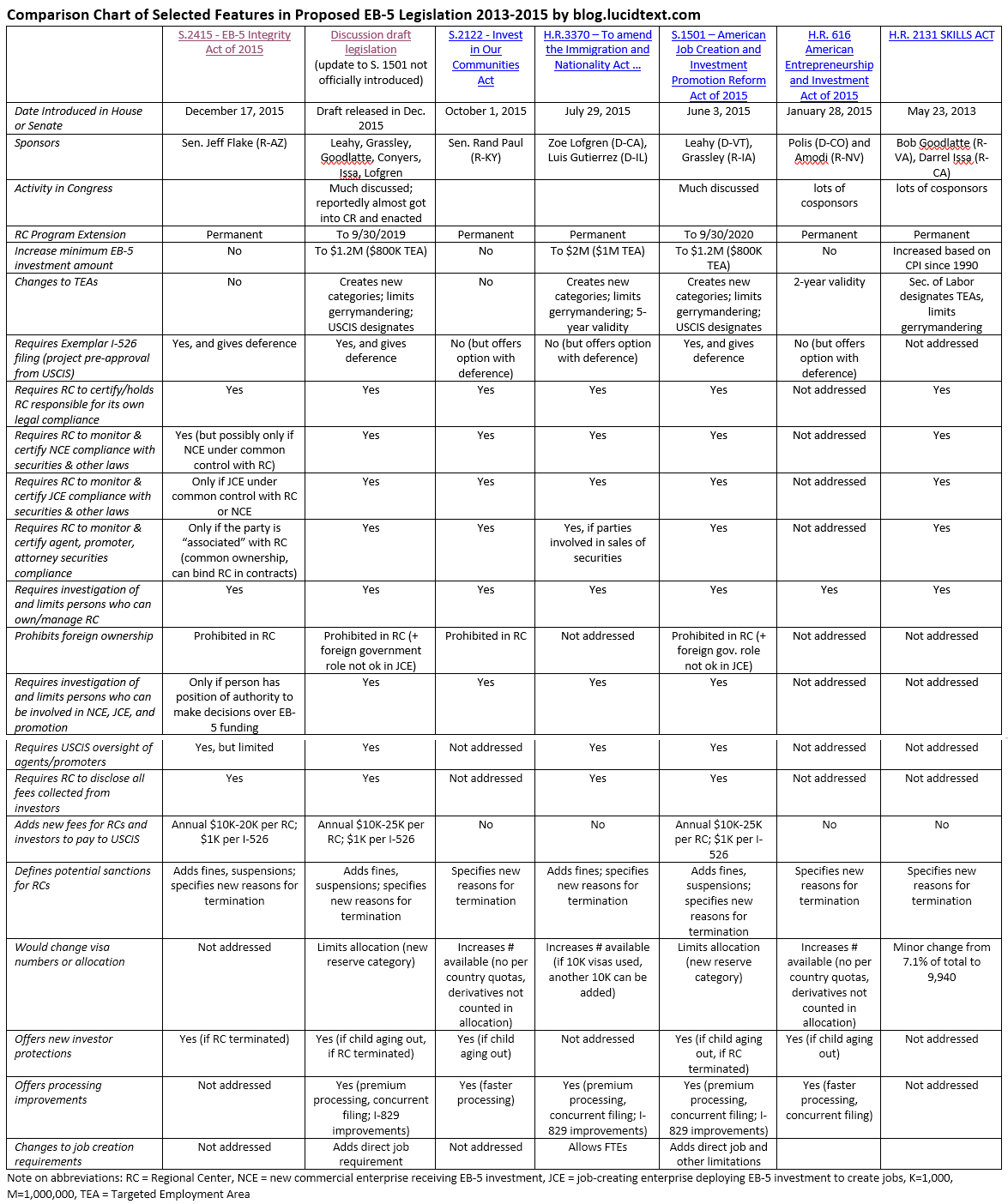
The Regional Center Program has just eight months before it needs another authorization from Congress. Significant EB-5 legislation may be unlikely this election year (I hear people hoping for another short-term extension by 9/30/2016), but we can foresee future directions in the flurry of reform proposals. To help visualize where we are, I’ve made a chart of EB-5 bills that are or were recently on the table. My chart is idiosyncratic (limited to provisions that particularly interest me as a business plan writer) and oversimplified, but it gives a handy overview. I’ve generously uploaded my original to Google docs, in case you’d like to enlarge the font or edit a new version with your own favorite nuances. (NOTE: the Google docs version linked above is now more updated than the chart image below.)
lucidcompchart
The comparison chart highlights areas of consensus and difference, and helps us think about what changes we should prepare to accept (or take action to forestall). Besides the rows dominated by “yes” (likely directions) and the rows full of differences (points of open debate), I’m particularly interested in the left-most columns: S.2415, because it’s the most recent proposal, and the Discussion Draft/S.1501 update, because it came nearest to enactment. These two bills are superficially very similar; S.2415 is a partially defused version of S.1501. S.2415 omits two of the most disruptive changes proposed in S.1501 – changes to TEA definitions and the qualifying EB-5 investment amount – and neatly clips difficult integrity measures by means of three simple terms: “affiliated,” “involved,” and “associated.” The integrity measures in S.1501 (and others) are hard because they would make regional centers responsible for the actions of parties often (in current practice) outside RC control. S.2415 reduces those proposed responsibilities by replacing “job-creating entity” in S.1501’s integrity proposals with the more limited “affiliated job creating entity” (with “affiliated” defined as controlled, managed, or owned by people involved with the regional center or new commercial enterprise) and by adding term definitions that limit who would count as “parties associated” or “persons involved” when it comes to compliance matters involving enterprises, agents, promoters, and attorneys. (To see for yourself, compare the term definitions on p. 29, 37, and 61 of S.2415 with those on p. 30, 37, and 76 of the Discussion Draft, and follow use of those terms.) S.2415 retains the basic shape of S.1501’s regional center integrity measures and program improvements, keeps the reforms that only inconvenience USCIS (additional reports and tasks) or that mainly hurt small regional centers (ie the annual fee), and cuts no corners when it comes to protecting against hypothetical national security threats. I don’t know whether S.2415 retains enough similarity to S.1501 to get any smiles from Senator Grassley (who is on the warpath, judging by quotes yesterday to RadioIowa in advance of his coming hearing on the EB-5 program), or whether it’s modified enough to have EB-5 community support broader than the interests represented by Senator Flake (and Cornyn and Schumer). I wait with impatience to hear legislative updates from people who know what’s happening right now on Capitol Hill. I’m also looking forward to 2/9 in San Francisco, where I’ll be part of a panel that NES Financial has organized to “discuss integrity measures and compliance requirements that have remained consistent through recent drafts of EB-5 legislation, and highlight solutions and strategies that will allow issuers to prepare for these changes.”

RC Program Extended to 9/30/2016

The Consolidated Appropriations Act, 2016, which includes a sentence authorizing the Regional Center program through September 30, 2016 (in Section 575 on PDF page 285) has been passed by Congress and signed by the President. Now it will become law, and the EB-5 status quo can continue for another few short months. If the alternative draft EB-5 legislation recently under discussion had been enacted instead, we’d now have a higher minimum investment amount for all EB-5 investors, more guarded and complicated targeted employment area parameters, limitations on foreign ownership of EB-5 enterprises, provisions that would curb the big EB-5 users as well as fees and requirements that could all but eliminate the little guys, solid new integrity measures, a heavier paperwork burden on regional centers and USCIS, and a relatively stable long-term footing. As it is, nothing in EB-5 has changed for now except the regional center program sunset date.

What happened is a mixed blessing. I’m glad that the most recent draft reform bill didn’t become law, as it included a few dangerously ambiguous, counterproductive, gratuitous and impracticable points (at least in the last version I saw) in addition to many wise and important modifications. But I’m also sad that we didn’t manage anything substantive or long-term this time around, despite an enormous amount of effort in that direction.

The last-minute clean regional center program extension in the omnibus bill could be interpreted cynically as a victory for a few powerful players who lobbied well to ensure that the trough not move just so long as they’ve got their snouts in it, regardless of long-term program viability and overall health (and as a victory for representatives who can continue to be courted and lobbied/bankrolled so long as they keep issues pending by deferring instead of resolving them). Or the short extension can be viewed positively as a victory for the majority who could benefit from giving Congressional leaders and stakeholders a few more months to come up with what they tried for but didn’t quite manage to produce this year: a really clear and practicable long-term authorization proposal worthy of enactment, something whose well-drafted language and provisions would support solid reform and progress and protect the regional center program’s broad-based benefits. But such a victory would require people to be willing to return to the table and get right back to the hard work of trying to forge lasting solutions. And will they be willing? Many who were at the long-term authorization table have a bitter taste in their mouths right now, disappointed that they didn’t hammer out better legislation in time and suspecting that even if they had the result could still have been preempted at the last minute. But their hope and efforts must be renewed, or the regional center program will not have a future.

For commentary on what happened, where we are now, and what will happen next, see Stephen Yale-Loehr’s article Congress Extends EB-5 Program for One Year Without Changes, Posted 12/16/15 and Senator Grassley’s statement on his website Grassley Vows Continued Push to Reform EB-5 after Fixes Ignored in Omnibus Spending Bill, Posted 12/17/2015.

Legislative Update: bill text with simple extension

UPDATE: See the post RC Program Extended to 9/30/2016

Last night Congressional leaders finalized the text of Senate amendment to H.R. 2029 Military Construction and Veterans Affairs and Related Agencies Appropriations Act, 2016 [Consolidated Appropriations and Tax Measures] (aka the omnibus appropriations bill, the spending bill, the funding bill, the spending deal, the spending package). Now the language is set, and we wait for Congress to vote and the President to sign. We’ve expected EB-5 to be one passenger on this omnibus, bringing Regional Center reauthorization and likely substantive EB-5 program changes as discussed in the discussion draft legislation put together by Judiciary Committee leaders and circulated last week by Senators Leahy and Grassley. I panicked at first when I downloaded the bill and didn’t find language from the EB-5 discussion draft or matches to EB-5-related search terms, but I finally located an EB-5 mention on PDF page 708 of the omnibus, as follows:

SEC. 575. Section 610(b) of the Departments of Commerce, Justice, and State, the Judiciary, and Related Agencies Appropriations Act, 1993 (8 U.S.C. 1153 note) shall be applied by substituting ‘‘September 30, 2016’’ for the date specified in section 106(3) of the Continuing Appropriations Act, 2016 (Public Law 114–53).

That’s all I can find — a proposed simple extension of the Regional Center program authorization for the reminder of the fiscal year, with no other EB-5 program changes. (As a reminder, Public Law 114-53 on pdf page 9 extends the Regional Center program to September 30, 2015, and  Section 610(b) of the Departments of Commerce, Justice, and State, the Judiciary, and Related Agencies Appropriations Act, 1993 (Public Law 102-395) (pdf page 47) is the act that established the regional center program.)

I keep an eye on The Hill and Congressional sites for updates on what’s happening with the legislation. Stop-gap measures may continue to be passed as needed to give the government a few more days of funding (and the regional center program and other programs a few more days of authorization) while our representatives take more time to read the enormous appropriations bill and make up their minds. They are reportedly likely to pass the bill, eventually (though the provisions include some doozies), as a majority do not want a government shutdown and do want a Christmas vacation. Meanwhile, the Regional Center program is still authorized (extended together with federal funding through stopgap measures), but rather in suspense while we wait to see what happens with the appropriations bill. The State Department January Visa Bulletin, for example, has not authorized any visa numbers for regional center investments, pending legislation to extend the program. Assuming that the bill does pass, people offering EB-5 investments still shouldn’t relax assuming no further change until the next regional center program expiration at September 30, 2016. Congress could still pass standalone EB-5 legislation and USCIS could still come out with new regulations any time, and the intense discussions around this year’s reauthorization show commitment to change on all sides. I would especially expect an increase to the minimum investment amount and additional integrity measures sooner rather than later.

2015 Visa Statistics, RC Termination, SEC Action, New RCs

2015 EB-5 Visa Statistics

Update: The corrected summary data table can be found in my 3/7/2016 post 2015 Visa Statistics by Country.

Other Items of Note

  • SEC Action on Attorneys: We’ve known for months that the SEC has been pursuing a crack-down on unlicensed persons acting as unregistered brokers, and specifically: immigration attorneys who take compensation for selling EB-5 investors on projects, despite lacking qualifications and licensure to give investment advice. Here is a copy of the SEC’s detailed complaint against one law office: SEC v. Hui Feng and Law Offices of Feng & Associates P.C. This 7/12/2015 article in Mondo Visione lists seven other individuals and firms who have also settled enforcement actions with the SEC, and links to copies of the Cease and Desist order for each. Honestly, I feared to see a lot more names on this list, but perhaps the SEC is starting with a warning shot and giving time for others to get their affairs in order. The detailed Feng complaint is good reading for anyone who receives or pays commissions for selling EB-5 investments, as the SEC goes into detail about what exactly was wrong and why it was wrong in the Feng case.
  • Regional Center Termination: One of the Regional Centers terminated in 2015 was brave enough to fight back, and now we can read about its case in the Administrative Appeals Office decision Matter of K-R-C, LLC, dated November 17, 2015. AAO dismissed the appeal, as nearly always happens, but it’s interesting to see what kind of evidence USCIS considered significant, the issues judged to be problematic, and the timeline of USCIS’s interactions with the Regional Center. A moral of this denial, as with so many other cases anatomized by the AAO, is the overwhelming importance of clear and clean paperwork. The case focuses on little things like how expenditures were coded on this or that document and how statements were worded on this or that filing and whether the proper reports were made at the proper time. This denial decision doesn’t go so far as trying to prove problems with the business itself, but terminates the RC based on issues apparent in the paperwork describing the business. Spend good money on your secretaries and bookkeepers and document preparers, because their humble work pushing papers and keeping numbers in order and documents in line could prove essential.
  • I-829 Approvals and Denials: I don’t expect anyone besides Mr. Whalen to click on this link, but FYI a very heavily redacted file titled I-829 RFEs, denials and approvals for NY and FL during 2009-2010 has appeared in the USCIS FOIA Reading Room in the Employment Based Petitions category. Connoisseurs may be interested in reviewing the I-829 RFE template used in 2009-2010 and seeing which lawyers were filing I-829 back then.
  • Legislative Update: Whatever I hear, I add to the first paragraph of my previous post.

New Regional Centers
Additions to the USCIS Regional Center List, 12/03/2015 to 12/08/2015

  • LCR Atlantic Gulf Regional Center (Florida, Georgia) www.lcrcapital.com
  • Southern California EB-5 Regional Center, LLC (California)

Legislative Update, New RCs

Legislative Update (see paragraph end for continuing updates)
It looks as if the Regional Center program may get reauthorized next week after all, with significant but not terminal changes. The chairs and ranking members of the House and Senate Judiciary Committees have reached an agreement on a reform package that may be included in the omnibus appropriations legislation that Congress is working on to fund the federal government past December 11. IIUSA’s Board of Directors has voted in favor of the legislation, stating in a letter to members that “we believe that, on balance, the bill achieves real reform with minimal disruption to ongoing job-creating economic activity and establishes a fair market for attracting investors going forward, with everyone under the same rules at the same time.” See IIUSA’s blog post and Senator Leahy’s press release, which includes a one-page summary and link to a discussion draft of the legislation (version MDM15J00 of American Job Creation and Investment Promotion Reform Act of 2015). See also Senator Grassley’s press release. The WSJ blog’s post Fight Over Green Card Investor Program May be Near End discusses the proposal’s supporters and opponents. Michael Homeier’s 12/7 email and 12/9 email and Martin Lawler’s 12/9 post share insiders views of on-going lobbying efforts. As reported by IIUSA on 12/11:

Today, the House passed a short-term funding bill (H.J. 2250) by a voice vote to avoid a government shutdown. The original EB-5 extension is included. Yesterday, the Senate passed the short-term, five-day continuing resolution (CR) by unanimous consent, giving lawmakers until December 16th to pass a long-term spending bill for the rest of fiscal year 2016.
Senate leaders have noted that they will not vote on a funding bill until the House does.  As a result, Congressional leaders will be facing a tight deadline due to the nature of Senate procedure.
Reports indicate that the House may vote on a long-term funding bill as early as Tuesday, December 15th.  As soon as the House passes a bill, Senate Majority Leader Mitch McConnell (R-KY) is expected to file cloture on the funding measure immediately, forcing Senators to wait 30 hours before they can vote on final passage and send a budget bill to President Obama to be signed into law. Negotiations between House Republicans and Democrats are ongoing and IIUSA continues to provide updates on the status of those negotiations.
Now that the fate of EB-5 legislation is firmly linked to the omnibus appropriations legislation, I keep watching The Hill site for new “spending bill” articles, which report on progress of that legislation.
12/15 Update: Here is a link to the finalized Military Construction and Veterans Affairs and Related Agencies Appropriations Act, 2016 [Consolidated Appropriations and Tax Measures]. Page 708 has a simple extension of the Regional Center program to September 30, 2016, and I can’t find any other EB-5 changes.

New and Renamed Regional Centers
Meanwhile, USCIS is still busily adjudicating Regional Center applications, and accepting name changes from RCs affected by the Cautions on Names of Regional Centers.

Additions to the USCIS Regional Center List, 11/12/2015 to 12/03/2015.

  • American Lending Center Florida, LLC (Florida)
  • American Lending Center Illinois, LLC (Illinois)
  • Bart Investment Group, LLC (Florida)
  • Chicago First Regional Center Inc (Illinois)
  • EB5 Group New York Regional Center, LLC (Connecticut, New Jersey, New York, Pennsylvania) www.eb5groupllc.com
  • EB5 Land Regional Center (Washington)
  • First American Regional Center, LLC (California)
  • Golden Sun Development Regional Center (Washington)
  • Greater New York Business Regional Center (New Jersey, New York, Pennsylvania)
  • High Stone Regional Center, LLC (Connecticut, New Jersey, New York)
  • Lifezone Development Regional Center (Washington)
  • ON Regional Center, LLC (California)
  • Piedmont Regional Center, Inc. (Georgia, North Carolina, South Carolina, Tennessee)
  • Sino Indus BK Capital LLC (New Jersey, Pennsylvania)

Renamed:

  • AFC Regional Center LLC (former name New York Federal Regional Center) (New Jersey, New York, Pennsylvania)
  • West Maingate Regional Center, LLC (former name US Maingate Regional Center, LLC) (California)
  • American Lending Center LLC (former name United States Employment Development Lending Center) (California)
  • Greystone EB5 Southeast Regional Center LLC (former name Greystone Florida Regional Center LLC) (Florida)
  • Harris Real Estate Fund LLC (former name U.S. Federal Investment Immigration Fund, LLC) (Arizona)

Legislative Update, Due Diligence, New I-485, New RCs

Legislative Update
We are now less than a month from December 12, when the Regional Center program will sunset if it doesn’t get another reauthorization. It’s possible that the program could get temporarily extended as part of the appropriations bill that also needs to get passed by December 11 (which would mean extension with no change through 9/30/2016), or there might be stand-alone legislation with some significant changes and reform as well as reauthorization, or our representatives might let the program lapse for a while because they haven’t worked out appropriate legislation in time but don’t want to see simple extension. Grassley, Corker, and Johnson sent a letter on 11/6 to Senate leadership saying that they oppose a straight reauthorization of the EB-5 Regional Center program in the anticipated appropriations bill that will cover fiscal year 2016, and advocate instead to continue the program together with measures to increase accountability and better guard against fraud and abuse. We wish they would hustle to formulate such measures. Grassley and Leahy have been quietly circulating a revised draft of S. 1501 (IIUSA has a copy, as do select real estate industry executives according to the Wall Street Journal Washington Wire blog). I’ve read the draft but decided not to comment here until it gets officially proposed. The new draft is significantly clarified and toned down from the original bill, though still a game-changer. But will passable legislation be proposed in time to make any difference? If only Washington worked more efficiently!

Due Diligence
I appreciated the article “EB-5 Due Diligence Matters” (November 3, 2015) by Douglas Hauer, John Nucci, and Peter Saparoff of Mintz Levin. The authors discuss the legal requirements for due diligence investigations and give practice pointers.

Form I-485 Update
USCIS has published new editions of the Form I-485, Application to Register Permanent Residence or Adjust Status and Supplements

New Regional Centers
Additions to the USCIS Regional Center List, 11/02/2015 to 11/12/2015

  • EB5 Capital Oregon Regional Center (Oregon, Washington): www.eb5capital.com
  • Empire Regional Center, LLC (New Jersey, New York)
  • Great Southern Regional Center (Georgia, South Carolina)
  • North Valley Regional Center (California)
  • Proficiency Regional Center LLC (California)

What is material change?

Summary
The EB-5 process allows limited leeway for change in documents or in reality. Ideally and in principle, all EB-5 petitioners fully demonstrate eligibility in their original I-526 documents, and investment projects go on to develop exactly as foreseen in the I-526 business plan. In real life, there are new circumstances and unforeseen events, not to mention mistakes and omissions, and change happens. This post discusses how and when change is (and is not) a problem in EB-5. (Last update: 01/2019)

Before I wade into details and examples, here’s a rough metric.

Q. What kind of changes can be a problem in EB-5?
— A. Material changes that affect decision-making.
Q. When are material changes a problem?
— A. While decision-making is in process.

And here’s where to find the official policy on material change: USCIS Policy Manual, 6 USCIS-PM G Chapter 4(C) and Chapter 5(C).

What are the principles behind the material change issue?

  • In visa petition proceedings, a petitioner must establish eligibility at the time of filing and that a petition cannot be approved if, after filing, the petitioner becomes eligible under a new set of facts or circumstances. See, e.g., Matter of Izummi, 22 I. & N. Dec. at 176
  • The petitioner must continue to be eligible for classification at the time of adjudication of the petition. 8 C.F.R. § 103.2(b)(1)
  • Form 1-829 approval is predicted by Form 1-526 approval and successful execution of the approved plan. Chang v.United States of America, 327 F. 3d 91 1 (9″ Cir. 2003) (Current policy now states that “USCIS does not deny petitions to remove conditions based solely on the failure to adhere to the business plan contained in the Form I-526 immigrant petition.” 6 USCIS-PM G Chapter 5(C))
  • Black’s Law Dictionary defines “material” as “having some logical connection with the consequential facts” and of “such a nature that knowledge of the item would affect a person’s decision-making process; significant; essential.”

What kind of change is material?

  • A change that’s part of an effort to make an apparently deficient petition conform to USCIS requirements
  • A change that reflects a substantial alteration in circumstances on which USCIS is relying in making its decision, and that would tend to influence the decision
  • A change that asserts eligibility under a materially different set of facts that did not exist when the immigrant first filed the petition
  • All elements of a petition can be subject to material change issues (including the business plan, offering documents, and evidence of investment and source of funds)

What kind of change is not material?

  • A change that affects facts not related to the immigrant investor’s eligibility
  • A change that occurs in accordance with a business plan, as a natural progression of the business

At what point is material change a problem?

  • Material changes are generally NOT acceptable during the period between a petitioner filing I-526 and receiving conditional permanent residence (CPR). This period includes both I-526 processing and the consular or adjustment of status process. If material changes occur in this period, the petitioner must go back to square one and file a new I-526 petition with the new scenario. (Filing a new I-526 is painful thanks to loss of priority date. That will change if USCIS finalizes priority date protections proposed in the  draft regulations posted 01/2017.) Redeployment policy creates one exception/qualification to material change policy. Switching investment projects (under certain conditions) before CPR is not considered “material” provided that investor capital is being redeployed after the initial deployment already met job creation requirements. (6 USCIS-PM G Chapter 4(C))
  • Material changes CAN be allowable during a petitioner’s conditional residence period (after the investor receives the EB-5 visa, and before removing conditions). USCIS will not deny an I-829 petition solely based on failure to adhere to the plan filed with the I-526 Petition. The I-829 petitioner should still demonstrate that he filed the Form I-526 plan in good faith with full intention to follow the plan outlined in the petition, and must still show that he meets the requirements for removal of conditions. USCIS is currently formulating new policy concerning the circumstances under which EB-5 funds might be removed from a project or moved from one project to another during the petitioner’s CPR period (draft memo). The more closely a petitioner adheres to the I-526 plan, the more he can rely on receiving deference to USCIS’s prior approval of that plan. (6 USCIS-PM G Chapter 5(C))
  • Material changes CAN be made between I-924/exemplar I-526 approval and actual I-526 filing. However, USCIS will not show deference (will re-adjudicate) when a new filing involves a different project from a previous approval, or the same previously approved project with material changes to the project plan.

Examples of material change (with fact pattern source in parentheses)

Changes judged to be material

  • A change made belatedly to correct a deficiency in the original filing (making an un-approvable petition approvable)
    • A petitioner filed Form I-526 in 1996 with a partnership agreement containing certain provisions. In 1997, USCIS issues a memorandum objecting to such provisions. The petitioner then files partnership agreement amendments to remove those provisions from his documents. (Matter of Izummi)
    • A petitioner filed a Form I-526 based on investment in a troubled business. When USCIS points out that the business does not qualify as troubled, the petitioner abandons the troubled business claim and substitutes a plan to create a new business instead. (Matter of Izummi)
    • A petitioner filed I-526 with a business plan and operating agreement that anticipated investment in and job creation by two NCE subsidiaries. In RFE, USCIS noted that one subsidiary was not wholly-owned and thus would not create eligible jobs. In response to RFE, the NCE revised the business plan and operating agreement to indicate that investment and job creation would be concentrated in the wholly-owned subsidiary. AAO agreed that this constituted an impermissible material change because made to cure deficiencies noted by USCIS in its RFE (MAR192019_01B7203.pdf)
    • A petitioner filed I-526 with documents including a provision that USCIS judged to be an impermissible debt arrangement. In response to NOID, the petitioner relinquished her rights under those provisions. USCIS found that although the waiver addressed the concerns, the new evidence presented a set of facts not established at the time of filing, and resulting in a material change to the original petition. (JUN252018_01B7203)
    • A petitioner filed a Form I-526 with documents foreseeing a return on investment that did not derive from the underlying investment. USCIS judged this did not qualify as investment at risk for the purpose of generating a return on that investment. In response to NOID, the petitioner submitted amended organizational documents. USCIS found that the amended documents remedied the deficiencies, but represented material change because they presented a set of facts not established at the time the petition was filed. (FEB282018_02B7203)
    • A petitioner filed a Form I-526 describing a loan model for direct investment, which would not qualify. In response to RFE, the petitioner modifies the structure to equity investment in a job-creating new commercial enterprise. (APR232014_01B7203)
    • A petitioner filed a Form I-526 associated with investment in a portfolio of projects. In response to RFE questioning aspects of this structure, the petitioner identifies one project within the portfolio as the target for her investment. (MAY172013_01B7203)
    • A petitioner filed a Form 1-526 in 2012 with a redemption clause. In April 2013, in response to RFE, the petitioner signs Agreement of Waiver to remove that clause (MAY272014_01B7203)
    • A petitioner filed a Form I-526 that does not indicate a management or policy-making role for the petitioner. An amended Operating Agreement filed in response to RFE identifies the petitioner as managing member of the NCE (Oct262009_01B7203)
    • A petitioner filed a Form I-526 in October 2012 for investment in a business that also depends on funds from other investors. In response to RFE, the petitioner provides letters of commitment for the additional investment, but the letters are dated after October 2012. (MAY272014_01B7203)
    • A petitioner filed a Form I-526 in October 2012 for investment in a project not yet underway. In response to RFE, the petitioner provides some evidence of business activity (land purchase, contracts made), but the documents are dated 2013. (MAY272014_01B7203)
    • A petitioner filed a Form 1-526 with a plan for an export business. In response to RFE pointing out deficiencies in the plan, the petitioner submits a new plan for the export business plus a restaurant. (SEP052013_02B7203)
    • A petitioner filed a Form I-526 with Operating Agreement provisions that suggest funds might not be at risk for job creation. When challenged, the petitioner files an amended Operating Agreement that removes the problematic provisions. (Feb182010_04B7203)
    • The petitioner files a Form I-526 on June 1, 2008, based on a $400,000 investment. In response to an RFE, the alien provides proof of the remaining required amount being invested on July 15, 2008. (2008 USCIS adjudicator training)
    • A petitioner filed a Form 1-526 with an arrangement for half of the capital to be paid back to him as a guaranteed return. In response to an RFE, he declares the arrangement null and void. (2008 USCIS adjudicator training)
  • A change that creates a new deficiency (making an approvable petition un-approveable)
    • A petitioner filed a Form I-526 associated with investment in a new commercial enterprise that wholly owns an employment-creating subsidiary. After filing, the subsidiary was no longer wholly owned by the NCE. (Jan072011_01B7203)
  • Changing fundamental aspects of the business plan, particularly those that affect determinations about EB-5 eligibility
    • The petitioner’s I-526 petition and documents subsequently provided to USCIS indicate a shift from focus on retail sales to retail and wholesale, to realty and investment. AAO/USCIS found these changes to be material because “The Petitioner has not explained how this change in business focus (e.g. from retail to realty and investment services) is a natural progression of the business. Further, such a modification in the nature of the NCE’s business activities would be ‘predictably capable of affecting’ our determination of whether the Petitioner will prospectively create the requisite qualifying jobs.” A change of structure in the Operating Agreement is also material. AAO was also concerned that the shift in business focus could be associated with location change, which would also be material. “A change in the location of the NCE would ‘have a tendency to influence’ or would be ‘predictably capable of affecting’  our determination of eligibility for immigrant investor purposes as the location of the investment determines the required capital investment threshold.” (MAY102016_02B7203 dismisses the original appeal, while APR262017_02B7203 dismisses the motion to reopen and reconsider)
    • A petitioner filed a Form 1-526 with a plan for a grocery store. Later, she adds a plan for a restaurant not mentioned in the original filing. (FEB162005_01B7204)
    • A petitioner filed a Form 1-526 for investment a Regional Center project that owns and will redevelop a property. Subsequently, the property is lost to foreclosure and has to be re-acquired with new financing. This temporarily puts the project in doubt and permanently changes development budget numbers used in the economic impact analysis. (Feb182010_04B7203)
    • A petitioner filed Form I-526 for a regional center-sponsored project. After I-526 approval, but before the investor receives a visa, the regional center is terminated. The project did create jobs, but in a job-creating entity separate from the new commercial enterprise (OK for regional centers, not OK for direct EB-5). Proceeding without regional center involvement would require the NCE to absorb the JCE and make it a wholly-owned subsidiary. This structural change would constitute a material change to the original petition. (JUL182016_01B7203)
  • Changing or losing regional center sponsor
    • If a regional center immigrant investor changes the regional center with which his or her immigrant petition is associated after filing the Form I-526 petition, the change constitutes a material change to the petition.  (Language added for the first time on 8/4/2018 to the Policy Manual 6 USCIS-PM G Chapter 4(C))
    • The termination of a regional center associated with a regional center immigrant investor’s Form I-526 petition constitutes a material change to the petition (Language added for the first time on 6/14/2017 to the Policy Manual 6 USCIS-PM G Chapter 4(C))
    • A Petitioner invested in a project whose regional center sponsor was terminated. The petitioner wished to continue to pursue an EB-5 visa as an individual investor independent of a regional center. USCIS found that this would lead to material changes. Outside the RC program, the petitioner would need to demonstrate both the requisite direct job creation and that the JCE is the wholly-owned subsidiary of the NCE. But meeting those conditions would necessitate material changes and thus a new petition, because having insufficient qualifying jobs is a material change, and requiring the NCE to absorb the JCE would be a material change. (AUG032016_01B7203).
    • A petitioner filed a Form I-526 associated with a project sponsored by a Regional Center. Before I-526 was approved, the Regional Center lost its designation. The petitioner then amended the petition based on investment in a project within a different Regional Center. (AUG062014_01B7203)

Changes judged NOT material

  • Changes to aspects of the petition that don’t significantly affect the petitioner’s eligibility one way or another (ie changes not made to correct deficiencies in the original filing; changes that alter aspects of the business not fundamental to the petitioner’s eligibility)
    • “If the organizational documents for a new commercial enterprise contain a liquidation provision, that does not otherwise constitute an impermissible debt arrangement, the documents may generally be amended to remove such a provision in order to allow the new commercial enterprise to continue to operate through the regional center immigrant investor’s period of conditional permanent residence. Such an amendment would generally not be considered a material change because facts related to the immigrant investor’s Form I-526 eligibility would not change.” (6 USCIS-PM G Chapter 4(C) “Material Change”.)
    • A petitioner filed Form I-526 with a business plan that anticipated that the NCE would provide shuttle and tour services, with auto accessories sale as a sideline (about 10% of business). A subsequent site visit found little evidence of shuttle/tour service and auto accessories sale accounting for far more than 10% of the business. But AAO found that “Merely shifting the percentages of the types of services the Petitioner said the NCE would offer is not, by itself, a sufficient basis to deny the petition.” (JUN302017_01B7203)
    • The petitioner files a Form 1-526 and invests $1,000,000 in a business that is planning to operate a Chinese restaurant. In the RFE, it is revealed that the business has decided to operate a Peruvian restaurant instead. This is not a material change. (2008 USCIS adjudicator training)   [However, the petitioner in JUL062017_01B7203 tried to cite this training material to support an argument that she hadn’t committed a material change in changing from a fast food franchise restaurant to catering service to full-service seafood restaurant with catering. AAO did not accept the argument, finding that “The NCE’s business plans two and three constitute a material change to the original one because they represent far more than a change in food styles. …in addition to the type of food, business plans two and three include changes to the NCE’s nature of business, services offered, location, start-up costs, and staffing needs. These changes are material and are made to correct a deficiency in the original submission”]
  • Changes that are more modification of than departure from the original (revised documents that have strong continuity with documents originally filed)
    • The petitioner files Form I-526 with a partnership agreement and investment agreement that are inconsistent with each other. He subsequently files a set of amendments to the partnership agreement specifically to iron out those inconsistencies. (Matter of Izummi)
    • The petitioner files a Form 1-526 based on a Regional Center project that involves a loan agreement. In response to RFE expressing concern about a closing date already passed, the petitioner submits a renegotiated loan agreement extending the date. (JUL192005_01B7203)
    • A pending Form I-526 does not contain redeployment language, and the investment documents are subsequently amended to allow redeployment. “If the further deployment of capital is within the scope of the new commercial enterprise’s business activities in existence at the time the Form I-526 petition was filed, and amendments to the investment documents do not materially alter the facts in existence at the time of filing, such amendments, when considered under the totality of the circumstances, could likely not be considered a material change.” (7/19/2017 Talking Points)
  • Other examples of changes not judged material
    • “For example, if at the time of filing the immigrant petition, no jobs have yet been created, but after approval of the immigrant petition and before the investor has obtained conditional permanent resident status, the investment in the new commercial enterprise results in the creation of 10 jobs in accordance with the investor’s business plan as filed, such a change would not be considered to be material.” (6 USCIS-PM G Chapter 4(C) “Material Change”.)
    • The petitioner files Form I-526 based on investment in two hair salons. These salons use the investment but end up going out of business after 1.5 years, before I-526 adjudication. The petitioner intends to make additional investment and open new salons in the same TEAs with a different management company and different staffing plan. This is not judged a material change. (AUG152017_01B7203)
    • A regional center filed an amendment/exemplar request that USCIS initially denied, in part based on impermissable material changes from previous filings. AAO disagreed. “While the location, the Borrower, and the JCE differ from the initial filing, these changes are permissible because the hospital project is substantively similar to the management structure, construction and development entities, and economic analysis in the original 2015 business plans’ proposed project, and moreover, these changes were not an attempt to remedy a deficient petition.” For example, the petitioner showed that a new JCE was formed in response to evolving business needs before a NOID was ever received from USCIS. However, the decision notes the difference in material change standards for I-924 vs. I-526, and leaves unclear whether such changes would also be non-material for investor petitions. (AUG152018_01K1610)

Conclusion: What should we then do?

  • Try to file I-526 documents that fully demonstrate the petitioner’s eligibility (because if anything essential to demonstrating eligibility is missing from the original filing, or if some provisions/conditions in the filing would make the petitioner ineligible, those issues may not be possible to fix without committing material change)
  • Put EB-5 investment in enterprises/projects that are able to proceed predictably according to plan, at least for the first few years while the investor is waiting for conditional permanent residence (because the investor can get derailed by material change if the project departs significantly from the business plan while USCIS/DOS are still in process of reviewing the investor’s documents). Where aspects of the business are subject to short-term change and variation from plan, explicitly foresee that in the business plan and offering documents.
  • Try to choose a stable regional center sponsor. If the regional center loses its designation, every path to salvaging investor petitions may be blocked by material change problems.
  • Between filing I-526 and receiving an EB-5 visa, be careful when answering challenges and providing new evidence to USCIS/DOS. Points to make to support the case that any changes are NOT material:
    • Facts related to investor eligibility did not change
    • Change was not an attempt to remedy a deficient petition
    • Change was not in response to challenge by USCIS (change pre-dated RFE/NOID)
    • Change occurred as part of “natural progression of the business” and “in response to evolving business needs”
    • Fact pattern is “substantively similar” to original filing
  • Relax a bit once investors have conditional permanent residence, since material change won’t automatically derail them now, but don’t relax too much. Keep USCIS apprised of major new developments, and retain evidence of good faith efforts to follow the original business plan.

Additional Reading

  • In its Comment on Proposed EB-5 Regulations (p. 6-10), AILA explains why USCIS should specify that “a change is material if, after filing, the change causes the exemplar or EB-5 petition to no longer satisfy the eligibility requirements … Any other change may be significant or insignificant, but is not material to the ultimate approvability of the petition.”
  • A Business Plan is Not a Statue — Impacts of Business Plan Changes (Nov 17, 2016) by H. Ronald Klasko likewise argues that “A material change should be a change that makes an approvable project un-approvable, or makes an un-approvable project approvable.”

Update on RC Renewal, Articles (Retrogression, SEC), New and Removed RCs

Legislative Update
Last week Congress passed a two-year budget deal that raises funding levels and suspends the debt limit until 2017. This accomplishment eases the way for the spending package that needs to passed by December 11 to keep the federal government funded. And it could be good news for the EB-5 Regional Center program, if RC program reauthorization could be folded into the appropriations bill as has happened in the past. But we hear that powerful voices in Congress want standalone legislation with changes and reform, not just another reauthorization, and we aren’t hearing of progress toward making that happen. A couple bills came out in October, but we haven’t seen substantial new contenders – no work product from the negotiations by Grassley, Leahy, Goodlatte, and Issa; no new version of the leading Senate bill S. 1501; and nothing that looks like it has a serious chance of satisfying enough interests to pass. (EB5 Coalition has a bill comparison chart summarizing current offerings.) I am happy to report that IIUSA has just come out with an EB-5 legislative compromise proposal based on consultation with a broad base of stakeholders plus assessment of what could fly on Capitol Hill. For details, see the announcement: IIUSA Delivers Compromise EB-5 Legislative Proposal to Congress. We hope to inspire our representatives to engage in some compromising of their own, and avoid an impasse that would let the Regional Center program expire on December 11.

Articles (China Retrogression, SEC Actions)

New and Terminated Regional Centers
Additions to the USCIS Regional Center List, 10/19/2015 to 11/02/2015

  • City Connections Regional Center LLC (California must be USCIS error, presumably should be Connecticut, New Jersey, New York, Pennsylvania): www.ccrceb5.com
  • Deictic Investment Group LLC (California)
  • MCFI Southern California / Arizona (Arizona, California): www.mcfiusa.com
  • South Atlantic Coast Regional Center LLC (Florida, Georgia, North Carolina, South Carolina)

Renamed:

  • California Golden Pacific Regional Center, LLC (former name U.S. Golden Pacific Regional Center, LLC) (California)

Additions to the list of Terminated Regional Centers

  • USA Lifestyles Regional Center (Maine) terminated 10/13/2015
  • Spring Hill Homes LP Regional Center (Texas) terminated 10/22/2015

Direct v RC Structure (AAO decision), New RCs

New AAO Decision (Direct EB-5 Investment Structure, Evidence Standard, Multiple Investors)
I keep seeing evidence of confusion about how direct EB-5 and Regional Center EB-5 differ, and cases that try to use a Regional Center structure for direct investment. Test question: Which structures in Figure 1 are options for a direct EB-5 investment in a hospice business: A and B, or B only? (Assume that the hospice is owned by the entity in whose box it appears.)
Figure1
The correct answer is: B only, because job creation in A is indirect with respect to the new commercial enterprise. Counting indirect jobs requires Regional Center sponsorship; in direct EB-5, you can only count employees who provide labor for and receive wages directly from the new commercial enterprise. The NCE and the hospice could potentially have different tax ID numbers, but they must be a single enterprise (a single entity, or one entity wholly owns the other) in order for the NCE to count the hospice jobs as direct jobs. If the NCE makes a loan to or investment in another enterprise, the jobs resulting from that investment don’t count because they’re not the NCE’s direct jobs. Figure 1 is similar to the fact pattern from an actual direct EB-5 case that USCIS denied in 2011 and whose appeal the Administrative Appeals Office just dismissed (see decision OCT022015_01B7203 Matter of H-G-). The petitioner in this case first filed I-526 with a Structure A fact pattern, was denied, then reported on appeal that “the entity previously in the middle … has been dissolved to make this a direct investment and job creator” (Structure B). But the fix came too late; a petitioner must demonstrate eligibility at the time of filing and may not make material changes in an effort to make a deficient petition conform to regulatory requirements.

Another timely reminder in the Oct. 2nd AAO decision concerns evidence quality. AAO quotes 8 C.F.R. § 103.2(b)(2) to support the point that a petitioner must submit primary evidence unless it’s demonstrated to be non-existent or unavailable. (In this case, the petitioner provided letters from city officials saying that licenses had likely been issued, but should have provided copies of the licenses themselves or demonstrated the unavailability of such primary evidence.)

I’m also interested in the decision’s statement on the issue of multiple investors. The AAO writes that since the I-526 petition revealed that at least six EB-5 investors would be involved in this enterprise, the business plan should have shown the total investment and job creation for all six investors, and the petition should have included an agreement among the investors for job allocation.

New and Removed Regional Centers
Additions to the USCIS Regional Center List, 09/21/2015 to 10/08/2015

  • MW International LLC (California)
  • Paramount Regional Center, LLC (California)
  • EB5 Affiliate Network New York/Tri-State Regional Center (Connecticut, New Jersey, New York): eb5affiliatenetwork.com
  • Liberty EB5 Regional Center (Pennsylvania)

Additions to the USCIS list of Terminated Regional Centers

  • Next Bay Properties, LLC (California), terminated 10/1/2015