New & Removed RCs, Processing Times, Websites, Multifamily, NYT, Best Practices

New & Removed Regional Centers
Additions to the USCIS Regional Center List, 4/28/2015 to 5/11/2015

  • Golden State Economic Development Fund, LLC (California)
  • Encore Midwest Regional Center, LLC (Illinois and Missouri): encoreeb5.com
  • White Lotus Group Regional Center (Iowa and Nebraska)
  • Liberty Minnesota Regional Center (Minnesota and Wisconsin): libertyregionalcenters.com
  • American Regional Center Opportunity Fund, LLC (New Jersey, New York, and Pennsylvania)
  • Vistar’s EB-5 Business Alliance of Texas LLC (Texas)

Additions to the USCIS Terminated Regional Center List 4/22/2015 to 5/7/2015

  • LaSalle County Business Development Center (LCBDC) (Illinois)
  • US HITEC Regional Center (Illinois)
  • Tennessee Regional Center, LLC (Tennessee)

Other Items of Note

4/22 Stakeholder Disengagement

UPDATE: The prepared remarks of Chief Colucci and Deputy Chief Harrison have been posted on the USCIS website. Thank you USCIS!

I apologize for reminding you to call in to today’s EB-5 stakeholder “engagement.” What a waste of time. I’ve uploaded my recording as usual on the off chance that anyone wants to repeat the ordeal, and hope that my groans aren’t too audible in the background. Here is a summary of call content with time references to the recording:

  • [2:04 – 9:24] IPO Chief Nicholas Colucci gives an update on staffing levels, processing volumes, and Regional Center terminations.
  • [9:25 – 15:18] IPO Deputy Chief Julia Harrison reiterates but doesn’t explain or justify USCIS’s new stand on cash as indebtedness and loan proceeds as qualifying capital (investor source of funds issues). She acknowledges that that “there are questions” but states that “this is the way we do it now” and disinvites debate. Her statement will eventually be posted on the USCIS website, and I’ll link to that (for what it’s worth) when it’s available (and expect to eventually link to the retraction, once reason prevails).
  • [15:20 – 1:50:00] There is a Q&A with lots of Q and very few A to speak of. Many stakeholders call in bristling with questions and legal reference related to the indebtedness issue, but don’t even get the usual vague courtesy that their input has been heard with thanks and will be seriously considered. Input and questions on this topic are explicitly not welcome. Stakeholders call in begging for answers on oft-repeated questions (increasingly urgent now with the China cut-off date) regarding sustaining investment and changes between I-526 and I-829, and once again receive no response (except “wait for our ‘essentially drafted’ draft policy memo, forth-coming ‘as soon as possible,’ for comment on these questions”). Division Chief John Lyons fails to even understand questions that involve processing time implications, and scares us once again with evidence that ignorance and irrationality start from the top. Oh I’m so depressed! There may be a few real insights somewhere in the Q&A, but other bloggers will have to find them.

Apparently USCIS has learned from the investigation into former Chief Mayorkas, who tried to engage with stakeholders and hear their ideas, who pressed for transparent and consistent policy, and who was willing to be convinced with reference to law and policy and business reality that adjudicator interpretations might be wrong. And now we’re back to the bad old days. The leadership on today’s call let us know that “this venue is for us to state our positions, not for debate” and furthermore “everything that we do here is on a case by case basis.” (They may as well have said: “We can’t give general guidance because our decisions are made individually and reactively, not shaped by consistent general principles, and also we can’t lift the veil on our case-by-case decision-making because that would involve answering case-specific questions, so really why are we all here talking?”).

A few bits of actual information from the call:

  • Next meeting: USCIS will host an “interactive engagement” with its economists on June 4th. The meeting will focus on eligible costs for job creation. I will duly post the invitation when it appears, for what it’s worth.
  • Staffing: As of now IPO has 101 staff, including 53 adjudicators and 21 economists, and has a target of 121 staff by the end of the year. Director Colucci thinks this will be sufficient to help processing catch up to petition receipts.
  • Processing Times: Posted processing times apparently include times for expedited petitions, meaning that normal processing averages are longer than posted. IPO has prioritized petitions that are outside of posted processing times, and “expects to finish cleanup efforts by the end of the year.”
  • I-924a and Regional Center Terminations: In FY2013, USCIS terminated eight Regional Centers for failing to file I-924a and another seven Regional Centers for not promoting economic growth. For FY2014, USCIS issued 57 Notices of Intent to Terminate to Regional Centers that didn’t file Form I-924a for the year, is preparing additional NOIT alleging that the I-924a filing reflects failure to promote economic growth, and has terminated four Regional Centers outside of the I-924a review process (one because it dissolved, another two because they were the focus of criminal complaints, and another for misallocation of investor funds).
  • Processing Volume: From October 1, 2014 to March 31, 2015, IPO processing volumes were as follows (preliminary numbers):
    I-526 – Receipts: 5,250, Processed: 4,036
    I-829 – Receipts: 1,533, Processed: 341
    I-924 – Receipts: 170, Processed: 135

EB-5 Events

Don’t forget to dial in today at 1 pm Eastern for the USCIS EB-5 stakeholder teleconference.

Here are other good conferences and webinars to keep in mind, if you’re seeking quality (and often free) EB-5 information and networking opportunities.

Please email to alert me of good EB-5 webinars that I’ve missed in this list.

EB-5 Impact Map

mappreviewThe IIUSA website now features an interactive EB-5 Economic Impact Map based on the most recent peer-reviewed study of I-924a data for EB-5 Regional Centers. The map allows users to search by state or congressional district to find data on EB-5 investment amount, job creation, GDP contribution, and tax revenue contribution from 2010 to 2013. It looks as if the full 2013 impact report by the Alward Institute for Collaborative Science is not yet available for purchase, but the map provides very interesting summary data.

IIUSA Day 2 (Congress, Markets, Securities, Impacts)

Additional notes from the IIUSA EB-5 Advocacy and Leadership Conference in Washington D.C. April 12-14…

Congressional Update
We heard from three members of Congress: Senator Ron Johnson (R-WI), Hon. Zoe Lofgren (D-CA19), and Hon. Darrell Issa (R-CA49). Senator Johnson encouraged us to fight the cultural tendency to cartoonishly villainize business and success, but he didn’t seem as eager to support the immigrant part of immigrant investment. As chair of the Senate Homeland Security and Government Affairs Committee, he has formulated a strategic plan that is all about securing borders and defending against threats, with no bullet points related to the welcome mat aspect of immigration. Lofgren and Issa did promise to support Regional Center Program reauthorization, with changes, and referred back to their respective (now dusty) IDEA Act and Skills Act proposals. Lofgren and Issa agreed that the qualifying investment amount needs to be increased and that it would be nice, if tough, to increase the visa cap. IIUSA’s advocacy panel discussed the climate in Congress generally and opined that program reauthorization is likely, but that it will likely be another extension rather than permanency, and will likely involve changes to the minimum investment amount, TEA process, and additional oversight provisions. Apparently the executive actions on immigration quelled Congress’ appetite to discuss immigration issues, especially across the aisle, and many members are unwilling to consider any other immigration measures until the executive action issues have been dealt with.
Markets Update
Panel discussions suggested that mainland China is still basically the only choice for large EB-5 capital raises (e.g. over about $20 million), because it’s the only country with infrastructure in place, though an increasing variety of other countries have supplied EB-5 investors in recent years. A change to the licensing procedure for migration agents in China has resulted in a proliferation of new agencies (over 2,000). However agencies dealing with immigration in China do still need to be licensed, and foreign parties cannot obtain such a license or legally do their own advertising or seminars in China. Provincial Entry & Exit associations continue to help oversee and organize migration agencies. The Guangdong association for example, provides training and screening and even publishes rankings for member agencies. The panel of representatives from Chinese migration agencies noted that the market for EB-5 investments in China is still strong, and that they do not anticipate demand reduction in response to the China EB-5 cut-off date or the possible increase to the EB-5 investment amount. For additional info on the China market, note recent posts on the Klasko Law Blog.
Securities Law
If only the panel with Catherine DeBono Holmes, Michael Homier, Ozzie Torres, and Lili Wang had lasted another hour or so. Such timely and critically important information! Homeier discussed the SEC’s crackdown on receipt of broker fees by unlicensed persons. The SEC has reached settlement agreements with a number of attorneys (with an announcement naming 15-25 firms expected soon), and the likely next step is SEC cases against any Regional Centers that paid impermissible finders fees. Torres reminded the audience that our SEC panelist from the previous day basically said that there is no such thing as a finders exemption. (From my notes: C. Joshua Felker called the so-called finder’s exemption “a popular belief.” He stated that somebody called a “finder” is actually a broker assuming his activity matches the defined activity of a broker, and that foreign “finders” can only be compensated as such if they provide a name only and give no investment advice.) Of course attorneys can get paid for legal services, but they cannot get paid to refer a client to a Regional Center, and they’d be wise to generally avoid transaction-based compensation, which attracts SEC attention. The panelists discussed possible exemptions to broker-dealer registration and ways to involve broker-dealers in the process of selling EB-5 investments. For better summary than I can give of the securities law details, see Catherine DeBono Holmes’ articles on the Investment Law Blog. Here is the PDF copy of the booklet Regional Centers & Sponsors and U.S. Securities Laws that Cathy was giving away at the conference.
Economic Impact
IIUSA unveiled an economic impact study of EB-5 Regional Center investments from 2010 to 2013. The report was prepared by David Kay of the Alward Institute for Collaborative Science, and uses a comprehensive data set thanks to the FOIA process, which allowed IIUSA to obtain redacted copies of Form I-924a filings for all Regional Centers. I’ll link to the summary report and charts when IIUSA posts information. The short story is that during FY2013, spending associated with Regional Center investors contributed $3.58 billion to U.S. GDP and supported over 41,000 U.S. jobs. Not bad! The impact study breaks down impacts by spending category and by geography, down to the Congressional District level.

IIUSA Day 1 (USCIS, DOS, SEC, FINRA)

I’m at the IIUSA EB-5 Advocacy and Leadership Conference in Washington D.C., where the mood is mixed. The proposed legislation and congressional champions that we applauded at last year’s conference are now gone. Journalists who get paid for sensation and senators who didn’t get their way in confirmation hearings have had a heyday with EB-5, and there’s every incentive for the news to get worse as other officials with tangential EB-5 connections (e.g. Hilary Clinton) stand for election/roasting. (EB-5 makes a great political weapon if it looks inherently bad, so purple insinuation pays.) A few real-life scandals have happened besides the political mirage ones, not helping matters. Despite this gathering gloom, however, the tone here at the conference is not that depressed. The ballroom is full of people who are continuing to raise capital, who are seeing their own projects and investors succeeding and economic development happening in their own areas, and who know enough to put media reports in context. With this concentration of positive personal experience in the room, it’s easy to forget what’s outside. But we can’t be complacent, because the general public isn’t in our conference room, and scandal-mongering sounds louder than boring business success. Former DHS Secretary Michael Chertoff discussed the Regional Center program’s vulnerability and emphasized the need to convey a message that will give people confidence that EB-5 is good for America – a message that can be supported by solid and understandable job creation metrics, rigorous vetting of people and investments in the program, quality control in overseas marketing, and cooperation with local development agencies. (PS Membership Committee: This is also a time to push to increase IIUSA membership, aligning a greater number of concerned people with the best practices and education and message of IIUSA and broadening the financial base accordingly, not a time to redefine the association as an exclusive Big Boys Club effectively limited to those who make the most money from EB-5 Regional Centers.)

A few notes from today’s conference presentations…

USCIS Updates
The USCIS Investor Program Office did not provide a representative to this year’s meeting, but we did receive updates from Maria Odom and Fredrick Troncone from the CIS Ombudsman’s office. The Ombudsman is independent of USCIS but they liaise frequently with USCIS, have more power to extract information from the agency than we do, and ask the kind of questions we’d want asked. We got a preview of statistics that will be included in the Ombudsman’s annual report to Congress (forthcoming in June) and comments on staffing and retrogression. (The following are my notes from the live presentation, and I may need to correct some details after I can review a recording.)

  • 329 I-924 Regional Center applications are currently pending at USCIS.
  • I-526 investor petition filings showed a 50% increase in 2014 over 2013 (which had about as many receipts as 2012).
  • In FY2015, USCIS received over 5,200 I-526 petitions by the end of March.
  • As of the end of March, USCIS had 585 I-526 petitions with a Request for Evidence pending, 629 petitions with decision pending after response to RFE, and over 400 I-526 petitions with an outstanding Notice of Intent to Deny.
  • USCIS currently averages, per month, about 800 I-526s received and 630 I-526s processed. That means that the backlog of I-526s awaiting adjudication — already at a faint-worthy 13,027 petitions – is growing as receipts regularly exceed decisions.
  • USCIS’s plan to address the backlog, as reported to the Ombudsman, involves adding staff and approving overtime. Ms. Odom said that IPO presently has 54 adjudicators, 18 economists and 12 program analysts, and plans to add 25 more staff by the end of the year. (She also commented that this plan hardly seemed equal to really addressing the backlog). Ms. Odom noted the effect of USCIS’s Quality in the Workplace initiative, which replaced quantitative with qualitative goals – a good move for employee morale but creating challenges for setting goals related to number of petitions adjudicated.
  • USCIS’s promised policy memo related to retrogression is reportedly in final process, but apparently, mysteriously, the memo will not focus on the specifics of retrogression but rather on the issue of what constitutes material change. Oh well, material change is an important issue too. Ms. Odom’s understanding is that the much-questioned 2.5 year job creation window, stated in the May 30, 2013 policy memo, will be reiterated in the forthcoming memo. No word on whether the new memo may cover questions related to sustaining the capital investment or priority dates and child status issues.
  • We are reminded that the CIS Ombudsman serves as “an office of last resort” when there are EB-5 case problems. If you have a case that’s pending 60 days over posted processing times (or presents special issues) and you’ve already tried contacting USCIS about the problem, you can go to the Ombudsman. See http://www.dhs.gov/case-assistance.

DOS Updates
Charles Oppenheim, Chief of the Department of State’s Visa Controls Office, announced a May 1, 2013 cut-off date for mainland China-born EB-5 visa applicants. (You can also read this news, with commentary, in the Visa Bulletin for May 2015.) Per-country limits kick in when DOS foresees running out of visa numbers for the year – a new problem for the EB-5 program, which historically didn’t get close to using its annual allocation of around 10,000 visas. Now demand is up and we have our first cut-off date (affecting mainland China-born applicants, because they use a disproportionate number of EB-5 visas). Starting next month if you (and your spouse) were born in Mainland China and you get approval of an I-526 petition filed sometime after May 1, 2013, you can’t move forward in the visa stage of the process until DOS advances the cut-off date. (Everyone else is not affected.) Mr. Oppenheim anticipates advancing the cut-off date gradually, at least in conjunction with the new visa allocation that will come with the new fiscal year starting in October. It’s also possible that he might move the cut-off date back (which I learned is the only part of this process that’s accurately termed “retrogression”) if visa numbers prove even more limited than expected (which might happen if USCIS does improve its processing speed and volume). We’re encouraged to keep an eye on Item D in the monthly Visa Bulletin for periodic updates on movement of the cut-off date. The current cut-off date involves a wait of about two years (not terribly onerous, considering how long people have to wait for I-526 processing anyway), and demand trends suggest a wait of more like three years by the end of 2016. Panelists David Hirson and Bernard Wolfsdorf (and Robert Divine) pushed for clarification on procedural questions related to securing priority dates for child status protection, and Mr. Oppenheim promised that his legal department would be addressing such questions in a memo to be released in the next few days. (He may also have answered the question himself, but you’ll have to ask Mr. Hirson to translate into English!) Mr. Oppenheim also mentioned that visa usage is about 45% principals (investors) and 55% derivatives (spouse/children) – rather different from the 1/3 to 2/3 breakdown that I’ve heard previously. He warned specifically against trusting bloggers for visa advice, but nevertheless I’m repeating links to posts that I found helpful from Robert Divine and Ron Klasko.

SEC and FINRA
We got nice presentations from C. Joshua Felker (SEC Enforcement Division Assistant Director) and James Wrona (FINRA VP and Associate General Counsel) on the relevance of their agencies for EB-5 – but no breaking news that I could perceive. Felker mentioned five EB-5 enforcement actions but only named the three from 2013/2014. He did not discuss the forthcoming action involving some fee-taking immigration attorneys (see EB-5 Analytics for discussion of this important topic). The issue of whether/when a Regional Center may need to register as an investment adviser was also not really addressed (see Holmes & Shum’s recent article for discussion of this important topic). We got the usual reminders that SEC enforcement interests do cover registration issues as well as fraud, and that something that acts like a security is a security (and that acts like a broker, is a broker) regardless of what they’re called. I learned from Wrona that FINRA currently has about 60 broker-dealers engaged in EB-5 activity, a marked increase from previous years. The number of broker-dealers at the conference reflect this welcome trend. As we know, FINRA guidelines that particularly overlap with EB-5 include the suitability rule (which must consider both investment and immigration suitability for EB-5 per the Trustmont letter), the advertising rule, Bank Secrecy Act issues, and anti-fraud issues.

OIG and the Mayorkas legacy

After listening to an EB-5 stakeholder “Conversation with Director Mayorkas” teleconference on December 3, 2012, and hearing what seemed like just more idealistic talk about building greater expertise and professionalism and transparency into the EB-5 program, I wrote a depressed post titled “Promises for the future, not today.” I ended up deleting that post a couple months later when, to my surprise, Director Mayorkas’ Quixotic promises started coming true. He was a driving force behind hiring higher-grade subject matter experts onto the USCIS EB-5 adjudication team to improve the quality of adjudications; getting the EB-5 program office moved out of California to Washington D.C, where it gained more resources and more opportunity for oversight and collaboration with partners such as the SEC and FBI; hosting regular public stakeholder meetings to improve communication and transparency; and getting out a years-overdue EB-5 policy memo that helped make adjudication policies more standardized and transparent. Objectively, these moves were good for the integrity and health of the EB-5 program, though there were side effects. Presumably quite a few California adjudicators lost their jobs, and those who stayed with the program were reorganized and got more oversight and had to work harder (just as we who prepare paperwork had to step it up based on the rising review standards). I’m sorry but not surprised that Mr. Mayorkas has ended up with a nice big target on his back, especially since his next move after shaking up the EB-5 division and trying to whip it back into shape has involved helping President Obama with the Executive Actions on immigration. If you’d like to witness people aiming at that target, you can read the March 24, 2015 edition of the Office of Inspector General’s investigation into USCIS employee complaints. Have your gas mask ready to deal with the politics. Or if you just want the summary of the media’s take on this report: Mr. Mayorkas is a bad man who intervened in the decision-making of unimpeachable career civil servants out of favoritism for evil Democrats. My take is that a few disgruntled employee complaints about ambiguous cases cannot obscure how much Mr. Mayorkas improved the quality and predictability of EB-5 adjudications during his tenure by hiring business experts and economists and attorneys, getting more resources committed to EB-5, and pushing for published policy guidance. I personally blame his standards and staffing decisions for the fact that my business plans are about ten pages longer than they were pre-Mayorkas era and festooned with footnote citations to verifiable market and industry research. I also witness and appreciate the improved professionalism that he encouraged in preparation and review of EB-5 cases.
Update: See the comments for additional commentary and links to informed articles related to the OIG report.

What are TEAs and how do they work?

Every couple years, there’s a kerfuffle over the use and definition of the Targeted Employment Area (TEA) in the EB-5 program. People – recently Seattle Times journalists, for example – look at things like luxury hotels being built in wealthy downtown areas using EB-5 investment and ask wait a minute, is this right? Such projects nearly always get EB-5 investment in $500,000 increments (State Department stats show there’ve historically been very few Regional Center investments at the $1 million level), and the $500,000 reduced investment amount depends on the project being located within a TEA. The Seattle Times portrays the TEA reduced investment amount as a “loophole” being “exploited” by people who “gerrymander” a TEA by grouping high and low unemployment areas, then go on to develop a project in the prosperous part of the designated area. The Seattle Times editors believe that EB-5 program architects intended EB-5 investment dollars to be spent within depressed communities, that there aren’t centralized guidelines for defining TEAs, and that there’s a problem with state involvement in TEA designation. These points require some perspective.

First, the term “Targeted Employment Area” does have a set definition, articulated by Congress through law and elaborated by USCIS regulation. The term is not defined individually by states, and the term is not defined to equal “an economically depressed area.” The Immigration Act of 1990 that established the EB-5 program specifies that (in its own spelling): “the term ‘targetted employment area’ means, at the time of the investment, a rural area or an area which has experienced high unemployment (of at least 150 percent of the national average rate)” and “-The Attorney General may, in the case of investment made in a targetted employment area, specify an amount of capital required under subparagraph (A) that is less than (but not less than 1/2 of) the amount specified in clause (i)” (see PDF p 21-22 of IMMACT 1990). USCIS regulations and policy repeat this statutory definition, specify the reduced amount of capital, and elaborate practical issues in designation determinations (see the EB-5 Policy Memo p. 7-8 for discussion).

Because the TEA definition is in the law, changing the definition would be a statutory matter and a point to pursue with your Congressional representatives. But it’s worthwhile to look at the original intent. In 1990, Congress chose to define TEAs for the EB-5 program specifically in terms of employment (or rural areas). Congress could have defined TEAs based on poverty levels, crime levels, educational levels, exports, GDP growth rates, sales tax, or other metrics considered in other initiatives intended to benefit depressed areas, but it chose unemployment as the target. An area with median household income at $30,000 and unemployment of 7% would not currently qualify as a TEA; another area with median income at $100,000 and unemployment of 15% could qualify. The explicit intent with TEAs was to encourage job creation for high unemployment areas. Creating jobs for poor people and investing within poor neighborhoods are also worthy goals, but it happens that Congress did not choose to write such goals into the EB-5 law.

While the law and regulations define what constitutes a TEA, states are involved in implementation. Each state may choose an agency and give it authority to designate TEAs, which involves leeway to judge (1) appropriate boundaries of a geographic or political subdivision that constitutes the targeted employment area; and (2) which data set to use in calculating the area’s unemployment. In reviewing EB-5 petitions, USCIS generally gives deference to state designations, but double-checks that the data is acceptable and that calculations are consistent with methodologies established by the Department of Labor. The elements of state discretion lead to variation in TEA designations between states. Some state authorities will designate census tract groups and some won’t; states have different ways of deciding which geographic boundaries make sense; and a variety of unemployment data sets may be used. (Impact DataSource has a good article about state variation.) Just letting one agency decide for the nation using one yardstick would look cleaner, simpler, and more equal. But note what makes sense about local involvement. Based on population distribution and commuting patterns, for example, it might be reasonable to have a very large TEA area spanning certain suburbs, a very small one within a certain city neighborhood, and a banana-shaped one somewhere else along a busy highway. A local economic development agency could have a good basis for judging whether certain TEA boundaries make sense for the given region. I can’t visualize a federal agency coming up with one cookie cutter geography definition that fits from Alaska to Florida. Designated state agencies are typically labor departments or economic development authorities, which means their interests are aligned with the aims of the EB-5 program, making their discretion is as good as anyone’s. Of course project developers will try to draw geographic areas for their own advantage, but I can’t think of a better arbiter for this than the state authorities.

Under current rules, it’s possible to get TEA designation for an area whose average unemployment rate is high, even if parts of the area have low unemployment. So how do we feel about locating an EB-5 project in the healthiest part of the TEA? Would that subvert the intent of the EB-5 program? The Seattle Times suggests that TEA EB-5 projects in downtown Seattle fail the smell test. Let’s think about Potala Tower, which the Seattle Times describes as a $190 million hotel project in an upscale Belltown neighborhood. (Disclosure: I don’t know any more about this project than I learned from the Times.) I believe that Belltown is not depressed and that the hipsters living next door to the Potala project do not need the construction jobs or operations jobs that it will create. On the other hand, the hipsters next door probably won’t take the jobs. It seems more likely that the roofers and carpenters and housekeepers and managers who take the work will be residents of the less hip high-unemployment neighborhoods a few miles south. If Potala Tower would likely employ South Seattle residents, isn’t it reasonable to package those contiguous South Seattle neighborhoods with Belltown as a Targeted Employment Area? That’s gerrymandering, but could make economic sense, unless there’s a barrier around Belltown that isolates the jobs created and money spent there. And let’s consider the impacts of the $190 million Potala Tower project as compared with impacts of the $9 million Econolodge project that might be feasible to build smack within a depressed part of South Seattle. The luxury hotel would be a much larger new employer, but more distant from where most unemployed people reside. If I were advocating for those 20% unemployed residents of South Seattle and had to choose one project to encourage on their behalf, the Potala or the Econolodge, I’d have to consider carefully – maybe even in consultation with my good old state economic development authority. It’s not a simple question, and I wouldn’t bother asking why the upscale business can’t just locate to a downscale street. Assuming that Belltown+South Seattle can reasonably, practically be called “an area,” and that Potala Tower could make a dent in the high unemployment concentrated in South Seattle, I’m not getting bad whiffs off this situation. As the EB-5 program is currently set up, a TEA EB-5 project should not fail the smell test simply because it’s luxury or in an upscale neighborhood, but only if it seems unlikely to create jobs in a high-unemployment area.

It’s possible to argue that the current TEA rules set a bar that’s too low, allowing too many areas to qualify; or that the $500,000 reduced EB-5 investment amount is too low, considering investor visa thresholds in other countries; or that the TEA definition wrongly focuses on unemployment when other metrics may be more urgent today. Those points are worth debating. I don’t think you can argue that TEA definitions and rules do not exist or are incoherent or endemically subverted, unless you begin by not grasping what the existing definitions and rules are. To avoid debating from ignorance, consider re-reading Carolyn Lee’s article on State Designations of EB-5 Targeted Employment Areas.

And while I’m on the topic of TEA misconceptions, let me caution you about paying someone to “discover if your site qualifies as a TEA.” The variation among states means that, unless your entire county or MSA has high unemployment or you’re in a rural area outside an MSA (in which case, no special designation is required), there is no universal data source or one simple calculation that will reliably determine a TEA around your site. It’s not very helpful to buy a report predicting a favorable census tract combination based on proprietary 2014 unemployment data, for example, if your state won’t designate census tract groups and uses 2013 BLS/2011 ACS data. If in doubt about TEA possibilities for your site, I’d start by getting the policy from your area’s designated authority (there’s one list of designated agencies here). Then you can start assessing TEA qualification, and consider assistance from professionals who are current on your state’s geographic area procedures and unemployment data sets.

EB-5 for real estate projects, New RCs

Roadmap to EB-5 as Financing for Real Estate Projects
IIUSA has posted a working draft of a paper by Professor Jeanne Calderon and Gary Friedland, Esq. of the NYU Stern Center for Real Estate Finance Research. (Update: the link now directs to the final 5/24/2015 version.)“A Roadmap to the Use of EB-5 Capital: An Alternative Financing Tool for Commercial Real Estate Projects” is a good resource for real estate people exploring the EB-5 option and looking for practical information about the program and detailed examples of how businesses have used EB-5. The authors confess the difficulty of researching this paper, and I think they occasionally put too much face value on claims by agents or Regional Centers about the greatness of their projects and wisdom of their strategies, but overall this is a very solid resource and provides useful guidance, particularly for EB-5-newcomers. I will link the paper on my Resources page and make an update when the authors publish a final draft.

New Regional Centers
Additions to the USCIS Regional Center List, 2/23/2015 to 3/4/2015

  • Regional Center Fund of America LLC (District of Columbia, Maryland, and Virginia): www.rcfamerica.com
  • Shrimp House US LLC (Florida)
  • Heartland Regional Center, LLC (New York, New Jersey, and Pennsylvania)

Removed from the list 2/23/2015 – 2/25/2015

  • Buffalo Regional Center (New York)
  • Silicon Valley Venture Investment Regional Center (California)
  • Tucker Development Corporation Regional Center (Michigan)

Immigrant investor program comparison

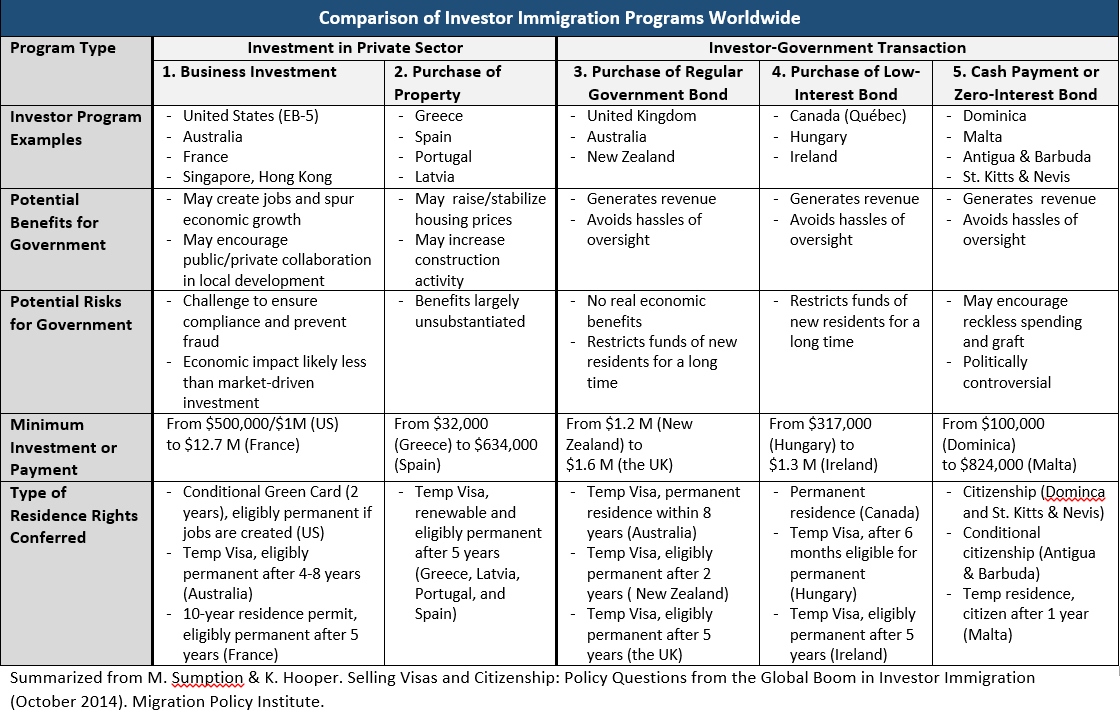
To understand what the EB-5 program is and is not, it’s helpful to look at EB-5 in context of other immigrant investor programs. Last year the Migration Policy Institute published a very nice report that does just that: Selling Visas and Citizenship: Policy Questions from the Global Boom in Investor Immigration (October 2014). The report divides immigrant investor programs into two main categories and five types, as summarized (by me) in the following table.
comptable
Note that EB-5 falls within the category of private-sector business investment, and does not involve an investor-government transaction. You can give the Malta government cash in exchange for citizenship (program type #5); you can’t give the U.S. government cash for citizenship. Australia offers the option of a government investment product (government bonds) to buy in exchange for a visa (program type #3); the U.S. government does not offer EB-5 investments, leaving that to the private sector. Spain will grant a temporary visa if you purchase property (program type #2); the U.S. will not grant an EB-5 visa simply for asset acquisition. Agents trying to sell EB-5 have muddied the waters here, because potential immigrant investors like security and simplicity, and it’s not easy to sell private sector investment. Investing in a private business requires sophistication and involves risk, but that’s not such a comfortable story. So some agents try to imply that the U.S. government sponsors/underwrites EB-5 investments, and some try to peddle “secure investments” that are really only non-qualifying asset acquisitions. Do not listen to such stories. The fact is that the EB-5 and Regional Center programs fundamentally involve at-risk investment in job-creating business. You cannot buy a green card, the U.S. government does not offer or sponsor your investment (neither Regional Center approval nor project “pre-approval” constitute endorsement or underwriting by the government), and you can’t gain permanent residence simply by expending a certain amount of money. You can immigrate to the U.S. by making a qualifying investment that is spent to develop a new commercial enterprise that creates jobs. Or you can decide that the U.S. is too much trouble and go to St. Kitts & Nevis to buy citizenship.

A business investment-type program has advantages and disadvantages for governments. On the positive side (so far as domestic politics are concerned), the program can’t be criticized for simply selling green cards, and it may create jobs and spur economic growth. On the negative side, the government has a tough task in ensuring program integrity and maximizing economic impact when it doesn’t control the investment transaction. If you’re interested in this topic, I recommend reading the entire Migration Policy Institute report, which reflects thoughtfully on policy implications for each type of immigrant investor program.

ABC News stories, New RCs, IIUSA Conference

ABC on EB-5 Investors
This has been a week of journalistic exposés of how unsavory high-net-worth people can be. The New York Times has published a series of articles unveiling shady characters who’ve been buying up prime New York real estate, the Guardian has a multi-part series on how HSBC’s Swiss private bank has facilitated financial malefactors, and ABC news has released a bunch of screamer articles and videos on EB-5 investors that ask the question “are suspected criminals, spies, terrorists buying their way into the US?”
There are a few lessons for businesspeople offering EB-5 investments. First, do be serious about vetting your investors, assuming you don’t want to end up some day with unsavory connections and cameras chasing you down a hallway. USCIS, the State Department, OFAC and their partners are much more serious and meticulous about vetting EB-5 petitioners than the ABC reports imply, but still you can’t be too careful with your own screening.
As you read the ABC stories yourself and field reactions from others, here are some points to keep in mind:

  • ABC’s key sources appear to be Senator Charles Grassley and a few disgruntled USCIS employee insiders who felt they were rushed and micromanaged;
  • Senator Grassley’s stand on immigration is to increase border security, beef up interior enforcement, oppose amnesty, scrutinize DHS, and find program abuse;
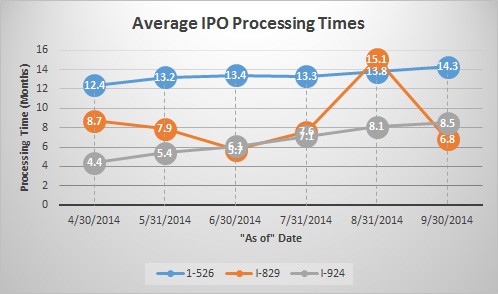
  • Each EB-5 investor’s petition currently takes an average 13.8 months to get reviewed by USCIS, which is not exactly a rush job; both the petition process and subsequent visa process involve stringent review and requirements;
  • In fact you can’t buy a green card in the US, not for $500,000 or for any other amount; some countries do have visa-for-sale programs but the US does not; the EB-5 program grants a visa in exchange for investor-funded business development resulting in job creation, not for money (to put the EB-5 program in context, see this Migration Policy Institute report on investor visa programs around the world);
  • The fact that an investigation exists is a cause for concern, but not sufficient basis for assuming that the investigation will close with a guilty verdict;
  • There are terrorists and spies and cheats in the world, but people are not terrorists because they’re Iranian and are not spies and cheats because they’re Chinese, despite ABC’s implications.

FYI: EB5info has posted a copy of the memo referenced in the story, and IIUSA and Klasko Law have issued reaction statements.

IIUSA Conference Registration
A reminder that this is the last week for early bird registration for IIUSA’s 8th Annual EB-5 Regional Economic Development Advocacy Conference on April 12-14 in Washington D.C. We’ll have a lot to advocate about this year.

New Regional Centers
Additions to the USCIS Regional Center List, 12/31/2014 to 2/3/2015

  • Dine’ Bi Keyah Regional Center, LLC (Arizona and New Mexico)
  • American Liberty Alliance (California)
  • Zhonghong Regional Center LLC (California)
  • Live in America – Colorado Regional Center LLC (Colorado): www.liveinamerica.us
  • EB5 Capital – New York Regional Center (Connecticut, New York, New Jersey, and Pennsylvania): www.eb5capital.com
  • Birch Miami Dade Regional Center (Florida): www.birchcapital.com
  • Mariana Stones Corporation Ltd. (Guam)
  • Live in America – Indiana, Michigan, Ohio Regional Center (Indiana, Michigan, and Ohio): www.liveinamerica.us
  • Live in America – South Regional Center LLC (Kentucky and Tennessee): www.liveinamerica.us
  • Diamond City Montana EB-5 Regional Center, LLC (Montana)
  • Lubert-Adler Northeast Regional Center, LLC (New Jersey and New York): lubertadler.com
  • Queens Fort New York Regional Center, LLC (New Jersey, New York, and Pennsylvania): queensforteb5.com
  • West Penn Regional Center (Pennsylvania)

12/5 Meeting, I-924A, Processing Times, New RCs (CA, IL, IN, RI, WI)

12/5 EB-5 Stakeholder Engagement
USCIS provided EB-5 program updates and answered stakeholder questions at the quarterly stakeholder engagement on Friday. USCIS Director Leon Rodriguez honored the event with an appearance, and stated that he desires to be not only a manager of but also an enthusiast and champion for the EB-5 program. IPO Chief Nicolas Colucci indicated that IPO has reached 94 staff, with another 10 adjudicators to be added in the next few weeks. We learned that USCIS is preparing a retrogression policy guidance memo, that the Government Accountability Office is conducting an audit of the EB-5 program with respect to fraud risk/mitigation strategies and validity of economic model job creation (instigated by Senators Grassley, Coburn, and Corker), that USCIS continues to prioritize fraud prevention (with a 15-member Fraud Detection National Security team and plans to expand site visits and compliance review), and that additional in-person stakeholder events are planned for 2015. USCIS invited stakeholders to submit comments and ideas for the forthcoming retrogression policy guidance memo and for how to improve ELIS and the Regional Center Document Library. Division Chief Julia Harrison gave practical tips on source of funds documentation, Division Chief John Lyons made some ill-considered statements on troubled business job creation, callers brought questions that were answered from the 5/30/2013 EB-5 policy memo or not answered, and anti-immigration lobbyists took up time advertising their theories while pretending to ask questions. I will link more detailed stakeholder meeting summaries from other commentators here as available. In the meantime, I’ve uploaded my recording of the call as usual, if you’d like to review it.

I-924 Form revisions
USCIS is revising the Form I-924 and Form I-924A, and you are invited to submit your comments at regulations.gov.

I-924A Filing
If you are a Regional Center principal, do not forget to file your I-924A before December 29. USCIS terminated seven Regional Centers in 2014 for failure to file.

Executive Action and EB Visa Categories
President Obama’s executive action on immigration does not directly affect EB-5, but Robert Divine has a nice article on what it does do. See Obama Legalizes Undocumented, Tweaks EB Categories.

Processing Times
USCIS has posted its monthly update to IPO processing times. I-526 and I-924 times are about the same (14.7 and 9 months respectively) while average I-829 times are up to 8.6 months.

Additions to the USCIS Regional Center List, 11/24/2014 to 12/8/2014

  • Regional Center Enterprises I, LLC (California)
  • Central California Regional Center, LLC (California)
  • American Dream Fund Chicago Regional Center, LLC (Illinois, Indiana, and Wisconsin): www.adreamfund.com
  • RI EB-5 Regional Center, Inc. (Rhode Island): rieb5rc.com

FAQ page, Retrogression, I-829, Processing Times, New RCs (CT, IL, IN, LA, NJ, NY, TX)

FAQ
I have started a new Frequently Asked Questions page that compiles official and unofficial USCIS answers to questions that affect business plans. So far I’ve linked in answers from USCIS policy guidance and stakeholder meetings, and I’ll be adding references to AAO decisions that treat sticky business plan questions.

Retrogression
Speaking at the IIUSA conference on October 23, Charles Oppenheim predicted that the EB-5 visa category will likely retrogress in July 2015. This remains a moving target, however. Ron Klasko’s blog has published a timely article on Surviving and Thriving in Times of EB-5 Quota Backlogs.

I-829
You may thank us at the IIUSA editorial committee for another great edition of the Regional Center Business Journal (October 2014). Three feature articles provide advice and analysis for I-829 petitions: The Latest Analysis of What USCIS Looks For in EB-5 I-829 RFEs and Denials, It’s Never Too Soon to Begin Preparing for I-829 Petition Filings, and Removal of Conditions for EB-5 Investors: Practical Guidance in Preparing I-829 Petitions.

Processing Times
The USCIS website has a sharp new look as of last week, but no new EB-5 content except a IPO processing times update. I-829 times are back to normal, while average I-526 and I-924 processing times continue to inch up.
IPO 930

IIUSA Conference
Mark your calendars for IIUSA’s 2015 EB-5 Regional Economic Development Advocacy Conference on April 12-14, 2015 in Washington, DC.

Additions to the USCIS Regional Center List, 10/20/2014 to 11/04/2014

  • EB5 Fund, Inc. (Connecticut, New Jersey, and New York)
  • Great Lakes Regional Center, LLC (Illinois, Indiana, and Wisconsin): www.glrceb-5.com
  • Southern Opportunity Regional Center LLC (Louisiana and Texas)
  • Premier Regional Center, LLC (Texas): www.premierregionalcenter.com

12/5 EB-5 Stakeholder Meeting (in person)

From: U.S. Citizenship and Immigration Services
Sent: Monday, November 03, 2014 9:31 AM
Subject: USCIS Invitation: EB-5 Immigrant Investor Program Stakeholder Engagement, 12/05/2014

Dear Stakeholer,

U.S. Citizenship and Immigration Services (USCIS) invites you to participate in a stakeholder engagement session on Friday, Dec. 5, from 1 to 3:00 p.m. Eastern to discuss the Immigrant Investor Program. This engagement is part of our efforts to enhance dialogue with external stakeholders regarding the program, also known as EB-5.

During the first part of this engagement, we will provide EB-5 program updates from fiscal year 2014 and discuss initiatives for fiscal year 2015. The second part of the engagement will be a question-and-answer session. You may ask non-case specific questions or provide feedback on the EB-5 program.

You can attend this engagement either in-person or by teleconference. Please note that in-person attendance is limited to the first 80 people who register.

To register for this session, please follow the steps below:

  • Visit our registration page to confirm your participation
  •  Enter your email address and select “Submit”
  •  Select “Subscriber Preferences”
  •  Select the “Event Registration” tab
  •  Be sure to provide your full name and organization
  •  Indicate if you plan to attend in-person or by teleconference; and
  •  Complete the questions and select “Submit”

If attending in-person, please RSVP for this event no later than Friday, Nov. 14.

Once we process your registration, you will receive a confirmation email with additional details.

To submit questions before the teleconference, please:

If you have any questions regarding the registration process, or if you have not received a confirmation email within two business days after you register, please email us at Public.Engagement@uscis.dhs.gov.
Dec 5 EB5 Quarterly Stakeholder Engagement Invitation.pdf

IIUSA Conference, AILA Book, New RCs (CO, CA), Removed RCs (CO, FL)

To those in San Francisco this week for the 2014 IIUSA EB-5 Market Exchange, happy deal-making! I’m not able to make this conference, but send best wishes and look forward to sharing feedback from attendees.

To those stuck behind a desk this week, I recommend you to the virtual EB-5 masterclass that is AILA’s new Immigration Options for Investors & Entrepreneurs, 3rd Ed. I received a free copy as a contributing author (I wrote the chapter on EB-5 business plans), but can now testify that the book is worth the full price ($129 for AILA members, $199 for the rest of us). This is not a collection of quick opinions, general introductions, and veiled advertising but a set of serious articles that incorporate comprehensive research and extensive experience. If I were an immigration attorney working with EB-5, I’d buy the book for the sample documents and case materials alone, not to mention excellent articles such as Estelle McKee’s practical discussion of issues in demonstrating job creation in I-829 petitions and Carolyn Lee’s definitive analysis of the at-risk requirement. (And Suzanne Lazicki’s lucid treatment of the EB-5 business plan!)  If I were an investor or offering EB-5 investments, I probably wouldn’t buy the book for myself (it’s specialized and heavy) but I would make sure that the attorney representing me had a copy. The book works hard to make good on its promise “to provide everything you need to successfully represent clients in this highly specialized area.” Click here to preview the Table of Contents, and update your Christmas list as needed.

I expect to have important updates shortly, as USCIS is overdue to update Q4 2014 petition processing statistics, and the State Department may come out with the Report of the Visa Office 2014 any day. For now, we just know that average processing times are holding steady for I-526 (13.8 months) and I-924 (8.1 months), and have shot up for I-829 (to 15.1 months, likely in connection with the transfer from California to Washington DC).

Those interested in Targeted Employment Area issues should note the new approach to TEA designations adopted by California, which has tended to be a trendsetter.

Meanwhile, USCIS continues to add and subtract Regional Centers from its list (and continues to fail to update its FOIA reading room with designation letters for the Regional Centers approved since 2012).

Changes to the USCIS Regional Center List, 10/1/2014 to 10/20/2014

Added:

  • Dynasty Group Regional Center, LLC (California)
  • California Economic Development Fund, LLC (California)
  • California Capital Investment Regional Center, LLC (California)
  • InvestAmerica EB-5 (Colorado) www. investamericaeb5.com

Removed:

  • Invest U.S. Regional Center (Colorado)
  • Hollywood Beach Regional Center LLC (Michigan)

New RCs (CT, NJ, NY, PA), Removed RCs (CO, FL, GA, MI, OK, TX, WI), I-924A Reminder

I have been tracking changes to the USCIS Regional Center list since early 2010, and today for the first time I am reporting more deletions than additions. I expect that this may be a new trend, as Regional Centers voluntarily exit the program or have their designations terminated. We know that many of the 588 or so Regional Centers currently in existence do not have current offerings. Some have already completed the projects that the Regional Center was formed to fund, some are casualties of a processing black hole that delivered belated I-924 approval well after the applicants had already lost interest and opportunities, some are on ice because the operators found foreign fundraising unexpectedly onerous, some are placeholders created by serial Regional Center filers with no projects but positioning to be attractive operators, and some are in trouble. Of Regional Centers with little apparent activity, some may choose to disband, some may demonstrate that they are in fact still promoting or about to promote economic growth, and some may be challenged by USCIS for failure to fulfill their mandate.

The federal fiscal year ended September 30, which means that it’s time for all Regional Centers to assess their current standing and, if they wish to continue, to justify their existence to USCIS. Recall that “Regional center means any economic unit, public or private, which is involved with the promotion of economic growth, including increased export sales, improved regional productivity, job creation, and increased domestic capital investment.” 8 C.F.R. § 204.6(e) Regional Centers that are still interested in maintaining their designation have until December 29 to show USCIS that they are still involved in the promotion of economic growth by filling out the I-924A form and, if needed, attaching a letter with additional explanation regarding their activities. The easiest ways to receive a Notice of Intent to Terminate are to simply not file I-924A at all and/or to be the subject of high-profile legal action. But that’s not the only conceivable way to lose designation. Robert Loughran’s analysis of termination letters, which I’ve linked here before, itemizes factors that have been used to justify Regional Center terminations. IPO Chief Nicolas Colucci reminded us in the 9/10 stakeholder meeting that USCIS is taking the I-924A responses seriously, so all Regional Centers should be sure to fill out the I-924A form, consulting both the I-924A form instructions and the Questions and Answers on I-924A, and keeping in mind the Regional Center mandate.

Additions to the USCIS Regional Center List, 9/16/2014 to 10/01/2014

  • Lightstone New York Regional Center, LLC (Connecticut, New York, New Jersey, Pennsylvania): lightstoneeb5.com
  • Adirondack Regional Center of New York, LLC (New York)

Subtractions:

  • Ecorntech Regional Center (Wisconsin)
  • Michigan Renaissance Regional Center (Michigan)
  • Gateway Georgia Regional Center (Georgia)
  • South Florida EB-5 Regional Center, LLC (Florida)
  • InvestAmerica EB-5, LLC (Colorado)
  • Kansas Bio-Fuel RC, LLC (Kansas)
  • South West Biofuel RC, LLC (SWBRC) (Texas, Oklahoma)

There’s another glossy report out on the EB-5 program, this one a positive and well-researched one from the American Immigration Counsel’s Immigration Policy Center. If you want to give someone a solid and accurate introduction to EB-5’s bright side, I recommend The US Immigrant Investor Program: New American Investors Making a Difference in The Economy. (And if you prefer train wrecks, sign up for Google news updates to get the unfolding drama of accusations and confusion around the breakdown of EB-5 partnerships in South Dakota.)

Cautionary Tale (KS), Processing Times Update

I assume that immigration lawyers don’t have many would-be immigrants calling up to say “I want to get a CR1 visa. Please help me find a wife.” People understand that marriage and immigration are separate issues. Of course the lawyer who handles your paperwork doesn’t also help you fall in love. The CR1 relative visa grants you benefits based on a relationship that you have entered into, but the marriage decision is obviously separate from and prior to the immigration process.

When all this is clear for an immigrant spouse, why do immigrant investors get confused? Immigration lawyers do often hear the request “I want to get an EB-5 visa. Please help me find an investment.” Apparently many people do not understand that, in the US, the investment decision and the immigration decision are separate. The lawyer who handles your immigration paperwork is not placed or qualified to select a good investment for you. Neither is USCIS. The EB-5 visa grants you benefits based on an investment decision that you have made, and that decision involves factors that are separate from immigration considerations. Potential immigrant investors, take note! Investing half a million or a million dollars is a serious matter in itself, just as getting married is a serious matter in itself. These are not fundamentally immigration matters, even when they provide a basis for a visa later. Get advice from people who know about investing or who know about marriage. Go on lots of dates, talk about everything, meet the family, see a marriage counselor. Research the investment opportunity and the principals and get qualified investment advice. If you skip all that and just focus on immigration, you’re missing the point and are very vulnerable to getting hurt by your marriage or by your investment decision.

The news this week reminds us of what can happen. See the SEC’s notice “SEC Charges L.A.-Based Immigration Attorneys With Defrauding Investors Seeking U.S. Residency” and a more detailed article in the local news “Three charged by SEC in western Kan. ethanol scheme.” It’s hard to tell whether this started out a fraud or just as incompetence/bad luck that spiraled into fraud, but either way I don’t think this could have happened if the victims involved had recognized that EB-5 investment decisions require serious attention and diligence, and that one should not depend on immigration consultants to advise on much less to manage investments.  At the same time, the perpetrators might not have dared so much had they taken the investment angle of EB-5 seriously. Maybe the perpetrators thought that EB-5 is just an immigration program and they were free to do what they wanted so long as not caught by USCIS review. Now the heavy hand of the Securities and Exchange Commission is on them, reminding them that EB-5 investments are  investments and regulated and policed as such, regardless of the immigration angle. 

In other news, IPO processing times have been updated on the USCIS Processing Time Information page, with little change since last update.

IPO731

China visa availability

IIUSA VP Robert C. Divine on Saturday’s Announcement of EB-5 Visa Unavailability for China for Remainder of FY-2014

by Robert C. Divine, Vice President, IIUSA; Shareholder, Immigration Group Chairman Baker Donelson Bearman Caldwell & Berkowitz, P.C.

Saturday’s dramatic announcement of EB-5 visa unavailability for China for the remainder the fiscal year provides a low impact “dry run” for a process that will have more “bite” next fiscal year. (For the record, Saturday was August 23, 2014).First, let’s remember what Saturday’s announcement does NOT do: It does not affect any I-526 or I-829 processing at all, does not delay immigrant processing for people not born in mainland China, and does not even affect mainland Chinese after next month. But let’s think about what it portends.

– Read the rest of this article at: http://iiusa.org/blog/#sthash.OZjUfbxV.dpuf

New Resources (Petition Processing and RC Approvals, SEC matters, Stakeholder Meetings), New RCs (CA, NY, NY, PA, TX)

A wrap-up of recent items of items of EB-5 interest around the web.

Petition Processing and RC Approvals

SEC Matters

Stakeholder Meetings

  • Be sure to sign up for the 9/10 EB-5 Stakeholder Meeting announced this week.
  • USCIS Director León Rodríguez had a few words on the EB-5 program in his engagement on August 14. IIUSA reports on takeaways from that meeting.

Additions to the USCIS Regional Center List, 7/29/2014 to 8/19/2014

  • Art District Los Angeles Regional Center, LLC (California)
  • North American Regional Center (New Jersey, New York, Pennsylvania)
  • American Vision Regional Center (Texas)

And finally, a mystery. The Regional Center page on the USCIS website is gone. A web admin accident? Or something more? I’ll keep checking back to see what happens.

I-526 Business Plan Evidence (7/29 AAO Decision)

Last month, the Administrative Appeals Office upheld denial of Regional Center-affiliated I-526 petitions based on EB-5 investment “to fund the development, production, sale, and eventual manufacture of alcoholic gelatin shots” (JUL292014_01B7203 and JUL292014_02B7203). I read that far and guessed that problems would be focused on the business plan, and sure enough. The investors also had some source of funds issues, and the cake was iced by the fact that the escrow agreement stipulated return of capital upon I-526 denial, which effectively terminated the investment before the petitioner had a chance to appeal the denial. But USCIS/the AAO focus on the business plan. To quote:

First, in the RFE, the director indicated that the petitioner did not source and itemize all pro forma financial data. … On appeal, the petitioner claims that she complied with the submission of a comprehensive business plan set forth in Matter of Ho and cites to sections of the business plan. The petitioner must submit a comprehensive business plan. 8 C.F.R. § 204.6U)(4)(i)(B).To be “comprehensive,” a business plan must be sufficiently detailed to permit the Service to draw reasonable inferences about the job-creation potential. Matter of Ho, 22 I&N Dec. at 213. Mere conclusory assertions do not enable USCIS to determine whether the job-creation projections are any more reliable than hopeful speculation. Id. The business plan does not reflect the source of the pro form financial data, and the petitioner did not submit detailed and itemized pro forma financial data that would meet the elements of a “comprehensive” business plan. Although the chiefs decision indicated that the petitioner did not submit detailed and itemized pro forma financial data, the petitioner does not submit the information on appeal.

Second, in the RFE, the director indicated that the petitioner did not demonstrate that the sales projections and the production and marketing costs were reasonable when compared to industry standards, and the input parameter was not reliable because the sales forecasts and pro forma financial statements do not demonstrate whether the sales projections are reasonable to the current market environment or when compared to industry standards. In response, the petitioner indicates that the sales projections and production and marketing costs were prepared by _______ and that ______ President, based the projections on actual industry experience. The chief determined that the petitioner did not submit any financial documents to support Mr. ____ claims, and the petitioner did not provide any evidence demonstrating a contractual agreement of to distribute the alcoholic gelatin shots.

I have no personal knowledge of this case, but it’s interesting to me as a business plan writer. Could I have helped prepare a plan that USCIS would have approved? Or is USCIS demanding evidence that excludes this type of proposal? Imagining that our alcoholic gelatin shot developer, Mr. X, had called me first for the business plan, I went out to look for sources of evidence to validate his sales forecasts and financial projections.

If Mr. X had a real estate-based proposal he could commission an appraisal report, and if he were in a well-organized industry such as hospitality he’d have good options for a third party market/feasibility study to corroborate his projections. USCIS sees a lot of real estate-related and hotel deals, and is accustomed to seeing such studies attached to the business plan. A reliable-looking third party study is the easiest way to assure USCIS’s comfort level with market and financial projections. Assuming that there is no name-brand source for a market study relevant to developing alcoholic gelatin products, I consider whether it’s possible for me to help make the business plan’s internal analysis strong enough to stand on its own. Does Mr. X’s business resemble other businesses for which financial information is available for comparison? Who collects industry data relevant to this business? When a business falls squarely within a NAICS code that groups similar businesses, then I can help support business plan projections with reference to published data for that NAICS category (for example from the Economic Census and Risk Management Association Annual Statement Studies). When a publicly traded company handles a similar product, I can reference data from annual reports and investor presentations. When a business is in an industry that’s covered by an active trade association or that’s of interest to economic development agencies, there we have more promising data sources. In Mr. X’s case, “development, production, sale, and eventual manufacture of alcoholic gelatin shots” involves activities that span several NAICS codes, and the NAICS categories lump businesses that may be operationally quite different from the subject, so NAICS category data may not be very helpful. The Internet leads me to product and pricing information for several competitors, which would help support sales estimates, and yields some data on industry trends and growth (and locates a Kickstarter for another alcoholic gelatin shot producer, in case you regretted missing your chance to invest). However I didn’t find sources to support a strong estimate of market size or potential penetration. Presumably Mr. X has tested and measured the market through his contacts, but USCIS will want more than his word to back up his conclusions.

I’d have had to call Mr. X back and say “I’m sorry, I don’t think I have the sources to handle this plan for EB-5. You could still consider EB-5 if you’re far enough along to have evidence for actual sales and financial performance (e.g. sales contracts, historical financials). But this may not work if you’re still at the estimate and projection stage, because I don’t know where we’re going to find evidence that will support your estimates and projections to USCIS’s satisfaction. I’m not saying that your product and proposal aren’t great – I just wonder whether EB-5 will work for you, since you’re not on a well-beaten path. But thank you anyway for calling me, and please think of EB-5 again if you have a restaurant or assisted living facility or other vanilla proposal that’s easier to sell to a nervous industry outsider like USCIS.” And indeed, I have phone calls like this several times a month. How many bright entrepreneurs and innovative products have I discouraged from EB-5! Yes, I’m pessimistic, but then funding is a matching game. EB-5 naturally won’t match every promising business, just like VC funds or bank loans or tax credits won’t match every proposal, and I wish I could’ve spared Mr. X an uphill battle.

The questions that USCIS asked Mr. X were reasonable, even if unfairly difficult to answer for this proposal. But I do have a complaint: that USCIS excludes experience as evidence. Here USCIS might learn from the Small Business Administration. SBA examiners have told me that their analysis of viability considers “is this proposal reasonable when compared to industry standards?” and also “how reliable are the people behind this proposal?” The SBA will assess the track record, credit, and relevant experience of the principals as critical factors in the credibility of a business plan. USCIS does not have a tradition of doing that. Our AAO decision doesn’t treat Mr. X’s experience and qualifications as relevant, and only asks for third party evidence to bolster his projections. Has Mr. X ever successfully launched a food/beverage product? Has he managed a business? What experience does he have in the industry? What’s his track record in financial matters? These are obviously relevant questions. I daresay USCIS would weed out more wishful-thinkers and frauds by focusing on verifiable answers to such questions than by simply fixating on third party references to support projection numbers. Recognizing experience as one pillar of business plan credibility would also potentially put more openness to innovation in the EB-5 program. Otherwise, EB-5 will be effectively limited to proposals that can show their reasonableness by demonstrating that they’re as similar as possible to what everyone else is doing.