SEC Ireeco, State Dept, Economists, New & Removed RCs

I have a sleeve full of urgent articles on the nature of the Regional Center program, inspired by legislation debates, and also a desk full of yet more urgent business plans for clients worried about the legislation debates and eager to get their deals filed. So this blog is getting neglected, but here are a few updates.

SEC Action
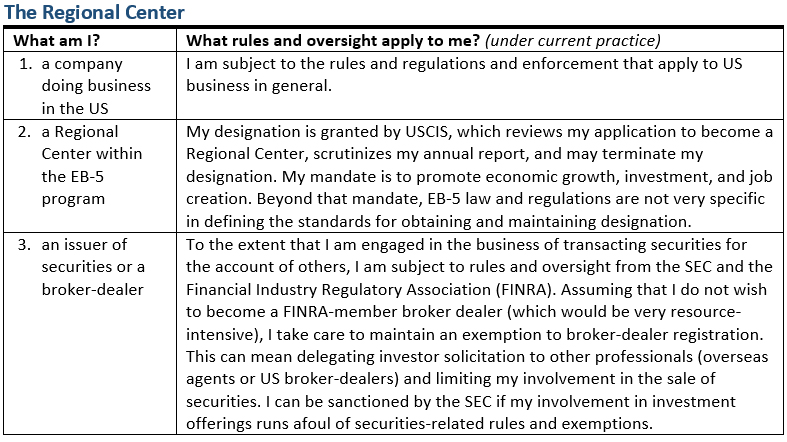
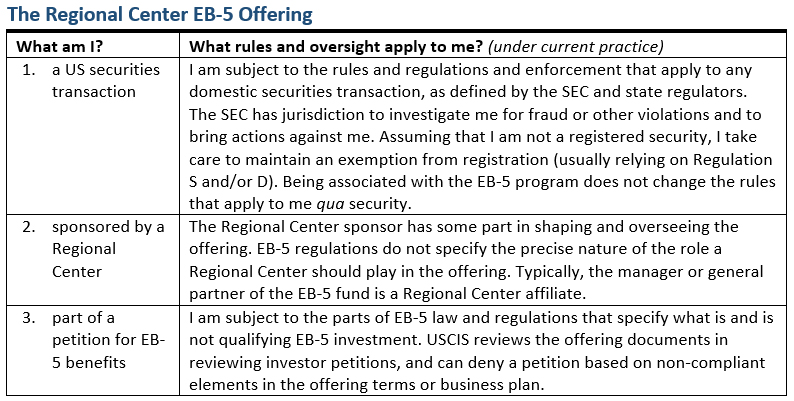
The SEC has announced charges against a firm for acting as an unregistered broker for EB-5 investors. See the SEC’s press release SEC Charges Unregistered Brokers in EB-5 Immigrant Investor Program. Michael Homeier emailed some helpful commentary on this case and Cathy Holmes has written a helpful article. This kind of action is not a surprise. The rules are clear and the SEC has repeatedly stated that it has its eye out for unlicensed persons receiving placement fees for introducing investors to investment offerors. EB-5 is a good place to hunt for this kind of offender, since the field includes many players who know more about immigration than about investment and are thus vulnerable to tripping up on securities issues. This case does not involve fraud, just failure to register, but the consequences are still serious and a good wake-up call for everyone. Ignorance of the law is no excuse! Talk to your counsel and make sure that nothing you’re doing could put you afoul of registration requirements. And recall that paying an improper fee can be just as wrong as receiving it. People who allege that EB-5 is a free-for-all should also take note of this SEC announcement, which reflects the fact that EB-5 investments are indeed regulated just like any other security.

State Department Update
The cut-off date for mainland China-born EB-5 visa applicants moved from May 1, 2013 to September 1, 2013, as of the July Visa Bulletin. This is good news, and means more Chinese investors who’ve passed I-526 can get in the queue to receive visas.

USCIS Updates
USCIS has posted notes from the June 4 stakeholder engagement with economists. The most recent update to IPO processing times (posted July 15) shows a fractional dip in I-526 times (to 13.4 months) and slight increase to I-829 and I-924 times (to 13.1 and 12.2 months respectively). USCIS has officially suspended its Electronic Immigration System (ELIS) for Form I-526, and the Regional Center Document Library is now inactive — not a surprise, considering feedback from the people who struggled to use these tools. Also note that there’s a new and significantly expanded edition of the Form I-829 (dated 5/7/2015).

New and Removed RCs
Additions to the USCIS Regional Center List, 6/08/2015 to 6/23/2015

Additions to the USCIS Terminated Regional Center List 5/7/2015 to 6/9/2015

  • SZNW (California)
  • EB-5, MRC LLC (Michigan)

S.1501 legislation introduced; USCIS engagement on job creation

USCIS Engagement with Economics
Today USCIS held its “EB-5 Interactive Series: Expenses that are Includable (or Excludable) for Job Creation.” Here is my recording of the call. When USCIS publishes its summary, and when economists make comments, I’ll link to them here. I didn’t hear anything ground-breaking except for one point that looks inconsistent with written policy, and should eventually be recognized as wrong, so I’ll reserve my comments.
UPDATE: USCIS has posted “talking points” from this engagement.

New legislation introduced into the re-authorization debate
Senate Judiciary Committee Chairman Charles Grassley (R-Iowa) and Ranking Member Patrick Leahy (D-Vt.) have introduced S. 1501 (American Job Creation and Investment Promotion Reform Act of 2015), legislation to reauthorize and reshape the EB-5 Regional Center program, and to change some aspects of the EB-5 program generally. UPDATE: Yesterday I posted a hasty rant on this bill, which I’ve decided to take down as reader response has encouraged me to look more carefully at the provisions before commenting. Take a look at the bill for yourself and see what you think. I may continue to revise this post with additional commentary.
Probably the best commentary so far on the bill is Two Key Senators Introduce Bill to Extend and Improve EB-5 Program By Stephen Yale-Loehr.

NYU article, 2015 Q2 Processing Stats, May 5 AAO Killer, New RCs

NYU Article
We now have a final version of the paper “A Roadmap to the Use of EB-5 Capital: An Alternative Financing Tool for Commercial Real Estate Projects” (May 22, 2015) by Professor Jeanne Calderon, Esq. and Guest Lecturer Gary Friedland, Esq. of the NYU Stern School of Business. For real estate developers considering EB-5, this paper is valuable for the database of examples alone, not to mention 70 pages that carefully explain how the program can work for real estate projects. The authors tell me that their project database with ongoing updates will be posted on the NYU Stern School of Business site.

2015 Q2 Processing Stats
USCIS has finally posted official EB-5 petition processing stats for Q2 2015. It’s wonderful to see that IPO is getting up to speed on I-829 processing while also increasing I-526 volumes. Meanwhile, note that volume of petition receipts has fallen each quarter this year.

2015 AAO Decisions on I-526 Cases
So far USCIS has posted four 2015 AAO decisions on appeals of denied I-526 petitions, including three sleepers and a bombshell. APR012015_01B7203 briefly remands the appeal to IPO in light of a court settlement, APR032015_01B7203 comes to an apparently reasonable conclusion that the business plan was not credible and waxes for several pages on “material misrepresentations” and their consequences, MAY082015_01B7203 dissects source of funds problems, and MAY052015_01B7203 pursues a blindly doctrinaire line on the requirement that “the petitioner must demonstrate eligibility for the visa petition at the time of filing.” In the MAY052015_01B7203 case, the offering memorandum filed with the original I-526 had a sentence that USCIS judged an impermissible redemption agreement. All investors signed and submitted an Agreement of Waiver to remove that sentence, and USCIS/the AAO didn’t dispute that the OM+waiver was now compliant but said that the petition still needed to be denied because the waiver post-dated I-526 filing and therefore the petitioner wasn’t technically eligible at the time of filing. This point is fair to the letter of the law, but one wonders, why decide to pound this technicality?  The petitioner did not include evidence of non-EB-5 capital commitments in the first petition filed in 2012, but duly provided the evidence when USCIS got around to requesting it in 2013. But USCIS/the AAO declined to credit the commitment letters provided in part because they post-dated the original I-526 filing. If this standard were applied fairly to all EB-5 cases – if no petitioner could file unless all other funding had been documented as raised before he filed – then multiple-EB-5 investor deals (most of the EB-5 program) would become next to impossible. Further, EB-5 would be limited to the projects that can and are willing to get all the conventional funding they need in the bank one to two years before they can hope to receive EB-5 investment (considering USCIS’s long I-526 processing times, and the common use of EB-5 escrows contingent upon I-526 approvals). In other words, EB-5 would be limited to projects that don’t need EB-5; that can take out their bank loans and go to work right away before investors even file I-526 and regardless of what happens with the I-526 petitions. The AAO decision hammers this point even further in the section that tries to apply the standard that “simply formulating an idea for future business activity, without taking any meaningful concrete action, is similarly insufficient for a petitioner to meet the at-risk requirement.” Specifically, the AAO/USCIS decided that the petitioner had not placed the required amount of capital at risk in part because the contractors who had been engaged to build the subject assisted living facility had not actually started work before the investor filed I-526. Naturally the petitioner needs to show more than a general idea for a future business, but this decision seems arbitrary and unreasonable in its application of the requirement. The business owner says “yes, here are the meaningful concrete actions we have taken” and the AAO lawyer says “no, I don’t think those qualify as a meaningful concrete action; you should’ve gone further” – what is this but an arbitrary judgment made by someone with no clear metric and no claim to qualification to assess the stages in establishing various types of business? And where is the acknowledgement of the one to two-year spanner that USCIS review puts into any development plan? And what would this mean, if applied fairly to all? Again, EB-5 would be limited to 1) projects that don’t actually need EB-5 investment, since they would be required to fully mature prior to/without it; and/or 2) investors who don’t really care about the EB-5 visa, such that they can develop projects well in advance of and independent of the fate of their EB-5 petitions. I think I’m upset about this case partly because it appears to involve the kind of business that many people would like the EB-5 program to support. EB-5 petitioners were providing about half of the capital needed to fund small assisted living facilities in Texas – a business that looks like it could have provided jobs in areas of genuine need and might not have gone forward without the EB-5 investment. Why press interpretations of the regulations that knock out this kind of investment, while further privileging deals that just use EB-5 to take out a few million of existing financing for some multimillion building project that was going ahead anyway? Someone is not thinking very carefully.

New Regional Centers
Additions to the USCIS Regional Center List, 5/21/2015 to 6/1/2015

  • U.S. Investment Regional Center, LLC (Arizona): usirceb5.com
  • Alexico Los Angeles Regional Center, LLC (California)
  • California Blue Sky Regional Center, LLC (California): Designation Letter
  • California Investment Regional Center, LLC (California): www.eb5-circ.com
  • Economic Development & Investment Group LLLP (California)
  • Gateway California Regional Center (California): www.gatewayeb5.com
  • Western Pacific Regional Center, LLC (California, Oregon, Washington)
  • USEGF Florida Regional Center (Florida)
  • Advantage America Hawaii Regional Center, LLC (Hawaii): www.aaeb5.com
  • GO USA EB-5 Regional Center, LLC (Illinois): www.gousaeb5.com
  • American Regional Center-Las Vegas, LLC (Nevada)
  • Century New York City Regional Center (New York): www.centurynyceb5.com
  • Land of Sky Regional Center, LLC (North Carolina, Tennessee): www.landofskyregionalcenter.com
  • Ohio Lakeside Regional Investment Center (Ohio): www.uslakesideeb5.com
  • The Lawrence Economic Development Corporation (Ohio): www.lawrencecountyohio.org
  • JMIR Texas Mega Metro Regional Center, LLC (Texas)
  • Washington Foreign Investment Management Group, LLC (Washington): www.eb5wfimg.com

2013 EB-5 Impact Study, New & Removed RCs

2013 EB-5 Impact Study
Every year IIUSA commissions an economist to analyze data on EB-5 investment amounts and job creation as reported by Regional Centers in their I-924A annual reports. The 2013 report was prepared by the Alward Institute for Collaborative Science, and has been just released — for free! See The Economic Impact and Contribution of the EB-5 Immigration Program 2013, prepared by David Kay. Past reports have been only available for purchase at a hefty rate; this one may be publicly available because IIUSA is hoping to get an updated version shortly based on 2014 annual report data. The report is a wonderful resource because it’s based on professional, peer-reviewed analysis of a comprehensive data set obtained via FOIA request, and helps translate the performance of individual Regional Centers into numbers for GDP and job creation by geographic area and sector.

New & Removed Regional Centers
Additions to the USCIS Regional Center List, 5/11/2015 to 5/22/2015

Additions to the USCIS Terminated Regional Center List 5/23/2015 to 5/22/2015

  • Front Burner Restaurants Regional Center – Southern California(California)
  • Louisiana Mississippi Regional Center (Louisiana, Mississippi)
  • New Jersey Liberty Regional Center, LLC (New Jersey)
  • Tennessee Regional Center, LLC (North Carolina)
  • Coastal Carolina Regional Center (South Carolina)

Suggested RC program changes (Jeh Johnson letter)

The EB-5 Regional Center program needs another reauthorization from Congress before September 30, 2015, and debate is heating up as to what program changes may be packaged with the reauthorization. The last couple program extensions included only minor tweaks (and were for a shorter period than hoped), but some significant changes are likely this time around. An important document in the debate is a April 27, 2015 letter from Secretary of Homeland Security Jeh Charles Johnson to Senator Grassley and Senator Leahy (click the link to read the letter). Here’s my summary of (and parenthetical comments on) Secretary Johnson’s proposals:

  • That Congress define additional bases for terminating regional centers and denying applications and petitions, with a particular focus on fraud risk and national security concerns. (This doesn’t look like a big change from current practice, as USCIS has already fit a wide variety of reasons for Regional Center termination under the official justification of “no longer promoting economic growth,” and petitions can already be denied and revoked for fraud and misrepresentation. And one hopes that broader authorization wouldn’t turn into excuse for decisions based on mere suspicion or without notification or due process.)
  • That Congress provide USCIS with the options of fining or temporarily suspending a regional center, in addition to the option of terminating it.
  • That Congress authorize USCIS to require that all regional center principals be U.S. citizens or lawful permanent residents. (This would be an important change from current practice.)
  • That Congress authorize USCIS to prohibit participation in regional centers and commercial enterprises by people with certain criminal and civil violations.
  • That Congress authorize USCIS to request reporting on and certification of regional center compliance with securities laws. (It’s not clear what exactly this would involve, and to what extent such a requirement would put a regional center in the position of having to certify compliance for activities by sellers or loan recipients that it doesn’t control.)
  • That USCIS be authorized to require and publish regional center annual reports that would include project progress reports, description of fund usage, and accounting of job creation. (It’s not clear how this would differ exactly from the current I-924A. With USCIS having omitted for years to follow up on promises to publish I-924A data, and hardly releasing any documents except as forced by FOIA, I’m skeptical of the promise/threat to publish.)
  • That USCIS be authorized to charge regional centers $20,000 per year to fund an “EB-5 Integrity Fund” that would underwrite audits and site visits.
  • That Congress refine the TEA definitions to limit them to a specified number of continuous census tracts and to include closed military bases by default. (Kudos, CMB lobbyists!)
  • That Congress increase the EB-5 investment amount for both TEA and non-TEA investments, and to link the investment amount to an inflation index from now on. (Mr. Johnson does not suggest an amount for the increase, but states that USCIS is separately writing an increased minimum investment into revised regulations.)
  • That Congress authorize USCIS to require regional centers to file business plans and offering documents in advance of individual investor filings. (Apparently, a sort of “dummy-I-526” process, which we’d like if processing times weren’t so long. Mr. Johnson also notes that this requirement is already being incorporated in regulations under revision.)
  • In the letter, Mr. Johnson also notes that he has approved a new protocol specifically defining and limiting how members of the public and Congress may communicate with USCIS, and limiting senior leadership intervention in case adjudications.

Secretary Johnson is not the only one who can write to senators and advocate for changes. Consider getting on board with advocacy efforts and contacting your Congressional representatives to express your views about Regional Center program reauthorization. IIUSA has drafted a letter with helpful comments on suggestions in the Johnson letter.

New & Removed RCs, Processing Times, Websites, Multifamily, NYT, Best Practices

New & Removed Regional Centers
Additions to the USCIS Regional Center List, 4/28/2015 to 5/11/2015

  • Golden State Economic Development Fund, LLC (California)
  • Encore Midwest Regional Center, LLC (Illinois and Missouri): encoreeb5.com
  • White Lotus Group Regional Center (Iowa and Nebraska)
  • Liberty Minnesota Regional Center (Minnesota and Wisconsin): libertyregionalcenters.com
  • American Regional Center Opportunity Fund, LLC (New Jersey, New York, and Pennsylvania)
  • Vistar’s EB-5 Business Alliance of Texas LLC (Texas)

Additions to the USCIS Terminated Regional Center List 4/22/2015 to 5/7/2015

  • LaSalle County Business Development Center (LCBDC) (Illinois)
  • US HITEC Regional Center (Illinois)
  • Tennessee Regional Center, LLC (Tennessee)

Other Items of Note

4/22 Meeting Statements, New RCs, RC Terminations

Note that the prepared remarks of Chief Colucci and Deputy Chief Harrison from the April 22 EB-5 Stakeholder Meeting have been posted on the USCIS website. So long as stakeholder engagements are about making statements, it is very nice to get these statements in written form.

New & Removed Regional Centers
Additions to the USCIS Regional Center List, 4/13/2015 to 4/27/2015

Additions to the USCIS Terminated Regional Center List 3/28/2015 to 4/21/2015

  • Nevada California Regional Center (California, Nevada)

Regional Centers spooked by the growing list of terminations may be interested in Robert Divine’s article “Regional Center Terminations” on p. 18 of the March 2015 Regional Center Business Journal. Mr Divine discusses the process, reasons for, and consequences of termination. Recall that blatant securities violations are just one reason for termination, with others including lack of activity, failure to file Form I-924a, USCIS rejection of the model used for project development, and USCIS accusations of misreporting or mismanagement. In the April 22nd EB-5 stakeholder meeting, Chief Colucci revealed that the majority of recent Regional Center terminations have been associated with the Form I-924A, based on lack of filing or on matters raised during I-924A review. With that in mind, the article “Form I-924A as a National Security and Fraud Detection Tool” by Andersson and Bulter (p. 21 in the March 2015 RCBJ linked above) is also essential reading for Regional Centers. The article describes the I-924A review process as revealed by published DHS reports and an internal USCIS document (included, probably by accident, in a response to an IIUSA FOIA request). Reading about the process, it’s clear that USCIS is trying to be serious about Regional Center oversight. They will not only read the Form but screen program principals and investment entities through TECS (the modified Treasury Enforcement Communications System), coordinate with USCIS Fraud Detection and National Security in case of any questions, examine the Regional Center website for red flags (including use of USCIS logo, implication of USCIS endorsement, and guarantee of repayment or visa), perform Internet searches for derogatory information, scrutinize foreign ownership, and examine results from USCIS’s iCLAIMS database.

4/22 Stakeholder Disengagement

UPDATE: The prepared remarks of Chief Colucci and Deputy Chief Harrison have been posted on the USCIS website. Thank you USCIS!

I apologize for reminding you to call in to today’s EB-5 stakeholder “engagement.” What a waste of time. I’ve uploaded my recording as usual on the off chance that anyone wants to repeat the ordeal, and hope that my groans aren’t too audible in the background. Here is a summary of call content with time references to the recording:

  • [2:04 – 9:24] IPO Chief Nicholas Colucci gives an update on staffing levels, processing volumes, and Regional Center terminations.
  • [9:25 – 15:18] IPO Deputy Chief Julia Harrison reiterates but doesn’t explain or justify USCIS’s new stand on cash as indebtedness and loan proceeds as qualifying capital (investor source of funds issues). She acknowledges that that “there are questions” but states that “this is the way we do it now” and disinvites debate. Her statement will eventually be posted on the USCIS website, and I’ll link to that (for what it’s worth) when it’s available (and expect to eventually link to the retraction, once reason prevails).
  • [15:20 – 1:50:00] There is a Q&A with lots of Q and very few A to speak of. Many stakeholders call in bristling with questions and legal reference related to the indebtedness issue, but don’t even get the usual vague courtesy that their input has been heard with thanks and will be seriously considered. Input and questions on this topic are explicitly not welcome. Stakeholders call in begging for answers on oft-repeated questions (increasingly urgent now with the China cut-off date) regarding sustaining investment and changes between I-526 and I-829, and once again receive no response (except “wait for our ‘essentially drafted’ draft policy memo, forth-coming ‘as soon as possible,’ for comment on these questions”). Division Chief John Lyons fails to even understand questions that involve processing time implications, and scares us once again with evidence that ignorance and irrationality start from the top. Oh I’m so depressed! There may be a few real insights somewhere in the Q&A, but other bloggers will have to find them.

Apparently USCIS has learned from the investigation into former Chief Mayorkas, who tried to engage with stakeholders and hear their ideas, who pressed for transparent and consistent policy, and who was willing to be convinced with reference to law and policy and business reality that adjudicator interpretations might be wrong. And now we’re back to the bad old days. The leadership on today’s call let us know that “this venue is for us to state our positions, not for debate” and furthermore “everything that we do here is on a case by case basis.” (They may as well have said: “We can’t give general guidance because our decisions are made individually and reactively, not shaped by consistent general principles, and also we can’t lift the veil on our case-by-case decision-making because that would involve answering case-specific questions, so really why are we all here talking?”).

A few bits of actual information from the call:

  • Next meeting: USCIS will host an “interactive engagement” with its economists on June 4th. The meeting will focus on eligible costs for job creation. I will duly post the invitation when it appears, for what it’s worth.
  • Staffing: As of now IPO has 101 staff, including 53 adjudicators and 21 economists, and has a target of 121 staff by the end of the year. Director Colucci thinks this will be sufficient to help processing catch up to petition receipts.
  • Processing Times: Posted processing times apparently include times for expedited petitions, meaning that normal processing averages are longer than posted. IPO has prioritized petitions that are outside of posted processing times, and “expects to finish cleanup efforts by the end of the year.”
  • I-924a and Regional Center Terminations: In FY2013, USCIS terminated eight Regional Centers for failing to file I-924a and another seven Regional Centers for not promoting economic growth. For FY2014, USCIS issued 57 Notices of Intent to Terminate to Regional Centers that didn’t file Form I-924a for the year, is preparing additional NOIT alleging that the I-924a filing reflects failure to promote economic growth, and has terminated four Regional Centers outside of the I-924a review process (one because it dissolved, another two because they were the focus of criminal complaints, and another for misallocation of investor funds).
  • Processing Volume: From October 1, 2014 to March 31, 2015, IPO processing volumes were as follows (preliminary numbers):
    I-526 – Receipts: 5,250, Processed: 4,036
    I-829 – Receipts: 1,533, Processed: 341
    I-924 – Receipts: 170, Processed: 135

EB-5 Events

Don’t forget to dial in today at 1 pm Eastern for the USCIS EB-5 stakeholder teleconference.

Here are other good conferences and webinars to keep in mind, if you’re seeking quality (and often free) EB-5 information and networking opportunities.

Please email to alert me of good EB-5 webinars that I’ve missed in this list.

EB-5 Impact Map

mappreviewThe IIUSA website now features an interactive EB-5 Economic Impact Map based on the most recent peer-reviewed study of I-924a data for EB-5 Regional Centers. The map allows users to search by state or congressional district to find data on EB-5 investment amount, job creation, GDP contribution, and tax revenue contribution from 2010 to 2013. It looks as if the full 2013 impact report by the Alward Institute for Collaborative Science is not yet available for purchase, but the map provides very interesting summary data.

New and Removed RCs

Additions to the USCIS Regional Center List, 3/23/2015 to 4/13/2015

Additions to the Terminated Regional Centers page:

  • Ariel International Regional Center (Texas)

Processing times for EB-5 petitions have been updated for April, but the numbers are identical to the previous report (I-526: 14.2 months, I-829: 12.3 months; I-924: 11.7 months).

IIUSA Day 2 (Congress, Markets, Securities, Impacts)

Additional notes from the IIUSA EB-5 Advocacy and Leadership Conference in Washington D.C. April 12-14…

Congressional Update
We heard from three members of Congress: Senator Ron Johnson (R-WI), Hon. Zoe Lofgren (D-CA19), and Hon. Darrell Issa (R-CA49). Senator Johnson encouraged us to fight the cultural tendency to cartoonishly villainize business and success, but he didn’t seem as eager to support the immigrant part of immigrant investment. As chair of the Senate Homeland Security and Government Affairs Committee, he has formulated a strategic plan that is all about securing borders and defending against threats, with no bullet points related to the welcome mat aspect of immigration. Lofgren and Issa did promise to support Regional Center Program reauthorization, with changes, and referred back to their respective (now dusty) IDEA Act and Skills Act proposals. Lofgren and Issa agreed that the qualifying investment amount needs to be increased and that it would be nice, if tough, to increase the visa cap. IIUSA’s advocacy panel discussed the climate in Congress generally and opined that program reauthorization is likely, but that it will likely be another extension rather than permanency, and will likely involve changes to the minimum investment amount, TEA process, and additional oversight provisions. Apparently the executive actions on immigration quelled Congress’ appetite to discuss immigration issues, especially across the aisle, and many members are unwilling to consider any other immigration measures until the executive action issues have been dealt with.
Markets Update
Panel discussions suggested that mainland China is still basically the only choice for large EB-5 capital raises (e.g. over about $20 million), because it’s the only country with infrastructure in place, though an increasing variety of other countries have supplied EB-5 investors in recent years. A change to the licensing procedure for migration agents in China has resulted in a proliferation of new agencies (over 2,000). However agencies dealing with immigration in China do still need to be licensed, and foreign parties cannot obtain such a license or legally do their own advertising or seminars in China. Provincial Entry & Exit associations continue to help oversee and organize migration agencies. The Guangdong association for example, provides training and screening and even publishes rankings for member agencies. The panel of representatives from Chinese migration agencies noted that the market for EB-5 investments in China is still strong, and that they do not anticipate demand reduction in response to the China EB-5 cut-off date or the possible increase to the EB-5 investment amount. For additional info on the China market, note recent posts on the Klasko Law Blog.
Securities Law
If only the panel with Catherine DeBono Holmes, Michael Homier, Ozzie Torres, and Lili Wang had lasted another hour or so. Such timely and critically important information! Homeier discussed the SEC’s crackdown on receipt of broker fees by unlicensed persons. The SEC has reached settlement agreements with a number of attorneys (with an announcement naming 15-25 firms expected soon), and the likely next step is SEC cases against any Regional Centers that paid impermissible finders fees. Torres reminded the audience that our SEC panelist from the previous day basically said that there is no such thing as a finders exemption. (From my notes: C. Joshua Felker called the so-called finder’s exemption “a popular belief.” He stated that somebody called a “finder” is actually a broker assuming his activity matches the defined activity of a broker, and that foreign “finders” can only be compensated as such if they provide a name only and give no investment advice.) Of course attorneys can get paid for legal services, but they cannot get paid to refer a client to a Regional Center, and they’d be wise to generally avoid transaction-based compensation, which attracts SEC attention. The panelists discussed possible exemptions to broker-dealer registration and ways to involve broker-dealers in the process of selling EB-5 investments. For better summary than I can give of the securities law details, see Catherine DeBono Holmes’ articles on the Investment Law Blog. Here is the PDF copy of the booklet Regional Centers & Sponsors and U.S. Securities Laws that Cathy was giving away at the conference.
Economic Impact
IIUSA unveiled an economic impact study of EB-5 Regional Center investments from 2010 to 2013. The report was prepared by David Kay of the Alward Institute for Collaborative Science, and uses a comprehensive data set thanks to the FOIA process, which allowed IIUSA to obtain redacted copies of Form I-924a filings for all Regional Centers. I’ll link to the summary report and charts when IIUSA posts information. The short story is that during FY2013, spending associated with Regional Center investors contributed $3.58 billion to U.S. GDP and supported over 41,000 U.S. jobs. Not bad! The impact study breaks down impacts by spending category and by geography, down to the Congressional District level.

IIUSA Day 1 (USCIS, DOS, SEC, FINRA)

I’m at the IIUSA EB-5 Advocacy and Leadership Conference in Washington D.C., where the mood is mixed. The proposed legislation and congressional champions that we applauded at last year’s conference are now gone. Journalists who get paid for sensation and senators who didn’t get their way in confirmation hearings have had a heyday with EB-5, and there’s every incentive for the news to get worse as other officials with tangential EB-5 connections (e.g. Hilary Clinton) stand for election/roasting. (EB-5 makes a great political weapon if it looks inherently bad, so purple insinuation pays.) A few real-life scandals have happened besides the political mirage ones, not helping matters. Despite this gathering gloom, however, the tone here at the conference is not that depressed. The ballroom is full of people who are continuing to raise capital, who are seeing their own projects and investors succeeding and economic development happening in their own areas, and who know enough to put media reports in context. With this concentration of positive personal experience in the room, it’s easy to forget what’s outside. But we can’t be complacent, because the general public isn’t in our conference room, and scandal-mongering sounds louder than boring business success. Former DHS Secretary Michael Chertoff discussed the Regional Center program’s vulnerability and emphasized the need to convey a message that will give people confidence that EB-5 is good for America – a message that can be supported by solid and understandable job creation metrics, rigorous vetting of people and investments in the program, quality control in overseas marketing, and cooperation with local development agencies. (PS Membership Committee: This is also a time to push to increase IIUSA membership, aligning a greater number of concerned people with the best practices and education and message of IIUSA and broadening the financial base accordingly, not a time to redefine the association as an exclusive Big Boys Club effectively limited to those who make the most money from EB-5 Regional Centers.)

A few notes from today’s conference presentations…

USCIS Updates
The USCIS Investor Program Office did not provide a representative to this year’s meeting, but we did receive updates from Maria Odom and Fredrick Troncone from the CIS Ombudsman’s office. The Ombudsman is independent of USCIS but they liaise frequently with USCIS, have more power to extract information from the agency than we do, and ask the kind of questions we’d want asked. We got a preview of statistics that will be included in the Ombudsman’s annual report to Congress (forthcoming in June) and comments on staffing and retrogression. (The following are my notes from the live presentation, and I may need to correct some details after I can review a recording.)

  • 329 I-924 Regional Center applications are currently pending at USCIS.
  • I-526 investor petition filings showed a 50% increase in 2014 over 2013 (which had about as many receipts as 2012).
  • In FY2015, USCIS received over 5,200 I-526 petitions by the end of March.
  • As of the end of March, USCIS had 585 I-526 petitions with a Request for Evidence pending, 629 petitions with decision pending after response to RFE, and over 400 I-526 petitions with an outstanding Notice of Intent to Deny.
  • USCIS currently averages, per month, about 800 I-526s received and 630 I-526s processed. That means that the backlog of I-526s awaiting adjudication — already at a faint-worthy 13,027 petitions – is growing as receipts regularly exceed decisions.
  • USCIS’s plan to address the backlog, as reported to the Ombudsman, involves adding staff and approving overtime. Ms. Odom said that IPO presently has 54 adjudicators, 18 economists and 12 program analysts, and plans to add 25 more staff by the end of the year. (She also commented that this plan hardly seemed equal to really addressing the backlog). Ms. Odom noted the effect of USCIS’s Quality in the Workplace initiative, which replaced quantitative with qualitative goals – a good move for employee morale but creating challenges for setting goals related to number of petitions adjudicated.
  • USCIS’s promised policy memo related to retrogression is reportedly in final process, but apparently, mysteriously, the memo will not focus on the specifics of retrogression but rather on the issue of what constitutes material change. Oh well, material change is an important issue too. Ms. Odom’s understanding is that the much-questioned 2.5 year job creation window, stated in the May 30, 2013 policy memo, will be reiterated in the forthcoming memo. No word on whether the new memo may cover questions related to sustaining the capital investment or priority dates and child status issues.
  • We are reminded that the CIS Ombudsman serves as “an office of last resort” when there are EB-5 case problems. If you have a case that’s pending 60 days over posted processing times (or presents special issues) and you’ve already tried contacting USCIS about the problem, you can go to the Ombudsman. See http://www.dhs.gov/case-assistance.

DOS Updates
Charles Oppenheim, Chief of the Department of State’s Visa Controls Office, announced a May 1, 2013 cut-off date for mainland China-born EB-5 visa applicants. (You can also read this news, with commentary, in the Visa Bulletin for May 2015.) Per-country limits kick in when DOS foresees running out of visa numbers for the year – a new problem for the EB-5 program, which historically didn’t get close to using its annual allocation of around 10,000 visas. Now demand is up and we have our first cut-off date (affecting mainland China-born applicants, because they use a disproportionate number of EB-5 visas). Starting next month if you (and your spouse) were born in Mainland China and you get approval of an I-526 petition filed sometime after May 1, 2013, you can’t move forward in the visa stage of the process until DOS advances the cut-off date. (Everyone else is not affected.) Mr. Oppenheim anticipates advancing the cut-off date gradually, at least in conjunction with the new visa allocation that will come with the new fiscal year starting in October. It’s also possible that he might move the cut-off date back (which I learned is the only part of this process that’s accurately termed “retrogression”) if visa numbers prove even more limited than expected (which might happen if USCIS does improve its processing speed and volume). We’re encouraged to keep an eye on Item D in the monthly Visa Bulletin for periodic updates on movement of the cut-off date. The current cut-off date involves a wait of about two years (not terribly onerous, considering how long people have to wait for I-526 processing anyway), and demand trends suggest a wait of more like three years by the end of 2016. Panelists David Hirson and Bernard Wolfsdorf (and Robert Divine) pushed for clarification on procedural questions related to securing priority dates for child status protection, and Mr. Oppenheim promised that his legal department would be addressing such questions in a memo to be released in the next few days. (He may also have answered the question himself, but you’ll have to ask Mr. Hirson to translate into English!) Mr. Oppenheim also mentioned that visa usage is about 45% principals (investors) and 55% derivatives (spouse/children) – rather different from the 1/3 to 2/3 breakdown that I’ve heard previously. He warned specifically against trusting bloggers for visa advice, but nevertheless I’m repeating links to posts that I found helpful from Robert Divine and Ron Klasko.

SEC and FINRA
We got nice presentations from C. Joshua Felker (SEC Enforcement Division Assistant Director) and James Wrona (FINRA VP and Associate General Counsel) on the relevance of their agencies for EB-5 – but no breaking news that I could perceive. Felker mentioned five EB-5 enforcement actions but only named the three from 2013/2014. He did not discuss the forthcoming action involving some fee-taking immigration attorneys (see EB-5 Analytics for discussion of this important topic). The issue of whether/when a Regional Center may need to register as an investment adviser was also not really addressed (see Holmes & Shum’s recent article for discussion of this important topic). We got the usual reminders that SEC enforcement interests do cover registration issues as well as fraud, and that something that acts like a security is a security (and that acts like a broker, is a broker) regardless of what they’re called. I learned from Wrona that FINRA currently has about 60 broker-dealers engaged in EB-5 activity, a marked increase from previous years. The number of broker-dealers at the conference reflect this welcome trend. As we know, FINRA guidelines that particularly overlap with EB-5 include the suitability rule (which must consider both investment and immigration suitability for EB-5 per the Trustmont letter), the advertising rule, Bank Secrecy Act issues, and anti-fraud issues.

OIG and the Mayorkas legacy

After listening to an EB-5 stakeholder “Conversation with Director Mayorkas” teleconference on December 3, 2012, and hearing what seemed like just more idealistic talk about building greater expertise and professionalism and transparency into the EB-5 program, I wrote a depressed post titled “Promises for the future, not today.” I ended up deleting that post a couple months later when, to my surprise, Director Mayorkas’ Quixotic promises started coming true. He was a driving force behind hiring higher-grade subject matter experts onto the USCIS EB-5 adjudication team to improve the quality of adjudications; getting the EB-5 program office moved out of California to Washington D.C, where it gained more resources and more opportunity for oversight and collaboration with partners such as the SEC and FBI; hosting regular public stakeholder meetings to improve communication and transparency; and getting out a years-overdue EB-5 policy memo that helped make adjudication policies more standardized and transparent. Objectively, these moves were good for the integrity and health of the EB-5 program, though there were side effects. Presumably quite a few California adjudicators lost their jobs, and those who stayed with the program were reorganized and got more oversight and had to work harder (just as we who prepare paperwork had to step it up based on the rising review standards). I’m sorry but not surprised that Mr. Mayorkas has ended up with a nice big target on his back, especially since his next move after shaking up the EB-5 division and trying to whip it back into shape has involved helping President Obama with the Executive Actions on immigration. If you’d like to witness people aiming at that target, you can read the March 24, 2015 edition of the Office of Inspector General’s investigation into USCIS employee complaints. Have your gas mask ready to deal with the politics. Or if you just want the summary of the media’s take on this report: Mr. Mayorkas is a bad man who intervened in the decision-making of unimpeachable career civil servants out of favoritism for evil Democrats. My take is that a few disgruntled employee complaints about ambiguous cases cannot obscure how much Mr. Mayorkas improved the quality and predictability of EB-5 adjudications during his tenure by hiring business experts and economists and attorneys, getting more resources committed to EB-5, and pushing for published policy guidance. I personally blame his standards and staffing decisions for the fact that my business plans are about ten pages longer than they were pre-Mayorkas era and festooned with footnote citations to verifiable market and industry research. I also witness and appreciate the improved professionalism that he encouraged in preparation and review of EB-5 cases.
Update: See the comments for additional commentary and links to informed articles related to the OIG report.

New and Removed RCs

USCIS continues to designate new Regional Centers and add others to the list of Terminated Regional Centers. For the past couple years, it’s been common for large operators to apply for multiple Regional Centers even if they didn’t have immanent projects for all the centers. This secured them the potential to sponsor investments over a wide geographic area, and positioned them to move forward promptly if projects were identified. Now, however, USCIS is being aggressive about terminating any Regional Centers not currently demonstrating contributions to economic growth, and we can expect to see many dormant centers being culled from the list. I have mixed feelings about this. On the one hand, I’m not comfortable with how the Regional Center list has bloated since the loose hypothetical project standard lowered the barrier to entry to for new RCs. On the other hand, I know of well-managed regional centers that have not recently sponsored a project but are committed to the program and have strong potential for future performance, and it seems a shame to nip them in the bud. Public agencies will also be less likely to consider EB-5 as a tool for the toolkit if maintaining Regional Center designation requires ensuring a constant stream of EB-5-funded projects.

Additions to the USCIS Regional Center List, 3/9/2015 to 3/23/2015

New Terminations, 3/9/2015 to 3/18/2015

  • New Jersey Regional Center, LLC (New Jersey)
  • EB-5, MRC LLC (Michigan)
  • American Life Ventures Everett, LLC (Washington)
  • Palm Coast Florida Regional Center (Florida)

What are TEAs and how do they work?

Every couple years, there’s a kerfuffle over the use and definition of the Targeted Employment Area (TEA) in the EB-5 program. People – recently Seattle Times journalists, for example – look at things like luxury hotels being built in wealthy downtown areas using EB-5 investment and ask wait a minute, is this right? Such projects nearly always get EB-5 investment in $500,000 increments (State Department stats show there’ve historically been very few Regional Center investments at the $1 million level), and the $500,000 reduced investment amount depends on the project being located within a TEA. The Seattle Times portrays the TEA reduced investment amount as a “loophole” being “exploited” by people who “gerrymander” a TEA by grouping high and low unemployment areas, then go on to develop a project in the prosperous part of the designated area. The Seattle Times editors believe that EB-5 program architects intended EB-5 investment dollars to be spent within depressed communities, that there aren’t centralized guidelines for defining TEAs, and that there’s a problem with state involvement in TEA designation. These points require some perspective.

First, the term “Targeted Employment Area” does have a set definition, articulated by Congress through law and elaborated by USCIS regulation. The term is not defined individually by states, and the term is not defined to equal “an economically depressed area.” The Immigration Act of 1990 that established the EB-5 program specifies that (in its own spelling): “the term ‘targetted employment area’ means, at the time of the investment, a rural area or an area which has experienced high unemployment (of at least 150 percent of the national average rate)” and “-The Attorney General may, in the case of investment made in a targetted employment area, specify an amount of capital required under subparagraph (A) that is less than (but not less than 1/2 of) the amount specified in clause (i)” (see PDF p 21-22 of IMMACT 1990). USCIS regulations and policy repeat this statutory definition, specify the reduced amount of capital, and elaborate practical issues in designation determinations (see the EB-5 Policy Memo p. 7-8 for discussion).

Because the TEA definition is in the law, changing the definition would be a statutory matter and a point to pursue with your Congressional representatives. But it’s worthwhile to look at the original intent. In 1990, Congress chose to define TEAs for the EB-5 program specifically in terms of employment (or rural areas). Congress could have defined TEAs based on poverty levels, crime levels, educational levels, exports, GDP growth rates, sales tax, or other metrics considered in other initiatives intended to benefit depressed areas, but it chose unemployment as the target. An area with median household income at $30,000 and unemployment of 7% would not currently qualify as a TEA; another area with median income at $100,000 and unemployment of 15% could qualify. The explicit intent with TEAs was to encourage job creation for high unemployment areas. Creating jobs for poor people and investing within poor neighborhoods are also worthy goals, but it happens that Congress did not choose to write such goals into the EB-5 law.

While the law and regulations define what constitutes a TEA, states are involved in implementation. Each state may choose an agency and give it authority to designate TEAs, which involves leeway to judge (1) appropriate boundaries of a geographic or political subdivision that constitutes the targeted employment area; and (2) which data set to use in calculating the area’s unemployment. In reviewing EB-5 petitions, USCIS generally gives deference to state designations, but double-checks that the data is acceptable and that calculations are consistent with methodologies established by the Department of Labor. The elements of state discretion lead to variation in TEA designations between states. Some state authorities will designate census tract groups and some won’t; states have different ways of deciding which geographic boundaries make sense; and a variety of unemployment data sets may be used. (Impact DataSource has a good article about state variation.) Just letting one agency decide for the nation using one yardstick would look cleaner, simpler, and more equal. But note what makes sense about local involvement. Based on population distribution and commuting patterns, for example, it might be reasonable to have a very large TEA area spanning certain suburbs, a very small one within a certain city neighborhood, and a banana-shaped one somewhere else along a busy highway. A local economic development agency could have a good basis for judging whether certain TEA boundaries make sense for the given region. I can’t visualize a federal agency coming up with one cookie cutter geography definition that fits from Alaska to Florida. Designated state agencies are typically labor departments or economic development authorities, which means their interests are aligned with the aims of the EB-5 program, making their discretion is as good as anyone’s. Of course project developers will try to draw geographic areas for their own advantage, but I can’t think of a better arbiter for this than the state authorities.

Under current rules, it’s possible to get TEA designation for an area whose average unemployment rate is high, even if parts of the area have low unemployment. So how do we feel about locating an EB-5 project in the healthiest part of the TEA? Would that subvert the intent of the EB-5 program? The Seattle Times suggests that TEA EB-5 projects in downtown Seattle fail the smell test. Let’s think about Potala Tower, which the Seattle Times describes as a $190 million hotel project in an upscale Belltown neighborhood. (Disclosure: I don’t know any more about this project than I learned from the Times.) I believe that Belltown is not depressed and that the hipsters living next door to the Potala project do not need the construction jobs or operations jobs that it will create. On the other hand, the hipsters next door probably won’t take the jobs. It seems more likely that the roofers and carpenters and housekeepers and managers who take the work will be residents of the less hip high-unemployment neighborhoods a few miles south. If Potala Tower would likely employ South Seattle residents, isn’t it reasonable to package those contiguous South Seattle neighborhoods with Belltown as a Targeted Employment Area? That’s gerrymandering, but could make economic sense, unless there’s a barrier around Belltown that isolates the jobs created and money spent there. And let’s consider the impacts of the $190 million Potala Tower project as compared with impacts of the $9 million Econolodge project that might be feasible to build smack within a depressed part of South Seattle. The luxury hotel would be a much larger new employer, but more distant from where most unemployed people reside. If I were advocating for those 20% unemployed residents of South Seattle and had to choose one project to encourage on their behalf, the Potala or the Econolodge, I’d have to consider carefully – maybe even in consultation with my good old state economic development authority. It’s not a simple question, and I wouldn’t bother asking why the upscale business can’t just locate to a downscale street. Assuming that Belltown+South Seattle can reasonably, practically be called “an area,” and that Potala Tower could make a dent in the high unemployment concentrated in South Seattle, I’m not getting bad whiffs off this situation. As the EB-5 program is currently set up, a TEA EB-5 project should not fail the smell test simply because it’s luxury or in an upscale neighborhood, but only if it seems unlikely to create jobs in a high-unemployment area.

It’s possible to argue that the current TEA rules set a bar that’s too low, allowing too many areas to qualify; or that the $500,000 reduced EB-5 investment amount is too low, considering investor visa thresholds in other countries; or that the TEA definition wrongly focuses on unemployment when other metrics may be more urgent today. Those points are worth debating. I don’t think you can argue that TEA definitions and rules do not exist or are incoherent or endemically subverted, unless you begin by not grasping what the existing definitions and rules are. To avoid debating from ignorance, consider re-reading Carolyn Lee’s article on State Designations of EB-5 Targeted Employment Areas.

And while I’m on the topic of TEA misconceptions, let me caution you about paying someone to “discover if your site qualifies as a TEA.” The variation among states means that, unless your entire county or MSA has high unemployment or you’re in a rural area outside an MSA (in which case, no special designation is required), there is no universal data source or one simple calculation that will reliably determine a TEA around your site. It’s not very helpful to buy a report predicting a favorable census tract combination based on proprietary 2014 unemployment data, for example, if your state won’t designate census tract groups and uses 2013 BLS/2011 ACS data. If in doubt about TEA possibilities for your site, I’d start by getting the policy from your area’s designated authority (there’s one list of designated agencies here). Then you can start assessing TEA qualification, and consider assistance from professionals who are current on your state’s geographic area procedures and unemployment data sets.

IPO Processing Times, 12/5 Engagement Notes, New RCs

EB-5 Processing Times
The monthly processing update for the USCIS Investor Program Office shows slight increases to processing times for all EB-5 petitions.
times

12/5/2014 Engagement Notes
USCIS has posted a summary, transcript of the Director’s statement, and slides from the December 5, 2015 EB-5 stakeholder engagement. There’s no Q&A or other content that wasn’t presented at the meeting. To review the meeting in more detail, consult Robert Divine and Melanie Walker’s summary.

New RCs
Additions to the USCIS Regional Center List, 3/4/2015 to 3/9/2015

  • California One Investment Center, LLC (California)
  • EB-5 Bonds California, LLC (California)
  • EB5 Florida Hotels & Investments Regional Center LLC (Florida)

Name change: from My EB5 Green Card Regional Center to My Florida Regional Center LLC DBA My EB5 Green Card Regional Center

EB-5 for real estate projects, New RCs

Roadmap to EB-5 as Financing for Real Estate Projects
IIUSA has posted a working draft of a paper by Professor Jeanne Calderon and Gary Friedland, Esq. of the NYU Stern Center for Real Estate Finance Research. (Update: the link now directs to the final 5/24/2015 version.)“A Roadmap to the Use of EB-5 Capital: An Alternative Financing Tool for Commercial Real Estate Projects” is a good resource for real estate people exploring the EB-5 option and looking for practical information about the program and detailed examples of how businesses have used EB-5. The authors confess the difficulty of researching this paper, and I think they occasionally put too much face value on claims by agents or Regional Centers about the greatness of their projects and wisdom of their strategies, but overall this is a very solid resource and provides useful guidance, particularly for EB-5-newcomers. I will link the paper on my Resources page and make an update when the authors publish a final draft.

New Regional Centers
Additions to the USCIS Regional Center List, 2/23/2015 to 3/4/2015

  • Regional Center Fund of America LLC (District of Columbia, Maryland, and Virginia): www.rcfamerica.com
  • Shrimp House US LLC (Florida)
  • Heartland Regional Center, LLC (New York, New Jersey, and Pennsylvania)

Removed from the list 2/23/2015 – 2/25/2015

  • Buffalo Regional Center (New York)
  • Silicon Valley Venture Investment Regional Center (California)
  • Tucker Development Corporation Regional Center (Michigan)

2/26 USCIS SOF teleconference, New RCs

USCIS Engagement on EB-5 Source of Funds
Today USCIS hosted an “EB-5 Interactive Series” teleconference on the topic of Requests for Evidence on Lawful Source of Funds for Investment. As promised in the invitation: “The topic of discussion will be lawful source of funds used for capital investment in the EB-5 program. We will discuss common reasons why petitioners receive requests for evidence and types of evidence that are helpful to submit.” The call was nicely detailed and highly technical and offered no surprises that I could spot, but then I don’t work with source of funds documentation. If this is your field and you want to review the call, you may download my recording. (See also the Klasko law blog and EB-5 Insights blog for comments on the call.) USCIS stated that it will not be posting an engagement summary, so we won’t have the convenience of just reading the prepared statements read on the call. USCIS concluded the call with four general tips for avoiding a source of funds RFE: (1) explain any inconsistencies in the documents provided; (2) if a required document is unavailable, explain why; (3) consider the probative value of evidence (ie evidence from an objective third party will be more compelling than evidence from you/your friend/your family/your company); (4) provide full translations of foreign documents. UPDATE: USCIS has posted these tips on a new EB-5 Evidence page.

New Regional Centers
Additions to the USCIS Regional Center List, 2/3/2015 to 2/23/2015

  • EB5 United West Regional Center, LLC (California)
  • North American Center for Foreign Investments, LLC (California)
  • Pacific Investment & Immigration Regional Center (California)
  • Front Range Regional Center, Inc. (Colorado and New Mexico): www.pathwayseb5.com
  • BLT TriState Regional Center LLC (Connecticut, New Jersey, New York)
  • USCFID New York LLC (Connecticut, New York, New Jersey, Pennsylvania)
  • Midwest Regional Center, Inc. (Kentucky)
  • Northeast Monument Regional Center LLC (Massachusetts, New Hampshire, Rhode Island)
  • G.R.E.E.N. Regional Center (New Jersey)
  • The New Mexico Regional Center (New Mexico)
  • U.S. Immigration Recovery Fund NY, LLC (New York)

Removed from the list: Midwest EB-5 Regional Center, LLC (Ohio, Kentucky)

Immigrant investor program comparison

To understand what the EB-5 program is and is not, it’s helpful to look at EB-5 in context of other immigrant investor programs. Last year the Migration Policy Institute published a very nice report that does just that: Selling Visas and Citizenship: Policy Questions from the Global Boom in Investor Immigration (October 2014). The report divides immigrant investor programs into two main categories and five types, as summarized (by me) in the following table.
comptable
Note that EB-5 falls within the category of private-sector business investment, and does not involve an investor-government transaction. You can give the Malta government cash in exchange for citizenship (program type #5); you can’t give the U.S. government cash for citizenship. Australia offers the option of a government investment product (government bonds) to buy in exchange for a visa (program type #3); the U.S. government does not offer EB-5 investments, leaving that to the private sector. Spain will grant a temporary visa if you purchase property (program type #2); the U.S. will not grant an EB-5 visa simply for asset acquisition. Agents trying to sell EB-5 have muddied the waters here, because potential immigrant investors like security and simplicity, and it’s not easy to sell private sector investment. Investing in a private business requires sophistication and involves risk, but that’s not such a comfortable story. So some agents try to imply that the U.S. government sponsors/underwrites EB-5 investments, and some try to peddle “secure investments” that are really only non-qualifying asset acquisitions. Do not listen to such stories. The fact is that the EB-5 and Regional Center programs fundamentally involve at-risk investment in job-creating business. You cannot buy a green card, the U.S. government does not offer or sponsor your investment (neither Regional Center approval nor project “pre-approval” constitute endorsement or underwriting by the government), and you can’t gain permanent residence simply by expending a certain amount of money. You can immigrate to the U.S. by making a qualifying investment that is spent to develop a new commercial enterprise that creates jobs. Or you can decide that the U.S. is too much trouble and go to St. Kitts & Nevis to buy citizenship.

A business investment-type program has advantages and disadvantages for governments. On the positive side (so far as domestic politics are concerned), the program can’t be criticized for simply selling green cards, and it may create jobs and spur economic growth. On the negative side, the government has a tough task in ensuring program integrity and maximizing economic impact when it doesn’t control the investment transaction. If you’re interested in this topic, I recommend reading the entire Migration Policy Institute report, which reflects thoughtfully on policy implications for each type of immigrant investor program.