EB-5 Visa Timing in 2020

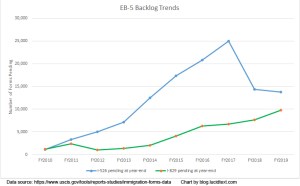
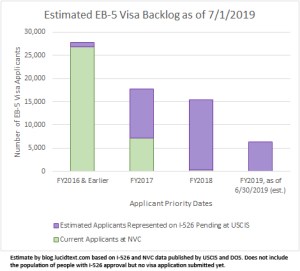
At least 70,000 people are currently in the stage between I-526 filing and receiving visas (conditional permanent residence). Who will receive EB-5 visas in 2020? The answer depends on visa availability, I-526 timing, and the role of country caps.

Visa Availability

Thanks to roll-over of unused numbers from other categories, EB-5 has a few more visa numbers than usual to work with this year.  Department of State has allocated 11,111 visas to EB-5 in FY2020, of which any one country can get up to 778 visas (7%) under the country caps.  (China is the exceptional case, having access to 288 visas by right plus – in practice – all the numbers unclaimed by low-volume countries. About 5,200 EB-5 visas will be leftover and available to China in FY2020, DOS estimated in October – almost 1,000 more than last year.)

I-526 Timing

For many people, I-526 processing time is the major factor determining the visa wait time. We have three primary sources of information about petition processing times: the USCIS Check Case Processing Times page (which has updates about twice monthly that I log here), the Historical Average Processing Times Page (with annual averages), and the Immigration & Citizenship Data page (which has quarterly updates on processing volume). The sources present this puzzle about I-526 processing times to date:

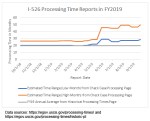
  • the Check Case Processing page currently reports an estimated time range for I-526 processing of 32.5 to 49.5 months, and has reported times in the range of 27 to 52 months since June 2019;
  • the Historical Average Processing page says that I-526 were pending an average of 19.8 months in FY2019;
  • the January 2020 Visa Bulletin has a final action date of May 1, 2018 for India, suggesting that there are Indians who filed I-526 21 months ago and already at the visa stage
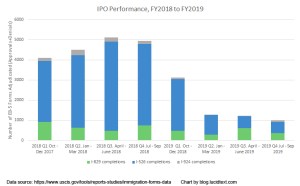
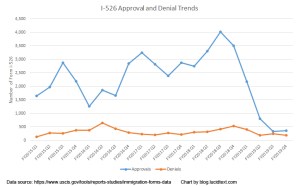
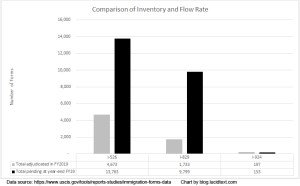
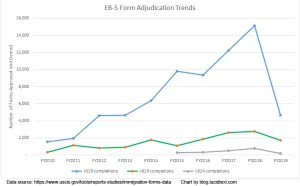
  • the Immigration & Citizenship Data page last reported 13,000 I-526 petitions pending as of June 2019. That workload could possibly take 3-5 years to process only if USCIS processed fewer than 4,000 petitions a year going forward. But as recently as 2018, USCIS was processing that many I-526 every quarter.

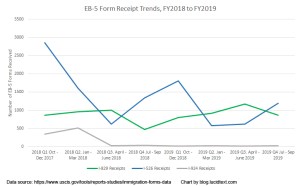
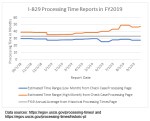
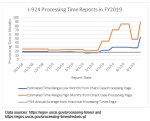
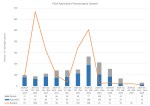
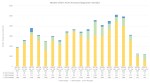
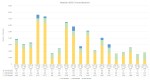
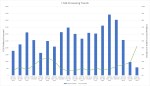
Looking at the puzzle (and at my charts below, which plot the bi-monthly processing time report updates against the reported annual average), I incline toward the theory that USCIS started, mid-FY2019, to inflate the months reported on the Check Case Processing page to discourage complaints and inquiries, not because the average I-526 petition has been or will be pending 3-5 years. But we’ll have a better sense of the processing reality when more recent volume numbers get published. I hope that USCIS processing improvements will be a major focus of efforts in 2020 to improve EB-5 program integrity and viability.

Visa Timing by Country:

EB-5 investors today can expect to apply for a visa promptly upon I-526 approval, unless they are from China, Vietnam, or India – countries whose demand currently exceeds the 7% of annual EB-5 visas available to each country under the country cap. The country cap adds a constraint to the EB-5 process, creating backlogs and wait times for high-demand countries while keeping the path clear for new applicants low-demand countries. This status quo has been challenged by the Fairness for High-Skilled Immigrants Act. H.R.1044 passed the House in July 2019 (365 – 65), and Senator Mike Lee has worked tirelessly since then to push the companion S.386 in the Senate, negotiating his way progressively through blocks from Senator Paul, Senator Purdue, and most recently, Senator Durban. The Fairness for High-Skilled Immigrants Act bill has been around for five Congresses without ever becoming law (with a previous version also passing the House in 2011 before dying in the Senate), so I do not really expect it to pass now. But I also do not ignore the possibility, considering the intense lobbying push in 2019, and the bill’s major consequences. If by chance it passed, the bill would remove the country cap from all EB visas, thus decreasing the EB-5 visa wait for the backlog of China applicants while increasing the wait for people with more recent priority dates. If passed, new EB-5 investors from any country could expect to wait about seven years for conditional permanent residence, based on the size of the total EB-5 backlog. Most people currently awaiting I-526 approval would face a 3-7 year wait for visa availability, depending on priority dates, if the bill passed.

Visa Bulletin

Assuming no statutory change, the January 2020 Visa Bulletin provides the following projections for EB-5 visa availability through April/May 2020:

  • The EB-5 category will remain “current” for most countries, meaning that people from most countries can file visa applications as soon as they qualify, regardless of priority date.
  • The final action date for China “may be possible to advance at a slightly faster pace.” (The China FAD advanced an average of just one week per month in 2019, and is at November 22, 2014 as of January 2020.)
  • The final action date for India will “likely to advance at a very rapid pace until the level of demand increases.” (The India FAD has advanced a year since being set in July 2019, and jumped from 1/1/2018 in December 2019 to 5/1/2018 for January 2020.)
  • The final action date for Vietnam will likely have “limited forward movement.” (The Vietnam FAD advanced 26 weeks in 2019, and has reached 12/8/2016 for January 2020.)

Here are the stories I see behind the Visa Bulletin projections:

  • EB-5 will remain current for most countries, because most countries have fewer than 778 people who could possibly reach the EB-5 visa application stage this year.
  • The China final action date may advance due to an increase in visa supply, but the advance will likely be slight due to concurrent increase in visa demand. DOS expects to have nearly 1,000 more EB-5 visas to give China in FY20 than in FY19, as discussed above. Greater capacity would help the queue advance more quickly. However, Chinese filed over 3,000 more I-526 in FY15 than in FY14 (13,530 vs 9,722, to be precise). The Visa Bulletin is moving into that filing surge as it starts to accept visa applicants for FY15 priority dates. Greater volume of visa applicants for FY15 priority dates would tend make the line advance more slowly.
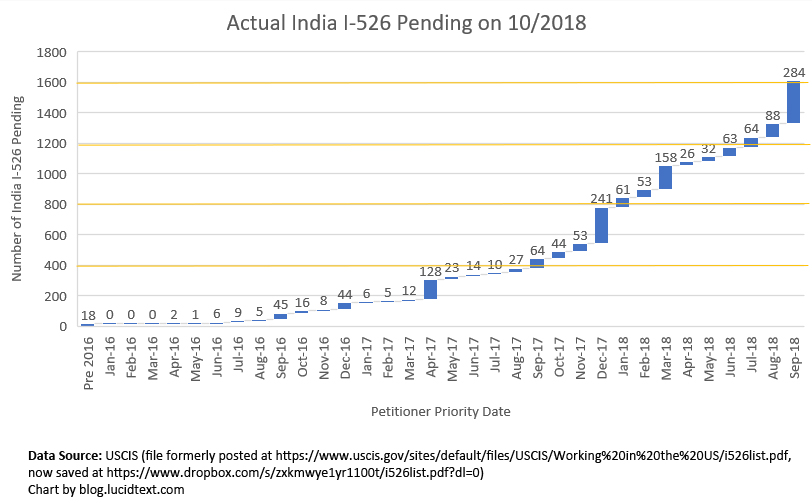
  • The India final action date has advanced rapidly because “the level of demand” has been low, and expected to remain so. “Demand” means the number of Indians documentarily qualified for a visa – i.e. with I-526 approval and visa application or I-485 in order. That number is low only because USCIS is slow and erratic with I-526 adjudication. Charles Oppenheim estimates that there were 4,000 to 5,000 Indians in line for an EB-5 visa in 2019 – enough to claim many years of visas.  But about 85% of that queue was stuck in the I-526 stage, and thus not yet qualified to demand a visa. Department of State has 788 visas to give Indians this year. Which of those 4-5K Indians in the queue gets one of the 788 visas depends on which I-526 USCIS can approve this year. So long as USCIS is very slow, only approving a few petitions, and particularly delaying old petitions, the Visa Bulletin will continue to advance the India FAD to open the door for those few who have reached the visa application stage. If USCIS increases volume of I-526 approvals, then more Indians will be able to compete for this year’s visas. In that event, the India FAD will slow its advance, or even move back in time to accommodate an influx of applications with older priority dates. Personally, I expect the India FAD to retrogress this year. Indians filed at least 330 I-526 petitions from January to May 2018, enough to absorb at least a year of visa numbers. Indians filed at least 806 I-526 petitions between April 2017 and May 2018 (April 2017 being the near end of the estimated time range for I-526 processing, according to the current USCIS processing times information page). That’s enough to absorb more than two years of available visas. All that demand will pull the India FAD back, assuming it can ever emerge from I-526 processing.  The Visa Bulletin FAD for India advanced from May 2017 to May 2018 in just seven months, and from January 2018 to May 2018 in just one month – which tells us that DOS simply hasn’t yet received the surge of visa demand that’s on the way from those early priority dates. The 300 or so Indian investors plus family from early 2018 could not possibly have all received visas in December 2019. When the petitions stuck in I-526 processing finally arrive at the visa stage, the visa bulletin will have to recalculate and may retrogress the India FAD.
  • The Vietnam FAD is expected to advance slowly from the current date of December 8, 2016. One would expect the movement to be slow because Vietnamese filed many I-526 in FY2017 – 523, to be precise, as compared with 404 petitions filed the previous year. This higher volume means that FY17 priority dates will take longer to move past the visa window than FY16 priority dates. Meanwhile, many FY17 petitions have completed I-526 processing, and thus the applicants are qualified and ready to claim available visas. However, we can see that the full surge of FY17 demand from Vietnam has not yet hit the visa stage, since the Visa Bulletin Chart B is still current for Vietnam, and USCIS is still allowing applicants to file I-485 using Chart B. That window could close as the pool of qualified Vietnamese applicants grows.

Visa Retrogression

People from China, Vietnam, and India who apply for visas through adjustment of status will be interested in this document, which gives helpful Q&A on visa availability and the I-485 process: USCIS Responses to Questions from the American Immigration Lawyers Association (AILA)

RC List Updates

And to close the year, an update on changes to the USCIS lists of approved regional centers. Note that I update approvals on my blog RC List page (together which such contact info as I can find) and terminations in my Excel Terminations log (together with a log of termination reasons and links to all termination letters posted so far by USCIS).

Additions to the USCIS Regional Center List, 08/27/19 to 12/30/19.

  • EB5 Affiliate Network Southeast Regional Center, LLC (Alabama, Georgia, Mississippi, South Carolina, Tennessee)
  • Plymouth Park Regional Center, LP (Texas)
  • Protogroup, Inc. (Florida) — Reinstated after termination in 2018
  • Southeast Regional Center LLC (Alabama, Georgia)

EB-5 form filing fees

We have opportunity to review and comment on the U.S. Citizenship and Immigration Services Fee Schedule. The proposed rule was published on 11/14/2019, and comments are due by 12/16/2019.

The proposed rule appeared at a busy time in EB-5 and I haven’t heard much talk about it. But this could be important. Future processing times could depend on today’s fee decisions. And EB-5 processing is a major factor in the future survival and integrity of the EB-5 program.

The fee review asks this important question: what resources does USCIS need to provide adequate service? Considering what has changed since the existing fees were set in 2016, how do filing fees need to change?

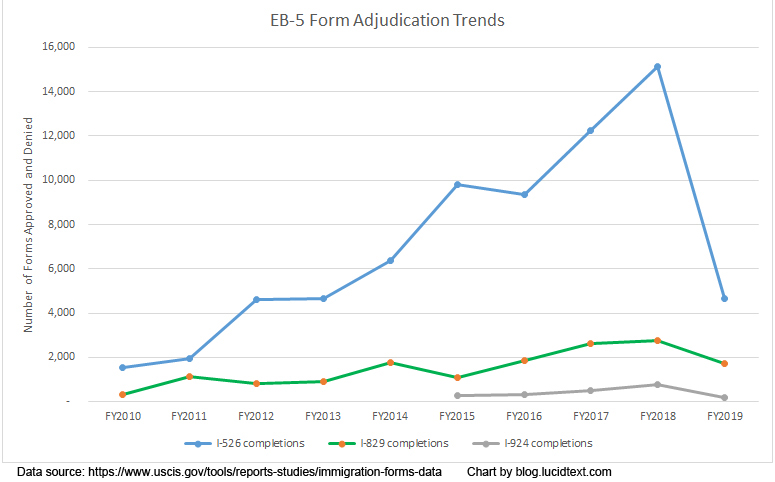
The fee review reports that the work associated with EB-5 forms has increased significantly since the last fee adjustment in 2016, but the 2019 rule proposes only minor increases to EB-5 filing fees.

Proposed Rule Table 6 — Completion Rates per Benefit Request*
Form  in May 4, 2016 Proposed Rule in November 14, 2019 Proposed Rule Change
I-526 6.5 hours 8.65 hours +33%
I-829 5.5 hours 8.15 hours +48%
I-924 40 hours 34.95 hours -13%
I-924A 5 hours 10 hours +100%
Proposed Rule Table 19 — Proposed Fees by Immigration Benefit
Form Current Fee (Proposed May 4, 2016) New Fee (proposed November 14, 2019) Change
I-526 $3,675 $4,015 +9%
I-829 $3,750 $3,900 +4%
I-924 $17,795 $17,795 0%
I-924A $3,035 $4,470 +47%

* Completion rates “reflect what is termed ‘touch time,’ or the time an employee with adjudicative responsibilities actually handles the case.”

How do we feel about this fee proposal? To me, that small fee increase over 2016 looks like bad news. A 9% fee increase for I-526 does not look equal to addressing the 33% increase to per-form touch time, not to mention the 100% increase to I-526 processing times and 50% decrease to processing volume that occurred between 2016 and 2019. If the labor to adjudicate Form I-829 has nearly doubled since 2016, how will a 4% fee increase give resources to handle that? Does the 0% increase to the I-924 fee indicate that USCIS considers the currently-posted 62 to 115-month I-924 processing time acceptable?

The fee rule aims “to determine the USCIS resources needed to process benefit requests within established adjudicative processing goals.” The rule does not disclose what processing goals it uses. But the goals can’t differ much from the status quo, if the rule expresses little need for additional resources for EB-5.  (To review the dire status quo: according to the current Check Case Processing Times page, a petition is only “outside normal processing” after 1,527 days for I-526, 1,339 days for I-829, and 3,452 days for I-924. But, side note for people filing Mandamus complaints, note that the Historical Processing Times page has a quite different statement of average processing times in 2019.)

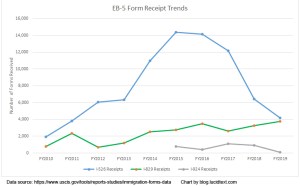
I don’t only worry that proposed fee increases are not proportional to the reported increase in work per form. Total revenue is also a concern. Revenue equals price times quantity. If form fees stay about the same, and receipts plummet, then USCIS will have a smaller and smaller EB-5 budget to work with. The fee review estimates $83 million average annual revenue from proposed EB-5 fees, assuming about 19,000 EB-5 forms get filed in FY2019/2020. (This is summing I-526, I-829, I-924, and I-924A.) In reality, annual average EB-5 receipts were only about 10,000 for FY2018/2019 per USCIS data, and will be even lower going forward assuming that the law of demand holds following the doubling of the EB-5 investment amount. The picture won’t be pretty, if IPO ends up having less than half the new fee revenue that it expected, while still needing resources to adjudicate years-worth of pending forms on top of new receipts.  I wonder if the terrible performance we saw at IPO in 2019 wasn’t linked in part to low revenue due to dropping receipts, even as workload remained heavy due to pending petitions. (Sadly, there’s apparently no GAAP revenue recognition principle for USCIS accounting.) And the fee-setting methodology employed by USCIS apparently assumes that for any given year, receipt volume = workload volume. That’s not the reality for EB-5, given long processing times and fluctuating but generally falling demand.

In commenting on the proposed rule, I’m inclined to advocate for much higher EB-5 form filing fees. That considers the current unacceptable processing situation, and assumes that future resources depend on future fee revenue.  But I can see other arguments. EB-5 fees are linked to EB-5 adjudication costs in theory, for calculation purposes, but not necessarily in reality. If EB-5 fee revenue increased, that might buy more resources to improve EB-5 adjudications. Or the added revenue might help subsidize fee-exempt forms, get appropriated for ICE, or cover other USCIS shortfalls and overhead.  Even if the increased EB-5 fees stayed with EB-5, a new petitioner wouldn’t technically be paying the cost of her own adjudication, but helping to cover the cost of adjudicating the 20,000+ EB-5 petitions still pending from previous years. I see the unfairness in calculating fees for the incoming few at a rate needed to subsidize the cost of adjudicating the many still pending. (Though I also don’t see an alternative.)  Furthermore, one could argue that the longer completion times and ballooning processing times aren’t due to lack of adjudicative resources, but to bad policy and management that should be addressed before increasing fees. And finally, it’s possible that although the proposed rule invites public comment, it’s actually to late too influence decisions about resource allocation. I don’t know. But for those interested in this topic, I welcome your thoughts. Here is a draft of a comment that I wrote, and shared with IIUSA. This comment has not been submitted to USCIS, and I welcome input, objections, corrections, and improvements before the submission deadline. At least I’m sure that we shouldn’t miss the chance to speak to USCIS about the critical issue of processing. USCIS has long way to go to achieve its goal “to recover the full operating costs associated with administering the nation’s immigration benefits system, safeguarding its integrity, and efficiently and fairly adjudicating immigration benefit requests, while protecting Americans, securing the homeland, and honoring our country’s values.”

Targeted Employment Areas from November 21

The EB-5 Immigrant Investor Program Modernization Regulation Final Rule took effect on November 21, 2019, and  changed USCIS Policy for Targeted Employment Area (TEA) definitions and process.  Rather than reacting with questions and complaints, I carefully review the specific content of current TEA policy, place changes in context, and address the theoretical background and practical implications. This simple post took a great deal of work and thought.

POST AGENDA

A. Who is affected by the new TEA rules?

B. What areas can now qualify as a TEA?

C. What data can now be used to qualify a TEA?

D. Who determines TEAs, and how and when?

DISCUSSION

A. Who is affected by the new TEA rules?

New TEA rules apply specifically and only to all I-526 petitions filed on or after November 21, 2019. (The final rule for the EB-5 regulation gave a 120-day implementation/transition period: that period started upon publication of the final rule on July 24, and ended when the rule took effect on November 21.)

“Applies to Form I-526 filed on or after Nov 21” is a hard and fast rule. This is very clear in the final rule text, and confirmed by subsequent comments.  The new TEA rules apply to every I-526 filed from 11/21 – no matter if the project had previous investors or an Exemplar I-526 approval pre-11/21, and no matter if the investor is seeking to retain a pre-11/21 priority date when filing the new I-526. The new TEA rules do not apply to any I-526 filed before 11/21, even if the investor funds had not been fully invested in the NCE or deployed to the JCE before 11/21. IPO Chief Sarah Kendall reassured the IIUSA conference that her staff have been trained to adjudicate each pending I-526 based on the rules in place at the time that I-526 was filed. People who filed I-526 before 11/21/2019 are only indirectly affected by the new TEA rules, to the extent that open offerings must now be amended. But policy specifies that such conforming amendments will not count as material change for past investors.  As always, TEA qualification is not an issue at the visa application or I-829 stages.

While the new EB-5 regulation applies to all I-526 filed going forward, it does not apply entirely new rules. Rural areas, for example, have the same definition before and after November 21. The standards for a high-employment MSA TEA are no different now than they were under previous policy. Data recommendations remain unchanged. This post goes on to review what is and is not new.

B. What areas can qualify as a TEA?

The old rules gave the states authority and flexibility to designate geographic areas for TEAs. The new rules instead specify a limited list of possible TEA areas defined by DHS. From now on, a job-creating entity is in a TEA if it is in one of the following defined areas:

  1. A rural area, defined as an area that is not in a standard Metropolitan Statistical Area as defined by the Office of Management & Budget, and not within the outer boundary of any city or town having a population of over 20,000 or more based on the most recent decennial census; or
  2. A high unemployment area, defined as an area that has experienced unemployment of at least 150 percent of the national average rate. For high unemployment, “area” can only mean:
    1. A Metropolitan Statistical Area (MSA)
    2. A county within an MSA
    3. A county that contains a city or town with 20,000+ population
    4. A city or town with population of 20,000+ or more which is outside an MSA
    5. A single census tract, and/or
    6. A group of census tracts comprising the census tract where the job-creating entity principally does business, plus any or all directly adjacent census tracts (PDF p. 11-12 of the NPRM illustrate specifically what DHS has in mind.)

Option 2.4 and 2.6 were revised by the regulations; other options match previous policy. The new list of geographies that can qualify excludes several areas that states were willing to designate as TEAs: census blocks, census block groups, and sprawling groups of census tracts.

As before, the EB-5-funded job-creating entity must principally do business and create jobs within the TEA area.

If you have an EB-5 project in mind, how can you find out the potentially qualifying “areas” to which it belongs?  You can get a quick sense of geography just by looking up the city/town name on Wikipedia, which will tell you to what county and MSA (if any) the place belongs, and give ballpark population data. From there I’d go and enter the project address in the government’s FFIEC mapping system, which will identify the census tract for that address, show the directly adjacent census tract numbers, and confirm whether or not the address is in an MSA. Once having identified the possible geographic areas for a TEA determination, you’re ready to think about data.

C. What data can be used to qualify a TEA?

Since November 21, USCIS does not automatically approve any particular unemployment dataset for TEAs. Before November 21, USCIS also did not offer deference for unemployment data and methods. Regarding TEA data, the regulation simply repeats language that was introduced back in the May 30, 2013 EB-5 Policy Memo, and that has been included in (6)(G)(2)(A)(5) of each Policy Manual iteration since: “USCIS will review determinations of the unemployment rate” and “acceptable data sources for purposes of calculating unemployment include U.S. Census Bureau data (including data from the American Community Survey) and data from the Bureau of Labor Statistics (including data from the Local Area Unemployment Statistics).”  BLS data was specifically identified as acceptable in the December 2009 Neufeld Memo. By 2012, USCIS clarified that it would accept ACS data with census share methodology for subareas not covered by BLS. The point of this history lesson: we are not standing on new ground now, regarding data.  USCIS only changed its deference to state designations of TEA geographies — there never was deference for the data portion of TEA analysis, and suggested data sources remain unchanged. In fact, TEA requirements are, if anything, clearer now than they used to be.  To quote from discussion in the regulation final rule related to acceptable data:

  • The regulation “does not provide one specific set of data from which petitioners can draw to demonstrate their investment is being made in a TEA. Rather, the burden is on the petitioner to provide DHS with evidence documenting that the area in which the petitioner has invested is a high unemployment area, and such evidence should be reliable and verifiable.” [Consistent with previous policy.]
  • “The data necessary for the TEA designation determination is publicly available from the Bureau of Labor Statistics or U.S. Census Bureau. A TEA designation request alternatively can be supported with other data, public or private, provided that DHS can validate that data.” [Consistent with previous guidance.]
  • “Regardless of which reliable and verifiable data petitioners choose to present to DHS, the data should be internally consistent. If petitioners rely on ACS data to determine the unemployment rate for the requested TEA, they should also rely on ACS data to determine the national unemployment area to which the TEA is compared.” If considering state data, the rule cautions that “petitioners may not be able to compare the state census tract data to a national unemployment rate that utilizes the same methodology.”
  • To calculate the weighted average for a group of census tracts, the Final Rule opts to keep the cumbersome method described in Footnote 41 of the NPRM, except specifying that civilian labor force rather than total labor force should be used: (1) divide the labor force of a census tract by the labor force of the entire TEA area; (2) multiply this figure by the unemployment rate of that census tract to calculate a weighted unemployment rate for that tract; (3) repeat Steps 1-2 for each tract in the TEA area; (4) sum the weighted unemployment rates for all tracts in the group to calculate a total that can then be compared with the national unemployment rate.

The final rule optimistically states that the TEA process can be “easily navigated by any petitioner–whether associated with a regional center or not–for little or no cost,” because “unemployment data is readily available by which they can determine if an investment in a particular area satisfies applicable TEA designation requirements.”

The person who wrote the rule clearly never tried to pick an address, venture online, and find and interpret appropriate unemployment data for that location at the MSA, county, city, and census tract levels. It’s not easy.  In practice, most people will have to pay qualified consultants to help with the data portion of TEA determinations. But if you still want a sense of what’s available to the public, a few links:

  • Guidance for Labor Force Statistics Data Users, published by the U.S. Census Bureau, reviews the types and sources of unemployment data available for different types of geographic areas. The EB-5 regulation merely acknowledges that “no one dataset is perfect for every scenario”; Census Bureau guidance explains which dataset to use for which scenario.
  • The Bureau of Labor Statistics publishes monthly and annual unemployment data for the nation, MSAs, and counties. TEA designations have traditionally referenced the annual data –  one doesn’t want to update the TEA analysis every month, and annual data facilitates apples-to-apples comparisons across geographies. To find the annual average employment rate for an MSA or county, open the BLS Local Area Unemployment Statistics page to the section on Tables and Maps Created by BLS. Within that section, scroll down to the “Annual Average” subsection, and within that subsection to “Metropolitan Area Data” and “County Data.” (This link jumps directly to annual average county data.) Alternatively, perform a search using the Featured LAU Searchable Database. Either way, you will be directed to a table crammed with data that’s ugly and not convenient to print and share, but reliable and verifiable.  The nationwide annual average employment rate, for comparison, is on this page. Monthly data is less workable for TEA purposes, but has a benefit of coming in focused and print-friendly reports.  For county data, I like the BLS reports linked to the Geographic Information > Economic Summaries page. They’re in PDF format, and handily compare county unemployment with nationwide unemployment, as required for TEA designation. If my project were in a clear high-unemployment county covered by one of these reports, I’d consider this resource.  (Just keeping in mind that BLS refreshes these reports every month, and does not archive older versions, so they’re not directly verifiable over time. Archives of monthly MSA data can be found here, but monthly county data archives are tougher to locate.)
  • The U.S. Census Bureau’s American Community Survey comes in because BLS does not collect or report unemployment data at the census tract level, or for cities outside MSAs. One can search for ACS data for employment by geography, including at the census tract level, using the advanced search function in the old factfinder.census.gov or the new data.census.gov. The census bureau search functions are not friendly to casual human users, and their employment data is relatively outdated. State TEA designations would frequently update ACS employment data for census tracts with reference to the more recent BLS unemployment data at the county level using a method called census share (as described here by BLS and here in the EB-5 context, for example). But I don’t recommend trying this at home. You’ll want an experienced professional to crunch data for any TEA below the county level. But in the meantime, to get a preliminary sense of unemployment at the census tract level, try using one of the free mapping tools for EB-5, such as by IIUSA and Impact DataSource.
  • State workforce agencies also publish labor market information, as part of a nationally designed LMI infrastructure that connects BLS, the Census Bureau, and each state. Such state-reported data should also be acceptable, as it’s linked to the BLS and ACS data specifically name-checked by DHS as evidence that “should be reliable and verifiable.” The challenge is to determine which national unemployment rate is comparable to the state unemployment rate. (For example, should use the BLS national rate if the state is referencing BLS data or ACS data updated with census share methodology, the ACS 2017 5-year estimate unemployment rate if the state’s numbers are based on ACS 2017 5-year estimates, etc.)

D. Who determines TEAs, and how and when?

We’d gotten comfortable thinking about TEAs determined in advance by state agencies, via designation letters.  That TEA letter comfort was useful for marketing, but somewhat of an illusion.  In fact, TEA determinations were never fixed as of the date of a letter, because policy has required TEA status to be determined for each investor based on the date of investment or I-526 filing (whichever came first). As discussed above, state letters were not granted automatic deference; USCIS reserved the right to question the timeliness, data, and methods. We’ve long had to work with a degree of uncertainty and case-by-case discretion by USCIS when it comes to TEAs.  The new situation is not necessarily more ambiguous, just different.

Determining the geography component of TEAS

The regulations depart from previous practice primarily by eliminating state designation of TEA geography. The power to designate an “area” now lies with DHS, and DHS has made the geography determination once and for all in advance by specifying a limited and strictly defined list of possible areas in the final rule.  Petitioners just have to pick one of the defined area types (see the list in Section B above), and provide unemployment data for that area.

DHS intended for the new reg to eliminate ambiguity and individual discretion from the geography element of TEAs, and apparently succeeded.  There’s no need for anyone to “designate” the geography portion of a TEA; a list of acceptable geographic areas has already been defined.

Determining the unemployment data component of TEAs

As discussed above, the process for data remains unchanged in theory. Whoever provided the TEA data, USCIS has always reviewed and assessed that data in context of each investor petition, and determined as part of I-526 adjudication whether TEA requirements were met.

In the past, we’ve used letters from state agencies as a vehicle for presenting unemployment data to USCIS. Nothing in the regs would prevent us from continuing to do this. DHS has relieved state agencies of the extraneous responsibility of drawing boundaries for EB-5 incentive areas. DHS has not stripped state workforce agencies of their own mandate to supply workforce data.  State agencies may or may not be amenable to continued requests from EB-5 users for unemployment reports customized to DHS-defined areas. But state letters are a tidy and convenient vehicle for reliable unemployment data, and it doesn’t hurt to ask. State workforce agencies are subject to uniform, nationally-designed standards for Labor Market Information (LMI) reporting, so USCIS couldn’t suspect the agencies of being idiosyncratic or inventive with the data portion of a TEA determination.  At least, I would try the state workforce agency, before downloading hundred-column spreadsheets myself from the internet, and before requesting unemployment analysis from some former Uber driver Joe Smith now d/b/a TEA Designations, LLC.

In the past, we’ve used consultants, particularly EB-5 experienced economists, to help identify TEAs and approach states for letters. Now, we can ask those same consultants to prepare letters with unemployment analysis to present to investors and USCIS. We should demand that the consultant’s work product meet these standards: (1) define the geographic area with specific references to the latest EB-5 policy/regs, (2) identify the sources for population and employment data with sufficient specificity to allow the reader to go online and find the publicly-available data referenced, (3) show all the steps in any calculation, (4) explain, with references to the EB-5 regulation and BLS and/or Census Bureau guidance, why the analysis is reasonable. If you, as a reader, can verify the data and see that the analysis aligns with authoritative guidance, odds are the USCIS adjudicator will likewise find it reliable and verifiable. I’d demand more detail and footnotes from a consultant report than from a state letter. Compared with the Georgia Department of Labor, Joe Smith has a hurdle to prove his data and methods.

Whoever wrote the regulation seems to think that people can easily go online and get appropriate unemployment data to print out as evidence.  As briefly discussed above, BLS and ACS data is not that easy to navigate or interpret (or even print, for that matter), and info from third party mapping programs and other sources may or may not be up-to-date, reliable, and verifiable. It takes some expertise even to accomplish a simple task like choosing a national unemployment rate that’s internally consistent with a given local area unemployment rate. And it takes considerable expertise to bolster a TEA analysis with references and explanations that leave no crack for USCIS questions.  So I think we’re still in a world of securing TEAs using letters and reports – the only question is: who prepares them.

Some wondered whether DHS itself could start providing TEA designations in advance of investor petitions. The regulation states that “this rule does not establish a separate application or process for obtaining TEA designation from USCIS prior to filing the EB-5 immigrant petition and USCIS will not issue separate TEA designation letters for areas of high unemployment.” The regulation offers that a regional center may seek TEA determination by filing an exemplar petition, and “If the exemplar application is approved, the approval (including the TEA determination) will receive deference in individual investor petition filings associated with that exemplar in accordance with existing USCIS policy (for example, absent a material change in facts affecting the underlying favorable determination or its applicability to eligibility for the individual investor).” However, this offer is 100% useless and void, unless USCIS can start providing exemplar approvals in less than the time that it takes unemployment data to expire, and thus become inapplicable to individual investor eligibility.  The currently posted I-924 processing time is 62 to 115 months. No investor can claim TEA status at the time of investment or I-526 filing based on a TEA determination calculated five to ten years previously.

Regarding timing, the regulations do not imply a change from past practice.  A TEA determination has always needed to be valid at the time of an EB-5 investor’s investment or I-526 filing, whichever comes first. A TEA determination has always been valid so long as the underlying data is the most current available. Most state letters were effective for up to a year because they calculated unemployment rates from annual average data that is, naturally, updated just once a year. The regulations do not change what unemployment data is available, or when BLS and the Census Bureau publish updates. The regs do not suggest that DHS had a problem with the unemployment data and methods that states have used all these years, only a problem with how states were willing to gerrymander geographies. So I do not see any new policy or new ambiguity, when it comes to timing of TEA determinations.   When a consultant creates a TEA analysis, just be sure to specify the validity period for the underlying data, and point out that this defines the shelf life of the TEA determination.
11/21 Welcome to the New EB-5

The EB-5 Modernization Regulation takes effect today, November 21, 2019. As a reminder, the USCIS EB-5 Page summarizes what’s new, the full text of the final rule gives all the detail and background of the new regs, and the USCIS Policy Manual EB-5 section contains current policy as updated by the regs. It’s possible that rules will be changed again sooner or later by legislation, but that has not happened yet. (The regional center program’s most recent authorization also coincidentally expires today. It will be extended without affecting the regulation, assuming that the Senate and President sign off on the clean continuing resolution that the House passed on Tuesday. I track developments on my Washington Updates page.)

To recap what’s new beginning today, thanks to the effective regulations:

  1. I-526 filed from today through 2024 are subject to a minimum investment of $1.8 million, or $900,000 in a Targeted Employment Area (TEA). After that, investment amounts will be adjusted again based on inflation.
  2. I-526 filed from today have different TEA issues. The definitions are more restricted, and the process has changed. It’s no longer possible to simply order a TEA designation letter from the state, and expect USCIS to defer to that letter. Instead of pre-designation by the states or DHS, TEAs get confirmed on a case-by-case basis as part of I-526 adjudication, based on data provided by the petitioner. (This post discusses the detail.)
  3. From today, people can have the option of filing a new I-526 while retaining the priority date of a previously-approved I-526. (This post discusses the detail.)
  4. From today, people who are removing conditions can enjoy some process improvements related to I-829.

And that’s all. A few simple changes, but with significant consequences. EB-5 usage will be different now that the price tag is two to three times higher than it used to be, now that urban TEAs are more limited, and now that there’s no longer a deadline to hurry investment decisions.

EB-5 Legislation? (S.2778, S.2540)

Since 2015, when the last three-year regional center program authorization expired, there’s been much effort to get EB-5 legislation passed. At minimum, we need Congress to put the regional center program on a stable footing by giving it a long-term authorization. (Since 2015, the program has been extended 17 times, each time for just a few weeks or months.)  Other features that one faction or another hope to get into legislation: update the EB-5 minimum investment amounts, revise the Targeted Employment Area incentive, implement additional integrity measures, improve procedures, and provide visa relief.

However, the status quo has been profitable, and those who profited most have resisted change. Several times since 2015, negotiators were reportedly close to getting EB-5 legislation attached to a funding bill, but ultimately did not succeed. Reviewing the history gives perspective on where we are today.

  • December 2015: Senators Grassley, Leahy, Goodlatte, Conyers, Issa, and Lofgren drafted legislation that would have given the RC program a 4-year authorization, changed the EB-5 investment amount to $1.2 million ($800,000 in a TEA), restricted TEA definitions, and added integrity measures. According to Senator Grassley, “On that first day of December negotiations, there was a lot of discussion about how New York wouldn’t be able to compete with rural America if our reforms were enacted.  They thought the bill was unfair to urban areas.” Grassley claimed that he tried to compromise, but could not go far enough. ABC News reported that “the legislation was defeated by a group of lawmakers led by New York Democrat Chuck Schumer, who argued that security improvements were a good idea, but the way the reform was written would unfairly hurt investments in his home state.” ABC quoted a Schumer spokesman: “Sen. Schumer supports reforms that will bring transparency and accountability to the EB-5 program, but strongly believes that the EB-5 program should continue to act as a catalyst for thousands upon thousands of jobs throughout New York.”
  • December 2016: A version of the The American Job Creation and Investment Promotion Reform Act of 2016 originally introduced by Representatives Goodlatte and Conyers was seriously discussed for inclusion in the December 2016 funding bill. This legislation would have given the RC program a 6-year authorization, gradually increased the the TEA EB-5 investment amount to $800,000 while leaving the $1M standard unchanged, revised TEA definitions, and revised integrity measures. But this also proved unacceptable. Senator Grassley wrote a post listing the specific reasons for “why this package was not acceptable to some – notably the U.S. Chamber of Commerce that was the most rigid in not compromising” and complained again that “the industry love the status quo and the billions of dollars that pour in to affluent areas.” The Wall Street Journal reported that “Related Cos., a developer of massive mixed-use projects, has waged an aggressive campaign to head off proposed changes to the so-called EB-5 program in an apparent effort to keep low-cost money flowing to luxury urban projects such as its $20 billion Hudson Yards development in Manhattan.” A few million in lobbying dollars proved money well spent for Related, which eventually raised $1.2 billion in EB-5 investment for Hudson Yards. According to the WSJ article from January 2017, Related Companies “found support from a handful of key senators including Sen. John Cornyn (R., Texas) and Sen. Charles Schumer (D., N.Y.), who have been resistant to the changes opposed by the developers.” A spokesman told WSJ that Schumer believes good projects in EB-5 “should rise to the top based on how many jobs they’ll create,” and that the government shouldn’t be trying to direct development to specific parts of cities.
  • March 2018: The EB-5 Immigrant Investor Visa and RC Program Comprehensive Reform Act negotiated by Grassley, Goodlatte, Cornyn, Flake reportedly came close to inclusion in the March 2018 funding bill. This bill would have given the RC program a 5-year authorization, increased the EB-5 investment amount to $1.025 million ($925,000 in a TEA), revised TEA definitions, and revised integrity measures. I saw this bill as a generous compromise to urban interests. But the bill also failed, and Senator Grassley had an opinion as usual about what happened. “For the last year, my staff, along with Chairman Goodlatte, Senator Cornyn, and Senator Flake’s teams, has worked around the clock to produce an EB-5 reform package. Everyone made numerous concessions in order to reach a deal, and after more than twenty meetings and countless hours of drafting, we produced a reform package that was fair. These reforms weren’t acceptable to the big moneyed New York industry stakeholders who currently dominate the program. And because big money interests aren’t happy with these reforms, we’ve been told they won’t become law.”

This story gets repetitive. But now, circumstances have changed, due to the EB-5 Modernization Regulation to take effect on November 21, 2019. The regulations will create a new status quo of exclusive TEA definitions and investment amount increases that would tend to reduce the flow of EB-5 investment overall, and channel EB-5 investment away from many urban areas. That’s not the status quo that EB-5 protectionists want to protect, and now legislation offers the only path to change.

That brings us to S.2778 – Immigrant Investor Program Reform Act, introduced by Senators Mike Rounds (R-SD), Lindsey Graham (R-SC) and John Cornyn (R-TX). Charles Schumer (D-NY) has already signed on as an additional co-sponsor, pivoting from his traditional role as quasher of EB-5 bills. Robert Maples of Greenberg Traurig, who previously expressed Related’s objections to the EB-5 regulations, praises S.2778 for “proposing long overdue improvements to modernize the EB-5 program in alignment with industry and market principles.” IIUSA lauds “the EB-5 industry’s ability to work together and come to an agreement on many issues that until now left industry stakeholders divided.” Perhaps we finally have an EB-5 bill that can avoid being blocked.

S.2778 proposes Targeted Employment Area changes that would allow EB-5 capital to continue to flow to high-quality urban projects that naturally attract investment, instead of countering market principles by encouraging capital toward projects in less prosperous areas. The bill would shift TEA definitions to privilege the areas that major regional centers already favor (Opportunity Zones, closed military bases), and – more to the point – would minimize the incentive to choose a TEA investment over a standard investment.  In the regulations comment linked above, Related Companies argued that a $100,000 differential would be fair and reasonable (avoiding the problem — from Related’s perspective — of “financial incentive for foreign investors to invest in TEAs, regardless of the project”), and that’s what S.2778 proposes.  While past statute and the new EB-5 regulations offer a 50% TEA discount, S.2778 would offer a 9% TEA discount, with $1,100,000 standard investment and $1,000,000 TEA investment. This would essentially eliminate the monetary TEA incentive. As a concession, S.2778 offers two additional TEA incentives related to timing: expedited I-526 processing, and set-aside visas. These are safe concessions for New York City, because expedited processing is limited by USCIS’s ability to deliver such a benefit, and the visa set-aside incentive is limited to the number of visas offered (must stay under 3,000, or the incentive disappears) and to the few countries that need a visa incentive (China, Vietnam, India).  Current law already sets aside 3,000 visas annually for TEA investments (INA Sec. 203(b)(5)(B)), but people forget that because the existing TEA set-side has had zero incentive effect in practice. Set-asides only have any incentive value if limited to a few. The industry consensus proposal offered to give some potency to the new TEA set-asides by restricting them to TEA investors filing after the date of enactment. S.2778 does not specifically state such a restriction, however. I hope the restriction is not still implied, because reserving up 3,000 visas annually for incoming investors and their families would be at the direct cost of reducing visas available to the tens of thousands of past EB-5 applicants (mostly TEA investors) who are currently waiting for visas. To the extent that visa set-asides and expedited processing can work at all as incentives, they work by offering queue-cutting. That would not be fair to 70,000+ people in the queue before the rule was made. To the extent that the timing-related incentives would not work at all, they are unfair to parties in negotiation who accepted these concessions in faith that they would be effective TEA incentives to replace the monetary incentive.

Visa-limiting TEA incentives aside, S.2778 offers some  backlog relief. The bill would make no additional EB-5 visas available, but would soften the pain of waiting for visa availability. S.2778 offers the possibility of parole (entry to the United States) and work authorization for EB-5 applicants with I-526 approval who have been waiting over three years for a visa. This would extend to EB-5 investors abroad the benefit already available to applicants in the U.S. who file I-485 to adjust status. Otherwise, parole has been restricted to urgent humanitarian or significant public benefit reasons. (Links FYI that describe how parole currently works in the I-485 context and for applicants abroad.) I wonder about the politics of offering parole to EB-5 investors, since the administration cancelled parole for immigrant entrepreneurs and threatened to take it away from U.S. military families.  But if this benefit can be enacted (and DHS consents to implement it), parole could really help EB-5 investors stuck abroad waiting for visas – particularly direct EB-5 investors who struggle to manage their US businesses from afar. This is not a visa giveaway, does not change the EB-5 visa limit, and only offers the weak promise that DHS may “temporarily parole… on a case-by-case basis,” but at least it’s something. Besides parole, the bill offers to soften the pain of long wait times by permanently protecting children from age-out. I understand that IIUSA pushed very hard for the additional relief of applying the EB-5 visa limit to investors, as intended by EB-5 program architects, not investors plus family, but that provision did not make the final bill. Visa relief has never had much chance, considering that immigration politics does not favor increasing visa numbers, and that there’s little self-interest for the dominant regional centers in reducing the time they have to deploy and redeploy low-cost EB-5 capital.

Other positive features of S.2778 include 6-year authorization for the regional center program and recourse for investors and projects following termination of a regional center.

If I could choose three modest improvements on S.2778, I would suggest:

  • Authorize DHS to assess fees necessary to meet reasonable processing time goals for EB-5 investor petitions. This is one of the few good ideas in Grassley and Leahy’s S.2540 EB-5 Reform and Integrity Act, which defines targets (in days) for each form, and charges USCIS to set fees to allow meeting those targets. The latest proposed fee rule from DHS shows that DHS will not, on its own initiative, allocate resources to improve the current status quo of 2-4 year processing times for I-526 and I-829. Congress needs to step in to push DHS toward processing integrity, and to authorize the resources necessary. (S.2778 suggests premium processing with a fee, but only for regional center applications, amendments, and reports, not for investor petitions. S.2778 suggests collecting $51,000 in additional fees from investors, but specifies that these are to be used for enforcement activities, not processing improvements.)
  • Delete the $10,000 annual fee for regional centers that are not-for-profit or have fewer than 20 investors. If Congress wants to see at least a few face-saving EB-5 projects in distressed areas, it should keep the regional center option affordable to small entities, and open to areas that won’t have high-volume deal flow. A $20,000 annual fee – or $50,000 annual fee for that matter — is nothing to a regional center handling hundreds of millions of EB-5 capital. But a minimum a $10,000 fee (especially on top of all the other cumbersome red tape suggested by the bill) could eliminate small regional centers with modest and occasional EB-5 capital raises. The $10,000 minimum regional center fee is a handy as an anti-competitive measure, benefiting large, high-volume and established regional centers by helping to clear the deck of small players, but such a winnowing would not benefit EB-5’s potential or reputation.
  • Include at least one genuine integrity measure – i.e. at least one measure that involves something besides reporting to and making records available to DHS. At minimum, why not borrow another good idea in Grassley’s S.2540: require regional centers to make their annual statements available to their investors. Record-keeping, reporting, and certifications are fine activities in themselves, but not anti-fraud measures if just paper disappearing into the vaults at USCIS, along with all the other paper that doesn’t get read for years. But that’s as far as S.2778 goes. S.2778 excludes an integrity measure that’s been in other EB-5 reform bills, including S.2540: the requirement to have an independent fund administrator to monitor the deployment of funds into any affiliated job-creating entity, and keep alien investors informed about the deployment.  In the cover article to their 2018 database of SEC actions, Friedland & Calderon note that “virtually every SEC civil enforcement action involving EB-5 fraud the NCE did not have an independent fund administrator, escrow conditions were ignored, and periodic reports of the status of investor funds were not furnished to investors.” Effective integrity measures had better address such proven vulnerabilities. It’s hard to imagine that any of the specific SEC cases would’ve been forestalled just by enhanced reporting to and threat of sanctions from USCIS. If I were putting EB5 language into a funding bill, and serious about program integrity, I’d consider taking the fund administration language from S.2540.

I will not bother to say more about Grassley and Leahy’s S.2540 EB-5 Reform and Integrity Act — a bill that no one will support. S.2540 alienates prosperous urban interests by not replaceing the TEA rules in the EB-5 regulations, and excludes most everyone else with a blizzard of restrictions, requirements, and fees that would be too much for most stakeholders serving distressed urban and rural areas. S.2540 doesn’t propose to simply terminate the regional center program, but the effect would be pretty close. So S.2778 is what we have, a bill with enough benefits for enough people to win support. The industry is rallying round and making positive statements. There’s some hope that language from S.2778 will get included in a funding bill this year, trump unwanted regulations, and provide desperately needed long-term authorization for the regional center program. Perhaps I too should pretend that S.2778 is an excellent bill and represents fair compromise.

A few links to other perspectives on the legislation:

October 2019 Oppenheim EB-5 wait time estimates

Department of State Visa Control Office Chief Charles Oppenheim presented about EB-5 visa availability at the IIUSA conference on October 29, 2019. Here are his presentation slides and my recording. (Update: Lee Li of IIUSA has written a helpful slide-by-slide commentary on Oppenheim’s presentation in his article Data Analysis on Fiscal Year 2019 EB-5 Visa Number Usage & Estimated Visa Waiting Lines.)

The October 2019 presentation suggested encouraging headlines: shorter wait times and faster-moving visa bulletin dates than previously predicted. Behind the headlines lies a vexed story that I shall tackle in this difficult post.

Post Agenda:

  1. Put Oppenheim’s October 2019 EB-5 timing estimate in context of past estimates
  2. Discuss how to read the “EB-5 Applicants with Petitions on file at NVC and Estimated USCIS Applicant Data” slide in Oppenheim’s presentations
  3. Review the factors that can cause the EB-5 backlog to grow and shrink
  4. Collect available data relevant to interpreting Oppenheim’s estimates for China, Vietnam, and India
  5. Interpret Oppenheim’s estimates for India
  6. Discuss how backlog data relates to estimated Visa Bulletin final action dates

1. October 2019 Presentation in Context

Oppenheim estimates total EB-5 backlog size (actual applicants at the National Visa Center plus estimated applicants associated with pending I-526) and then calculates wait times as a function of backlog divided by annual visas available.  The following table compares key results from Oppenheim’s October 2019 presentation with previous presentations on October 30, 2018 and May 6, 2019.

Summary of Oppenheim Estimates 10/2018 to 10/2019
Potential year wait to visa availability if I-526 filed “today”October 30, 2018 PresentationMay 6, 2019 PresentationOctober 29, 2018 Presentation
Brazil1.51.61.4
China mainland1416.516.2
India5.78.46.7
South Korea2.22.43
China Taiwan1.721.9
Vietnam7.27.67.1
Backlog size (total applicants) as of…October 1, 2018April 1, 2019October 1, 2019
Brazil                   1,010                   1,114                       977
China mainland                 52,828                 49,537                 48,589
India                   4,014                   5,851                   4,707
South Korea                   1,513                   1,676                   2,121
China Taiwan                   1,162                   1,386                   1,342
Vietnam                   5,008                   5,269                   4,971
Worldwide Total                 69,060                 73,157                 70,198

Note that Oppenheim’s backlog and wait time estimates fell between May and October this year for all countries except South Korea, with particularly significant  reduction in the wait time estimate for India. I didn’t expect that, considering reports of a flood of I-526 filings ahead of the November 21 regulations deadline. What’s the story? Are there indeed fewer people in line for an EB-5 visa now than there were back in May, or has there been a change or omission in Oppenheim’s calculation? If fewer people in line, how did that happen? If a change or omission in the calculation, what is it, and should that cause us to rethink Oppenheim’s past or current wait time estimates? Read on…

Interpreting the “EB-5 Applicants with Petitions on file at NVC and Estimated USCIS Applicant Data” slide

The data quoted above comes from this key slide, a version of which is included in each of Oppenheim’s IIUSA presentations since 2018.

This slide is important because Oppenheim’s wait time estimates are calculated from the orange column. For example 977/700=1.4 year estimated wait for Brazil. 4,707/700=6.7 year estimated wait for India. The calculations assume average 700 visas available per year under the country cap, though the total can vary by year. The denominator for China is less predictable. Oppenheim estimated a 16.2-year wait for China in October 2019, which means that he must have been assuming 48,589/16.2 = 3,000 annual visas available on average to China going forward. (Aside: Oppenheim did not explain why he chose the 3,000-visa assumption for China. China received 4,326 visas in FY2019, and Oppenheim estimates that 5,270 visas will be available to China in FY2020. Average visas available to China going forward will only average as low as 3,000 if rest-of-the-world demand continues to rise going forward, which seems unlikely considering impending investment amount increases. Note also that the wait time estimates should have been tagged for petitions filed as of October 1, 2019–since that’s the date of the data upon which they are based–not for petitions filed as of October 29, 2019. Considering the likelihood of a filing surge in October 2019, this distinction could be significant.)

In his October 2019 presentation, and in follow-up discussion in person, Oppenheim clarified these points about how to read the EB-5 Applicants slide:

  • The “Actual Number of Applicants at NVC” column is just what it says: an accounting of the actual applicants with petitions on file at the National Visa Center as of October 1, 2019. This column does not include people who have I-526 approval but without active petitions on file at NVC for one reason or another. It does not include applicants currently seeking a visa through adjustment of status with USCIS. The column includes no assumption about the number of actual applicants at NVC who may eventually get denied. The NVC column is most significant to Oppenheim’s visa bulletin calculations, because it indicates how many people are ready to claim a visa. (The I-526 column estimates potential future demand. But no one in that column is currently qualified to claim a visa, and Oppenheim does not know for sure when and if those potential applicants will emerge from the I-526 process and become qualified.)
  • “DoS ESTIMATED Number of Applicants with Petitions on File at USCIS” refers specifically to I-526 petitions, and does not include I-485 petitions. This column estimates the future visa applicants associated with pending I-526 using this formula: actual I-526 pending at USCIS * assumption about approval rate for these I-526 * assumption about average visas per approved I-526. The pending I-526 data and approval rate assumption come from USCIS. The visas-to-I-526 assumption uses the “average percentage of EB-5 principal investors” Department of State data point that divides EB-5 visas issued to investors by total EB-5 visas issued to investors plus family. Oppenheim could not disclose the specific numbers used to calculate this column for October 2019. I’m particularly sad that he couldn’t disclose what USCIS told him about pending I-526 by country. He did volunteer that the I-526 approval rate assumption in the 10/2019 DoS estimate is the same for all countries, and lower than the approval rate assumption used for previous estimates. He further indicated that the “percentage of principals” assumption in the 10/2019 DoS estimate varies by country, is based on averages for visas issued in FY2019 and FY2018.
  • “Estimated Grand Total” equals the blue column plus the green column. Oppenheim has not been counting I-485 applicants anywhere in the table because historically a small percentage of EB-5 visas have gone through adjustment of status. He agreed that it would be a good idea to count pending I-485 applicants in future backlog estimates. (Another hint that the “Estimated Grand Total” might be missing something: Oppenheim estimates about 48,600 total applicants for China. This seems unexpectedly low considering that at least 35,500 Chinese filed I-526 since the start of FY2015, per USCIS data, and few of those Chinese could’ve received visas yet considering that the visa bulletin still has a November 1, 2014 final action date for China. So either the China backlog has in fact experienced major attrition along the way — plausible, considering sentiment among past Chinese investors — or some category of Chinese who still could apply for a visa are not being counted in the NVC or I-526 columns.)

Potential Factors in Backlog Total Change

The size of the EB-5 backlog is constantly changing, as people enter the line by filing I-526 and bringing family, and leave it by losing eligibility or receiving visas. To review specific factors that can cause change over time to the numbers in Oppenheim’s backlog calculations, and/or the actual backlog:

Number of “Actual Number of Applicants at NVC”

  • Decreased by applicants receiving visas
  • Decreased by applicants being denied visas or losing eligibility (e.g. aging out, I-526 revoked)
  • Decreased by applicants abandoning their petitions (need to contact NVC annually to avoid this)
  • Increased by more investors receiving I-526 approval and filing visa applications (thus moving from the green column to the blue column)

“DoS ESTIMATED Number of Applicants with Petition on File at USCIS”

  • Increased by I-526 filings
  • Decreased by I-526 approvals and denials
  • Increased or decreased by changes to the DoS assumption about number of pending I-526 that will be approved
  • Increased or decreased by changes to the DoS assumption about how many family members will be associated with each principal applicant

“Estimated Grand Total”

  • Increases if increases from incoming I-526 filings plus approval rate and family member assumptions exceed decreases from outgoing applicants who received visas or lost eligibility.
  • Decreases if the opposite data and assumptions prevail.
  • Could increase if Oppenheim started to count populations not included in the “Actual at NVC” and “Pending at USCIS” columns. This includes EB-5 applicants on pending I-485, and possibly other people with potential eligibility (I-526 approval) who do not currently have active petitions at NVC.

Data

Here is my spreadsheet that collects data particularly relevant to questions about Oppenheim’s wait time estimates in 2018 and 2019 – basically, available data related to the above bullet points.  I gaze at and play with these numbers as I to try to back calculate Oppenheim’s estimates, answer questions, and interpret a story. I’m not showing my messy calculations, but present the inputs for the convenience of others working with the similar questions. Curating this spreadsheet was not easy.

Example Interpretation and Application

Take India as an example of the challenge to interpret Oppenheim’s estimates.

Oppenheim’s estimated India wait time fell by 1.7 years between April 1, 2019 and October 1, 2019 because Oppenheim estimated that the India backlog fell by 1,078 applicants during that period —  Q3 and Q4 of FY2019. This backlog reduction is the net of 66 additional applicants at NVC and 1,144 fewer estimated applicants associated with pending I-526.

DOS issued 252 visas to Indians in Q3-Q4 of FY2019. (We don’t know how many visa applications were denied.) 252+66=318, so apparently the 1,144+ applicants who left the I-526 column between May and October did not all transfer over to the NVC column.

It could be that many applicants were indeed approved out of the I-526 column but then disappeared into uncounted categories—ie the pending I-485 pool and the still-preparing-a-visa-application pool. If that were true, then those people are out of Oppenheim’s calculation but not out of the queue in reality. In that case Oppenheim’s latest wait time would be an underestimate.

Or, maybe few applicants were actually approved out of the I-526 column, but the I-526 column slimmed nevertheless thanks to downgraded assumptions about I-526 approval rates and family size. Oppenheim confirmed in follow-up conversation that he did indeed change assumptions about future approval rates (significantly) and family sizes (insignificantly) for the October 2019 calculation. If I-526 receipts and adjudications were about equal in Q4 (as they were in Q3), then a changed visas-per-pending-I-526 assumption could explain the entire 20% change in estimated  applicants associated with India I-526. If I-526 receipts in fact exceeded adjudications in Q4 – as I would’ve thought considering the expected pre-regs filing surge and continually lengthening processing times reports – then the visas-per-pending-I-526 assumption must have fallen by even more than 20%. If Oppenheim’s revised visas-to-investor assumptions are more accurate than his previous assumptions, then the wait time estimates from May 2019 and October 2018 were overestimates. If not, the October 2019 estimate is an underestimate.

Oppenheim’s backlog estimate does not count applicants on pending I-485. In FY2018, consular processing accounted for over 90% of visas issued to China and Vietnam, and 67% of visas issued to Indians, according to the Annual Report of the Visa Office. If there continue to be a significant number of Indian EB-5 applicants on I-485, then Oppenheim is undercounting the India backlog. For China and Vietnam, it appears relatively safe to only look at NVC numbers.

Oppenheim’s backlog estimate does not make an assumption about the number of applicants pending at NVC who will not end up claiming visas. However, this factor might be significant in reality, as suggested by Oppenheim’s commentary on the visa bulletin. The India final action date jumped in August and September 2019 thanks to an unexpectedly large return of visa numbers. Those returned numbers represent people who had been at the head of the NVC queue but then were denied at the visa interview, or missed the interview. Their disappearance resulted in visas that had been marked out for them returning to NVC and becoming available to people who had expected a longer wait time.

Overall, contemplating the numbers for India, I conjecture:

  • That there can’t after all have been much of an Indian I-526 filing surge at least up to September 30, 2019 (Indeed, only South Korea clearly experienced a major filing surge in FY2019 Q4)
  • That Oppenheim must now be estimating an I-526 approval rate well under 75%
  • That a relatively low approval rate going forward is plausible, given trends at USCIS, and would mean that previous wait time estimates assuming higher future approval rates were overestimates
  • That the current India wait time estimate is likely still an underestimate because it does not count I-485

But such conjectures are exhausting and unsatisfying. I’ve temporarily suspended my EB-5 timing estimate service, because it’s so tedious to try to navigate and quantify all the “if/thens.” And then any estimate must be so laboriously and frustratingly qualified. Until now, I have generally used Oppenheim’s point-in-time estimates as anchors for priority-date-specific timing estimates. But that doesn’t work as well when Oppenheim’s assumptions change between the points in unknown ways.  When USCIS finally publishes I-526 data for FY2019 Q4 (and even better, FY2020 Q1), we’ll at least have a few more facts to anchor estimates and to help interpret Oppenheim’s estimates. And please please please USCIS, why can’t you continue to publish data on pending I-526 by country and month of priority date? This is so important to program integrity, and not justifiable as a state secret.

Backlog Estimates and the Visa Bulletin

Oppenheim’s IIUSA presentation gave predictions for Visa Bulletin final action dates.

Oppenheim Final Action Date Predictions on October 29, 2019
 December 2019 Visa BulletinOctober 2020 Visa Bulletin Prediction
China MainlandNovember 15, 2014Best case: March 8, 2015Worst case: February 15, 2015
IndiaJanuary 1, 2018Best case: currentWorst case: November 2017
VietnamDecember 1, 2016Best case: June 1, 2017Worst case: April 1, 2017

Again, the India case is a challenge. How could the October 2020 Visa Bulletin possibly become “current” for India in one year (meaning visas available to qualified applicants for all priority dates) if Oppenheim doesn’t expect October 2019 priority dates to have visas available for another 6+ years? This becomes possible if the pool of qualified applicants remains small despite the large total backlog. In other words, if most of the 6+-year India backlog remains bogged down in slow I-526 processing, and thus unable to claim available visas. Oppenheim apparently foresees that Department of State could find itself in October 2020 with 700 visas to give India and well under 700 Indian applicants pending at NVC. That could happen if USCIS keeps up its low volume of approvals. This situation is less likely for Vietnam and China, because there are already significant NVC backlogs for those countries from back when USCIS adjudicated more petitions.

Among the many bad consequences of slow and chaotic I-526 processing: it devalues priority dates. In December 2019, Department of State offers visas to Indians with priority dates up to January 1, 1018, according to the visa bulletin.  Meanwhile, USCIS is processing investor petitions filed 29 to 50 months ago,  according to its processing times report. That means that Indians with late 2017 priority dates can be claiming visas now, ahead of Indians with 2015, 2016, and 2017 priority dates who are still stuck in I-526 processing. Obviously, the backlog is not moving in order by priority date.  In a queue system, a person’s wait time should be a function of the number of other people already in line at the time he or she entered the queue. That would allow for fairness and predictability. But the EB-5 queue is falling into disorder thanks to the two-step process. When USCIS is slow to adjudicate I-526 petitions, and apparently advances them out of date order, then priority dates lose their predictive value. It’s not fair that an Indian with a November 2017 priority date can claim a visa today, while an Indian with a November 2015 priority date isn’t even outside of normal I-526 processing times according to USCIS. It’s not fair when wait time estimates have to ask not only “how many people were in line before me” but “how many people will be able cut in line before me thanks to disordered USCIS processing?” But that’s the fact that we face today, thanks to USCIS processing failures.

Ironically, the “best case” scenario for the October 2020 visa bulletin assumes a worst case scenario for I-526 processing. If USCIS speeds up after all, approving more I-526 and thus advancing more applicants to the visa stage, than future visa bulletin final action dates will move further back.

10/29 Kendall remarks for IIUSA

The USCIS website has published Immigrant Investor Program Office 2019 IIUSA EB-5 Industry Forum Sarah M. Kendall Remarks October 29, 2019. (I also recorded the remarks, but my recording adds nothing of significance. Kendall followed the script.)  This post highlights what I did and did not learn from Kendall’s remarks.

I-924A Tips

Kendall helpfully offered specific tips for avoiding questions on the Form I-924A Annual Report:

  • Avoid inconsistencies with information previously provided to USCIS (and when something is different, explain)
  • Remember to provide government-issued photo ID for all regional center principals, as required
  • Remember that changes to a Regional Center’s name, ownership, organizational structure, principals, and geographic area must be reported separately with a Form I-924 amendment; RCs cannot simply notify USCIS of such changes on an I-924A.

Processing Times

Sarah Kendall mentioned three factors behind low production and high processing times in 2019: the lapse in regional center program authorization from 12/22 to 1/25 that disrupted processes, a training session for I-526 adjudicators and economists, and a greater focus on program integrity. The first two factors each cost a few isolated weeks of adjudicative time, so presumably the third factor is the major reason for a massive 60% drop in production. “In 2019, IPO focused on enhancing the integrity of the program and working to find ways to protect the program from abusive actors. This has meant greater coordination with agencies in the law enforcement community and with other partners, including at the Securities and Exchange Commission. …We have also invested in building more robust quality assurance and control programs to ensure consistent adjudication practices. …All of this has some impact on processing times.” Kendall referenced “understandable concern in the community” regarding processing times, but did not otherwise apologize for low production or foresee improvement.  And why would she, if the processing slowdown resulted from an enforcement focus that she does not regret? “We have a dedicated and hard-working staff who continue to handle this complex caseload with diligence and integrity. …IPO has made structural changes to ensure continued program integrity. …we continue to place importance on continually assessing and improving of the EB-5 program’s integrity. … Safeguarding the integrity of the EB-5 program is of paramount importance to USCIS and to the public. We seek to effectively administer the program and guard against abuse.” Kendall concluded by stating that “the expectations we have for ourselves are to run this program with efficiency and with integrity.” But the efficiency expectation does not appear anywhere else in her remarks. Nor does Kendall indicate any awareness that efficiency is also an integrity issue. She may not realize that USCIS’s posted 2-5 year processing times serve to attract abusive actors, promising time for fraud to flourish, while discouraging responsible actors who want their projects and investors to succeed.

Other notes

Otherwise, Kendall’s remarks largely follow the principle expressed by that exemplary civil servant Sir Humphrey Appleby: “So long as there is anything to be gained by saying nothing, it is always better to say nothing than anything.”

  • TEA determinations: Kendall restated what’s stated in the regulations, without adding clarification or interpretation.
  • Partial investment before November 21: Kendall restated existing policy related the “actively in the process of investing” option, and reiterated the regulation provision that petitions are subject to the rules effective as of the date they were filed. Her comments did not break any ground on this topic, as discussed in my previous post.
  • Redeployment: Kendall briefly referenced existing guidance in the Policy Manual, and stated that IPO still continues to work on clarifications (with public input still welcome).
  • Protection for innocent investors: Kendall generally summarized policy that constrains the flexibility USCIS is able to offer innocent investors when a regional center or project encounters problems.
  • Regional Center oversight: Kendall argued that requirement for regional centers to engage in monitoring and oversight is not new.
  • Premium processing: As always, USCIS is not considering a premium processing option for I-526.


11/6 USCIS Policy Manual Update

The USCIS Policy Manual has been updated as of today with some edits to the EB-5 section in Volume 6 Part G,  and Adjustment of Status section in Volume 7 Part A. As usual, I saved the revised EB-5 section as a Word document in my folder of PM editions, and made a comparison document that redlines changes since the previous version.  I approached the policy manual update with some excitement, wondering (1) whether the PM update would add guidance or detail on TEA designation or priority date retention, and (2) whether USCIS would try to slip in any other policy changes under the cover of a regulations update. The answer to both questions is: no.  The PM says even less about new TEA rules and priority date retention than the reg says. The 11/6 PM update does not reflect all changes in the reg (i.e. does not include the new provision regarding evidence of property transferred from abroad, and does not mention most I-829 changes.)

Update: Robert Divine has written an article for IIUSA that reviews the changes.

Here is the update notice email from USCIS.

From: U.S. Citizenship and Immigration Services <uscis@public.govdelivery.com>
Sent: November 6, 2019 9:41 AM
Subject: Policy Update Notice on EB-5 Modernization Final Rule

USCIS is revising its policy guidance in the USCIS Policy Manual to align with the EB-5 Immigrant Investor Program Modernization Final Rule, published on July 24, 2019, and effective Nov. 21, 2019.

We are updating the USCIS Policy Manual to conform with the final rule’s provisions, which include:

  • Priority date retention for certain EB-5 immigrants;
  • An increase in minimum investment amounts;
  • Reforms to targeted employment area designations; and
  • Clarification of USCIS procedures for the removal of conditions on permanent residence.

Please see the Policy Alert for more detailed information on this update.

Conference Rumors (partial investment, visa wait times)

I heard IPO Chief Sarah Kendall and Department of State Visa Control Office Chief Charles Oppenheim speak last week at the IIUSA conference in Seattle.  I’ll blog in detail about these talks and other news and insights from the conference as time permits, but first to quickly address a couple misconceptions that may affect current decision-making.

Rumor credits Kendall’s talk with announcing that it’s now acceptable to file I-526 with less than $500,000 before November 21, and Oppenheim’s talk with announcing that EB-5 backlogs have fallen. These impressions are not quite accurate, in context.

Sarah Kendall confirmed a point related to TEA requirements as they intersect with the “investing or actively in the process of investing” requirement. Her comments did not create or change the “actively in the process of investing” alternative to investing the full amount prior to I-526 filing.  Partial investment remains an option that’s just as available, narrow, and risky as it has always been. For discussion, see Joey Barnett and Vivian Zhu’s article “EB-5 Minimum Investment Amount Increases to $900,000 November 21, 2019 – Can an EB-5 Applicant Invest Less Than the Full $500,000 Now and Still Qualify?” and Robert Divine’s article “Member Perspective: EB-5 Implications from IIUSA Conference Leading up to November 21 Effective Date of Regulations” (and his previous cautionary words about skeletal filings.) Personally, I would not file I-526 with less than $500,000 invested because USCIS makes it so tough on the business side to prove that funds not actually in the enterprise account still qualify as “at risk” in the enterprise, as required. For examples of petitioners who invested less than the minimum amount before I-526 filing, and specific problems that they faced, see: FEB012017_01B7203, Oct262009_01B7203, Apr162009_01B7203, Nov032008_01B7203, OCT072005_01B7203. The official policy is here in the policy manual.

In his presentation on October 29, 2019, Charles Oppenheim estimated EB-5 visa wait times for current investors from China, India, and Vietnam that are shorter than the wait times he had estimated back in April 2019. This reflects a reduced estimate of the total backlog of EB-5 applicants (visa applications+ estimated applicants associated with pending I-526). However, the number of investors in line for an EB-5 visa has likely not fallen since April 2019, considering the number of of I-526 filings and adjudications and visa issuances since then. Oppenheim’s total backlog estimate fell due to revised assumptions about the number of visas to eventually be claimed by those investors. Specifically, he’s now estimating fewer visa applicants associated with pending I-526, because he increased the I-526 denial rate assumption for all countries, and decreased the family size assumption for some countries. I’ll blog and spreadsheet the detail when IIUSA publishes the slides, which Oppenheim promised would include some data not in the conference presentation. But to the bottom line: Oppenheim’s revised estimates are mixed news.  Considering the surge of people starting the race, it’s worrisome to see Oppenheim looking at the finish line and estimating that a reduced number of people will make it to the end to claim a visa.  For EB-5 investors considering risks, they must assume (a) solid success rate with associated long wait times, or (b) shorter wait times predicated on high failure rate. It’s one or the other, considering demand. (B) is unfortunately plausible, considering IPO’s recent behavior, so I don’t necessarily question Oppenheim’s revised predictions with shorter wait times.

Insights from AAO Decisions (debt arrangements, currency swap, diverted capital, regional center activity, project progress)

So far in 2019, the Administrative Appeals Office has published 80 decisions on I-526 appeals and motions, and 16 decisions on I-924 appeals. As someone who prepares documents for USCIS review, I read the AAO decisions to keep up with current adjudication trends and unspoken policy. This post highlights a few EB-5 cases of particular interest.

Debt Arrangements

In MAY302019_01B7203 and MAY302019_02B7203, the AAO reopened previously dismissed appeals and approved the I-526 petitions based on the USCIS Policy Manual October 2018 correction regarding redemption agreements. I wonder if this offers hope for other I-526 that were denied in 2017 and 2018 due to suspected debt arrangements that USCIS has since clarified are acceptable.

Currency Swaps and SOF Investigations

A number of recent appeals focus on the recently-controversial issue of currency swaps. In a currency swap, the EB-5 investor sends local currency to the local account of an intermediary, and the intermediary then wires an equivalent amount in US dollars to the investor’s offshore account.  In late 2016/early 2017 USCIS started questioning this previously-accepted practice, and began requesting source-of-funds documenation for the intermediary (as discussed for example by Hermansky and Klasko). Lawyers questioned USCIS’s reasoning, and embattled cases are now reaching the AAO decision stage. JUL052019_01B7203 is particularly interesting, because AAO sustained the appeal. “Here, the Chief has not questioned the validity of the agreement with ___ nor identified discrepancies or irregularities in the record…. Without any identified negative considerations, we find the evidence in the record sufficient to establish, by a preponderance, that the funds transferred to ___ originated with ___’s lawful business activity, and relatedly, that the Petitioner had invested the minimum amount of required capital.” In the following cases, however, AAO agreed with USCIS that source and path of funds were not sufficiently documented in currency swap scenarios: OCT252019_01B7203, OCT172019_02B7203, OCT152019_01B7203, OCT112019_02B7203, OCT012019_02B7203, SEP192019_01B7203, AUG302019_02B7203. These cases were denied for lack of evidence that the intermediary was legally able to make the exchange, lack of evidence that the intermediary used lawful funds to make the exchange, and timing problems. Distaste over an arrangement “designed to circumvent local banking regulations” also appears to be a factor.

AUG302019_01B7203 is another rather interesting source of funds case, being a denial based on information that emerged when “In October 2017, USCIS officials conducted an overseas investigation during which they interviewed the Petitioner and others regarding the source of funds used in his investment.”

Recovering from Fraud

In the wake of SEC activity to weed bad actors out of EB-5, we’re left with the question of whether viable projects, innocent investors, and any good partners/successors of the bad actors can possibly recover and get back on track after a fraud incident.

OCT172019_01B7203 Matter of W-Z- tests the question of whether a petitioner can, after I-526 filing, make additional investment to replace diverted capital. The petitioner had invested $500,000 in the NCE, but $185,000 of that amount never made it to the project thanks to a rogue principal. With that principal out of the way, the petitioner offers to replace the diverted capital with another $185,000, so that the project has the full amount of investment and can proceed with job creation. But AAO says no, because “the foreign investor must show that his or her investment of at least $500,000, in its entirety, has been made available, without interruption, to the NCE for job creation.” The operative words in this statement are “without interruption.” AAO says that this statement rephrases this Matter of Izummi/policy requirement: “the full amount of funds made available to the businesses most closely responsible for creating the employment upon which the petition is based.”  But that doesn’t look like a simple restatement to me. Is “without interruption” really intrinsic to the Matter of Izummi analysis? The AAO indicates that for the petitioner’s additional $185,000 investment to qualify, he would have to establish that he had invested or was actively in the process of investing that additional amount before he filed I-526. “The replacement of EB-5 capital with other funds does not equate to a return of the original capital attributed to the investor, even if both originate from the same source. His intention to replace the diverted funds, thus, does not establish that $500,000 of his capital has been made available since 2015, without interruption, to the NCE for job creation purposes.” Does the EB-5 “at-risk” requirement actually justify this hard “without interruption” line?  The decision goes on to give additional reasons for denial, but speaks against supplementary investment as if it’s wrong in principle, regardless of other circumstances.

SEP252019_01K1610 Matter of V-A-O-C-A-C-D-R-C- tests the question of whether a regional center with the most reputable of operators (State of Vermont) can recover from the bad actions of previous partners. The state fought hard, on behalf of past investors and on-going projects, to keep designation at least long enough to complete current EB-5 projects and implement an orderly wind-down of operations. But AAO dismisses the appeal of Vermont Regional Center’s termination. Ironically, the determinative reason seems to be the state’s responsible intent to not sponsor any new EB-5 projects. The unspoken rule seems to be, new I-526 filings = promoting economic growth, while no new I-526 filings = no longer continuing to promote economic growth.

Regional Center Activity

USCIS claims that “When determining whether a regional center continues to promote economic growth, we consider the totality of the circumstances, weighing positive and negative factors to reach a conclusion.”

However, as pointed out in one of this year’s termination appeals, it appears that in fact “USCIS has, sua sponte, determined that the only acceptable evidence of promotion of economic growth is the filing of Form I-526 petitions by investors in projects affiliated with a regional center within three years of receiving its designation.” This is evident from my log regional center terminations, which shows that 103 regional centers have been terminated so far for not having had any I-526 filings during a period of time (the metric varies by decision – most often three years, sometimes two, four, or five years). The appeal MAR152019_01K1610 pointed out that “this temporal requirement does not appear in any statute, regulation, or USCIS policy guidance,” which makes it a bit unfair, and that “the statute and regulations related to termination of a regional center’s designation are impermissibly vague.” But the AAO spends no time on this procedural issue, merely saying that the Applicant didn’t make a constitutional point, and if he had, constitutional points are outside AAO jurisdiction.

Instead, the AAO decisions on termination appeals tend to follow this shape: (1) review the applicant’s evidence of activity in developing projects and promoting investment opportunities, and (2) conclude yes, that’s positive activity, but there haven’t been any recent I-526 filings for this regional center.  No investor petitions means no data on EB-5 investment resulting in increased export sales, improved regional productivity, job creation, increased domestic capital investment, or other positive indicia of promotion of economic growth. The regional center is not promoting economic growth in the only way we can measure – I-526 filings – and therefore must be terminated. It starts to feel petty and hyper technical. In AUG302019_01K1610, A-G-C-R-C got terminated (1) because the I-924A filing fee amount was written on the check as “three thousand three hundred thirty five,” not “three thousand thirty five” (and USCIS was not able to accept a check with the corrected lower amount because it post-dated the filing deadline), and (2) because no I-526 had yet been filed within 21 months of the regional center’s designation. A-G-R-C applied to be a regional center in 2014 and didn’t get approved until 2016. USCIS didn’t even give the RC as much time to secure investors as it gave itself to review the application.

Many of the termination appeals in 2019 include this language: “The evidence discussed above demonstrates the Applicant’s pursuit of new projects, an action which in and of itself serves as a positive factor in determining whether the regional center continues to promote economic growth. However, it does not show that these actions resulted in increased export sales, improved regional productivity, job creation, increased domestic capital investment, or other positive indicia of promotion of economic growth.” How to make such a showing remains a challenge for regional centers that are now preparing Form I-924A, and need more time to secure investment. If USCIS doesn’t manage more nuance, its blind three-year metric will end up eliminating all the regional centers that Congress actually wants in EB-5 – the ones in rural/distressed/low-profile areas that will inevitably have relatively low volumes and long lead times. (For additional discussion, see my 2018 post on Preparing to File I-924A.)

Project Delays

Many I-526 decisions in 2018 and 2019 are associated with just a couple regional center projects with many investors who each filed all possible appeals and motions. The Arizona international trading mall case and the cellulose-to-sugar conversion factory case have a simple moral: when a project does not move forward according to plan, instead suffering multi-year delays, it’s tough to demonstrate that the plan was/is reasonable.  AAO dismissed all the appeals, denied all the motions to reopen and reconsider, and went further to revoke I-526 approvals that had been made before  project delays became apparent. I feel sorry for the investors, and envious of the lawyers who earned fees from this blizzard of repetitive AAO activity. (I’m not including links to all the cases, but open a few entries at random in the 2018 or 2019 folders of I-526 decisions, and you’ll encounter them.)

Other decisions

Other decisions that may be of interest to people who follow these topics: JUN062019_02B7203 (bridge financing problem considering the length of the bridge), SEP232019_01K1610 (remands an Exemplar project denial based on USCIS’s unreasoned claims of unreasonableness), JUL222019_01K1610 (makes an issue about source of funds for a regional center applicant), MAR152019_01B7203 (discusses material change specifically as an issue of rectifying a deficiency in the original petition).

Reauthorization, Country Caps, S.2540, Visa Bulletin

Since last writing, Congress gave the regional center program another short authorization, the Fairness for High-skilled Immigrants Act almost passed the Senate, Senators Grassley and Leahy introduced a new piece of EB-5 legislation, and the Visa Bulletin offered a surprise window for Indians and Vietnamese to file I-485 regardless of priority date. I’ve had to hop, trying to keep my Washington Updates page up-to-date.

On Friday President Trump signed H.R. 4378, a continuing resolution that keeps the government funded and the regional center program authorized through 11/21/2019 —  or until the next funding bill or (more likely) the next short-term continuing resolution. The history of regional center program authorization now looks like this.

The regional center program needs the stability of a long-term authorization — something it hasn’t gotten since 2012. So far as I know, IIUSA and EB5 Coalition are still marching in lockstep and arm-in-arm over a consensus wish list for legislation that combines long-term authorization with an investment threshold lower than what was set in 1990, a neutered TEA incentive, and a TEA set-aside provision to set aside visas for incoming investors at the inevitable cost of reducing visas available to past investors. Meanwhile, last week Senators Grassley and Leahy announced proposed EB-5 legislation that does not appear to have benefited from any EB-5 industry input. S.2540 – A bill to reauthorize the EB-5 Regional Center Program in order to prevent fraud and promote and reform foreign capital investment and job creation in American communities is an updated version of the EB-5 Reform Acts associated with Senator Grassley’s office since 2015. Unlike previous versions, the new bill does not treat investment amounts or TEA designations. It does attempt to define measures that would improve the integrity and security of the EB-5 program. I admire the intention, but wish that Senator Grassley’s office had consulted with anyone who knows EB-5 in practice. If S.2540 passed, it would sweep almost everyone out of EB-5 except a few big-city regional centers (the only ones who could afford the swathes of new red tape and fees proposed) and direct EB-5 (whose existence the bill apparently forgot). That’s not Senator Grassley’s objective. If I had more time, I would write an analysis for Grassley’s office to explain where and how the S.2540 proposals depart from their intent, and suggest fixes that would better support the laudable accountability and transparency goals. Even better if this task could be done cooperatively by the EB-5 industry. But it seems that industry has decided to put all its marbles in the hope of no-compromise backroom deals.

Speaking of a few billionaires trying to cut deals, the Fairness for High-skilled Immigrants Act keeps coming back in the Senate. As of today the bill is blocked by Senator Durban, Senators Grassley, Paul, and Purdue having been talked out of their opposition. The funding bill process offers another possible opportunity to get the legislation passed on the down-low, tucked into a thousand-page omnibus. Unfortunately I can’t find anyone but Breitbart to keep me informed about developments. (I record what I hear of the various versions and actions in this post.) If the Fairness for High-skilled Immigrants Act can pass the Senate and get signed by the President, then there would be no more country cap on EB visas. That means the people already in line for an EB-5 visa – somewhere around 70,000 – would simply receive visas in order by priority date, regardless of nationality. With 10,000 EB-5 visas available per year, that means about 7 years to issue visas to everyone already in line, and 7+ years for any new investors to get a visa. That would be more than fair to the Chinese in line, who invested under a country cap that promised 10+ year visa waits. It would be less than fair to people born elsewhere, who invested under a country cap that promised little to no visa wait.  The bill offers to protect people already in the visa queue by saying that no one with an approved immigrant petition shall receive a visa later than that person would otherwise have received a visa under previous rules. However, that doesn’t help EB-5 because most of the non-China backlog is still stuck in slow I-526 processing, and thus does not yet have petition approvals that would protect them. The EB-5 industry has been nearly silent on this legislation, thanks to interests divided between China and the rest of the world. The industry will collapse if the bill passes, with new EB-5 demand quelled by the threat of a worldwide 7+year wait to conditional permanent residence.

I made a couple charts to assist in visualizing the impact of the Fairness for High-skilled Immigrants Act. To estimate how many years a given priority date would need to wait for a visa under the act, just add up the number of applicants with earlier priority dates, and divide by 10,000. (The latest version of the legislation has no transition period for EB-5.) To estimate how many people would be retroactively affected if the Fairness for High-skilled Immigrants Act becomes law, look at the number of applicants represented on petitions still pending at USCIS. (These charts are rough estimates starting from data by country and priority date published by USCIS and DOS as of October 2018, and that I updated with estimates based on worldwide I-526 and visa data since then. I guess the charts may be undercounting by about 10,000. As a reminder, my EB-5 Timing Page collects all the data to which I have access.)

At least there’s one bit of happy news for past investors. USCIS announced that in October 2019, applicants from Vietnam and India who are living in the U.S. and have I-526 approval can file I-485, regardless of priority date. The Visa Bulletin has two charts for EB visas: Chart A Final Action Dates and Chart B Dates for Filing. USCIS has agreed to use the Dates for Filing cart in the October 2019 Visa Bulletin, and all countries except China are Current in that chart.  This doesn’t necessarily affect the total time to actually get a visa, but having the I-485 filed brings significant benefits.

The USCIS AOS page explains that it opens Chart B “If USCIS determines there are more immigrant visas available for a fiscal year than there are known applicants for such visas.” The fiscal year starts in October with 700 visas available each to Vietnam and India, and apparently there aren’t yet 700 people ready yet to take those visas. No wonder, when USCIS is only advancing about 200 worldwide I-526 petitions a month. As illustrated in the above chart, much of the effective line for EB-5 visas is still stuck in USCIS processing.

FY2019 Q3 EB-5 Forms Processing Data

In her talking points for the EB-5 Modernization Stakeholder Call (September 9, 2019), Investor Program Office Chief Sarah Kendall made the following statement regarding processing times.

  1. IPO UPDATES AND PROCESSING TIMES

USCIS continues to process applications from regional centers and petitions from immigrant investors in a manner that strives to ensure timely adjudication while maintaining program integrity.

Over the past few years, IPO has been working diligently to reduce processing times by onboarding additional personnel, resulting in adjudicating more than 14,900 Immigrant Petitions by Alien Entrepreneur (Form I-526) in fiscal year 2018, which was an approximate 69% increase over the average completions for the previous five fiscal years.

During fiscal year 2019, the sunset of the Regional Center program during the last part of December and through most of January, cost IPO adjudicative time even after the program was reauthorized. IPO was forced to pivot to stand alone petitions and I-829 work and halted production on I-924s and I-526s associated with a Regional Center.

Additionally, IPO has taken significant steps in building more robust quality assurance and control programs to better ensure consistent adjudication practices, including conducting an extensive training session for all I-526 adjudicators and economists.

These reasons, along with temporary assignment of some staff to other agency priorities, have resulted in longer processing times, which you may have noticed with the May update to our online processing times.

These talking points do not suggest a crisis. The statement leads by emphasizing strong performance in 2018, and attributes the “longer processing times” that we “may have noticed” in 2019 to temporary factors: the few-week lapse in regional center authorization in December/January, a training session, and temporary reassignment of staff. There’s no suggestion of a major and persistent problem.

USCIS has now published FY2019 Q3 processing data for EB-5 forms on the Immigration and Citizenship Data page, and the numbers are concerning.

  • IPO is approving dramatically fewer I-526 than ever before:
    • Completion rates for I-526 have fallen 63%, comparing FY2019 with FY2018 year-to-date.
    • In FY2019 Q3, IPO processed fewer I-526 than ever before in its history – only 579 completions for the whole quarter, as compared with 3,000-4,400 completions per quarter last year.
    • In FY2019 Q3, a record number of I-526 decisions were denials — 42%. The average I-526 denial rate is 20% in FY2019 YTD, as compared with 9% in FY2018 YTD.
  • IPO is processing dramatically fewer forms in total than ever before:
    • Completion rates across EB-5 forms (I-526, I-829, I-924) have collectively fallen 59%, comparing FY2019 with FY2018 year-to-date. This demonstrates that IPO is not merely reallocating resources internally, but has become less productive across the board.
    • In FY2019 Q3, IPO processed more I-829 than in the previous quarter, but still a low volume – lower than average 2017/2018 performance for I-829.
    • Both IPO and the industry seem to have given up on I-924, with just a few handfuls of I-924 receipts and completions in the last two quarters. (And no wonder, when the current Processing Times report indicates that an I-924 is only considered “outside normal” processing after 90 months.)
  • Reduced performance combined with backlogs threaten long processing times.
    • FY2019 Q3 processed 579 Form I-526, and ended the quarter with 13,070 pending I-526. If IPO were to continue at the same processing volume, then the pending I-526 would take 13,070/579=23 quarters=5.6 years to process. If IPO had kept up (or can soon return to) last year’s volume of 3,000+ completions per quarter, then the same backlog would take just one year to process.
    • FY2019 Q3 processed 613 Form I-829, and ended the quarter with 9,295 pending I-829. If IPO were to continue at the same processing volume, then the pending I-829 would take 9,295/613=15 quarters=4.8 years to process.
  • The processing crisis at IPO is reflected in every quarter so far of FY2019, with each quarter worse than the last, and all together much worse than IPO’s performance from 2015 through 2018. I very much hope that the contributing factors are temporary, as Sarah Kendall suggested. I wish that she’d mentioned any expectation or intent to improve any time soon — at least to previous performance levels. Otherwise, one’s left to suspect an unspoken reason: that IPO has a new policy to maximize time spent per petition. But that would be a terrible move for program integrity. Long processing times benefit fraudsters, who can flourish in the expectation of years before USCIS gets around to reviewing investor petitions and catching the fraud. The worst harm and deterrent from long processing times falls on the best users — projects that genuinely need EB-5 investment and care about their investors. I hope that USCIS recognizes this important integrity issue, and soon improves — at least returning to the performance levels achieved in recent years.
  • Meanwhile I-526 receipts remain low, with the pre-regulations surge not in evidence yet as of June 2019.

For links to previous articles on processing data, see my EB-5 Timing Page.

Reauthorization by CR

The Regional Center program is currently authorized through September 30, 2019 as part of 2019 appropriations. We depend on Congress to pass a 2020 appropriations bill that continues to carry regional center authorization. As usual, Congress has not yet figured out government funding for the new year, so there will be another one or more Continuing Resolutions to extended 2019 appropriations and defer the deadline. Today, the House passed H.R. 4378, which defers the expiration of government funding (and incidentally the regional center program sunset) to November 21, 2019 (or until there’s a new appropriations bill, whichever comes fist.) The measure now goes to the Senate, which will vote on it next week. Since the Senate has not come up with any alternative, I assume that the bill will pass, the government will not shut down, and the regional center program will remain authorized for now. When the reauthorization is passed, then final action dates for regional center EB-5 categories will no longer be “unavailable” in the October Visa Bulletin. (See Visa Bulletin Section D for an explanation.)

November 21, 2019 also happens to be the date for new EB-5 regulations to take effect, but I assume that Congressional appropriators were thinking about Thanksgiving vacation, not minor regulations, in choosing the date. And if history is any guide, there may be another CR with a new short-term deadline passed before November 21. And possibly a series of CRs.

Here, FYI, is the daisy chain of language related to regional center program authorization.

  • H.R. 4378 (p. 3-4, 7) “The following sums are hereby appropriated… namely: Such amounts as may be necessary…for continuing projects or activities… that are not otherwise specifically provided for in this Act, that were conducted in fiscal year 2019, and for which appropriations, funds, or other authority were made available in the following appropriations Acts: … (6) … title I of division H of Public Law 116–6…Unless otherwise provided for…  authority granted pursuant to this Act shall be available until whichever of the following first occurs:  (1) The enactment into law of an appropriation for any project or activity provided for in this Act. (2) The enactment into law of the applicable appropriations Act for fiscal year 2020 without any provision for such project or activity. (3) November 21, 2019
  • This language refers back to Public Law 116-6 Division H, Title 1 (PDF page 463) which has current regional center program authorization in this sentence: “Section 610(b) of the Departments of Commerce, Justice, and State, the Judiciary, and Related Agencies Appropriations Act, 1993 (8 U.S.C. 1153 note) shall be applied by substituting ‘September 30, 2019’ for ‘September 30, 2015.’”
  • This language refers back to Departments of Commerce, Justice, and State, the Judiciary, and Related Agencies Appropriations Act, 1993 (Public Law 102-395) Section 610(b) (PDF page 47), which originally established the regional center program.

9/9 EB-5 Stakeholder Non-Engagement

In today’s EB-5 Immigrant Investor Program Listening Session:

  • IPO Chief Sarah Kendall made a statement that sounded promising in outline (IPO Overview, IPO updates, and comments on implementation of the proposed rule) but that proved insubstantial and unhelpful in fact. The statement was in very general terms, with no specific answers to the specific questions that I at least submitted in advance. Even the single data point — that IPO has 212 dedicated staff as of July 2019 — was unhelpful as Kendall never specified whether these staff are actually working on EB-5, or among those on “temporary assignment to other agency priorities.” The statement then wasted time by regurgitating what’s written in the regulation without telling us anything specific about how IPO interprets or plans to implement the regulation. This ungenerous statement will eventually get posted online. (UPDATE: here it is.)
  • Stakeholders, having been invited before the call to submit written questions that USCIS chose not to answer, were then further invited to press *1 and ask questions live for USCIS to not answer. I do not understand what this was supposed to accomplish. Why have a call at all, if it’s to be like this? The only reason to have a live engagement, instead of just soliciting email input, is if there’s going to be any engagement. There was zero engagement in this call.

USCIS said so little that I must resort to analyzing what was not said. If USCIS had any hope of turning around the catastrophically long and continually worsening processing times, which must have occupied at least half the advance questions, wouldn’t they have expressed such hope or at least intent? If USCIS knew how they would implement the priority date retention and TEA designation process in the new regs (likely the other half of advance questions) wouldn’t they have said something helpful on these topics? But the call offered no such support or encouragement.

Here is my recording of the call. I do not recommend it.

August Updates (IPO Processing, Terminations, Marketing, Regs & Legislation, Visa Bulletin)

USCIS Investor Program Office Updates: There’s evidence of increased activity at IPO.

  • Processing Times: The report on the USCIS Processing Time page improved this week for all EB-5 forms, with the “Case Inquiry Date” formula moving forward 76 days for I-526, 62 days for I-829, and 1,097 days for I-924. The months in the “Estimated Time Range” also dropped somewhat, and reduced their spread. I make regular spot checks of the daily report and enter them in this log. Making charts from this log, I note a possible rationale behind the recent fluctuations and slowdowns. Could the USCIS objective be to get all adjudications focused on the same date? Message to USCIS: what we need most of all is predictability within each form type (with productivity maintaining a reliable baseline or trending up). No one would cheer at the odd goal of making I-526, I-829, and I-924 equally slow. We are happy to see processing times finally trending down rather than up, though still with far to go.
  • Regional Center Terminations: In the email to USCIS copied in my last post, I noted that just 11 regional centers had been terminated so far in 2019. But USCIS proceeded to terminate a whopping 62 more regional centers in one week of August. Apparently, the regional center compliance team is back to work with a vengeance, though I-924 volumes remain low.

Other Updates

Regional Center Program Authorization: Regional center program authorization is currently attached to 2018 appropriations that expire on September 30, 2019. It appears likely that Congress will, per usual, fail to finalize 2019 appropriations in advance of the September 30 deadline, and instead defer the deadline with one or more Continuing Resolutions (CR). In the IIUSA Midyear Association Update Webinar, the government affairs panelist said he’d been assured that regional center program authorization will be included in the CR, if there is a CR.

EB-5 Reform/Change Regulations or Legislation: The IIUSA Midyear Association Update Webinar indicated that draft EB-5 legislation continues to circulate among select industry leaders, and to be discussed with Congressional offices. The webinar did not offer any timeframe estimate for such legislation to be advanced toward a vote. IIUSA did state that EB-5 has “Champions in Congress,” though the champions are not yet ready to be named and go public with EB-5 support. EB5 Investors Magazine reports that Senator Rand Paul is trying for a joint resolution that would withdraw the EB-5 regulation – but Senator Paul has not promoted this (or his backlog elimination bill) on hiswebsite. It looks unlikely that there will be any EB-5 program changes before the end of the year, beyond the changes that will result from the EB-5 Modernization Regulation taking effect on November 21, 2019. If only politicians and industry would allow for healthy enhancements and effective reforms for EB-5!

EB-5 Future: How much future does EB-5 have after November 21, 2019, when investment amounts will have increased and when – perhaps more to the point — and there’s no more deadline threat to hustle investment decisions and obscure visa availability and other issues? The industry is divided between people who are making a last mad rush and expecting to abandon the field after November, and people seeking a sustainable path into the future.

EB-5 Marketing and Oversubscription: I hear from multiple sources of significantly increased investment activity from Brazil, South Korea, and Taiwan in recent months, threatening backlogs for those countries. Unfortunately USCIS has not shared any per-country I-526 data since October 2018, so we can only guess at the likelihood that those countries are becoming oversubscribed in 2019. Prospective investors, you’ll want to monitor your markets while keeping in mind this rough metric: an additional year of visa wait for every additional 230 or so EB-5 investors from your country (assuming 700 annual visa cap and a 3:1 ratio of visas demanded to filed I-526). (If you want a more fine-tuned analysis that looks at country-specific historical trends and existing backlog, and explains how to model future waits from current assumptions, my timing estimate service is available.) The visa wait for any given investor is determined by the size of the backlog on the day she invests, so we try our best to estimate current volumes.

Visa Bulletin for India: Section D of the September 2019 Visa Bulletin includes this statement: “There has been a combination of a dramatic change in the USCIS demand pattern for adjustment of status applicants during July, and a larger than anticipated return of unused numbers which had been provided to consular offices for July use.  As a result, it has been possible to advance the Employment First and Second preference September final action dates for most countries, as well as the India Employment Fifth preference. ” The India Final Action Date for EB-5, which hadn’t been expected to move this month, advanced to September 1, 2017.

What does this mean for India EB-5 applicants in line? The Visa Bulletin just tells us that there were fewer-than-expected visas issued through consular processing in July, and different-than-expected demand in July for visas through I-485. I assume that must mean (1) a processing hold-up that resulted in fewer-than-expected people with old priority dates reaching the finish line in time to be able to claim a visa in July, or (2) more denials/withdrawals than expected. If (1), then the future visa claimants are still there, just held up by USCIS/consulate delays, and thus the total backlog picture/timing picture for India doesn’t change much. In that case, the September visa bulletin jump is an anomaly reflecting a temporary phenomenon, not a signal for the future.  If (2), then the total India backlog has actually become smaller, which means that people still in line advance more quickly than expected, with visa bulletin dates moving ahead accordingly.  On a down side, such attrition would signal problems with I-485, visa interviews, or sentiment among past investors.

I’m happy to see that Charles Oppenheim of Department of State Office of Visa Control has consented to speak at the IIUSA EB-5 Industry Forum in Seattle in October.  Let’s try to ask him the right questions.

Regional Center List Updates

Changes to the USCIS Regional Center List, 05/28/19 to 08/27/19.

New Regional Center Approvals


Name Changes

  • Smith Atlantic Regional Center LLC (former name Atlantic Coast Regional Center, LLC) (Connecticut, Delaware, District of Columbia, Maryland, Massachusetts, New Hampshire, New Jersey, New York, Pennsylvania, Rhode Island, Virginia)
  • Smith Central Regional Center LLC (former name Central Western Regional Center LLC) (former name USA Midwest Regional Center LLC) (Illinois, Indiana, Kansas, Kentucky, Michigan, Missouri, Ohio, Pennsylvania, Wisconsin)
  • Smith South Atlantic Regional Center (Florida, Georgia, North Carolina, South Carolina) former name: South Atlantic Coast Regional Center LLC

New Terminations in August 2019
(Too many to list here. Visit the USCIS Regional Center Terminations page and sort by date, or see my Excel file for terminations.)

Questions for USCIS Engagement

9/9 Update: USCIS did not answer even one of my questions in the engagement. (There was one piece of information — that IPO currently has 212 dedicated staff — but the call did not state whether these staff are currently assigned to EB-5 work, or among those temporary assigned to other agency priorities.)

From: suzanne@lucidtext.com
Sent: August 11, 2019 6:03 PM
To: ‘public.engagement@uscis.dhs.gov’
Subject: EB-5 Engagement

The following are my questions for the EB-5 Immigrant Investor Program: Listening Session, Monday, September 9, 2019.

    1. Processing Volume Questions

In the October 5, 2018 meeting with IIUSA, IPO Chief Sarah Kendall reported significant productivity improvements, which “represents that it was a good decision for the leadership here to invest additional resources in the program.” The changes to processing volume (completed adjudications) between FY2017 vs FY2018 YTD were +21.9% for I-526, +.2.6% for I-829, and +72.5% for I-924. However, productivity has fallen since then. Comparing FY2018 and FY2019 YTD (Q1 and Q2), the number of EB-5 forms processed decreased by half or more: -47% for I-526, -50% for I-829, and -76% for I-924.

Does IPO’s dramatic drop in productivity in FY2019 represent loss of resources, or a different approach to adjudications? If loss of resources, what caused this loss, and can it be remedied? (Has the large drop in EB-5 receipts resulted in reduced investment in EB-5 adjudications?) If reduced productivity is due to changes to the adjudications process or standards, what are these changes? (Has there been a change in workflow? In deference policy? In RFE standards?) Does IPO see any prospect of returning to the processing volume achieved in FY2018? If yes, when? If not, why not?

    1. Staffing Questions

In the October 5, 2018 meeting with IIUSA, IPO Chief Sarah Kendall reported that “we are fully staffed now,” with “close to 200-plus personnel at this time” including FDNS, Adjudications Management, and  a support team. What is the current staffing situation – total, and by department? How many personnel are dedicated to each type of adjudications: I-526, I-829, and I-924? Does IPO anticipate any additional hiring this year, or any reallocation of staff?

    1. Adjudication Priority Questions

The “Check Case Processing Times” page on the USCIS website says that “we generally process cases in the order we receive them.” However, the wide spread in the “estimated time range” reported on this page indicates that some cases are being processed two or more years earlier than others. Can IPO comment on reasons for this wide range in processing times? Do any of these factors result in some petitions experiencing longer wait times than others: whether direct EB-5 or regional center investment, the number of EB-5 investors in the project, the investor’s nationality.

    1. Response Time Questions

After a petitioner has filed a response to a RFE or NOID, how long should the petitioner expect to wait for a response from USCIS? What does USCIS consider a “normal” time between RFE response receipt and decision?

Considering the recent flood of Mandamus complaints, would USCIS like to suggest any additional measures short of Mandamus for petitioners with long-delayed petitions?

    1. Regulations Questions

What is IPO doing to prepare for the November 21, 2019 effective date of the EB-5 Modernization Regulation? Will Form revisions and policy manual revisions be complete by that time? Will IPO issue additional guidance regarding TEA evidence (to address ambiguities in the regulation regarding acceptable data and methodologies), and priority date retention (to address ambiguities in the regulation regarding the conditions under which the qualifying investment in a previously-filed petition can be counted toward the qualifying investment required for a newly-filed I-526).

Meanwhile, does IPO have any update or timeframe for the Regional Center Program regulation (RIN 1615-AC11) and EB-5 Immigrant Investor Program Realignment regulation (RIN 1615-AC26)?

    1. Regional Center Compliance Questions

IPO terminated 83 regional centers in 2017, 133 regional centers in 2018, and only 11 so far in 2019. Does this drop in terminations reflect a change in standards for regional center activity or compliance?

    1. Pending I-526 Data

In October 2018, IPO posted on the USCIS website a list that itemized pending I-526 by country of investor origin and priority date. This data was extremely valuable to program integrity, helping prospective investors to make informed decisions in light of the EB-5 backlog. But this list has since been removed from USCIS.gov. Will IPO publish an updated version of the list?

  1. Public Engagement

What can the industry do to best support IPO at this time? How can we help to reduce processing times? What input would be helpful from us?

We really appreciate this opportunity to engage with USCIS. Thank you!

Suzanne Lazicki
Lucid Professional Writing
(626) 660-4030
http://lucidtext.com/

9/9 Engagement Invitation

USCIS has emailed an invitation to EB-5 Immigrant Investor Program: Listening Session: EB-5 Listening Session_Invite_09092019_PL_OCC GovDel.pdf

Business Plans and RFE Response

Do responses to Requests for Evidence need business plans? What if the RFE for an I-526 petition includes this dread sentence “Upon reviewing the business plan, USCIS finds that the evidence in the record does not establish that the business plan is Matter of Ho compliant.” Should the RFE response submit an updated/revised business plan, or take another strategy?  Which forms of evidence will be most compelling to USCIS and most effective for the petitioner, when addressing USCIS questions and concerns related to the I-526 business plan?

The question is important, because Requests for Evidence have become so common and lengthy as to constitute, effectively, an additional stage in the EB-5 process.  The official EB-5 process includes the I-526 stage, which provides a business plan to reasonably predict prospective job creation, and the I-829 stage, which provides evidence to document actual job creation. The unofficial EB-5 process introduces the I-526 RFE stage, which preemptively asks for verification of actual job creation, masked as request for evidence that business plan predictions are reasonable.

It’s necessary to read the RFE carefully, to identify the concerns behind the requests. A statement in the RFE that “the I-526 business plan is deficient” has four possible meanings, each calling for a distinct response.

  1. “Not Up-to-Date”: The I-526 plan may be fine as a plan, but we (USCIS) are not interested in a plan anymore. Over the 2-4 years of processing delay, the business has had time to develop. Now we don’t care whether the petitioner established eligibility at the time of filing based on having a reasonable plan for the future. Rather, we want the petitioner to demonstrate eligibility as of today based on what’s already happened. Therefore we shall issue an RFE that calls the I-526 plan deficient just because it is a plan. In place of a plan and projections, we want a laundry list of evidence for past activity. For example, to quote recent RFEs: NCE tax filings to date, payroll records to date, bank records to date, and evidence for schedule milestones accomplished. This is justified by the idea that the only way to show that a business plan projection is reasonable is to prove that it already came true.
  2. “Not Complete”: The I-526 plan was deficient at the time of filing. Had we reviewed this plan promptly, while it was still up-to-date, we would still have found that it was not comprehensive and credible. The plan lacks the detail and supporting evidence that would normally be required to assess the credibility of a plan for the future.
  3. “Clarification Needed” The I-526 plan includes a few points that cause confusion — usually internal discrepancies, or discrepancies between the plan and external evidence. The RFE requests clarification on these points.
  4. Underlying Fact Problem” The I-526 plan might be beautiful as a document, but it describes a business that does not fit EB-5 requirements. Problematic elements might include prohibited debt arrangements, the wrong kind of structure, the wrong kind of job creation, unsuitable timing, failure to fit TEA requirements, or unacceptable immaturity or unpredictability.

Depending on the underlying concern, the RFE response may or may not need to include an updated business plan.

  1. Responding to the “Not Up-to-Date” RFE: In this type of RFE, USCIS does not identify problems with the original business plan as such, but requests evidence for implementation of the original plan. The petitioner could respond fully to this RFE by simply providing the specific evidence documents requested, such as tax, payroll, and permit records. This RFE does not ask for a revised business plan, because business plans treat the future and this RFE wants to know about the past. If actual performance closely followed the original business plan, and if the evidence documents speak for themselves, then an updated business plan would be needless and distracting. An updated plan can be helpful if actual performance has departed or will depart from the original plan.  In that case, a business plan is a good venue for putting new evidence in context, telling a coherent story that bridges the gap between the original plan and current conditions, and making a case for fundamental continuity despite non-material changes. Such an updated business plan must be written with great care and sensitivity to EB-5 requirements, to give the petition its best chance to demonstrate ongoing eligibility while avoiding material change problems. My RFE response service covers this type of business plan. (If actual performance has departed significantly from the original plan, then even the most expert business plan update may fail. But a slim chance of success can be maximized with a plan written by someone who is thoughtful, strategic, and intimately familiar with how USCIS has handled material change policy.) Note that one fair response to the “not-up-to-date” RFE would be “this RFE should not exist at all.” Most petitioners will want to comply instead of argue, to minimize risk and because this RFE response helps prepare the way for I-829, at least.  But arguments exist. USCIS is unreasonable to use an RFE to demand evidence that does not implicate eligibility at the time of filing (because such evidence did not exist at the time of filing), that would not have been requested had the petition been adjudicated promptly rather than delayed for many years, that belongs to the I-829 rather than I-526 stage, that appears to be fishing for material changes to provide denial pretext, and that slows adjudications to a crawl for everyone by doubling/tripling I-526 evidence. And it is impossible to write a business plan that will avoid this RFE. The mere passage of time due to USCIS delays creates  the “deficiency” of being not up-to-date, and of being a reasonable plan for the future rather than evidence of past performance.
  2. Responding to the “Not Complete” RFE: This type of RFE points out that the original business plan is deficient as a plan, suffering from content omissions. The RFE response has options: (a) provide the specifically-identified missing content as an amendment to the original plan, or (b) provide an updated business plan that includes the missing content plus takes opportunity to bring the entire original plan up-to-date. For an example, if the RFE just notes the lack of a hiring schedule, then a hiring schedule can be provided in the form of a business plan amendment. If the RFE just complains about lack of credibility due to unsupported market analysis, then a well-documented market analysis can be provided as additional evidence. A completely updated business plan may be called for if the RFE asked more wide-ranging questions, or if the positive factors in a business plan update look likely to outweigh the risk that unsolicited new information could open new questions and be labeled as material change.  Again, drafting such responses requires great care and significant EB-5 expertise. The very fact that USCIS decided to issue an RFE, instead of exercising its right to deny the petition outright for incompleteness, is a good sign for the petitioner. Value the second chance offered by the RFE, and make every effort to take advantage of it.  My RFE response service also covers these types of business plan amendments and updates.  (And note that unlike the “not up-to-date” RFE, the “not complete” RFE can be avoided. My business plan writing service and review service aim for business plans that are sufficiently comprehensive and credible to comply with Matter of Ho from the beginning.)
  3. Responding to the “Clarification Needed” RFE: This type of RFE asks for detail clarifications that often do not need a full business plan to answer. “The square footage is 32,000 on page 5 and 33,000 on page 10 of the original plan – which is correct?” A question like that can be answered in a few sentences and with the approved drawings as evidence. No need to revise the entire plan for the purpose of reconciling a few minor discrepancies and clearing up minor ambiguities. (But note to fellow business plan writers – even a tiny discrepancy can lead to months-long processing delay. Implement methods to avoid such errors in the first place.) “The original plan is for a McDonald’s but Google Maps currently shows a KFC at the project address – explain the discrepancy.” That kind of clarification may occupy a full business plan update.
  4. Responding to theUnderlying Fact ProblemRFE: This type of RFE points out underlying fact problems that would make the petitioner ineligible at the time of filing. For example, suppose the original business plan indicated that the petitioner made a loan to the NCE, while EB-5 eligibility requires equity. Pursuant to material change policy, such an eligibility problem at the time of filing I-526 cannot be fixed post-filing. Unless it’s possible to argue that the apparent problem did not really exist. Maybe the original business plan document was not written with care by Lucid Professional Writing, but by someone in a rush who made template errors and typos. Maybe the NCE’s operating agreement and tax filings clearly demonstrate that the petitioner’s funds were always in fact equity in the NCE from the beginning, and thus any reference to debt in the original business plan reflects a slip-up by the plan writer, not a problem in the reality upon which the petitioner’s eligibility depends. A business plan update or amendment in the RFE response can make such a case. But if a debt arrangement really existed at the time of filing, the most beautiful business plan revision cannot help. Again, it’s important to think strategically and realistically about what kind of RFE response is worthwhile, considering the facts.  (And for those just starting the process, be sure to get your EB-5 business plan written or at least reviewed by a careful expert.  Because once that business plan has been filed with USCIS, it’s difficult to fix document problems and almost impossible to fix reality problems.)

When thinking about RFE response strategy, I keep in mind the words that USCIS uses to conclude every RFE.

USCIS has determined that the record does not establish eligibility for the benefit sought. Accordingly, USCIS has requested evidence to address the issues outlined above. Petition is not precluded, however, from submitting evidence in addition to the evidence requested by USCIS that the petitioner deems relevant to address such issues. Petitioner must prove by a preponderance of the evidence – in other words, that it is more likely than not – that Petitioner is fully qualified for the benefit sought.

If Petitioner submits updated or revised documents, please note that “[a] petitioner must establish eligibility at the time of filing; a petition cannot be approved at a future date after the petitioner becomes eligibility under a new set of facts. See Matter of Katigbak, 14 I&N Dec. 45, 49 (Comm. 1971). Therefore, a petitioner may not make material changes to a petition that has already been filed in an effort to make an apparently deficient petition conform to [USCIS] requirements.” Matter of Izummi, 22 I&N Dec. 169, 175 (Assoc. Comm’r 1998); see also 8 C.F.R 103.2(b)(1).

This conclusion makes several key points:

  • The issue in every RFE is this: to establish by the preponderance of the evidence that the petitioner is eligible for EB-5 benefits. Thus:
    • Any evidence requested by USCIS, or provided by the petitioner in response, should be relevant to that single purpose.
    • The fundamental strategy question is not so much which specific evidence items does the RFE request, but which eligibility factor does USCIS think has not been established. The petitioner should identify that factor, and think about which evidence would best support eligibility in that area. The most compelling evidence may include items not mentioned in the RFE.
    • RFEs usually request sufficient evidence to prove every claim beyond a reasonable doubt, but such a standard is not required for approval. I-526 decisions are to be made based on a preponderance of the evidence standard.
  • The RFE exists to give an opportunity to supplement the record with new information and updated and revised documents. But the opportunity comes with a warning: new facts and corrections will actually make the petition un-approvable, if they appear to make any “material” changes to the original petition. This is the rocket science of RFE response: to prepare additional evidence that supports current eligibility without undermining eligibility at the time of I-526 filing.

For additional reading:

Priority date retention and redeployment, with flow chart

NOTE: The content of this post has been outdated since the EB-5 Immigrant Investor Program Modernization regulation was vacated in June 2021.

Among other changes, the new final rule for EB-5 Immigrant Investor Program Modernization “provides priority date retention to certain EB-5 investors.” This post (1) discusses context for this change, (2) summarizes the content of the change, and (3) provides a flow chart to illustrate the various options for changing course with an EB-5 investment.

Context Summary

Priority date retention is one small fix toward a major problem in EB-5: the mismatch between policy and reality when it comes to EB-5 timing.

The EB-5 at-risk policy and material change policy depend on a relatively short EB-5 process.  An enterprise can be expected to sustain itself and keep EB-5 capital deployed for five years or so, and to closely mirror the original business plan predictions for a year or two.

But reality, for many investors, is a protracted EB-5 process with years upon years in which changes will inevitably occur. Projects will finish, loans will get repaid, plans may evolve, and problems may occur. The at-risk and material change policies are not flexible to accommodate such business developments over time. The longer the immigration process, the more vulnerable investors become to prohibited project-level changes or to difficulty in sustaining the investment at risk – and that despite having created jobs as required. A decade-long wait for a visa becomes particularly problematic when the visa depends on no material changes occurring with the investment over that period.  Thus the need for options for good-faith investors who may find themselves, at some point over the years, needing their funds to be moved from one project to another.

The “redeployment” policies are one attempt to accommodate change over time. The first redeployment policy, now described in Chapter 2(A) and Chapter 4(C) of the EB-5 section in the USCIS Policy Manual, creates some flexibility within the at-risk and material change requirements that apply to investors prior to conditional permanent residence. Moving EB-5 investment from one project to another would often be considered a fatal change at this stage, but Type 1 Redeployment defines a limited option for acceptable redeployment in a new project/use following completed job creation, within the scope of the enterprise’s business.  The second redeployment policy, described in Chapter 5(C), recognizes even more flexibility in the at-risk and change policies that apply to investors once they have received conditional permanent residence. Type 2 Redeployment recognizes options for acceptable redeployment even before completed job creation, and even outside the scope of the enterprise’s ongoing business. While succeeding and getting repaid too early could be a fatal failure to sustain investment, Type 2 Redeployment policy offers a path to keep investment sustained.

The redeployment policies have not been well-loved (1) because everyone is confused by them (with many people not even noticing that there exist two distinct redeployment policies, and with not even USCIS able to explain the parameters), and (2) because the policies are a limited work-around, not a solution to the fundamental problems: excessively long wait times, and flawed underlying material change and at-risk requirements. “Redeployment” was at least intended to help by creating paths to accommodate some change. The flow chart at the base of this post illustrates the project change options introduced by redeployment policies, and the conditions under which they apply as described in the policy manual. Without redeployment policy, more arrows in the flow chart would lead to the “you lose” result box.

Priority date retention now introduces another limited work-around for investors who face losing the chance for a visa due to changes over the course of long waits. It’s especially helpful for one category of people excluded from the redeployment recourse: those whose regional center sponsor is terminated or changed while they are still waiting for a visa.  These people still face I-526 revocation thanks to DHS’s faulty interpretation/application of material change policy. But at least, the new final rule provides them opportunity to salvage the priority date, saving the place in the visa queue in case they’d like to try again with a new I-526.

Content Summary: Priority Date Retention in the Final Rule

(All the answers in this section, except for my aside on data, come from the text of the Final Rule for EB-5 Immigrant Investor Program Modernization.)

What is priority date retention?

This provision of the Final Rule allows a petitioner to retain the priority date of an approved I-526 petition to use in connection with any subsequent I-526 petition filed by that petitioner.

Who are the “certain EB-5 investors” eligible to take advantage of priority date retention?

Eligibility for priority date retention applies to the population of people at any given time who meet all these conditions:

  • The person is the petitioner on an I-526 petition that USCIS approved
  • The person has not yet received an EB-5 green card (conditional permanent residence)
  • If USCIS subsequently revoked the I-526 approval, it was for reasons other than (1) fraud or a willful misrepresentation of a material fact by the petitioner; or (2) a determination by USCIS that the petition approval was based on a material error

[Aside: DOS and USCIS statistics do not directly count this population. But to give a ballpark, I estimate that at least over 24,000 investors are currently in this window between I-526 approval and visa, and eligible to take advantage of the provision. Consider that no Chinese who filed I-526 after FY2014 has a visa yet per the visa bulletin, that there were about 35,500 China I-526 filed from FY2015-FY2018, that about 8,000 of those China I-526 were still pending at USCIS as of the end of FY2018, and that the approval rate for China I-526 has been about 90%. (Stats from my collection.) That’s already almost 24,000, and not counting the number of Vietnamese and Indian investors who are or will soon be stuck in that window thanks to retrogression. It’s another question what percent of this eligible population may be incentivized to take advantage of priority date retention. The most likely user: someone whose I-526 approval with an old priority date has been or is likely to be revoked, who comes from an oversubscribed country, and who has sufficient funds and immigrant intent to invest again in a new project at the new investment level.]

Clarifications in the final rule:

  • The final rule becomes effective on November 21, 2019. Beginning on that date, eligible people may file a new I-526 while retaining the priority date from a previously-approved I-526. The rule specifies no restriction on when the previously-approved I-526 need have been filed. [9/30 UPDATE: Robert Divine said at the IIUSA conference that he also interprets no restriction on when the new I-526 can be filed — could be before 11/21.] “The changes in this rule will apply to any Form I-526 filed on or after the effective date of the rule, including any Form I-526 filed on or after the effective date where the petitioner is seeking to retain the priority date from a Form I-526 petition filed and approved prior to the effective date of this rule.”
  • A priority date can only be transferred between one approved EB-5 petition and a subsequent EB-5 petition filed by that same petitioner. The priority date cannot be transferred between people (including, not to the investor’s spouse/dependents), and cannot be transferred to petitions for other visa categories.
  • Priority date retention does not provide grandfathering under old rules. If someone chooses to file a new I-526 petition after November 21, 2019, he or she may keep the priority date of a previous I-526, but not the rules that applied that that previous I-526. The new I-526 filing will be subject to the increased investment amount and revised TEA provisions. “The regulatory requirements, including the minimum investment amounts and TEA designation process, in place at the time of filing the petition will govern the eligibility requirements for that petition, regardless of the priority date.”
  • The priority date retention option depends on having an I-526 approval, and on not having an EB-5 visa. The commentary on the final rule explains why DHS thinks that filing I-526 is insufficient in itself to establish a priority date, and that people with an EB-5 visa do not need the priority date protection.
  • The priority date retention option is available to victims of fraud by projects or regional centers. In fact, it was designed to help them. A petitioner is only excluded if an I-526 was revoked due to fraud by the petitioner.
  • The final rule does not require NCEs to facilitate investors who wish to make a change. Nor does it change the EB-5 “at risk” requirement. That is to say, the rule does not change the difficulty of salvaging capital from one investment and moving it to another. The rule simply reduces the pain of starting over by allowing petitioners to at least salvage the old priority date if they choose to make a new investment and new I-526 filing
  • DHS does not care how many I-526 you file. No matter how many priority dates you have for EB-5 petitions, you can use the oldest one associated with an approved petition when claiming a visa.
  • The final rule specifies that it does not make any change to application of the Child Status Protection Act. The rule does not explain, if a petitioner had multiple I-526 petitions, which petition’s pendency gets subtracted from the child’s age at the time of visa availability.
  • The final rule does not consider the question of how USCIS would treat a situation where the investor files a new I-526 after 11/21 in the same NCE/same project for which he had an approved I-526 from before 11/21. This situation could arise for someone whose I-526 approval was revoked only for loss of regional center sponsor, though the project was/is viable. So long as the original $500,000 was sustained in the NCE, presumably it would counted toward the investment amount required for the new I-526. But what if some of the initial capital had been lost/misappropriated — does it all still count in the new I-526 filing? Or what if the project had no particular use for the additional investment the investor would be required to make under the new minimum investment amounts — at least no use related to job creation? Maybe people drafting the rule just assumed that new I-526 would be based on fresh investments in new projects. At any rate there’s no guidance for situations in which the investor may be trying to salvage his or her original investment, original project, and original job creation as well as the original priority date.

Flow Chart

Considering that redeployment  (as described in the USCIS Policy Manual) and priority date retention (as described in the final rule) are a maze of if-then statements, I’ve attempted a picture worth a thousand words. The flow chart image highlights several points that are often forgotten in discussions about redeployment: the existence of different redeployment options/requirements at different stages, and the pivotal questions of material change and whether or not the initial deployment already met the job creation requirement. (This chart matches my careful reading of the Policy Manual. But lawyers please email me with references if you see anything that does not match your reading, and I may update the image.)

References:
USCIS Policy Manual https://www.uscis.gov/policy-manual/volume-6-part-g
New Regulation: https://www.govinfo.gov/content/pkg/FR-2019-07-24/pdf/2019-15000.pdf
Material change references and examples: https://blog.lucidtext.com/2015/11/05/what-is-material-change/

EB-5 Regulation Published

The EB-5 Immigrant Investor Program Modernization Regulation (RIN 1615-AC07) has been published today in the Federal Register as a Final Rule. The final rule is effective in 120 days, on November 21, 2019. For every investor who files I-526 on or after November 21, 2019, the required minimum investment amount will be at least $1.8 million, or $900,000 in a Targeted Employment Area, with TEAs being subject to redefined rules. Those are the headlines. The final rule also retains the limited priority date retention provision, I-829 process tweaks, and minor clarifications as proposed in the Notice of Proposed Rulemaking (NPRM) in 2017.

For a solid summary of the rule’s content and implications, I recommend Robert Divine’s 5-page article for IIUSA The Rush is On: New EB-5 Rule Nearly Doubles Minimum Investment in 120 Days (July 23, 2019).

For those concerned to understand the rule and its background in detail, I recommend reading all 61 pages of the final rule itself. The actual regulatory amendments can be found on the final three pages. The rest of the document explains the final rule, how it differs from the NPRM and current regulations, DHS thinking behind the rule, and why the agency did or did not agree with industry comments.

My post will not duplicate Divine’s excellent analysis, or obviate the need to read the rule itself to know what it contains. But I’ll consider a few basic questions.

1. Will this rule actually take effect?

The rule will take effect in November, unless there is litigation against USCIS to stop the regulation, or Congress passes a new EB-5 law that would overrule the regulation. Both litigation and legislation have been bruited in the past. 120 days gives the industry a bit of time to pursue such alternatives, given inclination and opportunity. I guess that inclination depends on a calculation by the regional centers with budgets for lawyers and lobbyists. Their new markets will be damaged by the regulations. But does this matter to them, in light of the damage already resulting from oversubscription and wait times? Do they see sufficient long-term potential for new EB-5 demand to keep fighting for marketable investment amounts supported by TEA flexibility? The opportunity for a successful lawsuit does not look wide, considering the care DHS put into this regulation. I doubt imminent legislation, considering the political climate, and I would not want legislation based on the scandalous so-called industry consensus with TEA set-asides. But I do not discount these possibilities in the next few months, so long as the motivation exists to fight for an alternative to the regulations.

2. Should I hurry to file an I-526 petition before November 21, 2019?

I would ask a couple questions first. (A) Is it important to you that the investment amount is $500,000 rather than $900,000 or $1.8 million? and (B) Is it important to you that the investment result in a visa? If the answer to (A) is yes, then file. If the answer to (B) is also yes, then don’t hurry too much. Skipping due diligence, skimping on source of funds analysis, risking incomplete investment, pushing premature projects, neglecting to consider backlogs and timing issues … these timesavers are likely to leave you with a faulty petition that never results in a visa due to I-526 denial, and/or to visa wait problems not to mention investment problems. So waste no time, but don’t be hustled. Heed experienced lawyers like Robert Divine and Dan Lundy, who warn against skeletal filings. As a business plan writer, I aim to work twice as hard over the coming months to accommodate accelerated deadlines without sacrificing quality.

3. Will it be practically possible to raise EB-5 funds after November 21, 2019?

You know best whether your market has any taste for a $900,000 or $1.8 million investment, under current conditions. The IIUSA TEA mapping tool can help give a general idea of whether your project location could qualify at the $900,000 level going forward. (The tool was designed for the NPRM proposal, but the TEA provisions in the final rule are essentially the same as in the NPRM. A precise determination would require examining the underlying data and guessing how USCIS will implement the rule.) The final rule makes very clear that investment amount and TEA changes apply to all I-526 filed from the rule effective date onward, with no exceptions. (e.g. regardless of whether the project is in the middle of a raise, or has I-924 approval under the old rules). I do not think that EB-5 will die entirely, unless changes to visa allocations make the visa wait unacceptably long for all countries. But certainly, demand has not been and will not be remotely close to the numbers in Figure 1 and Table 3 of the final rule. And new EB-5 investors will want to consider the likelihood that the project they’re investing in will be able to successfully complete the capital raise before November 21, or risk a very tough market after November.

4. What did DHS spend two years doing with the EB-5 rule? Did they listen to industry input? Whose input and interests swayed their thinking?

The discussion in the final rule shows that DHS did indeed read the hundreds of public comments submitted on the NPRM in 2017, and engaged seriously with them. I can judge this because I also read all the comments. Most of the final rule consists of methodical response to the specific points made by the public. Sadly DHS dismissed many good ideas just for lack of supporting data and analysis, but at least they recognized the ideas. The content of the final rule shows that DHS was not manipulated by the much-maligned “powerful moneyed interests”. For example, Related NYC Metro Regional Center submitted over a hundred pages of comments personally and through proxies and had two in-person meetings with OMB about the regulations. The final rule acknowledges the arguments but does not soften any of the TEA restrictions or incentives opposed by Related. On the other hand, the final rule makes a major change from the NPRM – changing the TEA investment amount from $1.35 million to $900,000 – based on good input from someone of no importance. I can judge this, because I wrote the four-page comment that’s extensively cited in the final rule’s discussion of investment differential. (If only I’d written as compellingly about TEA designation! I didn’t occur to me DHS might decide to eliminate both itself and states from the designation business, and just leave petitioners and adjudicators with individual unguided judgment regarding which unemployment data and methodology make most sense.)

5. What does the rule mean for people who filed I-526 prior to November 21, 2019, and still making their way through the immigration process?

Changes to the investment amount and TEA rules do not apply to anyone who filed I-526 prior Nov. 21, 2019. Starting on Nov. 21, people between I-526 approval and conditional permanent residence may be able to take advantage of the rule’s new priority date retention provision. (Update: see my post on this topic.) Starting on Nov. 21, the relatively minor I-829 clarifications/changes will affect anyone reaching the I-829 stage. The rule includes no change to redeployment policy, material change policy, or visa availability.

6. Where do I go with my questions?

Your immigration lawyer and regional center should be there for you. Many webinars will be hosted. For example, Wolfsdorf Rosenthal have a webinar on Thursday, Klasko Law has a webinar on Monday, and ILW has a webinar on Tuesday. I will write additional blog posts as time permits.

And finally FYI, a copy of the email sent out by USCIS.

From: U.S. Citizenship and Immigration Services
Sent: July 23, 2019 10:16 AM
Subject: New Rulemaking Brings Significant Changes to EB-5 Program

Minimum Investments, Targeted Employment Area Designations Among Reforms

WASHINGTON—U.S. Citizenship and Immigration Services (USCIS) will publish a final rule on July 24 that makes a number of significant changes to its EB-5 Immigrant Investor Program, marking the first significant revision of the program’s regulations since 1993. The final rule will become effective on Nov. 21, 2019.

New developments under the final rule include:

  • Raising the minimum investment amounts;
  • Revising the standards for certain targeted employment area (TEA) designations;
  • Giving the agency responsibility for directly managing TEA designations;
  • Clarifying USCIS procedures for the removal of conditions on permanent residence; and
  • Allowing EB-5 petitioners to retain their priority date under certain circumstances.

Under the EB-5 program, individuals are eligible to apply for conditional lawful permanent residence in the United States if they make the necessary investment in a commercial enterprise in the United States and create or, in certain circumstances, preserve 10 permanent full-time jobs for qualified U.S. workers.

“Nearly 30 years ago, Congress created the EB-5 program to benefit U.S. workers, boost the economy, and aid distressed communities by providing an incentive for foreign capital investment in the United States,” said USCIS Acting Director Ken Cuccinelli. “Since its inception, the EB-5 program has drifted away from Congress’s intent. Our reforms increase the investment level to account for inflation over the past three decades and substantially restrict the possibility of gerrymandering to ensure that the reduced investment amount is reserved for rural and  high-unemployment areas most in need. This final rule strengthens the EB-5 program by returning it to its Congressional intent.”

Major changes to EB-5 in the final rule include:

  • Raising minimum investment amounts: As of the effective date of the final rule, the standard minimum investment level will increase from $1 million to $1.8 million, the first increase since 1990, to account for inflation. The rule also keeps the 50% minimum investment differential between a TEA and a non-TEA, thereby increasing the minimum investment amount in a TEA from $500,000 to $900,000. The final rule also provides that the minimum investment amounts will automatically adjust for inflation every five years.
  • TEA designation reforms: The final rule outlines changes to the EB-5 program to address gerrymandering of high-unemployment areas (which means deliberately manipulating the boundaries of an electoral constituency). Gerrymandering of such areas was typically accomplished by combining a series of census tracts to link a prosperous project location to a distressed community to obtain the qualifying average unemployment rate. As of the effective date of the final rule, DHS will eliminate a state’s ability to designate certain geographic and political subdivisions as high-unemployment areas; instead, DHS would make such designations directly based on revised requirements in the regulation limiting the composition of census tract-based TEAs. These revisions will help ensure TEA designations are done fairly and consistently, and more closely adhere to congressional intent to direct investment to areas most in need.
  • Clarifying USCIS procedures for removing conditions on permanent residence: The rule revises regulations to make clear that certain derivative family members who are lawful permanent residents must independently file to remove conditions on their permanent residence. The requirement would not apply to those family members who were included in a principal investor’s petition to remove conditions. The rule improves the adjudication process for removing conditions by providing flexibility in interview locations and to adopt the current USCIS process for issuing Green Cards.
  • Allowing EB-5 petitioners to keep their priority date: The final rule also offers greater flexibility to immigrant investors who have a previously approved EB-5 immigrant petition. When they need to file a new EB-5 petition, they generally now will be able to retain the priority date of the previously approved petition, subject to certain exceptions.