11/7 and 11/10 IPO Updates (processing, bridge financing, more), Baruch College Conference, RC List Updates
November 11, 2017 2 Comments
IPO staff met with EB-5 stakeholders twice this week, at an official Stakeholder Engagement on November 7 and at an EB-5 Conference hosted by Baruch College on November 10.
I’ve uploaded voice recordings of both presentations (11/7 here and 11/10 here), and you can watch the Baruch College presentation on YouTube here (IPO speaks in Part 6). Official remarks from the 11/7 engagement are posted on the invitation page. Hot topics included petition processing, Form I-924A, redeployment, bridge financing, and material change. I summarize a few highlights below.
EB-5 Program Introduction
At the 11/10 conference, IPO Senior Advisor for Economics Jan Lyons provided a basic yet substantive introduction to the EB-5 program and how it works. Agents and potential investors, this is an excellent source of reliable information straight from USCIS. He speaks near the beginning of the Conference presentation Part 6.
Processing Information
On 11/7, IPO Deputy Chief Julia Harrison generously spoke at length about processing issues, including staff allocation and petition workflow. Here’s my best effort to summarize the content (with time references to the 11/7 recording FYI).
- Petition adjudication at IPO is divided across several teams, including a team handling I-829 and customer service, a team handling direct EB-5 I-526, and a group of teams handling regional center I-526. I-924 is also a separate workflow. Each team is staffed by adjudicators and economists.
- IPO is working to increase capacity by cross-training personnel. Previously, adjudicators and economists had specialist roles, with economists reviewing project-related documents for I-526 and economic issues at I-829, while adjudicators looked at source of funds at I-526 and sustainment at I-829. Now economists and adjudicators are each being trained to handle a single petition from start to finish. The I-829 team is now fully-cross trained, and performing well. One of the I-526 teams is already cross-trained, and the effort will continue until all officers can individually handle any part of I-526 petition review. Ms. Harrison anticipates that this new approach will increase capacity, promote flexibility, and help IPO more nearly reach the goal of processing petitions in first-come-first-serve order.
- Ms. Harrison described the workflow for I-526 petitions. Previously, IPO would assign all I-526 for one project to a dedicated team for that project. IPO did not intend to prioritize adjudication for big projects, but Ms. Harrison acknowledged the difficulty of keeping petitions in first-in-first-out order when they were grouped in multiple workflows by project. Today, IPO is working with a two-stage process that separates adjudication of project-specific issues from investor specific issues. For regional center projects with multiple investors, IPO waits to receive two I-526 for the project (unless exemplar approval is in place). Those two I-526 are then assigned to a an economist or cross-trained team that reviews the project portion of the petitions. This process may involve issuing an RFC (request for clarification) email or RFE asking project-specific questions. When project issues have been adjudicated, the first two I-526s are released to the general queue for all regional center petitions. Petitions in that queue get assigned to adjudicators in more-or-less first-come-first-served order for investor-specific review. New petitions for a previously-reviewed project would go directly to the adjudication queue, and the project-related aspects of those petitions shouldn’t have to be reviewed anew. A petitioner who already responded to an RFC or RFE at the project-review stage may get another RFE at the investor-review stage, however. The petitions in the adjudication queue are in order by date but may not be finished in first-in-first-out order, due to case-specific issues. (How does the strategy to combine project-specific and investor-specific issues in officer training harmonize with the strategy to separate project-specific and investor-specific issues the adjudication workflow? That question did not come up.) Time references in the recording: 10:59 – 15:15, 17:46 – 22:32, 01:19:37 – 01:22:00
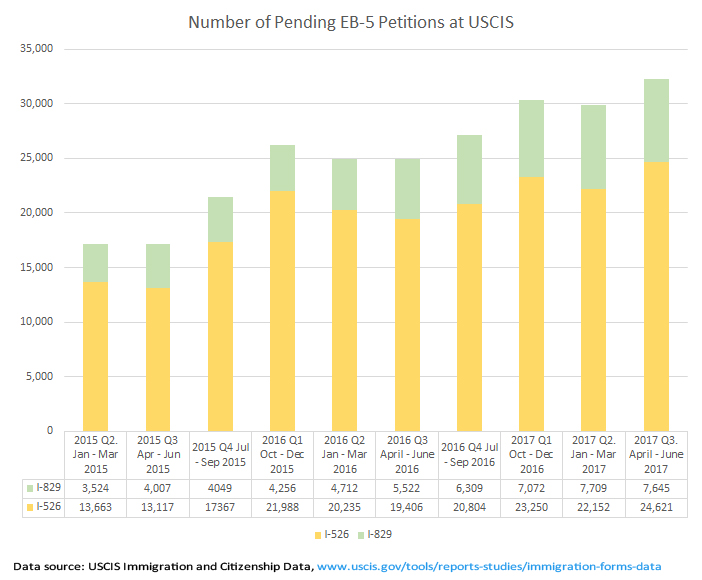
- Ms. Harrison points to posted processing times as the best estimate for when petitions filed in 2015 will be adjudicated. (26:22) She also noted that completion rate improvement in the past few months is not yet reflected in the Processing Times report.
- Direct EB-5 petitions have a separate queue from regional center petitions. The leader on the regional center side communicates about progress with his counterpart on the direct EB-5 side to help ensure that petitions filed at the same time are moved forward concurrently. (01:21:00)
- IPO lacks an automated system to match an I-924 exemplar request with previously-filed I-526 petitions for the same project. (When the matching happens, it’s by means such as office-wide emails asking “has anybody done a review of this project?”) Therefore, IPO requests that exemplar requests be filed with a cover letter that identifies receipt numbers for I-526 in the same project. In case an I-526 is approved before then I-924 is adjudicated, then the I-924 should also be approved, but ideally IPO wants to have the I-924 exemplar request and any concurrent I-526 adjudicated together by one person. This raises the question of whether the first approved I-526 couldn’t itself serve as exemplar approval, with no need for the I-924, but Ms. Harrison did not answer that question. It also makes us wonder how any Exemplar ever gets matched to associated I-526, even if they are filed subsequently. Ms. Harrison did indicate that IPO welcomes help in the matching process – a cover letter on the petition indexing it to related Exemplar, or even follow-up emails to the IPO customer service mailbox providing lists of associated applications/petitions for IPO’s reference. (9:23 – 10:58, 01:27:10 – 01:28:45)
- Currently, I-526 petitions are adjudicated more or less in first-come-first-served order by filing date, regardless of nationality. However, IPO is considering the suggestion to prioritize adjudicating petitions of countries that are not backlogged. IPO invites stakeholder feedback on this idea. (32:05 – 33:30, 01:19:37 – 01:22:04, 01:29:12)
- I-829 adjudications are making significant progress. Julia Harrison noted that the posted processing times don’t fully reflect the improvement yet, but she’s seeing much improved completion rates.
In the 11/10 presentation, IPO Senior Advisor for Economics Jan Lyons pointed out that IPO has finally cleared a huge hurdle – the surge of applications and petitions filed in advance of the December 2015 sunset date. That surge slowed down processing not only due to volume but to the poor quality of many petitions, apparently filed in a rush. I-526 and I-924 adjudications are proceeding more quickly and smoothly going forward. Mr. Lyons pointed out three factors that affect an individual’s processing time: place in the queue, the qualify of petitions before yours, and the quality of your petition.
Bridge Financing
This issue needs its own post, so I’ll just briefly mention the points at issue: whether bridge financing to be replaced by EB-5 must be “temporary” as in “a year or less” to qualify as a bridge and establish nexus, and whether EB-5 funds must pass through the job-creating enterprise account to repay the JCE’s bridge debt. IPO’s working answers are a tentative “yes” to the duration question and firm “yes” to the path question. Jan Lyons gave thoughtful discussion in the 11/7 call at time 01:01:28 – 01:10:11 and 01:40:01 – 01:42:11, and starting at time 12:55:24 of the 11/10 conference (I’ll let you listen for the details). And he welcomes feedback from the industry. That IPO hasn’t already received solid feedback demonstrates acute industry failure. In a healthy world, IIUSA would’ve shared bridge financing RFEs with membership months ago, and appropriate people would’ve gotten together to write and submit a constructive, well-footnoted article presenting reasonable guidelines for bridge financing in EB-5. As it is, I didn’t even hear about the RFEs ‘til very recently, and there hasn’t apparently been any industry collaboration except to whine about why the RFE creates problems (while putting the burden on IPO to solve a problem that our collective experience and industry sources are competent to address). For shame. (In case you weren’t informed either, see the RFE trends presentation at this link.)
Redeployment & Material Change
I lump these topics together because IPO’s answers to questions on both issues were the same: consult written policy. IPO did not clarify ambiguities in the redeployment policy, and did not fall into the trap of contradicting the clear material change policy. People who know better keep asking at meetings whether a petitioner can change projects or change regional centers before CPR — probably because they hope someday IPO might accidentally say the “yes” we’d like to hear. But investors beware: this is not a grey area. Policy and decisions are clear that material change before conditional permanent residence will derail a petition, and that project and regional center identity are material. Changing NCEs is not an option at any time. (I have a post detailing the material change policy and applications.) The grey area comes at the I-829 stage. IPO said they’re working on policy specific to the question of how to treat regional center changes for an I-829 petitioner. (For sure the petitioner is protected from any changes that occur after I-829 filing, but the situation before that is less clear.)
I-924A
Most answers to I-924A questions likewise boiled down to “read the instructions,” but you can re-listen to the 11/7 recording for any nuances. In the 11/10 meeting, Julia Harrison made the welcome comment that “two to three years” is not a hard and fast requirement for the time during which a regional center must sponsor a project or face termination. “We do look at the totality of the evidence you submit,” and will consider evidence that the regional center is “making progress toward a project” or at least “has something on the horizon” (2:44:00)
Policy & Regulations
Julia Harrison reports having no information to indicate that the April 2018 target date for finalizing the EB-5 regulations will not be met, though this does not depend on IPO. Her team is “always working” on the Policy Manual, but doesn’t have specifics on future updates. Lori McKenzie is no longer the Policy Division Chief, and Ms. Harrison did not mention a replacement.
Baruch College Conference
The EB-5 Conference with USCIS IPO, Hosted by the Steven L. Newman Real Estate Institute – Baruch College (November 10, 2017) had a number of solid presentations besides the IPO panel. Here is the list of speakers, and video of the panels.
Regional Center List Changes
Additions to the USCIS Regional Center List, 10/2/2017 to 11/08/2017:
- 1 America Regional Center (California)
- AHRC PA, LLC (Pennsylvania)
- ARE Regional Center (MA), LLC (Massachusetts)
- American Ace Development Regional Center, LLC (Connecticut, New Jersey, New York, Pennsylvania)
- American East Coast Regional Center, LLC (Connecticut, New Jersey, New York)
- American Fortune Regional Center, LLC (Texas)
- American Real Estate Growth Regional Center, LLC (California): www.aregrc.com
- City by City EB-5 Regional Center PR USA, LLC (Puerto Rico)
- Fairhaven Capital Advisors American Samoa Regional Center Corp. (American Samoa)
- Florida Opportunities Regional Center LLC (Florida)
- Genesis Regional Center, LLC (California)
- Golden Shores Regional Center (California)
- Gulf Coast SW Regional Center, LLC (Florida)
- Hawaiian Opportunities Regional Center, LLC (Hawaii)
- LA Yucaipa Regional Center, LLC (California)
- Liberty Investment Center LLC (Illinois, Wisconsin)
- MZH Capital Partners, Inc. (New Jersey, New York, Pennsylvania)
- Montana Real Estate EB-5 Regional Center, LLC (Montana)
- New Sun EB-5 Regional Center, LLC (California)
- Paradise City Funding Regional Center, LLC (Connecticut, New Jersey, New York)
- Pocono EB-5 Regional Center LLC (New Jersey, Pennsylvania)
- Related California Regional Center (California): www.relatedusa.com
- Related Chicago Metro Regional Center (Illinois, Indiana, Wisconsin): www.relatedusa.com
- Related Florida Regional Center (Florida): www.relatedusa.com
- SRC LA, LLC (California)
- South Carolina Global Regional Center (South Carolina)
- United Land RC LLC (Connecticut, New Jersey, New York, Pennsylvania)
- Vegas Regional Center, LLC (California, Nevada)
- Wealth Global Regional Center, LLC (Connecticut, New Jersey, New York)
- A List Partners Regional Center, LLC (Texas): www.alistpartners.com
- Inkstone States Regional Center LLC (Washington): www.inkstone-capital.com
- Noblemen Regional Center (Washington)
- Wasatch Front Regional Center, LLC (Utah)
This regional center was listed as terminated on 8/10/017, but restored to the approved list on 11/6/2017:
- Civitas Rio Grande Regional Center (Texas)
New Terminations:
- Charlotte Harbor Regional Center (Florida) Terminated 10/2/2017
- California Development Regional Center (California) Terminated 10/23/2017





 EB-5 Updates