2014 I-526/I-829 Processing Stats, SEC Enforcement, New RCs (AL, CA, FL, IL, IN, NY, OH, OR, TX)

Processing Statistics
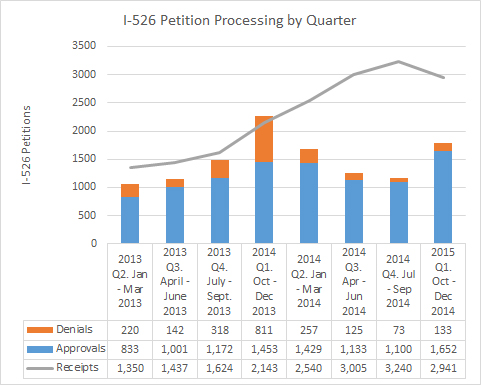
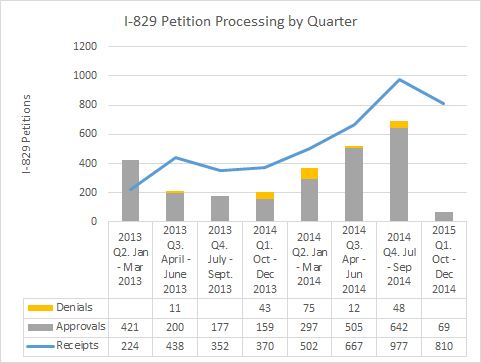
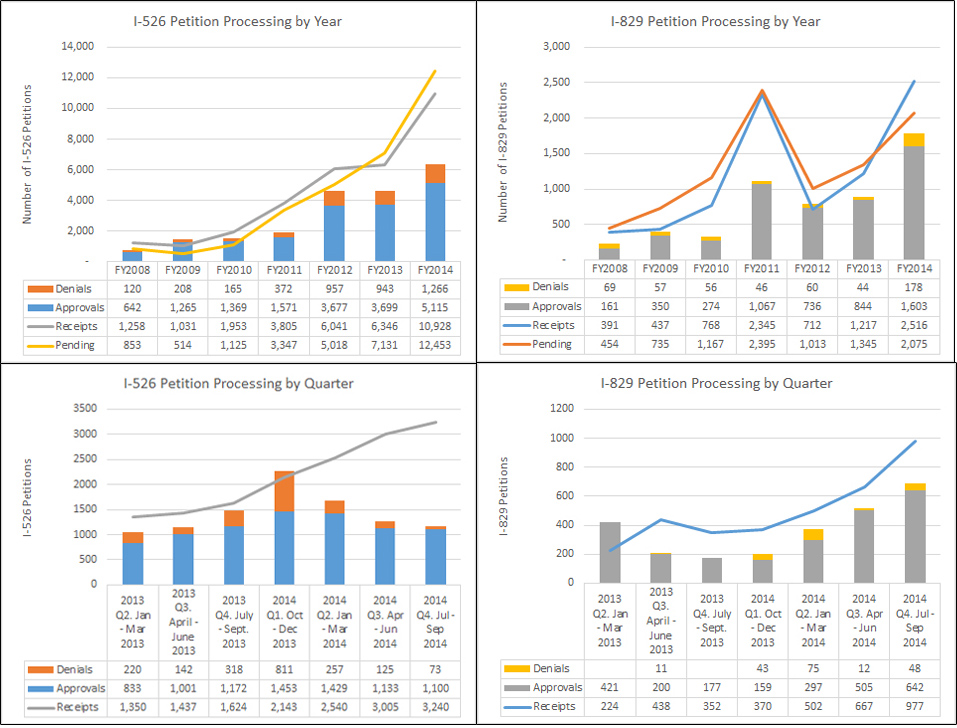
USCIS has updated its Immigration and Citizenship Data page with fourth quarter FY2014 processing statistics for Form I-526 and Form I-829.The numbers show dramatic increases in the number of petitions filed and the number processed. USCIS received twice as many I-829 petitions this year as last, and also processed twice as many. USCIS increased its I-526 processing volume as well, but not enough to keep up with receipts which exceeded 10,000 this year and pushed the volume of pending petitions over 12,000. That soaring line of I-526 receipts is sobering, considering that each represents an investor and only about 10,000 EB-5 visas are available annually for investors plus their spouses and dependents. (The State Department issued 9,228 EB-5 visas in FY2014, and China-born investors face a high probability of EB-5 quota retrogression in 2015.) On the bright side, 1,603 investors removed conditions this year, representing millions of dollars successfully invested and thousands of new jobs successfully verified. The image below shows summary charts from my Excel file of the data, based on files from the USCIS page linked above.
FY2014stats

SEC Compliance
Chad Ellsworth of Fragomen, Del Rey, Bernsen & Loewy, LLP has an interesting article Emphasis on Compliance and SEC Interagency Cooperation a Year after the Appointment of Chief Nicholas Colucci to the USCIS Immigrant Investor Program (EB-5). The article summarizes the SEC’s recent EB-5-related activities and describes the content of broad subpoenas issued by the SEC to a number of Regional Centers.

Additions to the USCIS Regional Center List,11/4/2014 to 11/24/2014

  • Cornerstone Regional Center, Inc. (Alabama and Florida): www.cornerstoneregionalcenter.com
  • Golden Opportunity Regional Center (California)
  • Southern California Health and Hospitality Regional Center, LLC (California): www.eb5mg.com
  • American Advancement Capital Co. (California)
  • Success Dragon, LLC (California)
  • Clearwater Beach Resort Regional Center, LLC (Florida): www.eb5clearwaterbeach.com
  • Miami Regional Center, LLC (Florida)
  • Orlando Regional Center, LLC (Florida)
  • Crossroads Investment Partners, LLC (Illinois, Indiana, Ohio)
  • NYC Regional Center, Inc (New York)
  • American International Venture Fund – Oregon, LLC (Oregon)
  • PetroSam, LLC (Texas): petrosam.net

FAQ page, Retrogression, I-829, Processing Times, New RCs (CT, IL, IN, LA, NJ, NY, TX)

FAQ
I have started a new Frequently Asked Questions page that compiles official and unofficial USCIS answers to questions that affect business plans. So far I’ve linked in answers from USCIS policy guidance and stakeholder meetings, and I’ll be adding references to AAO decisions that treat sticky business plan questions.

Retrogression
Speaking at the IIUSA conference on October 23, Charles Oppenheim predicted that the EB-5 visa category will likely retrogress in July 2015. This remains a moving target, however. Ron Klasko’s blog has published a timely article on Surviving and Thriving in Times of EB-5 Quota Backlogs.

I-829
You may thank us at the IIUSA editorial committee for another great edition of the Regional Center Business Journal (October 2014). Three feature articles provide advice and analysis for I-829 petitions: The Latest Analysis of What USCIS Looks For in EB-5 I-829 RFEs and Denials, It’s Never Too Soon to Begin Preparing for I-829 Petition Filings, and Removal of Conditions for EB-5 Investors: Practical Guidance in Preparing I-829 Petitions.

Processing Times
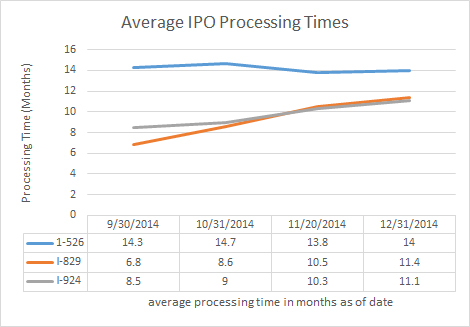
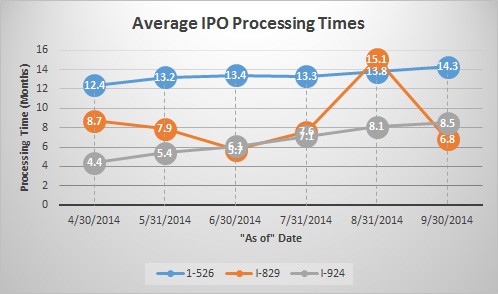
The USCIS website has a sharp new look as of last week, but no new EB-5 content except a IPO processing times update. I-829 times are back to normal, while average I-526 and I-924 processing times continue to inch up.
IPO 930

IIUSA Conference
Mark your calendars for IIUSA’s 2015 EB-5 Regional Economic Development Advocacy Conference on April 12-14, 2015 in Washington, DC.

Additions to the USCIS Regional Center List, 10/20/2014 to 11/04/2014

  • EB5 Fund, Inc. (Connecticut, New Jersey, and New York)
  • Great Lakes Regional Center, LLC (Illinois, Indiana, and Wisconsin): www.glrceb-5.com
  • Southern Opportunity Regional Center LLC (Louisiana and Texas)
  • Premier Regional Center, LLC (Texas): www.premierregionalcenter.com

12/5 EB-5 Stakeholder Meeting (in person)

From: U.S. Citizenship and Immigration Services
Sent: Monday, November 03, 2014 9:31 AM
Subject: USCIS Invitation: EB-5 Immigrant Investor Program Stakeholder Engagement, 12/05/2014

Dear Stakeholer,

U.S. Citizenship and Immigration Services (USCIS) invites you to participate in a stakeholder engagement session on Friday, Dec. 5, from 1 to 3:00 p.m. Eastern to discuss the Immigrant Investor Program. This engagement is part of our efforts to enhance dialogue with external stakeholders regarding the program, also known as EB-5.

During the first part of this engagement, we will provide EB-5 program updates from fiscal year 2014 and discuss initiatives for fiscal year 2015. The second part of the engagement will be a question-and-answer session. You may ask non-case specific questions or provide feedback on the EB-5 program.

You can attend this engagement either in-person or by teleconference. Please note that in-person attendance is limited to the first 80 people who register.

To register for this session, please follow the steps below:

  • Visit our registration page to confirm your participation
  •  Enter your email address and select “Submit”
  •  Select “Subscriber Preferences”
  •  Select the “Event Registration” tab
  •  Be sure to provide your full name and organization
  •  Indicate if you plan to attend in-person or by teleconference; and
  •  Complete the questions and select “Submit”

If attending in-person, please RSVP for this event no later than Friday, Nov. 14.

Once we process your registration, you will receive a confirmation email with additional details.

To submit questions before the teleconference, please:

If you have any questions regarding the registration process, or if you have not received a confirmation email within two business days after you register, please email us at Public.Engagement@uscis.dhs.gov.
Dec 5 EB5 Quarterly Stakeholder Engagement Invitation.pdf

IIUSA Conference, AILA Book, New RCs (CO, CA), Removed RCs (CO, FL)

To those in San Francisco this week for the 2014 IIUSA EB-5 Market Exchange, happy deal-making! I’m not able to make this conference, but send best wishes and look forward to sharing feedback from attendees.

To those stuck behind a desk this week, I recommend you to the virtual EB-5 masterclass that is AILA’s new Immigration Options for Investors & Entrepreneurs, 3rd Ed. I received a free copy as a contributing author (I wrote the chapter on EB-5 business plans), but can now testify that the book is worth the full price ($129 for AILA members, $199 for the rest of us). This is not a collection of quick opinions, general introductions, and veiled advertising but a set of serious articles that incorporate comprehensive research and extensive experience. If I were an immigration attorney working with EB-5, I’d buy the book for the sample documents and case materials alone, not to mention excellent articles such as Estelle McKee’s practical discussion of issues in demonstrating job creation in I-829 petitions and Carolyn Lee’s definitive analysis of the at-risk requirement. (And Suzanne Lazicki’s lucid treatment of the EB-5 business plan!)  If I were an investor or offering EB-5 investments, I probably wouldn’t buy the book for myself (it’s specialized and heavy) but I would make sure that the attorney representing me had a copy. The book works hard to make good on its promise “to provide everything you need to successfully represent clients in this highly specialized area.” Click here to preview the Table of Contents, and update your Christmas list as needed.

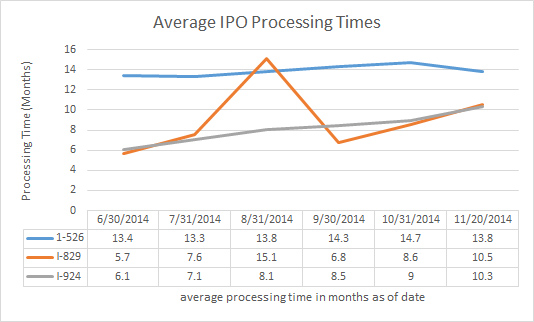
I expect to have important updates shortly, as USCIS is overdue to update Q4 2014 petition processing statistics, and the State Department may come out with the Report of the Visa Office 2014 any day. For now, we just know that average processing times are holding steady for I-526 (13.8 months) and I-924 (8.1 months), and have shot up for I-829 (to 15.1 months, likely in connection with the transfer from California to Washington DC).

Those interested in Targeted Employment Area issues should note the new approach to TEA designations adopted by California, which has tended to be a trendsetter.

Meanwhile, USCIS continues to add and subtract Regional Centers from its list (and continues to fail to update its FOIA reading room with designation letters for the Regional Centers approved since 2012).

Changes to the USCIS Regional Center List, 10/1/2014 to 10/20/2014

Added:

  • Dynasty Group Regional Center, LLC (California)
  • California Economic Development Fund, LLC (California)
  • California Capital Investment Regional Center, LLC (California)
  • InvestAmerica EB-5 (Colorado) www. investamericaeb5.com

Removed:

  • Invest U.S. Regional Center (Colorado)
  • Hollywood Beach Regional Center LLC (Michigan)

New RCs (CT, NJ, NY, PA), Removed RCs (CO, FL, GA, MI, OK, TX, WI), I-924A Reminder

I have been tracking changes to the USCIS Regional Center list since early 2010, and today for the first time I am reporting more deletions than additions. I expect that this may be a new trend, as Regional Centers voluntarily exit the program or have their designations terminated. We know that many of the 588 or so Regional Centers currently in existence do not have current offerings. Some have already completed the projects that the Regional Center was formed to fund, some are casualties of a processing black hole that delivered belated I-924 approval well after the applicants had already lost interest and opportunities, some are on ice because the operators found foreign fundraising unexpectedly onerous, some are placeholders created by serial Regional Center filers with no projects but positioning to be attractive operators, and some are in trouble. Of Regional Centers with little apparent activity, some may choose to disband, some may demonstrate that they are in fact still promoting or about to promote economic growth, and some may be challenged by USCIS for failure to fulfill their mandate.

The federal fiscal year ended September 30, which means that it’s time for all Regional Centers to assess their current standing and, if they wish to continue, to justify their existence to USCIS. Recall that “Regional center means any economic unit, public or private, which is involved with the promotion of economic growth, including increased export sales, improved regional productivity, job creation, and increased domestic capital investment.” 8 C.F.R. § 204.6(e) Regional Centers that are still interested in maintaining their designation have until December 29 to show USCIS that they are still involved in the promotion of economic growth by filling out the I-924A form and, if needed, attaching a letter with additional explanation regarding their activities. The easiest ways to receive a Notice of Intent to Terminate are to simply not file I-924A at all and/or to be the subject of high-profile legal action. But that’s not the only conceivable way to lose designation. Robert Loughran’s analysis of termination letters, which I’ve linked here before, itemizes factors that have been used to justify Regional Center terminations. IPO Chief Nicolas Colucci reminded us in the 9/10 stakeholder meeting that USCIS is taking the I-924A responses seriously, so all Regional Centers should be sure to fill out the I-924A form, consulting both the I-924A form instructions and the Questions and Answers on I-924A, and keeping in mind the Regional Center mandate.

Additions to the USCIS Regional Center List, 9/16/2014 to 10/01/2014

  • Lightstone New York Regional Center, LLC (Connecticut, New York, New Jersey, Pennsylvania): lightstoneeb5.com
  • Adirondack Regional Center of New York, LLC (New York)

Subtractions:

  • Ecorntech Regional Center (Wisconsin)
  • Michigan Renaissance Regional Center (Michigan)
  • Gateway Georgia Regional Center (Georgia)
  • South Florida EB-5 Regional Center, LLC (Florida)
  • InvestAmerica EB-5, LLC (Colorado)
  • Kansas Bio-Fuel RC, LLC (Kansas)
  • South West Biofuel RC, LLC (SWBRC) (Texas, Oklahoma)

There’s another glossy report out on the EB-5 program, this one a positive and well-researched one from the American Immigration Counsel’s Immigration Policy Center. If you want to give someone a solid and accurate introduction to EB-5’s bright side, I recommend The US Immigrant Investor Program: New American Investors Making a Difference in The Economy. (And if you prefer train wrecks, sign up for Google news updates to get the unfolding drama of accusations and confusion around the breakdown of EB-5 partnerships in South Dakota.)

New RCs (AZ, CA, CT, GA, MN, NJ, NV, NY, OH, PA, PR, TX, WA, WI)

WordPress tells me that not many people clicked on my link from last post to USCIS’s published Q&A from the 2/26/2014 EB-5 Stakeholder Meeting. So here’s another chance. This is really a good Q&A, with substantive responses on hot button issues including Regional Center sales, redemption agreements, deference, asset purchase, Census Tract aggregation, evidence at I-829 of model direct jobs, for-profit activities, guest expenditure jobs, bridge financing, hypothetical plan content, and geographic range of a Regional Center. I learned more from this written Q&A than I learned from listening to the meeting itself. I’m also bookmarking the page for the 9/10/2014 EB-5 Stakeholder Meeting, which will eventually also be updated with USCIS’s meeting notes.  In the meantime, Robert Divine and Melanie Walker have the best summary so far of key issues from the 9/10 meeting.

And USCIS has updated its Regional Center list.

Additions to the USCIS Regional Center List, 9/5/2014 to 9/16/2014

  • DRC Capital Partners, LLC (Arizona)
  • E & W Lake Tahoe Regional Center LLC (California)
  • New York Connecticut Regional Center, LLC (Connecticut, New York)
  • Encore Georgia Regional Center, LLC (Georgia): encoreeb5.com
  • Headwaters Regional Center, LLC (Minnesota, Wisconsin)
  • Pacific Casino & Entertainment Group Regional Center (Nevada)
  • AscendAmerica, LLC (Connecticut, New Jersey, New York, Pennsylvania): www.ascendamerica.com
  • MidAmerican Global Ventures, LLC (Ohio): www.midamericanglobal.com (The list currently shows Mag Ventures 1, LLC, Mag Ventures 2, LLC, Mag Ventures 3, LLC, but I assume this is a mistake that will be corrected.)
  • Caribbean Regional Center (Puerto Rico) http://caribbeanregionalcenter.com/
  • Abasto Regional Center (Texas): www.mcallenwarehouse.com
  • South Texas EB-5 Regional Center (Texas): www.stxeb5.com
  • USLiving Regional Center (Texas)
  • Pacific Viniculture (Washington)

9/10 EB-5 Stakeholder Meeting

In case you missed yesterday’s EB-5 Stakeholder Meeting with USCIS, here is a link to my recording. IPO Chief Nicolas Colucci provided program updates while new hires handled a question and answer session.

From the program updates we learned that the IPO (Investor Program Office in Washington DC) is still in hiring and training mode, with 83 staff as of now and an on-going goal to reach 110 by December 31. Most new hires have been adjudicators. IPO has been handling all I-526 and I-924, and I-829 will start transitioning from the CSC to IPO as of the end of this month. The IPO is also about to move to a new facility in DC, so be aware of current addresses. Revisions to the EB-5 regulations are still in progress, with IPO about to solicit more input from an interagency symposium with federal partners. IPO has selected the Department of Commerce to create a study on the economic impact of EB-5, due out next summer. Once again, we are promised an annual report in December with program related info, statistics, and a macro view of Regional Center activity.

Most significantly, we learned that USCIS has sent Notices of Intent To Terminate to 53 Regional Centers this year! Of these, 29 were sent to Regional Centers that failed to file I-924a in 2013, and 24 were issued recently for other reasons. A Regional Center receiving such a notice has opportunity to respond and try to address any defaults, so we aren’t necessarily about to see a flood of terminations. But it’s good to know that USCIS is serious about monitoring the on-going performance of Regional Centers, and challenging those that are “no longer serving the purpose of promoting economic growth.” With this in mind, Regional Centers should take care about filing the I-924a for 2014. Be sure to file it on time (before 12/29 this year) and to fill out the form completely. Mr. Colucci noted that RCs may attach a letter to the form to provide additional facts. (And you should definitely take that opportunity, if your RC’s activities in 2014 didn’t translate into numbers that look good on the form.)

From the Q&A period we learned that new permanent deputy chief Julia Harrison is very sharp, with the will and ability to provide informed, substantive, and helpful responses (as possible under the circumstances), while new division chiefs Lori Melton and John Lyons were and sounded sensible, respectively. It was confirmed that RC adjudications for a single project are still generally being grouped, which can be an exception to the general FIFO policy on I-526 processing. I expect that the most talked-over moments in this call will be Julia’s statement on potential impacts of China retrogression and the conditional acceptability of holdback escrows (starting about minute 15) and Martin Lawler’s question about guarantees between the NCE and JCE (1 hr and 14 minutes into the call). The Q&A includes a few other points of procedural interest to immigration lawyers, who composed the bulk of the callers, and you may review my recording for details, or go to other blogs for summaries (e.g. Robert Divine on the IIUSA Blog, EB5 Insights, Mona Shah Law). Generally, the message I got is that USCIS is looking to the 5/30 Policy Memo to provide guidance about what does and doesn’t work for EB-5, so the community may as well do the same.

UPDATE: USCIS has also posted an Executive Summary and Questions and Answers from the last regular EB-5 Stakeholder meeting on 2/26/2014.
Cautionary Tale (KS), Processing Times Update

I assume that immigration lawyers don’t have many would-be immigrants calling up to say “I want to get a CR1 visa. Please help me find a wife.” People understand that marriage and immigration are separate issues. Of course the lawyer who handles your paperwork doesn’t also help you fall in love. The CR1 relative visa grants you benefits based on a relationship that you have entered into, but the marriage decision is obviously separate from and prior to the immigration process.

When all this is clear for an immigrant spouse, why do immigrant investors get confused? Immigration lawyers do often hear the request “I want to get an EB-5 visa. Please help me find an investment.” Apparently many people do not understand that, in the US, the investment decision and the immigration decision are separate. The lawyer who handles your immigration paperwork is not placed or qualified to select a good investment for you. Neither is USCIS. The EB-5 visa grants you benefits based on an investment decision that you have made, and that decision involves factors that are separate from immigration considerations. Potential immigrant investors, take note! Investing half a million or a million dollars is a serious matter in itself, just as getting married is a serious matter in itself. These are not fundamentally immigration matters, even when they provide a basis for a visa later. Get advice from people who know about investing or who know about marriage. Go on lots of dates, talk about everything, meet the family, see a marriage counselor. Research the investment opportunity and the principals and get qualified investment advice. If you skip all that and just focus on immigration, you’re missing the point and are very vulnerable to getting hurt by your marriage or by your investment decision.

The news this week reminds us of what can happen. See the SEC’s notice “SEC Charges L.A.-Based Immigration Attorneys With Defrauding Investors Seeking U.S. Residency” and a more detailed article in the local news “Three charged by SEC in western Kan. ethanol scheme.” It’s hard to tell whether this started out a fraud or just as incompetence/bad luck that spiraled into fraud, but either way I don’t think this could have happened if the victims involved had recognized that EB-5 investment decisions require serious attention and diligence, and that one should not depend on immigration consultants to advise on much less to manage investments.  At the same time, the perpetrators might not have dared so much had they taken the investment angle of EB-5 seriously. Maybe the perpetrators thought that EB-5 is just an immigration program and they were free to do what they wanted so long as not caught by USCIS review. Now the heavy hand of the Securities and Exchange Commission is on them, reminding them that EB-5 investments are  investments and regulated and policed as such, regardless of the immigration angle. 

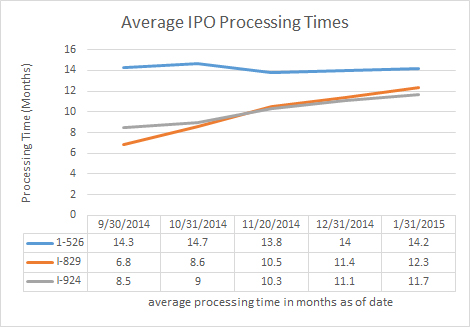
In other news, IPO processing times have been updated on the USCIS Processing Time Information page, with little change since last update.

IPO731

China visa availability

IIUSA VP Robert C. Divine on Saturday’s Announcement of EB-5 Visa Unavailability for China for Remainder of FY-2014

by Robert C. Divine, Vice President, IIUSA; Shareholder, Immigration Group Chairman Baker Donelson Bearman Caldwell & Berkowitz, P.C.

Saturday’s dramatic announcement of EB-5 visa unavailability for China for the remainder the fiscal year provides a low impact “dry run” for a process that will have more “bite” next fiscal year. (For the record, Saturday was August 23, 2014).First, let’s remember what Saturday’s announcement does NOT do: It does not affect any I-526 or I-829 processing at all, does not delay immigrant processing for people not born in mainland China, and does not even affect mainland Chinese after next month. But let’s think about what it portends.

– Read the rest of this article at: http://iiusa.org/blog/#sthash.OZjUfbxV.dpuf

New Resources (Petition Processing and RC Approvals, SEC matters, Stakeholder Meetings), New RCs (CA, NY, NY, PA, TX)

A wrap-up of recent items of items of EB-5 interest around the web.

Petition Processing and RC Approvals

SEC Matters

Stakeholder Meetings

  • Be sure to sign up for the 9/10 EB-5 Stakeholder Meeting announced this week.
  • USCIS Director León Rodríguez had a few words on the EB-5 program in his engagement on August 14. IIUSA reports on takeaways from that meeting.

Additions to the USCIS Regional Center List, 7/29/2014 to 8/19/2014

  • Art District Los Angeles Regional Center, LLC (California)
  • North American Regional Center (New Jersey, New York, Pennsylvania)
  • American Vision Regional Center (Texas)

And finally, a mystery. The Regional Center page on the USCIS website is gone. A web admin accident? Or something more? I’ll keep checking back to see what happens.

Processing Times and Volumes 2014 Q3

And now for images summarizing recent information on EB-5 petition processing times (from the USCIS Processing Time Information page, updated 8/7 for IPO), I-526 and I-829 petition volume (from the USCIS Immigration and Citizenship Data page, updated 8/19), and I-924 processing volume (my unofficial tally). The numbers show that EB-5 petition receipts still exceed the number of petitions processed every quarter, with that gap increasing for I-526 and holding steady for I-829. Denial rates were unusually low last quarter. Overall processing volume improved significantly for I-829 and fell again for I-526. Perhaps fortunately, since the 7,688 I-526 petitions received already in FY2014 would put us well over the annual EB-5 visa allocation if adjudicated in a timely manner.  Average processing times have not shown dramatic change over the past few months (except for when USCIS took I-924a out of the I-924 average between March and April). Meanwhile, the roster of approved Regional Centers continues to expand rapidly.
I526Q3 I829Q3
TimesQ3 RCapprovalsQ3
Click on any image to view the full size version.
And note my other new posts from today on business plans and the newly-announced 9/10 stakeholder meeting.

I-526 Business Plan Evidence (7/29 AAO Decision)

Last month, the Administrative Appeals Office upheld denial of Regional Center-affiliated I-526 petitions based on EB-5 investment “to fund the development, production, sale, and eventual manufacture of alcoholic gelatin shots” (JUL292014_01B7203 and JUL292014_02B7203). I read that far and guessed that problems would be focused on the business plan, and sure enough. The investors also had some source of funds issues, and the cake was iced by the fact that the escrow agreement stipulated return of capital upon I-526 denial, which effectively terminated the investment before the petitioner had a chance to appeal the denial. But USCIS/the AAO focus on the business plan. To quote:

First, in the RFE, the director indicated that the petitioner did not source and itemize all pro forma financial data. … On appeal, the petitioner claims that she complied with the submission of a comprehensive business plan set forth in Matter of Ho and cites to sections of the business plan. The petitioner must submit a comprehensive business plan. 8 C.F.R. § 204.6U)(4)(i)(B).To be “comprehensive,” a business plan must be sufficiently detailed to permit the Service to draw reasonable inferences about the job-creation potential. Matter of Ho, 22 I&N Dec. at 213. Mere conclusory assertions do not enable USCIS to determine whether the job-creation projections are any more reliable than hopeful speculation. Id. The business plan does not reflect the source of the pro form financial data, and the petitioner did not submit detailed and itemized pro forma financial data that would meet the elements of a “comprehensive” business plan. Although the chiefs decision indicated that the petitioner did not submit detailed and itemized pro forma financial data, the petitioner does not submit the information on appeal.

Second, in the RFE, the director indicated that the petitioner did not demonstrate that the sales projections and the production and marketing costs were reasonable when compared to industry standards, and the input parameter was not reliable because the sales forecasts and pro forma financial statements do not demonstrate whether the sales projections are reasonable to the current market environment or when compared to industry standards. In response, the petitioner indicates that the sales projections and production and marketing costs were prepared by _______ and that ______ President, based the projections on actual industry experience. The chief determined that the petitioner did not submit any financial documents to support Mr. ____ claims, and the petitioner did not provide any evidence demonstrating a contractual agreement of to distribute the alcoholic gelatin shots.

I have no personal knowledge of this case, but it’s interesting to me as a business plan writer. Could I have helped prepare a plan that USCIS would have approved? Or is USCIS demanding evidence that excludes this type of proposal? Imagining that our alcoholic gelatin shot developer, Mr. X, had called me first for the business plan, I went out to look for sources of evidence to validate his sales forecasts and financial projections.

If Mr. X had a real estate-based proposal he could commission an appraisal report, and if he were in a well-organized industry such as hospitality he’d have good options for a third party market/feasibility study to corroborate his projections. USCIS sees a lot of real estate-related and hotel deals, and is accustomed to seeing such studies attached to the business plan. A reliable-looking third party study is the easiest way to assure USCIS’s comfort level with market and financial projections. Assuming that there is no name-brand source for a market study relevant to developing alcoholic gelatin products, I consider whether it’s possible for me to help make the business plan’s internal analysis strong enough to stand on its own. Does Mr. X’s business resemble other businesses for which financial information is available for comparison? Who collects industry data relevant to this business? When a business falls squarely within a NAICS code that groups similar businesses, then I can help support business plan projections with reference to published data for that NAICS category (for example from the Economic Census and Risk Management Association Annual Statement Studies). When a publicly traded company handles a similar product, I can reference data from annual reports and investor presentations. When a business is in an industry that’s covered by an active trade association or that’s of interest to economic development agencies, there we have more promising data sources. In Mr. X’s case, “development, production, sale, and eventual manufacture of alcoholic gelatin shots” involves activities that span several NAICS codes, and the NAICS categories lump businesses that may be operationally quite different from the subject, so NAICS category data may not be very helpful. The Internet leads me to product and pricing information for several competitors, which would help support sales estimates, and yields some data on industry trends and growth (and locates a Kickstarter for another alcoholic gelatin shot producer, in case you regretted missing your chance to invest). However I didn’t find sources to support a strong estimate of market size or potential penetration. Presumably Mr. X has tested and measured the market through his contacts, but USCIS will want more than his word to back up his conclusions.

I’d have had to call Mr. X back and say “I’m sorry, I don’t think I have the sources to handle this plan for EB-5. You could still consider EB-5 if you’re far enough along to have evidence for actual sales and financial performance (e.g. sales contracts, historical financials). But this may not work if you’re still at the estimate and projection stage, because I don’t know where we’re going to find evidence that will support your estimates and projections to USCIS’s satisfaction. I’m not saying that your product and proposal aren’t great – I just wonder whether EB-5 will work for you, since you’re not on a well-beaten path. But thank you anyway for calling me, and please think of EB-5 again if you have a restaurant or assisted living facility or other vanilla proposal that’s easier to sell to a nervous industry outsider like USCIS.” And indeed, I have phone calls like this several times a month. How many bright entrepreneurs and innovative products have I discouraged from EB-5! Yes, I’m pessimistic, but then funding is a matching game. EB-5 naturally won’t match every promising business, just like VC funds or bank loans or tax credits won’t match every proposal, and I wish I could’ve spared Mr. X an uphill battle.

The questions that USCIS asked Mr. X were reasonable, even if unfairly difficult to answer for this proposal. But I do have a complaint: that USCIS excludes experience as evidence. Here USCIS might learn from the Small Business Administration. SBA examiners have told me that their analysis of viability considers “is this proposal reasonable when compared to industry standards?” and also “how reliable are the people behind this proposal?” The SBA will assess the track record, credit, and relevant experience of the principals as critical factors in the credibility of a business plan. USCIS does not have a tradition of doing that. Our AAO decision doesn’t treat Mr. X’s experience and qualifications as relevant, and only asks for third party evidence to bolster his projections. Has Mr. X ever successfully launched a food/beverage product? Has he managed a business? What experience does he have in the industry? What’s his track record in financial matters? These are obviously relevant questions. I daresay USCIS would weed out more wishful-thinkers and frauds by focusing on verifiable answers to such questions than by simply fixating on third party references to support projection numbers. Recognizing experience as one pillar of business plan credibility would also potentially put more openness to innovation in the EB-5 program. Otherwise, EB-5 will be effectively limited to proposals that can show their reasonableness by demonstrating that they’re as similar as possible to what everyone else is doing.

9/10 EB-5 Stakeholder Meeting

U.S. Citizenship and Immigration Services (USCIS) invites you to participate in a stakeholder teleconference on Wednesday, Sept. 10, from 2:30–4 p.m. (Eastern) to discuss the EB-5 Immigrant Investor Program. During this teleconference, USCIS officials will share EB-5 Immigrant Investor Program updates and respond to your questions. Visit the USCIS Public Engagement registration page to confirm your participation.

New RCs (CA, CT, DC, GA, IL, IN, MA, MD, NC, NH, NJ, NV, NY, PA, RI, VA, WA)

I’ve been busy recently and haven’t had news to break, but will emerge from the pile of paper on my desk to post my usual update of newly approved Regional Centers (which continue to redefine what qualifies as “focus on a geographic region”). For detail on what else has been said and done in EB-5 world over the past few weeks, I recommend you to http://iiusa.org/blog/. Also note that the June 2014 Regional Center Business Journal (online at http://issuu.com/iiusa) has some excellent content, including an article unraveling the intricacies of New Market Tax Credits and their potential in combination with EB-5, an article on Targeted Employment Area data changes, an article on how to approach escrow and fund administration if a broker-dealer will be involved in the offering, and an article that summarizes analysis by yours truly of 2013 Regional Center approval letters.  EB-5 Investors Magazine (http://magazine.eb5investors.com/) Spring 2014 edition is also very interesting. I question the information and conclusions in a few of the articles, but overall the publication is thought-provoking and substantial, with Meyer & Peng’s article on Due Diligence and Dual Representation in EB-5 Cases being particularly worth a read. Also, I can’t help smiling every time I look at the cover. Both these publications are rather tough to read online, but are available in print.

Additions to the USCIS Regional Center List, 7/8/2014 to 7/29/2014

  • Cal Pacific RC LLC (California)
  • SPG Regional Center, LLC (California)
  • EB5 Regional Center of America LLC (Connecticut, New Jersey, New York): www. EB5RCA.com
  • Northeast Regional Center, Inc. (Connecticut, Delaware, District of Columbia, Maryland, Massachusetts, New Hampshire, New Jersey, New York, Pennsylvania, Rhode Island, Virginia): www. pathwayseb5.com
  • EB5 Affiliate Network State of Georgia Regional Center, LLC (Georgia): www.eb5affiliatenetwork.com
  • Tur Partners Metropolitan Regional Center, LLC (Illinois, Indiana, Wisconsin): turpartners.com
  • Nevada Investment Regional Center, LLC (Nevada)
  • L&L New York Regional Center, LLC (New Jersey, New York)
  • New York Green Hotel Regional Center LLC (Connecticut, New Jersey, New York)
  • Carolina Growth Regional Center, LLC (North Carolina) http://www.carolina-eb5-regionalcenter.com/
  • Pacific Northwest Investment RC, LLC (Washington State)
  • Seattle Area Regional Center, LLC (Washington State): seattlearearegionalcenter.com
  • Name change from Utah High Country Regional Center to Golden Lamp Regional Center, Inc. (Utah): www.goldenlampregionalcenter.com

RIMS II Update, 5/31 Processing Times, New RCs (AZ, CA, FL, NV, TX)

News from the Bureau of Economic Analysis regarding RIMS II:

BEA to Release Modified Regional Input-Output Model in 2015
The Bureau of Economic Analysis plans to release in 2015 a modified economic model to replace the original Regional Input-Output Modeling System (RIMS II). Cost savings will be realized because the modified model will be updated less frequently.
Much like RIMS II, the modified model will produce regional “multipliers” that can be used in economic impact studies to estimate the total economic impact of a project on a region.
However, the modified model will be updated with new input-output (I-O) data only for benchmark years. That is — years ending in 2 and 7. The modified model will become available to customers in 2015 and incorporate 2007 benchmark I-O data and 2012 regional economic data.
Last year, as a result of budget sequestration and reduced funding levels, BEA discontinued updates to RIMS II. Orders for RIMS II multipliers, however, have continued to be accepted because the cost of fulfilling these orders is covered by a nominal processing fee.
After investigating ways to continue to meet the analytical needs of our customers but do so at a lower cost to BEA, the bureau decided to make a modified economic model available. Until the modified model is available in 2015, customers may continue to buy RIMS II multipliers.

USCIS has updated Processing Time Information for the Immigrant Investor Program Office. Average processing times for EB-5 petitions as of 5/312014 were 13.2 months for I-526, 7.9 months for I-829, and 5.4 months for I-924 (the previous report showed 12.4, 8.7, and 4.4 months respectively). The USCIS Regional Center page explains that the estimated time for I-924 processing went way down last month because USCIS stopped including I-924A in the average (and due to increased efficiency).

Additions to the USCIS Regional Center List, 6/24/2014 to 7/8/2014

  • RCI Arizona Regional Center, LLC (Arizona)
  • Encore California RC, LLC (California): encoreeb5.com
  • Front Burner Restaurants Regional Center – Southern California (California)
  • SoCal Regional Center, LLC (California)
  • EB5 Affiliate Network State of Florida Regional Center, LLC (Florida): www.eb5affiliatenetwork.com
  • EB5 Affiliate Network State of Nevada Regional Center, LLC (Nevada): www.eb5affiliatenetwork.com
  • Renewable Texas Energy Regional Center (Texas): texaseb5rc.com

New RCs, New AAO decisions, I-924 checklist, RC project list

A few recent items of note in EB-5-world.

  • USCIS has added a document enticingly titled “EB-5 Adjudication Manual” to the EB-5 section of the Electronic Reading Room for documents released in response to FOIA requests. I assume that the document was supposed to include all the materials used in an April 2014 two-week training course for new Investor Program Office Staff, but unfortunately it only gives us only the outline of that course (PDF page 123-126) and a lot of materials for Day 3 (a fairly uninteresting general introduction day). One bit of pay dirt in this file is a checklist for items to look for in an I-924 filing (PDF page 102). IIUSA, which made the FOIA request, is going back to request the full set of IPO training materials, which should be very useful.
  • I regularly get emails from people who found my Regional Center list and ask me about getting a list of Regional Center projects. My standard response is that such a list does not exist and probably couldn’t exist because it would be so hard to create and administer and so unlikely to be comprehensive enough or disinterested enough to be useful. But the proliferation of Regional Centers, many of which have no activity, intensifies the demand for someone to sort down to a short list of active investment opportunities, and I note that USAdvisors is attempting to meet that demand with the launch of its website  https://eb5projects.com. So far the site reports listing 306 projects, including from 101 Regional Centers and some direct EB-5 offerings.
  • USCIS continues to upload 2014 AAO decisions on EB-5 petitions. In my opinion the most significant are still the May 27th cases 01 and 02, which set a high bar for the level of “meaningful business activity” and “meaningful concrete action” that must have been undertaken prior to I-526 filing in order for funds to be considered at risk. Grounds for upholding denial in this case include the fact that the initial I-526 didn’t include documentary evidence of commitments for 100% of the funds (in addition to the petitioner’s) needed to fill out the capital stack (evidence submitted in response to RFE was not accepted as supporting eligibility at the time of filing), and the fact that the petition showed that the NCE had entered into service contracts but not that performance under those contracts had already occurred. USCIS seems to be taking an unreasonably hard line. Long processing times and use of escrow can mean that an investor files I-526 at least year before the NCE can expect to use the EB-5 funds. If the investment actually — as the EB-5 program intends — has a substantial role in launching the NCE’s new job-creating activities, then I-526s will naturally be filed at an early stage in business development before all details are confirmed, and the NCE will inevitably have limited activities prior to I-526 filing.

Additions to the USCIS Regional Center List, 6/10/2014 to 6/24/2014


More AAO decisions and New RCs (CA, CO, DC, DE, GA, IL, IN, MD, MN, NJ, PA, PR, TX, WI)

AAO Decisions

USCIS continues to upload 2014 AAO decisions on EB-5 petitions (with the May 27th decisions being newly added as of today). Joseph Whalen has summarized highlights.

Additions to the USCIS Regional Center List, 6/3/2014 to 6/9/2014

4/30 IPO Processing Times, New RCs (AL, AR, CA, DE, FL, GA, IL, LA, MD, MI, NJ, NV, NY, OR, PA, TN, TX, USVI, WA)

Today USCIS updated processing times for the Investor Program Office (IPO) as of 4/30/2014. Compared to the average times posted last month, I-526 times are one month better (now at 12.4 months), I-829 are about the same (now at 8.7 months), and I-924s went from 10.6 months to 4.4 months on average!

As I-924 processing speeds up, new entries continue to flood onto the USCIS list of approved Regional Centers.  But who is everyone? I now have all Year 2013 Regional Center approval letters thanks to an IIUSA FOIA request (watch for my analysis of them coming soon in IIUSA’s Regional Center Business Journal) and I can hardly wait for USCIS to get around to publicly posting that FOIA file so that I can include all the letters in my Regional Center directory.  In the meantime, please email me if you’d like to provide corrected contact information or a copy of your approval letter.  My Regional Center list page gets about 400 hits a week from countries around the world, so giving me info means some free advertising for you plus supporting my mission of increasing transparency in EB-5.

Additions to the USCIS Regional Center List 5/28/2014 to 6/2/2014

FY2014 Q2 EB-5 Petition Data, Material Change AAO Decisions, New RCs (AR, CA, CT, DC, FL, ID, IL, IN, MD, MI, NJ, NV, NY, PA, TN, TX, VA, WV, UT, WI)

The USCIS Immigration and Citizenship Data page has been updated again with data for I-526 and I-829 Petitions processed in the second quarter of Fiscal Year 2014 (January to March). Once again, here are my little charts illustrating how the numbers compare with previous quarters.
1526q2 I829q2
I-526 processing volumes show modest increase overall, but below last quarter’s spike and still nowhere near Mr. Colucci’s goal of having the number of processed petitions at least exceed the number of petitions received each week. I-829s, on the other hand, flew off the shelf in Q2 – maybe because they’re all the California EB-5 team has to work on as of February? We’ll see how the processing story continues to unfold in coming quarters.

USCIS continues to post 2014 Administrative Appeals Office decisions on EB-5 cases. APR232014_01B7203 and MAY122014_01B7203 are interesting as case studies of the much-misunderstood material change issue. People tend to panic that “material change” means that one can’t at any time deviate from any point of a business plan submitted to USCIS. The May 30, 2013 EB-5 Policy Memo and Matter of Izummi don’t say that, however. USCIS policy focuses on the period prior to I-526 approval and the problem of petitioners who, having filed an I-526 Petition that doesn’t demonstrate eligibility for EB-5 visa benefits, respond to Requests for Evidence with a new set of facts, materially changing the proposal under which the original petition attempted to qualify. The USCIS position is that the petitioner must demonstrate eligibility for the visa petition at the time filing, the petitioner cannot secure a priority date based on future events, and USCIS cannot consider facts that only came into being subsequent to the filing of the petition. For example, the petitioner in APR232014_01B7203 invested through a loan model with indirect job creation, which a non-Regional Center investor may not do, and then, in response to an RFE, tried to change track and present USCIS with a new and different business structure and investment terms. The AAO agreed that: “Purchase and termination of ___ in response to the director’s request for evidence in order to meet the direct job creation requirements reflects a material deviation from the business structure claimed at the initial filing of the petition. The business structure change constitutes an effort to make an apparently deficient petition conform to users and regulatory requirements. Therefore, users must analyze the petition only on the basis of the original claims.” In the MAY122014_01B7203 case, the petitioner’s problem was that “at the time of filing, he had invested only $105,000 and had not, at that time, properly committed the balance of the required investment with a secured note or agreement.” The moral of the material change story is to get your ducks in a row before filing an I-526 Petition. Don’t just throw something together and file it, assuming that the worst case scenario is that USCIS will send Requests for Evidence giving you a chance to go back and forth supplying new information and fixing problems until the petition is finally approvable. The worst case scenario is that the content of that original I-526 would need such material changes to become approvable that USCIS will say (to paraphrase): Forget it. This filing was crap, and if you have new facts and a new story now then you can go back to square one and file a new petition for us to consider. (For the official statement, see pages 24 to 27 of the EB-5 Adjudications Policy memo.)

The USCIS Regional Center list continues to expand by leaps and bounds, reflecting hard work by the USCIS Investor Program Office and adding to a crowded field. We’re continuing to see many multi-state RCs and many RCs associated with operators who control multiple RCs.

Additions to the USCIS Regional Center List 5/6/2014 to 5/27/2014

5/8 Colucci Remarks

USCIS has published the Prepared Remarks of Nicholas Colucci, Chief, Immigrant Investor Program at the IIUSA EB-5 Regional Economic Development Advocacy Conference on May 8, 2014 in Washington, DC. Thank you, USCIS! We really appreciate this transparency. Now everyone can review exactly what Mr. Colucci said regarding economic impact analysis.