Processing Report, Terminations, Regulations, RC List Changes
June 8, 2018 Leave a comment
Processing Time Report Update
The processing times reports for EB-5 forms were updated on May 31, 2018 with new Estimated Time Ranges and new variables for calculating the Case Inquiry Date. Until this update, the reports had been constant since March 23, 2018.
Form I-526 Processing Time:
* Estimated Time Range changed to 20-25.5 months (previous report: 25-32.5 months)
* Case Inquiry Date changed to today’s date minus 761 days (previous report used -971 days)
Form I-829 Processing Time:
* Estimated Time Range changed to 29-37.5 months (previous report: 23-30 months)
* Case Inquiry Date changed to today’s date minus 1,121 days (previous report used -893 days)
Form I-924 Processing Time:
* Estimated Time Range changed to 19.5-25 months (previous report: 17-22.5 months)
* Case Inquiry Date changed to today’s date minus 746 days (previous report used -663 days)
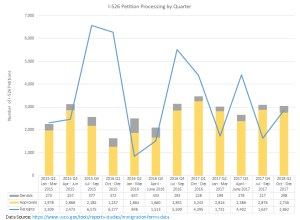
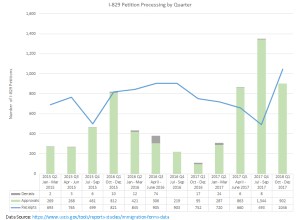
My theory, supported by an informed-sounding blog commenter, is that USCIS recalculated the time ranges based on a dramatic drop in I-526 receipts and dramatic rise in I-829 receipts over the past few months. (The Immigration Data page has not yet been updated with FY2018 Q2 or Q3 data, so I’m not sure.) Alternatively, IPO might have decided to reallocate resources away from I-829 to I-526 adjudication, or the I-526 team might be on fire while the I-829 team struggles with something.
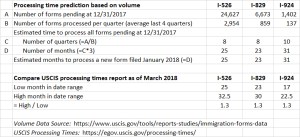
But it’s tough to interpret these reports. A processing time estimate could be either (1) forward-looking, “the average time it will take a petition filed today to get adjudicated” or (2) backward-looking, “the average time that petitions being processed today have been waiting.” It can’t be both because 1 and 2 are very different numbers, thanks to dramatic fluctuations in receipt numbers and changing processing capacity over time. But we don’t know which we’re getting with the USCIS processing time report. The “Case Inquiry Date” would logically be backward-looking, while the “Estimated Time Range” is forward-looking if, as I suspect, it’s calculated by dividing currently-pending petitions by current average rate of adjudication. But the report says that the Case Inquiry Date is based on the Estimated Time Range. But calculating a backward-looking estimate from a forward-looking estimate would be nonsense. So I don’t know what to think. (For everything else I know/don’t know about processing times, refer back to the post How Long Does I-526 Take? (III))
Considering the ambiguity (and the fact that the report, however it’s calculated, can evidently suddenly change by six months or more), better not rely on USCIS processing time information for major decision-making. Just one thing is clear: EB-5 petition processing times are too long, and fuel a number of the political and integrity threats that face EB-5 today.
Regional Center Terminations
The USCIS website has been updated with some additional termination notices for regional centers terminated through May 2017. I added the letters to my Termination Log, summarized in the following table.
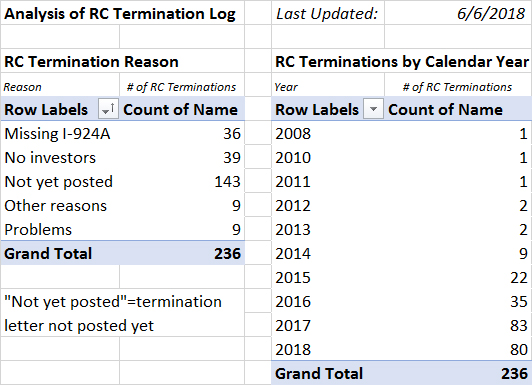
The recent termination letters mainly cite failure to file a Form I-924A annual report and/or inactivity (i.e. no EB-5 investors in the last 3-5 years) as reasons for termination. They rarely mention derogatory evidence as a reason.
Examples:
- Terminations based on inactivity, though the applicant attempted to show progress toward promoting economic growth: Green Card Gateway Regional Center, Alaska Gold and Mining Regional Center, LLC, Adirondack Regional Center of New York, LLC, MAY062018_01K1610 USAR, MAY032018_01K1610 LVEI
- A termination citing misrepresentations and credibility issues: Liberty West Regional Center, LLC
- Termination based on a voluntary withdrawal request: San Gabriel Valley Regional Center, LLC
- Termination based on over-reliance on the postal service: MAY112018_01K1610 IVRC
Regulations
The indefatigable Senator Grassley continues to nip at the heels of the EB-5 regulations. Today he sent a letter to President Trump with this complaint: “As I mentioned to you yesterday afternoon, certain EB-5 interest groups are telling investors they have ‘bought off the White House’ and that your Administration will never allow the EB-5 regulations to take effect. These comments are very disturbing, and undermine the American people’s faith in your ability to restore integrity to our immigration system.” Earlier this week he sent a letter to DHS urging “It is past time for your Department to publish the modernization rules. I have received reports that certain industry groups believe the White House will never allow the regulations to go into effect. Please confirm or deny this allegation, provide my office with an update on the status of these rules, and any impediments to their finalization.” (FYI I don’t know to which”certain industry group” Senator Grassley refers. To the extent that I’ve observed questionable marketing around the regulations, it’s people trying to hustle prospects into investing now by claiming that the possible August 2018 date for final action on regulations is actually a hard and firm August 2018 deadline to invest under current rules — while omitting to mention that final action date doesn’t mean effective date, and the OMB Unified Agenda dates are not guaranteed.)
I used to read between the lines of Senator Grassley’s legislative proposals that he wished to make EB-5 safe, legal, and rare, but now he seems ready to settle for just making it rare. Because the proposed EB-5 regulations (at least, the RIN: 1615-AC07 possibly on schedule to be finalized in August) do not in fact address the integrity or security concerns that the Senator raises in his letters; their major impact would be to dampen demand by increasing investment amounts.
I keep watching the OMB website to see when/whether the EB-5 regulations progress to the OMB review stage, but that hasn’t happened yet. Any status changes will be recorded on my Washington Updates page.
Regional Center List Changes
Additions to the USCIS Regional Center List, 05/25/2018 to 06/05/2018
- 900 Regional Center LLC (Hawaii)
- American Lending Center Arizona, LLC (Arizona): usa-rc.com
- Birmingham Alabama Regional Center, LLC (Alabama)
- Discovery California, LLC (California)
- Gladstone Regional Center, LLC (California)
- Golden Gateway Regional Center LLC (California)
- Napa Valley Regional Center (California)
- Northeast EB5 Regional Center, LLC (District of Columbia, Maryland, New Jersey, New York, Pennsylvania)
- Principal Regional Center, LLC (Washington)
- Southeast EB5 Regional Center, LLC (Alabama, Florida, Georgia, Louisiana, Mississippi)
- West Coast EB5 Regional Center, LLC (California, Oregon, Washington)
New Terminations:
- Encore Wash D.C. RC, LLC (District of Columbia, Maryland, Virginia) Terminated 5/25/2018
- Colorado Headwaters RC, LLC (Colorado) Terminated 5/24/2018
- Faustus Capital LLC (California) Terminated 5/24/2018
- Marianas EB5 Regional Center (Commonwealth of Northern Marianas Islands) Terminated 5/29/2018










 EB-5 Updates