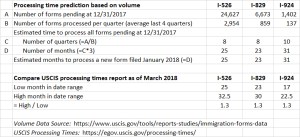
I-526 processing time (Part I)
December 28, 2017 51 Comments
Update: I have deleted this now-outdated post and replaced it with How long does I-526 take? (Part III)
immigrant investor program news
December 28, 2017 51 Comments
Update: I have deleted this now-outdated post and replaced it with How long does I-526 take? (Part III)
December 18, 2017 28 Comments
Update: For current status, check the Regulations Detail section of my Washington Updates page.
— Original Post —
While we have our eye on the legislation ball, the Office of Management and Budget has given us a new EB-5 deadline to think about. The Spring 2017 Unified Agenda had mentioned April 00, 2018 as a “Final Action Date” for regulations dealing with EB-5 investment amounts and TEAs (RIN 1615-AC07), but now the Fall 2017 agenda has advanced that prediction to February 00, 2018. I’d doubted the April date because so many factors seemed likely to delay regulations (the prospect of legislation instead, the fact that Congressional intent as expressed in draft legislation looks so different from what DHS put in the proposed regulations, the administration’s coolness to regulation in general, government inertia in general), but advancing the date to February looks like positive intent to really get the EB-5 regulations done.
We don’t know yet what will be in the final Rule 1615-AC07, since it may have been revised significantly since the Notice of Proposed Rulemaking. But as a reminder, here’s what the NPRM proposed:
The federal rulemaking process requires that “At the end of the process, the agency must base its reasoning and conclusions on the rulemaking record, consisting of the comments, scientific data, expert opinions, and facts accumulated during the pre‐rule and proposed rule stages.” In April 2017, the public responded to the NPRM with challenging questions and criticism, and some persuasive data and policy arguments. The agency must take these into account. If USCIS revised the proposed rule in response to public comment, they might have modified the proposed investment amount increases (nearly all commenters argued strongly for this), either narrowed or expanded the gap between TEA and non-TEA investment (there were spirited arguments on both sides), modified the restrictions on census tract TEAs, or reconsidered giving DHS the burden of issuing TEA designations. On the other hand, USCIS is not well known for changing track in response to evidence and arguments presented by the public. The Fall 2017 OMB notice reiterates USCIS thinking about the potential costs and benefits of the proposed regulations:
The proposal to raise the investment amounts and reform the targeted employment area (TEA) geography could deter some investors from participating in the EB-5 program. The increase in investment could reduce the number of investors as they may be unable or unwilling to invest at the higher proposed levels of investment. On the other hand, raising the investment amounts increases the amount invested by each investor and thereby potentially increases the total economic benefits of U.S. investment under this program. The proposed TEA provision would rule out TEA configurations that rely on a large number of census tracts indirectly linked to the actual project tract by numerous degrees of separation, and may better target investment capital to areas where unemployment rates are the highest.
If a final rule were published in the Federal Register in February 2018, it could go into effect as early as March 2018, and apply to petitions filed on or after the effective date. (See A Guide to the Rulemaking Process for an explanation of the typical process.)
On the other hand, the threat of immanent regulations may inspire Congress/industry to finalize EB-5 legislation ASAP instead.
Meanwhile, the OMB Unified Agenda has pushed back the estimated date for a Notice of Proposed Rulemaking for RIN: 1615-AC11, the EB-5 rule dealing with regional center designation, the exemplar filing process, continued regional center participation, and regional center termination. The Spring agenda had estimated April 2018; the Fall agenda has October 2018. We previously responded to this as a Advance Notice of Proposed Rulemaking. The agenda’s cost/benefit comment notes that:
DHS is still in the process of reviewing potential changes it would propose to the regional center process. DHS may propose to implement an exemplar filing requirement for all designated regional centers that would require regional centers to file exemplar project requests. An exemplar filing requirement could cause some projects to not go forward, but DHS is still in the process of assessing the impacts on the number of projects that may be affected. DHS anticipates that any proposed changes to the regional center program would increase overall program efficiency and predictability for both USCIS and EB-5 stakeholders.
December 14, 2017 7 Comments
Countdown to Regional Center Program Reauthorization
Visa Backlog Update
The backlog of EB-5 visa applications at the National Visa Center continues to grow, as one would expect with I-526 filing surges reaching the visa application stage. The Annual Report of Immigrant Visa Applicants in the Family-sponsored and Employment-based preferences Registered at the National Visa Center as of November 1, 2017 reveals that the EB-5 visa application backlog is 23% longer this year than last year, with 17% increase in pending applications from mainland China and a 106% increase in pending applications from other countries. I’ve added these numbers to my master backlog calculation spreadsheet, which has a projection tab to estimate how statistics translate into wait times.

Legal Actions
Additional reading for those interested in following litigation in the EB-5 space, and learning from the actions and statements that got other people in trouble.
Other Helpful Articles
McKee, Curylo, Parrington: Considerations for Independent Third Parties to Assist With EB-5 Investments (December 12, 2017)
Regional Center List Changes
Additions to the USCIS Regional Center List, 11/08/2017 to 12/05/2017:
One regional center was removed from the approved list, but not added to the terminated list:
December 8, 2017 20 Comments
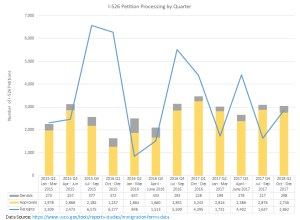
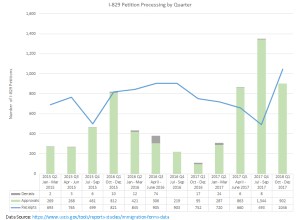
The USCIS Immigration Forms Data Page has posted EB-5 petition processing data for the 4th quarter of FY2017 (July to September 2017).
The good news is that in FY2017, IPO finally – for the first time since FY2009 – adjudicated more EB-5 petitions than it received during the year. That’s what needs to happen for the backlog to shrink and processing times to fall.
In FY2017, I-526 receipts were down 14% and I-526 adjudications up 31% from the previous year. I-829 receipts were down 24% and adjudications up 42% from the previous year.
Although I-526 receipts fell slightly in FY2017, they were still unsustainably high – enough to claim nearly four years of visa numbers if the annual EB-5 visa cap stays at 10,000. As before, the quarterly receipt trend shows filing surges around regional center program sunset dates.
I-829 receipts fell every quarter in FY2017, which is troubling. The State Department has issued the maximum number of EB-5 visas annually since FY2014, so I would expect a steady stream of petitions to remove conditions. Instead, it seems that an increasing number of people who received conditional permanent residence are failing to complete the EB-5 process. I-829 denial rates remain very low, however.
The most dramatic processing improvement in FY2017 came for I-829 petitions, particularly in the fourth quarter. I-526 processing has improved year-over-year, but not consistently by quarter.


IPO has steadily increased their processing capacity since 2013, and I hope that the trend will continue into 2018. IPO has committed to reducing processing times in 2018, and continues to hire new staff. (Last month USAjobs.gov posted a job announcement recruiting for “many vacancies” as Adjudications Officer at IPO. Fortunately for the poor pending petitions, I decided not to apply.)
USCIS apparently continues to refine its record-keeping system. The Q4 data report not only provides Q4 numbers but some revised figures for previous quarters and years (with variation by several hundred from previously-reported figures). The pending petition count remains a mystery. (One would expect quarter-end pending petitions to equal previous quarter-end pending plus current quarter receipts minus current-quarter adjudications, but that’s not the case.)
November 29, 2017 6 Comments
Updates:
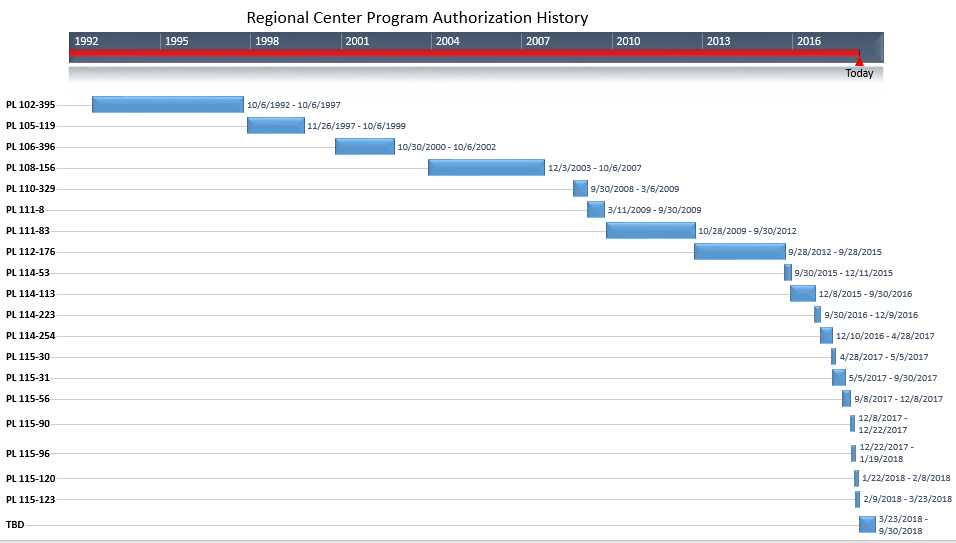
Original 11/29 post: EB-5 is permanent, but the EB-5 regional center program faces another sunset date. The RC program’s current authorization is tied to a continuing appropriations act that expires next week Friday, December 8. Sabers are rattling in Washington over the next funding bill, and we may be in for another short-term resolution while our representatives get things figured out. EB-5 hardly rates in the scheme of significant and controversial issues facing Congress now, and I don’t hear anyone speaking out about it. I expect we’ll see (1) a new appropriations bill or continuing resolution next week that includes clean extension to the RC program for the bill’s duration (since that’s been the pattern for two years, and the default option for a Congress busy with other matters); or (2) limited EB-5 program changes crafted by/for the few people who spend most on EB-5 lobbying, slipped quietly and at the last minute into a larger bill to facilitate passage and forestall review and criticism from a broader base of interests. I do not think the regional center program will be terminated, or omitted on purpose from the next appropriations bill. Termination calls have never been very loud or widespread, and termination would also take time and attention from Congress. However, the reauthorization picture is not pretty. The RC program has received seven short-term extensions in the past two years. Congress hasn’t taken positive action on EB-5 since 2012. A program with billions of dollars on the line deserves more stability, attention, and enthusiasm.

Chart notes: The PL numbers identify the public laws that contain regional center program authorization. Each opaque blue bar begins with the date of PL enactment and ends with the end of RC authorization in that PL. The light blue shading reflects the fact that the first three reauthorizations just extended the original authorization (from five years to seven, then ten, then fifteen years). If anyone knows how to fill in the authorization gaps in my chart before 2008, please email me the missing PL numbers.
November 11, 2017 2 Comments
IPO staff met with EB-5 stakeholders twice this week, at an official Stakeholder Engagement on November 7 and at an EB-5 Conference hosted by Baruch College on November 10.
I’ve uploaded voice recordings of both presentations (11/7 here and 11/10 here), and you can watch the Baruch College presentation on YouTube here (IPO speaks in Part 6). Official remarks from the 11/7 engagement are posted on the invitation page. Hot topics included petition processing, Form I-924A, redeployment, bridge financing, and material change. I summarize a few highlights below.
EB-5 Program Introduction
At the 11/10 conference, IPO Senior Advisor for Economics Jan Lyons provided a basic yet substantive introduction to the EB-5 program and how it works. Agents and potential investors, this is an excellent source of reliable information straight from USCIS. He speaks near the beginning of the Conference presentation Part 6.
Processing Information
On 11/7, IPO Deputy Chief Julia Harrison generously spoke at length about processing issues, including staff allocation and petition workflow. Here’s my best effort to summarize the content (with time references to the 11/7 recording FYI).
In the 11/10 presentation, IPO Senior Advisor for Economics Jan Lyons pointed out that IPO has finally cleared a huge hurdle – the surge of applications and petitions filed in advance of the December 2015 sunset date. That surge slowed down processing not only due to volume but to the poor quality of many petitions, apparently filed in a rush. I-526 and I-924 adjudications are proceeding more quickly and smoothly going forward. Mr. Lyons pointed out three factors that affect an individual’s processing time: place in the queue, the qualify of petitions before yours, and the quality of your petition.
Bridge Financing
This issue needs its own post, so I’ll just briefly mention the points at issue: whether bridge financing to be replaced by EB-5 must be “temporary” as in “a year or less” to qualify as a bridge and establish nexus, and whether EB-5 funds must pass through the job-creating enterprise account to repay the JCE’s bridge debt. IPO’s working answers are a tentative “yes” to the duration question and firm “yes” to the path question. Jan Lyons gave thoughtful discussion in the 11/7 call at time 01:01:28 – 01:10:11 and 01:40:01 – 01:42:11, and starting at time 12:55:24 of the 11/10 conference (I’ll let you listen for the details). And he welcomes feedback from the industry. That IPO hasn’t already received solid feedback demonstrates acute industry failure. In a healthy world, IIUSA would’ve shared bridge financing RFEs with membership months ago, and appropriate people would’ve gotten together to write and submit a constructive, well-footnoted article presenting reasonable guidelines for bridge financing in EB-5. As it is, I didn’t even hear about the RFEs ‘til very recently, and there hasn’t apparently been any industry collaboration except to whine about why the RFE creates problems (while putting the burden on IPO to solve a problem that our collective experience and industry sources are competent to address). For shame. (In case you weren’t informed either, see the RFE trends presentation at this link.)
Redeployment & Material Change
I lump these topics together because IPO’s answers to questions on both issues were the same: consult written policy. IPO did not clarify ambiguities in the redeployment policy, and did not fall into the trap of contradicting the clear material change policy. People who know better keep asking at meetings whether a petitioner can change projects or change regional centers before CPR — probably because they hope someday IPO might accidentally say the “yes” we’d like to hear. But investors beware: this is not a grey area. Policy and decisions are clear that material change before conditional permanent residence will derail a petition, and that project and regional center identity are material. Changing NCEs is not an option at any time. (I have a post detailing the material change policy and applications.) The grey area comes at the I-829 stage. IPO said they’re working on policy specific to the question of how to treat regional center changes for an I-829 petitioner. (For sure the petitioner is protected from any changes that occur after I-829 filing, but the situation before that is less clear.)
I-924A
Most answers to I-924A questions likewise boiled down to “read the instructions,” but you can re-listen to the 11/7 recording for any nuances. In the 11/10 meeting, Julia Harrison made the welcome comment that “two to three years” is not a hard and fast requirement for the time during which a regional center must sponsor a project or face termination. “We do look at the totality of the evidence you submit,” and will consider evidence that the regional center is “making progress toward a project” or at least “has something on the horizon” (2:44:00)
Policy & Regulations
Julia Harrison reports having no information to indicate that the April 2018 target date for finalizing the EB-5 regulations will not be met, though this does not depend on IPO. Her team is “always working” on the Policy Manual, but doesn’t have specifics on future updates. Lori McKenzie is no longer the Policy Division Chief, and Ms. Harrison did not mention a replacement.
Baruch College Conference
The EB-5 Conference with USCIS IPO, Hosted by the Steven L. Newman Real Estate Institute – Baruch College (November 10, 2017) had a number of solid presentations besides the IPO panel. Here is the list of speakers, and video of the panels.
Regional Center List Changes
Additions to the USCIS Regional Center List, 10/2/2017 to 11/08/2017:
This regional center was listed as terminated on 8/10/017, but restored to the approved list on 11/6/2017:
New Terminations:
October 26, 2017 27 Comments
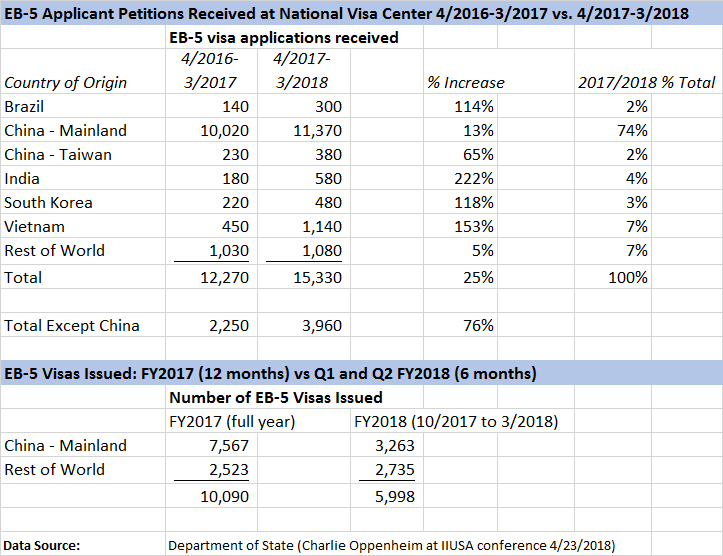
Visa Numbers Update (Vietnam, India)
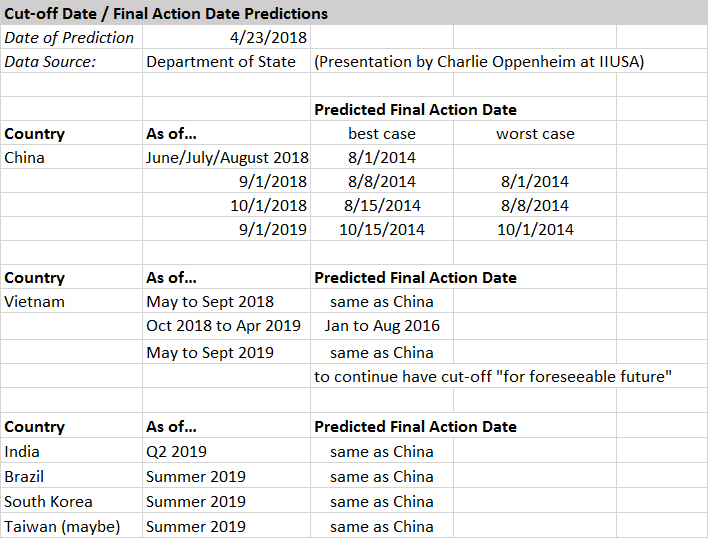
We heard some updated EB-5 numbers this week from Charles Oppenheim, the Chief of the Immigrant Visa Control and Reporting within the U.S. Department of State. Bernard Wolfsdorf gives highlights from the presentation in 5 Things I Learned from Charlie Oppenheim at the IIUSA 7th Annual EB-5 Industry Forum. The major news is Mr. Oppenheim’s prediction that Vietnam will have enough demand to be subject to a cut-off date in 2018, and India may need a cut-off date by 2020. Cut-off dates happen when a visa category is oversubscribed and a country demands more than its rightful 7% of available visas in that category. A cut-off date holds back applicants from oversubscribed countries long enough to let any other applicants from undersubscribed countries get first chance at available visa numbers. China is so far over the limit that it’s in an indefinite cut-off date situation with slow forward movement. Vietnam and India are just barely approaching the limit, and don’t have that much competition from other countries, so their cut-off dates would likely be temporary and hardly perceptible unless demand explodes.
I most appreciated the slide from the Mr. Oppenheim’s IIUSA presentation that gives a breakdown of pending applicants at the National Visa Center by country of origin (for the top five countries) and priority date. I added data from the slide to my Excel file of EB-5 backlog-related info, and correlate it with per-country I-526 receipt data from USCIS. I’m copying below a couple tables that illustrate (1) how we might forecast future cut-off-date-countries from information on I-526 receipts and approvals, and (2) that life is not fair. (Note: see below for updated tables.)
Since the IPO Processing Times report indicates that USCIS has only gotten to processing I-526 filed in November 2015, one wouldn’t expect to see applicants with 2016 and 2017 priority dates already in the visa queue. But Department of State reports nearly 2,000 applicants from the top five countries with priority dates after 2015, which means that USCIS must have processed over 600 petitions out of date order. Of course the number of pending visa applicants with priority dates 2015-2017 is still very small compared with the number of I-526 receipts in those years, so a majority of petitioners are getting held up in slow I-526 processing. I am surprised at the number of applicants with early priority dates still pending at NVC, considering that the China cut-off date progressed to mid-2014 this year (per the Visa Bulletin) and the other countries don’t have a cut-off date.
12/11/2017 UPDATE: The Department of State has provided updated numbers for pending visas in its Annual Report of Immigrant Visa Applicants in the Family-sponsored and Employment-based preferences Registered at the National Visa Center as of November 1, 2017. Here are updated charts based on the new data.
TEA Reform Proposal
Industry discussion about potential legislation has focused on the House-Judiciary Chair EB-5 Reform Proposal, a one-page term sheet with notes for potential future legislation. The term sheet proposes replacing the current Targeted Employment Area (TEA) system with a R/UD system. R/UD stands for Rural or Urban Distressed – two areas that would be incentivized for EB-5 investment with a slightly lower investment amount and fees, reduced job creation requirement, and – most potent of all – set-aside visas.
A couple major questions to consider: which projects would qualify for incentives under the R/UD proposal, and who’d be the winners and losers, were the term sheet to become legislation and then law?
- The term sheet briefly defines Urban Distressed criteria: “must meet 2 out of 3 of the New Market Tax Credit Criteria.” The NMTC program has several sets of criteria, but we’ll assume the staffers mean the NMTC criteria for “severe distress” (since that’s the criteria referenced in previous EB-5 draft legislation): Poverty rate greater than 30 percent; median family income not exceeding 60 percent of statewide median; unemployment rates at least 1.5 times the national average. The term sheet gives this cryptic description of Rural criteria: “Base law + census tracts that would qualify under base law except for the fact that they are located in the outlying counties of MSA’s with population densities of less than 400 psm + Hatch fix.” I believe that means: Rural is an area with a population under 20,000 that is outside a Metropolitan Statistical Area (or a low population/low density area within the outskirts of an MSA). With those definitions in mind, you can get a sense of whether a project location might qualify for R/UD incentives using the CDFI Fund Mapping page provided by the US Department of the Treasury. For urban projects, select the NMTC mapping tool. When you enter the project address, the NMTC tool will bring up a map of census tracts around that address, with relevant NMTC data for poverty rate, income, and unemployment for each census tract. Check these numbers against the NMTC Severe Distress threshold, recalling that the EB-5 proposal would require 2 of 3 criteria to qualify. For rural projects, choose the BEA tool on the CDFI Fund Mapping page. This will bring up a map that lets you search by address and discover whether the address is in a non-metropolitan area, and the local area population. (To be sure of R/UD qualification, you’d need some additional guidance: whether and to what extent it’s allowable to group and average data across more and less distressed urban census tracts, what it means to be “outlying” in the rural context, and what source and date of data would be accepted. The term sheet doesn’t specify this.)
- To judge winners and losers, we look at proposed incentives for R/UD investment. The term sheet suggests that investments in R/UD areas would be incentivized in these ways: 1,500 annual set-aside visas each for R and UD (with any unused visas rolling over from year to year in the same category), $925,000 minimum investment, reduced job creation requirement (5 indirect), option for exemplar somewhat-premium processing (one year), and exemption from an extra visa fee. Investments outside R/UD areas would have a $1,025,000 minimum investment, compete for the 6,940 annual visas remaining after set-asides, and would be subject to a visa fee of $50,000. The R/UD definitions and visa set-asides would become available on the date of enactment, affecting everyone with a visa pending at that time. The term sheet specifies that people with pending petitions and applications wouldn’t need to increase their investment amount, but they would find themselves in a line suddenly made about 40% longer by set-asides that reduce the generally available visa pool. The term sheet offers this limited relief: “For 1 year after DOE, any unused set-aside visas may be used by investors who had filed petitions pending as of DOE that meet the new definitions of R/UD.” However, I guess that few pending petitions fall in that category. This means that the #1 loser in this proposal is the past investor still waiting on conditional permanent residence. Congressional staffers don’t cry over the past investor, because they’re annoyed by the filing surges that happened in recent years (while they failed to act) and have wanted retroactivity. Self-interested RC lobbyists may also have few tears for past investors, whose money is in the bank and whose presence in the backlog represents the major drag on recruitment of new investors. A small negotiating table could see a win-win in a proposal that could discourage past applicants into clearing out the backlog and smooth the way for new rural/urban distressed investment (effectively incentivized with set-asides) and new prosperous urban investment (still competitive thanks to minor investment amount difference). Industry players who care about past investors and clients exist, and I hope their concern will signify.
Audit and Inspection Change
The page on the USCIS website that formerly explained Regional Center Compliance “Audits” and Site “Inspections” now describes Regional Center Compliance “Review” and Site “Assessments.” It’s interesting that USCIS revised the titles to sound less threatening, though the promised content of the audit/review or inspection/assessment remains almost unchanged. The one content change I notice on the page is an additional bullet point for Regional Center Compliance Review: “Assess the effectiveness of internal controls related to the regional center’s administration, oversight, and management functions.”
October 13, 2017 13 Comments
[2019 Update: My post Forecasting Visa Availability: 5/6 Oppenheim projections and big picture (5/6/2019) provides perhaps a clearer big picture explanation of how the wait line works. 2018 Updates: see also my 4/8/2018 post EB-5 Visa Waiting Line and Visa Allocation and my 4/23/2018 post Visa Numbers (China, Vietnam, India, Brazil, S. Korea, Taiwan)]
How long does it take to get an EB-5 visa? Before we look at numbers, consider this picture illustrating variables in the EB-5 process from initial application to conditional permanent residence.
The investor files an I-526 and receives a priority date, goes through I-526 adjudication, and proceeds along with family members to I-485 status adjustment (if already in the US) or consular processing (if outside the US) in order to get EB-5 visas. The system has two major constraints: USCIS capacity to process petitions, and the annual quota on EB-5 visa numbers. These constraints have produced pile-ups of pending petitions and applications, illustrated by the green bins in the picture.
We have data for many parts of this picture, such as how many people are in each of the pending bins, the historical rate of receipts and approvals and denials, and the annual visa quota. The simplest way to estimate the visa wait line (the time from priority date to green card) is to add up the pending bins and divide that number by the annual quota. As there are currently 90,000+ people associated with the pending bins, and the annual EB-5 visa quota is about 10,000, the current total waiting line is 9+ years long. (Maybe longer, depending on assumptions about the other variables). As recently as mid-2014, the line was only about three years long (as we know from the Visa Bulletin, which indicates that China-born investors with June 2014 priority dates started getting visas in May 2017).
Calculating the actual visa wait time for any given person is complicated. Where is that person in line, relative to other pending petitioners and applicants? Is that person from China (which is oversubscribed and subject to a per-country limit) or from an undersubscribed country that’s free to take the first available visas? How have/will other process variables such as per-country receipts and approval rates change over time and affect calculations?
If I were someone born outside China considering EB-5 now, I’d feel good about the per-country limit that allows me to skip ahead of most China-born applicants in line (i.e. about 87% of the line). For me, the time IPO takes to process I-526 is the major factor in my total wait time.
If I were a China-born prospective investor, I’d look at everyone in line ahead of me, and also try to estimate how many queue-jumping non-Chinese may enter from behind in the time I have to wait. That calculation could add years to the potential wait time, well exceeding 10 years, if the number of non-Chinese investors increases dramatically in the future and IPO processing speeds up. Or future circumstances could quell new EB-5 demand, encourage existing applicants to drop out, or apply the per-country limit to other countries, improving the wait time for China-born investors who stay in the system.
All past investors should consider the significance of the visa quota constraint and the possibility that it will change. Indeed, it could change for the better. For example, if the State Department recognizes that Congress intended the 10,000 visa quota to apply to 10,000 investors, not investors plus family members, this would loosen the constraint and cut about six years from the current visa wait time. Unfortunately, quota reduction is also a live possibility. Industry lobbyists are reportedly considering legislation with visa set-asides that would reduce the generally-available annual EB-5 quota from 10,000 to 7,000. This could be disastrous for past EB-5 applicants, adding about four years to the wait time. Visa set-asides have emerged as a compromise between the Senator Grassley camp, which wants to incentivize rural/urban-distressed investment somehow, and certain regional centers, who resist an incentive based on a significant investment differential that would make their future prosperous urban projects uncompetitive. Tying the TEA incentive to visa set-asides rather than reduced investment would allow regional centers to keep attractive terms and options for future investors. Their past investors would suffer, but that cost seems not much counted. (My impression of the current legislation discussion comes from this webinar and this article.) Of course, maybe protections for past investors will be added to the legislation, or maybe there won’t be any deal and we’ll get new regulations instead. The regulations could significantly reduce new EB-5 demand, which would hurt the industry but benefit people who stay in the current visa queue.
And now, let’s get to the numbers. I’ve expanded and improved my backlog calculation spreadsheet, which now has multiple tabs that compile all the data I can find on each variable influencing the visa wait time for an EB-5 conditional green card. Keep the spreadsheet link, as I will update it whenever new inputs become available. (For those who don’t face backlog issues, see my posts on I-526 processing times Part I and Part II to help estimate the time between you and conditional permanent residence.)
Summary of EB-5 Visa Wait Time Variables
Additional Reading
Benefit from this blog? Please consider supporting the effort behind it. As the EB-5 industry changes, your contribution can help preserve this space for conscientious and freely-available EB-5 reporting. Donations go to Lucid Professional Writing (a for-profit business) to fund work on this blog. Thank you!
October 9, 2017 1 Comment
Direct EB-5 FAQ
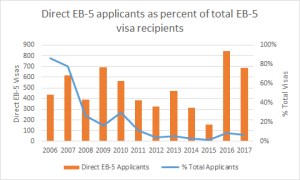
The regional center program dominates EB-5, but the alternate direct EB-5 track remains significant. 846 EB-5 visas went to direct EB-5 investors plus family in FY2016, and this number will likely climb as petitions from the past couple years finally reach the visa stage. Direct EB-5 can be an attractive option for foreign investors and U.S. business owners who wish to avoid the uncertainty surrounding the regional center program. About half the business plans I write these days are for direct EB-5.There remain, however, lingering misunderstandings about how EB-5 works outside the regional center program. I’ve prepared a new page, Direct EB-5 FAQ, that addresses questions about the nature and practical uses of direct EB-5.
Test your direct EB-5 knowledge.
- True or False? The direct EB-5 program will sunset unless re-authorized by Congress.
- True or False? A direct EB-5 investor must invest at the $1 million level.
- True or False? Real estate developments are the most common direct EB-5 project type.
- True or False? A majority of direct EB-5 investors have come from China.
- True or False? The direct EB-5 investor must majority-own the enterprise receiving investment.
- True or False? The direct EB-5 investor must have day-to-day managerial responsibilities in the enterprise receiving investment.
- True or False? If a direct EB-5 investor buys a business, that business and its employees will qualify as new for EB-5 by virtue of the new ownership.
- True or False? A new commercial enterprise can use direct EB-5 capital to invest in a separate job-creating enterprise.
- True or False? A direct EB-5 investor can count full-time equivalent jobs created by the enterprise.
Each of these statements is false. If you were surprised, then check out the Direct EB-5 FAQ page for direct EB-5 information, policy references, and case citations.
White House Immigration Principles & Policies
Just in time for Columbus Day, President Trump has sent Congress a list of Immigration Principles & Policies that 15th-century Americans could wish they’d had. The White House principles focus on border security and interior enforcement, and repeat the idea that legal immigration should feature a skills-based points system while reducing admissions for relatives, asylum seekers, and refugees. We shall see how Congress reacts to this guidance from the White House. The White House principles look positive for immigrant investment, but the points system would be fatal (at least in the scenario proposed by Tom Cotton, which would eliminate EB-5 and would not allow immigrant investment to support US entrepreneurs, but only immigrant-controlled business).
In the meantime, in honor of voyagers who continue to build our great nation as they bridge continents and pursue their dreams in face of doubt and adversity, I will quote the first paragraph of President Trump’s Columbus Day proclamation.
Five hundred and twenty-five years ago, Christopher Columbus completed an ambitious and daring voyage across the Atlantic Ocean to the Americas. The voyage was a remarkable and then-unparalleled feat that helped launch the age of exploration and discovery. The permanent arrival of Europeans to the Americas was a transformative event that undeniably and fundamentally changed the course of human history and set the stage for the development of our great Nation. Therefore, on Columbus Day, we honor the skilled navigator and man of faith, whose courageous feat brought together continents and has inspired countless others to pursue their dreams and convictions — even in the face of extreme doubt and tremendous adversity.
October 2, 2017 Leave a comment
Washington Updates
We’re entering FY2018 with another RC program sunset date coming up on December 8, 2017, and new EB-5 regulations waiting for final clearance by the Office of Management and Budget. In a September 28 podcast with Mona Shah, Peter Joseph of IIUSA reports that “Congressional leadership including Senator Cornyn, Majority Leader McConnell, and Speaker Ryan has spent time working with judiciary committee leadership in coming to an agreement. The fact that these parties continue to dedicate time to a legislative solution is a very good sign.” However, “We don’t know the details of what might come out of a Congressional agreement. Investment amounts and other key issues are part of a fluid conversation, and negotiation will continue until there is enough agreement to move to the next stage.” I’m glad to hear that conversations are on-going, with IIUSA taking an active part. I’m also inclined to agree with Mintz Levin’s conclusions in the thoughtful article Lawmakers May Not Spend Political Capital on Standalone EB-5 Bill (September 28, 2017). It’s hard to imagine that Congress will prioritize EB-5 legislation when issues like health care and tax reform are pending, and easy to imagine them deferring responsibility with another content-free short-term RC program extension, or waiting for regulations. If DHS finalizes new EB-5 regulations before Congress gets around to legislation, then Congress doesn’t have to touch donation-losing issues like investment amount increases and TEA reform. Congress must act eventually, because only Congress can authorize the RC program and deal with visa numbers, but we’ll see. Prior to the last couple sunsets I heard whispers that certain lobbyists had secured a gentleman’s agreement with staffers for new legislation that would protect the status quo. (Senator Grassley heard the whispers too, and was not pleased). I’m hearing similar reports this time around, together with protests from other people in communication with the same offices who say no, Congressional leadership is not on board with the status quo proposals (to minimize the investment differential, protect the natural advantage of big-city projects, and generally avoid painful disruption). I’m not sure what to expect. I look forward to listening in to EB-5 Legislation: Where Are We? a free webinar to be hosted on October 4 by Kurt Reuss of EB5 Diligence, with an all-star cast including Stephen Yale-Loehr, Robert Divine, Robert Cornish, Laura Reiff, H. Ronald Klasko, Carolyn Lee, and Douglas Hauer. (10/12 Update: Mona Shah reports on a possible new legislative compromise.)
Interesting Articles
- NES Financial has published another white paper with EB-5 Trends & Insights based on data from the many regional center transactions they facilitate. NES comments on 2017 trends in EB-5 capital structure, investor markets, escrow terms, and size and location of EB-5 projects.
- Bloomberg Businessweek recently featured EB-5 in How Rich Chinese Use Visa Fixers to Move to the U.S. (September 14, 2017). I appreciate the article for its clever graphic, and for its old-fashioned vision of Chinese flocking to the smooth path of EB-5, not sweating at home over backlog calculations and the question of whether an EB-5 green card is worth a decade wait on top of investment risk and political uncertainty and capital control complications. CNN Money seems closer to the current situation with its article America’s ‘golden visa’ is losing its luster in China (September 29, 2017). The changing role of Chinese investors in EB-5 will likely define our experience in 2018. Unless, of course, we get good news on legislation and visa numbers.
- Those involved with EB-5 investors from Iran, and people of conscience generally, will want to keep an eye on the emerging situation with President Trump’s new Presidential Proclamation on Visas. The State Department summarizes the revised travel ban, and how it affects nationals of Chad (?), Iran, Libya, North Korea, Syria, Venezuela, Yemen, and Somalia. (10/24 update: the Supreme Court has dismissed a final attempt to block the ban.)
SEC Actions
The Securities and Exchange Commission continues to highlight the need for investor vigilance. This month brought two new complaints, against Ronald Van Den Heuvel and Green Box NA Detroit (filed September 19, 2017) and Edward and Jean Chen and Home Paradise Investment Center LLC (filed September 20, 2017). I’ve added select details to my log of all SEC actions in EB-5. If we believe the SEC’s version of events, these cases did not involve complex or sophisticated schemes, just daylight theft and open lies enabled by related-party transactions and weak diligence. USCIS wasn’t necessarily taken in (the briefly-posted list of I-526 and I-829 adjudications by RC showed 0 petition approvals for Home Paradise), but quite a few investors were. The market needs to be more careful. The good actors who account for a majority of EB-5 players need to go the extra mile with transparency and account controls to demonstrate their good faith. Meanwhile, we appreciate the SEC putting bad actors on notice that EB-5 is not a free lunch.
Regional Center List Changes
Additions to the USCIS Regional Center List, 8/28/2017 to 10/02/2017
- American Real Estate Regional Center, LLC (Connecticut, New Jersey, New York)
- American Stone Energy EB5, LLC (Texas)
- Broadway Regional Center, LLC (California)
(Additionally Live in America – Carolinas Regional Center LLC, previously removed in error, has been restored to the list of approved regional centers)
- California Blue Sky Regional Center, LLC (California) Terminated August 29, 2017
- Arundel Capital Partners (Massachusetts) Terminated August 29, 2017
- California Economic Development Fund, LLC (California) Terminated September 25, 2017
- Global Medical Center of Southern California (California) Terminated September 25, 2017
September 21, 2017 8 Comments
The USCIS Immigration and Citizenship Data page has been updated with data from FY2017 Q3 (April to June 2017) for petitions including I-526 and I-829.
In the third quarter we see IPO making wonderful improvement to I-829 processing volume (likely thanks to the new I-829 team announced in March). Meanwhile, I-526 processing fell another step back (possibly due to resources diverted to I-829). We see another pre-sunset-date filing surge, though less dramatic than previous surges. The total number of pending EB-5 petitions increased again in Q3.
Here’s a bonus chart for people involved in advocacy. Notice how I-526 receipt numbers reflect the destabilizing effect of frequent regional center program sunset dates, with each threatened sunset preceded by a surge of EB-5 investors rushing to file. Notice also how much EB-5 demand has exceeded the EB-5 visa quota as currently interpreted. If about 10,000 EB-5 visas need to be divided by four quarters and three visas per investor, then the program can only afford about 800 new I-526 per quarter on average before facing a backlog situation. If Congress intended to accommodate 10,000 EB-5 investments annually, then an average of 2,500 investor I-526 per quarter would sustainable — and reasonable considering actual demonstrated demand.

EB-5 investors watching processing times should also keep the I-526 receipts chart in mind. IPO has spent a whole year processing I-526 petitions filed from July to December 2015, and is still stuck on November 22, 2015 as of the last two IPO processing time reports. But that’s no wonder considering the huge number of petitions filed July-December 2015. Once IPO finishes that mouthful, dates should advance quickly through the next two relatively light quarters.
For China-born investors trying to figure out what the I-526 numbers mean for the visa backlog, here are bonus charts with historical approvals and receipts by country in recent years. These numbers can help you guess how many non-China investors are among the currently-reported pending I-526 petitions, and how many of recent approvals went to non-China investors. (In other words, guess how many people will get priority in the visa queue.) I summarized these numbers from a complete dataset of I-526 receipts, approvals, and denials by country for every year since 1991 — a dataset you can purchase from IIUSA for the full detail. (For whatever reason these figures released in response to FOIA request don’t exactly match the totals published on the USCIS website, but still meaningful I think.) (For more detail, download my spreadsheets on statistics related to the visa backlog, and statistics related to I-526 processing times.)
September 13, 2017 Leave a comment
EB-5 Immigrant Investor Program: Stakeholder Engagement from New York City
U.S. Citizenship and Immigration Services (USCIS) invites you to participate in a stakeholder engagement on Tuesday, November 7, from 1 to 2:30 p.m. Eastern to discuss the Immigrant Investor Program, also known as the EB-5 program.
September 9, 2017 4 Comments
Regional Center Program Reauthorization
The EB-5 Regional Center Program authorization is now extended to December 8, 2017 thanks to H.R.601, which the President signed into law yesterday. Washington worked with admirable dispatch this time, cutting and finalizing the deal all within one week and nearly a month ahead of the September 30th deadline.
The law is hard to read, but for those who like to confirm things personally here’s the relevant language for regional center program extension. H.R. 601 “Continuing Appropriations Act, 2018 and Supplemental Appropriations for Disaster Relief Requirements Act, 2017” Division D Section 101 (PDF page 11) provides appropriations for “continuing projects or activities…for which appropriations, funds, or other authority were made available in the following appropriations Acts: … (6) The Department of Homeland Security Appropriations Act, 2017 (division F of Public Law 115–31), except section 310.” The previous regional center program authorization is in Public Law 115-31 Division F Section 542 (PDF page 298), so it’s one of the continuing activities that’s extended by H.R. 601 Division D Section 101. (And to go back another step, the language in PL 115-31(F)542 refers back to Section 610(b) of the Departments of Commerce, Justice, and State, the Judiciary, and Related Agencies Appropriations Act, 1993 (Public Law 102-395) page 47, which established the regional center program.) H.R. 601 Division D Section 106 (PDF page 13) further specifies that:
Unless otherwise provided for in this Act or in the applicable appropriations Act for fiscal year 2018, appropriations and funds made available and authority granted pursuant to this Act shall be available until whichever of the following first occurs:
(1) the enactment into law of an appropriation for any project or activity provided for in this Act;
(2) the enactment into law of the applicable appropriations Act for fiscal year 2018 without any provision for such project or activity; or
(3) December 8, 2017.The language in Section 106 is a good reminder that “extended to December 8” doesn’t mean “guaranteed to remain unchanged until December 8.” Congress will reportedly turn its attention to immigration issues in the next couple months, and they could come up with legislation before December that affects multiple visa categories including EB-5.
I-924A Filing Tips
I’m not sure what changed, since I don’t work directly with I-924A, but yesterday USCIS published a new version of the Form I-924A Filing Tips page.
SEC Request Denied (Kameli)
When the SEC files a complaint, it’s easy for the public to just assume that the defendant is guilty as charged and there won’t be any more to the story but determining punishment. Even worse, USCIS tends to assume this and has been known to deny and revoke investor petitions and terminate regional centers before the SEC cases are concluded. We all need to remember that sometimes the defendant might have a compelling other side of the story, and might not be found guilty. The district court judge overseeing a recent EB-5 case filed by the SEC just found that the SEC “in numerous instances has not presented fully developed arguments to show why defendants’ actions violated securities laws.” The judge’s memorandum opinion, which considers the defendants’ side of the story, is linked at the end of the article Senior living developer avoids EB-5 ban, receivership (September 7, 2017). For the SEC’s version of events see SEC v. Seyed Taher Kameli, et al., Civil Action No. 17-cv-04686 (June 22, 2017). The article SEC Suffers One of its First Major Losses in EB-5 Realm (September 12, 2017) summarizes the issues.2018 Update: The SEC v. Kameli case continues, however. The SEC came back with an amended complaint filed on January 29, 2018.
September 1, 2017 2 Comments
Redeployment
Julia Harrison’s published statement for the July 19 engagement in San Jose has been updated with cautious answers to two important questions about how redeployment policy applies to pending I-526 petitions. Specifically, whether adding redeployment language to filed documents would constitute material change, and what process and documents are required if redeployment occurs while I-526 is pending. The answers aren’t direct and substantial enough to provide comforting guidance, but on the other hand they’re so open-ended as to potentially offer a lot of flexibility for compliance. I’ll let you consult the link to read for yourself. You needn’t return to my recording to check whether these topics were discussed in more detail in person on July 19, because they were not. Maybe these redeployment questions came up in follow-up emails to the Public Engagement mailbox, and now kindly being shared with everyone. Though it’s lucky I’m so vigilant, or we might never have noticed that the USCIS website replaced one version of the July 19 talking points with another.Speaking of redeployment, here’s another helpful article. Fiduciary Duties of General Partners and Managers in Connection with Redeployment of EB-5 Capital (August 28, 2017) By Catherine DeBono Holmes
EB-5 Engagements
USCIS posted an official recording of the 8/24 I-924A webinar very promptly, and also sent a “Save the Date” announcement. “U.S. Citizenship and Immigration Services (USCIS) will hold the next EB-5 Immigrant Investor Program national stakeholder engagement on Tuesday, November 7, from 1 to 2:30 p.m. Eastern. This event will take place at the USCIS New York City Field Office with in-person and telephone participation and the option to submit questions in advance. We will send an invitation with more details in the coming weeks.”
Reauthorization
The next sunset date for the Regional Center Program comes in just a few days, on September 30. Since dropping or substantially extending the RC program would require attention and discussion, and no one seems to have time or interest for that, I’m guessing we’re in for another series of uncomfortable and inconclusive short extensions with spending bills, as in 2015 and 2016. (9/8 update: the Regional Center Program is now extended as part of a Continuing Resolution to December 8, 2017.)
EB-5 has an awkward position, politically. When the right likes investment but is queasy about immigrants, and the left is just the opposite, what’s the future of immigrant investment? EB-5 is a visa category that demonstrably creates rather than takes U.S. jobs, supports U.S. business development and American products, and brings in a small number of legal immigrants likely to generate a lot of tax dollars and not strain the welfare system. That should make it a favorite visa category, especially for economic nationalists. But a Congressman who’s actively working against the immigration prospects of US-raised kids and overseas grandmas is already getting some flack, and may hear criticism from all sides if he’s seen to simultaneously support wealth-related immigration. On the other hand, people concerned to protect visa opportunities get more political credit for focusing on kids and grandmothers and tech talent than on a small category of legal immigrants associated in the press with luxury real estate. So far as I know, no one in Congress has been interested enough in EB-5 recently to even criticize it, must less speak in support of it. The Senate Judiciary Committee is reportedly about to hold a hearing on immigrant visas, but EB-5 probably won’t be on the agenda. The hearing is designed to scrutinize visas that conflict with the administration’s “Buy American Hire American” policy, and EB-5 doesn’t conflict with that policy. Since EB-5 isn’t in the cross hairs, it may not even be on the radar. But I’ll keep looking for news, and please tell me if you have insights into what’s likely to happen between now and December. Maybe USCIS’s threat to possibly finalize EB-5 regulations by 4/00/2018 will incentivize lobbyists to push for substantial EB-5 legislation sooner rather than later, but we’ll see. A lot of good EB-5 projects and good faith investors depend on smooth seas ahead.
I-485 Interviews
Immigrants who apply for an EB-5 visa through the adjustment of status (I-485) rather than consular process should note the announcement that USCIS to Expand In-Person Interview Requirements for Certain Permanent Residency Applicants (August 28, 2017). These interviews are designed to provide USCIS officers with the opportunity to verify the information provided in an individual’s application, to discover new information that may be relevant to the adjudication process, and to determine the credibility of the individual seeking permanent residence in the United States. Miller Mayer comments on practical implications.
AAO Decisions (geography, material change, RC termination)
The 2017 folder of AAO decisions on I-526 appeals has already posted 177 decisions – or 26 decisions, if we exclude near duplicates (different petitioners, same decision). I read all the decisions and keep a log of points that are significant to my work with EB-5 business plans. A few comments on decisions that interested me.
- JAN132017_03B7203 (Matter of WX) and AUG152017_01B7203 (Matter of SL) deal with the same business model: a proposal to open and operate three franchise hair salons, of which the first two have identified TEA locations and the third is a plan for the future, with location to be determined. The AAO decisions confirm what I’ve always said: that only the identified locations can be considered for the total EB-5 investment and employment eligibility requirements. A petition can’t depend on applying TEA investment to a prospective location, since the TEA status of that unidentified location can’t be determined at the time of investment or filing.
- AUG152017_01B7203 (Matter of SL) has the additional wrinkle that the salons funded by qualifying investment had already gone out of business (after having operated 1.5 years) by the time USCIS got around to adjudicating SL’s I-526 petition. SL expressed her intention to make additional investment and resume operations in the same locations. Interestingly, AAO did not say that such a situation would automatically lead to denial or the need to file a new I-526 petition. AAO challenged the practical feasibility of restarting the business (based on minute analysis of the business plan), but does not challenge the very idea of funding a new business after the previously-funded business failed. The decision implies that business failure and need for new investment would not be, in themselves, a material change. The decision specifically states that opening new salons in the same TEA with different management and different staffing plan is not a material change.
- JUN302017_01B7203 (Matter of WL) gives another rare example of a change NOT found to be material. WL filed Form I-526 with a business plan that anticipated that the NCE would provide shuttle and tour services, with auto accessories sale as a sideline (about 10% of business). A site visit subsequently found little evidence of shuttle/tour service, and auto accessories sale accounting for far more than 10% of the business. But AAO judged that “Merely shifting the percentages of the types of services the Petitioner said the NCE would offer is not, by itself, a sufficient basis to deny the petition.”
- APR262017_02B7203 (Matter of YL) and JUL062017_01B7203 (Matter of YY) identify material changes and explain what makes the changes material. In Matter of YL, a change in business focus and location are judged to be “predictably capable of affecting” and “have a tendency to influence” determinations of whether the Petitioner invested at the required capital investment threshold and will prospectively create the requisite qualifying jobs. In Matter of YL, the petitioner filed a series of plans for different types of food service business. AAO judged that in this case “The NCE’s business plans two and three constitute a material change to the original one because they represent far more than a change in food styles. …In addition to the type of food, business plans two and three include changes to the NCE’s nature of business, services offered, location, start-up costs, and staffing needs. These changes are material and are made to correct a deficiency in the original submission.” (By the way I add these examples as they come to my master post on material change.)
- JUN222017_01B7203 (Matter of LPT) shows how real-life business development after I-526 can help the petitioner, so long as it’s successful. USCIS questioned the reasonableness and credibility of LPT’s business plan, and LPT responded not by revisiting the projections but by documenting actual successful business performance since I-526 filing. On the other hand, JUN132017_01B7203 (Matter of MYA) explains why disastrous developments after I-526 filing (in this case, the Palm House Hotel woes) justify judging the original business plan not credible in hindsight.
- APR182017_01B7203 is good reading for anyone intending to set up a direct EB-5 investment with elements of a debt model, such as preferred return.
- The cases from JUL192017_01B7203 to JUL282017_11B7203 are denials of appeals or motions to reopen/reconsider filed by Path America investors whose petitions were denied or revoked following the termination of Path America Regional Center. All are nearly identical to one or the other of the linked decisions, and dismiss the petitioners’ attempts to claim some due process protection.
Regional Center List Changes
Additions to the USCIS Regional Center List, 8/23/2017 to 8/28/2017
- Guardian Regional Center, LLC (Texas)
- NationSure, LLC (New York)
- State of Maine EB-5 Regional Center, LLC (Maine)
New Terminations
- Live in America – Georgia Regional Center LLC (Georgia) Terminated 8/18/2017
- Live in America – Boston Regional Center LLC (Massachusetts, New Hampshire, Rhode Island) Terminated 8/18/2017
- Live in America – Florida, LLC (Florida) Terminated 8/18/2017
- Live in America – Nevada Regional Center, LLC (Nevada) Terminated 8/18/2017
- Live in America – Louisiana Regional Center, LLC (Louisiana) Terminated 8/18/2017
- Live in America – U.S. Virgin Islands Regional Center LLC (U.S. Virgin Islands (USVI)) Terminated 8/18/2017
- Live in America – Arizona Regional Center, LLC (Arizona) Terminated 8/18/2017
- Live in America – Indiana, Michigan, Ohio Regional Center (Indiana, Michigan, Ohio) Terminated 8/18/2017
- Live in America Chicago Regional Center, LLC (Illinois, Indiana, Wisconsin) Terminated 8/18/2017
- Live in America – Midwest Regional Center, LLC (Minnesota, Wisconsin) Terminated 8/18/2017
- SoCal Regional Center, LLC (California) Terminated 8/18/2017
August 24, 2017 Leave a comment
I-924A Webinar
Today USCIS held a webinar to discuss the latest version of Form I-924A, Annual Certification of Regional Center. USCIS has linked an official recording to the webinar page. (I previously posted a folder with my recording.)
The webinar was technical and specifically focused on Form I-924A — what’s new in the December 23, 2016 version of the form, and how to complete it. A couple points of general interest came out in the presentation.
- The presenter highlighted the expanded definition of regional center “principal” in the new I-924A and additional information requested about principals. The presenter confirmed that the IPO Compliance Division plans to use this information to conduct background checks of everyone in a position to control, influence, or direct the management or policies of the regional center, and that the results of such background checks are material to the regional center’s ongoing designation.
- USCIS instructed that petitions that were withdrawn should be reported as “denied” on I-924A. This categorization could explain the petition approval and denial statistics published last month by USCIS, which reported a surprisingly high number of denied petitions. A caller encouraged USCIS to consider recording withdrawn and denied petitions as separate categories, and the call presenters said they’d consider the suggestion. The presenters also indicated that regional centers can add a note to I-924A explaining how many of the “denied” petitions were in fact denied, and how many withdrawn.
EB-5 Regulations
The Semiannual Regulatory Agenda published today by DHS lists regulation 1615-AC07 (the EB-5 regulation concerning TEAs and investment amount increases) as being in the “Final Rule” stage. The timetable on the rule’s summary page gives an estimated date of 04/00/2018 for Final Action. I’m not sure how seriously to take the agenda or the date estimate.
Articles
Developer FAQ: Jim Butler of JMBM Global Hospitality Group has put together a booklet titled The Developer’s EB-5 Handbook for EB-5 Construction Financing. Although targeted to hotel developers, this free booklet provides experienced answers to a range of practical questions common to businesses as they first consider EB-5 financing.
Large-Scale EB-5 Real Etate Projects: Gary Friedland and Jeanne Calderon of the NYU Stern Center for Real Estate Finance Research have released a new paper featuring a database of large-scale real estate projects that incorporate EB-5 into the capital stack. See EB-5 Projects Database: 2017 Supplement with Trends and Observations (August 16, 2017 Draft). This 2017 database collects publicly-available information on 26 projects in major metro areas with current/recent EB-5 raises. The authors previously published a 2016 database with 27 projects and a 2015 database with 25 projects. These large-scale projects are significant for the industry because they target such a large number of investors. The 26 projects in Friedland & Calderon’s 2017 database aim to attract 6,736 EB-5 investors, which means that they alone could use up over two years of available EB-5 visas. Megaprojects take a large piece of a small pie, are too big to fail, can offer attractive and well-managed investment opportunities, and present a public relations challenge. A high-profile luxury development in a Tier 1 city is not typical of the EB-5 program overall, but it is typical of the few projects that seek and find hundreds of EB-5 investors.
Vermont: Speaking of too-big-to-fail, I continue to follow the efforts of Vermont Regional Center to clean up from fraud charges against a couple of its project managers. The regional center has worked hard to recover from the disaster and (at least recently) to protect and compensate investors, but now faces having to respond to a NOIT from USCIS. A Notice of Intent to Terminate is not the same as a termination notice (the RC has a chance to respond to a NOIT, and not all NOITs are followed by termination), but it is a significant development. This news story discusses the whole situation, and this story gives detail of NOIT content. “What level of oversight are regional centers responsible to provide?” is a grey area question in EB-5, and a question that USCIS addresses in its assessment of Vermont Regional Center.
Regional Center List Updates
Additions to the USCIS Regional Center List, 08/01/2017 to 8/23/2017
- Liberty Regional Investment Center (Georgia)
- Nevada First National Regional Center, LLC (Arizona, Nevada)
- Pass2NY Regional Center, LLC (New York)
- USA New York Liberty EB-5 Regional Center, LLC (Connecticut, New Jersey, New York, Pennsylvania)
New Terminations
- IZON, LLC (South Carolina) Terminated 8/17/2017
- America’s Regional Center, LLC (Florida) Terminated 8/15/2017
- First American Regional Center, LLC (California) Terminated 8/14/2017
- Civitas Rio Grande Regional Center (Texas) Terminated 8/10/2017
- Illinois Valley Regional Center (Illinois) Terminated 8/10/2017
- Southern California Investment Center, LLC (California) Terminated 8/10/2017
- Powerdyne Regional Center, LLC (California) Terminated 8/2/2017
August 15, 2017 13 Comments
I-924A Webinar
U.S. Citizenship and Immigration Services (USCIS) invites you to participate in a webinar on Thursday, August 24, from 1 to 2 p.m. Eastern to discuss Form I-924A, Annual Certification of Regional Center. This webinar will discuss certain changes to the Dec. 23, 2016 edition of Form I-924A and the accompanying instructions. Here is the invitation with instructions for registration. This webinar is also mentioned in Julia Harrison’s Talking Points (July 2017), a new document on the USCIS website that covers a bit of content from the EB-5 engagement in San Jose.
EB-5 Processing Times
Good news! The latest IPO Processing Times report indicates that IPO had a productive June and possibly made a dent in processing times. Most reports since 2014 have shown IPO processing less than a month’s worth of filings each month, which meant it got further and further behind. But in June 2017, the “processing petitions as of” date advanced 1.1 months for I-526, 1.4 months for I-829, and 2.1 months for I-924. If IPO can keep working through more than 30 days of filings every month, we’ll see processing times come down. I understand that periodic filing surges make this difficult, however.
EB-5 Investors by Country: 2016
The latest Regional Center Business Journal has an article with interesting data on I-526 petition filings by country of investor origin, obtained via FOIA request from USCIS. See A New Lens: What the Latest Data Tells Us about Raising EB-5 Capital in an Increasingly Challenging Marketplace (June 2017) by Lee Li. The State Department publishes figures for visa issuance by country, but they aren’t a good indicator for current demand since most investors receive a visa years after investing. The figures on I-526 filings in 2016, however, likely reflect investment decisions in 2016.A few takeaways from the 2016 data on I-526 petitions:
- Vietnam and India register the largest demand spike, with 40+% increase in I-526 petition filings between 2015 and 2016
- Iran, Venezuela, and Mexico are three countries that made the top 10 countries by number of petition filings in 2016, though they weren’t in the top 10 for visas issued in 2016.
- Average I-526 approval rates vary by country. The lowest average approval rate in 2016 was for Iranian investors, at only 37%, while 96% of petitions from Hong Kong investors were approved. I will guess that approval rates correlate to the relative difficulty of verifying source of funds for specific countries, and on the relative experience/inexperience of people preparing petition paperwork for investors in each country. Other countries with low I-526 approval rates in 2016 were Mexico (57% approval rate), India (66%), and Russia (67%).
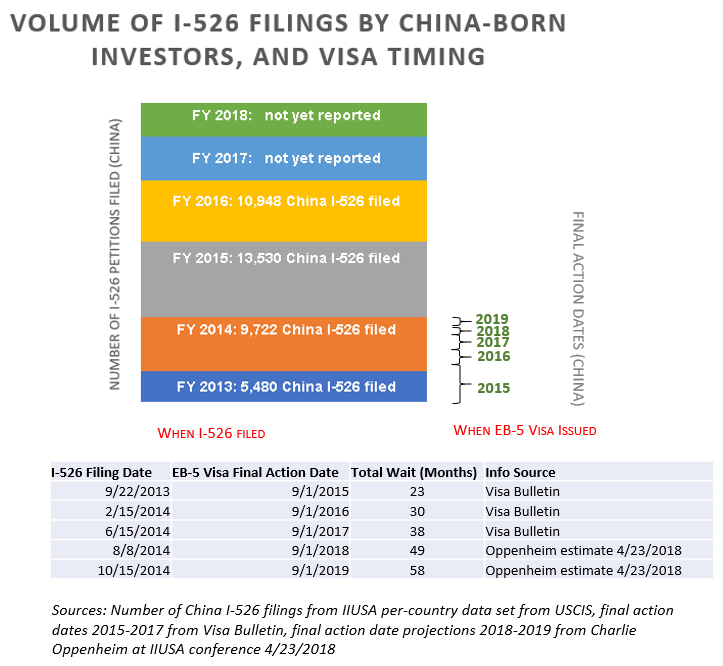
- China-born investors filed more or less 10,948 I-526 petitions in 2016, while the rest of the world filed about 2,325. China-born investors should pay attention to that “rest of the world” number, since those petitioners and their family get to go ahead of China-born investors in the visa queue.
Visa Numbers
Speaking of the visa backlog, here’s another good article addressing the situation and possible solutions: It’s All About the Numbers (August 8, 2017) by H. Ronald Klasko.
The status quo is unsustainable and requires serious response. So long as we have a few mega-projects flooding the program and the backlog with investors, we must unite in support of visa number solutions or EB-5 will become unusable for everyone. And the U.S. would benefit from providing visas to accommodate the volume of people willing to make major investments in our economy.
New Legislation
Representatives Brian Fitzpatrick (R-PA) and Dwight Evans (D-PA) have introduced an EB-5 bill: H.R.3471 – American Job Creation and Investment Into Public Works Reform Act of 2017. The bill is nearly identical to H.R. 5992 introduced last year by Goodlatte and Conyers, with the most significant difference being the suggestion that infrastructure projects administered by a governmental entity should get a visa set-aside. This bill is significant because it’s one of only two EB-5 bills officially on the table this Congress, but I don’t hear anyone talking about it. The sponsor and co-sponsor haven’t announced it on their websites. Industry as a whole will not like the fact that it doesn’t offer a solution to the visa backlog. The big-league lobbyists won’t like it because it retains the features of H.R. 5992 that they worked so hard to negotiate out of subsequent discussion drafts: retroactive application to petitions filed since June 1, 2015, hefty and clunky account transparency requirement, gift and loan restrictions, significant incentive to invest in a distressed TEA, and significant spread in the annual fee applied to large versus small regional centers. The additional visa set-aside proposed by H.R. 3471 is sweetened by the fact that the bill eliminates the H.R. 5992 suggestion to make the set-asides permanent. I’ve added the bill to my comparison chart, and will keep watching for discussion. The Hill has another article on controversial immigration issues linked to the upcoming September spending fight, but EB-5 doesn’t get a mention. Perhaps H.R.3471 is a subtle solution to the border-wall funding argument that dominates current immigration debate?
August 2, 2017 13 Comments
And now, Washington is talking about immigration after all. Today the White House announced that President Donald J. Trump Backs RAISE Act. Senator Tom Cotton introduced this bill back in February, but today released a significantly revised and expanded version of Reforming American Immigration for a Strong Economy Act (now with the number S.1720). The bill promises to “spur economic growth and raise working Americans’ wages by giving priority to the best-skilled immigrants from around the world and reducing overall immigration by half.” Most of the reduction would come at the expense of family-based visas, which would be cut dramatically. The proposal would keep the current 140,000 allocation for employment-based visas, but would do away with all current EB categories (including EB-5) and replace them with a “merit-based” or “skills-based” points system. A prospective EB immigrant would accumulate points to gain the right to enter an applicant pool, and then every year USCIS would invite the 140,000 applicants in the pool with the most points to file a visa petition. Points could be accrued based on age (the nearer to age 25 the better), English language test scores (the higher the better), educational credential (most points for US doctorate in STEM), extraordinary achievement (more points for Nobel laureate than Olympic medalist), job offer (more points for higher salary), spouse (negative points for low-point spouse), and investment in an enterprise that the immigrant will manage as a primary occupation (more points for bigger investment).
The bill seems unlikely to go far, considering that it proposes to change the current immigration system so radically and would hurt so many interests. In my capacity as a citizen, however, I’m very interested in this bill and the conversation around it. When we talk about immigration policy, we go straight to core questions of national identity – who we are, what we value, what borders define us, and where we want to go as a country. I’m fascinated by the history of U.S. immigration law, and how the laws reflect and shaped our socioeconomic history and values. I’m also fascinated by data on U.S. immigration, and how dramatically the data picture differs from the Emma-Lazarus-colored impression that both advocates and critics seem to have of US immigration. It’s helpful to consider the history and the data when assessing this new immigration vision as proposed by Senator Cotton and endorsed by President Trump.
August 1, 2017 Leave a comment
Helpful Articles and Resources
- USCIS Ombudsman’s 2017 Annual Report to Congress (June 29, 2017). The EB-5 section of the report (page 30-33) reviews facts we already knew, but is interesting in the way it highlights the EB-5 visa backog as a significant concern. I particularly appreciate the section on the USCIS Administrative Review Process in Employment-Based Decisions (page 23-26), which describes the three alternative administrative options for petitioners who think USCIS has made an erroneous decision: Motion to Reopen, Motion to Reconsider, and appeal to the Administrative Appeals Office (AAO). See especially the very helpful Figure 3.2 on page 25, which lays out the steps and process and considerations in each alternative.
- People who worried about the appointment of Julie Kirchner to Ombudsman (after she previously served as executive director of an anti-immigration group) and other recent appointments will be interested in Angelo Paparelli’s article The Known and Unknown Future of the EB-5 Immigrant Investment Program at USCIS and the Office of the USCIS Ombudsman (2017 Q2 Regional Center Business Journal)
- Bernard Wolfsdorf and Joseph Barnett give a nice summary of possible legislative and administrative solutions to EB-5 visa backlog problems in their post Solutions to the Chinese EB-5 Visa Backlog (July 27, 2017)
- Catherine Holmes and Daniel Lundy tackle another important concern for EB-5 investors in their article The Anatomy of an EB-5 Work Out: What Happens After the SEC Files Complaint and How Can the EB-5 Investors Protect their Interests (July 26, 2017)
- A group of lawyers have updated their white paper interpreting redeployment options in light of the June 14, 2017 update to the EB-5 Policy Manual. Standards and Guidelines for Redeployment of EB-5 Investment Funds (originally published February 21, 2017, updated July 24, 2017) by Klasko Immigration Law Partners, LLP, Arnstein & Lehr LLP, Jeffer Mangels Butler & Mitchell LLP
- Regional Centers will appreciate this practical article USCIS Compliance Audits – Preparing Regional Centers for the First Wave (2017 Q2 Regional Center Business Journal) by Mariza McKee, Kimberly Hare, and Clete Samson
Washington Updates
What is happening with EB-5 in Washington? I wish I knew. Immigration policy generally looks like an orphan child. The top three leadership posts at USCIS are all still filled by “acting” people (Lee Cissna was nominated but still not confirmed as Director), and now we’re missing a DHS Secretary as well, until Congress can find time to confirm a replacement for John Kelly. That can’t facilitate significant USCIS action like finalizing regulations or hiring. The White House website listed immigration as a top issue a few months ago, and gave an immigration policy statement, but not anymore. (8/2 Update: The White House is now talking about immigration with the RAISE Act.) I hear rumors that lobbyists are still actively talking to Congressional staffers about EB-5 legislation and regional center program reauthorization, but don’t know where that will lead. Congress has so many fish to fry. We wonder whether Congress can even figure out funding the government past September 30, and there’s talk of another short-term Continuing Resolution, which could mean another series of hop-and-skip extensions of the RC program, whose current authorization is tied to the 2017 funding bill. But it’s hard to predict. Insights or insider information, anyone? (8/3 Updates: Senator Cornyn, author of the draft EB-5 legislation released most recently, has announced Building America’s Trust Act, a new immigration bill that doesn’t appear to address EB-5. Representative Brian Fitzpatrick has introduced H.R.3471 with the promising title “To amend section 203(b)(5) of the Immigration and Nationality Act to implement new reforms, and to reauthorize the EB-5 Regional Center Program, in order to promote and reform foreign capital investment and job creation in communities in the United States, and for other purposes.” I’ll report more fully when the bill text becomes available.)
Regional Center List Changes
Additions to the USCIS Regional Center List, 07/17/2017 to 8/1/2017
- Cascadia Regional Center (Oregon, Washington): pathwayseb5.com
- Education Fund SW Regional Center (Arizona, California, Nevada, Utah): edufundamerica.com
New Terminations:
- Anacostia Regional Center (District of Columbia) Terminated 7/18/2017
- AAA Florida Senior Living Regional Center, LLC (Florida) Terminated 7/12/2017
- Allied Artist High Desert EB5 Regional Center (New Mexico) Terminated 7/12/2017
- Rosti Capital Regional Center (California) Terminated 7/17/2017
July 26, 2017 17 Comments
A small Employment Visa Engagement hosted at the US Patent and Trademark Office in San Jose on July 19 scored an impressive delegation from the Investor Program Office. I had a chance to meet and hear from IPO Deputy Chief Julia Harrison, IPO Senior Advisor for Economics Jan Lyons, and IPO’s FDNS Division Chief Kurt Vicha. They seemed more relaxed than usual at stakeholder meetings, and shared a lot of useful information. I haven’t seen USCIS post any notes yet (UPDATE: the USCIS website now provides Julia Harrison’s talking points from the engagement). I have summarized major points in this post. (And FYI here is my folder with a rough unauthorized recording and snapshots of slides.)
Processing Times
Julia Harrison noted that program integrity was a focus for FY2017, with the launch of the site visit and audit and I-829 interview programs, and she made the welcome announcement that FY2018 will specially focus on reducing processing times.
A few initiatives that IPO hopes will improve processing times:
I appreciated hearing Ms. Harrison say that IPO is “absolutely committed” to reducing processing times, but wish that she had mentioned some drastic measures. Education and operational efficiencies are welcome, but more will be needed to significantly improve processing times in view of a backlog that’s about 30,000 petitions long. Ms. Harrison did not mention new hiring, but I sincerely hope that’s also part of the plan.
Ms. Harrison pointed out that IPO does not have authority to offer premium processing (this would need to come from Congress), and also repeated, as has been said before, that IPO does not favor premium processing, anticipating that it would be unworkable because fees would probably not limit demand in the EB-5 context.
Advice for EB-5 Submissions and Business Plans
Jan Lyons spoke at length, introducing the EB-5 program from a business perspective and discussing adjudication issues. We forget the implications of having a veteran of investment banking and municipal finance at the helm at IPO, directing the team that reviews business plans and economic studies. When I started with EB-5 in 2009, one immigration attorney asked me to remove the financial projections from a business plan because “they’d just confuse the adjudicator.” Now we have an audience at IPO that knows how to read numbers, and struggles with the un-businesslike character of many EB-5 submissions. A cash flow statement is worth a thousand words to a finance person. Mr. Lyons shocked us with an estimate that only about 35% of business plans submitted to his office even contain a pro forma. If you’re an attorney who reviews petitions, help change this! Different types of financial information are appropriate to different types of projects, and in EB-5 the appropriate level of financial detail can vary depending on implications for the economic impact report, but a business plan without numbers cannot be called a business plan. Creating profit is the core rationale for any commercial enterprise (not to mention an EB-5 requirement per regulations and Matter of Izummi), and a plan without financials literally has no bottom line. A plan that’s only qualitative, not quantitative, gives a picture of the business that is incomplete, difficult to assess, and not credible. A business plan should have financials, and the financials should match and help explain the story that’s told in words. A pro forma doesn’t help if it lists revenue sources that the project description never mentioned, shows payroll expense insufficient to cover employees promised in the staffing section, indicates growth on a schedule different from what was anticipated in the schedule section, and assumes prices inconsistent with the market analysis. That will certainly confuse adjudicators, even and especially ones with 20+ years in investment banking. The industry needs to step up its game. (My service website describes the standards I use when writing and reviewing EB-5 plans.)
Key takeaways from the presentation by Mr. Lyons:
Site Visits and Audits:
Julia Harrison once again reviewed the difference between site visits and regional center audits, and added commentary on the purpose of each. Site visits are unannounced inspections of job-creating enterprises that look at the JCE site and assess the progress of development and job creation. Audits examine regional centers to see where money is going and whether the regional center has proper oversight and controls in place.
Kurt Vicha explained how the EB-5 site visit process has worked so far, and how sites are selected. In 2016, FDNS selected the one state with the most projects in each of four regions, and conducted site visits to job-creating enterprises (JCEs) in those states (for a total of 50 site visits). In 2017, FDNS selected JCEs for site visits based on a “window of opportunity” defined as about one year after I-526 approvals for that JCE, but before I-829 adjudication. Interestingly, there are about 225 JCEs within that window in 2017, and FDNS is on track to complete site visits at all of them. Inspectors are charged to observe and talk to people on-site about what’s happening at the JCE address, and then write an informational report. This report is then assessed in DC in context of petition filings, with opportunity for regional centers/project companies to respond to any questions. Mr. Vicha noted a common complaint that some questions specific to stand-alone filings have been asked at regional center JCEs (such as about the role of EB-5 investors in the business), and he promises that training will address this issue for next year. FDNS inspectors were hired at a high grade and receive extensive training.
Harrison and Vicha both suggested that site visits particularly emphasize schedule, and assessing whether the business or project has accomplished the activities anticipated in the schedule originally submitted to USCIS. Note to self: remind my clients to be extra conservative in estimating development schedule and hiring schedule dates! Better to estimate late in the business plan and give inspectors a happy surprise than to estimate on the early side and be accused of fraud if subsequent inspection shows unreached milestones.
As for audits, only one has been completed so far.
Visa Numbers and Wait Time
Charlie Oppenheim from Department of State was present, as genial and oracular as ever, and attempted once again to explain the allocation of visa numbers and the many contingencies and moving parts. He didn’t give any new figures related to the EB-5 visa queue, but mentioned that he estimated the wait time to conditional residence for a China-born investor filing now at about 9.9 years (my attempt to calculate had come up with 9.3 years). Those estimates don’t account for future demand, people dropping out, or action from Congress. Mr. Oppenheim said that Congress has not yet asked for his assessment of the proposal to only count investors toward the EB-5 visa quota (rather than investors plus family members as is the current practice), and opined that such a change would indeed require legislative action.
July 19, 2017 1 Comment
IPO has added a very valuable resource to the EB-5 Resources page on the USCIS website:
Suggested Order of Documentation
The links direct to pages that provide a suggested list and order of contents for each EB-5 form. The regulations and Form Instructions already describe the evidentiary requirements for EB-5 petitions and applications, and these new pages don’t add new requirements. Rather, they provide the content in handy checklist form and suggest a way to standardize submissions by arranging required documents in a predictable order. We keep asking IPO what we can do to help improve the adjudication process and processing times, and this is a very helpful response. Immigration lawyers take note! If we can widely adopt the suggested order of documentation for each form, and most petitions take on a standard shape, with the same tabs in the same order, this will certainly support operational efficiencies at IPO and should help reduce processing times. Julia Harrison flagged this resource at today’s Employment Visa engagement in San Jose. I’ll write another post with more complete report of helpful input from the IPO representatives Julia Harrison and Jan Lyons, Kurt Vicha of FDNS, and Charlie Oppenheim from Department of State.