EB-5 Visa Waiting Line and Visa Allocation
April 5, 2018 47 Comments
People who use EB-5 face some tough facts:
- Demand for EB-5 visas (annual I-526 filings) has been three to four times higher than EB-5 visa availability since 2011, resulting in a backlog now about a decade long. (For those not already familiar with the situation, here’s a simplified explanation.)
- New investors from most countries today can still expect to receive a conditional green card fairly promptly after I-526 approval, but only due to exceptions that will allow their applications to skip ahead of (push back) other people stuck in the backlog. (Or the overall wait could be shortened if the visa quota changes, or many people drop out of line.)
We respond to these facts by (1) advocating for backlog relief (AILA’s White Paper: Solutions to the EB-5 Visa Waiting Line gives suggestions), and (2) figuring out how the exceptions work, because investors and projects want to avoid a decade-long wait if possible.
The past few years offered a simple exception that allowed jumping much of the queue: be born outside China, since China accounts for most of the backlog and was the only oversubscribed country. Now, people from Vietnam face getting stuck in the visa wait line behind the Chinese (the May 2018 Visa Bulletin will have a Vietnam cut-off date), other countries wonder whether the same could happen to them one day, and Congress threatens set-asides and other changes to visa availability. And so we feel the urgency to understand just how visa allocation works, and relevant numbers.
First, here’s the law related to EB-5 visa allocation, with linked citations. (Or you can download my Word doc to get the text with headings to assist navigation.)
- The annual worldwide level for all employment-based (EB) immigrants is effectively 140,000. INA 201(d)(1)(A)
- At most 7.1 percent of the employment-based worldwide level is made available to immigrants in the EB-5 category. INA 203(b)(5)(A)
- Available EB-5 visas are issued to eligible immigrants in the order in which the immigrant petition was filed. INA 203(e)(1)
- At least 3,000 EB-5 visas are reserved annually for immigrants based on investment in a Targeted Employment Area. INA 203(b)(5)(B)
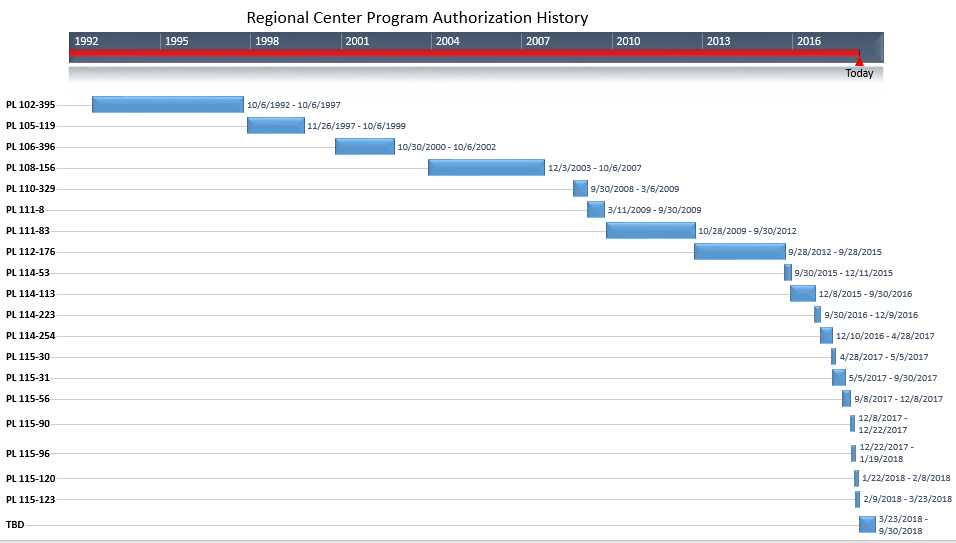
- 3,000 EB-5 visas are set aside annually for immigrants based on investment in a Regional Center. PL 102-395 Section 610(b) as amended by PL 105-119 Section 116(a)
- The EB-5 visas made available to natives of any one country may not exceed 7 percent of the available worldwide total. But if one or more countries gets held back by this rule, resulting in available visas with no one else to take them, then those remaining visas can be made available again without regard to per-country numerical limits for that year. INA 202(a)(2) and INA 202(a)(3) and INA 202(e) and PL 106-313 Section 104
- EB-5 visa numbers available to China annually under the per-country limit are reduced by 700 to compensate for cases processed under the Chinese Student Protection Act of 1992. PL 102-404 Section 2(d)(B)
I imagine Charlie Oppenheim at the Department of State, sitting at his desk on October 1, 2017 with 30,000 EB-5 visa applications before him and tens of thousands more to come as USCIS approves pending I-526. How does he apply the above rules to decide who gets a visa in FY2018, and in what order? I hope he addresses this question during his keynote speech at the IIUSA EB-5 Advocacy Conference on April 23. (4/25/18 update: here are notes from Mr. Oppenheim’s presentation. 10/30/18 update: See slide 5 in this presentation, and my recording of a panel on EB-5 visa numbers.) In the meantime, here’s my understanding of how the rules get applied in practice.
- #1 and #2 above give the target quota for EB-5 visa numbers in one year: 140,000*0.071=9,940.
- #3 specifies the basic rule of order: first-in-first-out by priority date (applicants with oldest I-526 priority dates are first in line for a visa)
- #4 to #6 are factors that can override the basic FIFO order principle. The applicant with oldest priority date gets the first visa number unless she’s held back by:
- #4) being the 6,941st+ applicant that year (9,940-3,000) who invested outside of a TEA, in which case she’s held back for any TEA-based applications to go ahead (thus far, non-TEA applications have been too few to trigger this set-aside)
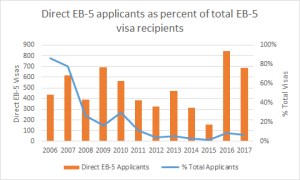
- #5) being the 6,941st + applicant that year who invested outside of a regional center, in which case she’s held back for any regional center-based applications to go ahead (thus far, direct EB-5 applications have been too few to trigger this set-aside)
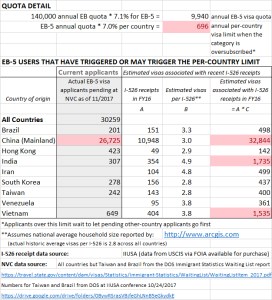
- #6) being the 696th+ applicant that year (9,940*0.07) from a single country, in which case she’s held back for any applicants from not-oversubscribed countries to go ahead (China has been oversubscribed and triggered the per-country cap since 2015, and Vietnam will as of May 2018)
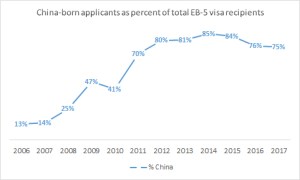
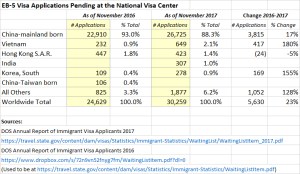
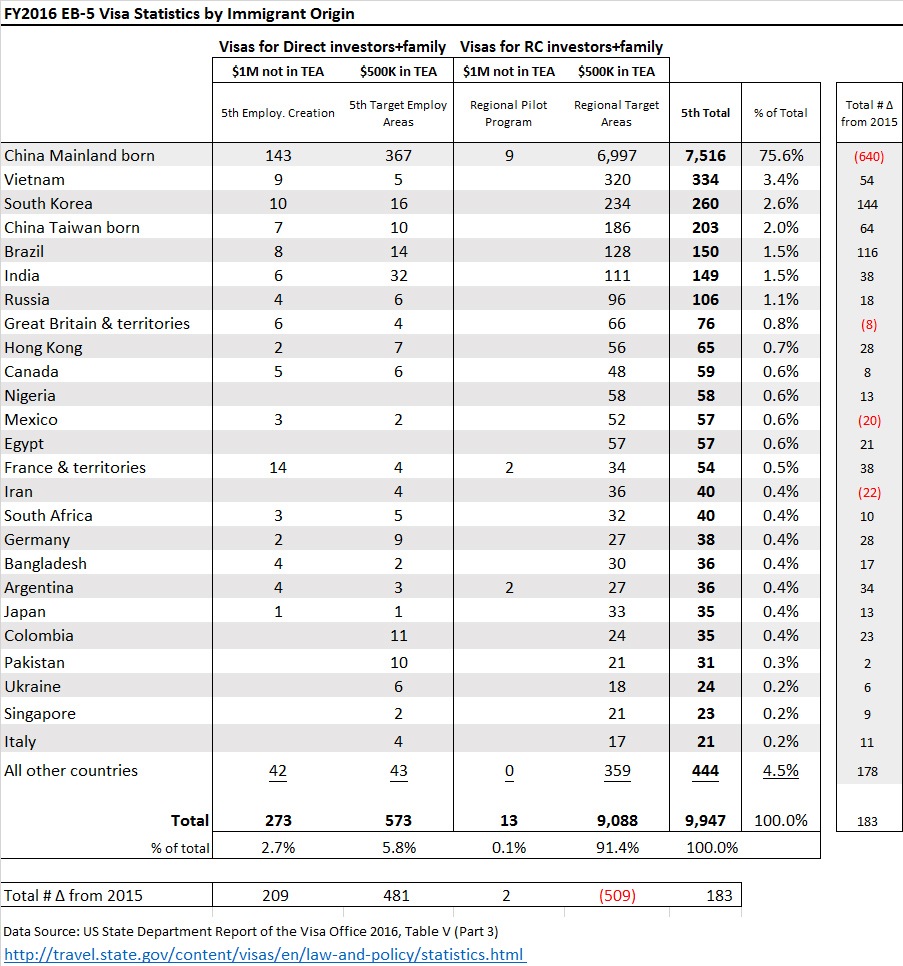
- #6 does not mean that 7% of visas get set aside annually for each country in the world. It does not mean that any one country gets only 7% of visas annually. #6 just means that any one country’s allocation gets capped at 7% so long as other countries are also competing to use up available visas. When other countries aren’t competing, then any visas still on the table get allocated to the waiting line in FIFO order without regard to per-country limits. So in 2017, China in fact got 75% of visas, which is what remained after numbers had been allocated to qualified applicants from other countries. (If not for the Chinese Student Protection Act, China could’ve received 700 visas plus the 75% leftover.)
- When total demand promises to exceed total available visas for the year, then DOS looks at individual countries to see which look likely to exceed the 7% per-country cap, and sets a cut-off date or final action date for each of those countries. When a cut-off date is in place, only people from that country with priority dates earlier than the cut-off date can proceed with visa applications; others are held back. DOS gradually advances the cut-off date to release just enough people to apply for available visas. At the beginning of the year, different oversubscribed countries can have different cut-off dates. When each country is getting its 7% of visas for the year, DOS looks at each country individually when setting the cut-off dates. When per-country caps have been met, then all oversubscribed countries are just competing together for remaining EB-5 visas left by not-oversubscribed countries. That means they are all in the same line again and will have the same cut-off date. (In practice that puts China at the head of the line for leftover EB-5 visas, since it’s been held back for years and thus its applicants have the oldest priority dates. Vietnam will start being held back in 2018, and its more recent held-back applicants will find themselves behind many longer-pending Chinese applicants. If India or Brazil get held back next, their still-more-recent applicants will find themselves behind both China and Vietnam in the competition for leftover visas. )
- Exceeding the 7% cap is scary because it puts a country in the same line as China for leftover EB-5 visas, and near the back of that line based on priority dates and the FIFO process. The saving grace for small countries is that they can at least get 7% of EB-5 visas every year, and probably won’t exceed that cap by very much. If I’m a Vietnamese applicant held back this year, I’ll be one of the older Vietnamese applications next year and thus well-placed to get one of 700 new EB-5 visas available to Vietnam then. What I can’t expect is to get an EB-5 visa left over after not-oversubscribed-countries took what they want, since tens of thousands of Chinese have earlier claim on any leftover visas. But small excess = small backlog = small need to compete for leftover visas, thus relatively short wait time. As an Indian, I’d be a bit more concerned and vigilant. India hasn’t had high EB-5 numbers before, but the companies that helped create the China backlog with giant EB-5 raises have turned to India. If Indians flock to big raises seeking 100s of investors, then they will end up needing many more than 700 visas per year, thus creating a significant India backlog that needs leftover visas but won’t get them for ages because behind the earlier China/Vietnam backlog plus squeezed by any new rest-of-the-world applications.
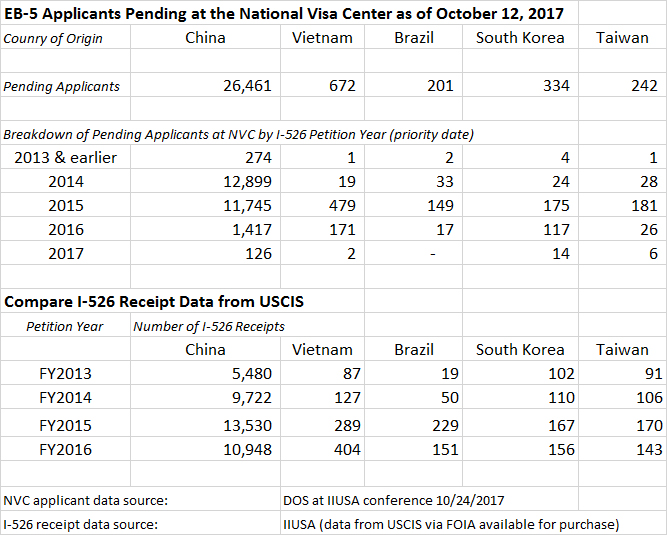
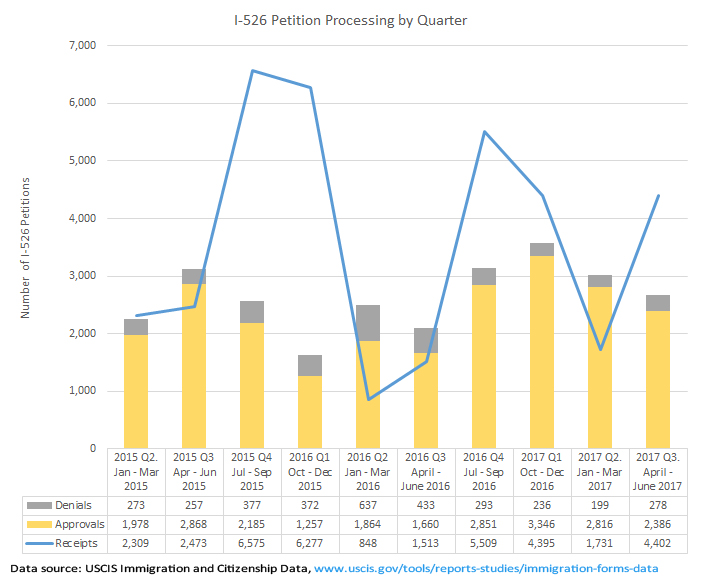
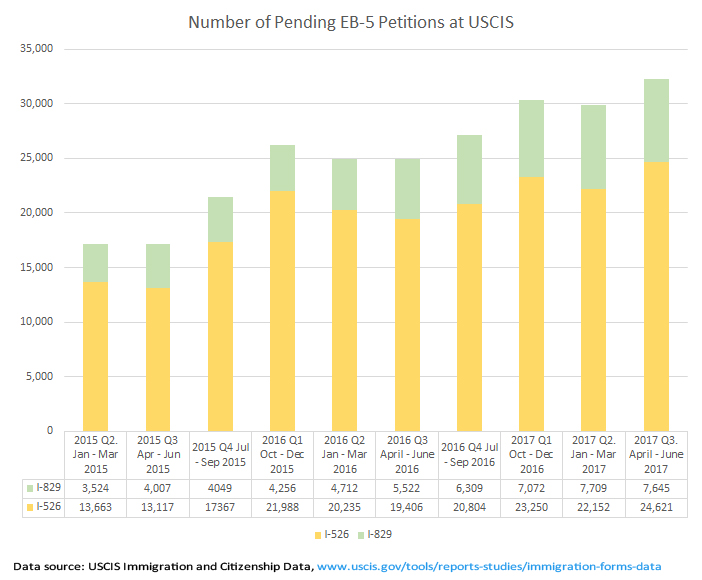
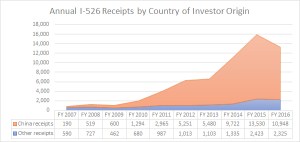
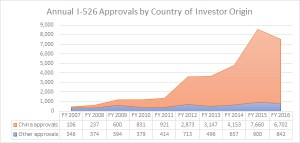
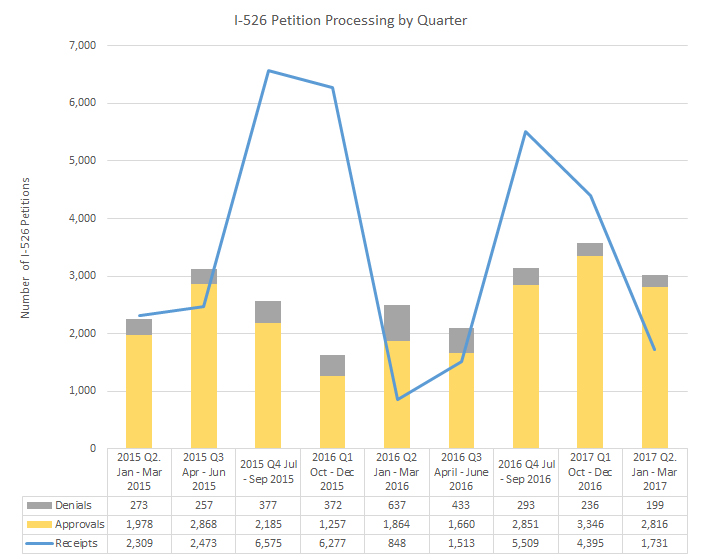
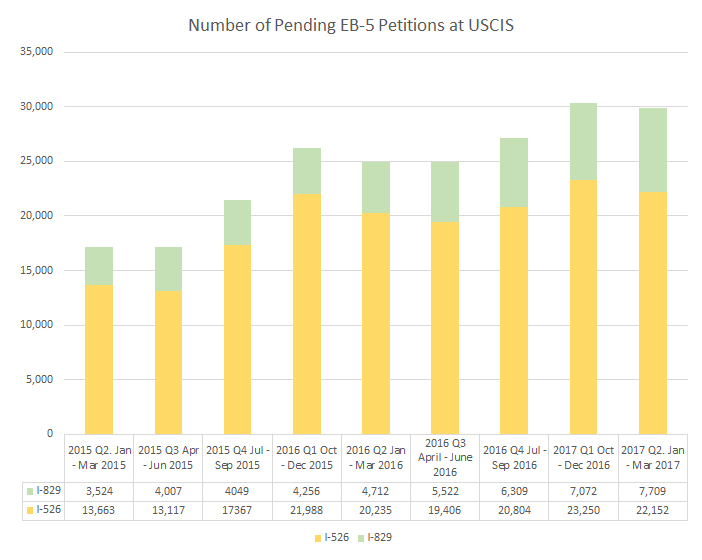
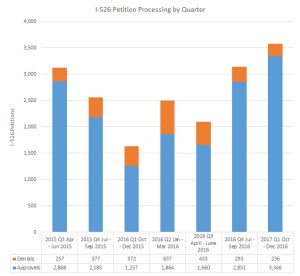
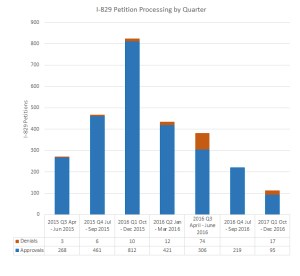
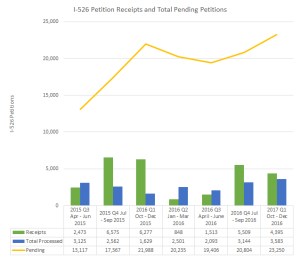
- Visas can only be issued to people with complete visa applications ready, not to people with I-526 investor petitions still pending at USCIS. But it’s important to keep an eye on I-526 petitions – on number of receipts, petitioner origin, adjudication speed, approval rates – to estimate how many of those petitions will become visa applications, and when. New visa applications from not-oversubscribed countries immediately reduce the number of leftover visas available to pending applicants from oversubscribed countries. New applicants from a country near the 7% cap could tip the balance into cut-off dates and backlogs for fellow-countrymen already in line. A major decrease in I-526 filings or increase in denials or withdrawals would reduce incoming pressure on the visa backlog, and shorten wait time projections. Estimates are tough with all these moving parts and limited data, but we must try. The China backlog ballooned quickly and came to many investors (and their projects) as a nasty surprise. They didn’t realize how many other Chinese investors were already in the system or entering at the same time, and what that would imply for future visa wait times. A cautionary tale.
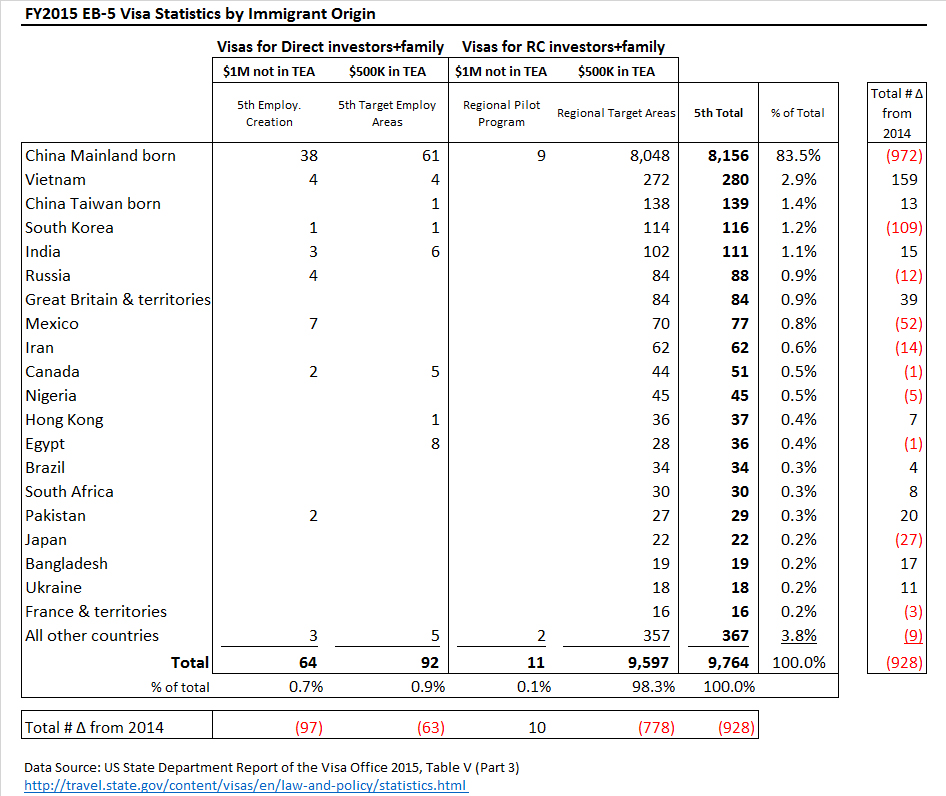
 To facilitate analyzing numbers relevant to country-specific visa availability, I’ve added a tab titled “Country Focus” to my ongoing Backlog Calc Excel file. (The numbers aren’t new, but highlight significant previously-reported I-526 and pending visa data. I even made a cartoon to assist in visualizing the numbers. The thumbnail image here gives a teaser of the new Excel tab.) I don’t offer conclusions, but information to assist your conclusions.
Additional reading:
- My post on Charlie Oppenheim’s 10/30/2018 presentation for AILA/IIUSA, with visa wait estimates
- My post on Charlie Oppenheim’s 4/23/2018 presentation at IIUSA, with visa wait estimates
- My post I-526 and EB-5 visa wait times; country-specific effects of potential changes (June 18, 2018)
- USCIS FAQ page on Visa Availability and Priority Dates
- Operation of the Numerical Control Process Department of State
- Numerical Limits on Permanent Employment-Based Immigration: Analysis of the Per-country Ceilings (July 2016) Congressional Research Service
Benefit from this blog? Please consider supporting the effort behind it. As the EB-5 industry changes, your contribution can help preserve this space for conscientious and freely-available EB-5 reporting. Donations go to Lucid Professional Writing (a for-profit business) to fund work on this blog. Thank you!

















 EB-5 Updates